by Chrissy Biello
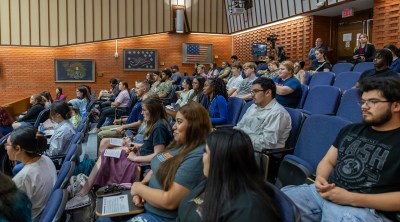
The Sam Houston State University Center for Law, Engagement, and Politics recently partnered with the SHSU Criminal Justice Department to host a CJ Real Talk event. With approximately 50 students in attendance and moderated by Professor Mike Yawn, the panel featured Montgomery County Chief Prosecutor Darla Faulkner, retired Lieutenant Criminal Investigator for Harris County Paul Smithers, and 12th District Court Judge David Moorman.

Professor Yawn structured the discussion chronologically, guiding the panelists through the legal process from the moment a crime is committed to when it reaches a judge’s docket. To set the stage, he introduced a hypothetical scenario in which a Sam Houston student is caught drinking and driving, registering a blood alcohol concentration of 0.12, which is above the legal limit of 0.08.

The conversation began with Investigator Smithers, who explained the circumstances under which an officer could pull the student over. He noted that probable cause is required to initiate a traffic stop. If the officer administers field sobriety tests, the next steps depend on the county’s policies.

In Harris County, for example, officers must contact a district attorney, provide all relevant details, and obtain approval before filing a charge for driving while intoxicated.
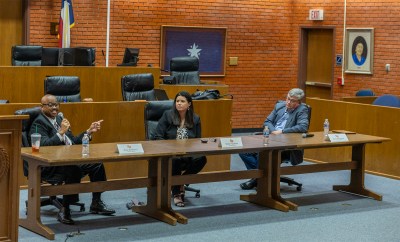
As the case progresses, investigators remain actively involved. When asked about her collaboration with criminal investigators, ADA Faulkner emphasized the close working relationship between prosecutors and investigators.

Smithers elaborated, comparing the dynamic to that of a married couple. Investigators, he explained, are responsible for gathering all available evidence and ensuring no crucial details are overlooked. Their role is to present a complete case during discovery so that defendants receive a fair trial.
When asked what factors could influence a case, Faulkner stressed the importance of mitigation evidence. She explained that defense attorneys should present information that humanizes their clients, such as testimony about their family life, employment, or community involvement.

These factors, she noted, can significantly impact the district attorney’s decision on whether to offer a plea deal. Faulkner further emphasized that many ordinary individuals receive DUI charges, and understanding their personal circumstances can shape the outcome of their cases.
Judge Moorman was then asked whether he had ever defended a DUI case while practicing law and what advice he would offer a student defendant.

He responded that he would begin by looking at the student’s academic record and community involvement, as prosecutors often focus solely on the risks posed by the defendant’s actions. Highlighting positive character traits could help, but he cautioned that students must take responsibility for their actions and avoid making the situation worse by repeating their mistakes.
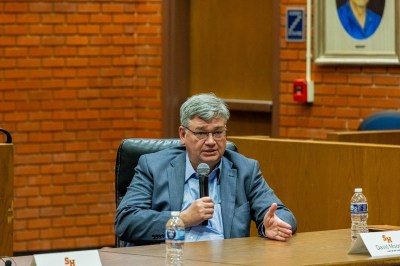
The discussion then turned to last-minute developments during trials. Investigator Smithers explained that unexpected evidence can surface, requiring investigators to act quickly to obtain necessary documents or verify new information.

This, he said, is why district attorney investigators must be present in court; they need to assist prosecutors in real time. He emphasized that when prosecutors are in trial, investigators are actively involved as well. Professor Yawn humorously added that he had once been told that if a prosecutor asked an investigator to procure a goat for a closing argument, the only acceptable response would be, “What color eyes should the goat have?”

During the Q&A session, many students took the opportunity to ask a question, including one about common misconceptions in the courtroom. ADA Faulkner addressed a prevalent myth about prosecutors: that they must secure a certain number of convictions to meet a quota. She clarified that her duty is to ensure justice is served, whether through dismissals, pre-trial diversions, fines, or other resolutions.
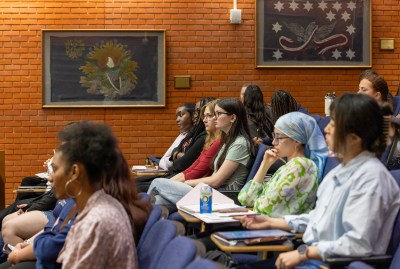
With strong student participation and insightful discussions from the panelists, the Center for Law, Engagement, and Politics was proud to work with the always-wonderful Doris Pratt and the SHSU Criminal Justice Department.

For those interested in similar opportunities, the Texas Tenth Court of Appeals will be visiting Sam Houston State University on April 16 in the CJ Courtroom. Cases will be heard at 10:00 a.m., 11:00 a.m., and 1:30 p.m.

 Center for Law, Engagement, and Politics