On the LEAP Ambassadors’ first day (or actually, evening!) touring downtown Austin, we walked through lively streets filled with loud music and a diverse array of people. For many of us, it was the first time to sixth street, which we traveled on simply to get to our restaurant. The travel was a bit slow going, owing to the maskless throngs (from which we took wide berth) and aggressive requests for money.
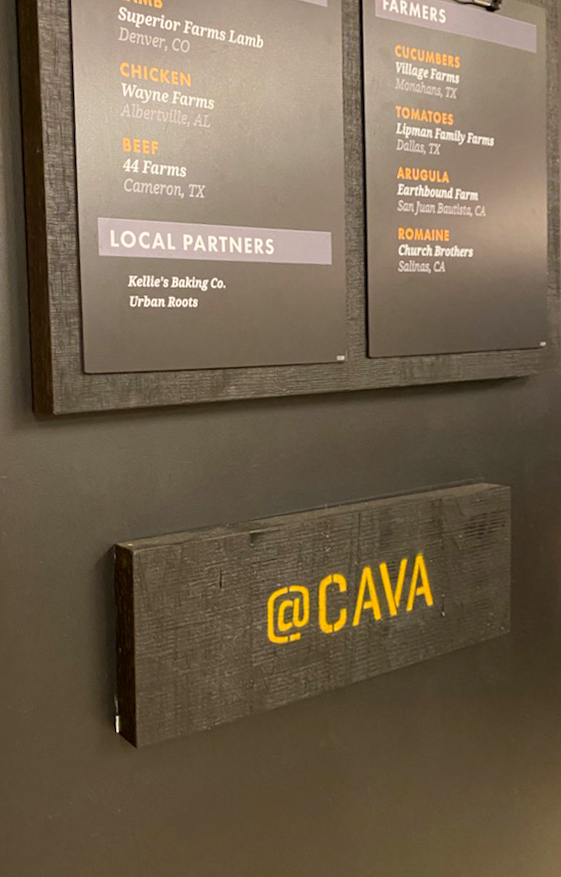
For dinner, we stopped at the Mediterranean restaurant CAVA.
The appetizing assortment of options ranged from lamb to falafel, which were topped with a variety of savory and sweet sauces, as well as other toppings. Although we had all had Mediterranean food previously, we did try new food items, whether it was falafel or tzatziki sauce, and we were very pleased!
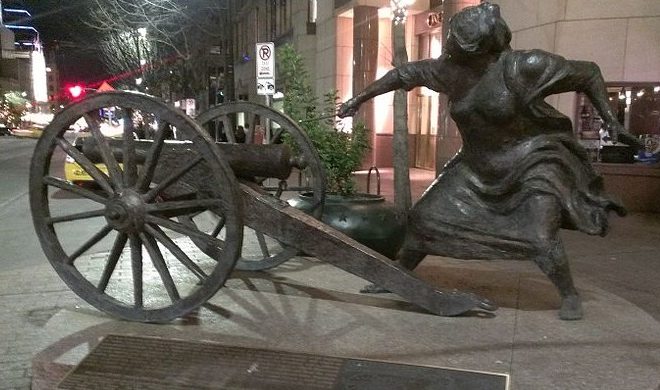
After wrapping up dinner, we walked up Congress Avenue, stopping near the statue of Angelina Eberly. Ms. Eberly was well connected, having hosted both Presidents Lamar and Houston in her home, but that did not impress her much. In fact, in 1842, when President Houston sent emissaries to remove the state archives from Austin and relocate them, Ms. Eberly greeted his officials’ with a cannon, thus repelling efforts to relocate the archives and capital. This “archives war” is preserved in Pat Oliphant’s statue prominently featured on Congress.
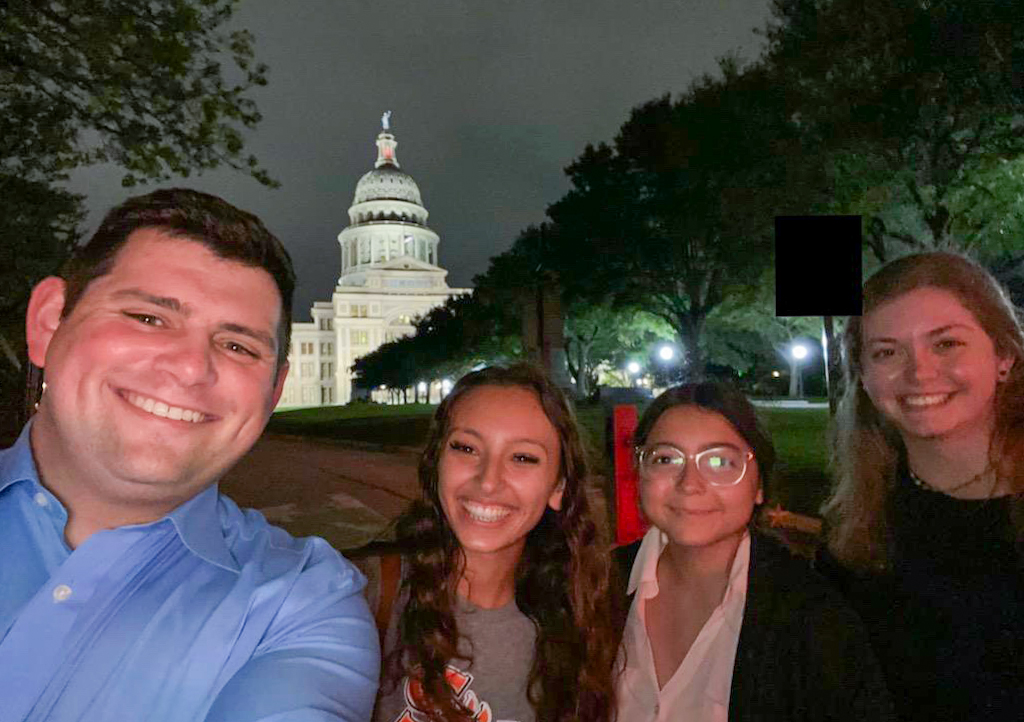
As we made our way further up Congress Ave, we took a moment to observe the Texas Capitol. Unfortunately, the gates to the Capitol were closed, and we had to view–and photograph–it from afar.
Across the street is Governor’s Mansion, where the LEAP Ambassadors were surprised (and excited) to encounter Governor Greg Abbott’s two golden retrievers. We weren’t positive of their identities, but Blake Roach, who works for the Governor, provided us with the dogs’ names (peaches and pancake) and a bit about their personalities!
Thus armed with knowledge, we posed with Peaches and Pancake and provided us with a very satisfying beginning to our trip.
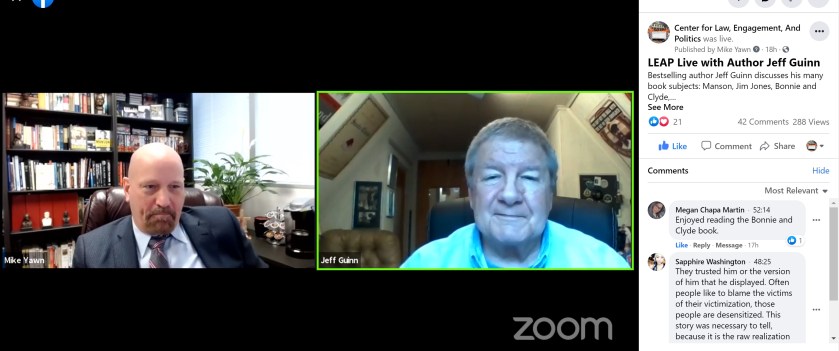
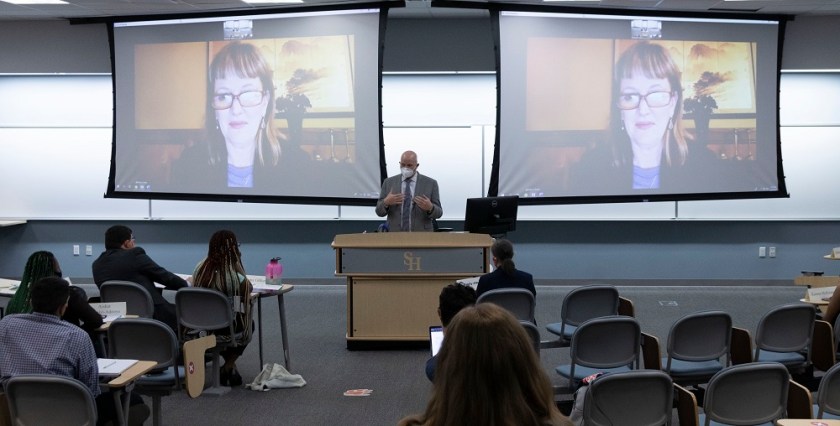
Today we had the honor of hosting a LEAP LIVE with NY Times best-selling author, Jeff Guinn. Guinn began by telling us that he had hoped to be an author since he was 8 years old, and that he considers himself fortunate to able to work as a full-time author.
Guinn began his career at the Fort Worth Star-Telegram as a journalist, where he learned how to properly conduct research, draw out the most relevant objective facts, and meet deadlines–traits that all contributed to him becoming a successful author.
Several of the biggest takeaways for us as students was an appreciation of Guinn’s intellectual curiosity, his perseverance, and his participatory way of getting to know his subjects or topics. In his newspaper days, for example, he worked as a migrant worker in the Rio Grande Valley, he lived in a (high-crime) public housing project, and he went homeless for nine days–during which time he was attacked by a drug dealer. This type of participatory journalism allowed Guinn to understand the topics about which he was writing.
This is a method he has used in his non-fiction works as well. For his work on Bonnie and Clyde, he traveled to the locations Bonnie and Clyde did; he slept in his car, as they did; he even swam a river they swam, all for the sake of better understanding their experiences. For his book on Jonestown, he traveled to the jungles of Guyana, cutting through area that marked Jonestown, now overgrown by jungle. He discussed, too, some of his work on The Vagabonds, which covered the annual travels of Henry Ford and Thomas Edison. (LEAP students were fortunate to have assisted in some small ways with the research for this latter work.)
Following the FB Live session, Mr. Guinn generously agreed to spend time with a handful of students, answering more in-depth questions about his career. This, too, was revealing and interesting, allowing us to see the research habits and techniques of a major writer. He told more about the friendships he has made in writing, including friends who are survivors of Jim Jones’ church; he went more in depth about his experiences interviewing the Manson women in California prisons; and he discussed his favorite artifact he’s seen while research his books (Thomas Edison’s original light bulb).
For me, the best advice he gave to us was that, no matter what our future careers are, we need perseverance. The bumps in the road are normal and everyone encounters them at a certain point. The successful fight through those bumps in the road.
Thank you Jeff Guinn for taking the time to speak with us about the experiences and encounters you have had, as well as sharing the knowledge and wisdom you have gained while researching your books.
The LEAP Center would like to thank the Sam Houston Memorial Museum and the Old Town Theater for allowing us to broadcast on their FB Channels. We’d also like to thank Sarah Faulkner for joining us in the post discussion.
For the thirteenth year, the Wynne Home Arts and Visitor Center hosted “Empty Bowls,” a worthy fundraiser that not only supports the arts, but which also fights hunger. Spearheaded by Wynne Home Staff Sarah Faulkner and Leara Phillips, the fundraiser brought in more than 100 people, raising more than $2,500 for the Senior Center in the non-profit’s efforts to fight hunger. For the LEAP Ambassadors, it is always a pleasure to help with a Wynne Home event, especially for such a worthy cause.
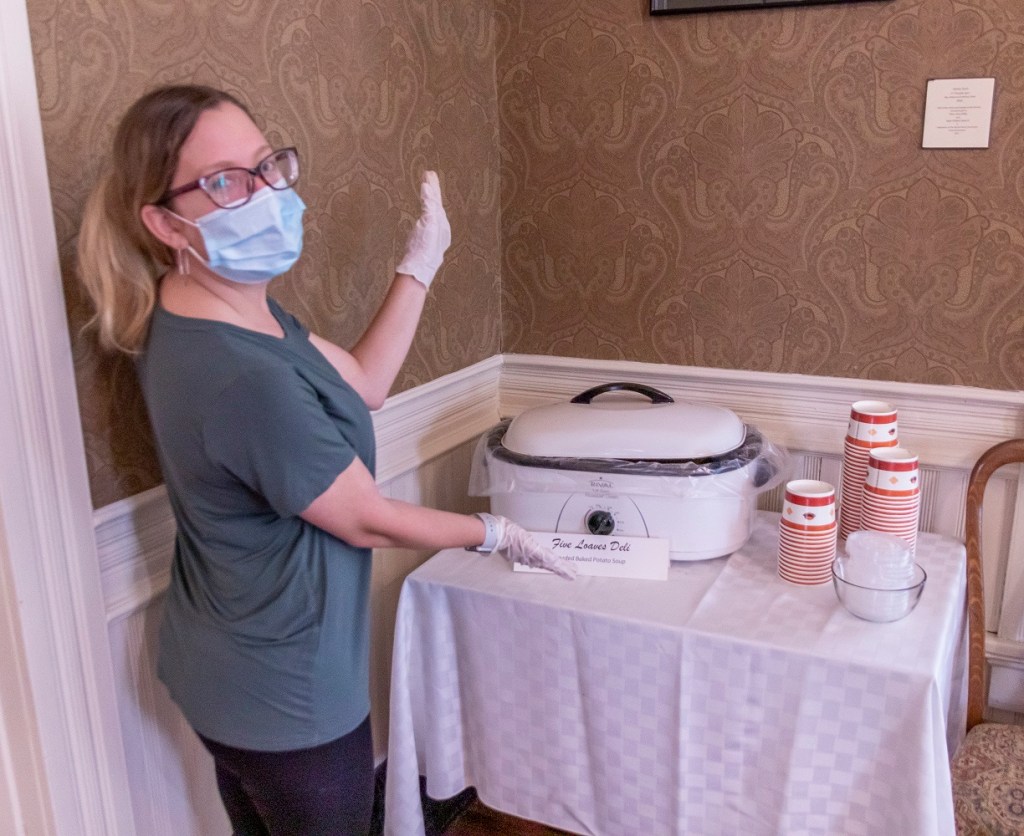
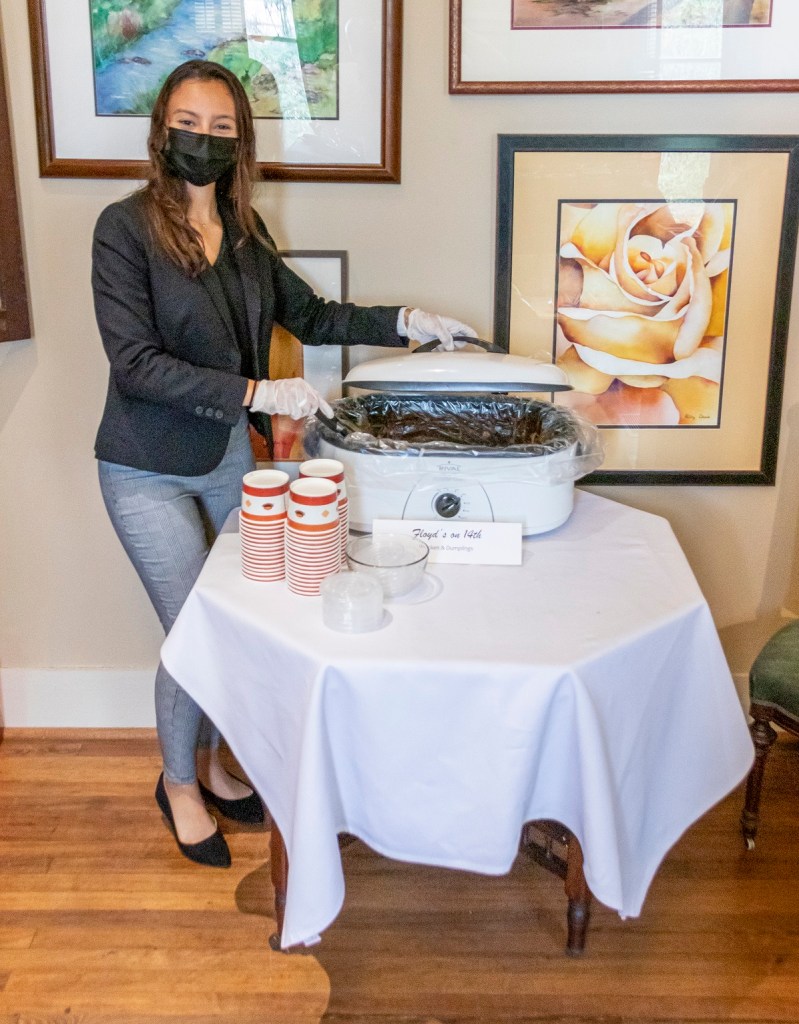
Approximately 200 people participated in bowl-making, either by actually working with Leara Phillips, ceramicists, or by working at Cork & Canvas to paint a bowl. Some of these bowls were selected for the silent auction, which are sold off to high bidders, with the funds also going to the Senior Center’s “Meals on Wheels” program. Other bowls were given to patrons who made a donation for lunch. The main lunch sponsor was HEB, with 5 Loaves Deli, City Hall Cafe, Carbonero Chicken Rotisserie, and Floyd’s on 14th also donating some great soups!
For us, the tasks were pretty simple. We ladled soup or otherwise helped with food provision, we greeted people, and we cleaned up a bit. It was a great learning experience, too, not just to see how the fundraiser works, but also to meet new people. With three of the Ambassadors being freshmen, most people in Huntsville are new to us, and we had the privilege of meeting City staff (Aron Kulhavy, City Manager; Rick Rudometkin, new Deputy City Manager; Tammy Gann, Economic Development/Special Projects Director; Tourism Manager, Tracy Rikard; Jessica Lacy, Visitor Center Coordinator; and, of course, Cultural Services Manager Sarah Faulkner; and Wynne Home Events Coordinator Leara Phillips), elected officials (Councilmember Pat Graham), and many other delightful people.
And not only did we see some wonderful bowls…
…but we also had a chance to see some great art in the Wynne Home’s main gallery. John Rodak’s work is currently on display, and the exhibit showcases his intricate and wonderful art work.
But perhaps our favorite aspect of this event is that a LEAP Center intern originally brought this event to Walker County some thirteen years ago. For almost every year since then, LEAP Ambassadors have volunteered for the event in some capacity, a tradition we hope continues for many more years.
Empty Bowls, 2018
Many thanks to the Sarah Faulkner and Leara Phillips of the Wynne Home Arts & Visitor Center and all of the sponsors for putting on another great event and helping a great cause!
For the 14th years, the LEAP Center has offered students the opportunity to take a real LSAT, without the stress and pressure of a score that counts. This is a crucial part of getting to law school: learning your current score so that you can develop a study plan that will get you a score that you want.
This semester, we had forty-three students sign up for LSAT, and we returned to an in-person (with masks and social distancing) format. Thirty-seven of those students showed up on a Saturday morning to take a four-hour test!
The real LSAT has been modified somewhat as a result of COVID, but beginning in August 2021, students will take four sections on test day: Analytical Reasoning, Logical Reasoning, Reading Comprehension, and an Experimental Section. Finally, students will also do a writing sample, although this does not need to be done on test day (it can be submitted about a week before or after).
There are more than 200 law schools in the US, and about 170 of these have a solid or strong record of students passing the bar and gaining employment. To get into one of these latter schools, students need an LSAT of about 150 or higher, with the very highest-ranked law schools looking for LSAT scores of about 175 or more.
As you might expect, the Mock LSAT scores, on average, aren’t as high as many students would like. That’s not a huge issue, because we encourage students to take the Mock LSAT “cold,” with no pre-studying. Once they get their baseline score, they can begin studying, take the Mock LSAT each semester, track their progress, and then as their official test date draws near, they can assess whether they want to take an LSAT Prep Course.
Over the past decades, these efforts have paid off. For the past dozen years, SHSU has consistently ranked in the LSAC’s “Top Feeder Schools” to law schools. Out of the 2,775 or so four-year degree-granting institutions in the US, SHSU ranks around 110 (top 4 percent) as a law school feeder. It’s one of the many programs that have grown in stature at SHSU, and we are excited for the students who are in law school now and those who will be enrolling soon!
Shortly after spring break, the PLS met up for our second meeting of the Spring semester. This meeting was special because this was the first meeting since the Covid-19 pandemic that darkened the world back in 2020 that we had our first in-person guest speakers.
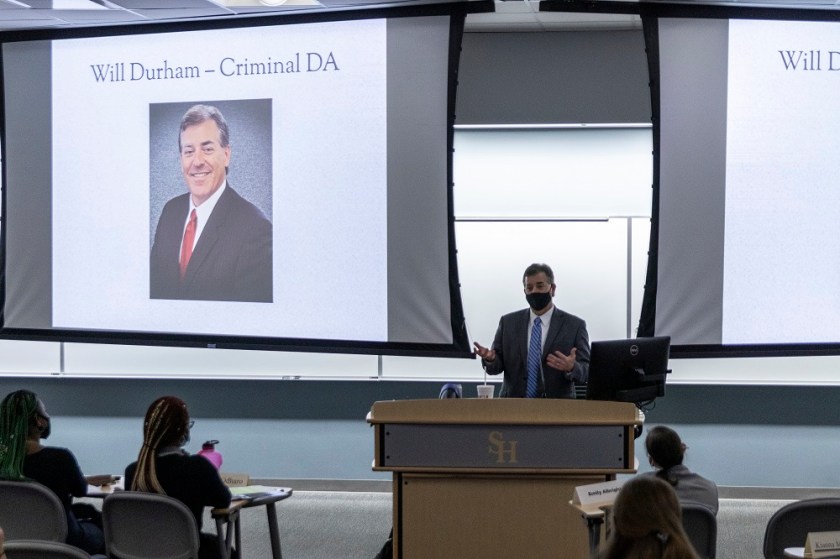
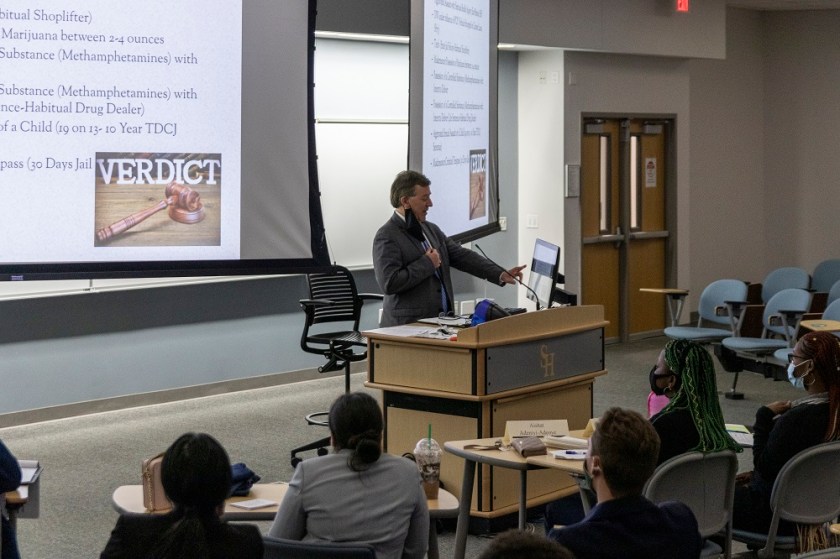
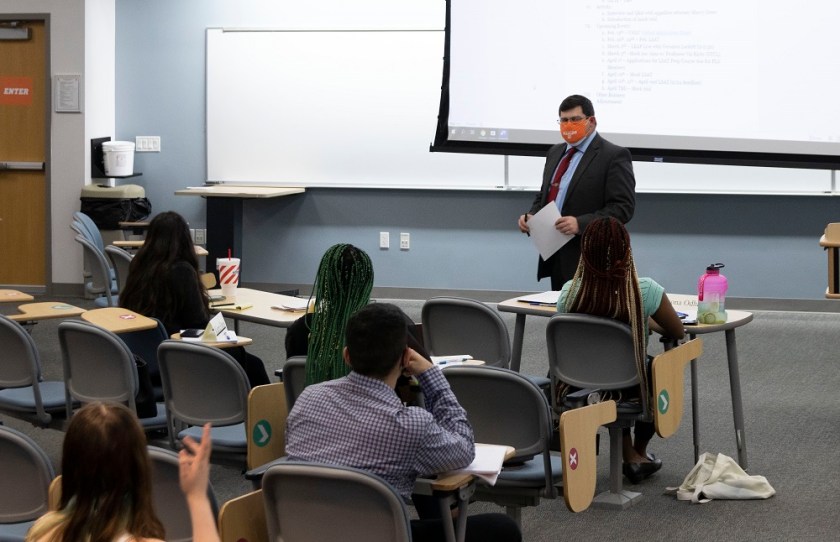
We had the great honor to have Walker County District Attorney Will Durham and his first assistant Stuart Hughes come and visit our organization and give us insight on what it is like to work in the DA’s office and what kind of cases they encounter.
Will Durham graduated in 1989 from the University of Texas at Austin with a Bachelor of Business Administration degree in management. After that, he went to law school at St. Mary’s University in San Antonio in 1992. Former D.A. David Weeks hired Durham out of law school as a misdemeanor and juvenile prosecutor. Soon after, he was promoted to felony prosecutor, where he handled many types of felony cases in district courts.
Durham practiced private law for many years with attorney Mance Michael Park in a firm called Park & Durham (now known as Park Law Firm) located in Huntsville, TX. Durham was sworn in January 2019, after the previous DA was in office for almost twenty-five years.
Durham explained that the D.A.’s office gets about 2,000 cases per year, which the office goes through to determine which cases to take to a grand jury, which then determines which cases should be prosecuted.
Nine out of the twelve jurors have to say yes for the case to go to court.
After he explained the process of how cases get an indictment, he went through his staff and the positions that exist in a District Attorney’s office, which range from positions that require a law degree, to others that require nothing but a good work ethic.
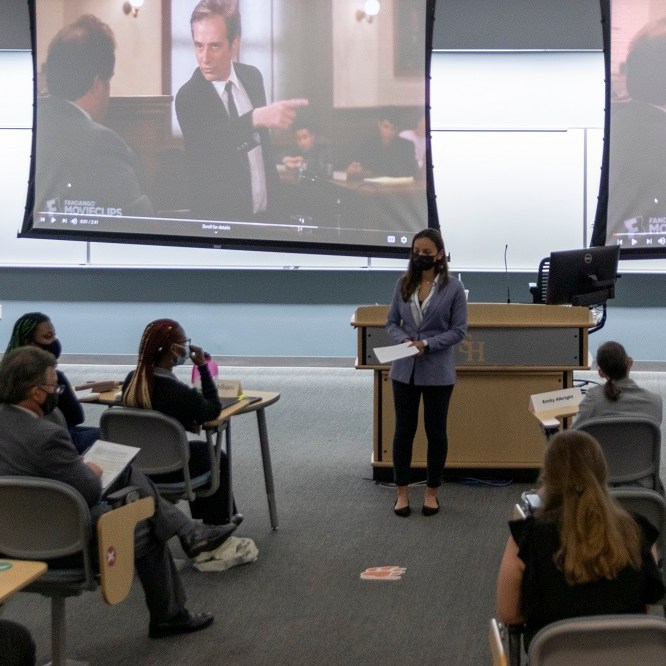
They then answered some questions about jobs and how we might work our way up in positions, and gave us more knowledge of everything each position does. When they were done with their portion of the information about the office, they showed us a slide show with the “10 Commandments of Cross-Examination” as well as clips from films featuring cross examination.
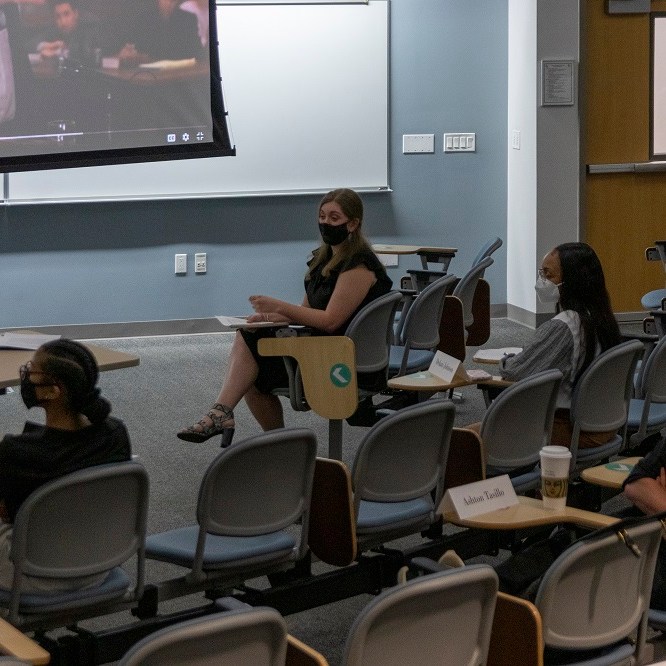
When they wrapped up their presentation, they watched two groups go through a cross-examination scenario and they gave us great feedback.
We are very appreciative of their spending an evening talking to us.
To end the meeting, our president, Quinn, did some housekeeping alongside with our VP of Finance Leslie Canchola Rangel, who discussed our finances. Quinn discussed our last meeting of the semester, the mock trial, which will be held on April 21st.
With a random number generator in hand, Val Ricks, Professor at South Texas College of Law, introduced himself to 16 pre-law students who registered to attend a virtual Mock Law School class on March 3, 2021. The class was taught by Professor Val Ricks, whose qualifications include a Juris Doctorate from Brigham Young University’s J. Reuben Clark Law School, legal work as an associate attorney with Kirton & McConkle, and almost 25 years teaching at South Texas College of Law. The Mock Law School class is a unique partnership between SHSU’s Center for Law, Engagement, And Politics and South Texas College of Law.
The students came to class prepared; they had already read and briefed the case which involved a contract dispute between the singer Mariah Carey and her stepfather. After Professor Ricks recited the facts of the case, he used the random number generator to select a student to discuss the legal issue of the case. Employing the Socratic Method of questioning, Professor Ricks skillfully led the pre-law students through the analysis of the legal issues in the case, the rule of law, and how the court applied the rule of law.
In evaluating the Class, several students commented that the Mock Law School Class gave them an opportunity to experience the real feel of law school while still being an undergraduate. Jessica Cuevas was grateful for the “amazing opportunity for a glance into the future of how my law school experience may be like regarding study habits and classroom settings. Attending the Mock Law Class solidified my decision to attend law school.”
In working through the logic of the Mariah Carey case, Professor Ricks homed in on some specific word choices in the opinion and mentioned synonyms for the legal terms. In this way, Ricks alluded to how language and law are closely linked.
After discussing the case, Professor Ricks asked some thought-provoking questions regarding the policies underlying the rule of law in the case and whether the court reached the correct result. In addition, like a question on a final law school exam, Ricks presented a hypothetical set of facts and asked the class to analyze the issue of the hypothetical based on the facts. Then, using the Mariah Carey case as precedent, he asked how a court would rule on the issue in the hypothetical case and what reasoning the court would use.
Professor Ricks followed up with some valuable advice for the pre-law students. He explained that law school is about studying old settled law so that as a practicing attorney, you have confidence in applying the law correctly to new fact patterns presented by clients. He suggested that students in law school take the Socratic questioning by law professors in class as a challenge and an opportunity to have a conversation with the professor. Ricks emphasized that the process of learning the law and applying it is more important than the specific legal cases. Yvette Mendoza commented, “ I loved this last part of the class because I was able to ask the law professor questions about law school.”
Professor Ricks advised the students of the importance of clearing everything off their calendar and devoting time to law school, especially in the first year of law school. Ruona Odharo asked a question about paying for law school. Ricks pointed out that South Texas College of Law strives to keep tuition as low as possible.
In response to Yvette Mendoza’s question on whether a student needs to go to a prestigious law school to get a good legal job, Ricks said that every law school teaches the same material using the Socratic Method, and that “excellence depends on you.” A great lawyer can come from any law school.
After the winter storm delayed our first meeting of the Spring 2021 semester, we were at last able to meet. We had an excellent turnout, with 20 new members joining, bringing us to a total of 50 PLS members this semester!
President Quinn Kobrin introduced the officers to the new members and kicked off the meeting.
After a brief overview of how the Texas court system works, we were introduced to our guest speaker of the evening. We were fortunate enough to have Marcy Greer, an appellate attorney currently employed at Alexander, Dubose, & Jefferson. Greer joined our meeting to share with us some insight about her career and what it takes to be an attorney.
We learned that she studied History and French at Emory University where she graduated with her B.A. After starting law school at the same university, she decided to uproot and move with her fiancé to study law at the University of Houston Law Center.
Next, we learned exactly what being an appellate attorney entails. Mrs. Greer’s job is to find potential errors from trials which could warrant an appeal, such as inadmissible evidence being presented to the jury or improper jury selection being practiced. Greer will work with a client’s team during trials to guide them and tell them what might be grounds for an appeal, which she said is one of the best parts of her job.
She explained that a large portion of her job is also to persuade, by a written brief and possibly oral arguments, an appellate court to evaluate the trial court decision and to reverse or affirm that lower court decision. Mrs. Greer informed us that we can watch these arguments via Zoom and YouTube to see how the cases work and how the decisions are made.
Toward the end of her interview, she gave us some tips about law school. She said it might be in the best interest of a student who feels unprepared for law school to take a gap year and work, which can give the student the chance to mature and experience a professional environment. She told us to try our best in law school; to find a great study group with the same mentality and goals as you, go to class prepared and to treat law school as a job, because you will likely succeed and have better options when it comes to job opportunities if you do.
Once her speaking portion was complete, she did a Q&A with Pre-Law Society members:
Q: When did your daughter take her gap year?
A: She took it after she graduated from undergrad and before her first year of law school. During the break, she decided to start her own baking business which has taught her a bit about responsibility. She loves it.
Q: What can you tell us about your experience working in a clerkship?
A: Clerking for a judge is a lot of hard work, but it can also be incredibly rewarding. Greer explained that the judge she clerked for would not tell her what she expected, nor did she want to be told what people thought she wanted to hear. Greer was given complete autonomy to research cases and present her honest answer to whatever case was at hand.
Q: When is the best time to seek out Clerkships?
A: Try to find and apply during your 2L year.
After the Q&A, we thanked her for her information and advice. To finish off the meeting, President Quinn discussed upcoming events, including a Mock Trial that is expected to occur at the end of the Spring semester. The PLS members were stoked to sign up. This gives us all a great opportunity to study our roles and put them into action, all the while learning about the legal process! Our next meeting will be on March 24th, 2021.
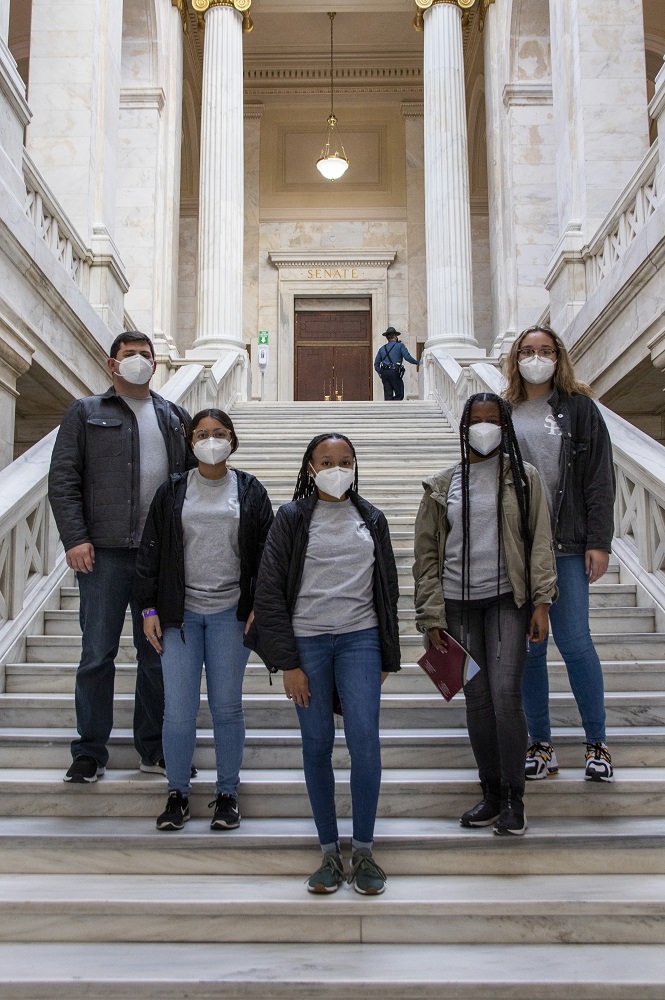
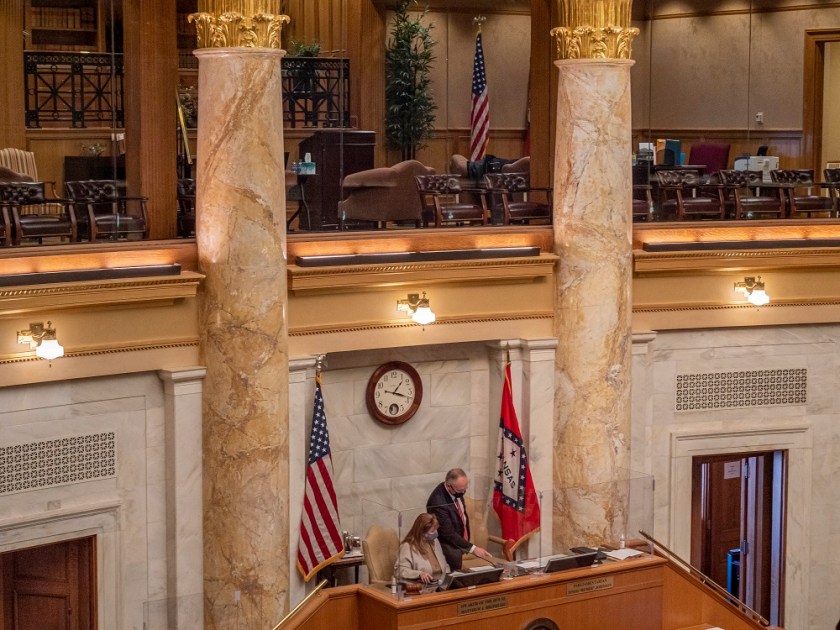
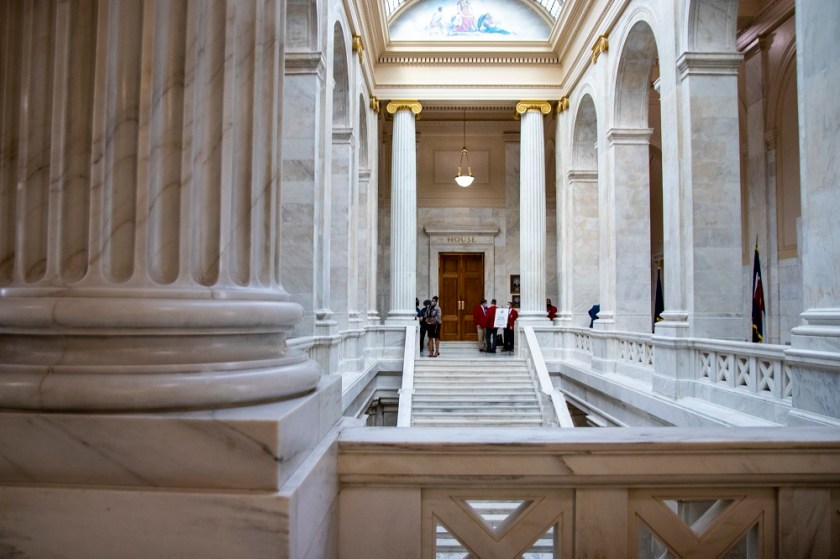
As we entered the grounds of our third state capitol building of this trip, we were instantly taken aback by its impressive stature. Just like the Mississippi capitol, the Arkansas capitol stood tall, with a golden crown-like statue at the top.
Of course, like the other two capitols we visited, the Greek and Roman influence on the architecture was noticeable immediately from the large pillars and pediment at the entrance. The Arkansas capitol building’s construction began in 1899 and finished in 1914, making the capitol over 100 years old.
After making it through security, we made our way to the rotunda, where we were greeted by Ms. Cheryl Augustine, who was so kind to give us a quick rundown of where all the rooms were located, and we also got a glance at Governor Asa Hutchinson, who walked right by us.
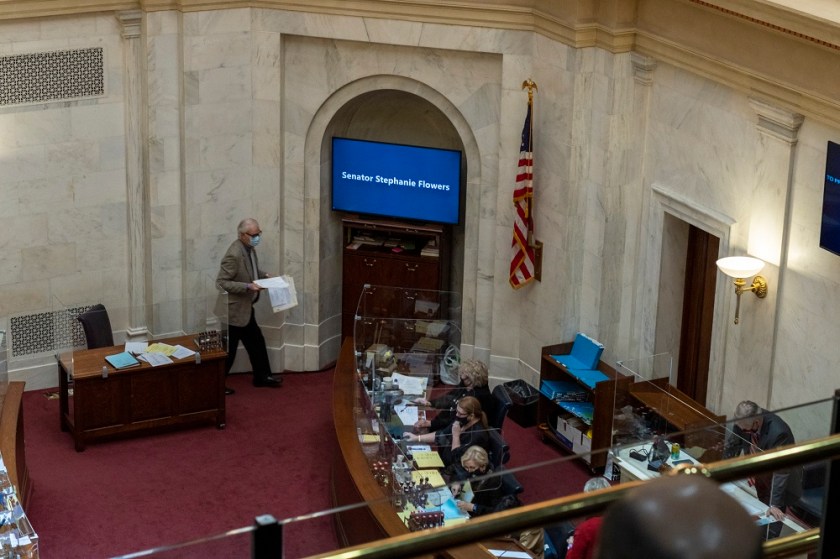
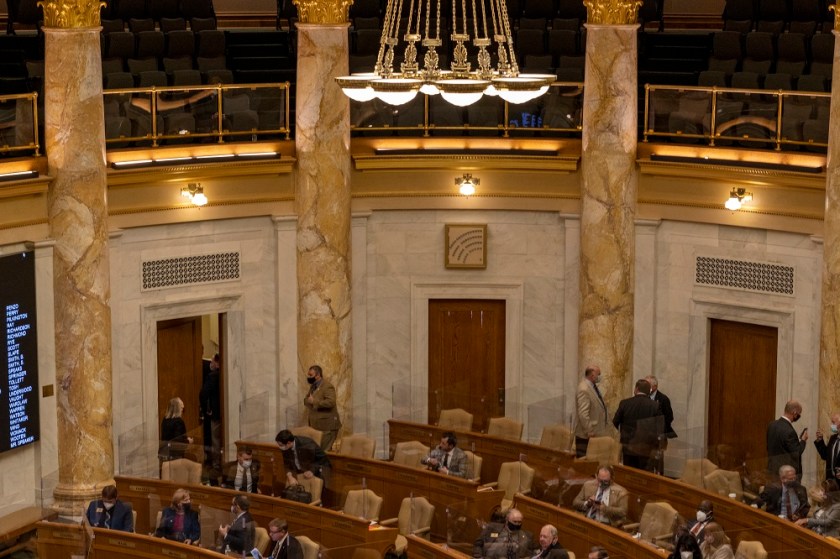
Cheryl then led us to the fourth floor, where we entered the “Senate” gallery to watch the Senate convene. Getting to see the Senate in action was a fun experience because we had a closer look at what was happening, and we even watched as the State Senators voted on a bill.
So, we would like to extend a huge thank you to Cheryl for getting us in!
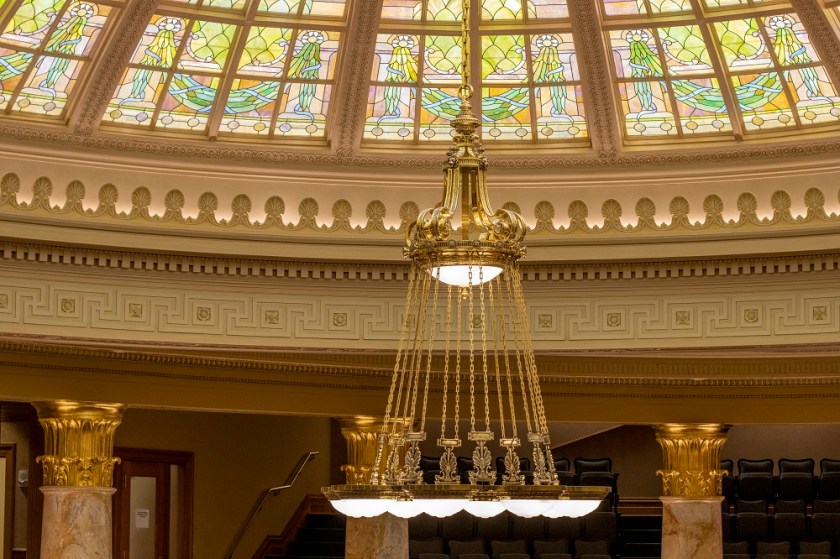
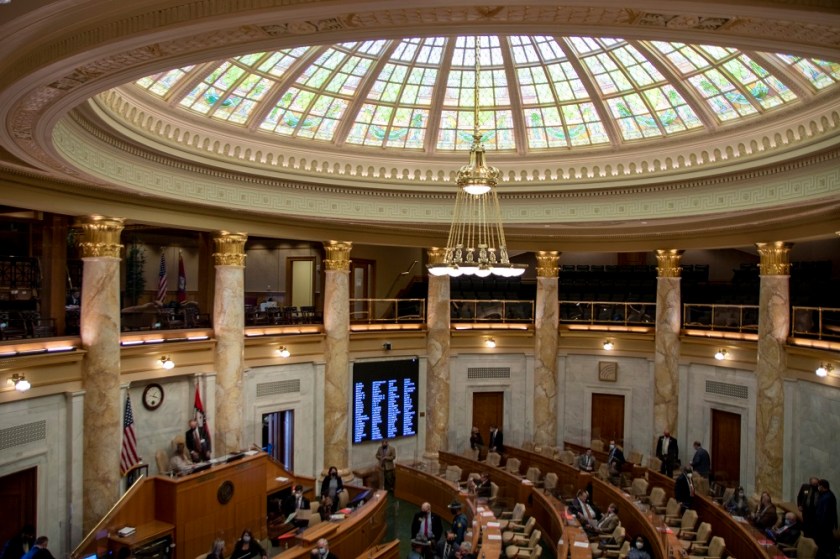
After seeing the senate proceedings, we thought we would take our chances and head over to the “House of Representatives” gallery to see if we would be able to go in there as well. Luckily, we were able watch the House in action too. The gallery of the House of Representatives is a beautiful large room with a tall gold chandelier hanging in the middle of the rotunda. The rotunda was also nicely crafted, with stained glass at the top that let in the light and brightened up the whole room, not to mention a pretty impressive VIP room.
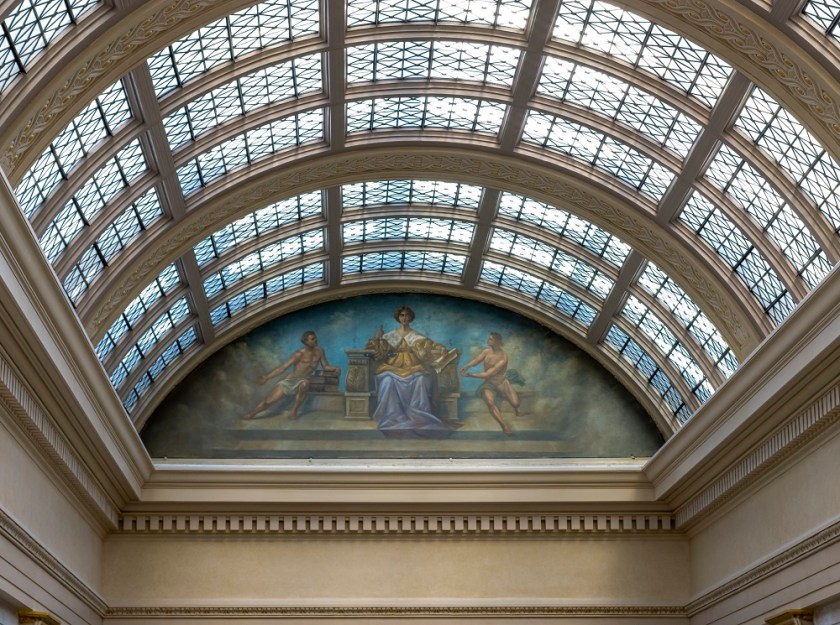
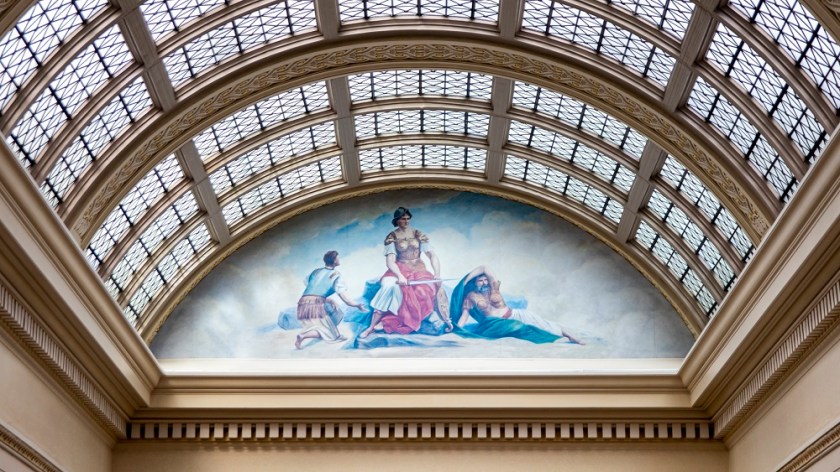
Outside, in the capitol rotunda, the 4,000-pound chandelier hangs suspended from the ceiling, incorporating over 2,000 brass, copper, zinc, iron, and glass parts. On the third floor of the building, right above the grand staircases that led us to the House and the Senate, were four murals that each had a different theme. Over the south – which is where the Senate is – the “Education” and “Justice” murals stood. Over the north – where the House is – the “War” and “Religion” murals were.
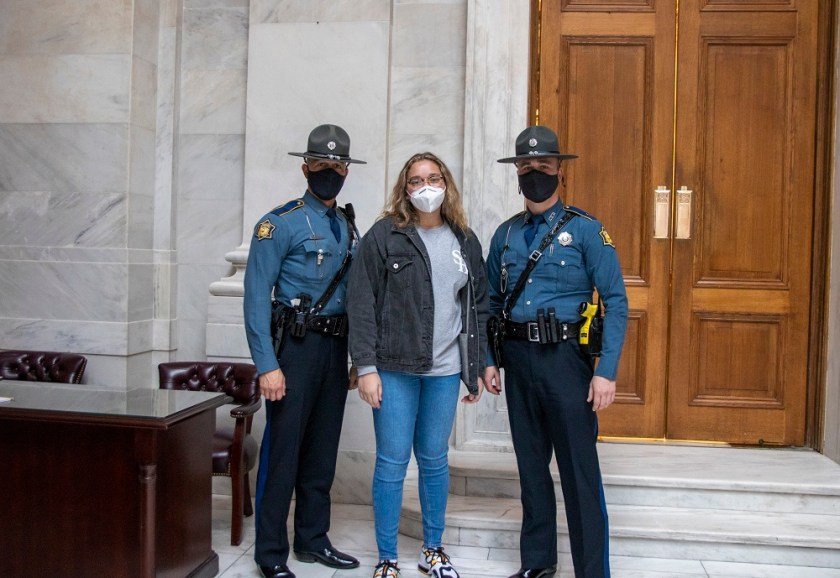
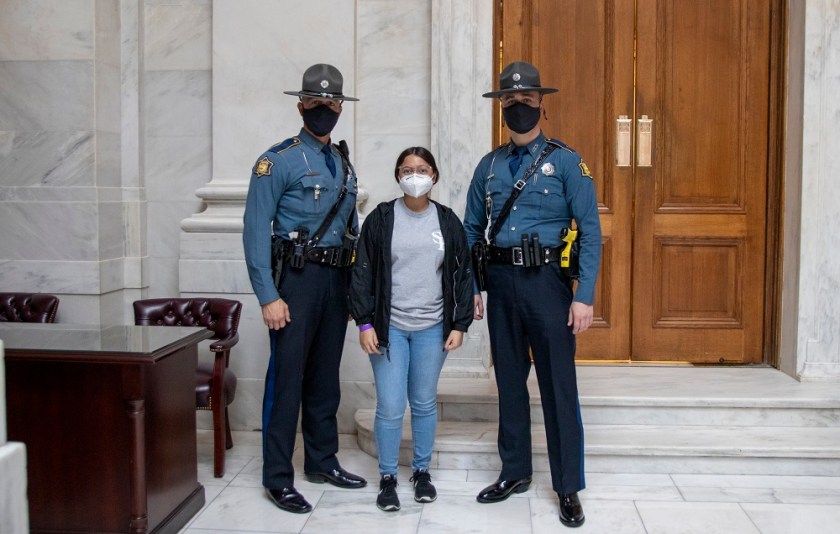
Across the archway, we spotted two capitol officers that I just had to get a photo with, and lucky for me, they were nice enough to do so, which pretty much made my whole day.
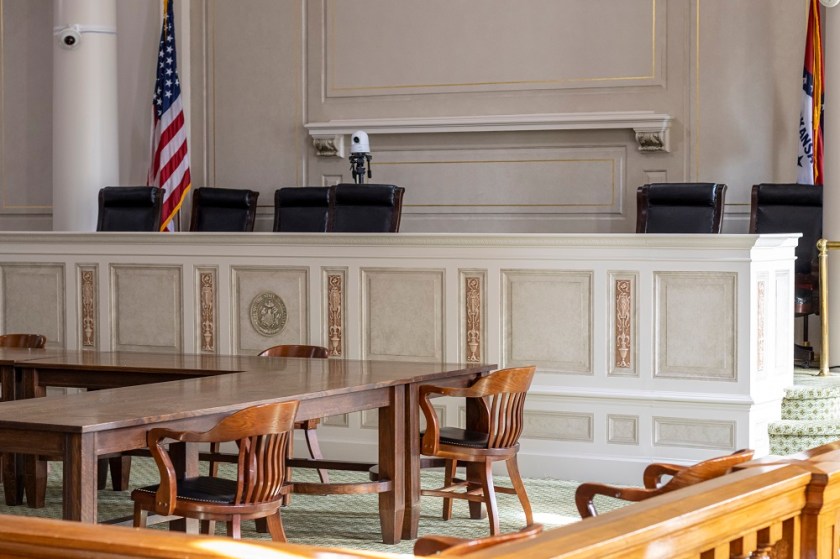
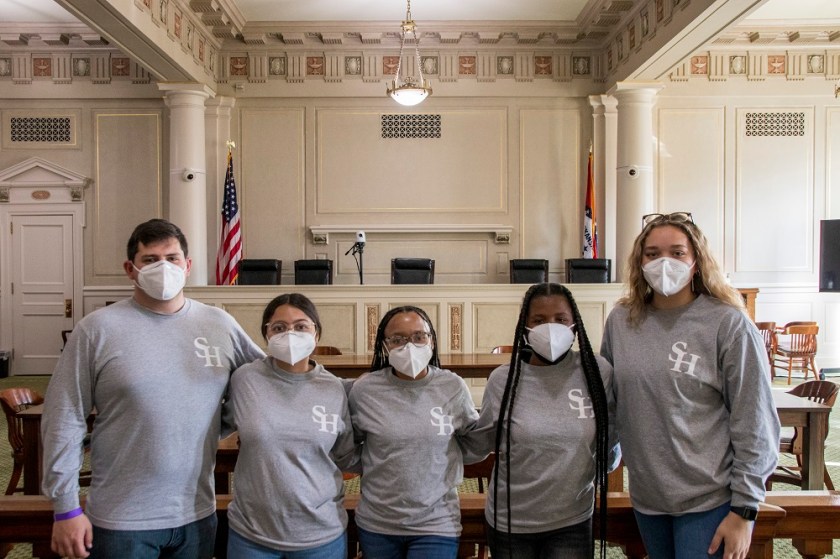
After that, we headed to the old Arkansas Supreme Court room, which also embodied a lot of the Greek architecture that is visible throughout the rest of the Capitol, such as the pediments over the doors and the large pillars surrounding them.
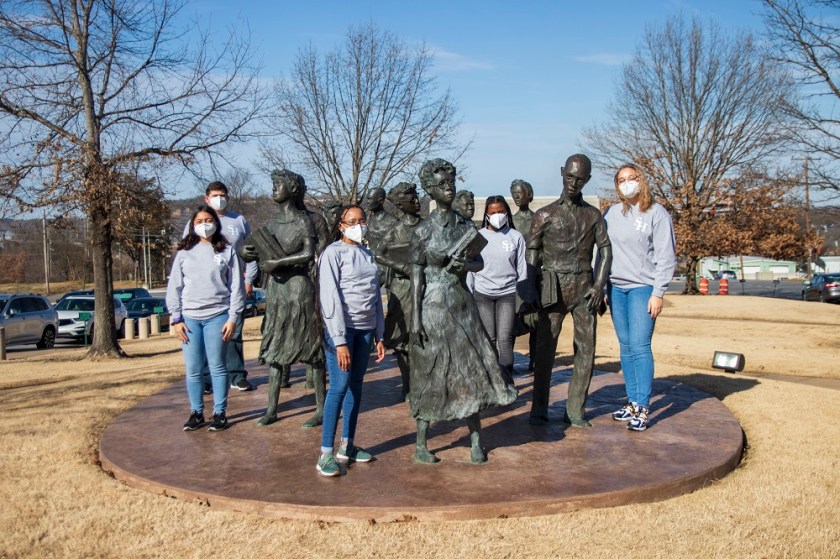
As a final stop, we toured the grounds of the Capitol to see “Testament,” by John and Cathy Deering. This a monument to the Little Rock Nine, and it features statues of each of these civil rights’ heroes.
Compared to the other three capitols that I’ve been to, Arkansas has made its way to the top of my list, and I’m happy to say that I am now 4 out of 50 of the state capitols down!
The Little Rock Nine
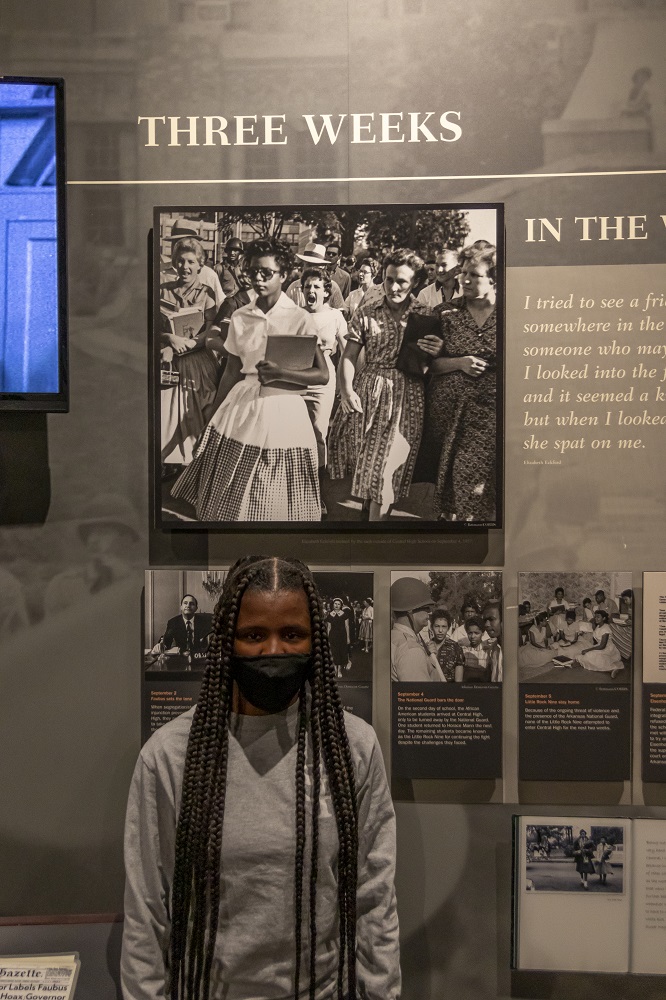
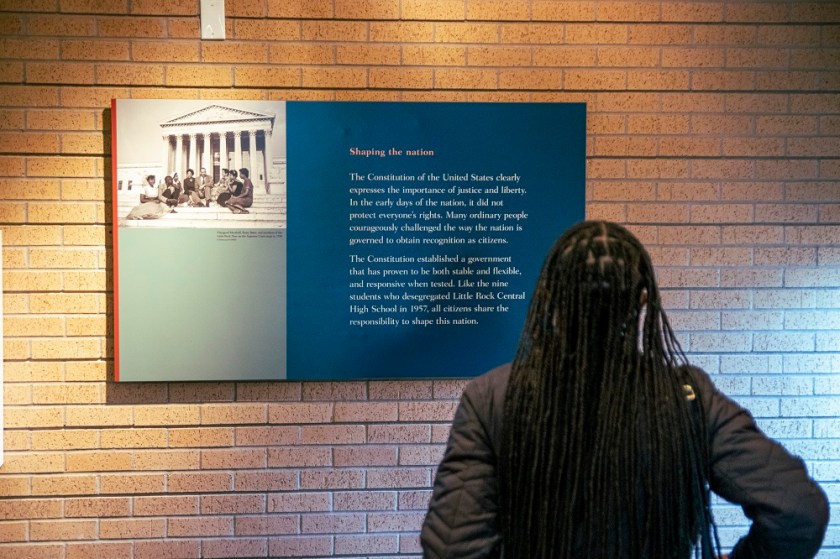
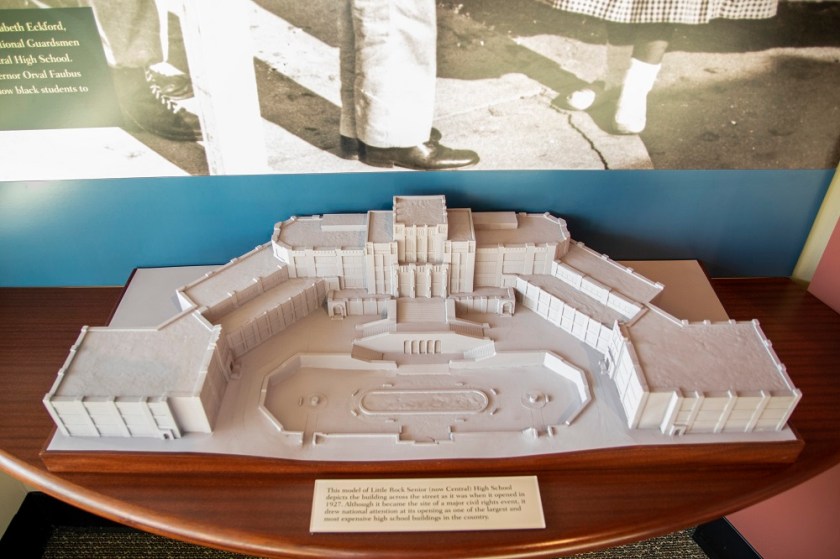
Following the Brown v. Board of Education decision in 1954, not all states were eager to begin the desegregation of public schools. Little Rock, AR was notably reluctant, and with the support and “leadership” of Governor Orval Faubus, this reluctance turned to outright rebellion. So it was in 1957 that Dwight Eisenhower sent in federal troops to force integration at Little Rock Central High, bringing international attention to the civil rights movement in the United States.
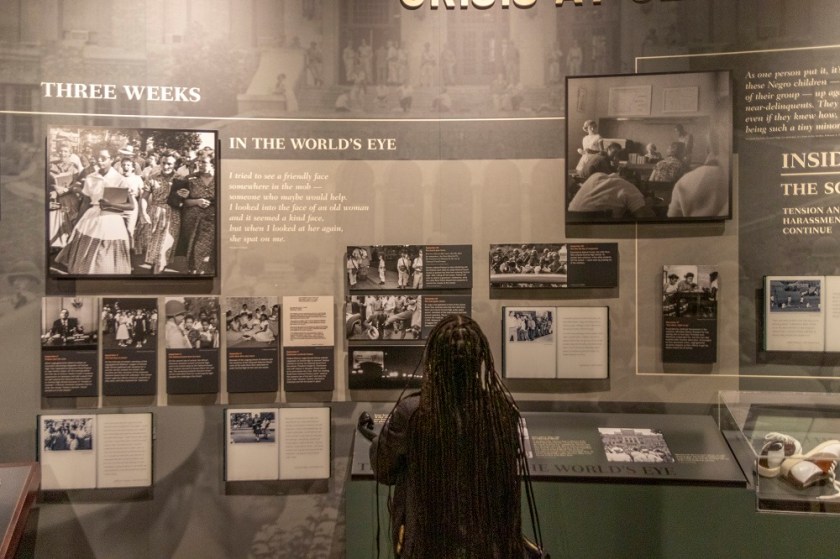
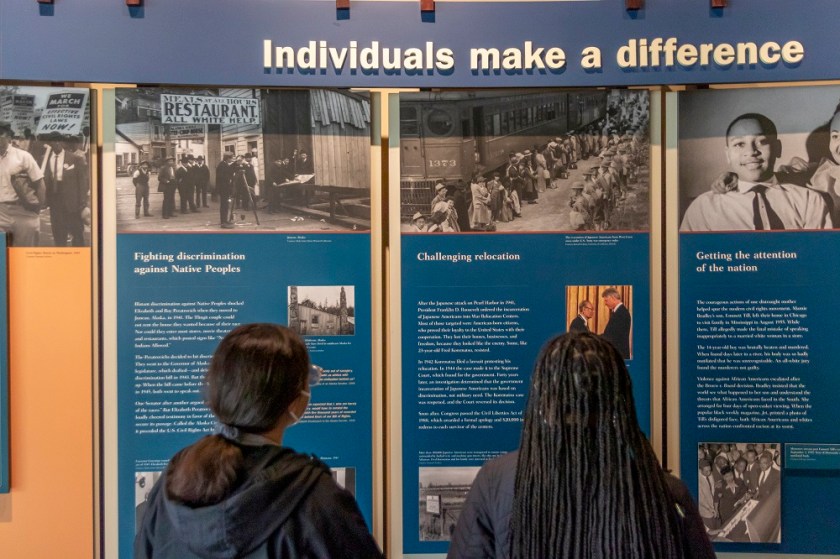
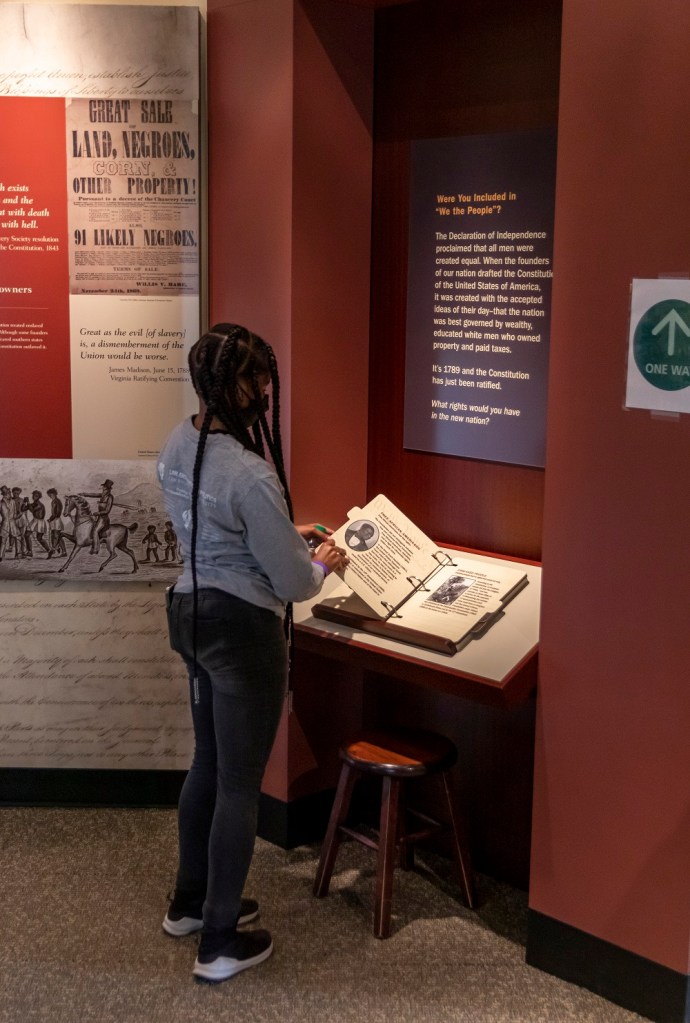
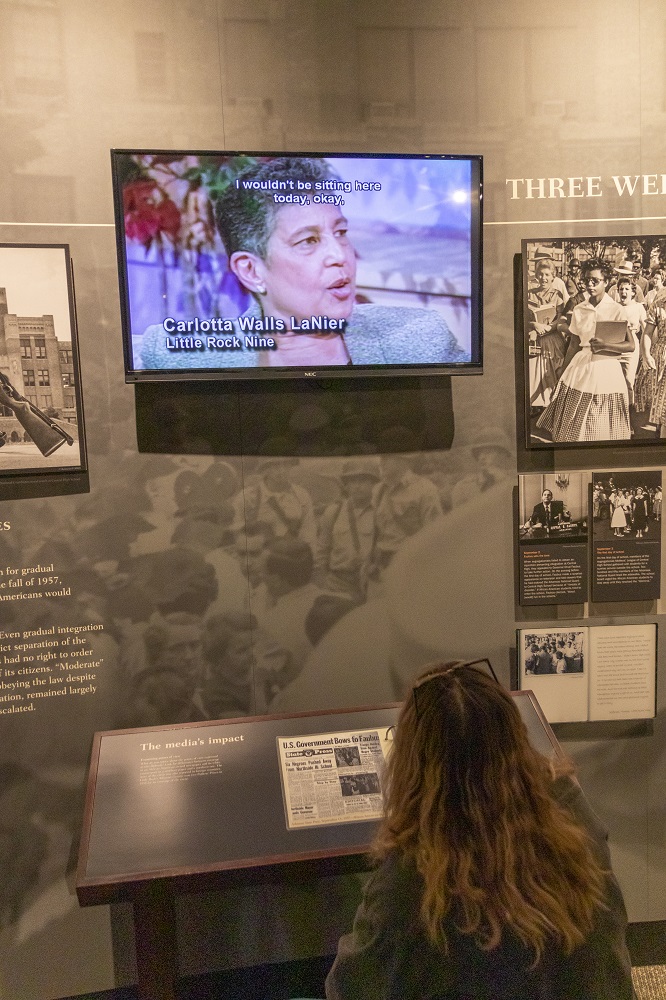
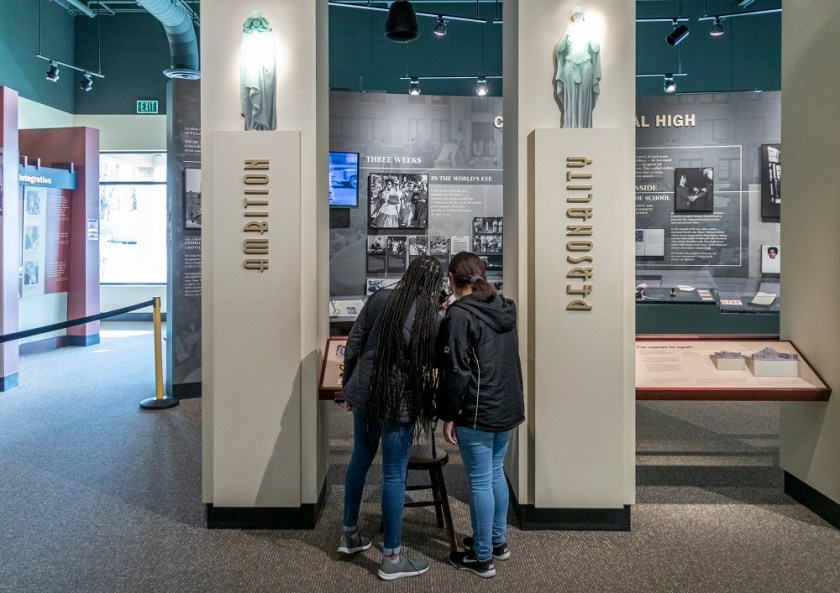
When inside the Little Rock museum, we quickly realized how fearless the nine African Americans had to be to make it through the obstacles they faced. Although only a small minority of the community, and clearly not enjoying the support of most of Little Rock’s citizens, they remained steadfast.
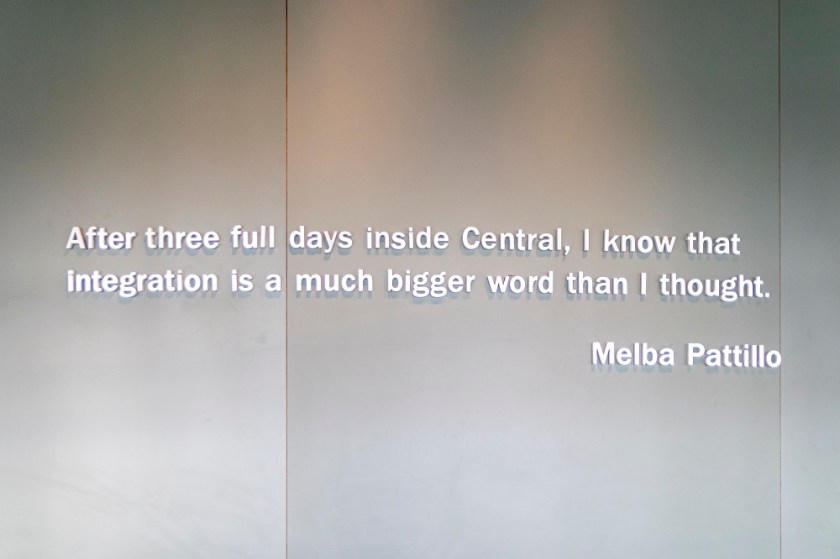
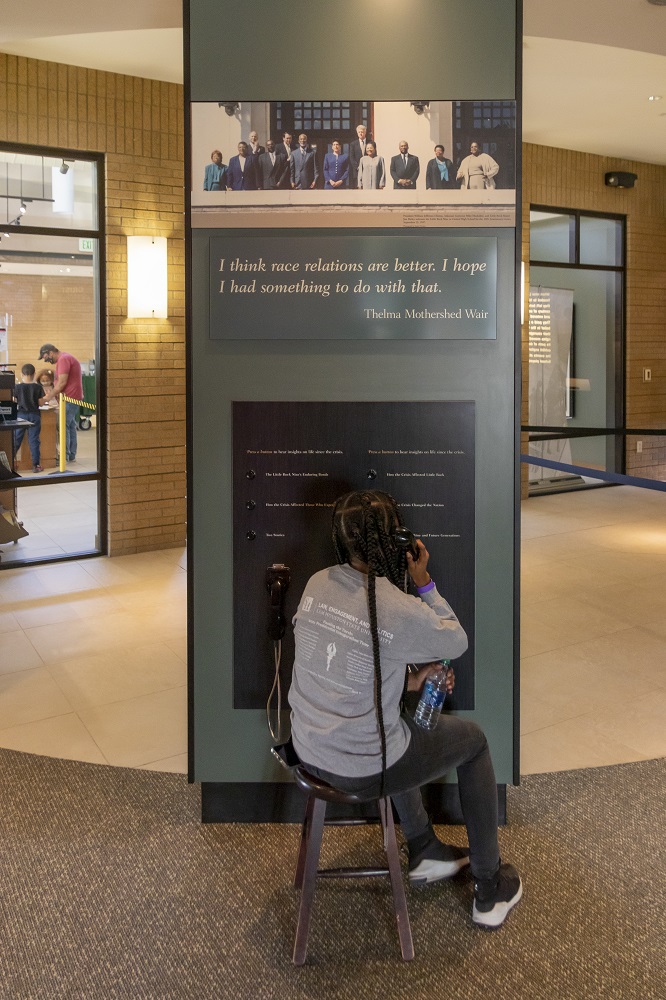
Of the many inspirational quotes populating the museum…
…the one that most resonated was a paraphrase from the spiritual “I Don’t Feel No Ways Tired.” The concept of continuing to move forward despite exhaustion has a significant meaning within the African-American community, and it made me think where we would be if Rosa Parks, Martin Luther King, and the Little Rock Nine hadn’t battled on.
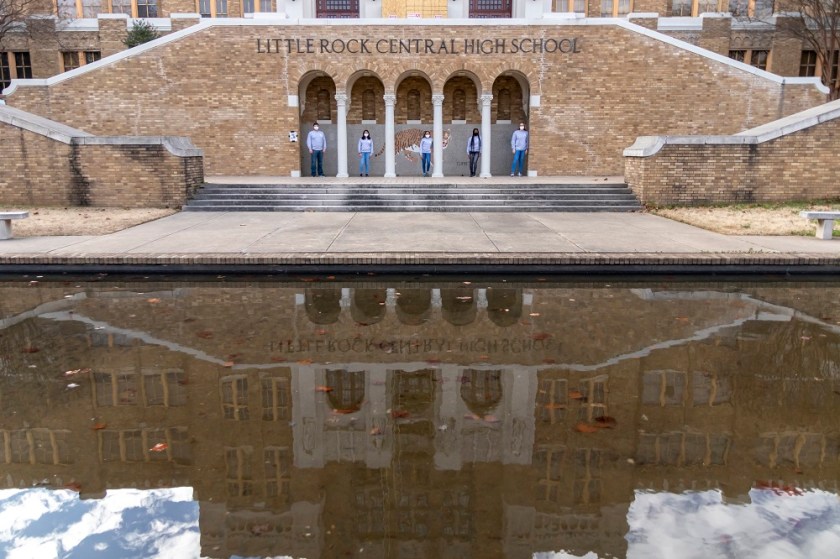
Making this even more poignant was visiting the high school grounds. The campus is beautiful, and very large! Although under construction, we were able to get some photos of us at the structure where civil rights history was made.
This visit was a good reminder of how far we’ve come, while still being cognizant of how far we have to go. But, of course, we will not get tired!
Pinnacle Mountain State Park
Ilexus Williams
After visiting the Little Rock High School Historical Site, the LEAP students embarked on what seemed like our toughest adventure yet: hiking. Just outside of Little Rock, Arkansas sits Pinnacle Mountain State Park. The state park covers 2,356 acres and the mountain has an elevation of 1,011 feet. Additionally, the park encompasses both biking and hiking trails.
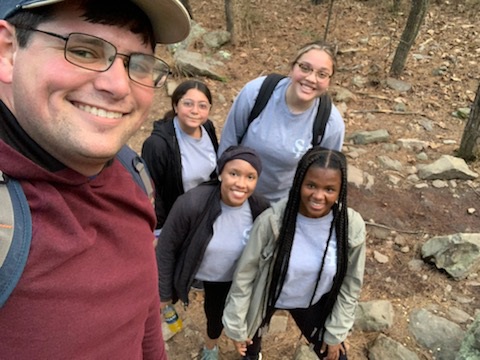
Our hiking trail of choice was the East Summit Trail! With strong will and determination, we started our 1.5 mile trek up East Summit Trail in a race to watch the sun set!
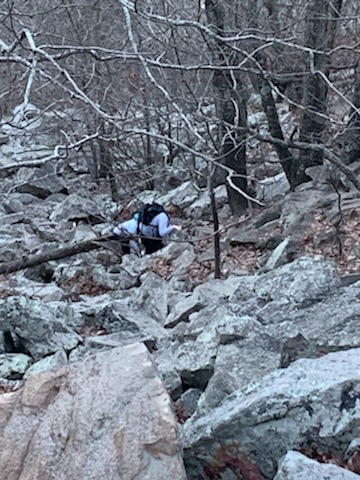
The beginning of our trail was a breeze, walking up a staircase of rocks. However, we came to the base of the mountain and faced what seemed like a sea of massive boulders. After digesting the overwhelming view, we started our ascent. Maneuvering our way through the rocks was very strenuous, so we took well-deserved breaks, which gave us a chance to enjoy the beautiful rolling plains behind us.
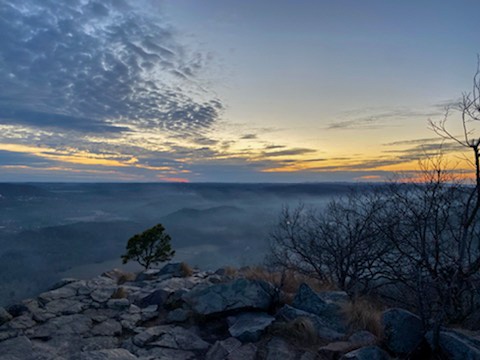
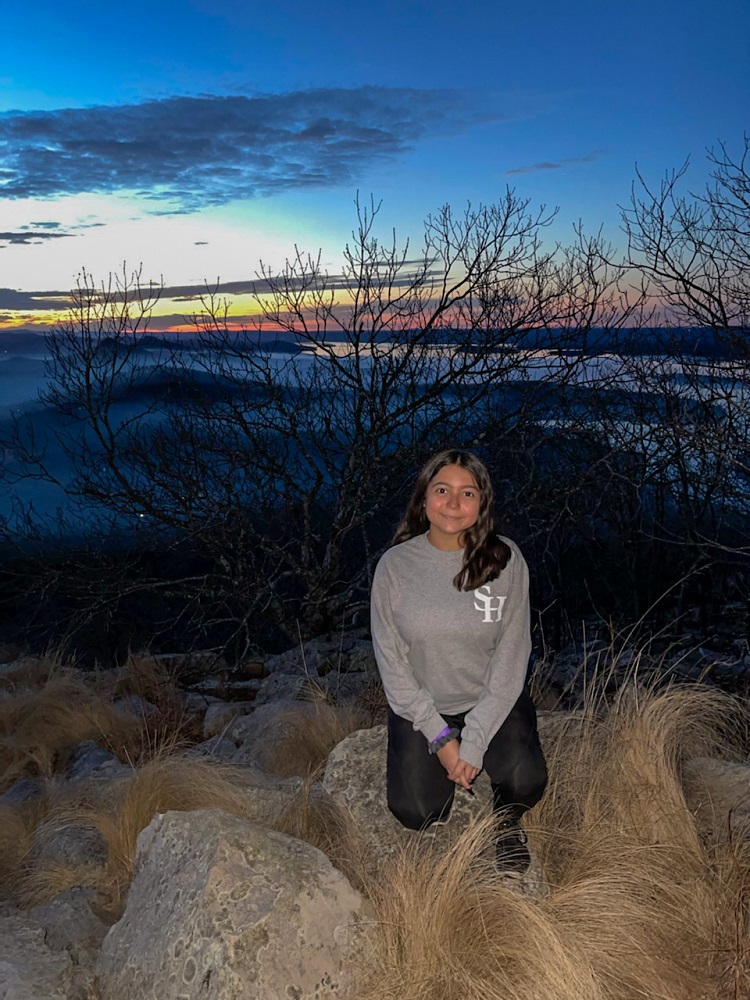
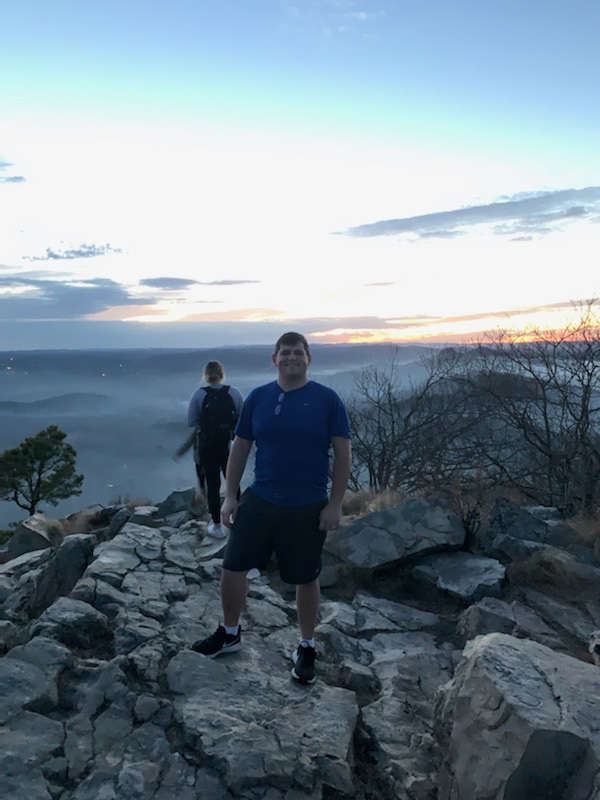
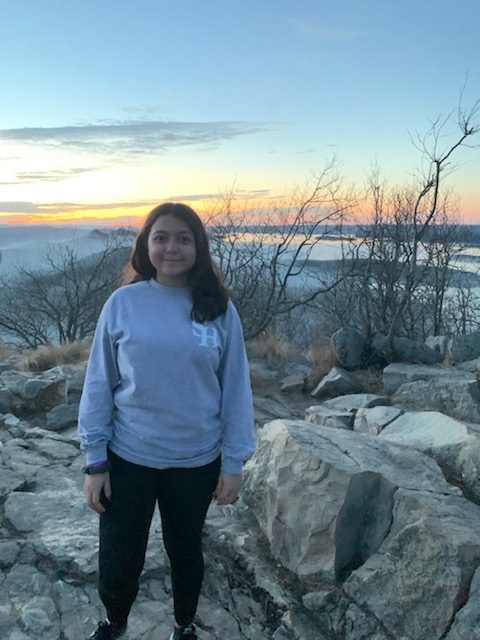
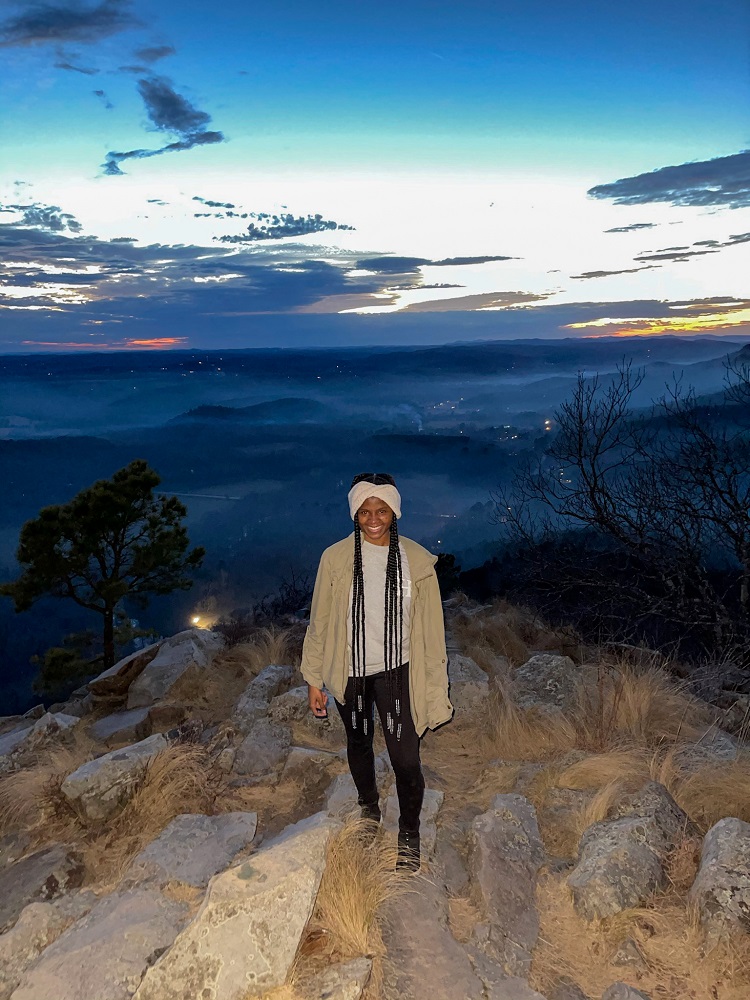
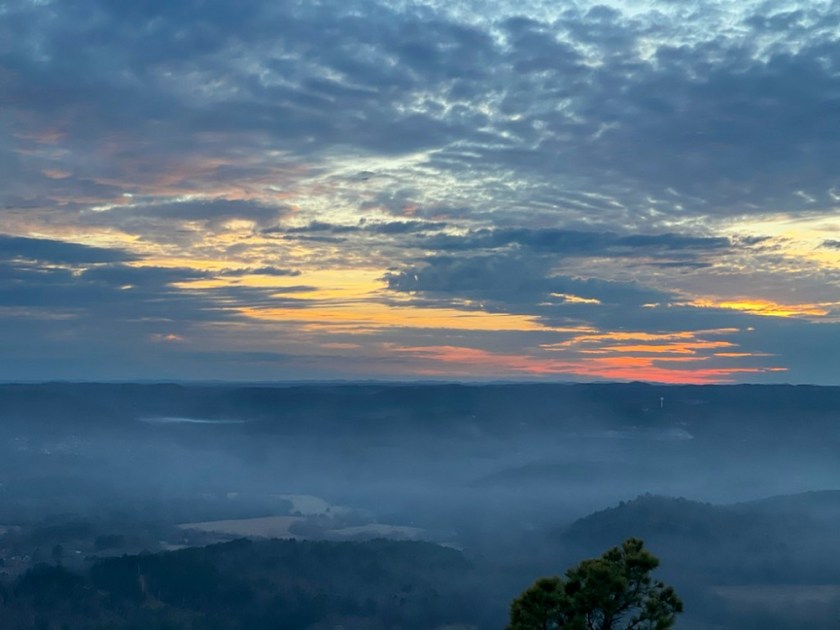
Finally, we reached the pinnacle, and it was breathtaking! The hard work that we put in to reach the top was fulfilling and well worth it. Being able to look out at the orange and pink hued sky and the expansive rolling hills gave us the opportunity to reflect on everything that we have experienced and allowed us to acknowledge how fortunate we are to take part on this trip. To paraphrase MLK, “we have been to the mountaintop,” and our experience was indescribable.