
Anyone who watches the news occasionally knows about climate change, but few people truly understand it. The Department of Environmental Sciences, however, worked to changed that by inviting Dr. Barry Keim, Professor of Climatology at LSU, to discuss this important topic to a group of faculty, staff, and students at SHSU. The turnout was impressive, with more than 100 people on hand to hear Dr. Keim, who was introduced by Drs. John Strait and Ava Fujimoto-Strait.

Anyone who experienced last summer was unlikely to be surprised by Keim’s first observation: 2023 was the hottest summer on record. But Dr. Kiem’s interests also extended to the related concepts of the Atlantic Ocean temperatures, storm surges, and, in general, extreme weather events. Interestingly, five of the ten largest Gulf of Mexico storm surges have occurred in the past 20 years, and another four occurred from the period of 1961-1975.
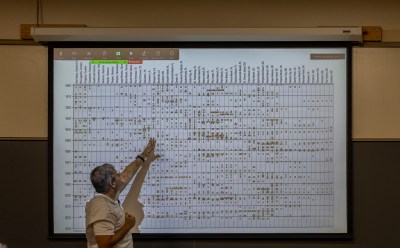
Another lens through which to look at climate change’s impact on storms is the sheer length of storm season. The “season” is defined as the period spanning the first “named” storm of the year to the last “named” storm of the year. In the late 19th century, the mean storm season was approximately sixty days, but in the last ten years, the storm season has lasted, on average, about twice that long.
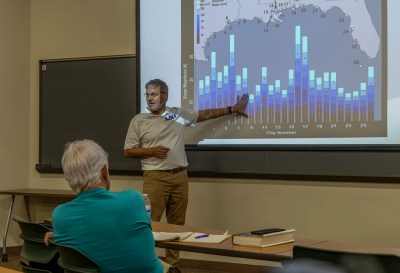
And, it turns out, while the total amount of rainfall may be more or less constant, this doesn’t mean that the rain is having the same effect from year to year. Instead, what we are seeing is longer periods without rain punctuated by more intense storms, resulting in more flooding and more hail damage.
Other measures show similar trends. Selected cities have experienced fewer freeze days over the past 100 years; and, by extension, an more than 70 percent of the counties in the US have seen an increase in annual “minimum temperatures” and about 40 percent of the counties have had an increase in the annual “maximum temperatures.”
A key takeaway, according to Kiem, is to focus more on the variability in temperatures and rain, and less on mean changes. And the potential results of these changes, Kiem noted, are “downright frightening.”
Kiem’s talk seemed to be prophetic. Following his talk, rains began, intensified, and caused much damage …

…in the Walker, Brazos, Grimes, and Montgomery Counties.
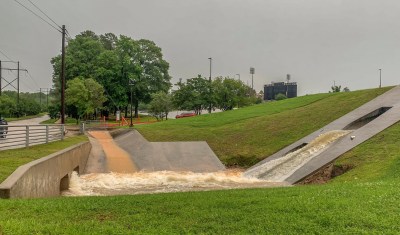
So much so that SHSU cancelled classes on the main campus. In an interesting coincidence, SHSU, perhaps for the first time, cancelled class on the first and last day of the semester because of weather-related events.
Many thanks to the Department of Environmental Science for bringing an interesting speaker to campus for the exchange of ideas–exactly what a University is designed to do!
 Center for Law, Engagement, and Politics