
By Morgan Robertson
While the LEAP Ambassadors often attend World Affairs Council (WAC) events in The Woodlands, this one was a bit closer to home. It was actually at SHSU’s “The Woodlands Center.”
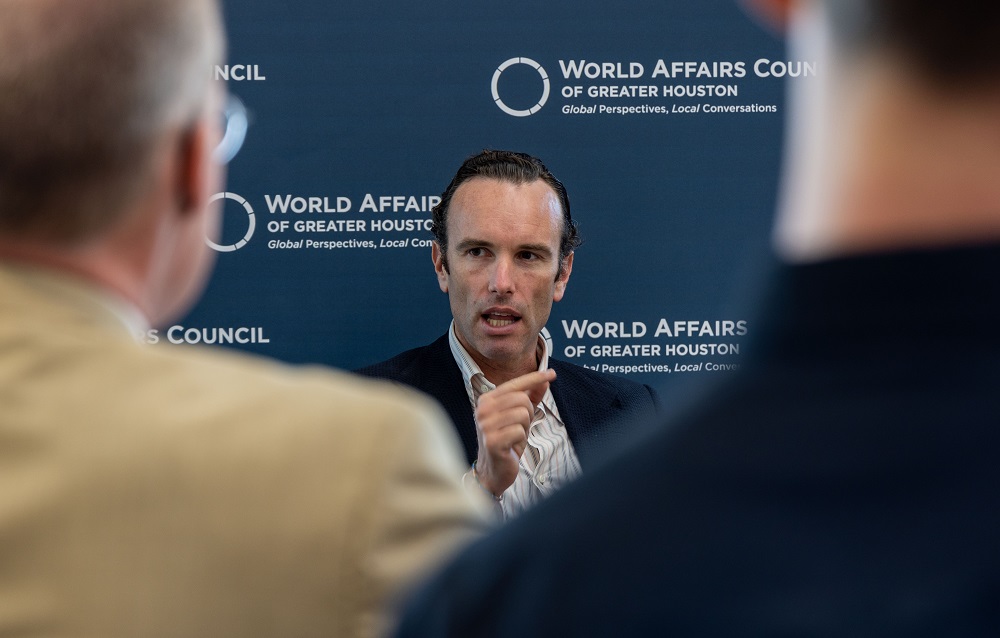
The speaker for the luncheon was Elliot Ackerman, a CIA Officer and Marine stationed in Afghanistan and Iraq, and who, in more recent years, has been a best-selling author of both fiction and non-fiction. The discussion was moderated, as usual, by the excellent Ronan O’Malley, the Director of Programs for WAC.

Attending with us were several SHSU students (Ashlyn Parker, Kiara Williams, Cynthia Boyd), an advisor (Stephanie Fors), and SHSU/community leaders (Gene Roberts, Dean Hendrickson, and Ken Holland).

Ackerman’s book The Fifth Act: America’s End in Afghanistan was the hot topic, and the conversation began with how the title of the book came to be. While he was on vacation with his family, Ackerman was asked to write a 500-word piece about the 20-year war in Afghanistan.

Ackerman joked that he was shocked and thought there was no way to detail and cover 20 years of war in 500 words. When he was asked to write about the operation in Afghanistan, it was referred to and described as a tragedy and he explained that his journalist’s mind made the connection of tragedy with Shakespeare’s plays. Because tragic drama often unfolds in five acts, and because there was a natural breakdown in five parts, Ackerman focused on these five topics: (1) President Bush,( 2) President Obama, (3) President Trump, (4) President Biden, and (5) the fall of the war.


Ackerman then harkened back to an earlier time in history and the construct of blood and treasure. In more detail, he explained that during the Civil War and WWII two main factors rose: the need for someone to fight and someone to pay. But, typically, everyone or almost everyone had to fight, pay, or otherwise sacrifice–and that, according to Ackerman, is no longer true.

Another difficulty is that, most wars can be marked as “victorious” following a positive and defined outcome–such as liberating Europe (WWII). With the War on Terror, a victory was preventing something (i.e., a terrorist attack) from happening. That poses some difficulty in terms of attributing credit or in achieving a defined conclusion.
The book and the non-fiction drama on which it is centered was interesting, so much so that almost all the LEAP guests, including the students, bought books. But the event was also satisfying for the company we were able to enjoy, the always-pleasant prospect of visiting with WAC staff (Ronan, Jahan, and Sandija)…

…and also meeting our advisor’s (Professor Mike Yawn) supervisor, Associate Provost Ken Hendrickson, who spoke following Ackerman, helping wrap up the event.


In short, it was another great World Affairs Council event, just made more great by the fact that it was held at an SHSU campus.

 Center for Law, Engagement, and Politics