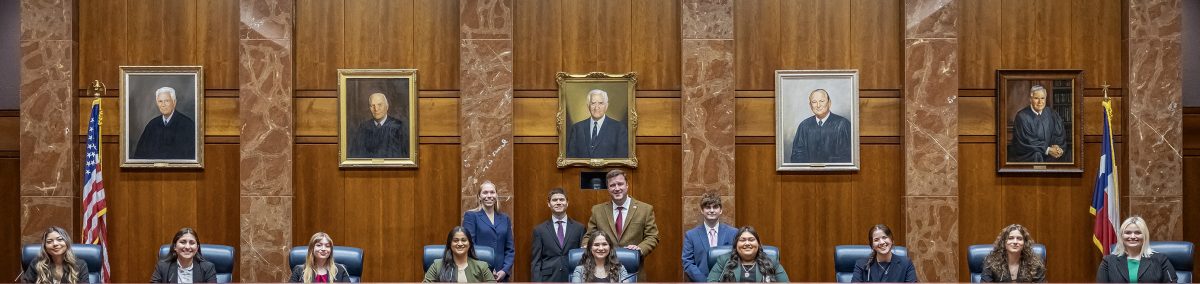
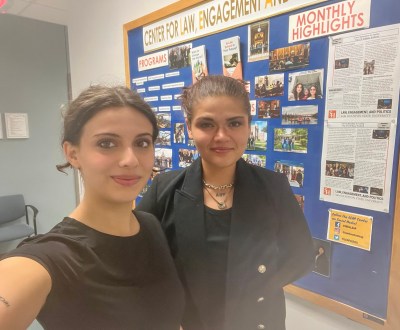
After a multi-year hiatus, the LEAP Center has revived its Moot Court Team, and SHSU Students Olivia Discon (Team Captain) and Maggie Betancourt will be competing at the Texas A&M Law School Regional Tournament on November 16-17.
What is Moot Court, Anyway?
Moot Court replicates the appellate process. Most people are familiar with the trial courts, where (typically) a jury judges the guilt of a defendant; witnesses are called to testify, are involved in direct and cross examination; and a single judge presides over the proceedings. But in an Appellate Court, attorneys compile documents, provide a written brief, and offer oral arguments, making the case that the lower court erred (petitioner) or didn’t (respondent) in the proceedings.
This fits right in with the LEAP Center’s activities, which already many law-school related activities, including inviting the 10th Court of Appeals to campus once a year to hear cases.
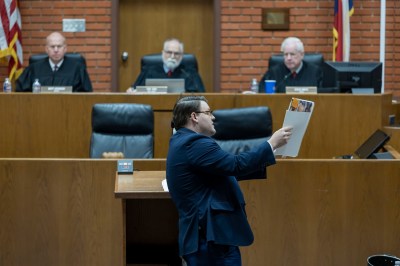
Without knowing it, then, the LEAP Ambassadors have had a mini-preparation for the Moot Court experience.
Moot Court Preparation
Although we may change formats in future years, the Moot Court experience works like this:
- May 1: AMCA Releases Case;
- August: Students read case and take “Foundations Quiz” to participate;
- September: Weekly practices begin;
- October: Practices continue and students may scrimmage other teams;
- November: Regional Tournament
- January: National Tournament
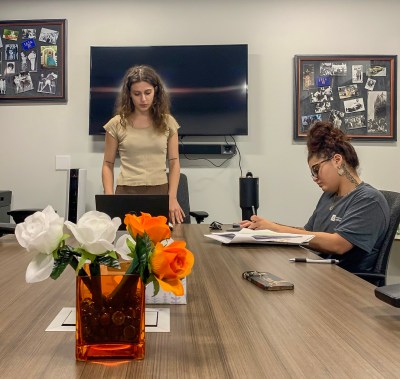
For the students, this means reading the cases (there are 21 cases in all) thoroughly, and developing arguments, modified over weekly practices, that can be used for their “courtroom” appearance.
Moot Court Benefits
In following this regimen, students gain many benefits. They…
- Learn how to read and understand court opinions;
- Learn how to write appellate briefs;
- Sharpen their critical thinking, writing, and communications;
- Gain substantive knowledge in the field of law;
- Gain exposure to law schools to which they may be applying.
Rules of Moot Court
After familiarizing themselves with the main case and associated cases, the competitors decide which of two issues they will be arguing before the court. This year’s case, which is based on the Michelle Carter encouraging suicide through text-messaging case, involves both the 5th Amendment (self-incrimination, tackled by Maggie) and 1st Amendment (free speech, addressed by Olivia).
The students also (more or less) split the 20-minute time limit, with each student making their case before the judges for about ten minutes.
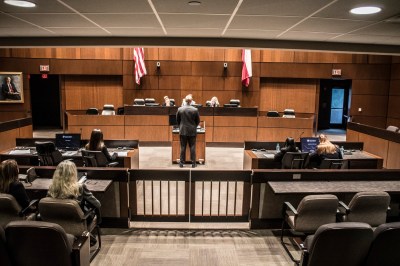
This can be tricky, because judges can interrupt as often as they want, and the time spent being interrupted counts against the time allotted. (See full rules below).
Although teams may compete in scrimmages that are self-arranged, their first (and probably only) appearance is at one of 15-16 regional tournaments across the United States, which host, collectively, approximately 120 Universities, many of which field multiple teams. The top 25-percent of these teams then compete in nationals in January.
SHSU Moving Forward
With help from Dean Gene Roberts, Stephanie Fors, and Victoria McClendon-Leggett, the students have gone through increasingly rigorous practices…
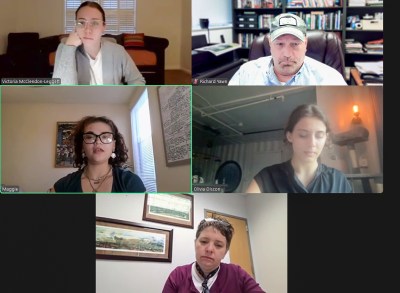
…culminating with a scrimmage on October 19, 2024.

This scrimmage, which took place on Zoom in three different states, involved 12 teams. Organized by Blacin Godfrey from the University of Louisiana at Lafayette, the students competed in three rounds, twice representing the petitioner and once representing the respondent.
Although the results have not yet been delivered to the teams, the SHSU team was able to enhance its practice in more realistic conditions, hear perspectives from more people, and commiserate with other moot court participants across the country.
Importantly, the scrimmage identified weaknesses in the team’s arguments; highlighted applications of other cases that should be considered for incorporation; and spotlighted weaknesses in delivery and presentation.
The team will continue its practice through November 16-7, when they will be one of 24 teams competing at TAMU Law School.
Getting Involved
For students who would like to be considered for SHSU’s Moot Court team next year, please contact Olivia Discon at oliviadiscon@shsu.edu or Professor Mike Yawn at mike.yawn@shsu.edu.

 Center for Law, Engagement, and Politics