
The Southern Legislative Conference indeed came to an end, but our adventures pressed on! On our way to Atlanta, LEAP Ambassadors took some key stops through South Carolina and Georgia to learn about this region and its historic relevance.

Tour of South Carolina’s Capitol Building
Ingrid Cuero
Before leaving South Carolina altogether, we made sure we stopped in Columbia, the Capital of the state. We approached the capitol grounds to find a full-blown protest occurring–with labor unions objecting the flight of jobs.
This did not stop us from getting some photos of the exterior….

…or from seeing several statues, including Strom Thurmond, who is famously known for conducting the longest filibuster in history: 24 hours and 18 minutes! (He was filibustering to prevent passage of a civil rights bill.)

Passing by South Carolina’s state tree; a lone palmetto on the South end of the structure, we entered the building, which opened to a marvelously decorated interior.


I was immediately taken by the two flags, the U.S. and the South Carolina flag on either side of the entrance.

One of my favorite details of the interior design was the consistent use of the palmetto tree and the state flower, the Yellow Jessamine. It’s all in the details; for example, the lamps and chandeliers emulated the palmetto in their structural composition, and the staircase was engraved with the flower.

John C. Calhoun, another of the State’s notable figures, was commemorated with a statue. Calhoun is the only man to have served as Vice President of the United States for two different presidents. He, like Thurmond, is not much of a figure for modern times, but is a key part of the Palmetto’s State’s history.

We then came across The Battle of Cowpens; one of the first portraits to portray an African American in battle. Painted by William Ranney, the scene depicts a “servant” intervening in battle to save Col. William Washington.

After interning in the Texas Capitol building this past semester, it was very interesting to see the many differences between the TX Capitol and the SC Capitol.
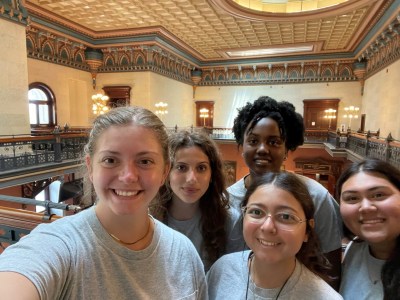
The first, and most obvious difference, is the size. While Texas’ Capitol building is much larger, the interior of South Carolina’s is far more intricate and elegant.

Another key difference is that in South Carolina, both chambers are in session every year, whereas in Texas the legislature convenes every biennium.

Although judges in Texas are elected, in South Carolina judges are selected by the General Assembly.


This was the second state capitol building I had ever been in, so to be able to compare my experiences–especially right after an internship in the TX Capitol–was an insightful opportunity! Meanwhile, we were all able to check off one more capitol out of 50, South Carolina was Michelle’s and Olivia’s favorite Capitol Building of the trip.


 Center for Law, Engagement, and Politics