
Working on little sleep, and following an eighteen-hour first day, LEAP Ambassadors arose at 6am to explore architecture in and around Pittsburgh, with a stop at PPG Place, a mural by Richard Haas, and two major works by Frank Lloyd Wright.
PPG Place
Our first stop was PPG place, a six-building, “glass gothic” design by Philip Johnson.

As part of our LEAP travels, we had seen Johnson buildings in Houston, and we had watched a documentary on him in preparation for this trip, but PPG place was a place like no other.

Completed in 1984, its towering glass spires and sleek facades embody Johnson’s signature postmodern style, blending classical elements with contemporary materials. Its gothic detailing pay homage to Pittsburgh’s industrial heritage, its all-glass encasing embraces the future with innovative design, and its central plaza allows for a nice place to gather, which we did!

Richard Haas Mural
As a teenager, Haas spent a summer apprenticing for Frank Lloyd Wright, so it is no surprise that his murals take on an architectural quality. Indeed, Haas’s website describes him as an “architectural muralist,” an apt sobriquet.

We know Haas primarily through his 15 works in Huntsville, but we’ve also seen his work in Fort Worth, which is a masterpiece. So it was with excitement that we tracked down his Pittsburgh mural, which is near the corner of Sixth and Fort Duquesne Boulevard.
As you might expect, it features an industrial scene, an homage to Pittsburgh steel-making history, with nods to its central location at the juncture of multiple rivers.
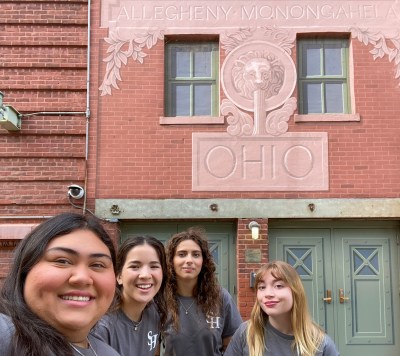
It’s always a pleasure to see Haas’s work, but this was especially true today, when we would also have a chance to see the work of his former boss, Frank Lloyd Wright.

Kentuck Knob
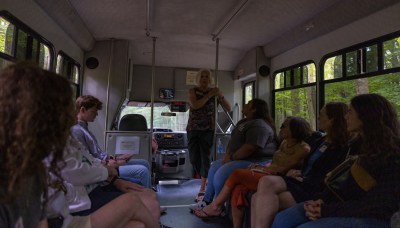
The first of our Frank Lloyd Wright site visits was to Kentuck Knob, which is nestled in the mountains of southwestern Pennsylvania. Designed in 1953, Kentuck Knob embodies Wright’s principles of organic architecture, seamlessly blending with its natural surroundings–and, in this case, adorned with a healthy helping of artwork, by artists such as Anthony Caro, Scott Burton, and George Rickey. We learned much of this thanks to our wonderful tour guide, Jan.
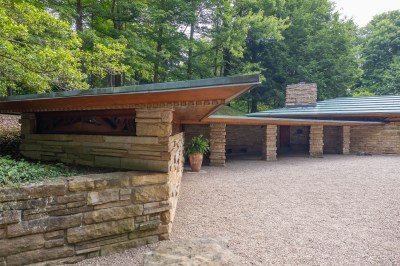
Among Wright aficionados, Kentuck Knob is known as a “Grand USoNian.” Wright’s USoNian homes were designed for middle-class residents. They were, relatively speaking, affordable, while still serving as an interesting, sculptural domicile.

Kentuck Knob had Wright’s characteristic overhanging eaves…

…adorned with clerestory windows;

…a double carport (he hated garages, which he regarded as receptacles for junk); and a “compression and release” entrance to the house.
The home follows is structured as a series of parallelograms, giving the home an interesting look and an aesthetic cohesiveness.
We were particularly struck by the beautiful living room with floor-to-ceiling windows (which could also serve as doors to the patio), beautiful Wright-designed furniture, and the unique touches for which Wright was famous.
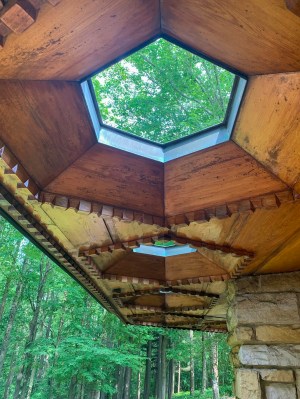
But it was the way the home interacted with the environment that we most enjoyed. The home is about five miles from Fallingwater, and the owners wanted their own “water element,” so they added a small rockfall and pool on the patio. The home is also perched on the brow of the hill, not atop the hill. Wright did this to ensure that the home merged with the environment (rather than overtaking the environment), and with a short walk along the property, we were able to see the beautiful art-adorned grounds and a view that even real-estate agents could not exaggerate.

Fallingwater
After visiting Kentuck Knob, another of Frank Lloyd Wright’s masterpieces, we headed to Fallingwater. Seeing Kentuck Knob had piqued my interest, and I was even more excited to explore another of Wright’s creations.
Frank Lloyd Wright was a fascinating and complex architect, known for his innovative USoNian homes—affordable, stylish, and functional houses for middle-class Americans. He also pioneered organic architecture, harmonizing structures with their natural surroundings, which Fallingwater epitomizes. Designed in 1935 and built directly over a waterfall in 1938 for the Edgar J. Kaufmann family, this house, which blends stone, concrete, steel, glass, and wood, celebrates what Wright termed “organic architecture.”
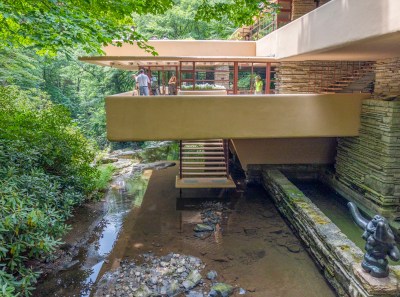
With the help of our tour guide, Millie from West Virginia, we approached the house. At first sight, Fallingwater was magnificent. Wright’s design philosophy was evident in the “hidden” doorway, a narrow entrance that transitioned into open spaces meant to connect inhabitants with nature. The structure is supported by concrete beams that project out over the waterfall, creating an impression of weightlessness.
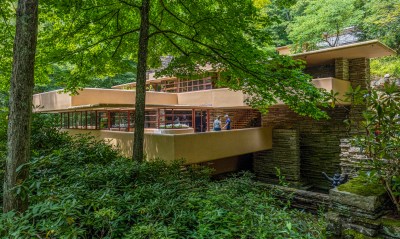
The entrance repeated Wright’s “compression and release” philosophy, and he continued the cantilever motif, making much of the furniture and design elements an echo of the home’s overall design. The living room’s open design encouraged social interaction while the more intimate upstairs rooms offered privacy. The master bedroom, with its large balcony over the waterfall, provided a serene and breathtaking view.
We noticed Wright’s attention to detail, such as the seamless glass-to-glass windows, which eliminated barriers between the indoors and the natural world, as well as the art work in the home–much of which also repeated the cantilever design.

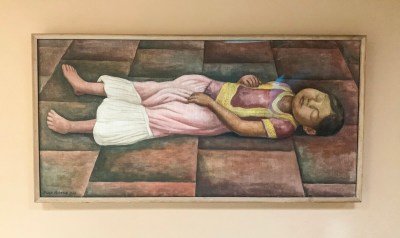
Indeed, art was a theme throughout the house, with a Picasso, several Audubon works, and a Diego Rivera (Frida Kahlo was a guest at the house!).
Our tour concluded with a view of the waterfall from across the home, capturing the full splendor of Wright’s integration of architecture and nature.

We all sat momentarily, taking in the beauty and snapping photos, cherishing the experience.


 Center for Law, Engagement, and Politics