
by Michelle Moya
To round off an eventful week, we had the honor of hearing Judge Alberto Gonzales provide both inspiring and informative perspectives. Known for his distinguished career in law, government, and academia–which Olivia Discon shared with us in her introduction…

…Gonzales shared invaluable insights, drawing from his extensive experience as the 80th U.S. Attorney General, White House Counsel to President George W. Bush, Texas Supreme Court Justice, and, most recently, as the Dean of Belmont Law School.

Judge Gonzales began with a visual presentation that showcased personal photographs from his time in the White House, and President George W. Bush, as well as images from his early years.

These visuals setting the tone as powerful reminders of how far a dedicated individual can go—from humble beginnings to the highest levels of government.
But it was principles taught to him by his parents, he explained, that guided him from his humble beginnings as one of eight children born to a construction worker through the highest levels of government service. Gonzales underscored the guiding principles that shaped his path, particularly the importance of “showing up,” his father both literally and figuratively taught him, which he emphasized as a key tenet of the work ethic he hopes to instill in any student.

The presentation seamlessly transitioned into an insightful comparison of Gonzales’ two high-profile roles: White House Counsel and U.S. Attorney General. Judge Gonzales, having held both prestigious positions, offered unique perspectives on these roles that few Americans can provide.
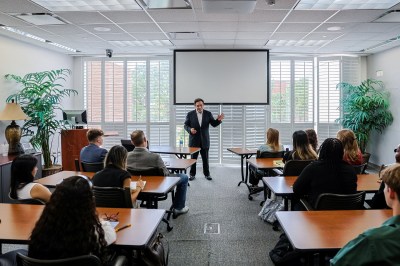
He explained that while both positions serve the American people, they do so in vastly different ways—the White House Counsel advises the President and a select group of legal advisors, while the Attorney General leads the nation’s legal apparatus, overseeing thousands of lawyers, acting as the chief law enforcement officer, and spending a lot of time on television.

Perhaps one of Gonzales’s most memorable moments was being the “designated survivor” by President during the 2007 State of the Union Address.

Using this opportunity to explain the presidential line of succession—from Vice President to Speaker of the House and beyond—and his own astonishment at the possibility that, under catastrophic circumstances, he could have become President of the United States.

Gonzales also focused on the importance of professional networks, sharing his own journey–from serving in the Air Force to attending Rice and then Harvard Law–which led to meeting Governor George W. Bush. This connection would profoundly shape Gonzales’s career–and it is clear his appreciation for this impact remains deeply felt.

When Jacob Wessels asked Gonzales what his most difficult action as Attorney General was, the former AG mentioned the investigation of former Congressman William Jefferson, which involved a search of the Representative’s congressional office.

While law-enforcement officials argued that the search was necessary to nail down a conviction, Gonzales was concerned about long-held principles relating to the separation of powers. He authorized the search, which was challenged in court (eventually being ruled partially unconstitutional), but Congressman Jefferson was ultimately convicted and sentenced to 13 years in prison-the longest such sentence imposed on a member of congress.

Having served many prestigious roles, Judge Gonzales distilled his philosophy into three key characteristics: integrity, vision, and discipline—qualities he emphasized as essential for success in both law and public service.
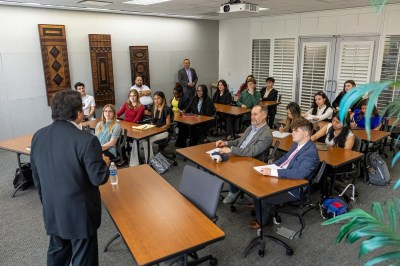
In addition to his reflections on leadership and ethics, Gonzales offered practical advice for students considering law school as Dean of Belmont Law–to which we listened attentively!

His advice was both practical and powerful: highlighting the importance of staying informed about current legal issues and honing strong writing skills—fundamental abilities for anyone pursuing a career in law and government careers. Gonzales also offered advice to students hoping to go to law school, from what to include on personal statements to the importance of GPA and LSAT scores.

Throughout the session, students were able to pose a range of thoughtful questions.


I had the chance to ask about Gonzales’s time on the TX Supreme Court, which he indicated he wasn’t sure was right for him. Gonzales had spent little time in a courtroom, and he had never been a judge before the appointment. Eventually, though, he decided that service was his calling, and this position led to his eventual appointment as White House Counsel and US Attorney General.

For SHSU students, this interactive discussion proved a great learning experience. As a thank you, LEAP ambassador Chrissy provided Judge Gonzales with a signed copy of the “The FBI Code” by former Assistant FBI Director Frank Figliuzzi. Grateful for his time and wisdom, we left the event motivated to dream big and stay committed to our paths of service and leadership!


 Center for Law, Engagement, and Politics