
For the past five years or so, the LEAP Center/Junior Fellows have teamed with Kaplan Testing to offer a Mock LSAT every semester. It is part of a larger set of offerings–and informational resources–that SHSU provides to help students fulfill their law-school goals.
Taking the Mock LSAT serves at least two functions: (1) It prepares them for a testing environment, making them more comfortable when they take the real thing, and (2) gives them a better idea of where they stand on the test and, therefore, how much more studying they need to do.
With those objectives in mind, 34 students showed up for the Mock LSAT on Saturday, October 17, 2015. Ricky Kaplan, an instructor from Kaplan Testing, joined them, providing the test and, afterward, a few pointers.
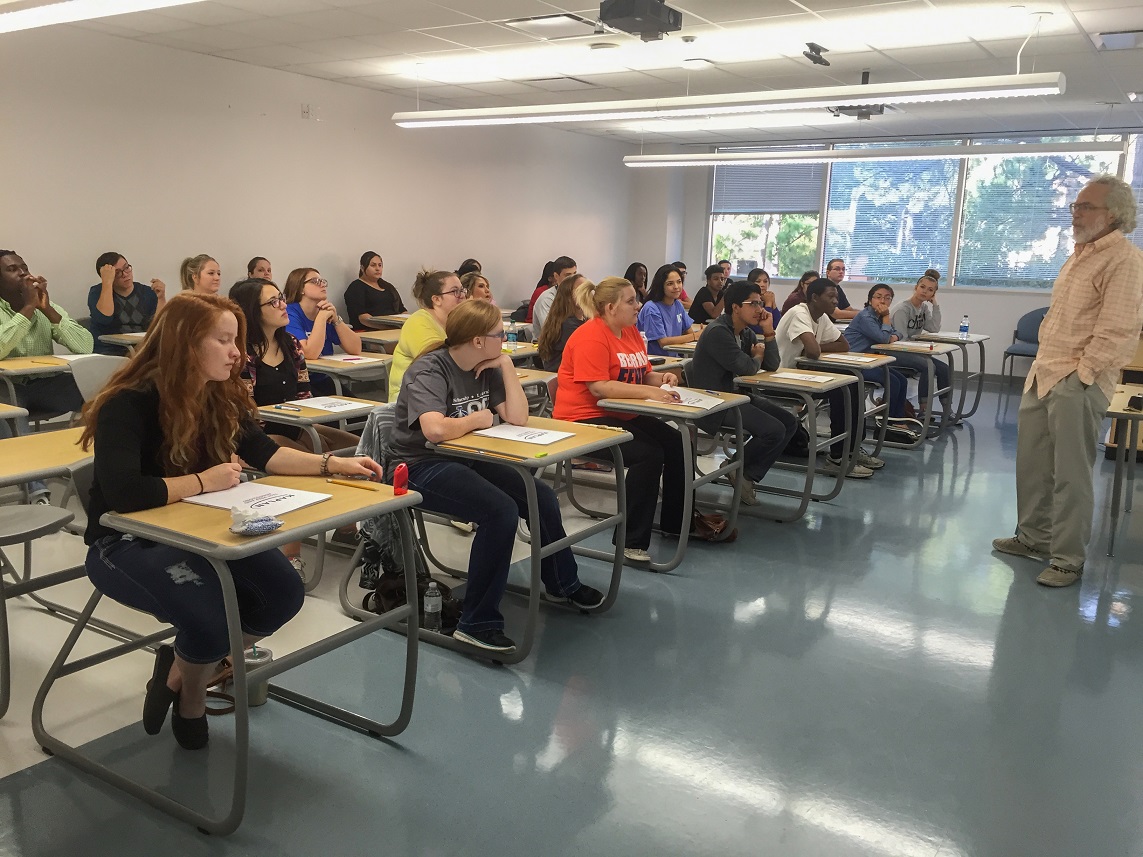
The actual test is approximately four hours long. There are five sections of the test, and each is 35 minutes long, with a short break in between. One of the five section is “experimental,” meaning that only four of the sections count, but the takers do not know which one is real and which is experimental. At the end, there is a 35 minute writing section. The writing section doesn’t count toward the LSAT score (120-180 scale), but it is sent to the law schools.
The Mock LSAT doesn’t have the experimental section or the writing section, but it is the closest thing that students are likely to get to the real test. Often, students take the test at home under less-than-realistic conditions (untimed or generously timed sections, frequent breaks) and then score much lower on the real test.
The LSAT is offered four times a year: in February, in June, in late September (or early October), and in December. Planning ahead is a key factor for students. The December test, for example, occurs the Saturday before finals. The February test occurs after some law schools’ application deadlines. Planning your college career such that you will be able to prepare for the LSAT, take it during a fortuitous time, and still get all applications in is part of the law-school success story.
Not surprisingly, according to national data, students with better GPAs and LSAT tend to apply earlier in the application process, with lower scorers and lower GPA-students applying well into the spring. To elaborate, about half of the students apply before January 15 of the year they want to be admitted. Of the students who apply by January 15, the mean LSAT/GPA is about 157/3.28. Of those who apply in March/April, the mean LSAT/GPA is less than 150/3.1. In short, students who have prepared more fully throughout their college careers tend not to procrastinate, have less need to retake the LSAT, and can more easily get letters of recommendation and other materials together.
One other set of facts that might be interesting. What majors are most likely to get into law school? The information below provides students’ majors, the percentage of students with that major accepted to law school, and the total number of students with that major accepted to law school. Political Science again leads the way, with about three times as many POLS students admitted to law school as any other major.
POLS: 81.3%, 11,791
Psychology: 79.05%, 4,133
History: 84.22%, 3,420
English: 80.81%, 3,230
Criminal Justice: 64.07%, 2,473
Economics: 83.07%, 2,518
Philosophy: 85.48%, 2,255
Sociology: 73.02%, 1,624
Communications: 74.84%, 1,541
Business Administration: 67.60%, 1,258
Accounting: 73.26%, 882
Marketing: 73.12%, 703
Management: 62.28%, 317
Classics: 88.42%, 275
Social Work: 58.23%, 145
As expected, the results tend to track with the breakdown of LSAT scores by major. At the top of the rung, you have majors such as Philosophy (157.4 mean LSAT), English, and POLS. The bottom four, all coming in below the national average, include Sociology, Communications, Business Administration, and Criminal Justice.
The results aren’t surprising. Majors with the most reading involved (Philosophy, Classics, History, POLS, English) have acceptance rates above 80%. Bright, intellectually curious students tend to be attracted to these majors, and the majors tend to encourage (require!) lots of reading and critical thinking.
More hands-on oriented majors such as Criminal Justice and Business tend to perform less well on the LSAT and, by extension, tend not to get into law school at the same rates. The same is true for the “soft” social sciences, such as Sociology and Social work.
Of course, this doesn’t mean that switching your major will help you get into law school. The best strategy is to follow the field you love, and you’ll likely study more and make better grades. But if that field doesn’t require a lot of reading (or a lot of rigorous reading) or much in the way of critical thinking and writing, then you may wish to add an academically rigorous minor and/or to supplement your formal curriculum with much leisure reading and some organizational work that will require genuine critical thinking (e.g., Moot Court).
Over the past ten years, law school applications have generally declined. The number of applicants ten years ago, for example, was 37% higher than this past year across the nation. But that has not been true at SHSU. In fact, law school applications from SHSU have gone in the opposite direction. In 2005, 67 people applied to law school. Since then, applications have increased 50%, and the number of SHSU students accepted to law school has tripled.
As a result, no doubt in part because of the Mock LSAT and other preparatory offerings at SHSU, the University is now one of the “Top 240 Feeder Schools” as measured by the law school admissions council. After moving onto the list in 2009, SHSU now ranks 156 in the country, in the top six percent nationally.



 Center for Law, Engagement, and Politics