Morgan Robertson
This past summer marked the 34th anniversary of the Tiananmen Square Massacre in the Peoples Republic of China, and when we noted that the World Affairs Council was bringing in Dr. Jianli Yang, a Tiananmen Square survivor, we wanted to be sure to be there.
As a refresh for our readers, from April to June in 1989, Chinese students held demonstrations in the well-known Tiananmen Square, Beijing. The students were protesting their limited political freedom, the educational system and much more under the CCP (Chinese Communist Party). In June of 1989, Martial Law was declared and troops were moved into the Square. The massacre began on the night of June 3 and resulted in the loss of thousands.

The LEAP Center strives to allow students to make connections across various disciplines and have opportunities to learn via firsthand accounts. This past Wednesday, LEAP Ambassadors, Olivia, Michelle and myself were accompanied by three new students, Macey Schank, Madison Cawthon, and Abraham Roby, and made our way to hear Dr. Jianli Yang. The noted Chinese dissident has dedicated his life to peacefully securing democratization in China and supporting human rights.
Once again, ChampionX graciously hosted this WAC event. ChampionX is proving to be one of our favorite venues, not just for the amazing views, but for the dedication and quality of the staff.

We were fortunate enough to meet John Breed, Manager of External Affairs for ChampionX, as well as President and CEO, Sivasankaran “Soma” Somasundaram, who spoke with us and who gave a few opening remarks about their partnership with WAC and the company.


Ronan O’Malley, Chief Programs Officer of WAC, began the dialogue with a brief outline of what shaped Dr. Yang’s humanitarian efforts. Dr. Yang opened by describing how his involvement and interest in human rights began. Dr. Yang was an official party member before 1986, believing he would have a positive impact on the CCP. However, his membership was defined by keeping tabs on other students and friends; Dr. Yang quickly realized that individuals do not change the party; the party changes individuals. At the time, such thing as revoking party membership did not exist and the only way to quit the party was to dissent.


In May 1989, Dr. Yang was studying mathematics at the University of Berkley, while watching the progression of student led protests in Beijing on CBS—covered by SUSU Alum, Dan Rather. Dr. Yang and other similarly motivated students watched on international news as CCP police began beating students in Tiananmen Square. Appalled by what he had seen, Dr. Yang made the decision to return to China to help in whatever way possible; he arrived one day before martial law was declared on the square.

Dr. Yang joined the demonstrations in the square, and like most students, returned occasionally to campus housing to shower and rest. On June 3, Dr. Yang returned to the Square, just as the soldiers opened fire on the crowds.
Dr. Yang described the atrocities he witnessed over those fateful days and how many of his friends were gunned down, beaten, or flattened by tanks. Many people are familiar with the famous “Tank-Man” photo, in which a lone demonstrator blocks the path of the encroaching tank; but for Dr. Yang, this was his reality.

During the reprieves of gunfire, demonstrators attempted to persuade and appeal to the soldier’s hearts by singing widely known nursery rhymes; the efforts ultimately were to no avail.


Many students made their way back to campus to await in terror of what was to come. Dr. Yang was directed by his advisor to flee, and he did. On June 7, 1989, Dr. Yang managed to secure a seat on a flight and several hours later landed in the United States. News had travelled fast, and reporters were waiting for the newly arrived Chinese passengers for any information as to what happened. From that point forward, Dr. Yang shared his story and hasn’t stopped.


The Human Rights Committee in the United States Congress invited Dr. Yang to testify, greatly contributing to the United States’ response. During the labor movement in China began in 2002, Dr. Yang seized the opportunity to return to China and offer his assistance. With a fake ID and a borrowed passport, Dr. Yang reentered China and immediately began helping groups strategize to protect their basic rights.

It was through these efforts that Dr. Yang was caught by country police and detained in for 5 years, with most of that time being spent in solitary confinement.
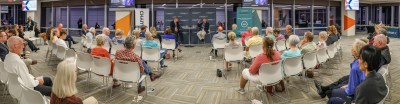
If the LEAP Students’ mood reflected the audience’s mood, the room was full of disbelief and sadness after hearing Dr. Yang’s experiences. Dr. Yang kept his hope, and encouraged us to do so as well. The work he has done for human rights is immeasurable.
Despite this somber closing note, our moods turned happy as we had the chance to meet Dr. Yang. He reminded us to be hopeful, and he offered us encouraging thoughts.


Thank you once again to the amazing WAC staff for organizing a great event, to ChampionX for hosting, and to Dr. Yang for inspiring others with his story.

_______________________________________________
Shanghai Bistro–Closing Note
As with all–or almost all–LEAP events, we sought a restaurant that would complement the theme of the evening’s program. We selected Shanghai Bistro, which proved to be excellent.
The staff were very friendly and accommodating. This was nice, because not all restaurants in The Woodlands are flexible.


This also gave us the chance to talk to the first-time attendees at a WAC event and to reflect on the evening and what we had learned. Such reflected fostered thankfulness, for friendships, for unique learning experiences, and for the sacrifices made by leaders such as Dr. Yang.

 Center for Law, Engagement, and Politics