Mike Yawn teaches at Sam Houston State University. In the past few years, he has taught courses on Politics & Film, Public Policy, the Presidency, Media & Politics, Congress, Statistics, Research & Writing, Field Research, and Public Opinion.
He has published academic papers in the Journal of Politics, Political Behavior, Social Security Quarterly, Film & History, American Politics Review, and contributed a chapter to the textbook Politics and Film.
He also contributes columns, news analysis, and news stories to newspapers such as the Houston Chronicle, San Antonio Express News, Seattle Post-Intelligencer, Stamford Advocate, Greenwich Time, Huron Daily Tribune, Laredo Morning Times, Beaumont Enterprise, Connecticut Post, and Midland Reporter Telegram.
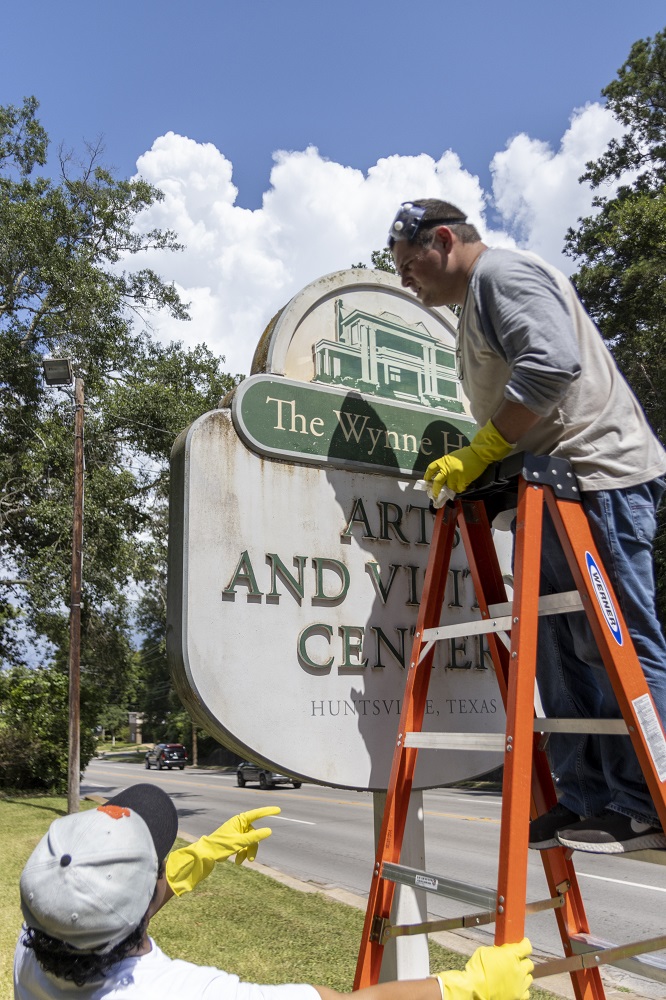
Yawn is also active in his local community, serving on the board of directors of the local YMCA and Friends of the Wynne. Previously, he served on the Huntsville's Promise and Stan Musial World Series Boards of Directors.
In 2007-2008, Yawn was one of eight scholars across the nation named as a Carnegie Civic Engagement Scholar by the Carnegie Foundation.
The big day has finally come! The 2021 New Politics Forum Campaign Bootcamp has concluded, and the LEAP Ambassadors headed out to tour yet another historical facet of Texas, the State Capitol.
Amidst the buzz and excitement of Sine Die—the conclusion of the legislative session—the Ambassadors toured and learned a great deal about the historic building.
We enjoyed seeing where the former Supreme Court was located and hearing our voice echo in the rotunda.
We even got to visit the chambers of House of Representatives and the Senate!
I particularly enjoyed learning about the important historical context of many prominent figures that were distinguished in portraits throughout the Capitol. There included people such as former Governor Ann Richards, Tennessean David Crockett, and our university namesake, Sam Houston.
While Quinn was especially familiar with the Texas Capitol, this was the first time for Jessica, Yvette, and me, so we had some fun.
I was in awe the entire time, as I was learning the history of my state in a most prestigious classroom. Furthermore, I was overwhelmed with the knowledge that I was on grounds where decisions are made that affect the day-to-day life and wellbeing of myself and people throughout the state. My favorite part of the entire tour of the Capitol my favorite part was learning more about various former governors and visiting the Texas House of Representatives and Senate Chambers.
It was a great history lesson, while also getting to see current affairs. We saw some action on the House and Senate floor, while also seeing Rep. Senfronia Thompson and other lawmakers.
And, outside, we even saw some protesters.
It was a real treat for us, and with some discussion from Professor Yawn, we learned about ways to return as interns…
In wrapping the up the 2021 Annette Strauss Campaign Bootcamp, we had the opportunity to hear from two final speakers—Crystal Perkins, a Democratic finance director, and Dustin Tropp, a Republican recruitment manager—to discuss and advise us on how to build our resumes and land a job in the industry.
To begin, Ms. Perkins spoke to the importance of being involved in the community in any way possible, be it through volunteerism or internships, so long as we are giving back and supporting a cause that we believe in. She suggested doing internships, following local media (newspaper, radio, and social media), and finding a mentor.
Lea
After their presentations, they opened the floor to questions about resumes or campaigns. A fellow participant asked if a resume should be nonpartisan or not. Both responded by saying that when applying for a campaign, they would prefer it list all your experiences while only going into depth about one or two to keep the resume at the preferred length of one page. This, of course, only applies to jobs with partisan employers.
Then came Mr. Tropp, who reiterated the importance of being involved, but also emphasized that we must learn how to advocate for ourselves. He mentioned how fellow Generation Z’ers must learn how to hold a conversation with the more experienced and older colleagues since it is a big deal breaker when trying to become more involved in politics.
At last came the moment we were all awaiting: it was time to film our pitch with our teams. Although we were all vying for first place, the experience gained from this event is a win on its own, as it will be applicable and extremely beneficial in our future academic and career paths.
The Campaign Pitch
With the exception of Quinn Kobrin, all of us found ourselves stretched–in a good way–by the Campaign Bootcamp. As our advisors mentioned, we drank water from a firehose, and on Saturday night and Sunday, we tried to assimilate the information, process it, and re-present it in a way that would work for our candidate.
By “our candidate,” we are referring to a hypothetical candidate assigned to each team by NPF staff. NPF created competing candidates, and it was a matter of chance which team got which candidate. By having both hypothetical candidates running for the same position, at the same time, over the same jurisdiction, the teams had very nearly identical tasks. The difference in outcomes, then, are the result of the team’s creativity, incorporation of knowledge learned at bootcamp, dedication of time and energy, and intelligence.
We began with something close to 45 or so participants, but by Sunday, we suspect there were more like half that, divided among six teams (we’d like to note that all four SHSU students stayed on camera, were present for every presentation, and all made at least one comment or asked a question).
Although we all began on different teams, Quinn and Jessica ended up on one team, and Yvette and Jade ended up on another team. We each, however, had time allocated to working and studying on our own, while also working dually and having breakout sessions with our entire teams.
Our presentations, which were filmed on Zoom, incorporated an overview, our team members, our fundraising strategies, the issues we would emphasize, our branding/marketing, a campaign strategy grid, and the like. Although we had been provided much of this information over the previous twenty-four hours, it was certainly different thinking of these things on our own and applying them to a different scenario!
We learned much, not only about campaigns, but also ourselves. It’s one thing, for example, to hear guidelines and understand them in the abstract; it’s another thing to put those to a test in a (simulated) real-world scenario. We also learned about our strengths and weaknesses with regard to attention spans, engaging and speaking up when in sessions; and working with team members, not all of whom put forth the same amount of effort. This, of course, is true of every enterprise, and this fact makes the experience all the more valuable.
Our goal was to get the presentation together by Saturday night…
… and then do the filming Sunday afternoon.
This worked pretty well, and we were able, in our separate rooms, to do our portion of the filming.
Notes, tissues (for allergies, not tears….), coffee, phones, water, and more coffee were called for and on hand.
In the end, all of us would have liked to have added to or changed aspects of our presentation, but all also felt as though we had done the best we could in the time allotted and with the energy we had.
Campaign Bootcamp – Final Thoughts
By: Jade Jones
And just like that, day three of the 2021 New Politics Forum Campaign Bootcamp is complete. This was my very first event with LEAP, and I am more than ecstatic to say that I had an amazing experience. Every day was filled with a plethora of advice and information from keynote speakers such as Judge Cyndi Krier and many campaign managerial specialists like Meagan Gardner.
Gardner’s comments of “Run for something one day!” and “Campaigns are really hard but they are fun!” resonated with me throughout the entirety of the bootcamp as I, equipped with newfound campaign management skills, was placed in a position to manage my own campaign through the weekend.
My experience was also shaped by keynote speaker Secretary Julián Castro. He tailored his speech towards the younger demographic of individuals that are coming into politics. He made me feel as though he understood the challenges faced by young, aspiring politicians such as dealing with feelings of uncertainty and doubt.
While my experience was shaped by Secretary Castro, the other ambassadors enjoyed a wide range of our speakers, including fundraising expert, Nancy Bocskor. Bocskor’s presentation about the art and technique of fundraising was consistently engaging and informative, and will be extremely beneficial to us in the future.
One of the most memorable moments was the unexpected twist of Nancy’s battling cats, during which a pair of scissors may or may not have been thrown.
Overall, this weekend was incredibly educational and extremely enjoyable. We would like to extend our sincere thanks to Cole Wilson, Bianca Solis, and the rest of the team at the New Politics Forum, for once again putting on a successful Campaign Bootcamp. We appreciate the effort they put into bringing in the top professional political minds from all over the country, and every year we look forward to learning something new.
The New Politics Forum labels its program a “Campaign Bootcamp” for a reason. It’s a packed schedule over the course of three days, designed to mimic both a military bootcamp and also the pace of an actual campaign. Students feel there isn’t sufficient time, which is exactly how campaign managers feel as they pursue electoral victory. With these circumstances in mind, we set out to do all that is possible, to the highest quality attainable, in the time allotted.
Our work day did not begin until 11am today, allowing us to get sufficient sleep and breakfast. Fortuitously, we had an inspirational speaker, Secretary Julian Castro, beginning our second day of Bootcamp. Castro’s words were encouraging, expressing the need for young people to get involved.
As the youngest member of President Obama’s Cabinet, Castro was an appropriate person to provide such advice.
Prior to being appointed by President Obama, Castro won a seat on San Antonio’s City Council and, ultimately, was elected as Mayor of San Antonio—the exact office we are running a simulated campaign for! Another aspect of Castro’s career was also appropriate for education as LEAP students at SHSU. When Castro spoke to the Democratic National Convention in 2012, he spoke of the American Dream as a relay, with one generation passing on a “baton” to succeeding generation, but with both generations running on the same race and for the same team.
LEAP students operate under this model: we participate not only to succeed for ourselves, but to hand off the baton to new members such that we maximize their chance of success, too. Our efforts benefit not only, but also those on “our team”—whether that team is LEAP, SHSU, young people, or all Americans.
With this inspirational beginning, we were poised to hear another inspiring speaker: Nancy Bocskor. LEAP students have a rich history with Ms. Bocskor, having hosted her at SHSU to much reward over the years (see here, here, or here for examples).
Ms. Bocskor spoke on fundraising, and she emphasized narratives. While facts and figures may motivate some, most people are drawn to stories, narratives that provide compelling reasons for putting hard-earned money behind a specific candidate.
Moreover, Ms. Bocskor emphasized (1) building trust, (2) keeping overhead low, and (3) giving every donor a chance to invest, even in small amounts.
Building on how to communicate to potential donors, Luke Marchant spent time with us working on a broader communication plan. Marchant gave us much in the way of nuts and bolts, with one of our chief tools being what was once called the “Leesburg Grid.” This is a tool for assessing the strengths and weaknesses of the candidates in the race, while also informing the campaign staff of ways to frame their candidate in the best light.
But appropriately, Marchant’s presentation touched on multiple aspects of a campaign.
We think of Luke’s tie as “Bearkat Orange”
How do we capitalize opponents’ mistakes and minimize our own candidate’s mistakes? How do we simplify complex issues such that our audience can understand and appreciate them? How, in a world of many issues, do we decide which policies to emphasize? For Bootcamp participants, who will have to communicate their strategy to a panel of experts, the advice was immensely helpful.
I should also add that Luke is one of the genuinely nice guys of Campaign Bootcamp. He has, over the years, helped many SHSU students, helped students irrespective of party, and proved an approachable and amenable mentor.
Helping us to wrap up this together was Matt Glazer, who like Luke Marchant and Nancy Bocskor, has been a part of Campaign Bootcamp for many years. As a long-time communications consultant, as well as a director of non-profits, Glazer was a good person to discuss “the pitch” with us.
Glazer emphasized that the pitch should contain multiple elements, particularly: (1) provide an overview, (2) pitch as an opportunity, (3) identify your problem, (4) offer a solution or solutions, (5) find ways to gain traction, (6) identify your customers/markets, (7) identify your competition, (8) come up with your business model, (9) manage your team effectively, and (10) allocate your funds wisely.
Proper nutrition is important for any Bootcamp
Relevant to all of our discussions over both days was the topics of ethics. To discuss that with us, Jamarr Brown, who has vast experience in staff training (particularly with Planned Parenthood), discussed campaign ethics with us.
While many may think this is an oxymoron, Brown provided some real-world examples to us, helping us keep in mind that, while the goal is to win and make people’s lives better, how we win also matters.
For many, this may have been a workday, but our work was just beginning. Our mission now was to take this learning and put it into practice: work with our team. Our team was assembled by NPF staff, who ensured the teams, at least at the outset, were balanced, and had a roughly equal shot at victory. And with that aim in mind, we set out to represent ourselves, LEAP, and SHSU well.
On the eve of Sine Die and the end of the Texas legislative session, the LEAP Ambassadors made their way to Austin, Texas to attend the New Politics Forum’s annual Campaign Bootcamp event.
The Ambassadors, in an effort to expand their cultural palate, visit local food establishment while traveling. Accordingly, in San Antonio, we stopped for lunch at The Point Panaderia & Cafe, a Puerto Rican restaurant. We enjoyed various new sandwiches, such as the pineapple-laden Tropical Express, chicken with guacamole, tripleta, and plantains.
Puerto Rican food was not chosen randomly. Generally speaking, it fits in with the Hispanic culture of San Antonio, and more specifically, Yvette Mendoza–one of the Ambassadors–is half Puerto Rican.
Culturally enriched, we hurried to the Texas Supreme Court Building for our first big stop of the trip.
Supreme Court Tour with Justice Jeffery Boyd
Yvette Mendoza
When we got to Austin, the LEAP Ambassadors experienced an exciting and in-depth tour of the Texas Supreme Court building in Austin, which was graciously given by Justice Jeffery Boyd and arranged by Blake Hawthorne.
Our tour began inside the courtroom, where we socialized with Justice Boyd and learned about his past work as a Deputy Attorney General of Texas, general counsel for Governor Rick Perry, and his time at the Thompson and Knight law firm.
As we stood in the courtroom, we admired the familiar faces on the painted portraits all along the wall of former justices, including Robert Gammage, an alumnus and former Professor at Sam Houston State University.
Justice Boyd then took us through a “secret door” into the robe room, where all nine justices don their robes before they head to the bench. Justice Boyd then explained that almost everything the justices do, including the order in which they sit or hang up their robes, is dictated by seniority.
We then had the unique opportunity of sitting at the justice’s bench.
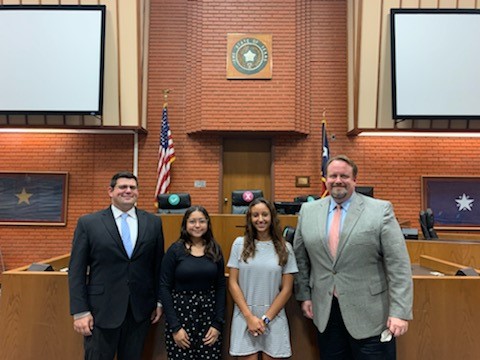
Justice Boyd was kind enough to take pictures with each LEAP Ambassador.
We proceeded then to the third floor, where Justice Boyd thoughtfully took us to see the justices’ offices, including his own.
Justice Boyd’s office has Abilene Christian University and Pepperdine Law School (his alma maters) merchandise, as well as a wall filled with law books. Just outside is a full-length balcony that overlooks the Texas Capitol.
To wrap up our tour, Justice Boyd took us across the hall to the conference room, where the justices deliberate about cases, and he showed us some additional spaces, and provided a wonderful explanation of the judicial process.
The tour was extremely informative to each one of our ambassadors, many of whom have hopes to either work on campaigns, run for office, or pursue a legal career.
On behalf of the LEAP Ambassadors, we truly extend our gratitude to Justice Boyd, and thank him for taking time out of his day to make our day one of the most memorable one with LEAP yet.
Campaign Bootcamp – Day 1
Jessica Cuevas
Despite the event being virtual this year for the second time, the LEAP Ambassadors were eager to kick off Campaign Bootcamp. The mission of the bootcamp is to draw out aspiring students who are interested in politics and would like to one day participate in or run a campaign by teaching the various aspects of the process. The main objective is that by the end of the event, students will be knowledgeable enough to have the opportunity to be hired on campaigns through skills they pick up and the connections they make.
At the beginning of the event, Cole Wilson welcomed us and introduced the first keynote speaker, Judge Krier, the county judge of Bexar County, San Antonio. Krier gave us a brief yet inspiring speech about the importance of civic engagement, then left to go vote in the San Antonio election.
We then began our first lesson: Campaign 101. Our instructor, Meagan Gardner, spoke about the vital and foundational facets of running a campaign.
In this session, we learned about what a campaign is, what is needed to win a campaign, and received a quick overview of the elements of a successful campaign.
Gardner was informative and passionate about the work done on campaigns, and even shared a few of her experiences. We then had the opportunity to ask questions related to what we learned, any advice, or further questions about her experiences. Three of us took advantage of this opportunity, and asked Gardner about her favorite campaign, her greatest challenge, and how she managed to continue to secure jobs after each campaign ended.
After this was the Voting 101 session with Matthew Hurtt, who opened the session by asking the participants to what experiences they have had with campaigns, if any. Within this session, we were taught how to seek out the right people to be involved in campaigns, and how to ensure such people follow through in participating through the election and beyond. Hurtt provided us with a new perspective on how to study demographics such as political affiliation, age, and voter turnout, as well as how to apply our understanding of those demographics to shaping and delivering our message. The key takeaway was to develop personal relationships with voters and volunteers to increase their dedication and engagement within the community.
The event concluded with an introduction to our group members and some time for us to socialize and network, then we broke for dinner. We are very grateful to all of the speakers who joined us today, and we can’t wait for Day Two!
Dinner
Jade Jones
Upon completing our first day of the Campaign Bootcamp, the LEAP Ambassadors had dinner at another local establishment, a LEAP go to: Kerbey Lane Cafe. The restaurant has a diverse menu, which often makes it ideal for a group of students with diverse tastes (and exposure to food), and they also have a seasonal menu, with many ingredients at their prime in the summer. At this late hour, we weren’t particularly adventurous, but we did enjoy their great “Kerbey Queso,” the Greek Chicken…
…turkey avocado…
…and a few more treats to cap our day.
With dinner over after 10pm, and blogs to write, and a campaign to work on, we called it a night, retreated to our rooms, and began burning the midnight oil.
On April 30th, LEAP Ambassadors volunteered and attended the annual Reagan Dinner, the annual fundraising event for the Walker County Republican Dinner. This year’s keynote speaker was Col. Allen West, with numerous other notable officials also taking the stage, all of whom helped make this a fun, informative, and successful event.
As we arrived at the Huntsville Fairgrounds, we were greeted by the host and Chair of the Walker County Republican Party, Linda McKenzie.
The LEAP Ambassadors were assigned certain tasks a few hours beforehand to help prepare for the event. We made sure all the tables were properly configured for the formal dinner. As the event time drew closer, we helped sign each guest and sponsor in. Through this process we got to meet many politicians and local citizens of Huntsville.
Once everyone was seated, we took a seat at a table that was sponsored by U.S. Congressman Kevin Brady, who was gracious enough to sponsor seats for students. Mrs. McKenzie then gave her opening remarks and introduced judges, council members, and many other important people. She was followed by District Attorney Will Durham, who led us in the pledge of allegiance. Then all 300 people were served savory ribeye steaks, mashed potatoes, bread rolls, and homemade cheesecake, all catered by the local Huntsville restaurant, Humphreys. While we ate dinner, Mrs. McKenzie ably emceed the program.
Speakers such as County Judge Danny Pierce…
Representative Ernest Bailes…
…and Congress Kevin Brady…
… updated attendees about happenings in the County, the state legislature, and the US Congress.
Our keynote speaker, Lieutenant Colonel Allen West, had a motivational speech that touched on an array of topics about conservatism. He specifically spoke on the importance of voting in local government races, emphasizing the impact young people will have on the future of our country.
Lastly, Colonel West gave us the opportunity to ask questions. One gentleman asked, “Will you be running for President?” He responded that he will be following the path of God wherever that may lead him. After Colonel West was done answering questions, he was kind enough to take a picture with the LEAP Ambassadors.
As the event came to an end, LEAP Ambassadors helped with the clean-up process. We would like to thank Linda McKenzie for the opportunity to help out with such an exciting event.
This past Wednesday, the LEAP Ambassadors hosted the District Attorney’s office, which sponsored a simulated voir dire, to help students better understand the jury selection process. Speaking to student participants from diverse majors, attorneys Stuart Hughes, Malori Martin, Phil Faselar, Taylor Carter helped the students understand the entire jury selection process. With this demonstration and the attorneys’ recaps, were able to see firsthand how voir dire factors into the trial process.
We acted as a group of potential jurors three separate times, each time learning a different attorney’s approach and method of getting to know a jury. An attorney’s job during this time is to find the type of juror they want to serve during the trial by asking broad questions that are relevant to the case. Members took on different personas and, to the full extent of their abilities, tried to answer questions as 56-year-old school district employees, 28-year-old graduate employees, and 45-year-old gas station cashiers–biographies provided to them by the LEAP Center. Members enjoyed the challenge of thinking on their feet and answering questions in character.
After the final voir dire, PLS members were able to ask questions about law school, learn about the different positions our guests held throughout their careers, and inquire about internships. Overall, it was an eye-opening experience for everyone involved. We saw a more in-depth view of the trial process and were able to offer a practice opportunity for the DA’s office coming out of a post Covid-19 world. Thank you to the Walker County District Attorney Office for coming to Sam Houston State University and teaching us about the voir dire process.
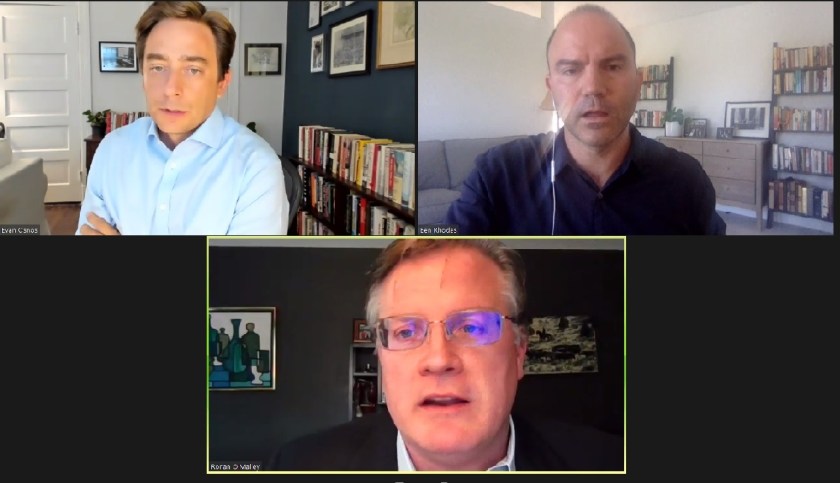
Last week, LEAP Ambassadors got together to watch the World Affairs Council’s Ronan O’Malley interview the former Speaker of the House, Rep. John Boehner.
Although nothing can compare to attending events in person, the WAC never fails to deliver intriguing and informative programs, even when we are watching remotely as a group.
With his new memoir, On the House, now for sale, Boehner tuned in to discuss his time in Washington, D.C., sharing a blunt and brutally honest perspective about what needs to change.
Boehner mentioned that he has, to date, met 10 U.S. presidents. I was intrigued to learn that he felt he had a good working relationship with President Bill Clinton. He described Clinton as the best politician he ever met, and said that he maintained a great relationship with the White house when Clinton was in office. He explained that the key to having a successful bipartisan relationship was compromise. However, he qualified that by reminding us that there is a difference between compromising on values and finding a common ground.
That being said, Boehner had no problem criticizing his former colleagues for failing to do just that. In what was certainly colorful language, the former Speaker of the House condemned the “knuckleheads” of Washington, a category of leaders consisting of both Republicans and Democrats, that prefer anarchy and disruption to actual governing. This group tends to consist of those who lean far in either direction and refuse to compromise.
To challenge these so-called knuckleheads, Boehner has come up with a number of quotes for current and future leaders to consider in their efforts to make a difference, which his staff has coined as “Boehnerisms.” Among these are: “Disagree without being disagreeable,” and “do the right things for the right reasons.” These are certainly helpful thoughts to keep in mind, not only in politics, but in all facets of life.
As always, the LEAP Ambassadors appreciate the efforts of the WAC to keep the community engaged and exposed to speakers like Speaker Boehner. We look forward to the next event, and hope to attend in person soon!
Last week, the LEAP Center invited SHSU students to ask questions and engage in conversation with Former Attorney General Alberto Gonzales. With top students participating in this small-group session, Judge Gonzales shared his experiences as Attorney General and various other positions he has held throughout his career.
After a brief introductory video…
… Judge Gonzales launched into his background, explaining how he became who he is today. Having grown up in Humble, Texas, Judge Gonzales talked of his upbringing and about how, upon graduating high school, he enlisted in the air force. Judge Gonzales was flagged as a good candidate for the United States Air Force Academy (USAFA), which he attended for three years. Following his attendance at the USAFA, Judge Gonzales received a degree from Rice University and a J.D. from Harvard Law School.
With a natural aptitude for practicing law, Judge Gonzales worked hard and became a partner at Vinson & Elkins, one of the largest law firms in Texas. Judge Gonzales eventually left the private sector to serve on the Texas Supreme Court, after which he was asked to serve as the White House Counsel to President George W. Bush. After that, Judge Gonzales was appointed the first Hispanic Attorney General.
Judge Gonzales then shared about his experience during September 11th, 2001 as White House Counsel. For most of us, our knowledge of 9/11 consists of what we have learned from classroom settings or our parents’ own accounts. Judge Gonzales was able to share a new and enlightening, yet chilling, perspective on that day. On the morning of the attack, Judge Gonzales was meant to fly out of Dulles Airport to give a speech. Following the first attack, all airplanes were grounded, and Judge Gonzales felt it necessary to return back to the White House and await President Bush’s arrival. After finally securing a mode of transportation via navy pilot, Judge Gonzales was able to return back to the White House. Judge Gonzales recalls watching President Bush walk off of Airforce One, walk right past him without a word, and into the White House to prepare to address the nation.
Toward the end of the event, Judge Gonzales opened the room to questions and discussion. Questions ranged from inquiries about his current position as Dean of Belmont College of Law, his time as Attorney General, the tough decisions made regarding national security, and a few little known facts about the White House.
Judge Gonzales shared with the students that while intelligence is important, hard work and dedication are even more important. There will always be times when easy decisions are impossible, but the perseverance of the individual is vastly required. Judge Gonzales encouraged us to strive for excellence and continue to surpass our own expectations for ourselves.