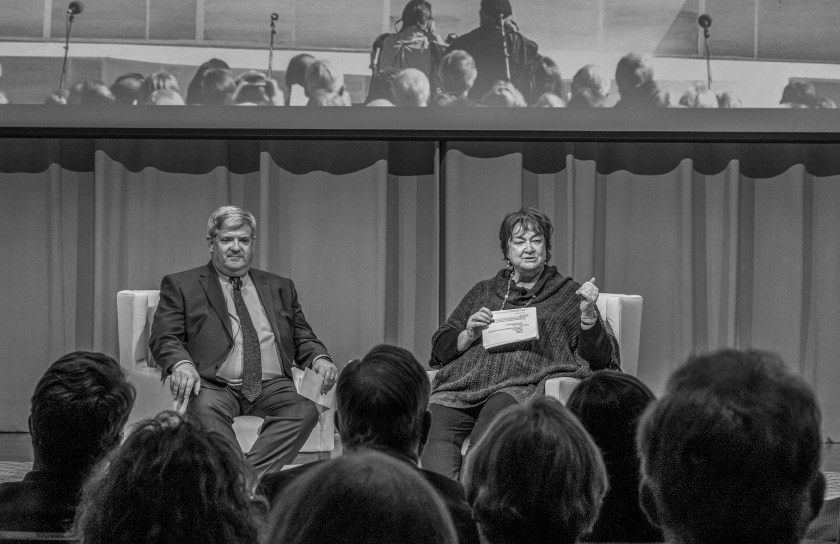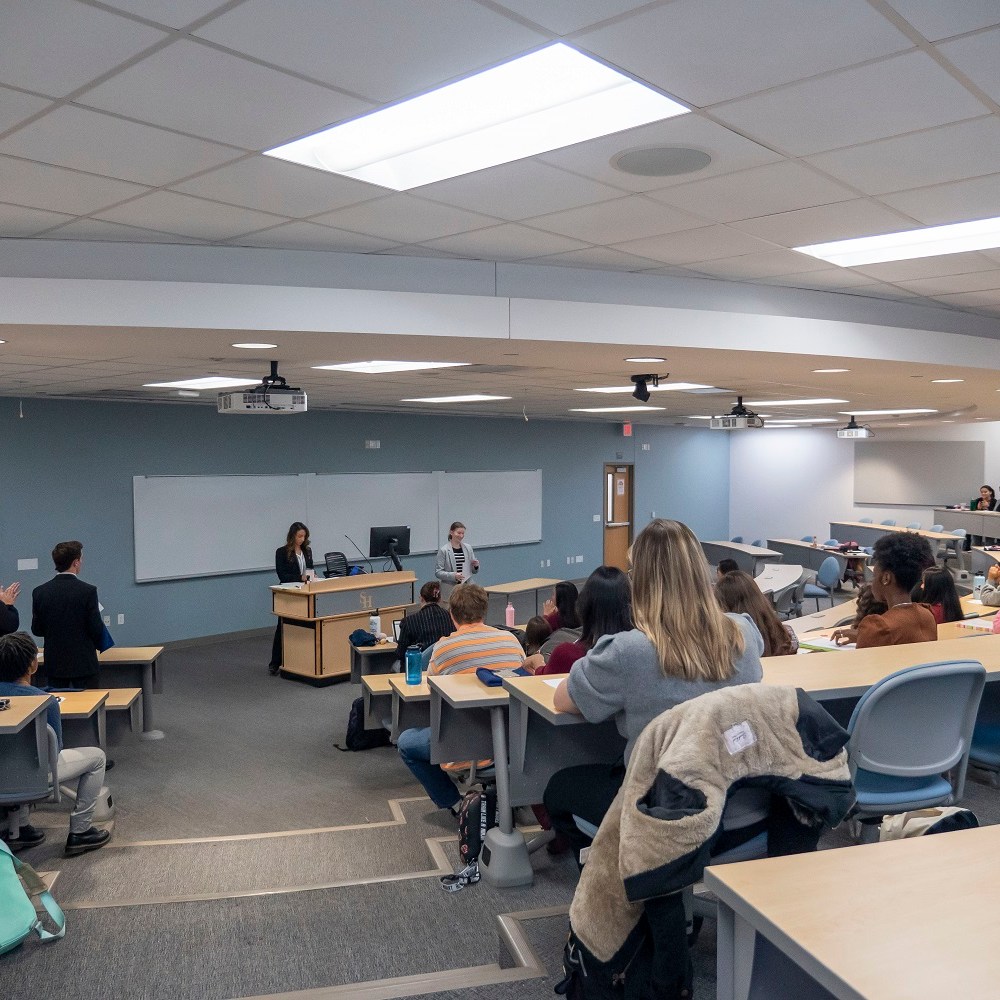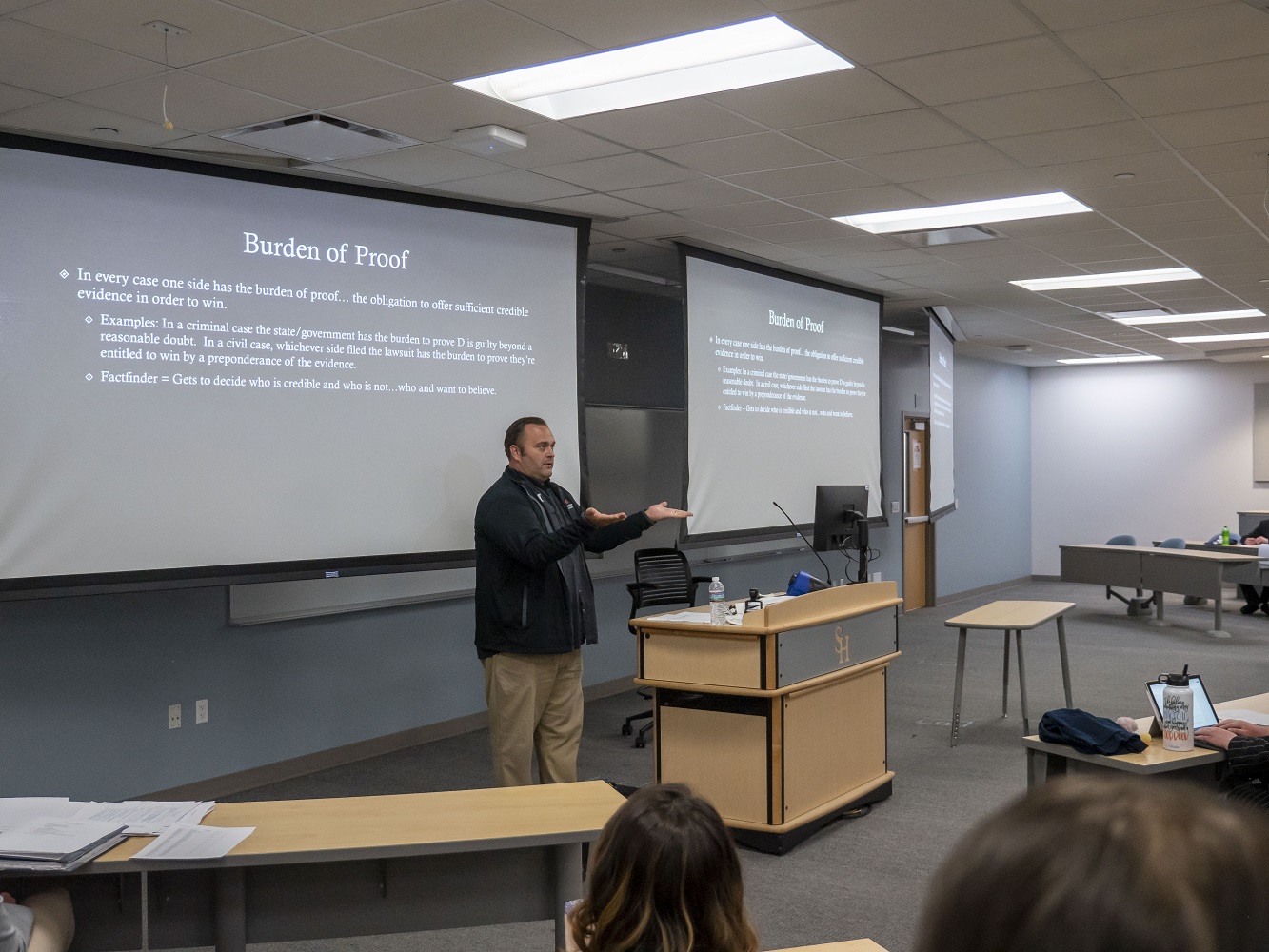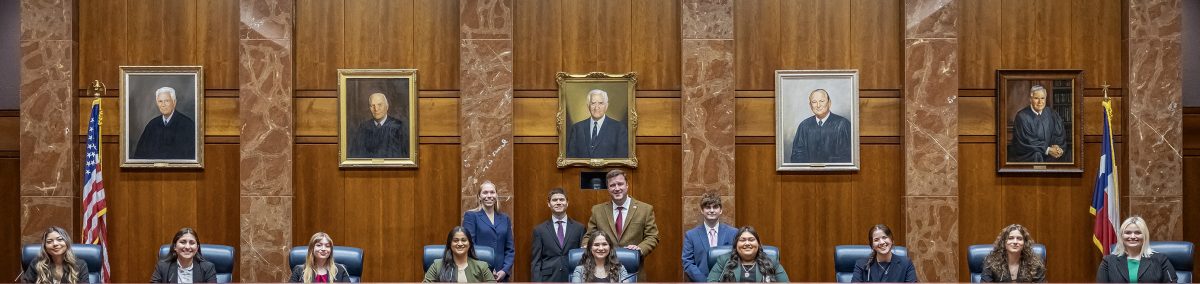
The second step in our journey through the incarceration process involves the prosecution and courts! We had an excellent opportunity to have a Walker County Courthouse tour, one led by County Court at Law Judge Tracy Sorensen. To discuss the prosecution side of things was Jennifer Jenkins, Senior Felony Prosecutor for the District Attorney’s Office. Every participant walked into the courthouse excited to hear the inner workings of a court from a judge’s and prosecutor’s perspectives.
Starting with the County Court at Law courtroom, Judge Sorensen explained her defense attorney days, as well as her two terms as Judge.
She oversees and handles cases involving juveniles, probates, child custody, and adult misdemeanors in the County Court at Law. Judge Sorensen has a trial jury of six total jurors in the issues that make it to trial.
We were even being taught scenarios about some instances that Judge Sorensen could hear and Prosecutor Jenkins might prosecute. For example, one of the students in Beyond Bars, Rachel Hill, was kind enough to let Professor Yawn use her as an example of a college student caught with less than a gram of marijuana.
Judge Sorensen and Jenkins mentioned they could probably reach a deal, one that might allow for a deferred adjudication, allowing Ms. Hill to keep this incident off her record. This made Ms. Hill very happy.
It was interesting to hear how the process works, while also getting advice from both Ms. Jenkins and Judge Sorenson.
Making our way up to the other side of the courts is the District Court, where Judge Hal Ridley and Judge David Moorman preside when in Walker County. These courts are physically larger, with space for a larger audience and 12 jurors. Portraits of prior judges are hung in the room, along with a portrait of Sam Houston.
While in this room, we shared our experiences of being a juror.
One of our participants, Steve Covington, discussed the time when he was selected to be on a jury hearing a pornography charge. As a juror, he was “forced” to watch hours of pornography in the jury room (with a jury consisting mostly of older women) to determine whether the content was criminal.
Ms. Jenkins and Judge Sorensen were kind enough to join us for dinner at Sam’s Table, where we all had a variety of Sam’s Table’s special menu items such as the Caprese Panini, Sams’s Secret Burger, and the Casado. Everyone enjoyed their meal while they had the opportunity to ask more questions about what it is to be a prosecutor and judge.
We took in new information from the tour and dinner; for that, we would like to thank Judge Sorensen and Ms. Jennifer Jenkins! It was fantastic getting to know more about the prosecutions and courts.
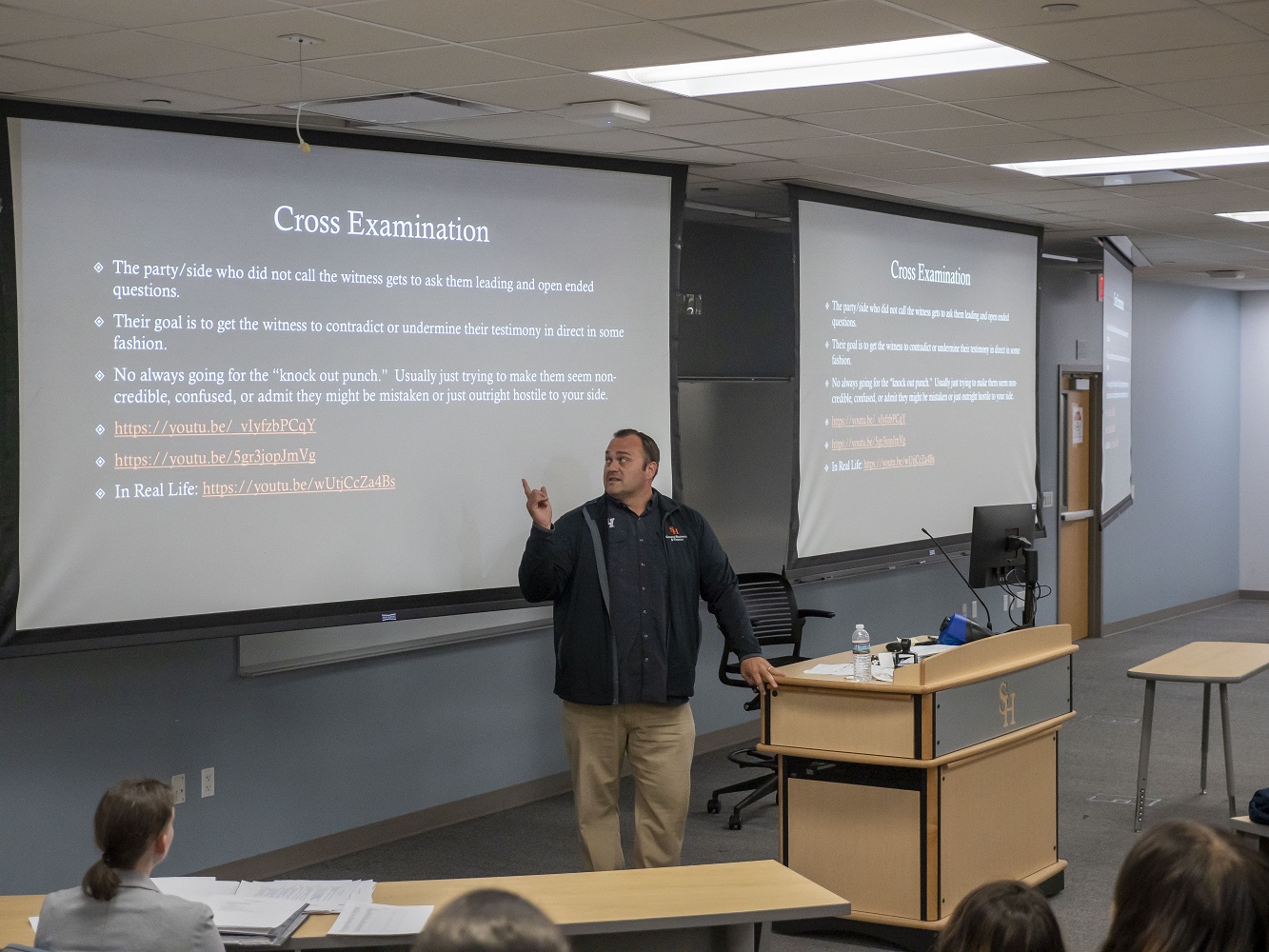
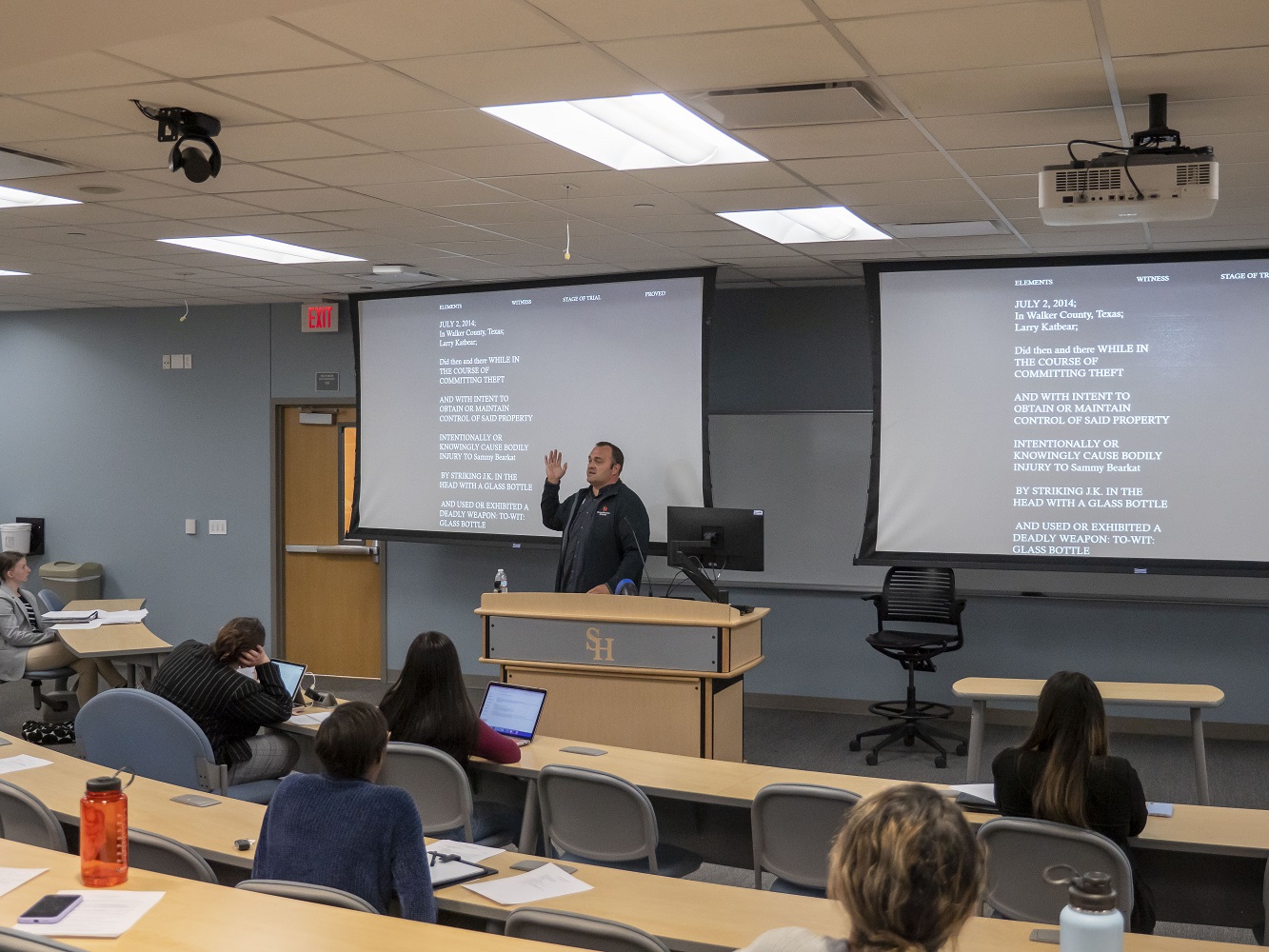
Continuing our journey of understanding the legal system, specifically the courts, the SHSU Pre-Law Society had the opportunity to hear from a former civil trial prosecutor, Mr. Chris Thompson! He received his law degree from St. Mary’s School of Law and has worked in the legal field in Walker County for 16 years. He is a practicing attorney who works on real estate issues, appeals, and personal injury. Mr. Thompson is also a professor at Sam Houston State University, where he teaches business law. With all the knowledge and background Mr. Thompson has, we were excited to hear his advice and tips on cross and direct-examination skills!
Direct and cross examinations are essential parts of our adversarial trial system, and Professor did a great job highlighting the two approaches.
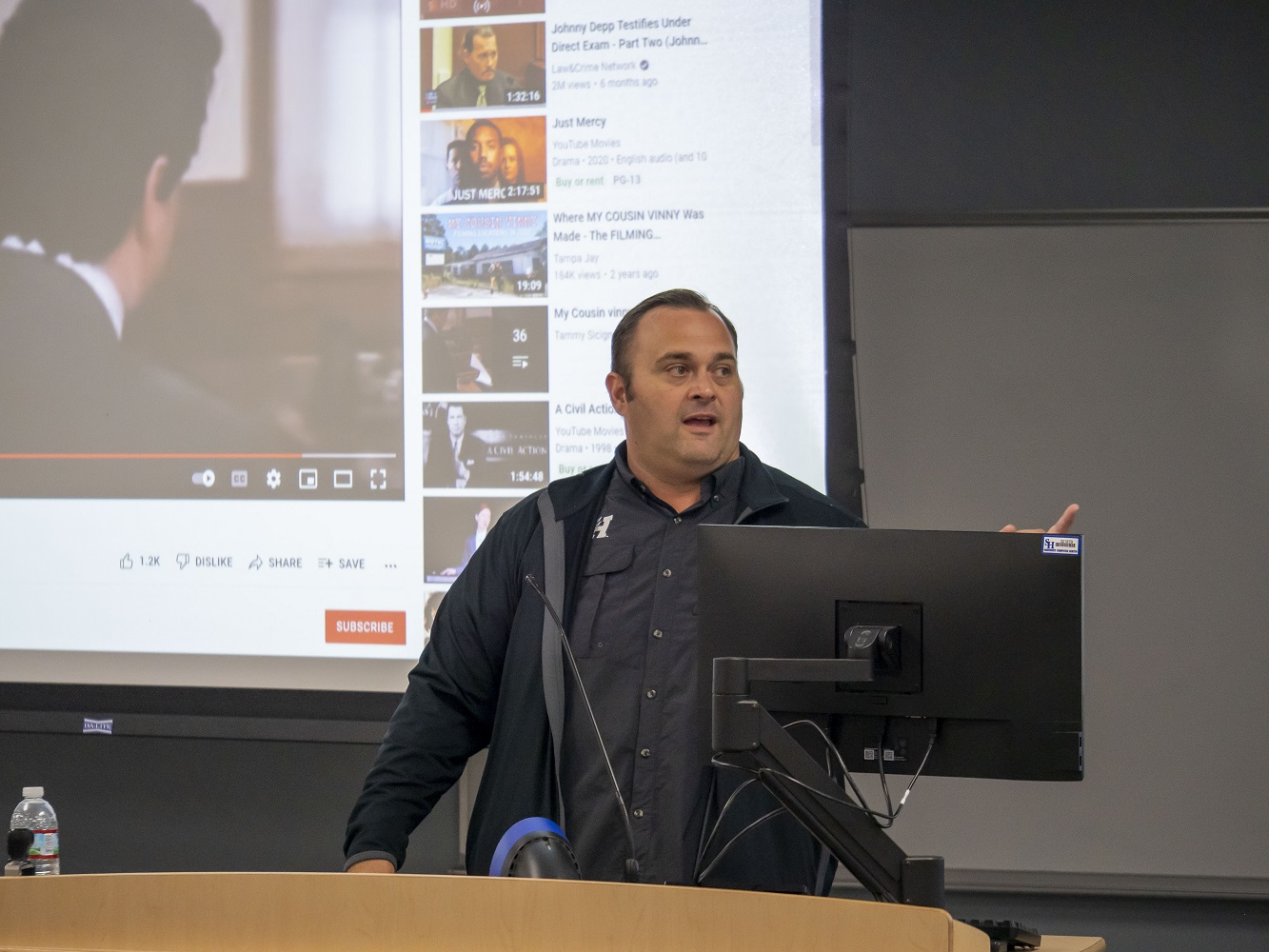
Mr. Thompson provided various examples of actual trials, such as the recent case of Johnny Depp v. Amber Heard. He highlighted the practice, noting that when doing cross, you force the witness into providing short responses, answering the specific question. Heard, for example, often wanted to provide context or additional information, which the Depp team successfully curtailed. It’s not that Heard can’t provide that information, but it’s her attorney’s job to re-direct and get that information in, if it, in fact, helps Heard’s side.
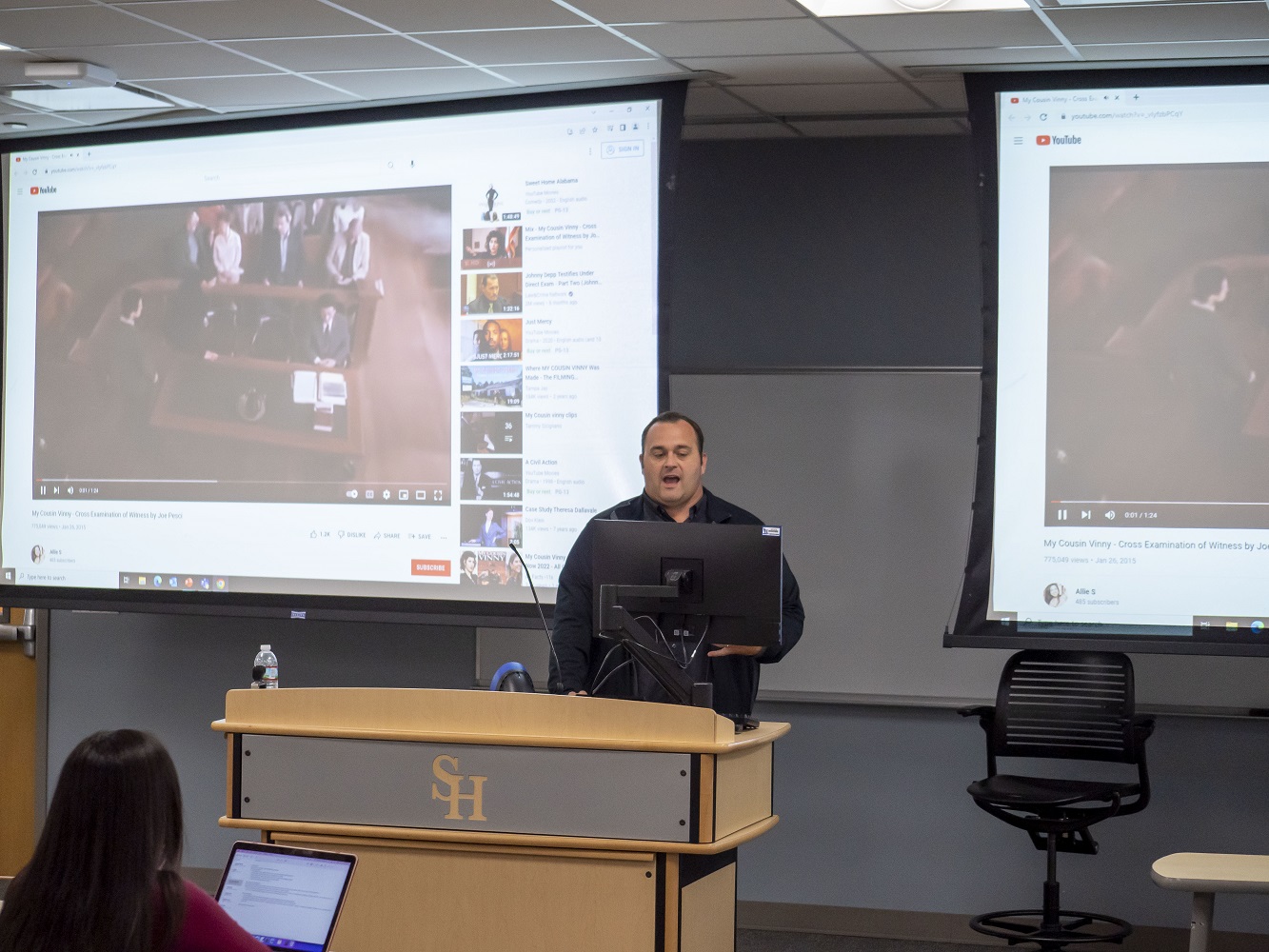
The other example was from a famous movie that most say has the best cross-examination scene, “My Cousin Vinny.” Mr. Thompson emphasized that the film perfectly expressed the importance of looking at the small details of the big picture. Every detail is essential to a case. When making a case, we need to build up the suspense, just like in a thriller movie or the “ah ha” moment.
Finally, Mr. Thompson pointed out the complexities of examining a witness. For example, when asking questions, you must know when the right moment is to stop asking further questions. This is key to leaving the jury to sway more to your side. All of these tips gave us a better understanding of what cross-examination is and how it can better prepare us for our cross-examination exercise for our next pre-law society meeting.
We want to thank Mr. Chris Thompson for taking the time out of his evening to speak with us and share his journey to becoming a lawyer and tips for cross/direct examination. His advice will help us with future endeavors and cases we may have as attorneys ourselves. Also, we would like to thank the people who attended this past meeting. See you at our next meeting on November 16th!
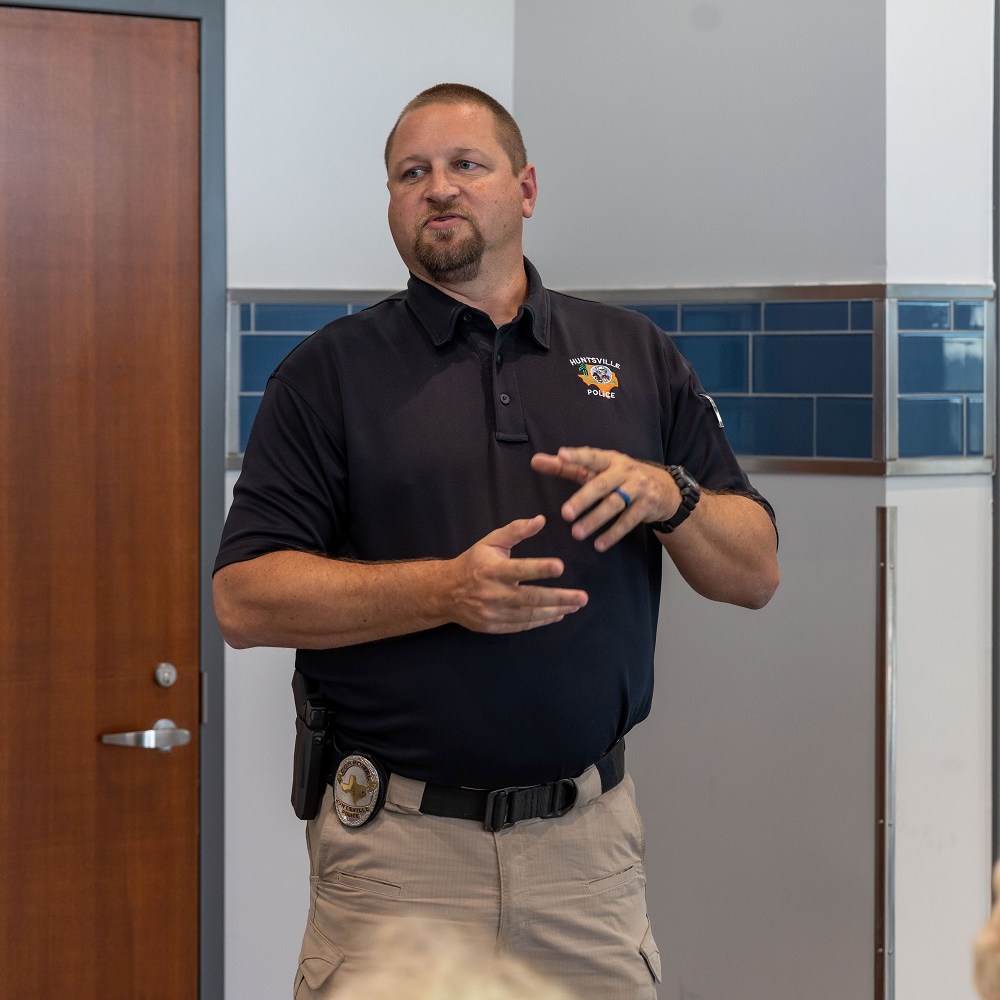
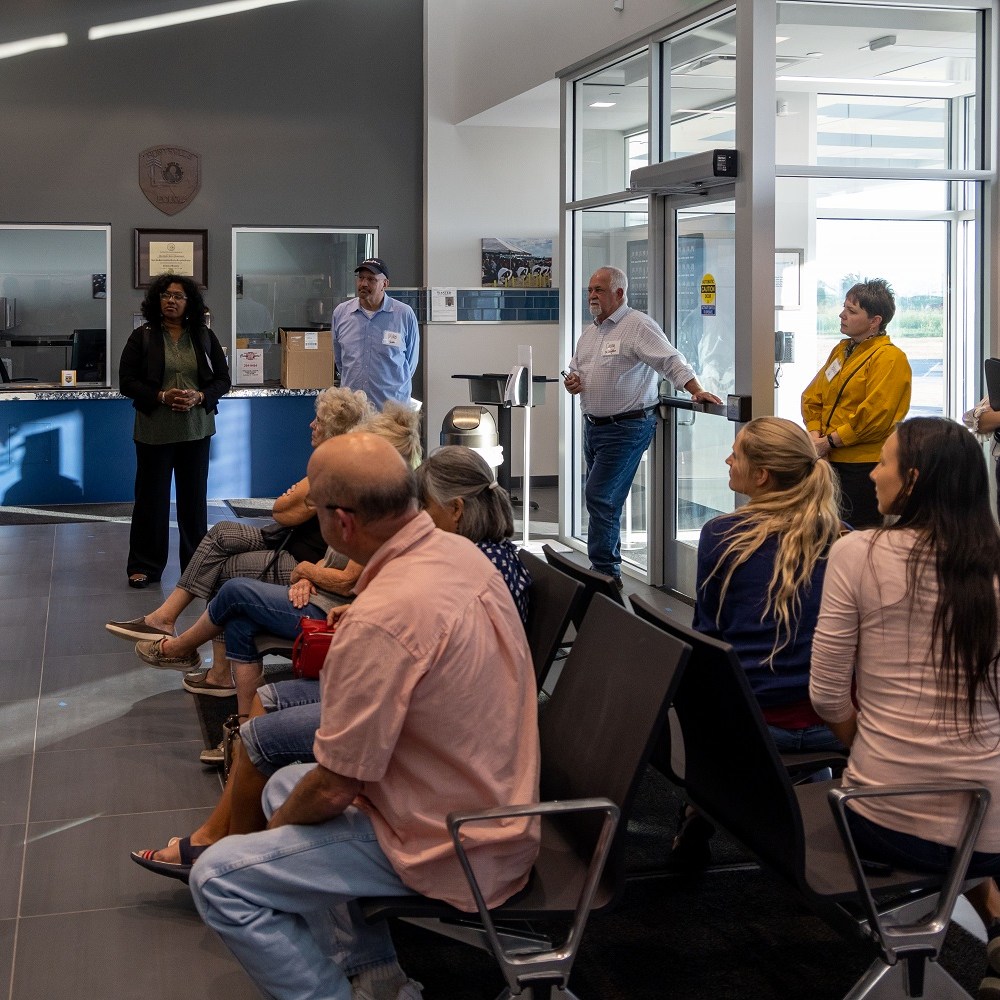
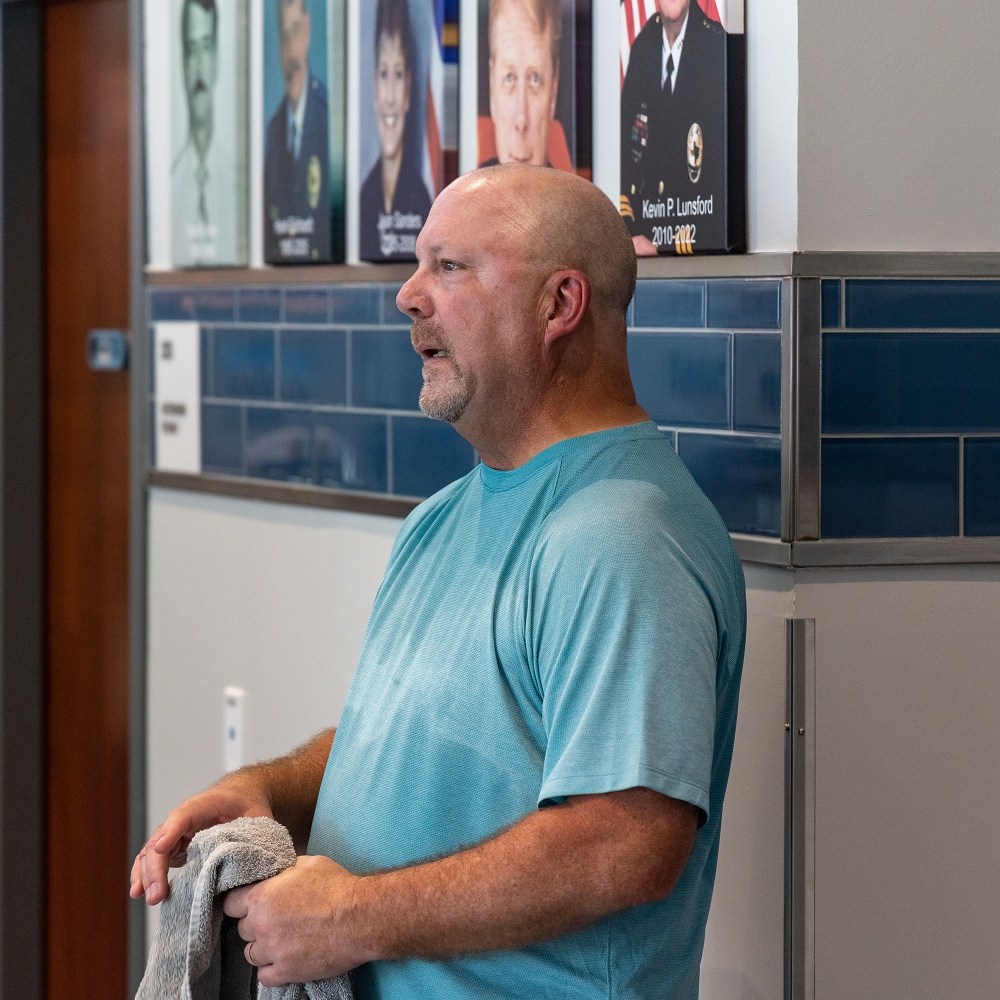
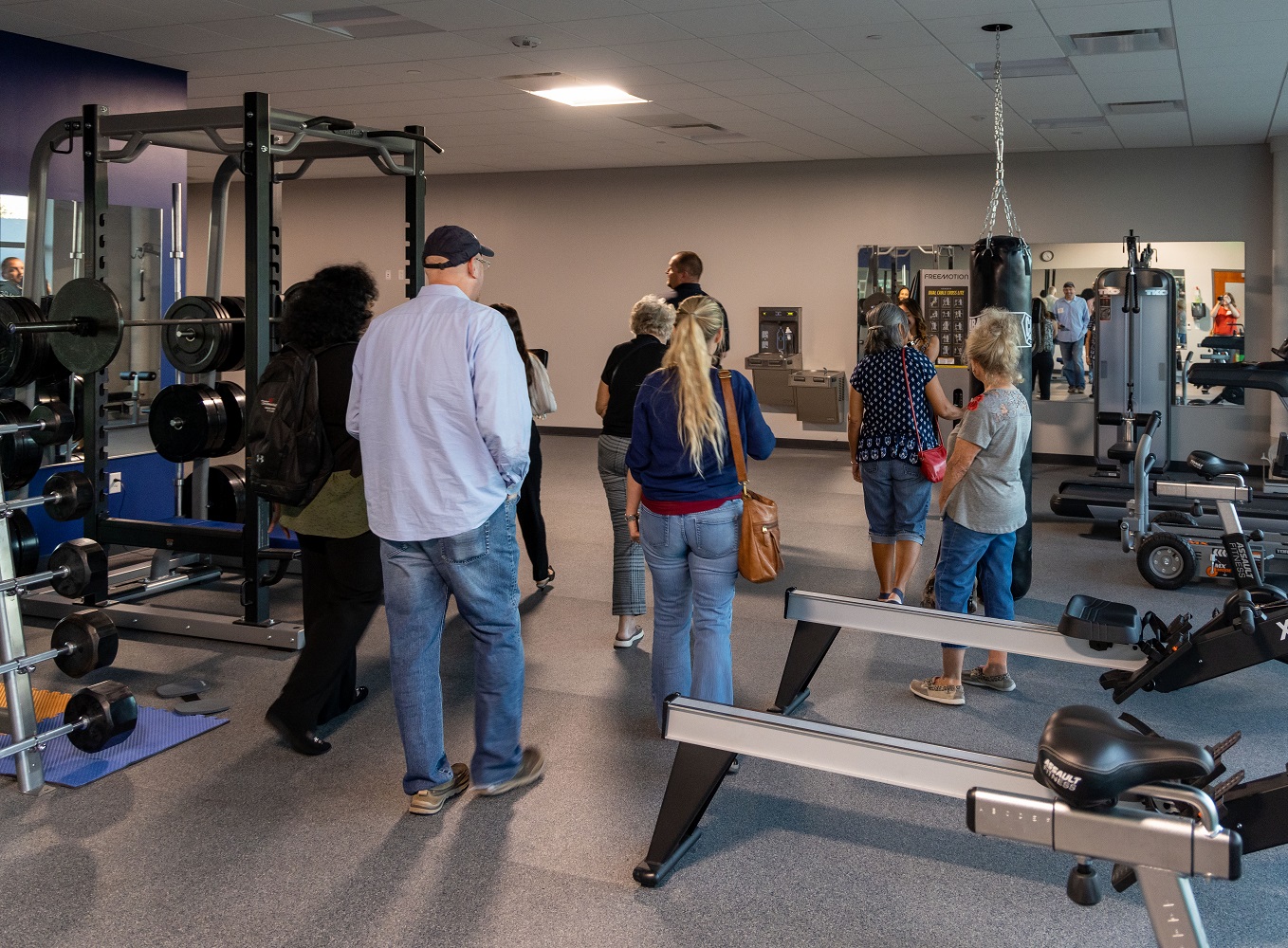
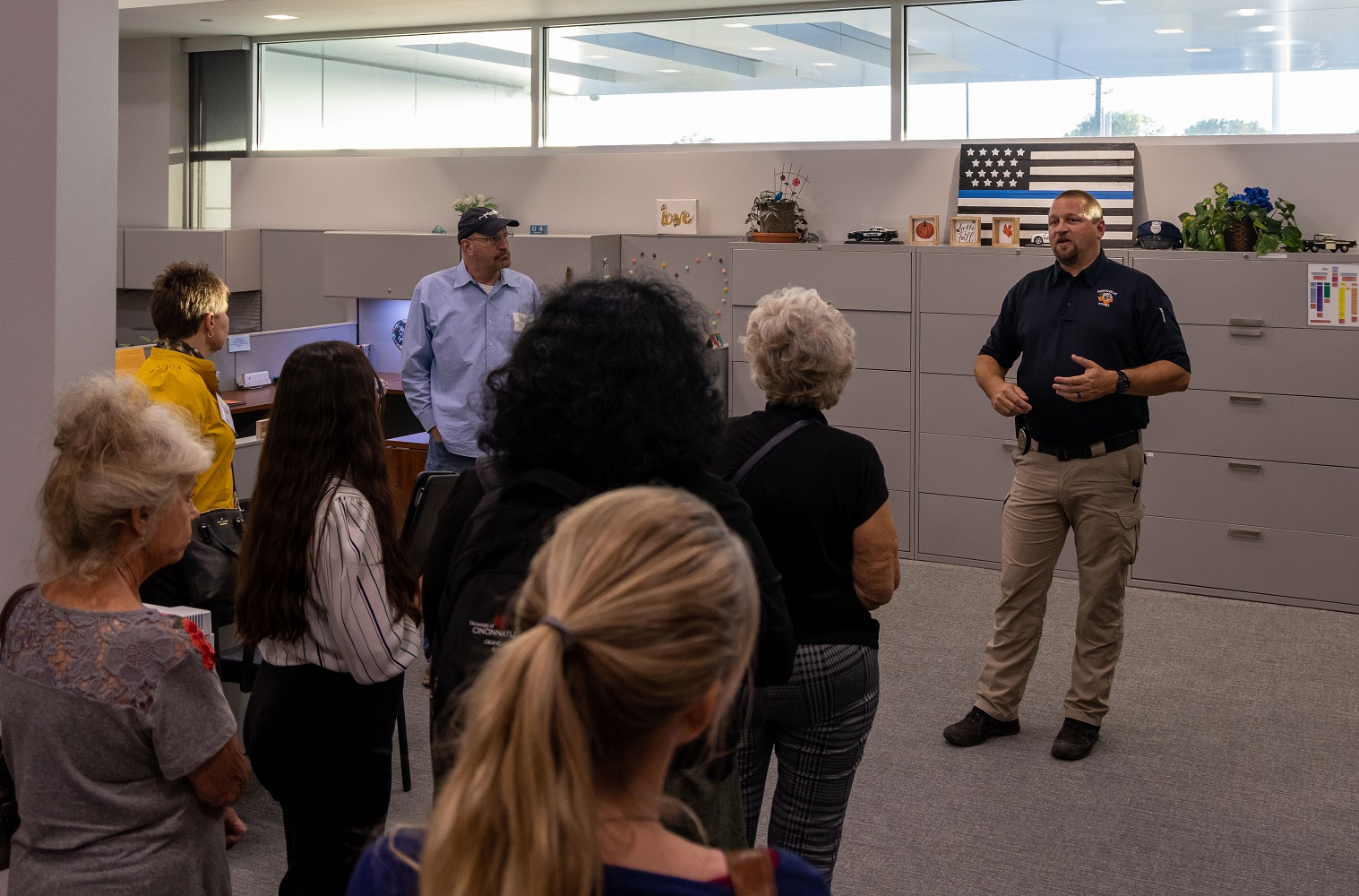
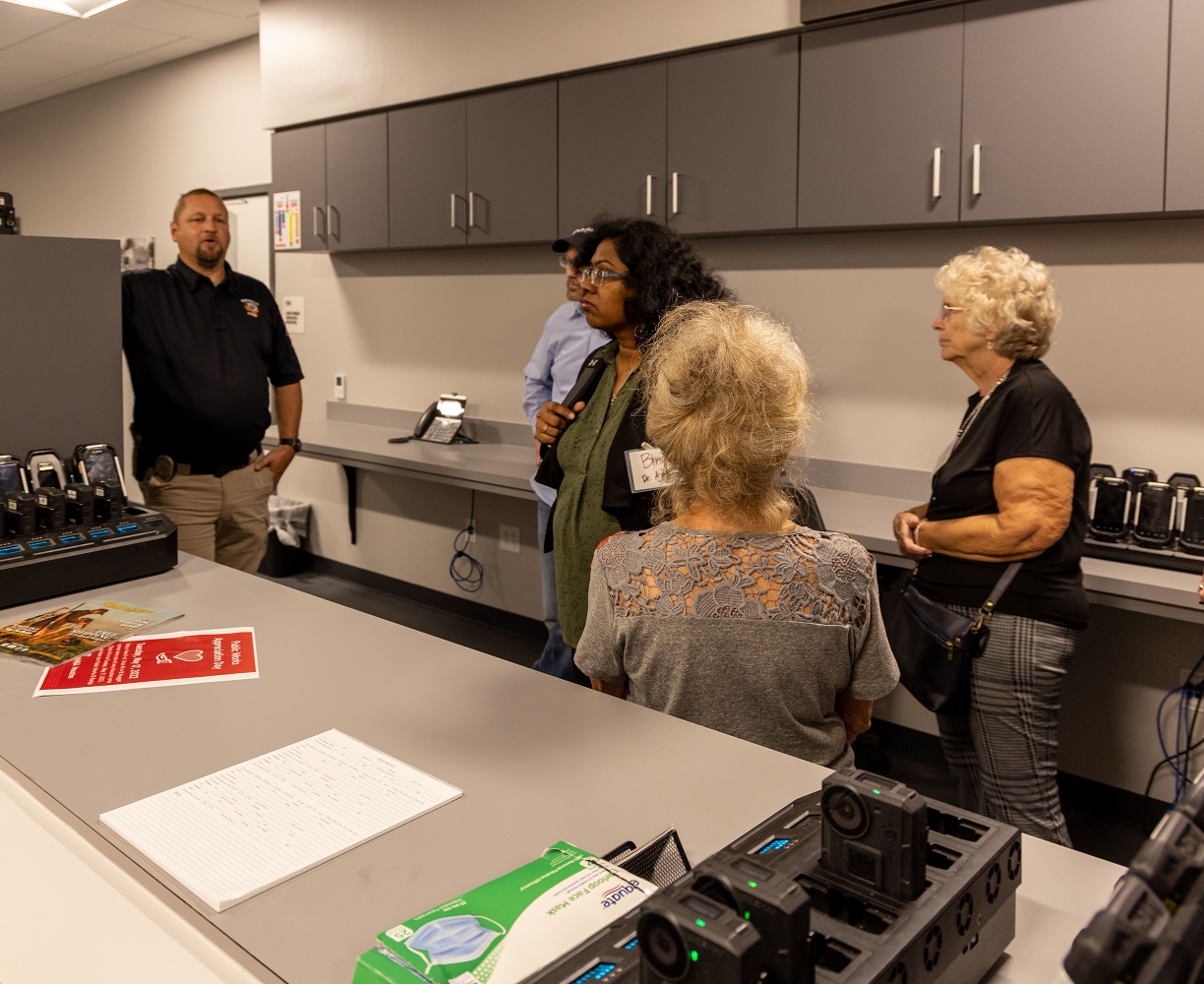
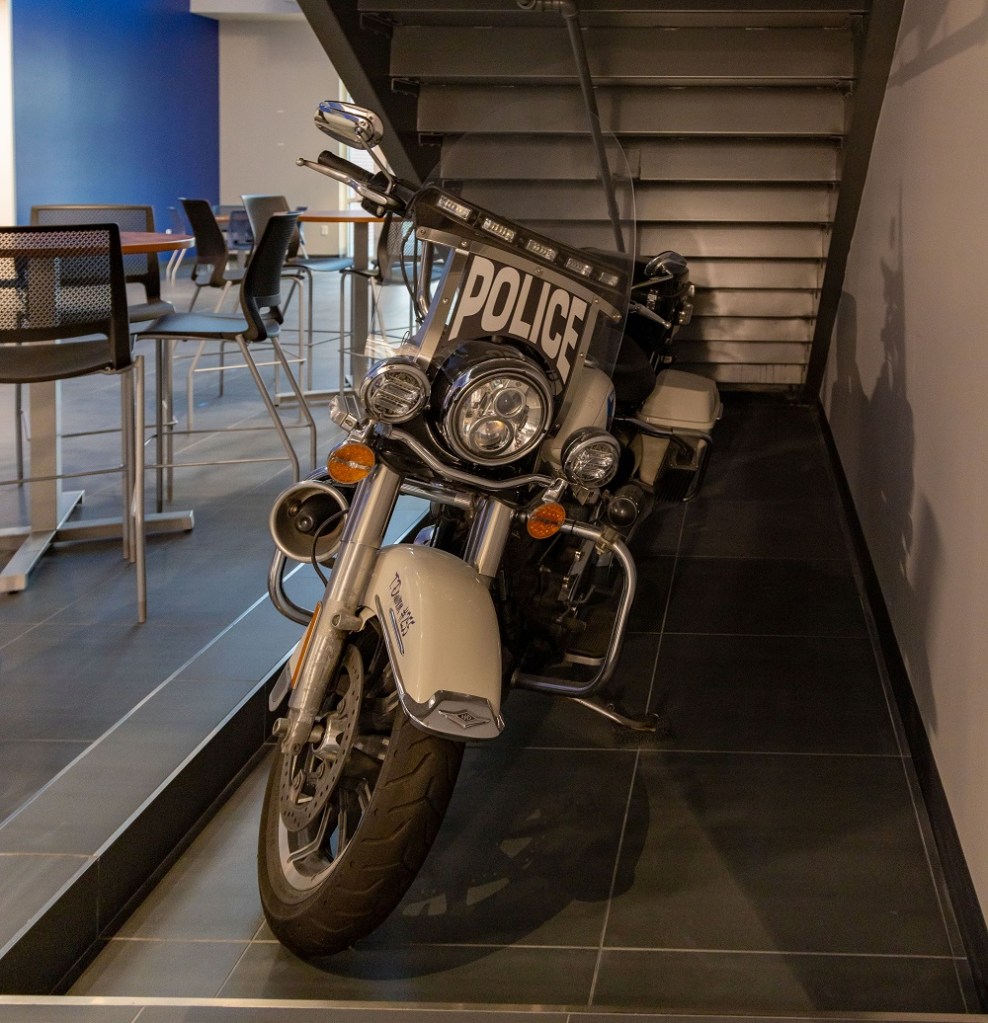
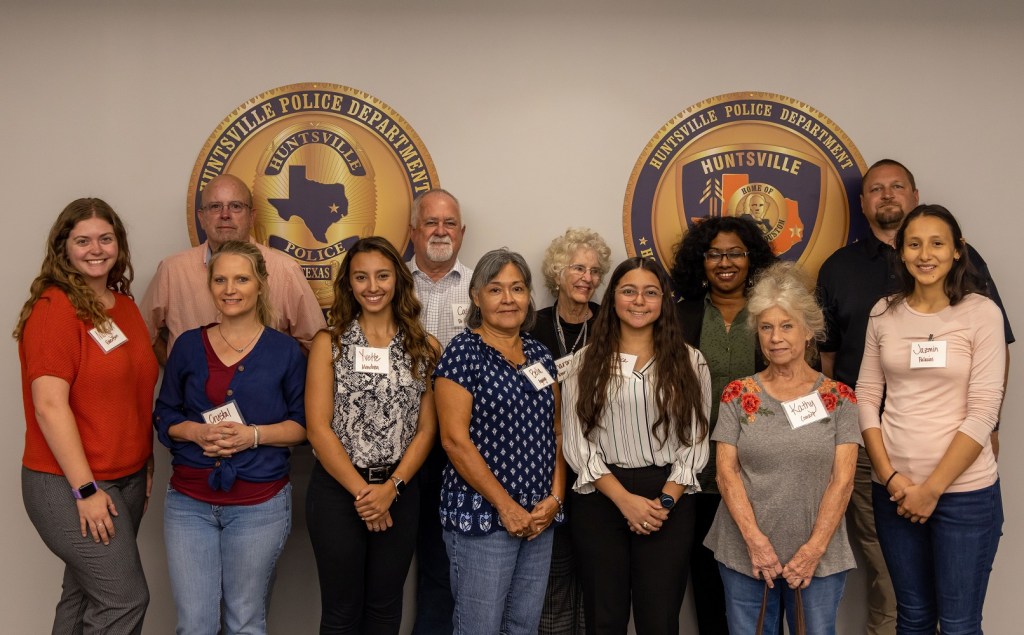
There was no better way to kick off our newest LEAP Program, Beyond Bars, than with a back-stage tour of the Huntsville Police Department led by Corporal David Warner. Starting us off was Lieutenant Curt Landrum, who told us the stories behind the artifacts, photos, and mementos that can be found in the waiting area. These included photos of all the chiefs, equipment from back in the day, and the “honorary” shovel used for the groundbreaking.
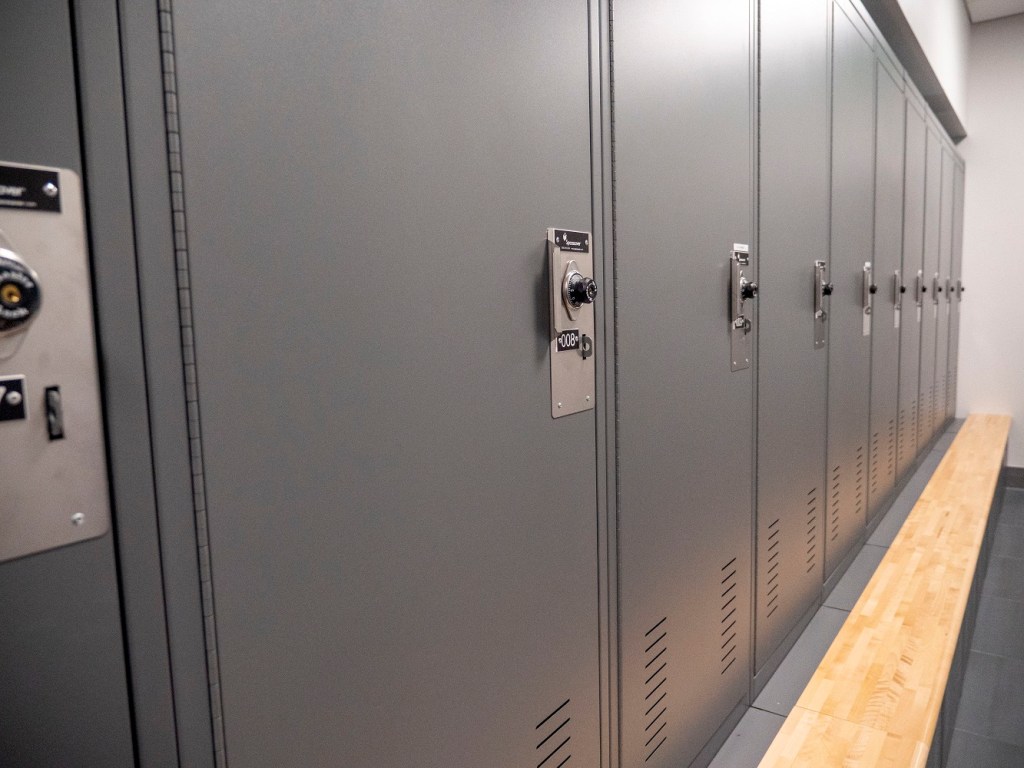
We also learned more about the building itself, and the interesting features of the structure. These included but were not limited to bullet-resistant glass, interview rooms, a gym, a locker room and showers, and a relay room. All of these have proven to be helpful and beneficial for various reasons such as security, privacy, and in the case of an emergency or a court hearing for those that drive in for a shift accommodation.
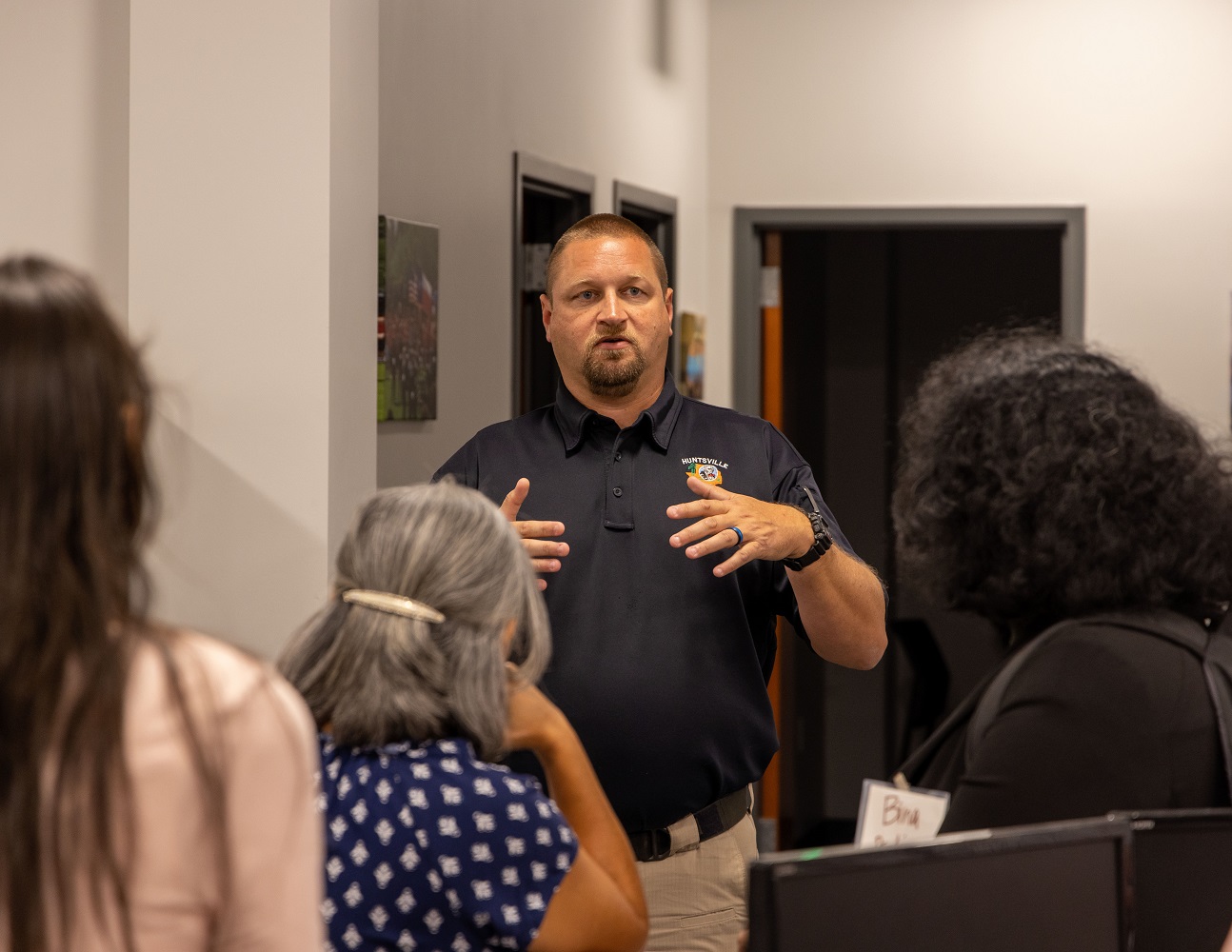
We had the opportunity to see the officers’ offices, computer spaces, and interview rooms. In a bullpen area with lots of open space and computers, we met a rookie who was enjoying (or not) filling out paperwork.
The coolest thing in this room was the computer screen that informs everyone where each patrol officer is, whether they are on a call, and if so, how long they have been on the call and the nature of the call. Interestingly, one officer had been called to the State Park to address “six teenagers taunting an alligator,” a crime-in-progress that we did not expect to see.
Before eating dinner, we had the opportunity to see the evidence room, and a joke was made that I would likely fit in one of the evidence lockers because of my small stature, haha.
We also learned a bit of Huntsville trivia. Did you know that on April 15, 2021, one officer gave 99 citations in a single shift? It was the most tickets ever imposed in the City’s history, at least as far as known, and it was done by a motorcycle officer.
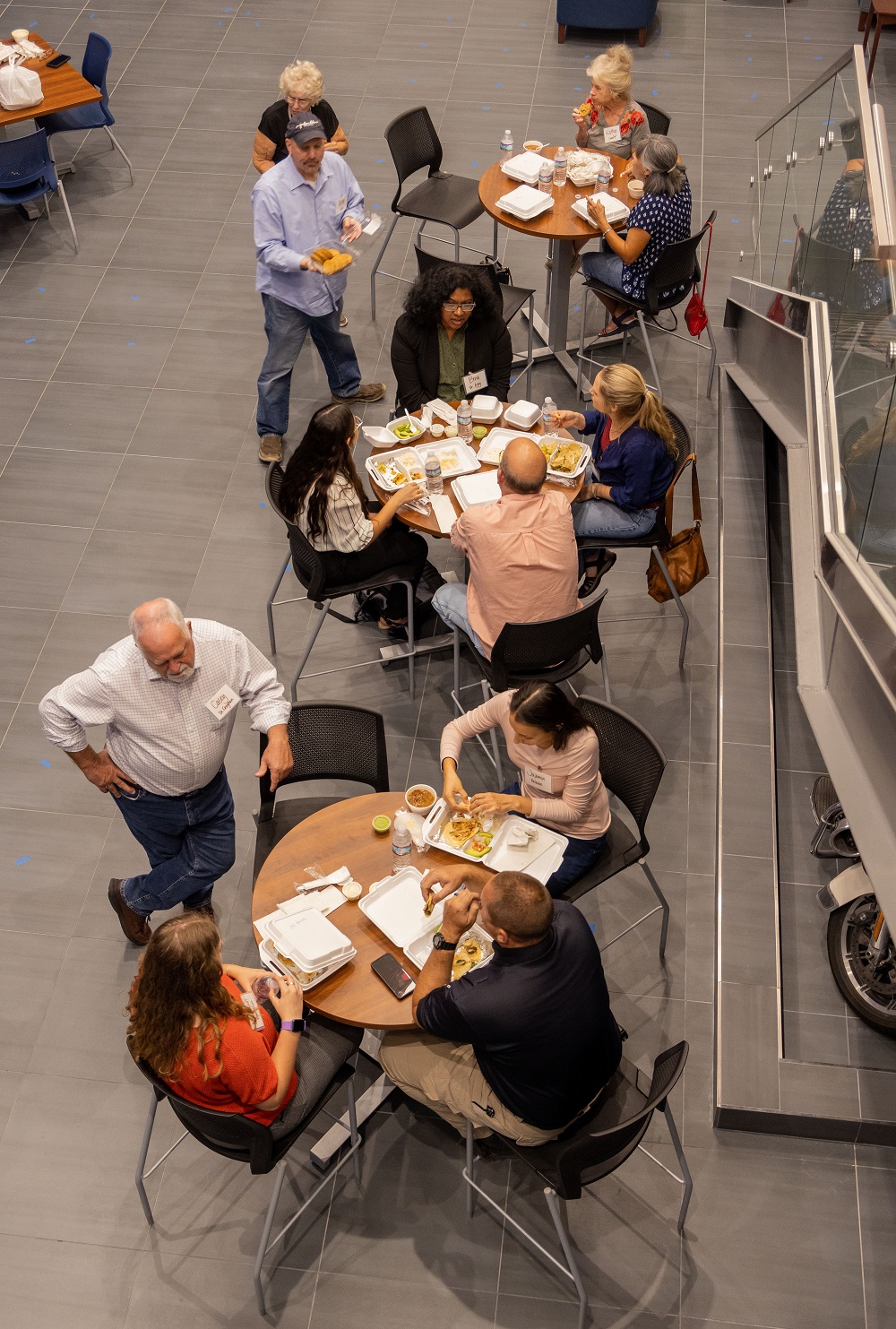
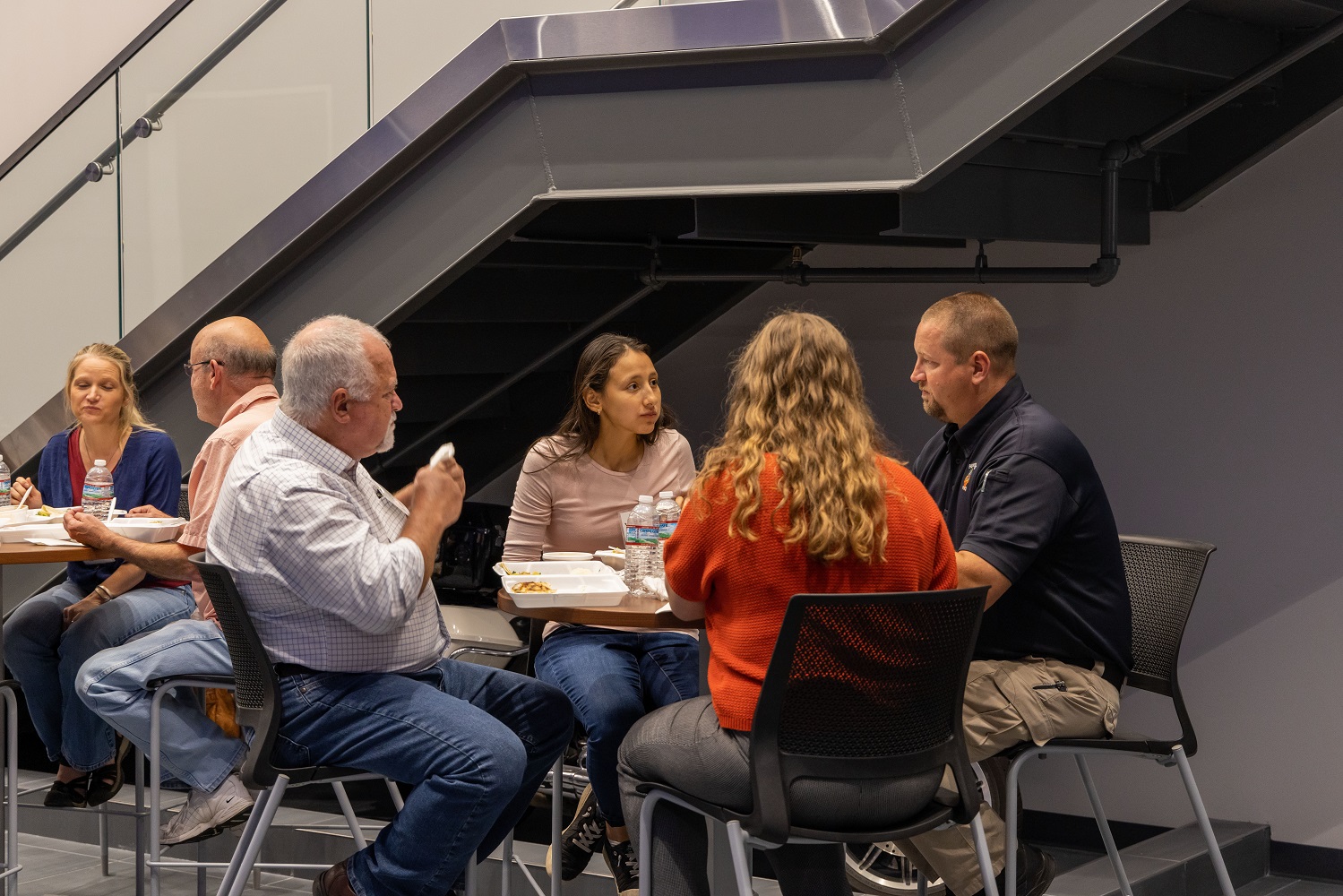
As the tour came to an end, we had the opportunity to dine in the Police Department’s lounge area with Corporal Warner, and little did we know of the activity that was awaiting us. On the menu, were delicious tacos al carbon: beef, chicken, pork, or shrimp, and or a choice of vegetarian, cheese, or pork pupusas from the local Salvadorian Restaurant, Carbonero’s.
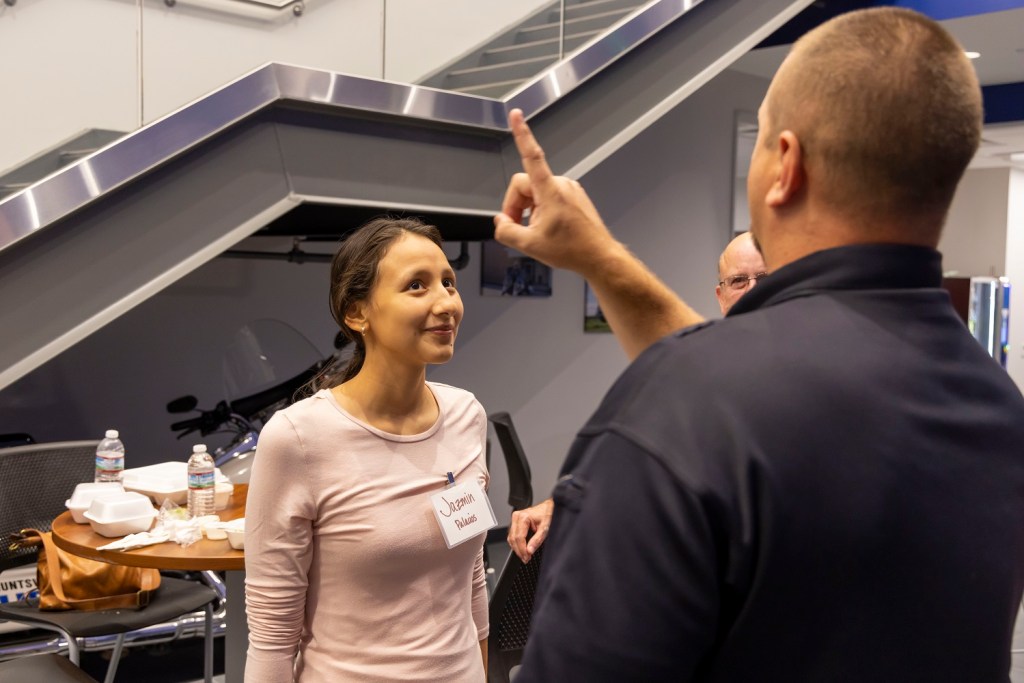
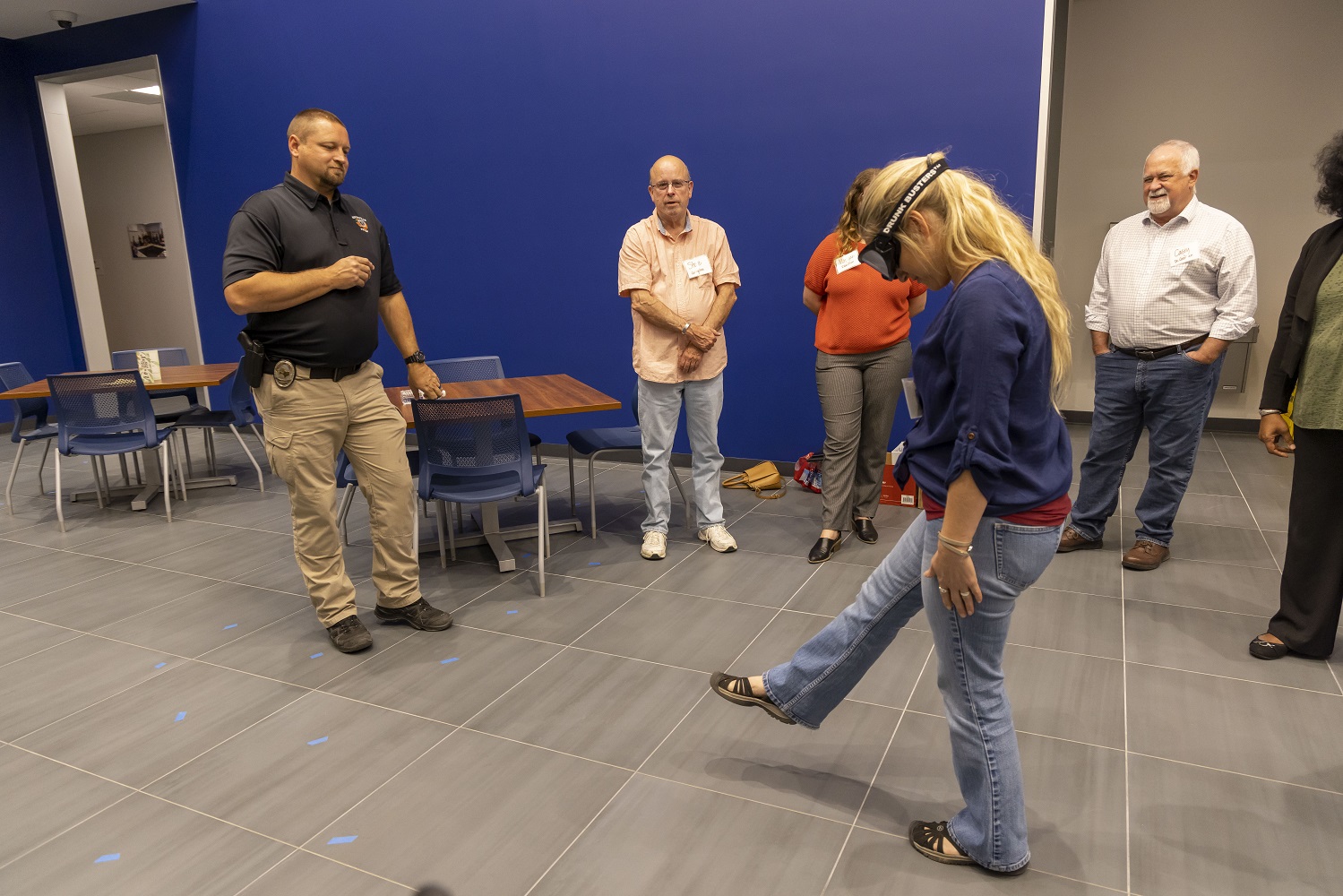
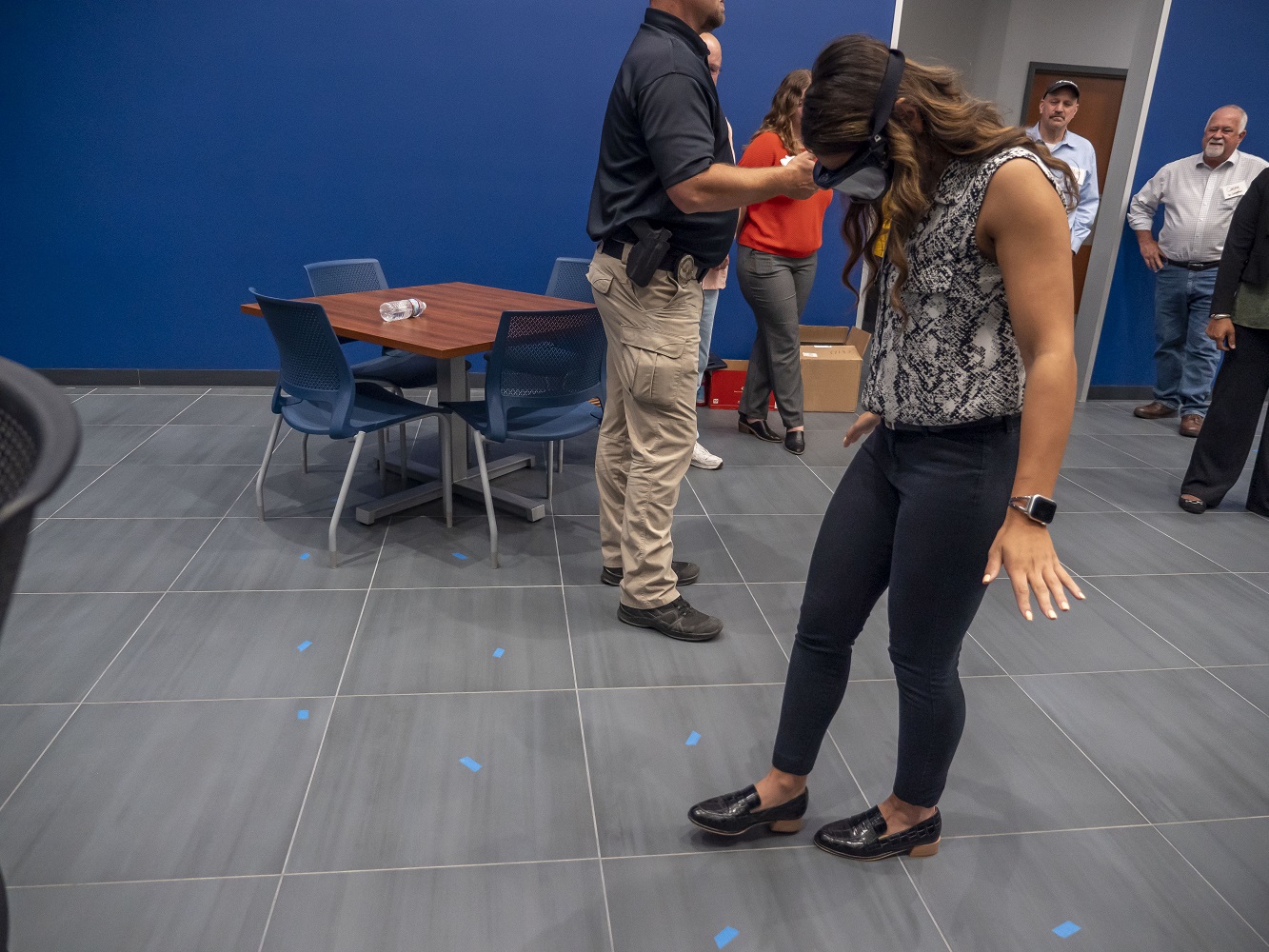
Corporal Warner provided us with a demonstration of what is done during a sobriety test. In particular, he spun us around and then conducted a “nystagmus” test, which is one of the key indicators of sobriety or the lack thereof. Jazmin Palacios, a Ph.D. student at SHSU, was voluntold to participate, and she not only did this test, but also wore the “drunk goggles” provided while doing a field sobriety test.
Corporal Warner instructed her to take nine steps and walk in a straight line, with each step she took she had to keep her hands by her side and walk heel to toe while counting out loud. It was slightly amusing to watch, but it is less fun when you are the one doing the test! Morgan also got lucky and was asked to do a one-leg test, where she had to count to ten out loud while keeping her leg raised up about an inch from the floor. Somehow, she managed to successfully complete this task.
As the night came to an end, the officer who had been sent to the State Park returned, and inquiring minds wanted to know: what happened to the alligator-taunting teenagers? As it turned out, “there were no alligators, no teenagers, and no witnesses.” Some of us may have been disappointed in the way that turned out.
It was a fun and educational night, everyone had the opportunity to wear the goggles and experience what it is like to be on both sides of the law. Many thanks to Corporal Warner and to the entire police department for helping to keep our community safe.
The LEAP Center would like to thank the Annette Strauss Institute for Public Life and their “Texas Civic Ambassadors Program” for assisting with the costs of the program.
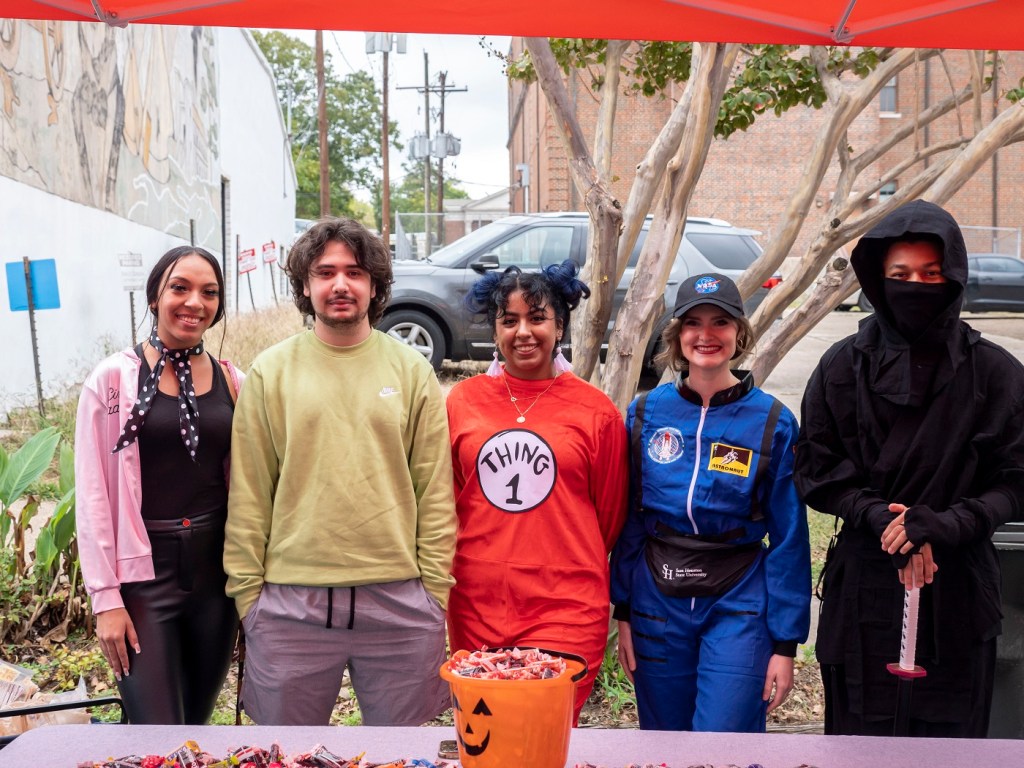
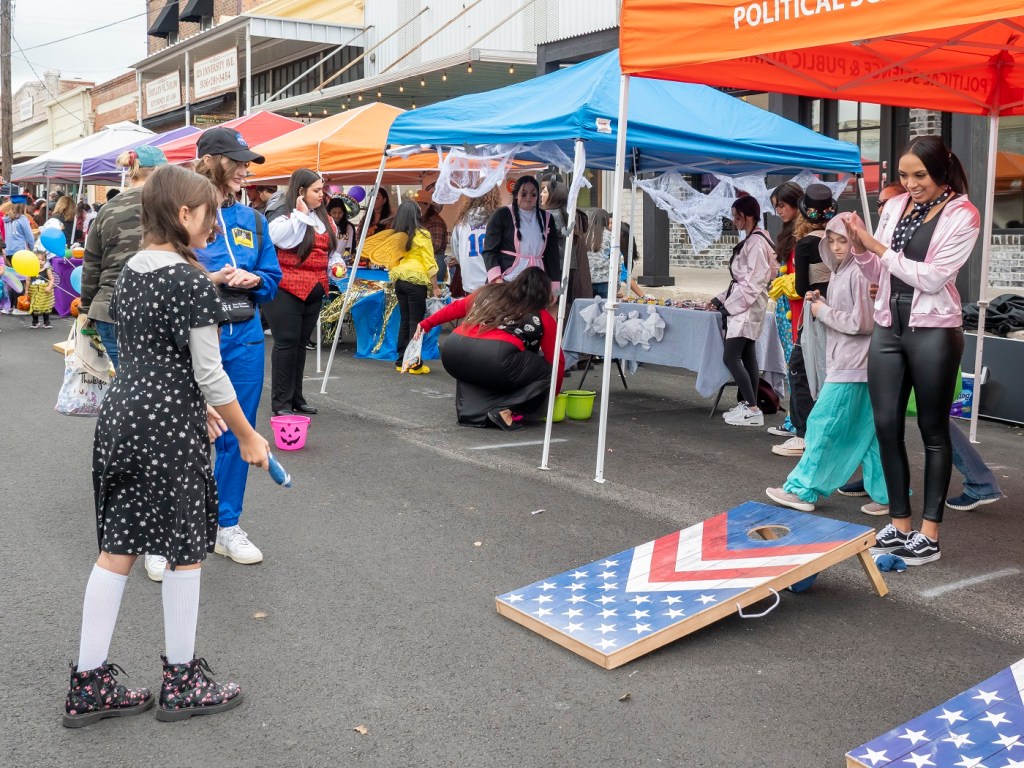
October has a few milestones for those in Huntsville, but none more important than Main Street’s Annual Scare on the Square! This year, we were fortunate enough to have 3 booths, all run by students from Professor Yawn’s classes. Two groups from the Local Government class and one group from University 1101 Pre-Law braved the eager trick-o-treaters, photo-snapping parents, and swarms of community members, to volunteer for this amazing event.
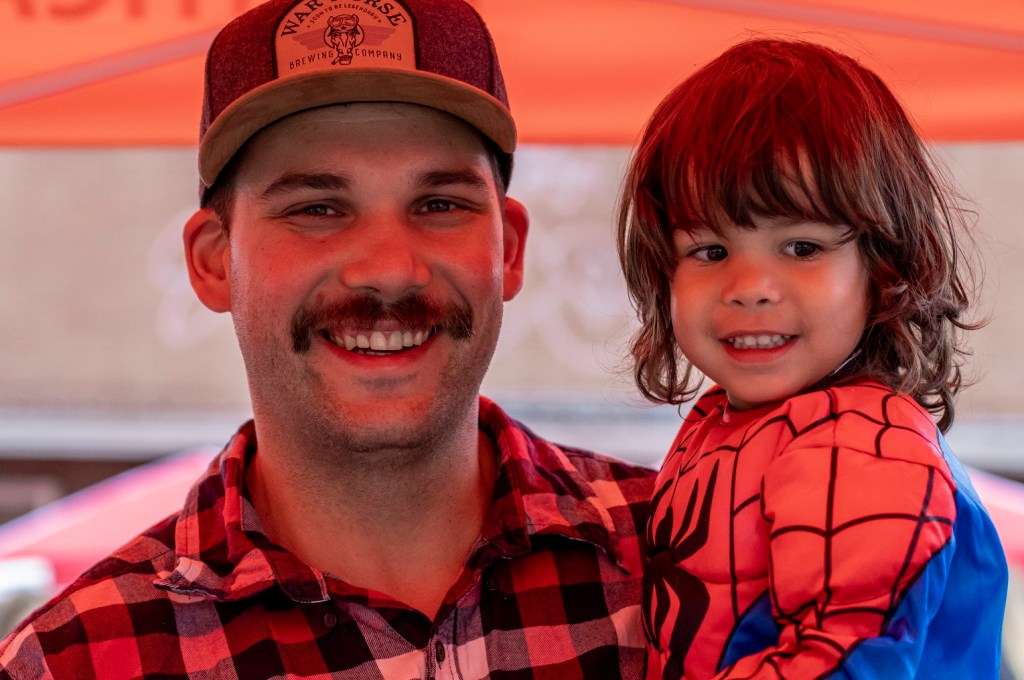
Main Street Coordinator, Annel Guadalupe was assisted by Main Street Intern and LEAP Ambassador, Jessica Cuevas.
Jessica Cuevas is the small child on the right, not the left.
The team did a wonderful job transforming our beloved downtown into a Halloween Celebration! Up at Rather Park, a DJ was stationed playing Halloween music, and there were fall-themed photo stations for families to remember their time at scare on the square. Yvette and I were on standby to offer assistance to the groups and to take pictures.
We coordinated our costumes from the movie Monsters Inc. and became known as the Monster photographers (although, within LEAP, we are known simply as “monsters”)!
Each group of volunteers brainstormed their own games and was responsible for bringing their ideas to life.
Booth one was run by one group from the local government class. Volunteers from this group were: Michelle Bright, Amor Sheffield, Matthew Smith, and Emily Lindahl, Adisen Massie, and Christina Biello.
Their game was perhaps the most creative and required quite a bit of skill from the young trick-o-treaters. With a small tub of rubber ducks and makeshift fishing poles, players were required to catch a duck to win candy! Some got the hang of fishing more easily than others, but intense concentration was a must for this game.
Booth two was the second group from the local government class, run by: Rachel Hill, Johnny Uribe, Gisela Soto, Giselle Martinez, Amari Gallien, and Cameron Gill.
This group kept the game simple, with classic cornhole boards. However, the true competitive colors of almost every player were shown in this game. This booth seemed to produce an endless amount of laughs, as volunteers enjoyed the game faces of the players.
The final group were all in their first semester at SHSU, and they did a great job of decorating their booth, assembling costumes, and putting on a game. This group included Sephora Pham, Faith Barnes, Peyton Jennings, McKenna Nonnennmann, Michelle Cardenas, and Cinthia Villareal.
To win candy at this booth, children had to toss a tennis ball into a Halloween bucket (which sounds easier than it actually is)!
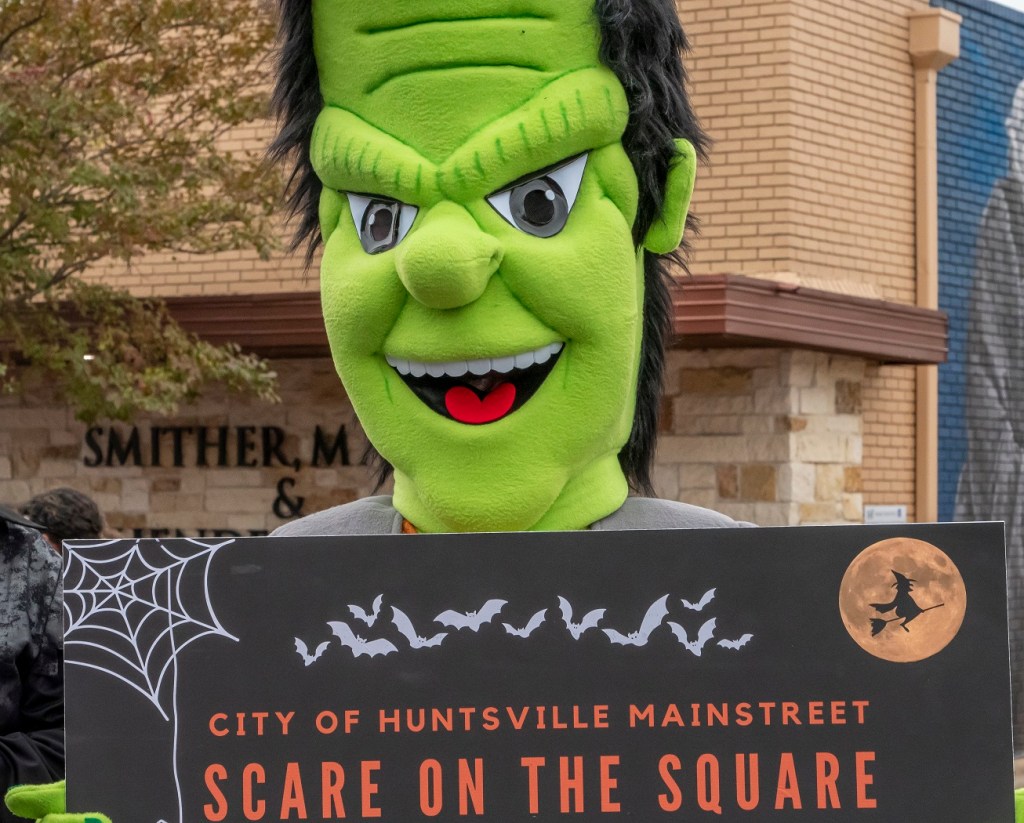
When it came time for the Costume Parade, Annel asked for a few volunteers to escort Frankenstein from the front of the parade! Gisela and Johnny helped corral masqueraders, and led them down the street toward the park.
The parade was a success; Johnny and Gisela even got to help city staff pass out beads to the participants.
Another highlight was just seeing all the young people–and older people–dressed up and having fun.
Scare on the Square is one of my favorite events of the year. Members of the community fellowship in our beautiful Downtown, enjoy the nice weather, and celebrate a fun holiday!
On behalf of the LEAP Center and the students who volunteered, thank you to Annel, Jessica, and the City of Huntsville for making this event possible!
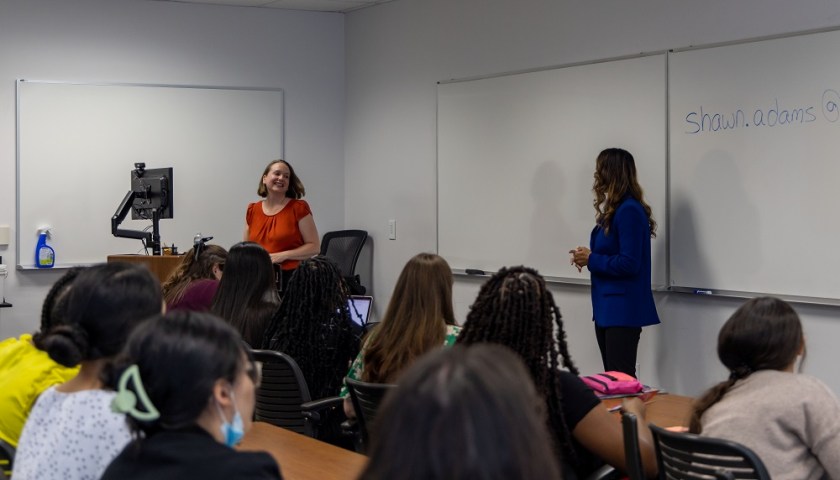
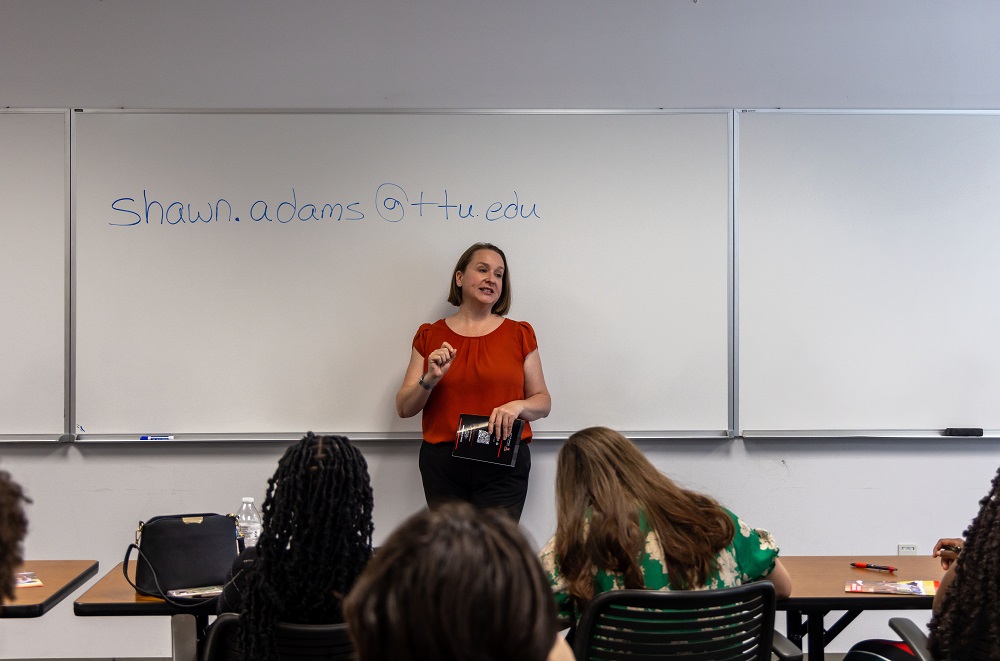
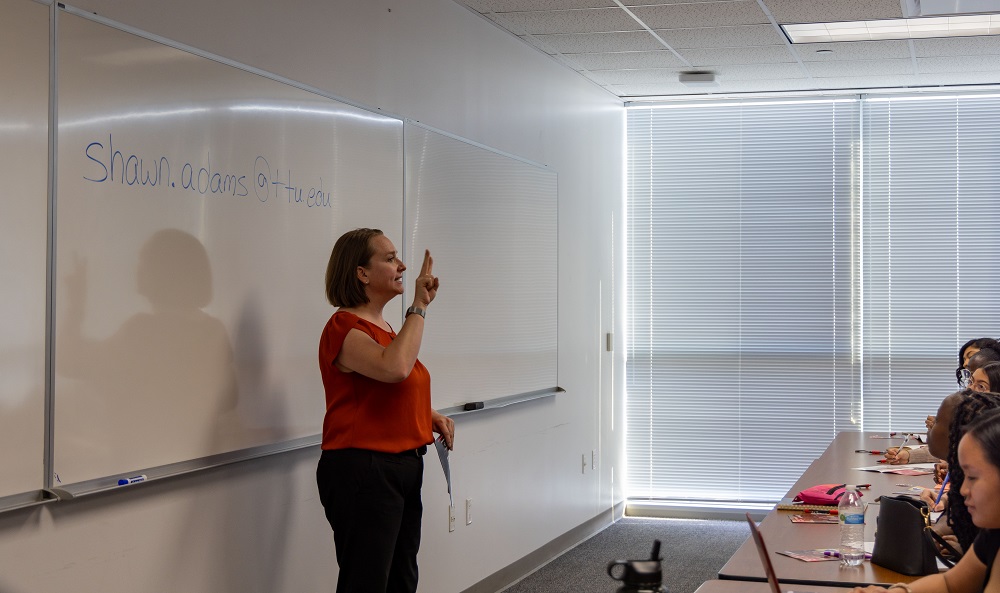
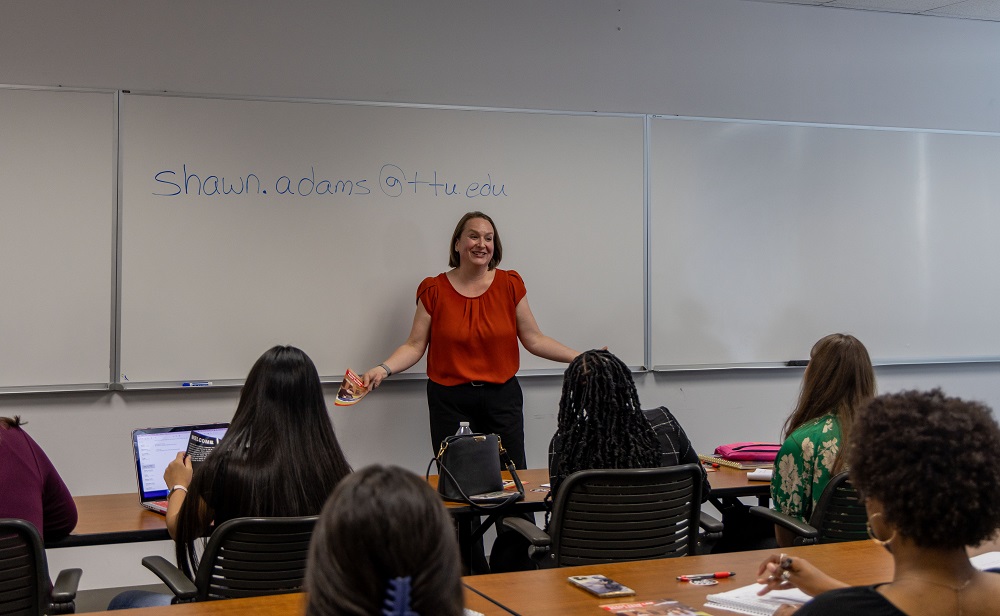
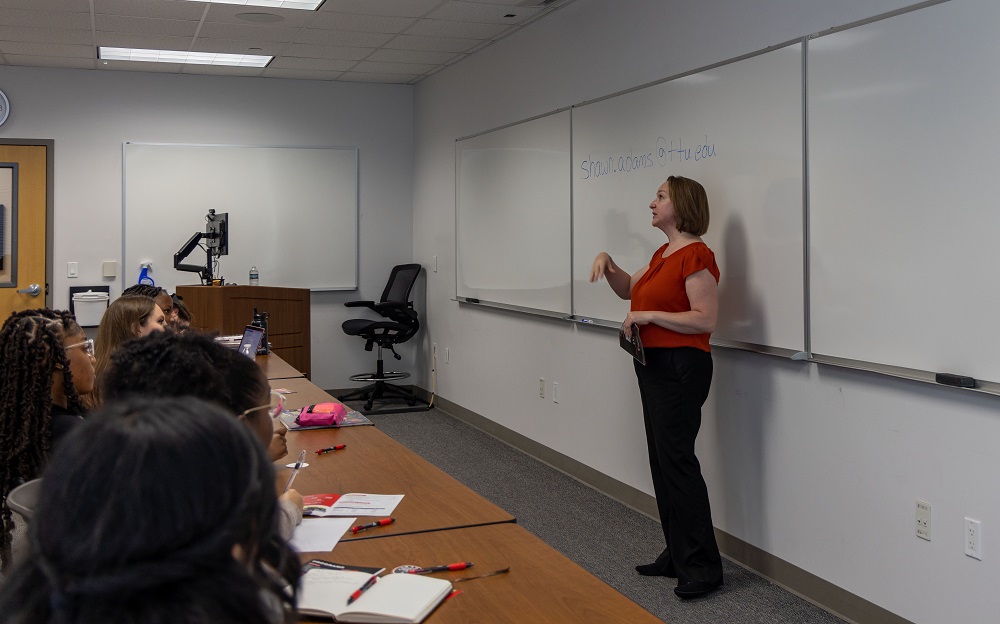
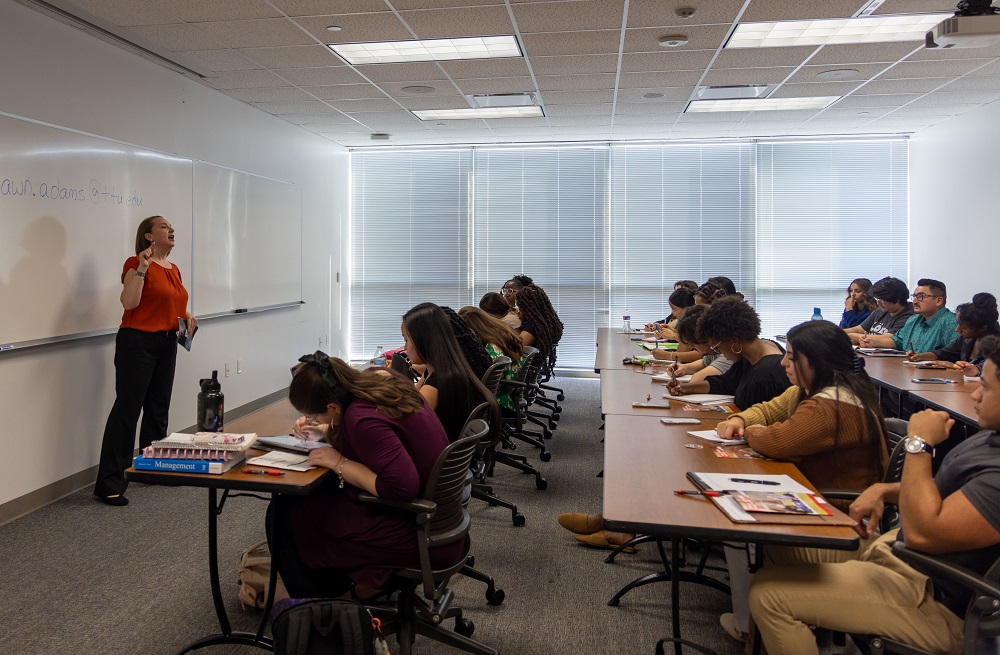
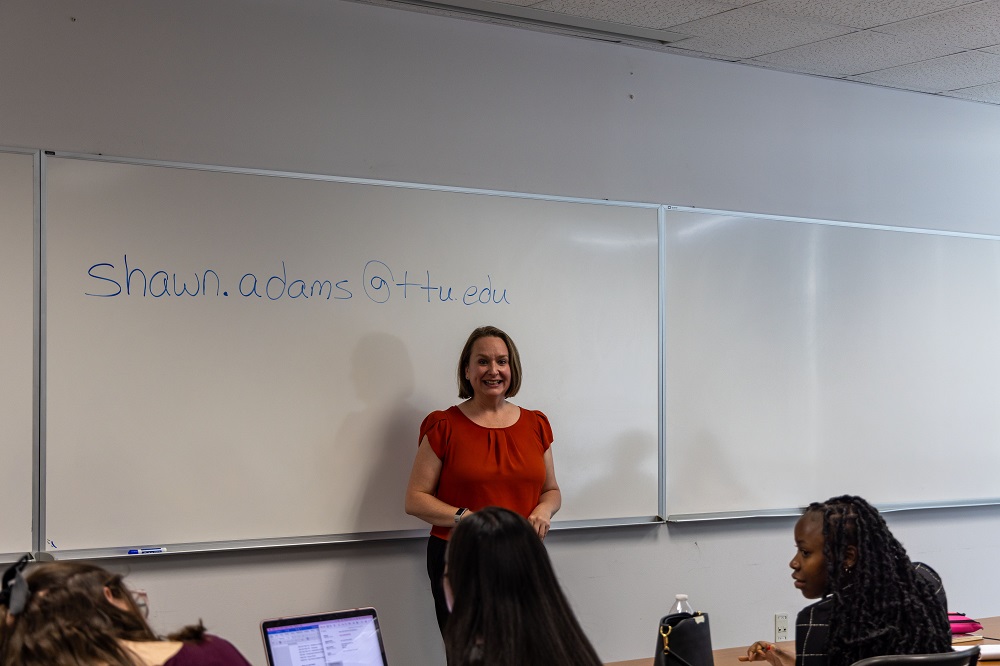
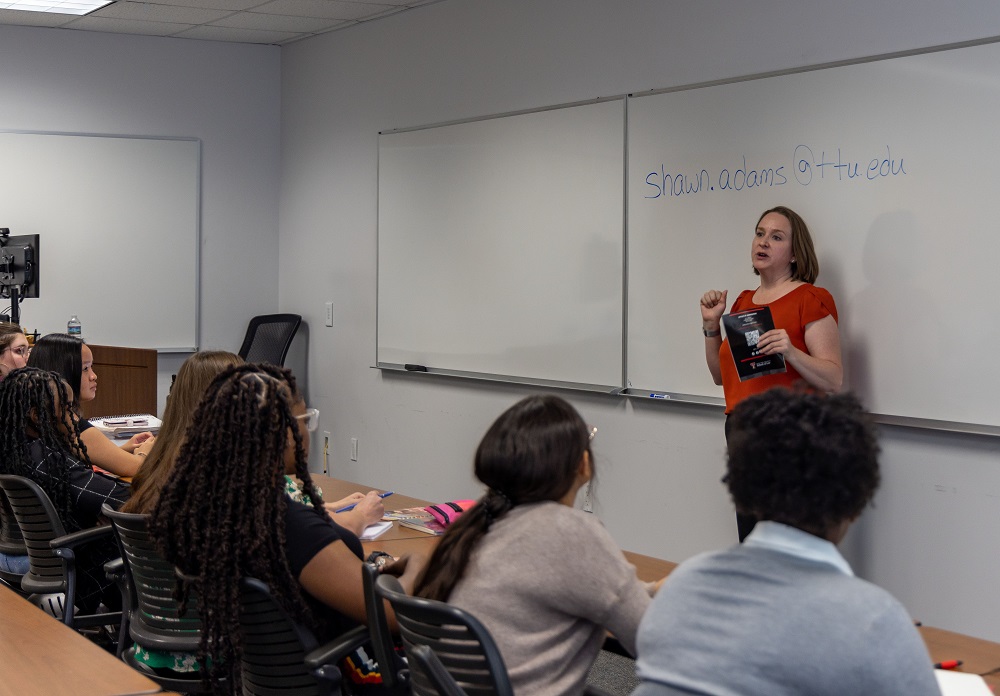
This past week at the Pre-Law Society meeting, we welcomed Ms. Shawn Adams, the director for recruitment at Texas Tech School of Law.
Ms. Adams graduated from Texas Tech with a Master’s in Business Administration and a JD! We learned a lot from her educational background and experience as a practicing attorney.
On this evening, her goal was not only to recruit students to Texas Tech School of Law, but also to give us loads of advice regarding the law school application process and what to look for in law schools. She started by looking for three main things when choosing a law school.
Looking at what the cost of living will be at the school apart from tuition
Bar passage rate
Post-graduate employment rate
All three items can be located on the law school’s 509 reports!
Ms. Adams covered what is needed in a law school application: transcript, letter of recommendation, personal statement, LSAT score, and resume–and how those are weighted at Texas Tech.
We also learned more about what Texas Tech school of law offers and how beautiful and engaging their campus life is! In addition, they offer many great resources for students interested in criminal defense and even have a dual degree program.
As the meeting ended, Ms. Adams stressed that it is essential to go at our own pace, and it is okay if we do not make straight A’s in law school because of how rigorous it is. And she encouraged us, noting that if we continue to work hard and have our hearts in the studying, we can go far.
Many thanks to Ms. Shawn Adams for her continual support of the LEAP Center and Pre-Law Society at Sam Houston State University.
The LEAP Center typically invites Professor Val Ricks from the South Texas College of Law–Houston to campus in the spring, but we made it a fall event this year. And so it was that, last week, Professor Ricks spoke to 35 SHSU pre-law students who signed up for an educational event–without extra credit, a class assignment, or give-away prizes.
They came because they wanted to learn, and they were willing to do some dense reading beforehand. The reading involved a contract, and this was no accident. Professor Ricks is one of the leading experts in the country on contract law; in fact, some of our alumni who have gone on to law school have informed us that they were assigned his book in their classes!
Professor Ricks began the course by informing us of his goals for this and any class that he teaches: (1) Get the words of the law – law is words, (2) Set the words out in a workable way, (3) Practice applying them, and (4) Consider what is “right” – the law is a moral exercise.
He went about this through the Socratic method since everyone loves being called on and questioned until they cannot answer. At least, we will have to if we plan on practicing the law, especially, in the courtroom. Through his random number generator, he called on those people to answer his questions regarding the G.D. Holdings, INC v H.D.H. Land & Timber, L.P., 407 S.W.3d 856, 2013, after delivering the facts and procedures of this case.
Many of us believed we were prepared but we did not know what to expect, so were we really prepared for Professor Ricks to hit us with questions like, What is the legal issue being addressed? How did you draw this conclusion? What is the ruling of the Court? A few of us addressed this question with the trial court’s ruling which led Professor Ricks to ask us, Where did you read that? Why do you think that is the final ruling? In these instances he let us help each other out when the person he called on was stuck, which we later learned that in an actual law class he would have picked that individual’s brain until they provided the answer he was looking for.
We continued this process as we provided evidence that we thought best fit or would prove the three different clauses of Promissory Estoppel- the legal issue of the case – (a) a promise, (b)foreseeability of reliance by the promissor, and (c) substantial reliance by the promisee to his detriment. It was at this moment, that we felt the high pressure that lawyers feel in a courtroom the most. With us acting as lawyers and Professor Ricks as a judge, who questioned us to help fill in the gaps in the story and understand what we were thinking. This proved to be a lot harder than we thought since proving that a promise, the first part of Promissory Estoppel, had been made was difficult and some of us soon learned that in this context a promise was defined as a commitment.
Following the class, most of us were more certain than ever that we wanted to attend law school. This was a sentiment Professor Ricks encouraged, as we learned when he stayed after to encourage us, answer questions, and take photos.
Two years ago, the National Center for State Courts (NCSC) made a decision that they needed approach to diversifying courts across the country. They created a new position–Director of Racial Equity, Fairness, and Inclusion–and they hired Bell to “address racial equality in the justice system.” And, today, owing to a partnership between CRIJ’s Diversity, Equity, and Inclusion Office and the Correctional Management Institute of Texas (CMIT), Bell spoke to faculty, staff and students at SHSU.
Introduced by Nu Epps, CJ’s Director of Diversity, Equity, and Inclusion…
…Bell got to the point quickly, discussing a “Blueprint” for a new justice system. This change begins with awareness, requires institutional (and institutionalized) change, is expanded by new processes, and is nourished by recruiting justice-system actors from a cross-section of the United States.
These changes can range from being aware of our biases, includes modifications of how we treat people in the justice system, and extends to the manner in which we target opportunities. One of these opportunities, which will be unveiled fully within the year, is C.O.R.A, which involves targeting minority-serving institutions for internships, clerkships, and positions within the criminal justice system.
Bell is well positioned to assess many of these changes. With a Bachelors Degree in Criminal Justice, a Master’s in Business Administration, a Certificate in Judicial Administration from Michigan State University, and a graduate of the NCSC Court Management Fellows program. He has also worked in the court system for more than a decade, serving as judicial administrator, clerk, and as a planner for the Criminal Justice Coordinating Council of Georgia.
Bell’s experience, wisdom, and inspirational message influenced at least one student in the audience. Kiara Williams, a senior Criminal Justice major at SHSU, noted that it was “an uplifting talk, and it opened me up to some opportunities I had not considered.”
Following the event, Bell spent time speaking with audience members, encouraging students (including Williams), and discussing potential future partnerships–before being whisked away to his next opportunity to spread a message of fairness and awareness.
After a long drive Wednesday evening to Louisiana, we were up and early to attend our first Academic Conference – The Popular Culture Association in the South! The three presenters for the Film and Noir session were Professor Yawn, Matthew Wysocki of Flagler College, and Lauren Mitchell of Vanderbilt.
Professor Yawn presented over “A Simple Plan,” directed by Sam Raini, (most famously known for the Evil Dead movies).
He argued that the film is best understood by looking at it from a tragic framework, with questions of free will and fate, the allure of the American dream at its center, and the tension between brothers.
The motif of “brotherhood” is seen again in “Only God forgives,” which Matthew Wysocki addressed in his presentation. More elaborately, though, it addresses the role of mother. Crystal, an untraditional mother if ever there was one, uses manipulation and raw power to gain even more power, abandoning all of what would normally be regarded as traditional maternal behavior.
Lauren Mitchell presented her paper over the movie “Hereditary. ” This film continues the theme of motherhood, highlighting the difficult time we have of seeing mothers as real people, who sometimes becomes mothers despite not wanting children, who sacrifice goals and hopes and dreams for others.
We successfully survived, and even enjoyed our first academic conference, and embarked on our way to our next stop!
Brunch at Elizabeth’s
Ashley Kinyon
This afternoon, we drove down to Elizabeth’s Restaurant right next to the Mississippi River. We started with an assortment of appetizers; boudin balls, fried green tomatoes, (some with seafood!), and possibly the strangest of the bunch, praline bacon. While we waited for the starters, we learned that many foods that we love in the US originated in New Orleans, either by invention or through trade. This includes pralines, which originated in France, but which was improved on in New Orleans, and then spread mostly through the South.
My favorite of the selection was the boudin balls, Morgan favored the fried green tomatoes, and for Yvette it was the praline bacon.
To maximize on adventure and try new (to us) flavors, we ordered four main dishes. For our main course, Morgan and Victoria ordered the shrimp and grits; the ratio of shrimp and grits was perfect.
Jessica played it safe with the avocado toast, with a poached egg. Although to her credit, the toast did have some NOLA spice to it, and she paired it with a side of grits.
Yvette chose the duck waffles, which she enjoyed but deemed too spicy, a recurring motif throughout the trip (and from what I gathered, throughout her life).
I picked the sweet meal out of the bunch and had banana foster French toast, which was delicious!
For dessert, we had bread pudding and pecan pie. The bread pudding was average, not the table’s favorite, but the pecan pie was amazing, better than any I’ve had in Texas.
Thoroughly stuffed and with high expectations for our next NOLA meal, we embarked on our adventure!
Homer Plessy
With a bit of downtime, we hustled over to a City Park, one highlighting civil rights. It was the site of Homer Plessy’s train ride, where he spurred a test case on Jim Crow laws.
Unfortunately, Plessy lost in 1896, and the doctrine of “Separate but Equal” became shameful precedent in the US, not replaced until 1954’s Brown v. Board of Education.
While at the Plessy site, we also looked over the rest of the park, taking in some of NOLA’s civil rights heroes.
Zooming through NOLA
Yvette Mendoza
We have concluded over three separate LEAP trips that there is no better way to learn more about a new city than by Segway, and we did just that in NOLA! Our excellent tour guide, John, with Nation Tours did a great job explaining the richness of history, architecture, and culture in New Orleans. So as the LEAP Ambassadors took their Segways through the French Quarter to the Mississippi River, we all gained a deeper understanding of NOLA.
John frequently time-traveled and described what the city was like in days past. Some of the tour was a refresher on previous history lessons, while other parts were new information. We learned that NOLA went through 4 major governing shifts. The city was initially founded by the French, taken over by the Spanish, fell again under French rule, and then finally doubled the size of the U.S. in 1803 with the Louisiana Purchase.
Next, we headed to Jackson Square. This central location is deemed such because of the “Hero of New Orleans,” Andrew Jackson, and his unexpected victory as General at the Battle of New Orleans in early 1815. This was a major win for the United States because it spared the US the prospect of the British having control over the mouth of the Mississippi.
Perhaps the prime feature of Jackson Square must be the stunning, almost 300-year-old, St. Louis Cathedral. This Cathedral is one of the oldest in the country and was founded during Spanish occupation!
Our jaws dropped when we discovered we were stepping in front of the oldest Cathedral. We could not miss a photo opportunity!
Up next, Bourbon Street! Here we learned more about the Spanish stock architecture and the fantastic bars that perform the best jazz in New Orleans. this blend of modern-day culture, with historic surroundings is the city’s largest source of revenue Pre-covid, NOLA saw millions of tourists each year, and now those numbers are significantly lower. In fact, without tourists, there is genuinely no thriving NOLA since no revenue is being made.
No matter your age, interests, taste, there is something to be found by everyone in NOLA!
New Orleans felt like its own country. The way the people, location, and everything else are something we are not used to. We are so grateful we were able to learn so much on the Segway Tour guided by John; thank you so much!
Dinner at Oceana
Morgan Robertson
To conclude our evening, we stopped at the corner of Conti and Bourbon for yet another taste of NOLA. Oceana is popular for having a wide variety of NOLA standards, such as oysters, po’boys, and étouffée to name just a few.
To start, we stuck with our trend of an assortment of appetizers including, gator tail bites, boudin balls, fresh, Rockefeller oysters, and chargrilled oysters. For Ashley and me, this was our first time to try oysters and we had slightly different reactions. Ashley tried the Rockefeller oysters and determined they were not her favorite. I tried all three and enjoyed the Rockefeller the most! Everyone enjoyed the boudin balls, and we all agreed that alligator tastes a lot like chicken.
For our main meals, we once again mimicked family style, and tried many new flavors. Victoria and I split a blackened redfish, with a side of greens, Yvette and Jessica ventured out with the taste of New Orleans (creole jambalaya, crawfish étouffée, red beans and rice with smoked sausage), Ashley had the fried shrimp platter, and Professor Yawn and Stephanie split the Bayou Duck.
Verdicts were split on what the best entrée was, but at least three out of seven favored the blackened redfish. The flavors were once again unique but fantastic, a trip to NOLA could be made simply for the food.
Despite having little room for dessert (except for Stephanie because she effectively planned) we selected three options carrot cake, la boehme crème brule, and of course, bread pudding. The bread pudding was easily the favorite, but everyone enjoyed the sweet treats to end our wonderful meal!
Bourbon Street
We might have seen Bourbon St. during the day, but it was almost a completely new place after dark. Our steps fell in time to the bass of the music around us, and it almost felt like a runway with the flashing lights. If it is true that anyone can find something on Bourbon St, it’s even more true at night. Being only a Thursday night, however, we might gone at a slightly better time as it was not insanely busy.
Not wanting to linger on Bourbon Street and needing some sleep, we headed back to our hotels, to get rest for another day of learning and fun tomorrow.