Rocking In Memphis: LEAP Ambassadors Visit Tennessee

July 7, 2016

After a long hike last night, and a much-needed sleep, we began the second day of our Midwest/Southern Tour with what is now a traditional scenic stop at The Old Mill, the final extant set of Gone With the Wind.

Old_Mill_Ambassadors_Cropped_Web

Most of us had been to The Old Mill before, but we were still very excited to jump out of the van and take in the beauty The Old Mill has to offer.  Moreover, Beatriz actually hadn’t been there, so she got her first taste of The Old Mill.

Old_Mill_Beatriz_Cropped_Web

Interestingly, the LEAP Center and Junior Fellows have photos at The Old Mill dating back to around 2006, making it almost a ritual among the organization.

Old_Mill_Ambassadors_3_Cropped_Web

After some exploration, and a few photo ops, of course, we all hopped back into the van for our next destination: the National Civil Rights Museum at the Lorraine Motel in Memphis, Tennessee.

On the way to the museum, though, we stopped by Graceland, the home of Elvis Presley, to leave a few messages on the stone wall.

Graceland_Signing_Web

And take a group photo.

Graceland_Ambassadors_Cropped_Web

We began the tour of the National Civil Rights Museum…
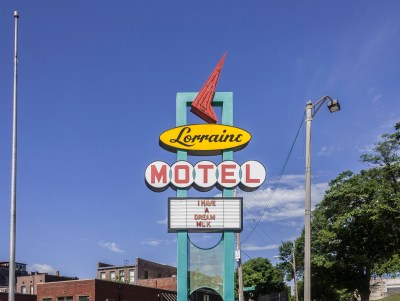
Lorraine_Motel_Sign_WEb

…with a special exhibit by artist Baret Boisson. Her work, themed “Inspiring Greatness through Words and Deeds,” focuses on portraits of heroes such as Mahatma Ghandi, Muhammad Ali, Rosa Parks, Abraham Lincoln, JFK, and her most recent–Martin Luther King, Jr.

The museum portrayed the process of the civil rights movement from the beginning to present in a very detailed and educational manner, and really emphasized the important role that civil disobedience and non-violent protest played thought the years.

Lorraine_Motel_Exhibit_6_Web

The museum’s first exhibit focused on the beginning of slavery. Slaves were considered property and were sold in exchange for items such as 40 pounds of gun powder, two iron bars, one copper bar, or even a mere five pieces of cotton cloth (an average cost of about $200 in the early 1800s). As they were bought they were expected to do heavy labor such as tending acres of tobacco plants.

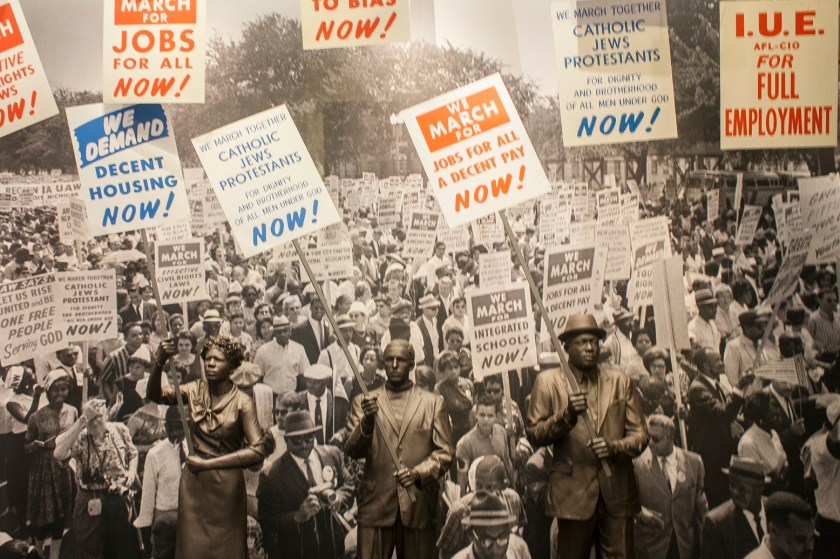
The slave trade lasted about 366 years, and we were able to see the process of change in America through the museum’s many exhibits. The exhibits were displayed in order beginning with the Montgomery Bus Boycotts…
Lorraine_Motel_Exhibit_4_Web

…followed by Freedom Rides, and the decision in Brown v. Board of Education.

Lorraine_Motel_Exhibit_5_Web

The final exhibit included the two hotel rooms where MLK was staying at the Lorraine Motel when he was assassinated.  The rooms have been restored to what their actual state at the time, including a clear view of the balcony where he was assassinated.

Lorraine_Motel_Exterior_Web

After touring the National Civil Rights Museum, we made our way through a stretch of decorative Memphis buildings to Gus’s World Famous Fried Chicken. We were astonished by how many visitors were crammed inside the small building. With elbows grazing, eager tourists and locals ready to indulge in the restaurant’s signature hot and spicy fried chicken, we LEAPsters pondered whether this chicken was worth the claustrophobia. As tables were cleared and re-filled and waiters rushed through the cracks of the narrow table arrangements, we took our seats.

Soon after ordering, our waiter made his way towards us with an arrangement of fried chicken, coleslaw, fried pickles, beans, fried okra, and seasoned fries hovering over his hand. As his arm motioned this behemoth lunch to float down to the table’s center, our senses where overwhelmed by the scent of fried heaven. Our hunger took hold of us, and after taking a second to strategize distribution of our food, we went through legs, wings, and breasts until there was only left some bones and a some shavings of breaded fibers. Each bite was an experience in itself, with the spice piercing, but not stabbing, at every taste bud, the layer of breading just right. It was clear that this meal was not the typical greasy chain-restaurant type of fried chicken. As our empty plates were lifted and our tables cleared it seemed that we were in need of more bites from this joint’s menu. We satisfied this with a shared slice of chess pie – the sweet, creamy treat was perfect to send us off onto our next Memphis adventure.

Memphis, also known as “Home of the Blues” and the “Birthplace of Rock and Roll,” boasts a small gem that has contributed to music we love and cherish, Sun Studio.

Sun_Record_Studio_Exterior

Sun Studio recorded legends during the 50’s and 60’s that most of us still know and love. After a bit of looking around on our own…

Sun_Record_Studio_Kaitlyn_Megan_Web

…and going through old records…

Sun_Record_Studio_Ryan_Web

To begin the tour, we learned about Sam Phillips, founder of Memphis Recording Services, which later became Sun Studio. Phillips originally opened the recording service using only a tape recorder to create recordings! Phillips primarily recorded blues music with artists like Howling Wolf, country music with a familiar name, Johnny Cash, and later transitioning into rock-n-roll with names like Jackie Brenston.

Sun_Record_Studio_2_Web

Even though many legends got their big break at Sun Studio, the fact that the most famous star to get his start at Sun Studio was Elvis Presley is hardly ever argued. In 1952, Memphis Recording Services transitioned to Sun Studio and began producing their own labels. Shortly after graduating high school in 1953, Elvis recorded his first tape at Sun Studio with a sliver of hope that he would be “discovered” by Sam Phillips. It took time for Elvis to win over Phillips, who was interested mainly in blues music, but with a push from Phillips’ secretary (who actually recorded the future “King of Rock-n-Roll”), he finally decided to give Elvis a chance.

Mixing old blues and country, a combination that hadn’t been experimented with yet, Elvis finally got his shot when his song (“That’s All Right (Mama)”) was played on the radio one afternoon in Memphis. The radio station’s phones were ringing off the hook.  Finally, Sam Phillips knew that he had someone special in his studio.

We visited the actual studio where Elvis recorded his music, on the last part of the tour.  Our ears were ringing with joy while listening to the original recordings of some of Elvis’ songs! Carl Perkins, Johnny Cash, and Jerry Lee Lewis were also discovered by and signed with Sun Records. Known as the “Million Dollar Quartet,” or the “Class of ‘55,” these four musicians would all shine fame on Sun Studio.

To end the tour, we had the opportunity to take pictures with the only original piece of equipment left from the heyday of Sun Records, a microphone that was most likely used by the members of the “Million Dollar Quartet,” and Elvis himself!

This slideshow requires JavaScript.

In the spirit of historical research–which has nothing to do with the fact that she finds him handsome–Megan searched out a  photo of Elvis to pose beside.

Sun_Record_Elvis_Megan

After rolling through the ages, the spirit of rock-n-roll stayed with us as we headed to Nashville and the Cheekwood Botanical Garden and Museum of Art. We began with the art museum in the Cheek mansion, which is not only large and beautiful, but is also graced by a large Steve Tobin sculpture in the front yard.

Cheekwood_Tobin_Daylight_Ambassadors_Web

The home was previously owned by Leslie and Mabel Cheek from 1933-35. Their daughter, Huldah Cheek Sharp, then offered the home to be used as a botanical garden in the 1950s. Now, the mansion is home to and furnished with many elegant works of art.

The current exhibit allowed us to roll through the various ages of art, from American Impressionism to abstract work. Also, like musicians’ attempts to provoke sensations in their audiences, these artists’ works are a direct translation of their life experiences — evident throughout the museum. Perhaps most interesting to us was a chandelier by Bruce Munro, an artist we saw at the High Museum of Art in Atlanta last year…

Cheekwood_Munro_4_Web

The compositions that filled the 55-room home were moving and memorable. Artists such as Childe Hassam used impressionistic paintings of nature that struck a different chord with art enthusiasts and provided a lasting respect for self-interpreting environmental art.

Megan: “My favorite painting was called, “Outskirts of East Gloucester.” The loose brushstrokes of a countryside brought a sense of home to me and happened to be a theme of the Cheek mansion. How often does one have the opportunity to look at beautiful art in a beautiful mansion? The garden and museum were definitely a “top hit” with the LEAP Ambassadors.”

Cheekwood_Painting_1

Still in the spirit of rock-n-roll, we began rocking the trails in search of the Carrell Woodland Trail’s sculptures (pun fully intended). The botanical garden was beautiful. Instead of arrangements of beautiful flowers, the parts we visited reminded us more of a state park. With cedar trees standing tall and proud, the sweet melody of the birds chirping and the cicada drone, we meandered across the trails looking for the sculptures.

As part of the trail, we passed the Cheekwood Prime Matter, Untitled, Steeple Dance, and Glass Bridge, among others.

Cheekwood_Siah_Armajani_Glass_Bridge_2_Web

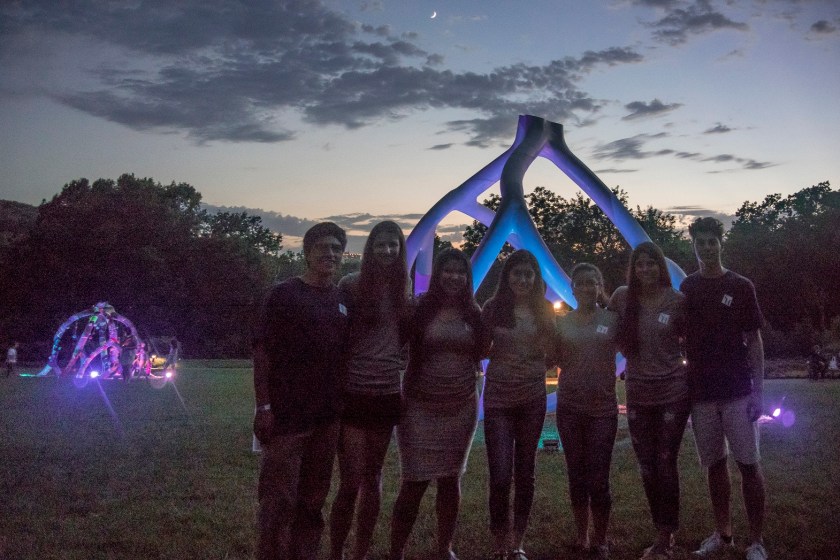
Last on our list was James Turrell’s Blue Pesher. The whole purpose of this chamber was to create a space where one could reflect by making their perceptions more sensitive. We sat inside, staring up the hole in the ceiling, into the sky, pondering on how to face the music of our lives. As the plaque outside the Blue Pesher puts it, “In this room, discover a commentary on the heavens and what it looks like from the inside of the chamber.” (Interestingly, “commentary” is the definition of the Hebrew pesher.)

Cheekwood_Turrell_Skyscape_Web
The sky at dusk as seen from the floor of Turrell’s Skyscape, Blue Pesher

With the sunset, the symphony within ourselves had to come to a slow and soft end, as the sky could no longer be seen. We headed back to the van knowing that the melody in our hearts had been heard and that our self-perspectives would be seen in a new light.
Cheekwood_Tobin_Ambassadors_Moon_Web

To continue enjoying our Nashville evening, we had dinner at Mitchell Delicatessen. Housed within a wooden facade that resembled a country home, the deli offered an eclectic assortment of sandwiches. From tofu to BBQ brisket to a Tennessee Tuna Melt to an Asian flank steak, it was a challenge to narrow down which to choose.

Megan: I chose the Asian flank steak. This renowned deli magnum opus (which was apparently featured in the Travel Channel) was unlike any other sandwich I had ever had the honor to taste. With steak smothered in provolone cheese on a bed of sliced bell, banana pepper, celery, carrots, and olives, this deli delicacy was enough to send my palate down a ride of flavorful delight. To make the experience even more interesting and add tad of an effervescente ride, my meal was accompanied by one of the eatery’s own draft cola.

We rounded out our second day of the trip with a very satisfying repast from Nashville’s culinary spectrum and headed to our hotel for a good night’s rest.

Cheekwood_Steve_Tobin_Moon_Web

Midwest, Day One: Big Time in Little Rock

Our Saturday morning began as a cold, rainy day, but we did not let that put a damper on our morning. We ventured into River Market for breakfast to kick start our day. I had the meaty melt omelet from Sweet Soul that quickly satisfied my hunger, Constance had the southwest omelet, and Professor Yawn had grits. Fueled by calories, we made our way to Little Rock Central High School and the nearby Little Rock Central High Museum, where we experienced history and learned more about the civil rights movement.

Little Rock Central High

Little Rock Central High School was once known as “America’s most beautiful high school” because of its blend of art deco and gothic revival architecture.

LRCH_Constance_Alex_WebWe were impressed with the message that the school sent to its students in the architecture itself.  In addition to the beauty of the structure, the front of the building is adorned with four relief statues, each corresponding to a different quality.  The qualities are: Ambition, Personality, Opportunity, and Preparation.

LRCH_Web

After admiring the architecture and taking additional photos of us on the steps tread by the Little Rock Nine…

LRCH_Constance_Alex_Closer_Web

…and making use of the beautiful colors around us…

Constance_Alex_Umbrella_Web

…we made our way to the visitors center where The Little Rock Central High School Museum is located. The museum highlights The Little Rock Nine, who were the nine African-American students chosen to be the first to integrate Little Rock Central High School. The museum had plenty of information on the crisis of 57’ that was shown in different ways.   As with most museums nowadays, it offers interactive experiences, with an entrance showing three screens, each with different information.

LRCH_Entrance_Screens_WebAmidst a discussion of the constitutional background of integration and the equal protection clause, we were reintroduced to the four qualities emphasized by Little Rock Central High: Ambition, Personality, Opportunity, Preparation.

LRCH_4_Web

My favorite section of the museum was a station with a telephone receiver and a small video screen that showed the events that happened during the desegregation of Little Rock Central High School, as told by the Little Rock Nine themselves.

LRCH_Alex_Phone_Medium_Web

The videos went into detail of what the first day, September 4th was really like, and how they felt that day and every day after. The first person perspective from the museum gave plenty of insight as to how chaotic and difficult it was to desegregate the high school in 1957. The Little Rock Nine described everything they went through which included: having rocks thrown at them, begin beaten up, the verbal abuse, the threatening phone calls to their homes, and the white people who wanted to be their friends but were too scared.


The Old Mill

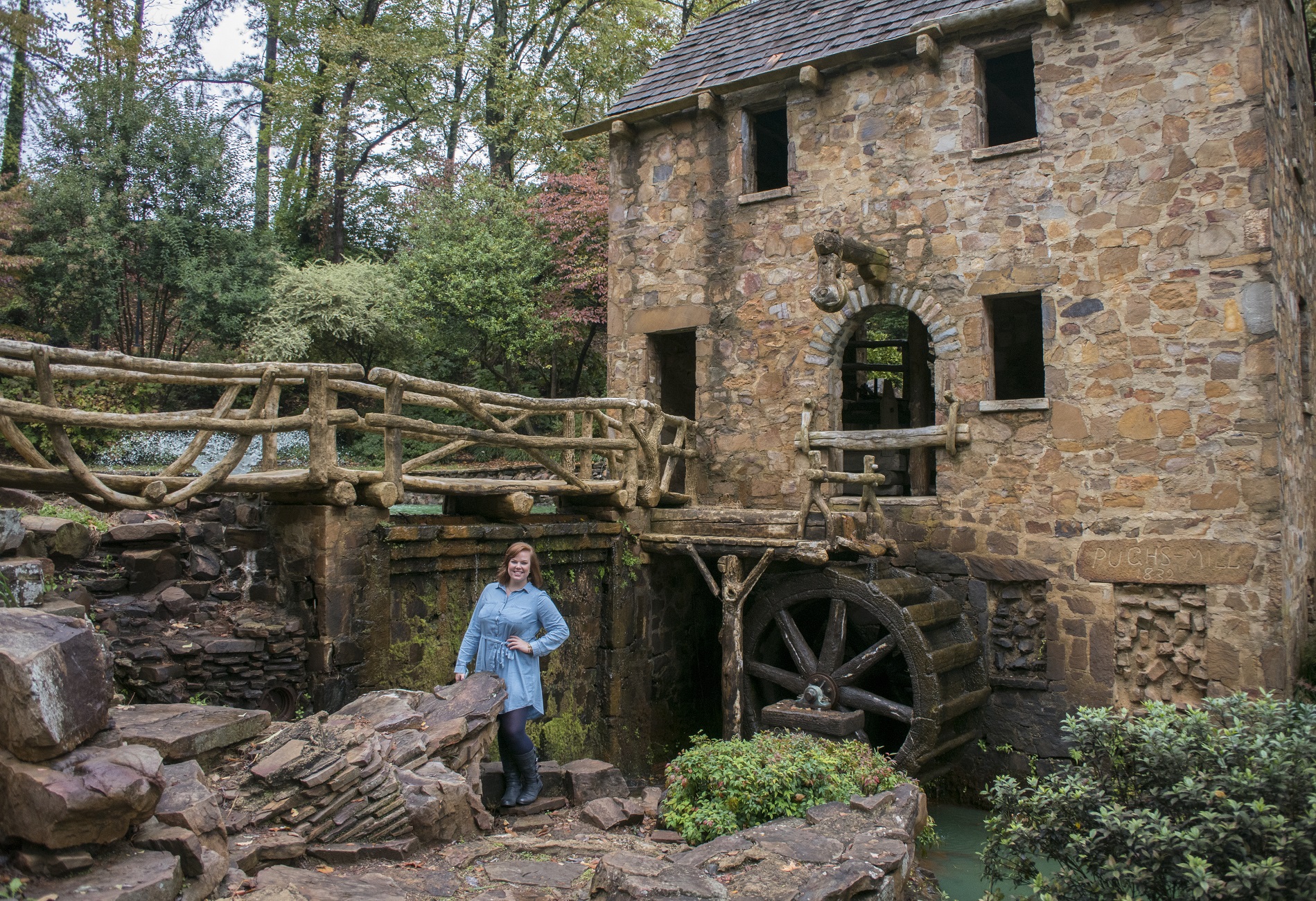
After leaving Little Rock Central High, we headed to “The Old Mill,” the last surviving set from Gone With the Wind.

Old_Mill_Bridge_View_Web

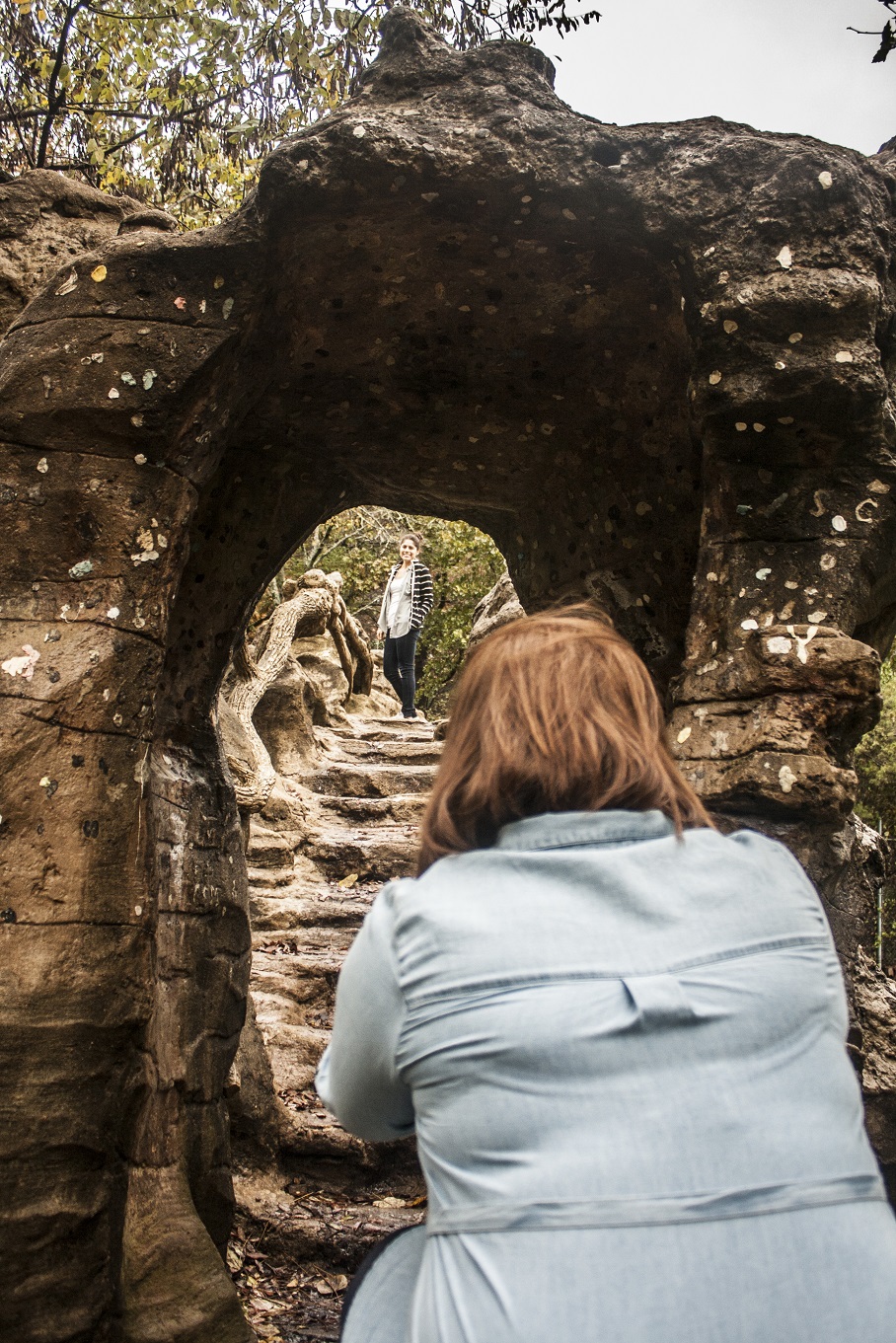
The Old Mill is known for being the last surviving piece of the 1939 film, Gone With the Wind. The Old Mill at T.R. Memorial Park was truly breathtaking, and definitely a site to see. We were welcomed by the trees that were changing colors due to the season, which made The Old Mill look even more picturesque than expected. The park is decorated with tree-entwined bridges that at first glance look like real trees, but were really constructed out of concrete by Senor Dionico Rodriguez. We were able to climb the tree-entwined bridge that crossed over the water and walk into The Old Mill.

Rock_Alex_Constance_Web

It’s difficult to describe the beauty of the Old Mill.  In addition to the Mill itself…

Old_Mill_Constance_2_Web…there is the stone cabin with open windows, perfect for photographs…

Old_Mill_Constance_Alex_Web…and the concrete, faux wooden bridge was a perfect prop for photographs, such as this one…

Old_Mill_Constance_Alex_Bridge_Web…or this one…

Old_Mill_Alex_Constance_Bridge_Closer_Web… or this one…

Old_Mill_Alex_Constance_Bridge_2_Web

There are also some interesting some side areas in the park.  We were able, for example, to climb up…

Alex_Well_Web

and into a well.

Constance_Alex_Well_2_Web

Which, as our professor noted, is one of the reasons we sign waivers before going on trips.


Lunch

After taking advantage of the picturesque environment we made our way to Whole Hog Cafe for a delicious lunch.

IMG_0928One of the best things about Whole Hog Cafe is that they have six different types of BBQ sauce on the table.   This allows guests to sample the flavors and then go with their favorite choice.  For our table, # 5, “Sweet, Dark, And Bold Molasses Flavor,” was the favorite.


Arkansas Arts Center

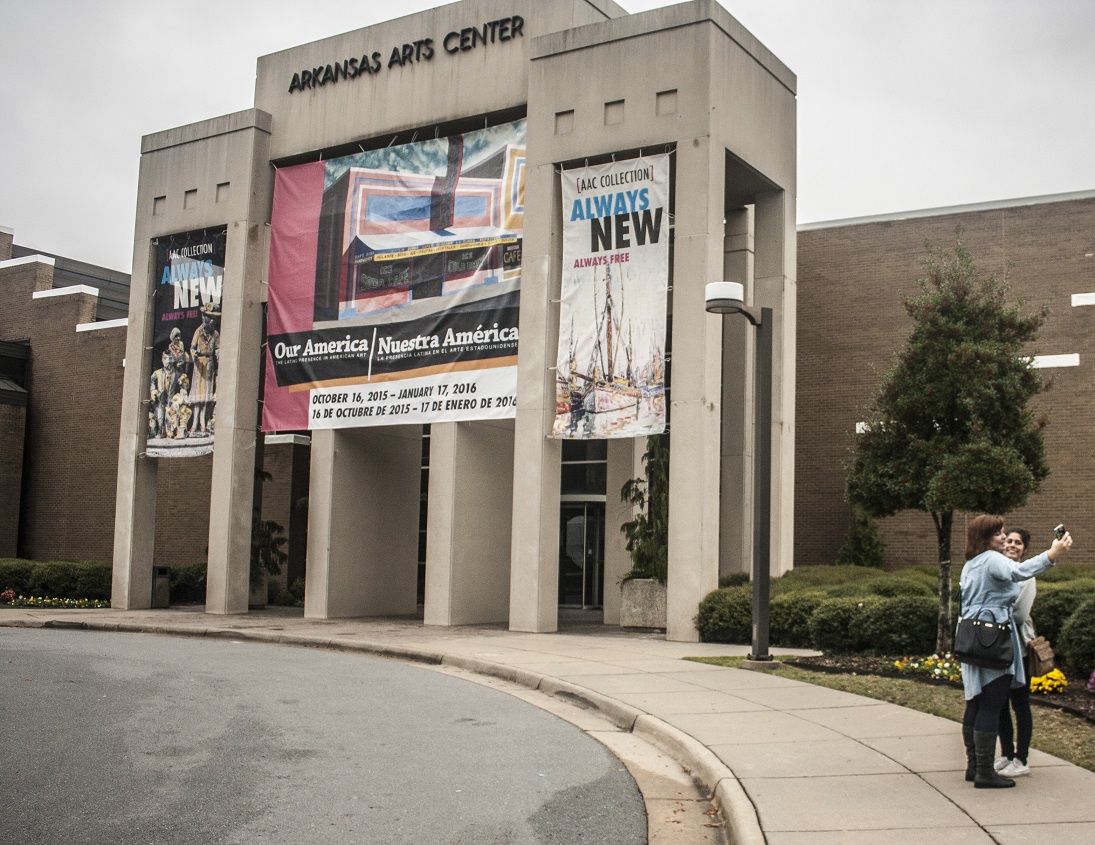
Following lunch, we made our way to a fine jewel in Arkansas culture, the Arkansas Arts Center.

Arkansas_Arts_Center_Constance_WebHome to more than 600 years of art, the Arkansas Arts Center proved compelling from Our America, the Latino exhibit on loan from the Smithsonian, to its permanent collection.

We had the pleasure of being escorted through the Latino exhibit by a museum docent who pointed out the intricacies in the portraits of the exhibit. Our tour began with a viewing of two side-by-side portraits by Scherezade Garcia, named The Dominican York, and Santo Trujillo is Dead.

Garcia_Art…which our tour guide believed were distinguished largely by tone…

Garcia_Art_2

Inspired by the struggle and aspirations of immigrants traveling to the states from their homelands, Garcia’s work mixed a compelling use of sequins, charcoal, ink, and acrylic to portray the hardships and opportunities immigrants encountered on their journeys. Next, we stopped at a painting by Juan Sanchez titled Para Don Pedro.

Sanchez_Art

The collage paid homage to Pedro Albizu Campos, a politician and leader in the Puerto Rican Independence Movement. Although beautiful in its own right, we found the work to be a bit too abstract and overwhelming to enjoy, comparatively, but were interested in the concepts.  Moving on, we viewed two pieces by New Yorker, Elia Alba called Larry Levan (snake) and Larry Levan (three is better than one).

Alba_Art

Alba_Art_2

Ms. Alba sought to display the incongruity between the third culture of immigrants and Hispanics in the United States with the American culture, seen in the awkward joining of faces to mismatched bodies. For the viewer, the works evoked discomfort due to lack of aesthetic beauty, much like the discomfort felt by those of different cultural backgrounds during the Civil Rights Movement. After viewing a few more works, notably a sculpture by Luis Jimenez,

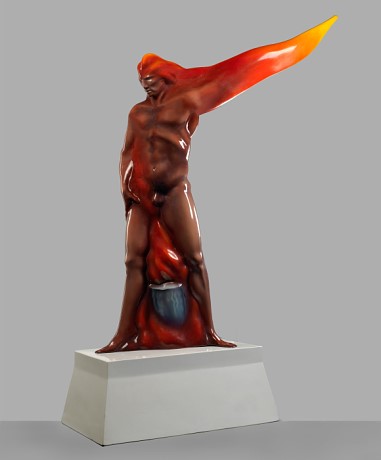
Jiminez_Art

Man on Fire, who taught notable Huntsville artist Jesus Moroles, and being surprised by a sculpture by Mr. Moroles himself, Georgia Stele

Moroles_Art
We bid adieu to our docent and set off to spend a few quick minutes exploring the permanent collection. Considering anything in Arkansas to be a “jewel” would be hard to those not knowing what the state has to offer. That said, the Arts Center happens to be home to many world-renowned artists, Monet, Renoir, Picasso, and Rembrandt to name a few. We particularly enjoyed Monet’s Effet de soleil couchant, Port-Villez (Effect of the Sun Setting, the Seine at Port-Villez)…

Monet_AR_Arts_Center_Web

….full of dark purples and greens to catch the eye, and Picasso’s Aureau ailé contemple par quatre enfants (Winged Bull Gazing on Four Children), depicting children being frightened by an almost dragon-like bull.

Constance_Picasso_Alex_Web

Needing to make it to our next destination on time, we hurried out of the Arkansas Art Center after only spending very little time in their exhibit halls. Impressed by the collection in a state that does not get much cultural street cred, we left intrigued and hopeful to discover more famous artists at our upcoming art destinations.


Bill Clinton Presidential Library and Museum

Full from our saucy lunch at Whole Hog Café, we drove back into Little Rock proper to explore, quickly I might add, the Bill Clinton Presidential Library and Museum. The 42nd President of the United States, and 42nd Governor of Arkansas, President Clinton was long-time resident of Little Rock, having grow up here and also served as Attorney General and Governor of the state.  As President, Clinton promised to be a “bridge into the 21st century, and the Clinton Museum reflects that metaphor, standing almost suspended over the ground and toward the Arkansas River.

Armed with a little less than an hour, Alex and I took off up the escalator to explore as much as possible in such a short time. Confronted with columns on each side of both floors and exhibits interspersed between, we learned that the museum was modeled to copy The Long Room at the Trinity College in Dublin, Ireland.

Clinton_Library_Long_Room

We were surprised to also find a Dale Chihuly piece, Crystal Tree of Light, inside. It was one of two that was made for the White House Millennium celebration held on New Years Eve in 1999. After being hung in the White House, one of the pieces was donated to the Clinton Presidential Foundation in 2004 and resides permanently in the library now.

With less time available, we read about Clinton’s accomplishments as president, his work in Foreign Service, including the many State dinners he held, and the First Lady’s work alongside her husband. Inspired by the power President Clinton held, even Alex was caught day dreaming about one day being a cabinet member to influence great change in our country.

Cabinet_Table

We ran out of time in the library to really grasp all that President Clinton’s time in office is known for but were impressed by the vast information made available by the museum and the organized nature of it all. Exhilarated by the change enacted between 1993 and 2001, we made our way back into the rainy weather to, hopefully, tour Little Rock by Segway.


Little Rock Segway Tour

We’ve segwayed quite a few cities: Dallas, Austin, Oklahoma City, New Orleans, and, now, Little Rock, AR.  It’s hard to pick a favorite from among these, but Little Rock ranks high on this list because it’s such a picturesque city.  The views were complemented by our knowledgeable and laid-back tour guide, Henry Barker.

Barker took us to the Clinton Presidential Library, along the Bill Clark wetlands preserve, to Heifer International and, even though we had seen many of these areas, he filled in details we didn’t know.  Heifer, for example, won a Platinum rating from LEED for using mostly recyclable materials and because the materials came from within 500 miles of Little Rock.

Segway_Heifer_WebAnd when segwaying along the Bill Clark wetlands area, we saw an egret.

Egret_Web

The most fun, however, came when we glided along the river market area.  We saw the many sculptures along the riverway…

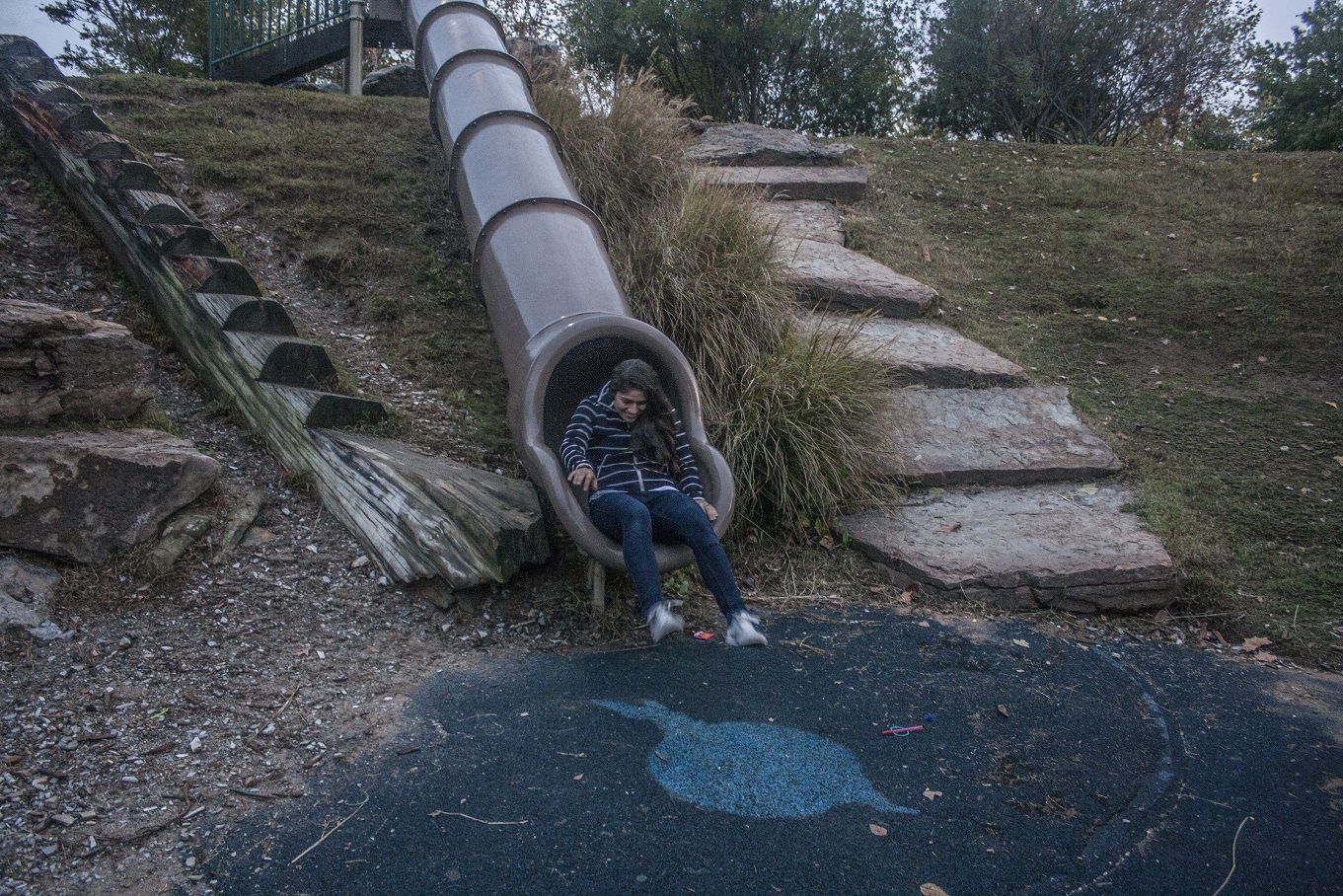
Segway_Alex_Constance_Stephanie_Web…stopped for a bit to play on Little Rock’s amazing playground, which has a high-speed slide…

Slide_galvan_Webb…a tunnel system, which Alex took to like an enthusiastic groundhog, and a spider-web jungle gym…

Spider_Web_Constance_Alex_Web

Spider_Web_Alex_WebWe also spent some time at the H. U. Lee International Gate and Garden, which honors H. U. Lee, the founder of the American Taekwondo Association.  Strangely, Mr. Lee decided to settle in Little Rock because it reminded him of South Korea.

Lee_Pavillion_Web

We also stopped to let our friends and fellow members of LEAP that we wished they were here with us.  So, Austin, Karla, Kaitlyn, Jazmin, Beatriz, Caitlin, Bella, Brian, Jamaus, and Megan, we wish you were along with us!

Constance_Alex_Greetings_Web


Dinner and Moving On

After a day of touring the city, we had worked up a hunger, and there’s no better place to eat in the River Market area than Sonny Williams.  We began our meal with an appetizer of Elk and Alligator, and followed it with Lamb Chops and Creole Seafood.

And with all that food in us, we decided to take one last walk along the river market area.

Junction_Bridge_Sculpture_Night_WebThe bridges were washed in orange colors, in honor of Halloween.

Junction_Bridge_Night_WebAnd the beautiful view of Little Rock from one of its seven bridges made for a memorable way to end a memorable day.

Little_Rock_Skyline_Web