As the LEAP ambassadors’ research drew to a close, still more adventures await them on the road. Although the various activities we got to engage in on the way to Detroit were elucidating and interesting, the true focus of our trip was as stated previously, to help Jeff Guinn in researching the Vagabonds.
For that effort, from Monday to Thursday, we followed the same routine; getting to the Henry Ford Museum’s research library around 9 a.m., researching for a few hours, getting lunch with Mr. Guinn and Mr. Fuquay, researching some more, and finally spending an hour touring the museum or the adjacent Greenfield Village.
This was a phenomenal opportunity to see a best-selling author in the research environment. Additionally, we got to hear many stories and see many amazing artifacts.
Research
One highlight was being taken back into the conservation section of the Henry Ford, where we were shown a Lincoln refrigerated truck that was being restored.
1922 Car Used by Vagabonds
Incredibly, this was the very refrigerated truck that Henry Ford, Harvey Firestone, and Thomas Edison had taken along with them on a few of their camping trips! We got to stand next to real history, and see how the team of the Henry Ford is working to preserve and restore such artifacts for future generations to enjoy.
Another special treat was being able to help Jeff Guinn pick out pictures for his book from the Henry Ford’s digital collection.
Reviewing Vagabonds Photographs for Mr. Guinn’s Book
We sat down and looked through 231 pictures, narrowing these down to about 40. Mr. Guinn will look through other sources before settling on which ones he wants to see appear in the book. At that point, the marketing team for Simon & Schuster, Mr. Guinn’s publisher, will dissect his choices, and they will make the final decisions.
During our breaks, where we could wander freely in the museums. Following our first day, which we spent focusing primarily on the Beatles Exhibit and automobiles in the Henry Ford Museum, we spent the last couple of days looking over planes, civil rights exhibits, Americana, and even furniture.
Henry Ford Museum
But this was no ordinary furniture; many of the pieces were owned by highly accomplished gentlemen. We saw a desk used by Edgar Allen Poe for most of his adult life, for example. It is possible that some of the stories and poems that are so loved today, like “The Raven,” “The Telltale Heart,” or “The Pit and the Pendulum,” were scribed at this very desk.
Edgar Allan Poe’s Writing Desk
We also got to see John Hancock’s card table and Mark Twain’s writing table!
Mark Twin Portrait & Writing Table
In the planes section, the Museum had a replica of the Wright Brothers’ plane…
Replica of Wright Brothers’ Plane
…and a little known Ford plane, which never really proved successful commercially.
Ford Company’s Unsuccessful Plane
In the Americana section, they had a copy of Thomas Paine’s “Common Sense”….
Thomas Paine’s “Common Sense”
… and the chair in which Abraham Lincoln was sitting when he was assassinated.
The Abraham Lincoln from Ford Theater
As the above suggests, some of the artifacts were unusual, even unsettling.
On a more inspirational level, the Museum had the bus on which Rosa Parks refused to take a back seat, both literally and metaphorically.
The Bus on Which Rosa Parks Refused to Take a Back Seat
Amazingly, people were even allowed to sit in the seat she refused to relinquish. The Museum also had guidelines of the “Montgomery Improvement Association” (led by Martin Luther King, Jr.) distributed to African Americans which helped them stand for their rights without putting themselves or others in undue danger.
Wrapping Up
Finally though, Thursday afternoon rolled around, and our time at the Henry Ford drew to a close. We said our goodbyes to Jeff Guinn and Jim Fuquay while thanking them for giving us the opportunity to work with them for a week.
L-R: Jim Fuquay, Brian Aldaco, Jeff Guinn, Paul Oliver
Besides being a great researcher and a great teacher, he is a very personable and amiable man, who really does love his work. The joy he takes in his research is reflected in both his books and in his interactions with others. After spending a week with Jeff Guinn, you can’t help but be interested in whatever subject he’s writing about!
Sad to leave Savannah, we awoke early this morning before sun rise to begin our travels. Montgomery was our first destination of the day. Before heading into the city, we visited Liger’s Bakery for sweet treats to kick off the day. For a few of us, a doughnut was a perfect way to boost our energy after little sleep.
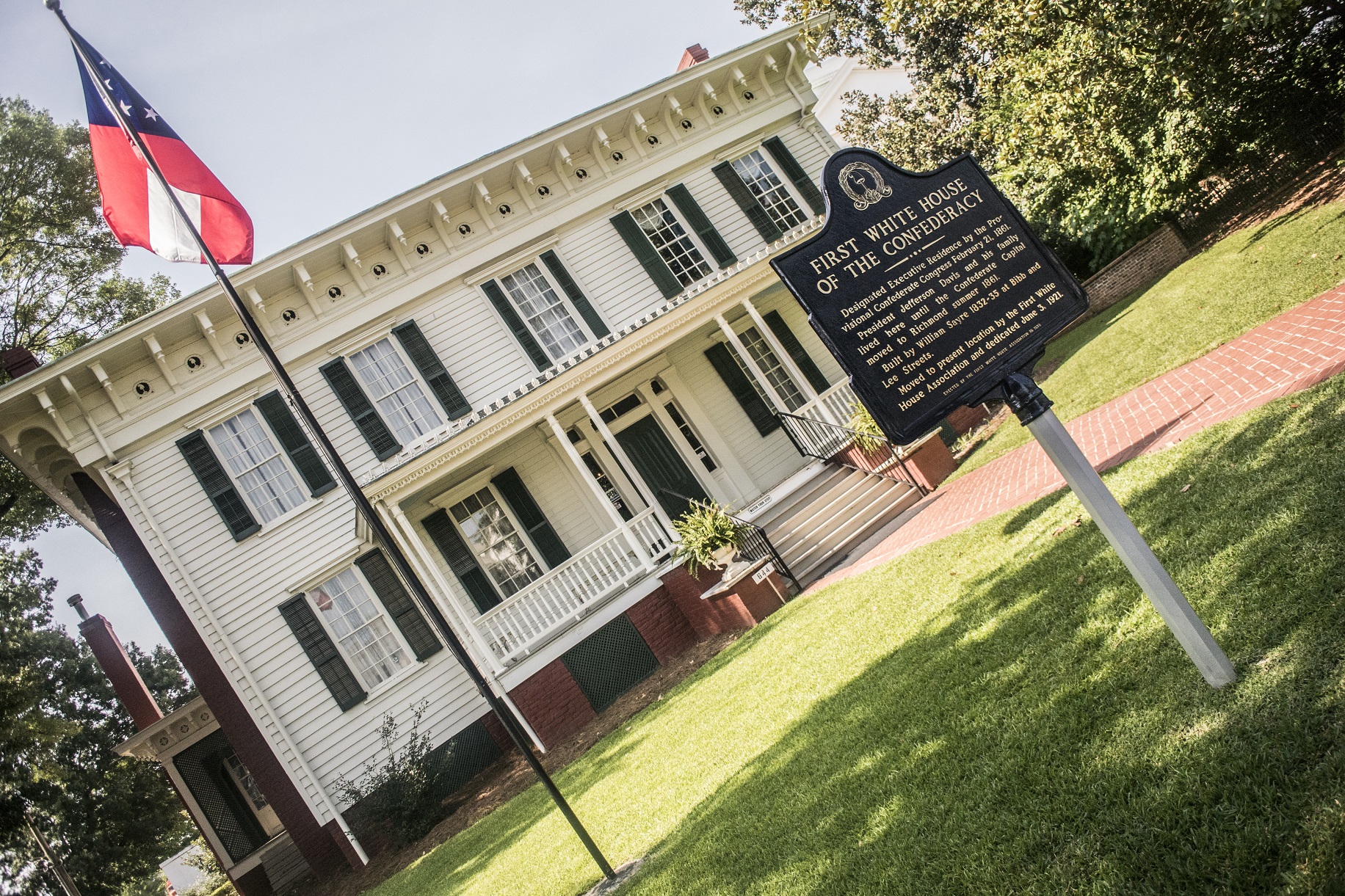
Once chosen for its central location within the Confederacy and for its easy access to travel routes, Montgomery was the perfect place to build the first Confederate White House during the Civil War. Since then, the building has been moved to its new location on the South side of the Alabama State Capitol. President of the Confederate White House, Jefferson Davis and his family lived in the home from the time it was built in 1835 until the time the Confederate Capitol was moved to Richmond in 1861. The home showcased two bedrooms, the First Parlor, the Second Parlor, the Dining Room, and the President’s Study. The first of the two bedrooms was Jefferson Davis’s bedroom which included artifacts from throughout his life, such as his slippers and Bible.
Another interesting room, the President’s Study contained many pieces of furniture used by Jefferson Davis and was a room where many important decisions were made for the Confederacy. Amidst the current controversy surrounding the Confederate Flag, the Confederate White House in Montgomery seemed unbothered by the dispute and fit in with the surrounding landscape with the capitol.
Against this strong backdrop of confederate history, more modern history also played out in Montgomery–the civil rights movement. Rosa Parks was a thriving civil rights activist along with Martin Luther King Jr. and Reverend E.D. Nixon. She was born and raised in Tuskegee, Alabama. Because her mother was an educator, she was taught to read and write and later attended the city Industrial School for Girls.
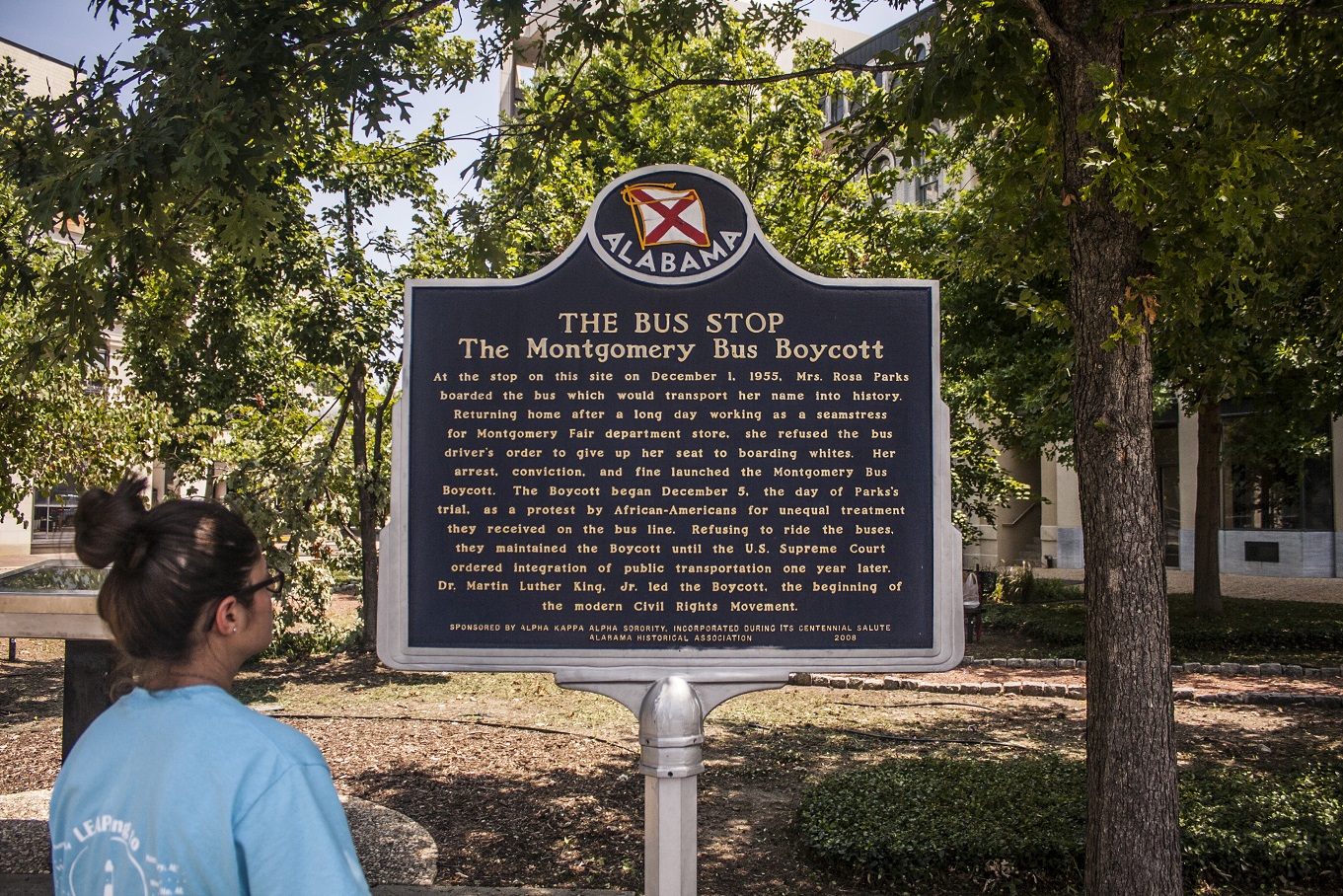
We had the opportunity to not only visit the museum dedicated to her and the history she impacted, but also the exact spot Rosa Parks boarded the segregated bus…
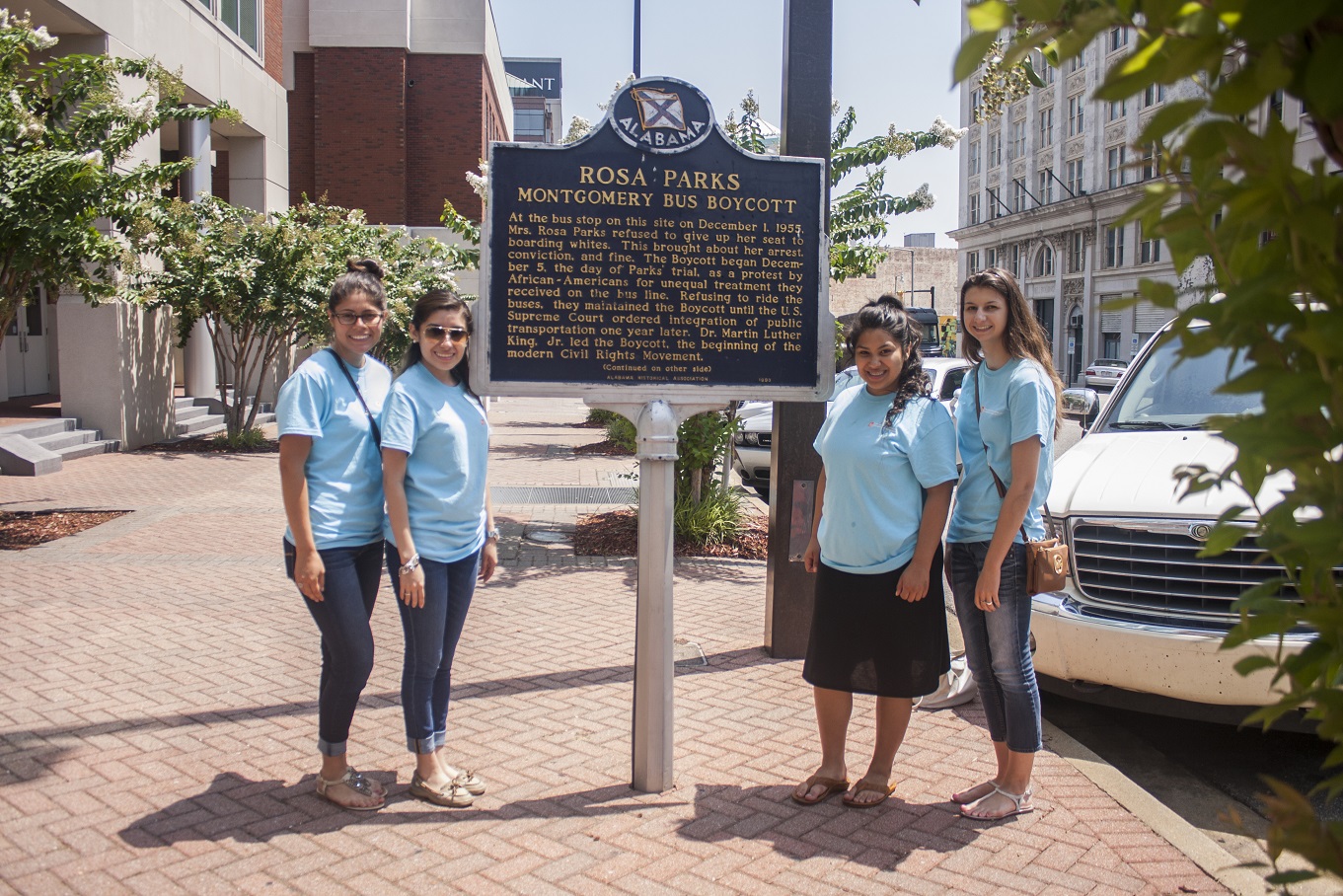
…and the bus stop where she was arrested.
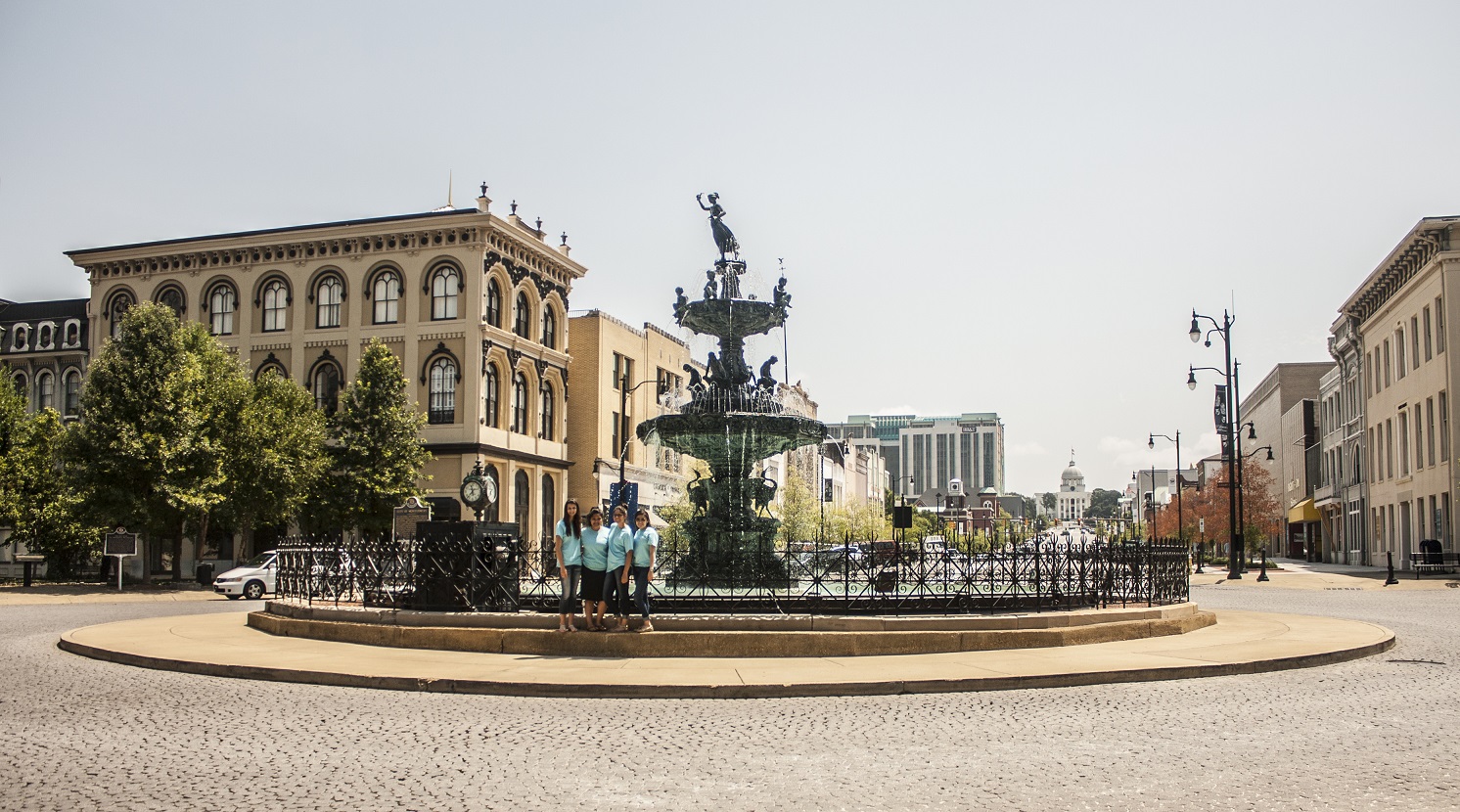
The Rosa Parks Library and Museum tour began with background history of Mrs. Rosa Parks and her involvement in the Civil Rights Movement. She was the secretary of the NAACP and worked very closely with Dr. King and Rev. Nixon in the nonviolent protest for equality. Mrs. Parks refused to give up her seat on the bus and was arrested. This was a transition point for the state of Alabama and segregation laws. This also prompted the Bus Boycott that caused the bus companies to lose thousands of dollars. In order to support the boycott African Americans refused to ride the bus, so they walked or carpooled around town. This boycott lasted 13 months until justice was served. Rosa Parks was the perfect example of using educational and spiritual guidance to seek justice. Her and many other Civil Rights leaders have paved the way for many Americans today. Following the tour of the museum, we walked across the street to stand at the spot she was arrested. It was an honor standing in a place where a brave woman had made up her mind to be treated nothing less than equal. With conviction and respect, we stood reflecting upon how different America would be today without Rosa Parks contribution and leadership in the Civil Rights Movement. Time was running short so we made our way to visit the Alabama State Capitol, after briefly checking out some of the beautiful architecture, art, and history in the downtown.
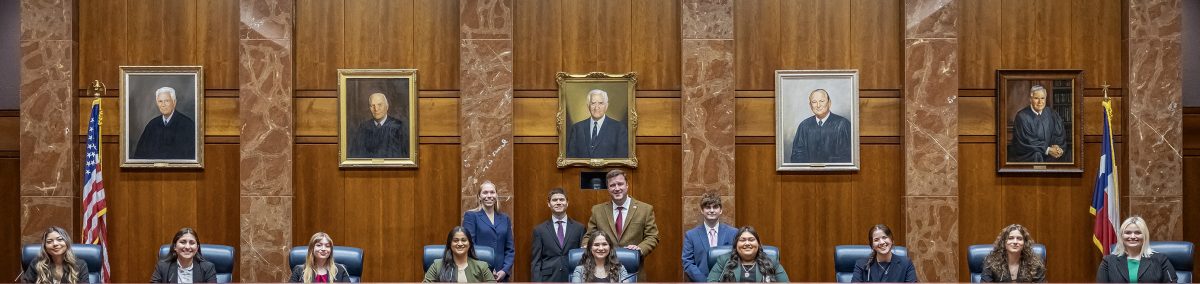
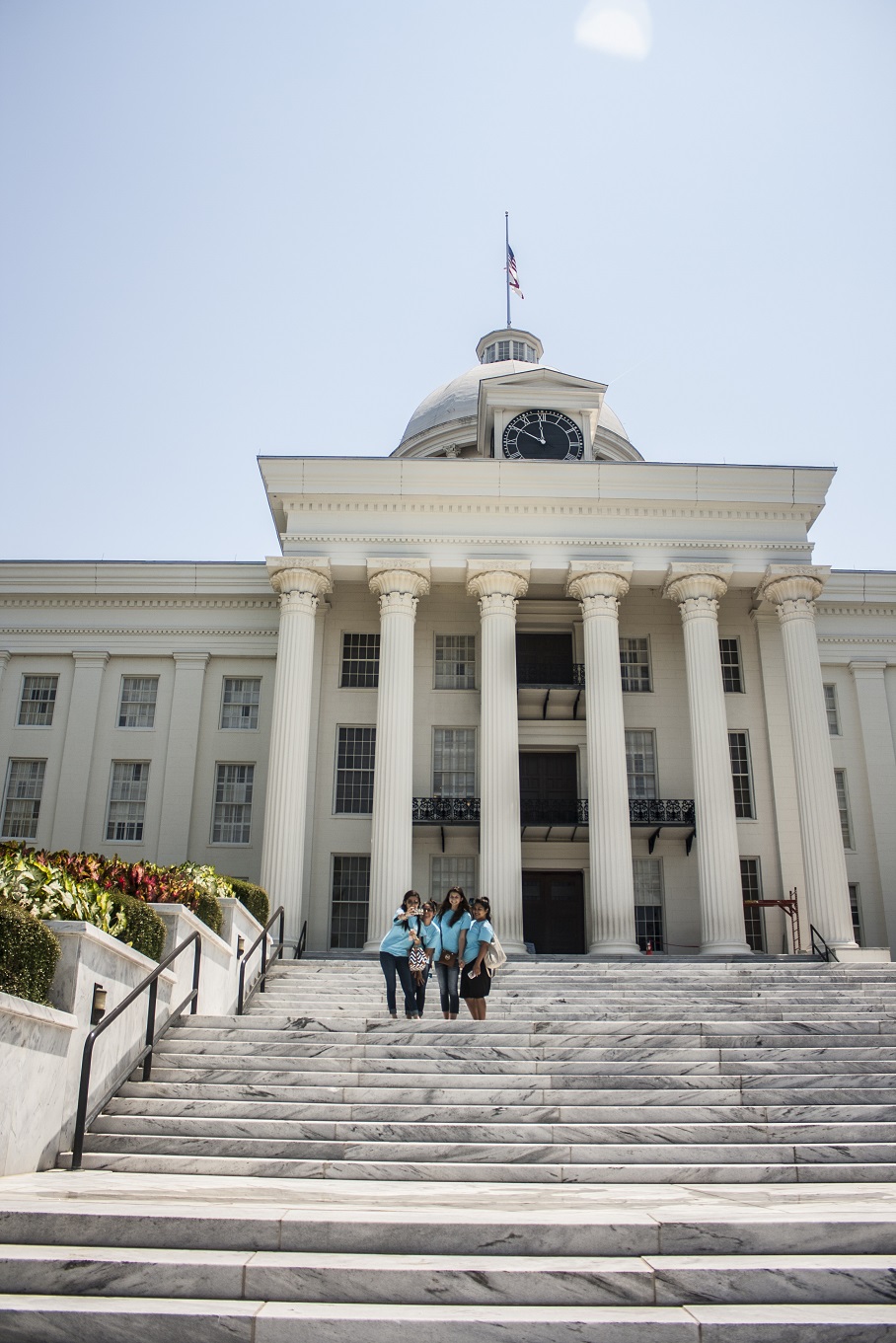
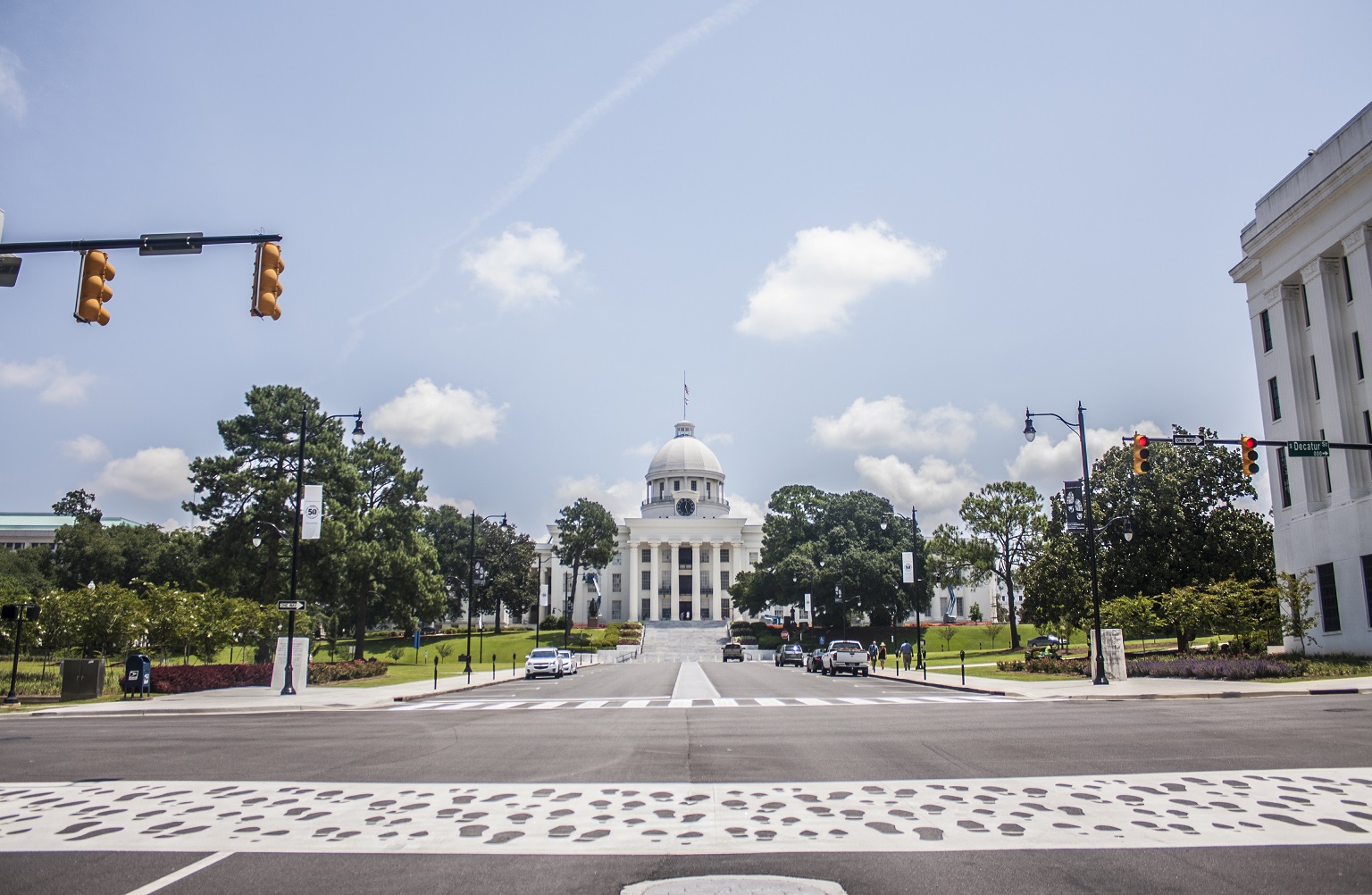
Architecturally, the Alabama State Capitol modestly resembles the United States White House.
Much smaller than the Texas State Capitol, many offices have moved out of the main Capitol building and into various buildings bordering the Capitol building.
Our self-guided tour began in the Governor’s Hall, a common feature of state capitol buildings. Here, we admired the portraits of previous Alabama Governors leading up to the current Governor’s office. Also, on the first floor we were able to see the previous Supreme Courtroom which has now been converted into a World War Memorial. On the second floor, the previous House and Senate Chambers are now open for public viewing.
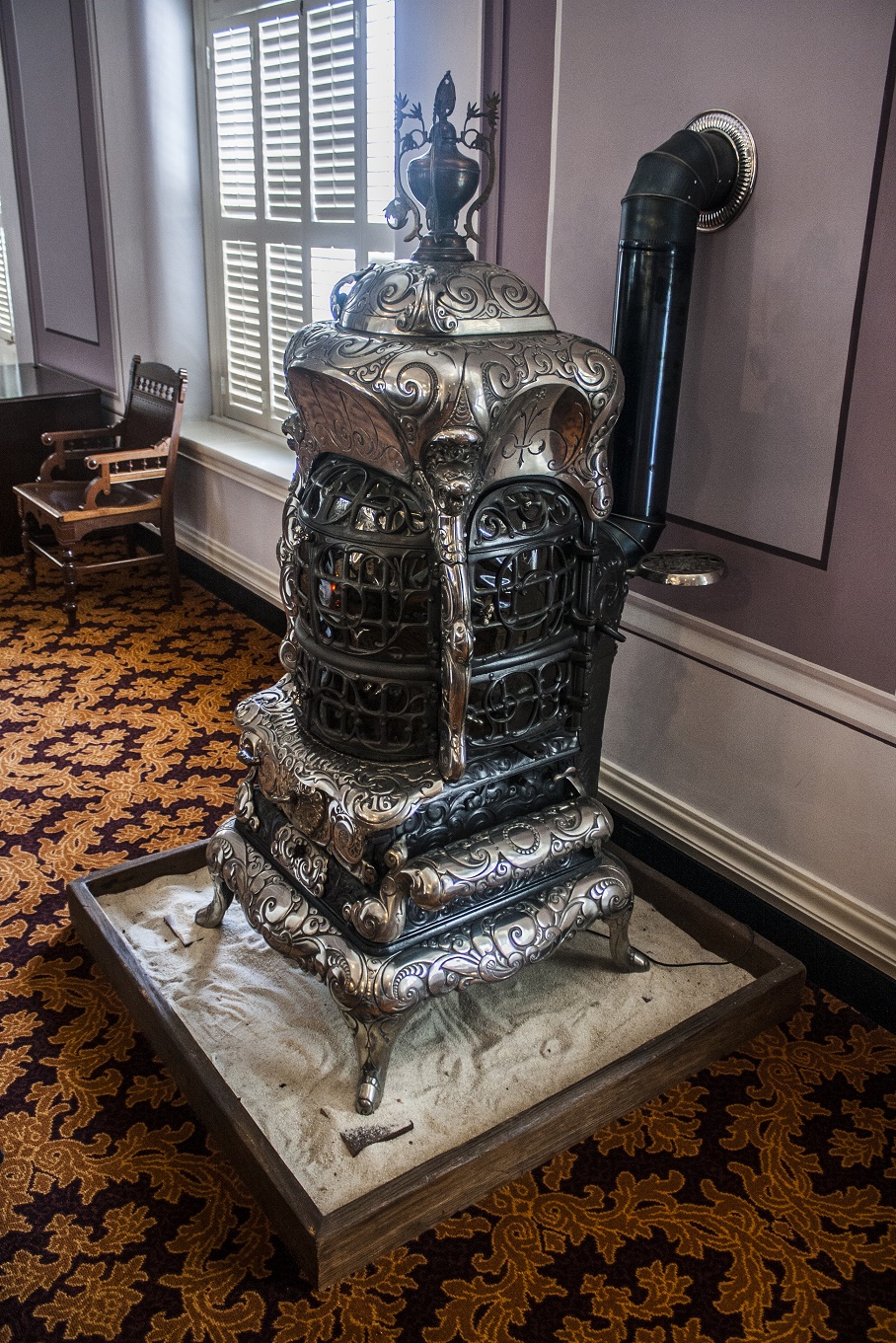
Stove in AL House of Reps
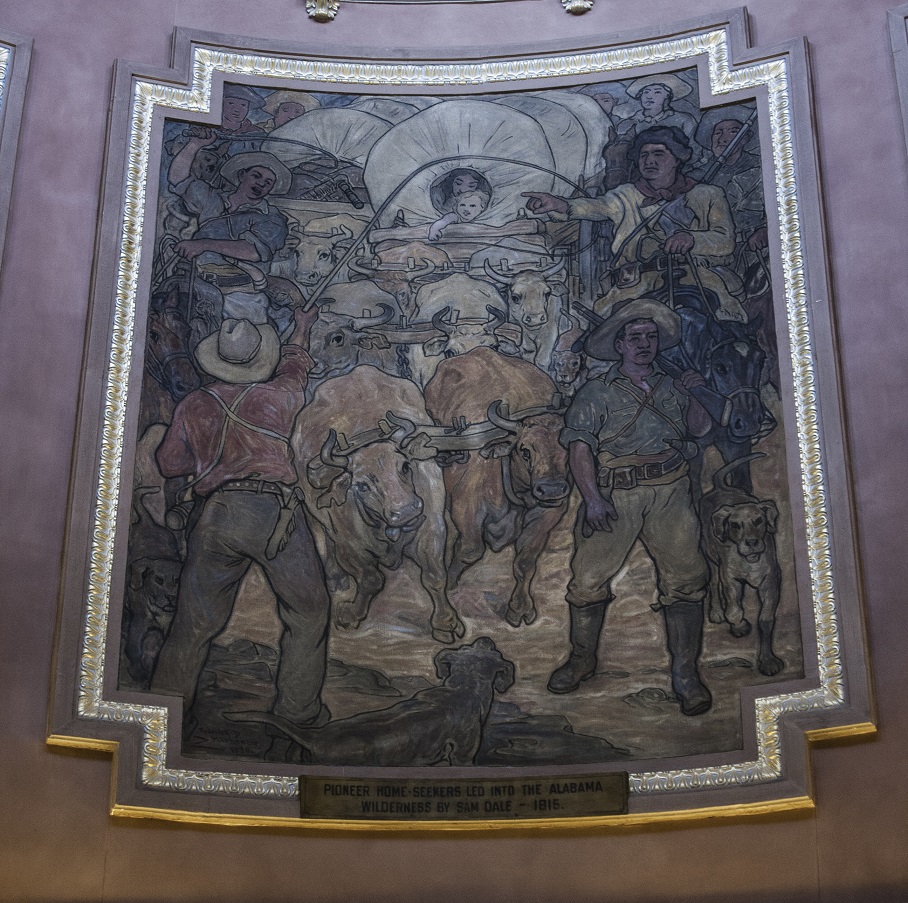
Reflective of the Antebellum Era, much of the furniture and fixtures were original from when the capitol building was originally built in 1849. Part of the second floor opened up to the rotunda, richly decorated in warm colors with scenes throughout Alabama’s history.
Finally, the third floor consisted of the House and Senate gallery where citizens could come and observe the legislature in session. One of the most interesting locations at the Alabama State Capitol is the location where Jefferson Davis was sworn in as President of the Confederacy. Marked by a bronze star, everyday visitors are able to stand in the same spot Jefferson Davis entered office for the confederacy. The Alabama State Capitol is our third state capitol to visit on our Tour of the Deep South. Not only has it been interesting to learn about their architectural similarities and differences, but also to learn about how the state government works in each state. In order to stay on schedule, we hurried over to the Dexter Avenue King Memorial Baptist Church where Dr. Martin Luther King Jr. preached for six years of his life to read the historical marker and take a quick picture.
Interestingly, the cross-walk in front of the church is marked by painted shoeprints. The shoeprints not only decorate the city scape, but also reflect MLK’s march from Selma to Montgomery, but also the African-American’s bus boycott, which required them to walk rather than take the bus.
For lunch we went to Chris’, home of the world famous hot dogs in Montgomery, Alabama. Chris’ opened in 1917, celebrating their 98th year anniversary May 1st of this year. The restaurant is mostly known for their hot dogs. Their special hot dog comes with 2 dogs, sauerkraut, chili, onions, and mustard. The addition of their famous Chris’ chili gives its world famous recognition. Not only did the restaurant have great lunch food, it also has an interesting history. Hank Williams, a famous country musician often visited Chris’, making it one of the hottest places to hangout in the mid nineteen hundreds.
The restaurant also advertises their support of equality during the Civil Rights Movement where their served African American citizens alongside white citizens. In the end, this was a neat place to have a comfortable lunch in the heart of downtown Montgomery.
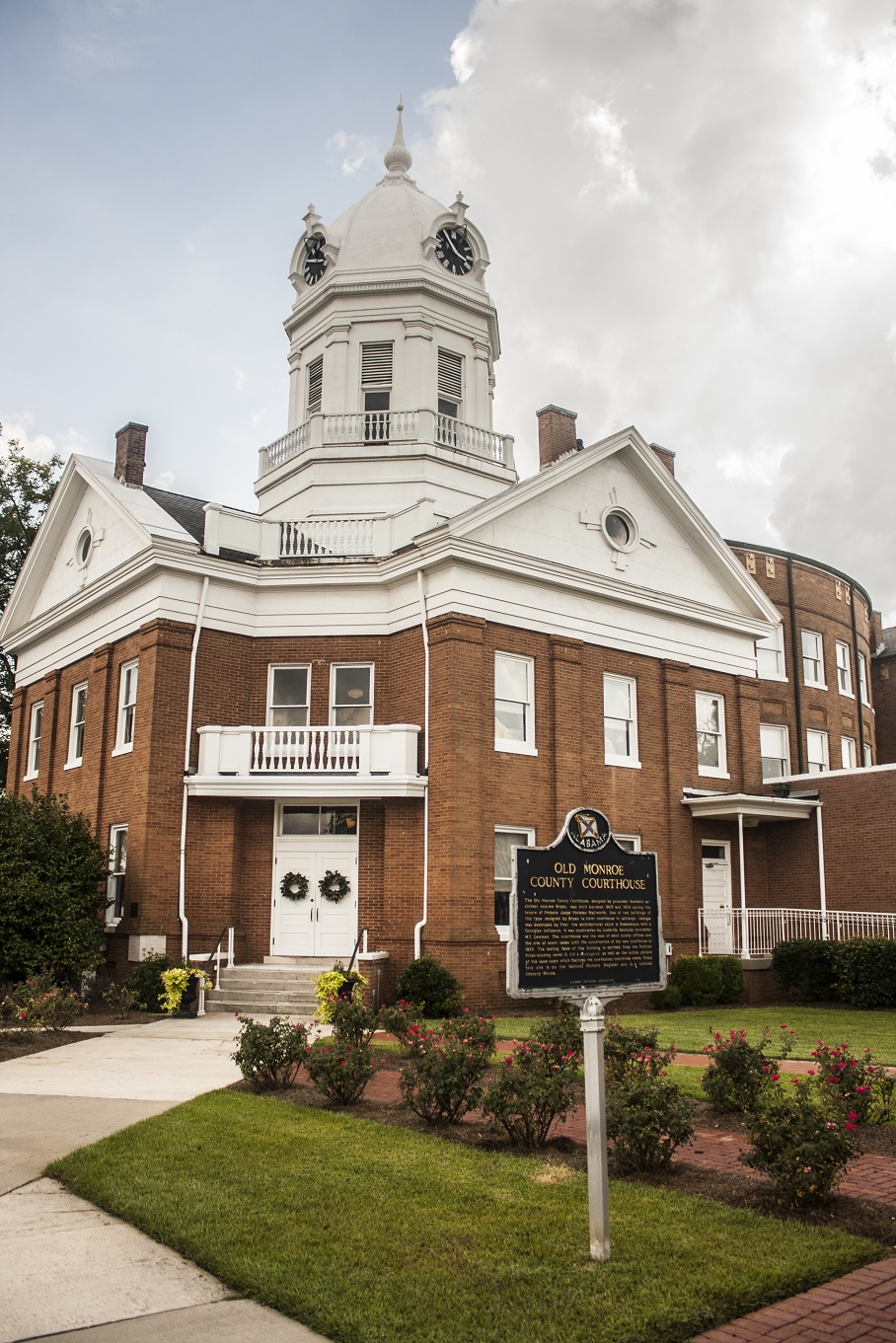
After lunch we embarked on our trip to Monroeville, Alabama. Once we arrived in Monroeville we stopped to tour the Old Monroe County Courthouse to learn more about Harper Lee and her friend, Truman Capote.
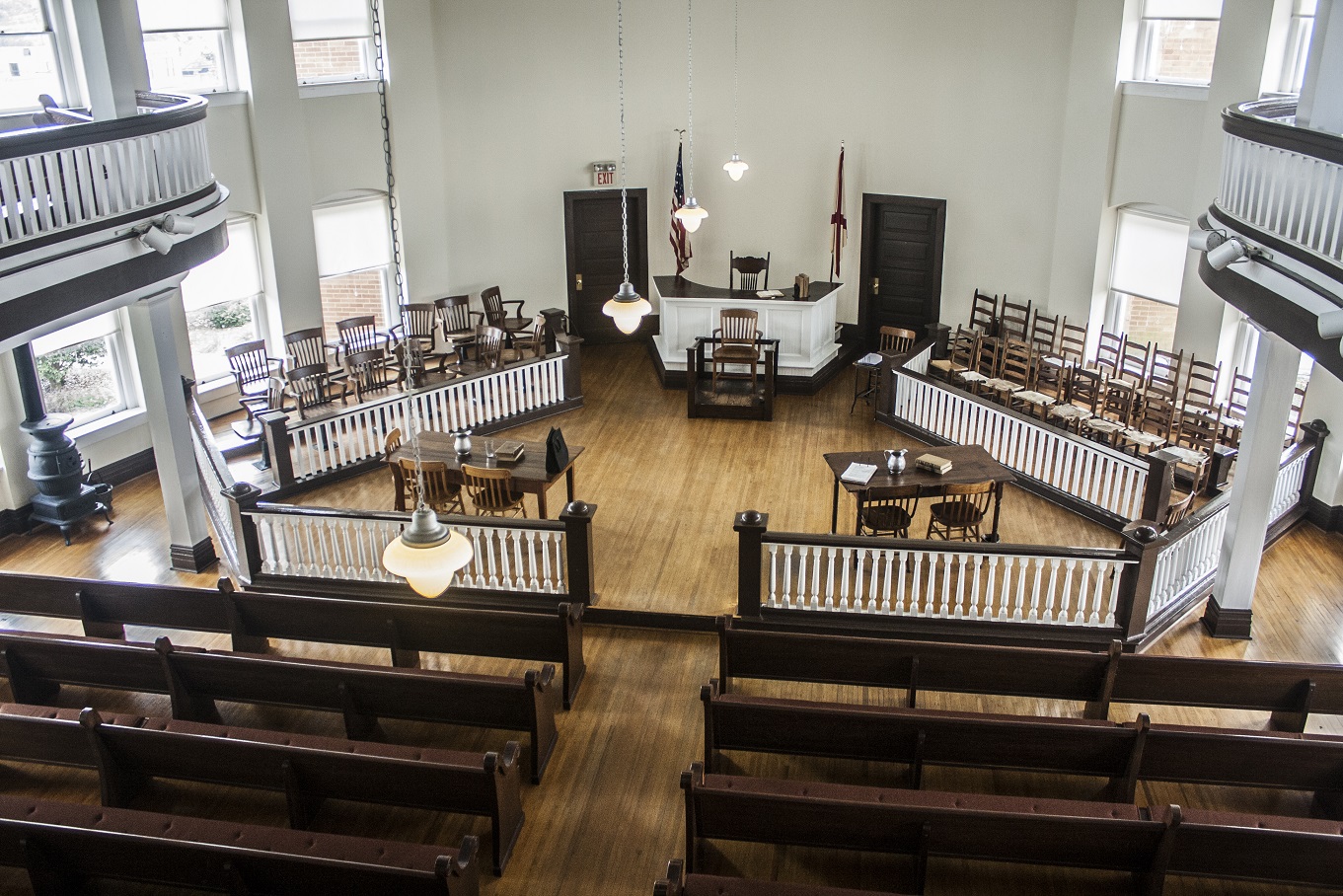
Harper Lee is the author of “To Kill a Mockingbird” and Truman Capote is the author of “In Cold Blood” and “Breakfast at Tiffany’s”. The Old Monroe County Court House was restored to its 1930’s appearance. The courthouse is also the model for the courtroom in the To Kill A Mockingbird movie.
Many people think that the movie was filmed in the Monroeville courthouse but it was actually recreated onto a Hollywood sound stage by Henry Bumstead. Fans of the novel and movie visit Monroeville because it is Harper Lee’s hometown which she based Maycomb on. The court house became a famous attraction which prompted Monroeville to build a separate court house and turning the Old Court House into a museum. We were able to wander through the museum and read Harper Lee’s words regarding her book being turned into a movie and learn about Truman Capote’s childhood. One of the quotes that I liked best from Harper Lee was “In an abundant society where people have laptops, cell phones, iPods, and minds like empty rooms, I still plod along with books. Instant information is not for me. I prefer to search library stacks because when I work to learn something, I remember it.” Capote also had much to say about Harper Lee and through his words I learned that Harper Lee longed to become a lawyer like her father and almost did before realizing her calling was really writing. My favorite thing in the museum was a piece of “the famous tree” where Dill, Jem and Scout found the pieces of gum, marbles and a watch left by Boo Radley. Once everyone had the opportunity to look around we hoped back in the van, checked out some of the city’s homages to Lee…
…and to Truman Capote’s boyhood home…
As we arrived in Biloxi, we searched to find dinner. In the end, we chose Adventurous Pub and Spirits. A few members of the group shared the seafood platter with a combination of fried shrimp, oysters, catfish, and fries. Biloxi’s location to the Gulf of Mexico, made seafood an easy choice for dinner. Although, it was a much different restaurant than what we expected, the group enjoyed it and headed to check into our hotel to catch up on extra rest. Tomorrow, we have another eventful day of sightseeing and traveling as we head to New Orleans.








 Center for Law, Engagement, and Politics