
It’s always exciting to begin a new semester in the Pre-Law Society, but this was especially the case this year, when we set a new record for members with 144! The lines delayed the meeting a bit…

…but the wait was worth it: we had Deans of Admission from South Texas College of Law (Nakita Wanza), University of Houston Law Center (Pilar Mensah), and Texas Tech University School of Law (Danielle Saavedra). With a general session moderated by President Olivia Discon and breakout sessions that followed, it was a semester’s worth of information into one record-breaking meeting.


General Body Meeting
Not wanting our minimal business reports to get in the way of the main program, President Discon and the officers moved rapidly through the business.


It was, however, the panelist’s evening. President Discon did an excellent job moderating the event, and we learned information that is useful for pre-law students everywhere.
How important are grades and the LSAT?
Very important! While this is to be expected, many students may not realize that (1) law schools look at your cumulative GPA–grades from dual credit, community colleges transferred in, repeated grades (the original grades are factored back into the GPA for law school)–and (2) the LSAT is the only indicator they have that is common to all students who apply. Keep those grades up and make appropriate plans to spend the necessary time on LSAT studying–the latter of which demonstrates times management, a much needed skill in law school.

What do law schools look for in personal statements and letters of recommendation?
All three Deans emphasized the personal statements, noting that they were looking for authenticity. This is the chance for the students to provide information provided only by a personal statement and to provide an insight into the applicant’s true self. For those who wish to present their true selves through AI, Deans of Admissions can tell. Moreover, applicants should (1) follow instructions and (2) proof read. You’d think this would be common sense, but every year, law schools receive personal statements addressed to other schools, longer than the permitted length, or responsive to prompts not provided by the school.

Similar care should be taken with letters of recommendation. Some students may be tempted to ask the professor they liked the most, or they thought was “cool,” or someone whom they spoke with often. But law schools want to hear from professors who have seen the student’s writing, (critical) thinking skills, and reading ability. If the class didn’t require any of these things, or if you didn’t earn a strong grade in the class, seeking letters elsewhere might be your best bet. Dean Mensah also encouraged students to have their letter writers identified by their junior year, rather than waiting to the last minute–another time management lesson!

Additional Information
The schools emphasized the importance of taking this process seriously and the importance of character. Of course, character can reflect a student’s priorities–such as grades and the LSAT–dedication to those priorities, and those who possess integrity will carry that trait with them into law school, and one hopes, to their career beyond.
President Discon also introduced Michael Chambers, an SHSU alum (class of 2023) who is a 2L at South Texas College of Law. He emphasized the importance of hard work, asking questions when needed, and applying oneself in an area of interest.

With this foundation, the general body meeting was adjourned, and students left for breakout sessions, each of which featured a presentation from a different school.

South Texas College of Law (STCL)
by Katherine Burnett
The South Texas College of Law session was led by Associate Director of Admissions, Ms. Nakita Wanza, along with 3L law student and SHSU alum, Michael Chambers. Ms. Wanza began by walking students through the “holy trinity” of law school applications: the LSAT, the personal statement, and letters of recommendation. She emphasized the importance of researching every school you’re considering—especially their median LSAT scores—and setting that as a target when preparing.

Once the basics were covered, the discussion shifted to opportunities available at STCL. These include internships, legal clinics, student ambassador positions (which Michael called the “best job ever”), moot and mock court, journals, and more. Michael shared personal insights about his law school journey, noting that success comes from daily study habits but also from keeping a flexible schedule. He reassured students that “cold calling” isn’t as terrifying as it’s made out to be—it feels more like a conversation once you get used to it.


Michael also discussed how summers in law school are “what you make of them,” whether through internships, travel, or taking a break. On the topic of grades, he explained that law school’s suspenseful grading system makes it harder to track progress, but the best indicator of understanding is whether you truly know what’s happening in class.

The session wrapped up in just thirty minutes with Nakita and Michael encouraging students to study hard, stay open-minded, and remember that law school is within reach.

University of Houston Law Center
By Madison Cawthon
In another breakout session, we heard from Pilar Mensah, Assistant Dean of Admissions at the University of Houston Law Center–which we toured on August 1! Dean Mensah shared valuable details about UH’s programs, starting with the flexibility of part-time and full-time options, as well as the availability of dual degree pathways alongside the JD.

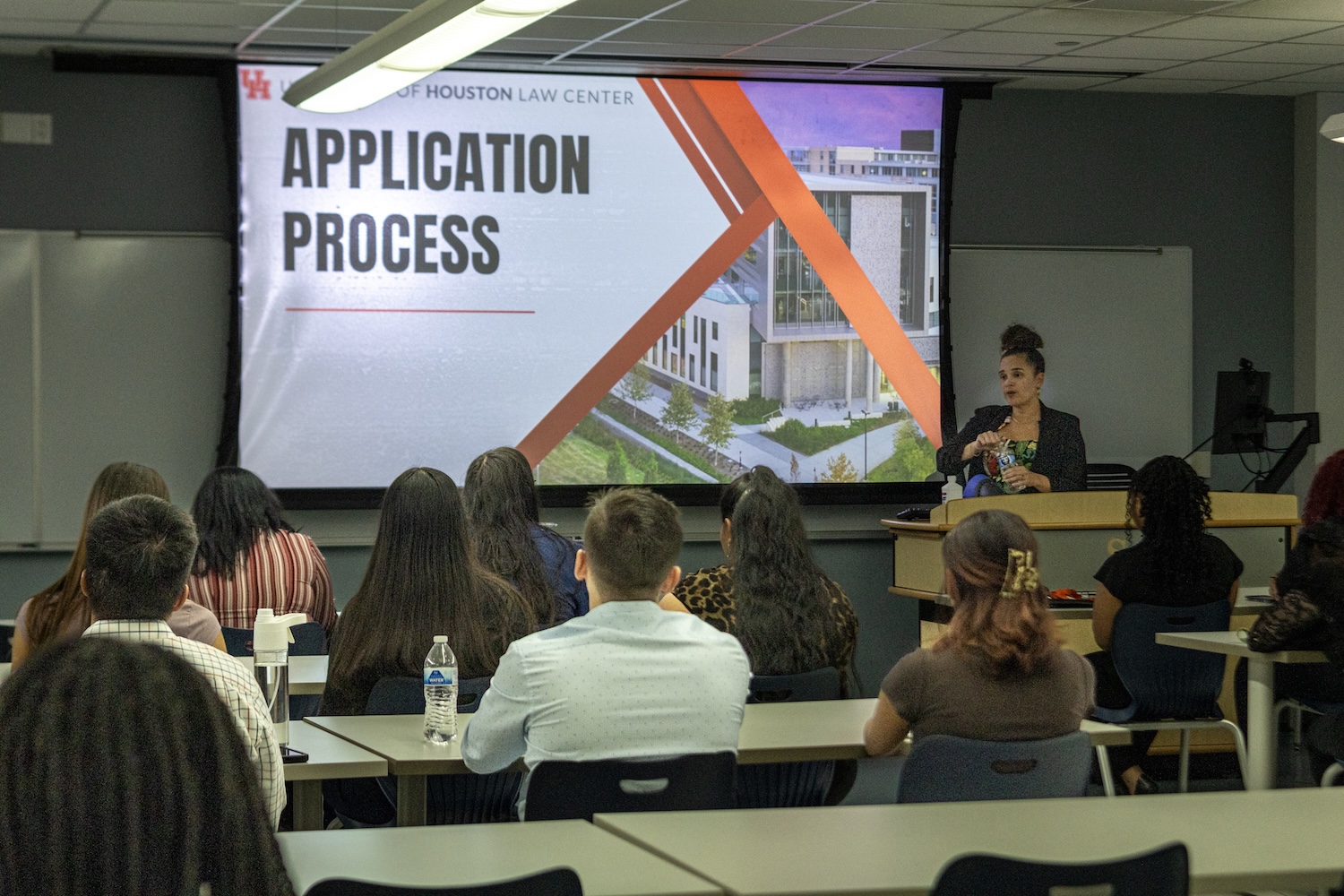

She also highlighted UH’s wide variety of legal courses, student organizations, and other opportunities for involvement, along with the amenities and on-campus housing available to law students.
These resources, she explained, help foster both academic and community life at UH Law.

Toward the end of the session, Dean Mensah offered insight into what admissions officers are really looking for in applicants, sharing her perspective on how to stand out in the process. She then opened the floor to questions, giving students the chance to engage with her directly about both law school in general and the UH Law experience specifically.

Texas Tech School of Law
by Madison Thurkettle
Danielle Saavedra, Assistant Dean of Admissions and Director of First-Generation Resources at Texas Tech Law School, brought an encouraging perspective to the session.

For many, applying to law school can feel daunting, but Dean Saavedra worked to replace that sense of intimidation with confidence and motivation.

She began by highlighting the importance of undergraduate years in the admissions process. Law schools carefully consider your GPA from the first three years of college, but she reminded us not to view “median numbers” as immovable barriers. While GPA and LSAT scores matter, Texas Tech looks beyond the numbers, valuing the strengths, experiences, and qualities that make each applicant unique.

On the LSAT, Dean Saavedra stressed preparation and time management but also reminded us that the exam does not define who we are—it’s simply one more step toward a legal career. She also shared practical admissions advice: timing is critical, and applying in the fall helps your application stand out.

Dean Saavedra highlighted the personal statement as one of the most important components of an application. She urged students to follow instructions carefully and to write authentically, rather than trying to predict what admissions officers want to hear. She even admitted that she wished she had reached out to admissions when she was applying, encouraging us not to hesitate with questions.
She closed with a reminder to adopt a growth mindset. Law school, like the application process itself, comes with challenges, but each obstacle is an opportunity to learn and improve—a mindset that will serve us well far beyond admissions.

Concluding Thoughts
With 144 members–one of the largest organizations on campus–and a top-notch panel, members left the meeting with a bounce in their step, despite the late hour. They also have a renewed sense of mission, understanding the importance of committing oneself to a course of study, behaving with integrity, and managing their time and energy toward their highest priorities–qualities that, incidentally, are valuable in all courses of study, careers, and in life.


 Center for Law, Engagement, and Politics