This summer was a bit busier than usual, with my job, LEAP activities and volunteerism, and an LSAT Prep Course occupying my time. But I still found time to spend time with family, and I still managed to explore and learn in the process!
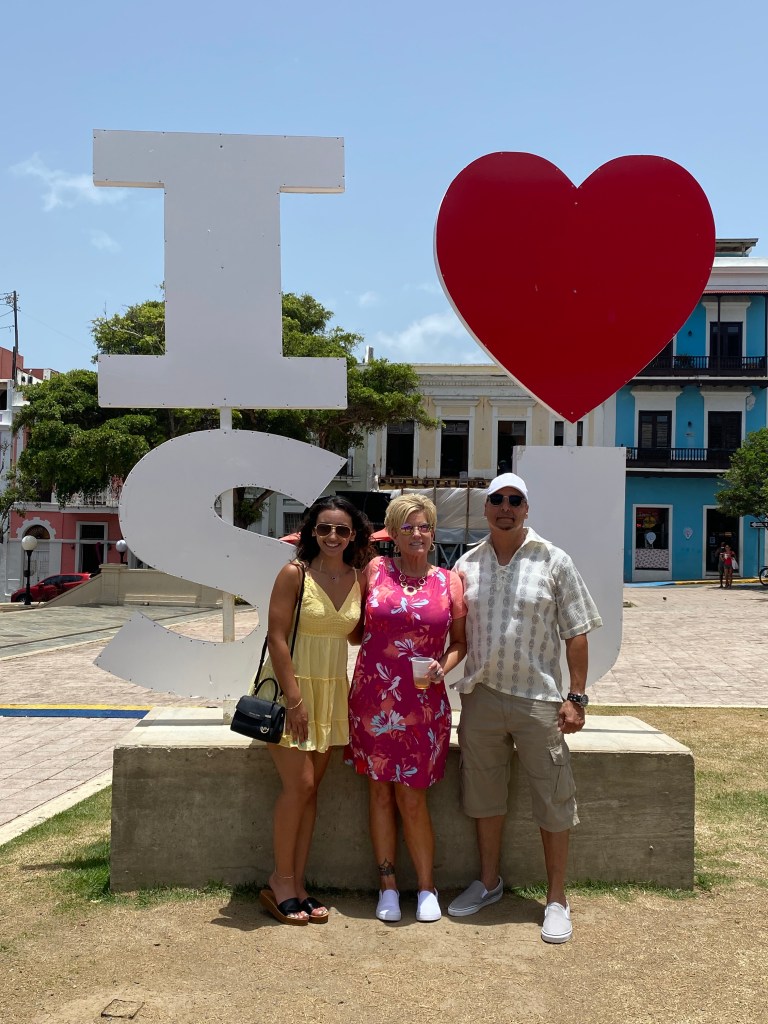
Let me take you along the journey of my summer trip right as we wrap up our summer. My family and I went to the beautiful island of Puerto Rico, where my mother’s side of the family is from.
I had the opportunity to not only visit my family, but immerse myself in nature, learn more about my culture, eat fantastic food, and, most importantly, relax.
Here are some of my favorite things I was able to do in Puerto Rico that I recommend for anyone interested in interesting adventures.
First, hike through the beautiful El Yunque National Forest. You will fall in love with vibrant green palm trees and the touches of pink from our native flower, the hibiscus. Here, some trails will take you to the highest peak with breathtaking views. As I climbed to the top, I stumbled upon iguanas left and right. It was an excellent way to experience the island’s nature, but make sure you bring a rain jacket!
While getting a good exercise and learning more about the history of Puerto Rico, I walked through Castillo de San Felipe del Morro, a fort located at the Northwestern point of Old San Juan, Puerto Rico. Its construction began in 1539 when the Spaniards governed Puerto Rico, and this fort was used to defend against naval attack.
You can’t forget Puerto Rico’s excellent food, such as tostones (fried plantains), pernil (pork), rice and beans, and various desserts! My favorite restaurant in Puerto Rico has to be the Zimple Restaurant and Bar. They had a variety of seafood. I fell in love with Paella Marinera, which has octopus and shrimp on top of perfectly seasoned rice.
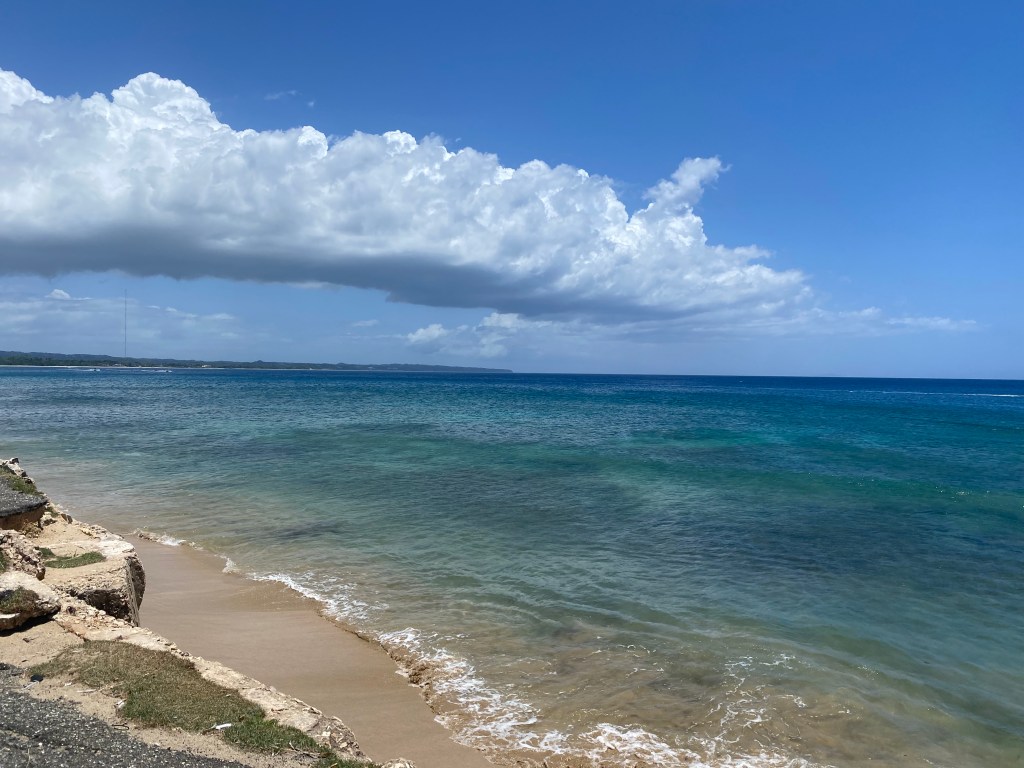
Lastly, you can’t miss the beautiful palm trees stretching across the ocean shore! Puerto Rico is a lovely island that I’d recommend adding to your destinations list.
If it’s summer, the Alley Theatre is offering one of their “Summer Chills” programs, and this year’s production was “Clue,” a play that is based on both the 1985 film and the board game. The result was a madcap hour and a half of hilarity, made even more enjoyable by the fact that many LEAP Ambassador alumni joined us for the festivities.
At least two of the students had never seen a live play, so this was new for them. But even those who had seen live theatre were unlikely to have seen a play of this sort: it was frenetic, screwball, a surreal in equal measure–think the Marx Brothers starring in an Agatha Christie play.
The play began with a minimal set, but the spareness of the set permitted quick transformations, allowing the audience to experience a library, a billiard room, a lounge, and a study.
Of course, the sets contained secret doors, a dangerous chandelier, and lights that flickered in a storm. It was, after all, a dark and stormy night…
And, of course, there was the well-known characters: Professor Plum, Colonel Mustard, Miss Scarlet, Mrs. Peacock, Mr. Green, and Mrs. White–each with a mysterious past. Ms. White, for example, seem to marry men who wound up dead. When asked how many husbands she had, she responded, “My own? Or other women’s husbands?”
Along with these typical characters, there was Wadsworth (the butler), Yvette (the maid), and an equally hapless cook and singing telegram singer. And, of course, Mr. Body, who died not once, but twice. There was also a police officer, an “unexpected police officer,” a “backup police officer,” and a driver of a broken-down car. Put these together, along with numerous corpses, and you have quite enough of a murder mystery.
But the mystery was secondary: the primary action was the comedy. Yvette was a prancing, jiggling exhibitionist; Colonel Mustard was painfully, comically slow; Mrs. Peacock was an elderly tippler; Mr. Green was delightfully clumsy; and yet it was Wadsworth that was the star of the show.
Collectively, they went through slow motion reenactments of deaths; performed live-action imaginings of alternative universes; and Wadsworth completed a one-man reenactment of the entire play in about four minutes.. And all of this happened while the cast drew upon “And Then There Were None,” the “Clue” Board Game (at one point, using the board as a map to the “house”), borrowed Charlie Chaplin’s “Smile” from “Modern Times,” while also parodying “Gone with the Wind” and “Casablanca”–as in, “Of all the board games, in all the world, he has to walk in to mine.”
To extend the Casablanca theme, it was an afternoon that continued beautiful friendships. Bianca Saldierna (SHSU 18), Will Phillips (SHSU 13), Deanna Youngblood (SHSU 13), and Brian Aldaco (SHSU 18)–along with some significant others–joined us for the fun and caught up on old times.
The LEAP Ambassadors would like to thank all the LEAP and Junior Fellows alumni who helped develop a wonderful program and continue to support SHSU and LEAP! Additional notes: Dr. Robert Donahoo, Professor of English and Drama at SHSU, wrote a wonderful review of the play here, and Melissa Pritchett, who played “Yvette,” is an SHSU alum!
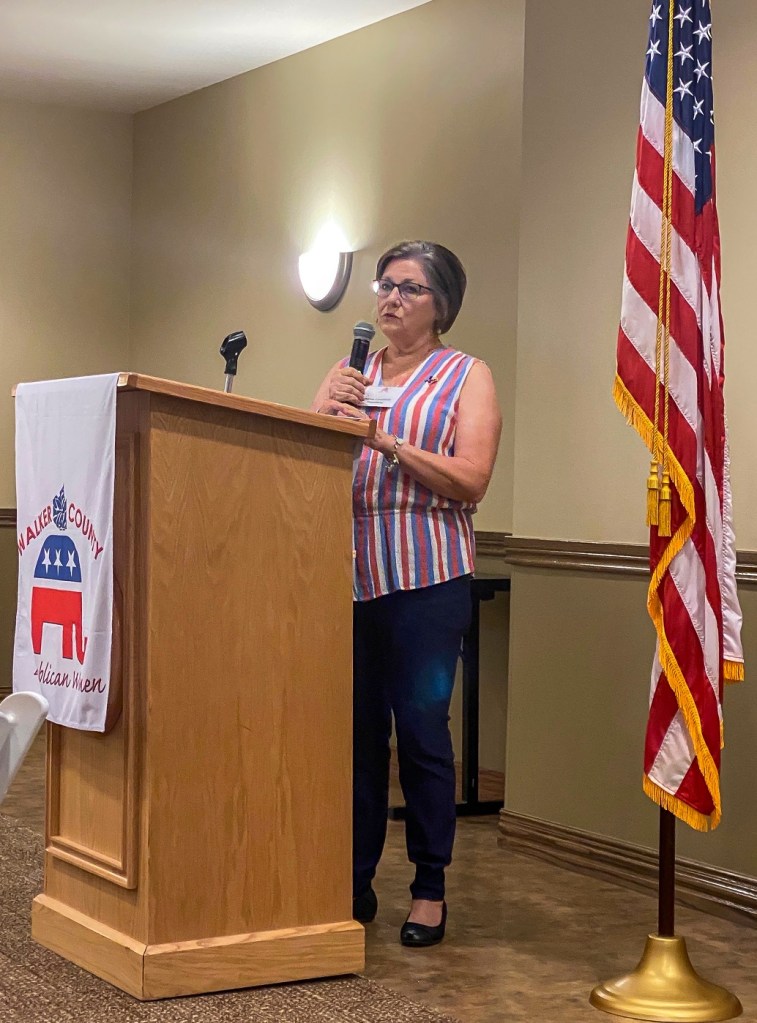
With the legislative session coming around the corner, the Walker County Republican Women invited Senator Charles Schwertner, who represents district 5, to speak at their meeting to provide an update on the upcoming legislative session and other developments in the state and district.
Following some preliminary business, with President Lunsford and Judge Sorensen…
…Senator Schwertner discussed border security, public schools, and other issues of the day.
Aside from discussing issues at a state government level and what we are doing to resolve them, the members and I learned more about Senator Schwertner. He is a practicing orthopedic surgeon, and his wife is currently a physician who is also a 3L at UT Austin. Interestingly, their three sons are also attorneys.
The lunch also provided the LEAP Ambassadors a chance to do a “pre-interview” of sorts for the Sam Houston Austin Internship Program. On hand were Senator Schwertner’s Chief of Staff Drew Graham, Deputy Chief of Staff Leah Clark, and District Representative Kassie Fleming, each of whom took the time to explain how their office at the Capitol operates and each staff member’s role. They emphasized the importance of having a flexible political mindset and always being a team player.
Getting to learn more of the inner workings of a legislative office during the session was very informative, and having the opportunity to learn more about the politics in our district was very helpful!
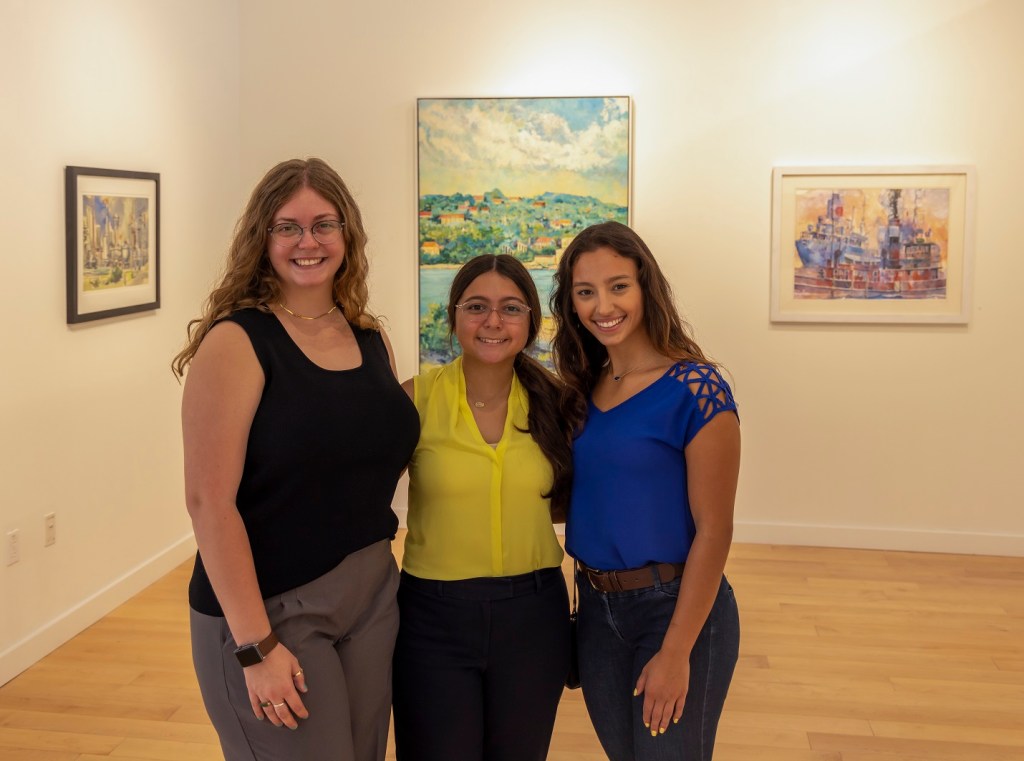
With the start of the semester around the corner, the LEAP Ambassadors celebrated their favorite professor’s birthday by viewing the SHSU Art Department’s new exhibit, “The Light from a Star” and by enjoying cupcakes from the local bakery, Two Blondes and A Bakery. The exhibit included works from Charles Pebworth, Jimmy H. Barker, Harry Ahysen, Stanley E. Lea, May Schow, and Kenneth Zonker, all of whom taught at SHSU–and, of course, produced some wonderful art.
We were welcomed into the room by a large Stanley E. Lea collage but not nearly as big as the one featured on the north wall of the first floor.
Both of these collages featured orange prominently, perhaps as a nod to Lea’s almost three decades of teaching at SHSU. His work can also be found locally in the GPAC as well as the Wynne Home Arts Center.
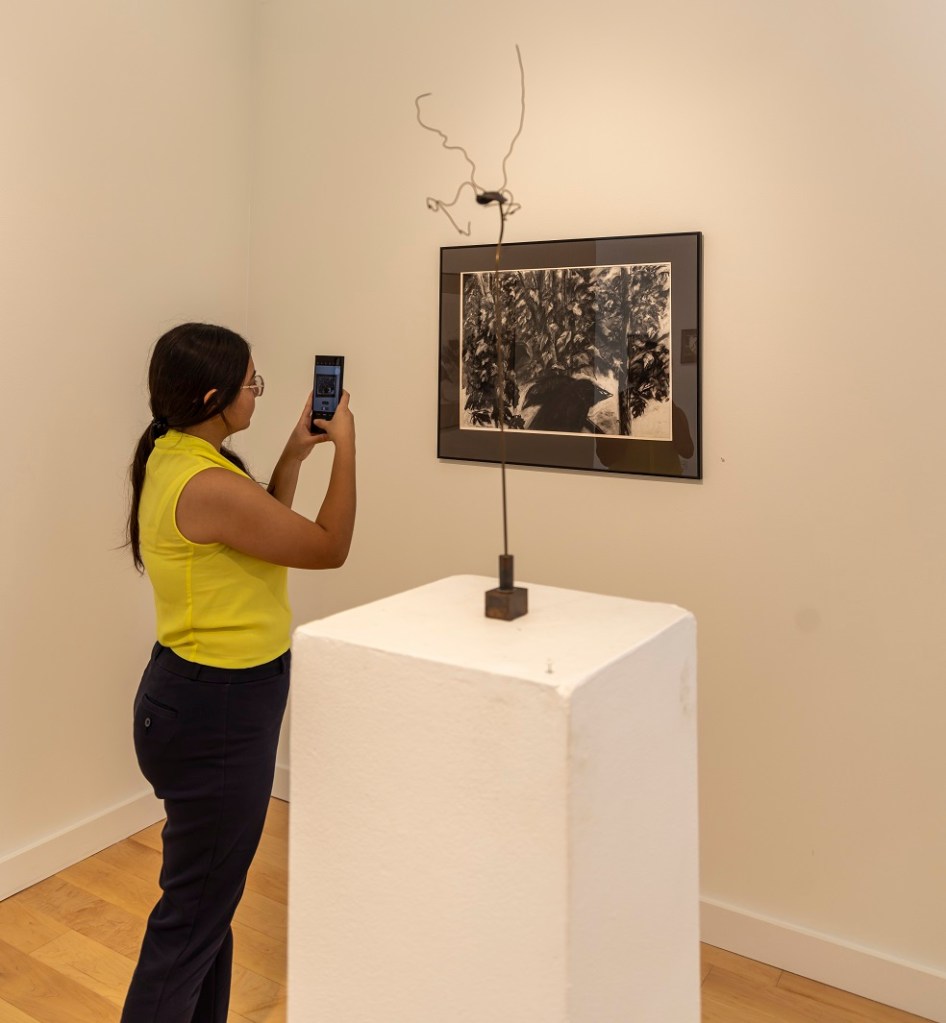
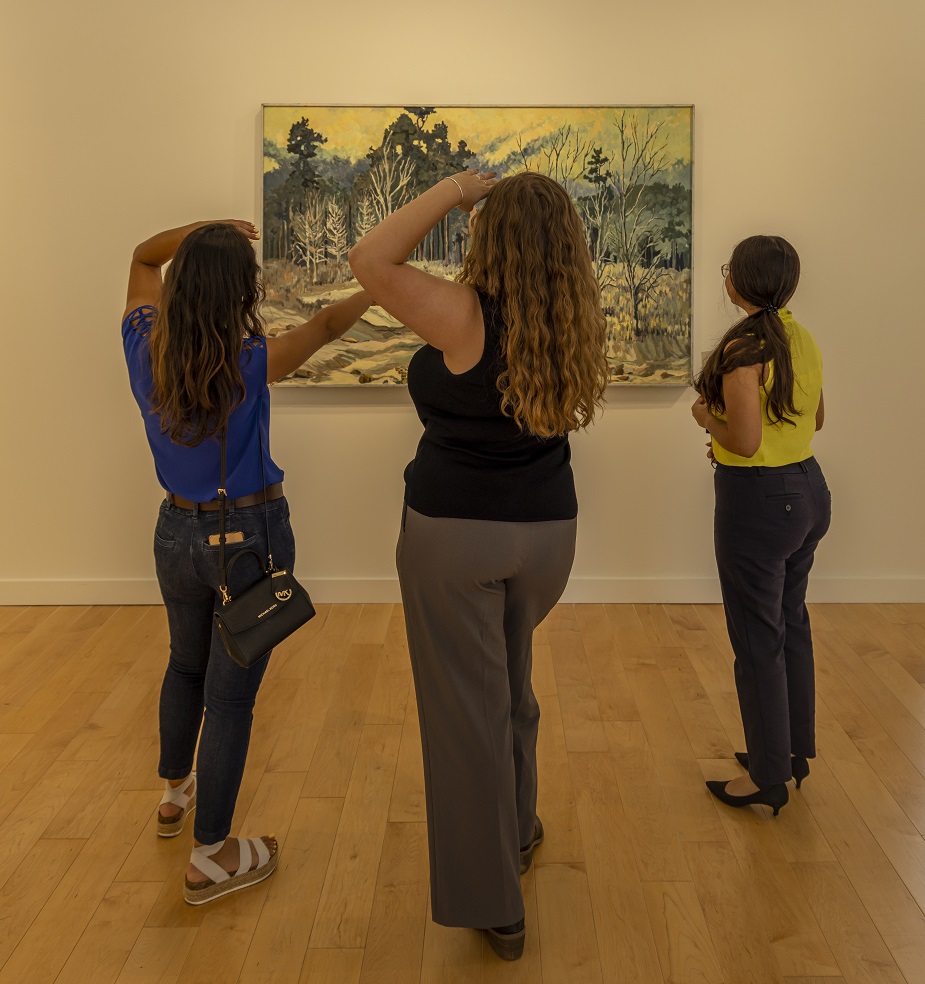
The exhibit was a collection of artwork created with different media, but I loved the vibrant watercolors utilized in the 1989 untitled painting of trees by Harry Ahysen, which we had trouble photographing.
This painting was unique since both Professor Yawn and Ms. Stephanie mentioned that it was quite different than anything they had previously seen by Ahysen. Yvette’s favorite was number seven in the exhibit, Lake Travis, by Harry Ahysen in 1984. It was a beautiful painting with a lot of blues and greens to capture the beauty of the lake, sky, the surrounding city, and landscape.
Although it had a darker theme than the prior watercolor painting and the Lake Travis painting, all of the ambassadors found another Ahysen nature art piece interesting.
Ahysen was a quick worker, and his work sold well throughout his lifetime. In 1980, he was designated by the Texas Legislature as the State Artist of Texas, and his work can be found in various campus locations and at City Hall in Huntsville.
Morgan’s attention was drawn to an art piece done by May Schow that resembled colors and techniques used by French symbolist painter Paul Gauguin, albeit with some American Regionalist overtones.
Schow was a real find for us, because even Professor Yawn and Ms. Stephanie were not familiar with her work, but we were all intrigued and wanted to see more.
In the adjacent room, the exhibit continued, and upon entering there were paintings by Jimmy H. Barker. These were done with pencil and or charcoal on paper and therefore had a much darker theme which the ravens within added to. As well as the weather outside since it was cloudy and raining, I did like untitled number 18 in the exhibit by Barker that had not only the birds but also trees around them.
Barker passed away six years ago, after a long career at SHSU and of community involvement.
Outside the exhibit, there was a small lounge area that featured the James Surls Through It All, which is a woodcut print on paper.
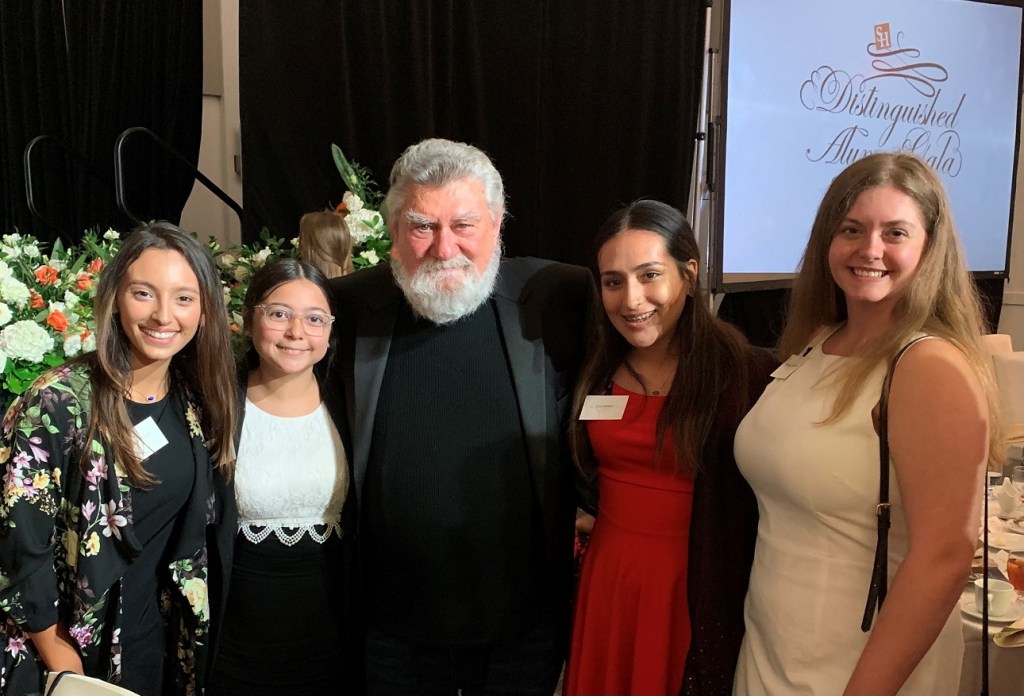
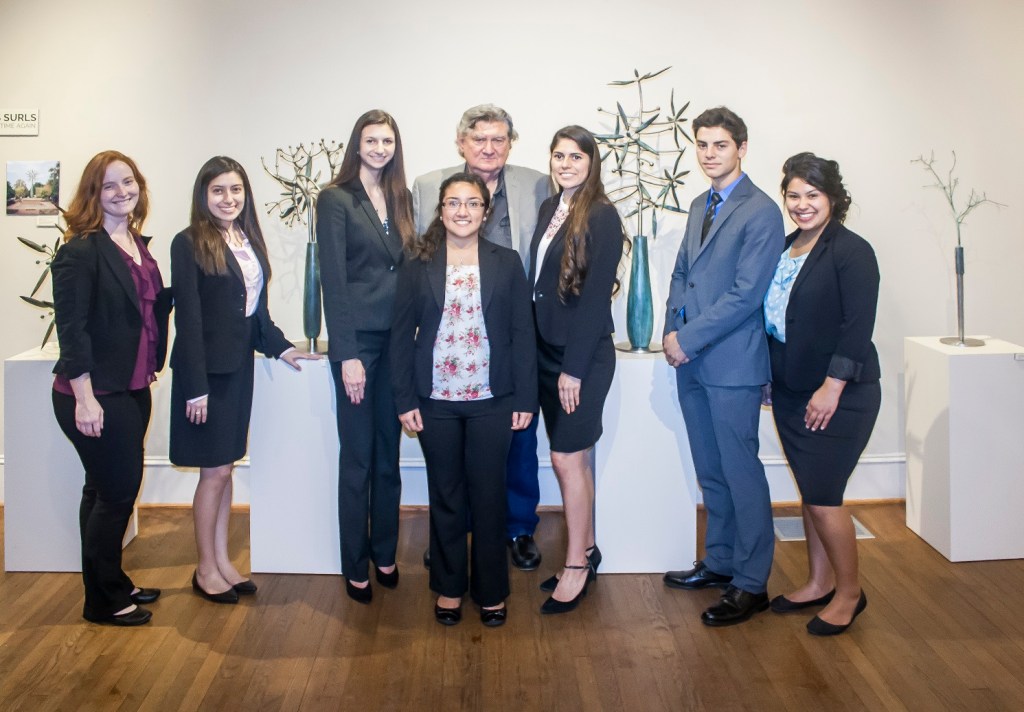
It was very different yet like his sculptures since it repeated his motif of blades throughout the print. Surls is one of our favorites, and we were fortunate to meet him at least year’s distinguished alumni gala…
…and to have seen his work across the country…
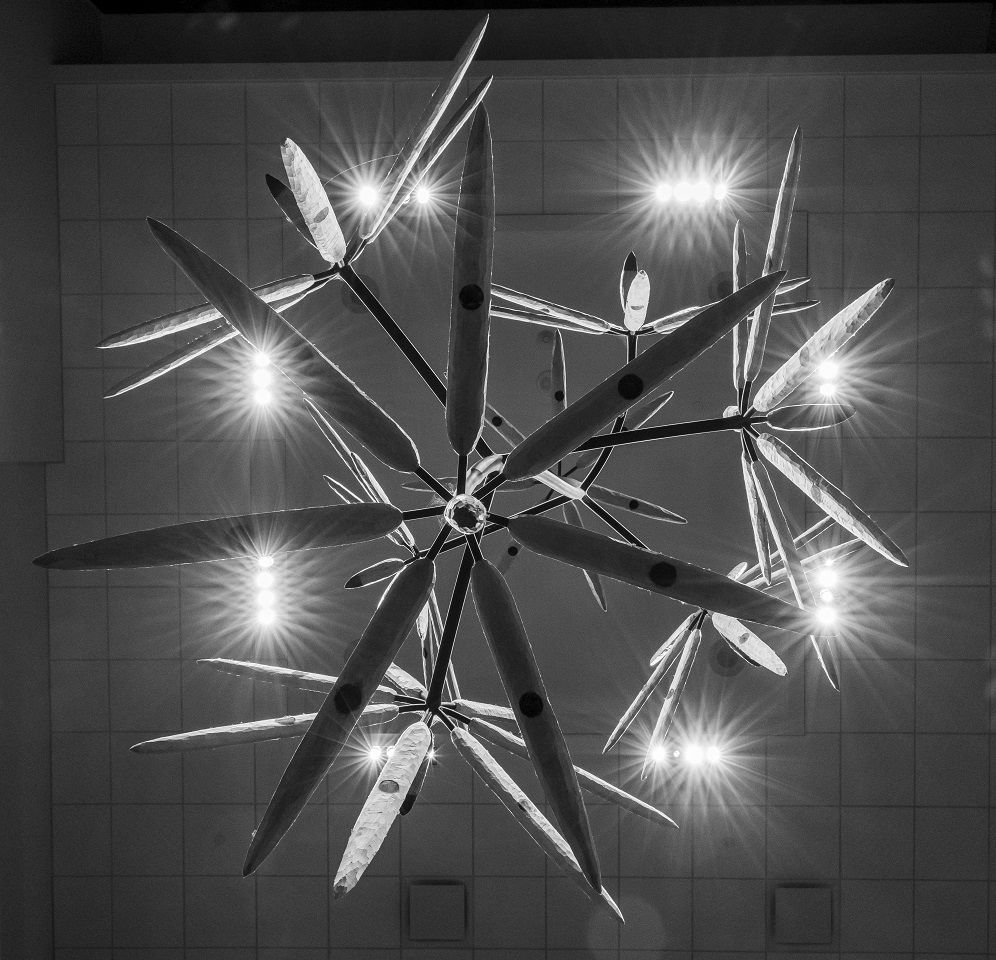
There was also a Charles Pebworth, like the ones we have seen before, with what appeared to be bronze and copper–or, perhaps, a stainless steel with a bronzish patina. It was not in the exhibit proper, but is on, we presume, permanent display on the first floor.
Pebworth’s work can be found around the country and, locally, it can be found in the First National Bank, the Wynne Home, the Gaertner Performing Arts Center, and the Newton Gresham Library. We also visited this piece in the Hyatt in downtown Houston.
We also enjoyed seeing some of Charles Jones’s works around the first floor, woodcuts done in his usual style of famous individuals from the art and literary worlds.
We visited the gallery the Friday before school begins–move-in day–but the exhibit is up until August 27, so we encourage everyone to stop by next week, enjoy the beautiful art work, and experience part of SHSU’s artistic legacy.
On behalf of the LEAP Ambassadors, we would like to thank the Art Department for letting us view this exhibit today and to wish Professor Yawn a “Happy Birthday!”
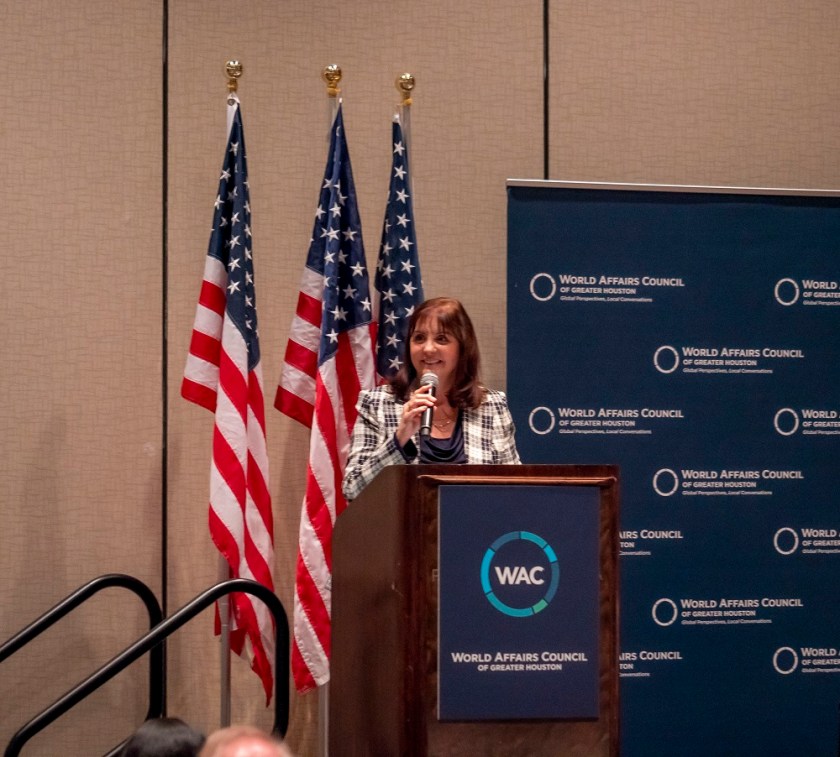
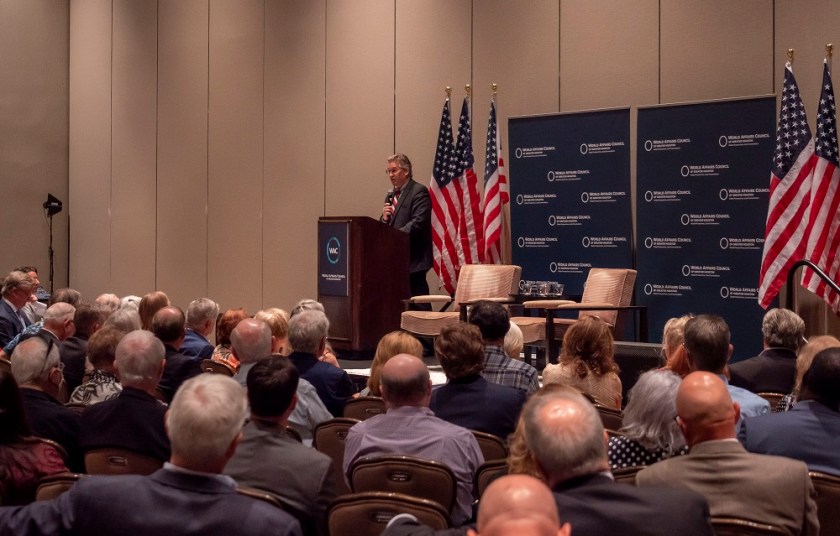
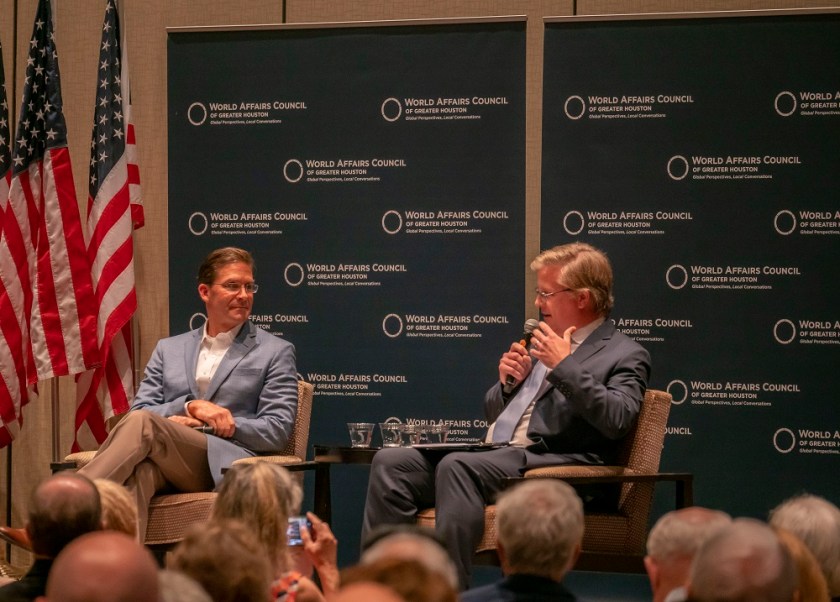
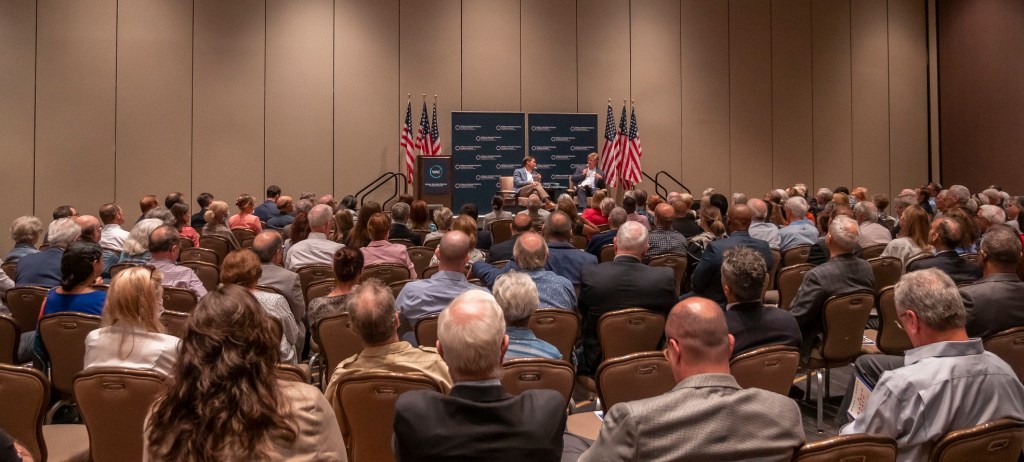
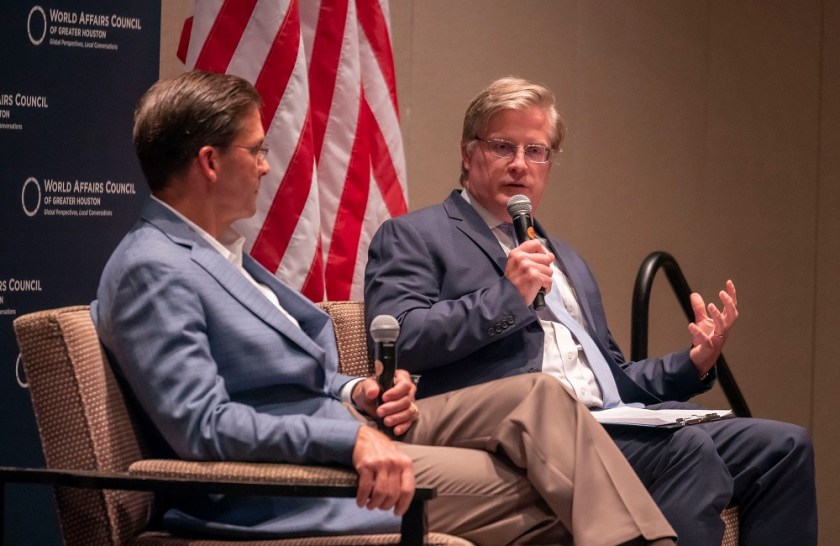
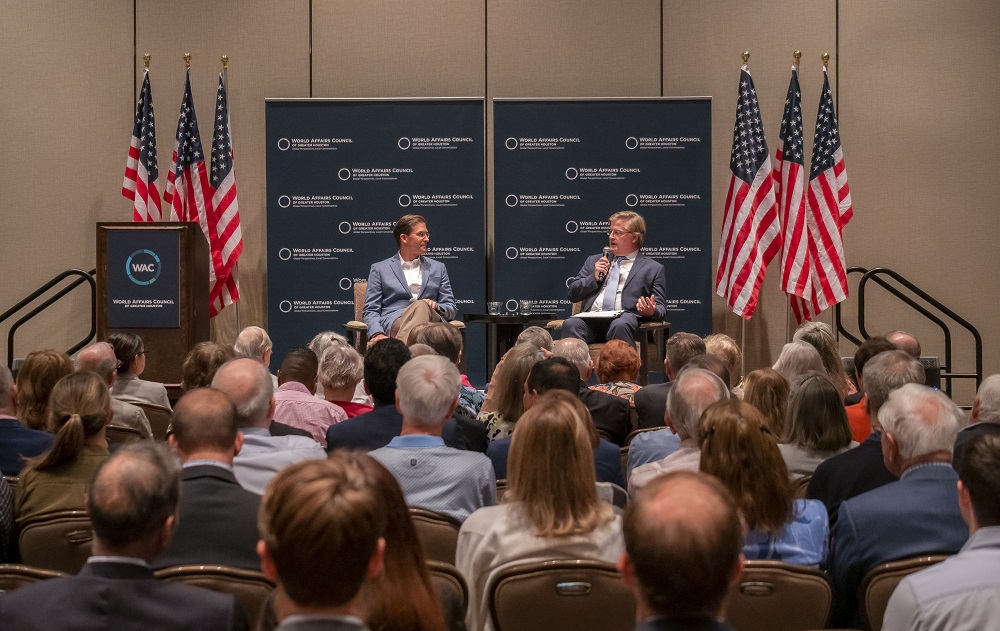
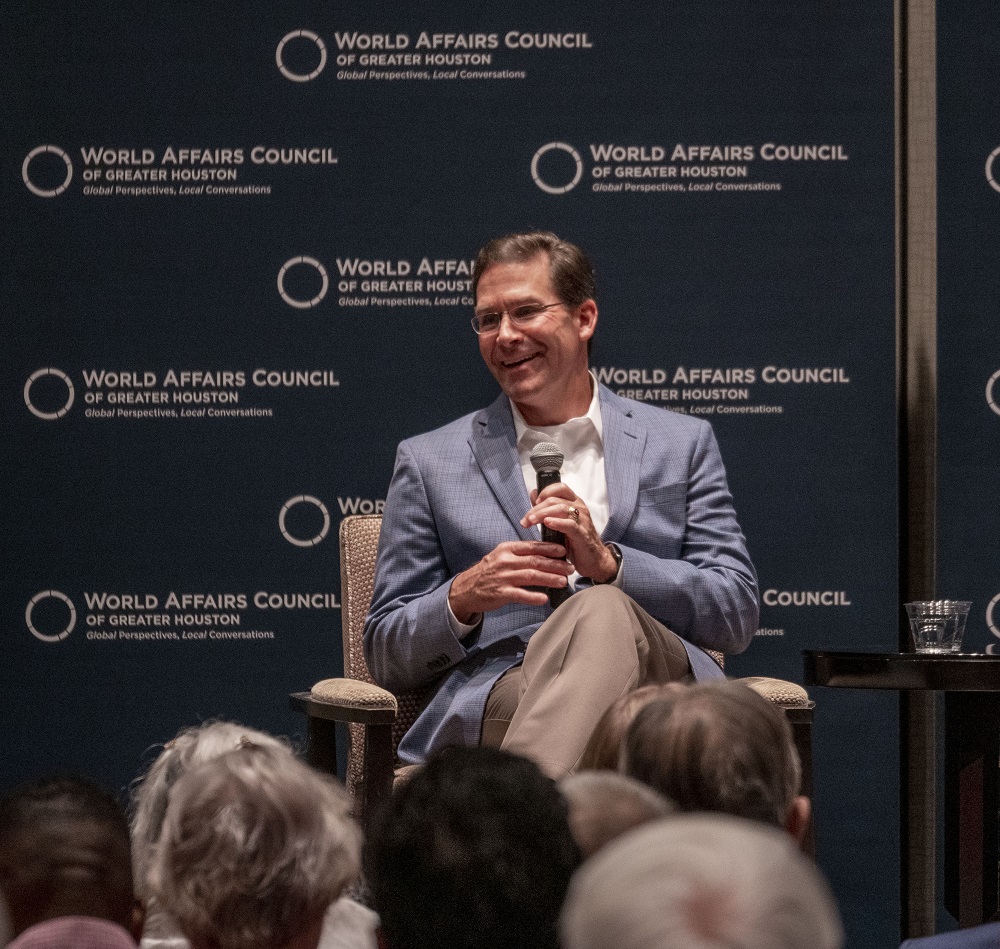
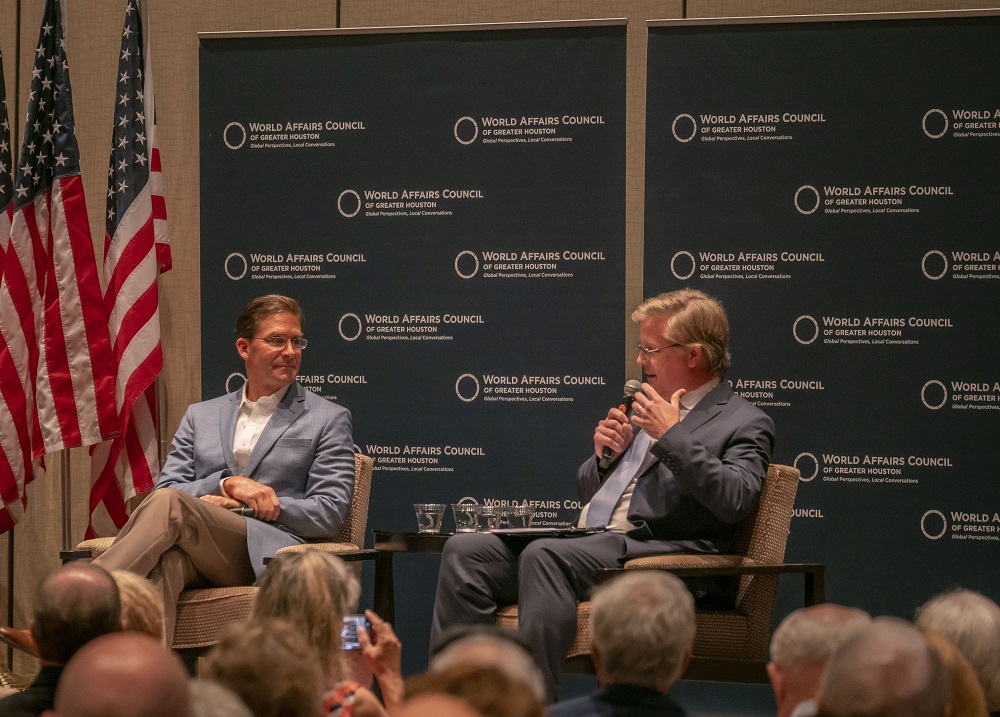
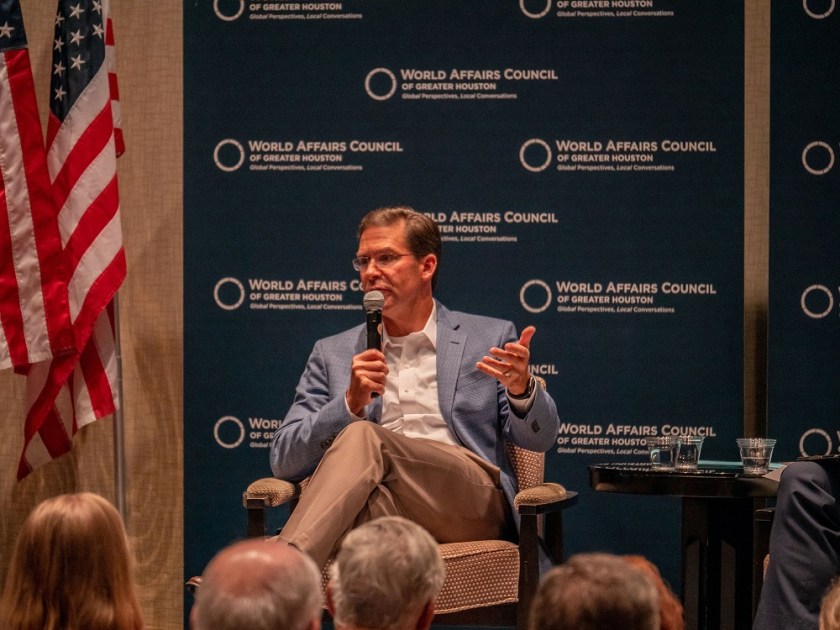
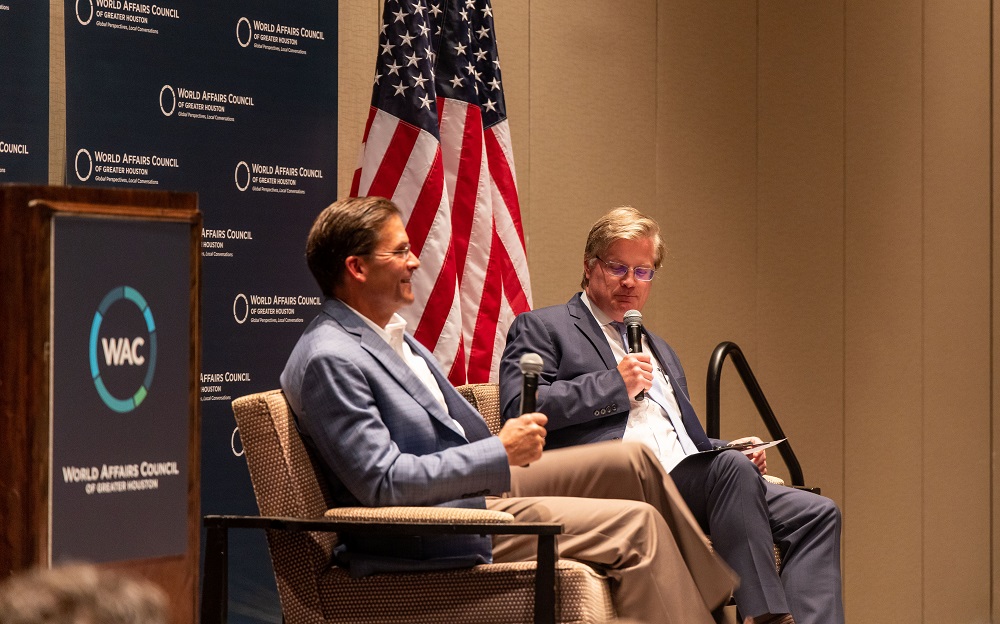
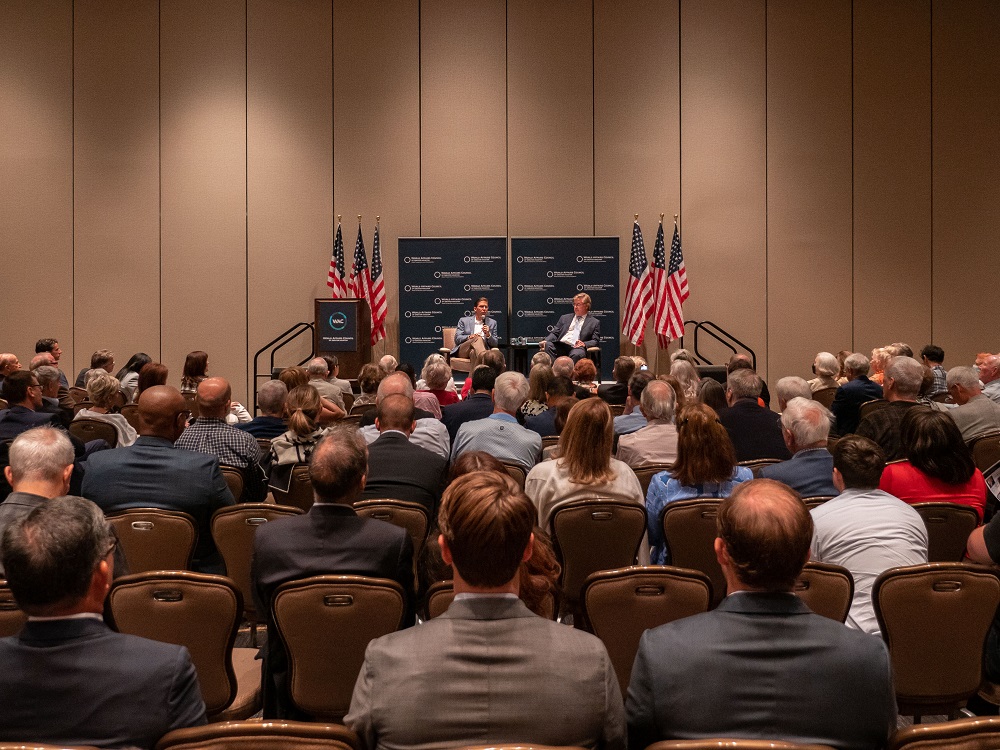
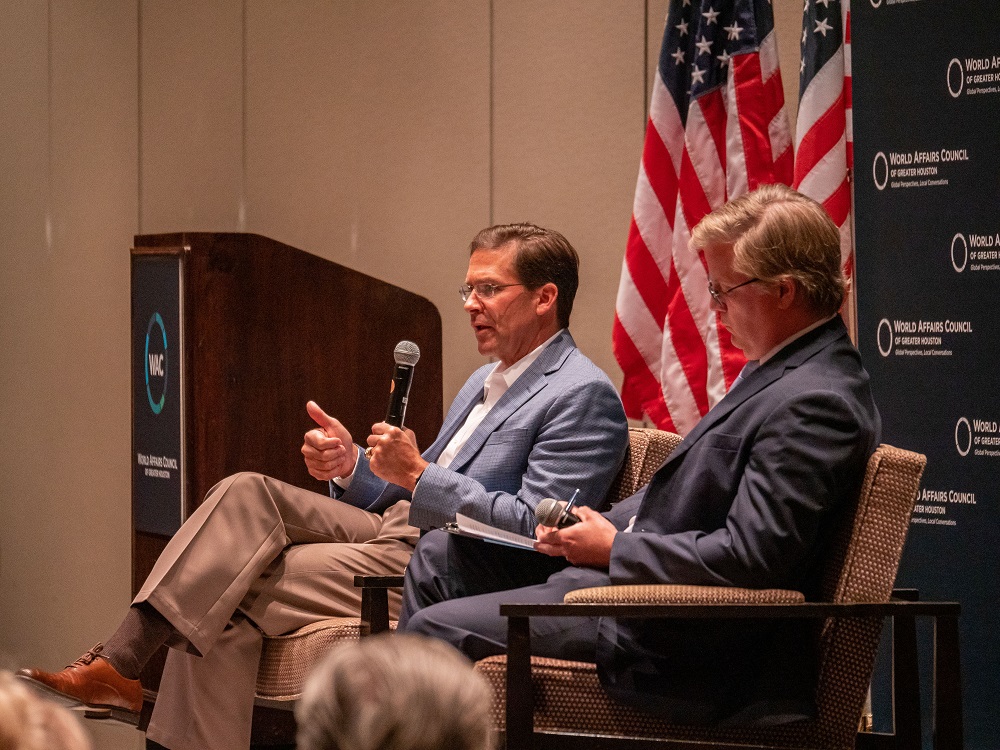
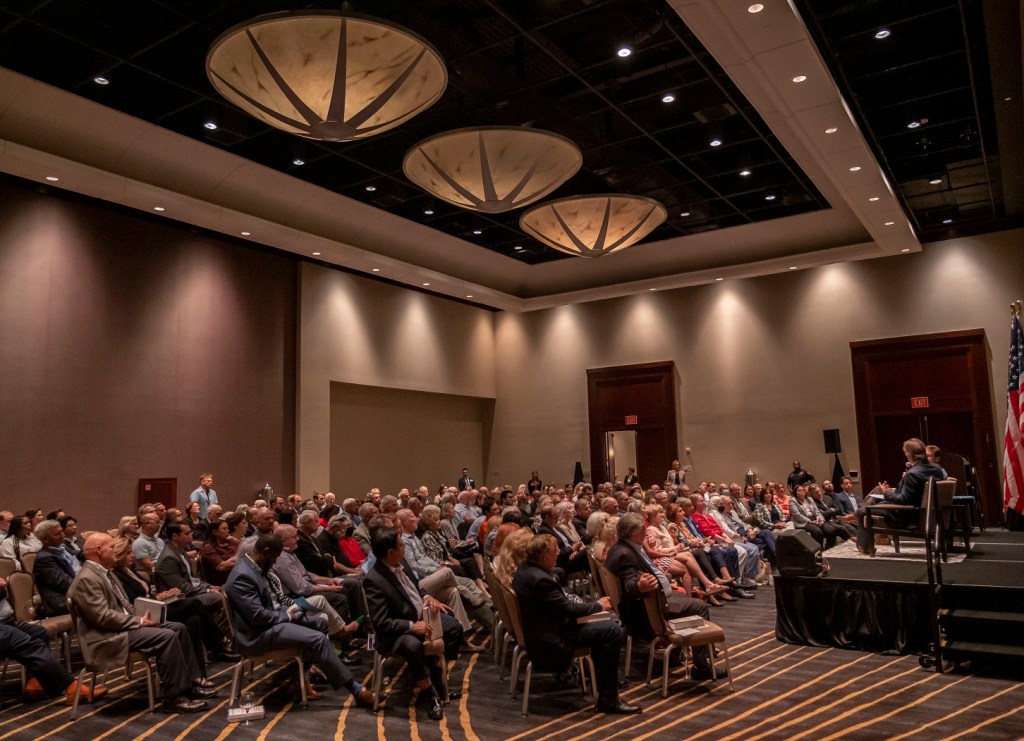
On Monday evening The LEAP Ambassadors headed south towards Houston to attend yet another amazing World Affairs Council event, this one featuring former Secretary of Defense Mark T. Esper. From June 2019 to November 2020, Esper served as Secretary of Defense under the Trump administration–during what he concedes were highly unusual times. WAC Director Maryanne Maldonado led off the evening…
Mr. O’Malley began by asking a question about Esper’s hero: George C. Marshall.
Esper was born in Marshall’s hometown, and during his time at West Point, Esper studied Marshall the man and military strategist. Marshall was known widely for his characteristics of honor and integrity, which Esper tries to live by.
Right off the bat, it was clear that Esper would not shy away from the harder topics. The first question was based on working with President Trump and the atmosphere in the Capitol.
Esper acknowledged the difficulties, noting that while some of the media reports were exaggerated, he and other Cabinet officials had to do a lot of “managing up”: that is, managing their supervisor, to ensure that actions detrimental to the United States weren’t turned into policy.
Ronan and Esper then explored different parts of American military experience in recent years, including turmoil in North Korea, the strategic prioritization of Afghanistan, and domestic protests surrounding the George Floyd protests.
Presidential focus for the past 20 years, irrespective of party, has been on Afghanistan. As Secretary of Defense, Esper identified bring some sort of conclusion to the Afghani war as a priority, but he identified numerous steps he would have taken to avoid the catastrophic pullout that the US undertook a year or so ago.
More recently, Esper was confronted with a (quite literally) trigger-happy Chief of State during the protests surrounding the George Floyd killing. Esper clearly doesn’t relish the government’s frequent turn to the military to solve things outside their wheelhouse: they weren’t, for example, the best choice to call on during COVID, and they weren’t designed to quell domestic unrest–and they definitely weren’t going to “shoot protestors,” as the President had purportedly inquired about.
While Esper was often critical of Trump, he also noted that some of the criticism was overblown. He noted that some of Trump’s unconventional tactics ended up effective, and he noted that some of Trump’s policies have been followed by Biden.
The evening was concluded with a few more thoughts from Esper, particularly his thanks to those who serve, and his hope that military service would be less frequently invoked–but, when invoked, more widely participated in by the general public.
The semester hasn’t yet begun, but that makes this the perfect time to get some pre-semester work, activities, and learning in. With that in mind, we partnered with the Freshman Leadership Program, and we undertook a tour of Huntsville and SHSU.
Although we’ve been on a few tours of Huntsville and we know the community pretty well, we wanted to learn some new things, and we wanted to be on hand should any of the FLP students want a student’s perspective on things.
Our tour itinerary involved: (1) a trip to Arnaud’s Food Truck court, (2) the avenues, (3) Eastham Thomason Park, (4) Sam Houston’s grave, (5) the District Attorney’s office, (6) downtown area, the Richard Haas murals and the Old Town Theatre, and (7) the prison, and (8) Austin Hall.
We began with designer lemonades from Arnaud’s, and the general consensus is that we would be returning!
With an idea of encouraging students to shop local, the many offerings of Arnaud’s food trucks opened up a variety of culinary options to students.
The FLP students seemed intrigued by the Dan Phillips’ homes, and several were even already familiar with the Boot and Cowboy Hat homes. Downtown, we learned more of the Richard Haas murals, with a lesson on how the architecture of the DA’s office…
…was used to help craft the design of the Smither Building’s art murals. Haas repeated the arch motif, used paint to mimic the color of the bricks, and through trompe l’oeil managed to recreate some of the relief elements on the DA’s office. And, of course, all this was done while visually celebrating Sam Houston’s history in Huntsville.
We also had a chance to see Haas’s work at the Old Town Theatre, where Morgan also works, and where all the LEAP Ambassadors have volunteered.
We even got to go in the theatre and learn about their programs!
And as a sort of bookend, we discussed Sam’s Table–another of the LEAP Ambassador’s favorite restaurants–with the incoming freshmen.
In the last leg of the tour, we learned more about TDCJ and the Huntsville Unit, including the difference between “Death Row” and the Execution Chamber, which are different entities in different locations. We also discussed a different prison issue: bats. Driving past the TDCJ warehouse (which is filled with bats) and the “Bat Houses” (which are not filled with bats).
And with a final drive around the University and Austin Hall–the oldest educational building west of the Mississippi–we and the FLP returned to our cars, dorms, and other retreats to prepare ourselves for the new semester.
We returned with a lot more knowledge and the community than we left with!
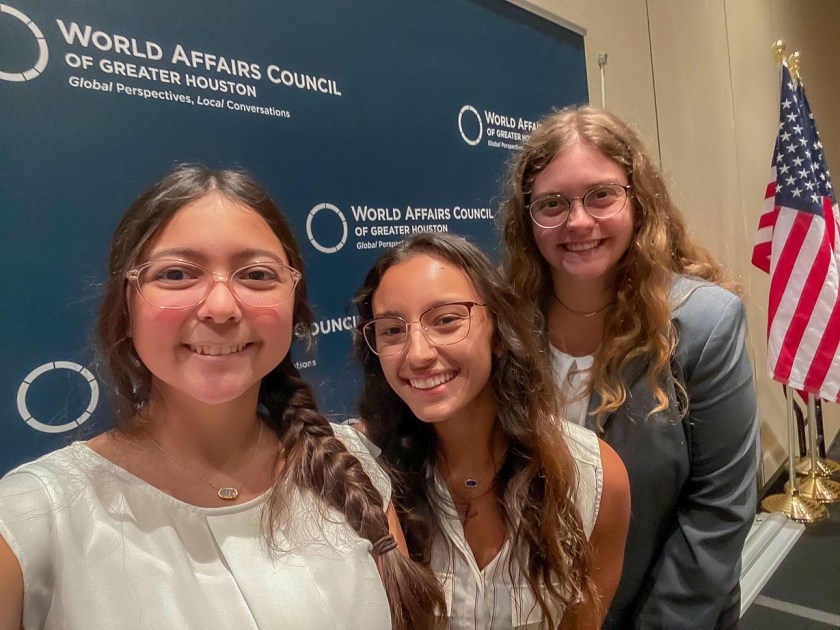
The speaker for the luncheon was Elliot Ackerman, a CIA Officer and Marine stationed in Afghanistan and Iraq, and who, in more recent years, has been a best-selling author of both fiction and non-fiction. The discussion was moderated, as usual, by the excellent Ronan O’Malley, the Director of Programs for WAC.
Attending with us were several SHSU students (Ashlyn Parker, Kiara Williams, Cynthia Boyd), an advisor (Stephanie Fors), and SHSU/community leaders (Gene Roberts, Dean Hendrickson, and Ken Holland).
Ackerman’s book The Fifth Act: America’s End in Afghanistan was the hot topic, and the conversation began with how the title of the book came to be. While he was on vacation with his family, Ackerman was asked to write a 500-word piece about the 20-year war in Afghanistan.
Ackerman joked that he was shocked and thought there was no way to detail and cover 20 years of war in 500 words. When he was asked to write about the operation in Afghanistan, it was referred to and described as a tragedy and he explained that his journalist’s mind made the connection of tragedy with Shakespeare’s plays. Because tragic drama often unfolds in five acts, and because there was a natural breakdown in five parts, Ackerman focused on these five topics: (1) President Bush,( 2) President Obama, (3) President Trump, (4) President Biden, and (5) the fall of the war.
Ackerman then harkened back to an earlier time in history and the construct of blood and treasure. In more detail, he explained that during the Civil War and WWII two main factors rose: the need for someone to fight and someone to pay. But, typically, everyone or almost everyone had to fight, pay, or otherwise sacrifice–and that, according to Ackerman, is no longer true.
Another difficulty is that, most wars can be marked as “victorious” following a positive and defined outcome–such as liberating Europe (WWII). With the War on Terror, a victory was preventing something (i.e., a terrorist attack) from happening. That poses some difficulty in terms of attributing credit or in achieving a defined conclusion.
The book and the non-fiction drama on which it is centered was interesting, so much so that almost all the LEAP guests, including the students, bought books. But the event was also satisfying for the company we were able to enjoy, the always-pleasant prospect of visiting with WAC staff (Ronan, Jahan, and Sandija)…
…and also meeting our advisor’s (Professor Mike Yawn) supervisor, Associate Provost Ken Hendrickson, who spoke following Ackerman, helping wrap up the event.
In short, it was another great World Affairs Council event, just made more great by the fact that it was held at an SHSU campus.
July 26th marks the death anniversary of General Sam Houston, and each year on this date, the Sam Houston Memorial Museum opens the Steamboat House to the public.
As an SHSU student, I want to learn more about Sam Houston, and this desire was reinforced even more by the fact that I am the recipient of a generous scholarship provided by SHMM. So, I attended the Museum’s opening of the Steamboat House as part of their reenactment of Sam Houston’s death and the Victorian customs associated with mourning.
Dr. Rufus Bailey had commissioned this home as a wedding gift for his son and daughter-in-law. Its original name was “Buena Vista,” and while it might have offered a “good view,” Bailey’s son and daughter-in-law, according to oral history, weren’t keen on living in it, and they opted, instead, to look for other views. The home, then, was vacant, enabling General Sam Houston make it his home when he returned to Huntsville, following his removal as Governor of Texas.
As the group of visitors approached the home, we were given black ribbons to commemorate the anniversary of Houston’s death. We entered Sam Houston’s room, a mix of a study and a bedroom. Most of the items were period pieces, but we did see Houston’s bed and boots. Seeing these original artifacts, as well as the fact that the clock on the mantel was stopped to the time of his death: 6:15.
We were then gestured into the next room where “Margaret Lea Houston” would tell us about the three phases of mourning she went through after General Sam Houston’s death. During the first phase: Deep Mourning, women would dress in black, from head to toe, including gloves and veils (and, of course, no adornments such as jewelry). During this time, widows were given space, allowed to mourn alone. Once they were ready to talk, they entered the second phase of mourning: Full Mourning. The transition to this phase was marked by moving from the wearing of all black to wearing black with a white collar, along with cuffs and jewelry. During this period, the widow might receive visitors, discuss her sadness with others, and correspond by mail with others.
In the third phase, Half Mourning, women wore lively colors such as lilac, lavender, and light gray, and more elaborate patterns. This is the briefest stage, and it indicated that the widow was ready to rejoin societal interaction.
Men, on the other hand, were not expected to mourn for as long or as elaborately. The black ribbon I received is similar to what men wore during their mourning period.
We were then guided into the next room, the kitchen, where we could see one way that the kitchen could have been designed and what they would have eaten. Soon after, we walked up the stairs into the parlor where the funeral of General Sam Houston was held, and we heard from his “mother-in-law,” Nancy M. Lea, who discussed her feelings about Texas’s greatest hero and her son-in-law. While she initially opposed the marriage, Ms. Lea overcame her doubts, and she came to embrace her son-in-law.
Now, if you are wondering why one of Texas’ heroes had a small funeral, that would be because (1) mail was slow and (2) General Houston was very unpopular at the time, a function of him refusing to pledge an oath of loyalty to the Confederate States of America.
For these reasons, only a select few attended his funeral on July 27th at 4:00 pm. The funeral was indeed held less than 24 hours from his death because back then, their only way to store bodies was to ice them, and in Texas heat, it made it challenging to keep the body in a presentable condition.
Despite him not being as popular and not many people attending his funeral, on August 5, 1863, the Dallas Herald printed an obituary mentioning the great man General Sam Houston was, and encouraging people to put aside their objections to his “failure” to support the confederacy: “Let us not shed tears to his memory due to one who has filled so much of our affections. Let the whole people bury with him whatever of unkindness they had for him.”
With those positive vibes, I allowed myself a very unVictorian-like smile and reflected what a good choice I made attending SHSU.
Postscript: The Steamboat House was originally located a block or so from the Oakwood Cemetery–where Sam Houston is buried! Following Sam Houston’s death, the home deteriorated, and it wasn’t until 1937 that the Museum was moved to its present location and refurbished. If you have not had the opportunity to visit the Steamboat Home on the Sam Houston Memorial Museum Grounds, make plans to do so on July 26th, 2023!




















 Center for Law, Engagement, and Politics