Coby Steele and Kevin Hernandez–After arriving in Austin late in the evening (2:30am), we had an early morning beset by cold weather. In fact, our planned trip to Capitol Hill was delayed a bit, but we did not let this deter us…
Following some roaming around the Capitol…
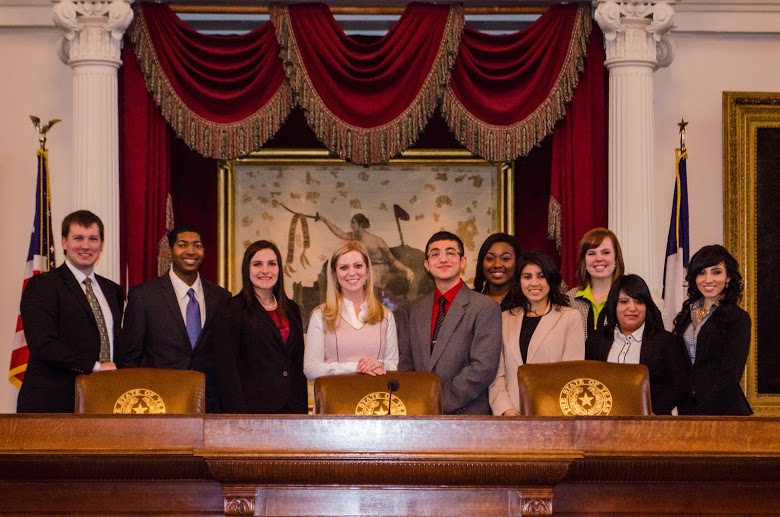
TX Senate Chamber
we met with Senator Charles Schwertner’s staff: Chief of Staff Tom Holloway and District Director Leah Alexander. They walked us through the workings of the Senator’s office in both the Legislative and non-Legislative years, as well as their duties. We were surprised at the amount of work for such a small staff, and we found the policy side of things particularly interesting.
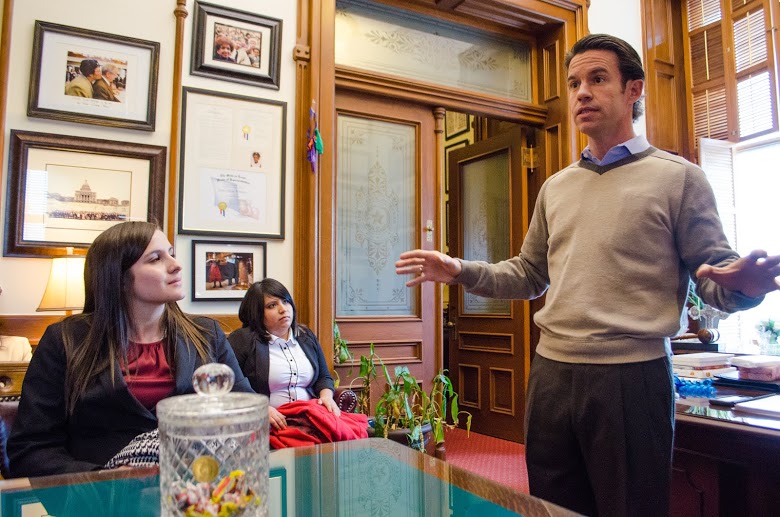
Leah Alexander Presents to LEAP Students
Elected officials rely heavily on staff to explore model legislation, analyze the costs and benefits of legislation, and to summarize existing legislation. There’s a lot of work that goes into these bills, and only a small portion get passed.
After our visit in Senator Schwertner’s office, we broke from the Capitol for lunch at Frank and Angie’s Pizzeria in downtown Austin. The restaurant is so named because of the original owner Angie having a strong affection for Frank Sinatra. There we were joined by a fellow LEAP Center student, Brian King, who is currently interning at the Capitol for Representative Senfronia Thompson. We all got to enjoy the Pavarotti, a vegetarian pizza; the Chairman of the Board, a type of supreme named for Sinatra; and our favorite was the Sicilian which incorporated bell peppers into the pizza. A single pizza was the equivalent of a large delivery pizza, so there was plenty to fuel us for what still lay ahead.
Following lunch, another treat awaited us. Nikki Cobb, Chief of Staff for Representative John Otto, and Chris Griesel, the Parliamentarian of the House of Representatives, met with us on the House floor to discuss the process of how a bill becomes a law.
Nikki Cobb and Chris Griesel Present
The discussion was very engaging; Mr. Griesel displayed an encyclopedic knowledge of history and procedure, as well as frequent bursts of humor to lighten what, in other hands, could be a dry topic. Mrs. Cobb was very helpful in answering questions about the legislative process, while also providing details on her career path. Both spoke about a common theme of working together with other legislators and not making enemies or bridges because they said one day “they may need you to pass a bill, and another day you may need them.”
Nikki Cobb with LEAP Center Students
After our exclusive and unprecedented experience in the House chamber we met Todd Kercheval, a man with a diverse resume. His work ranged from being a Legislative Aide to Chief of Staff to work in an executive department to lobbyist. While most of our day was more oriented to the different formalities of the Texas legislature, Mr.Kercheval touched on the essentials needed to work efficiently in the fast paced world of Texas politics. He emphasized two points: initiative and integrity.
Todd Kercheval Discusses Lobbying
After a day of amazing presentations, we had an amazing dinner. In our case, it was at Fogo de Chao, a spectacular Brazilian steak house, which is a short walk away from the festive and ever-exciting 6th street. We were joined by old colleagues and recent alums Brian King, Emily Johnson and Will Phillips, who all provided great conversation through the rest of the night. The experience was new for a good portion of us, and the quantity and quality of the food was a bit surprising, as was the speed of its delivery to the table. This was one of the best possible ways to end an overall marvelous day on our visit to the Heart of Texas.
Ashley Richardson and Joycelyn Ovalle–As LEAP Center students, we strive to take initiative. It’s a good thing! This morning, adaptability and initiative shaped our Austin trip, which was almost derailed by what Austinites described as “inclement weather.” The Capitol Building Officials, however, closed down the offices, leaving us without a guided tour of the Capitol Building.
We adapted. Professor Yawn offered an impromptu tour of the Capitol, offering neat facts and historically accurate facts pertaining to politics and law. In fact, some straggling tourists soon joined the group, asking, “Is this a public tour?” Along the way, and sometimes with stragglers, we saw our favorite governors, Elizabet Ney’s statue of Sam Houston, and some Capitol art.
LEAP Center Students With Sam Houston
But we weren’t the only ones who adapted. Senator Schwertner’s Chief of Staff (Tom Holloway) and District Director (Leah Alexander) came into work despite the “snow day,” and offered us a wonderfully interesting overview of office administration, discussing staff positions, duties, and a general conversation about “life on the Hill.” For students who have learned most of their politics in classrooms and television, this real-world discussion was valuable, and many of us left hoping that we would be able to apply that knowledge on the Hill in the near future.
Tom Holloway & Leah Alexander
With those thoughts in our head, we headed to Frank and Angies, where three colossal-size pizzas were devoured.
To begin our afternoon sessions, we headed to the House Chamber, where Chris Griesel (House Parliamentarian) and Nikki Cobb (Chief of Staff to Representative John Otto), taught us about the process of shepherding legislation through the Texas Legislature.
House Parliamentarian, Chris Griesel
Comparing his job to an air-traffic controller, the former lawyer turned Parliamentarian used a modified version of the Socratic Method to engage the students, while Ms. Cobb provided valuable insights from an insider’s perspective.
Nikki Cobb with LEAP Center Students
Having “class” in the House Chamber added to the experience, and we were sitting on the edge of the House members’ seats, soaking in as much information and advice as possible.
We concluded our visit to the Capitol with a visit to Representative Senfronia Thompson’s Office. Ms. Thompson, one of the most senior members of the Texas Legislature, invited lobbyist Todd Kercheval to speak to us. He offered motivational words emphasizing how persistence and diligence can change destiny, and he shared with us his path through various public service positions culminating with his position as lobbyist.
Lobbyist Todd Kercheval
Although our formal schedule for the day was complete, we still had plans for dinner at Fogo de Chao, where several SHSU alumni joined us for a meal that was almost overwhelming in its profuse offerings of lamb, chicken, and beef.
To work off some of the food and to extend conversation, we took a half-mile stroll around downtown Austin, including a view of Sixth Street, adding an exciting end to an exciting day!
With the start of the spring semester, students are trying to settle in and get adjusted to an increasingly hectic schedule. That’s also true of politicians, who are facing primary elections in less than three weeks. And last night, the lives of the students and politicians intersected at the Reagan Dinner in Walker County, when TX Representative Dan Branch, TX Representative John Otto, Congressman Kevin Brady and 20 or so other elected officials mixed with students and locals in a fun-filled evening.
Rep. Branch Keynotes Reagan Dinner
The event combined fun and food, with Representative Dan Branch giving the keynote address. Befitting a “Reagan Day” Dinner, Branch offered his favorite Reagan quotes, including these orders: “I have left orders to be awakened at any time in case of national emergency — even if I’m in a Cabinet meeting.” He also generously spent time sharing stories with the students following the event.
Rep. Branch with LEAP Center Students
We were doubly lucky in that our tickets were sponsored by Representative John Otto and Senator Charles Schwertner. Some of our group sat with Representative Otto and his wife, Nancy, while others sat with Senator Schwertner’s District Representative, Hayden Paul. They were very nice, spending time discussing the business of governance and providing useful advice.
While all the students were interested in the political side of things, the night was particularly interesting for Ashley Richardson who, like Otto, combines an interest in Accounting and Politics. “It was inspiring,” noted Richardson, “I hope to follow a similar career one day, and it was a great learning opportunity.”
John & Nancy Otto with LEAP Ctr Stu.dents
Major thanks to Representative Otto and Senator Schwertner for providing tickets, to the organizers—Linda McKenzie, Tracy Sorensen, and Kay Deahl—for their great work, and to Representative Dan Branch for a fine speech. Their efforts opened up doors for us, and we are very grateful.
This was a perfect start to a planned three-day weekend. Following the event, we are picking up our Democrat friends, and we’ll head to Austin for more education, fun, and food!
Many thanks to Cindy Blaylock for organizing the Women’s Conference, featuring key speakers discussing women’s issues. Speakers such as Dessie Cherry, Shirley Wallace, Diana McRae, and Representative Senfronia Thompson spoke to an audience of more than 100 members, including two Political Science interns, Veronica Vera and Oscar Aguilar.
On our final day, our travel day, we still got some sight-seeing in. Although we had spent considerable time in Norman, we had focused our energies on the University of Oklahoma campus. Today, we visited the downtown area, where we checked out some of the public art…
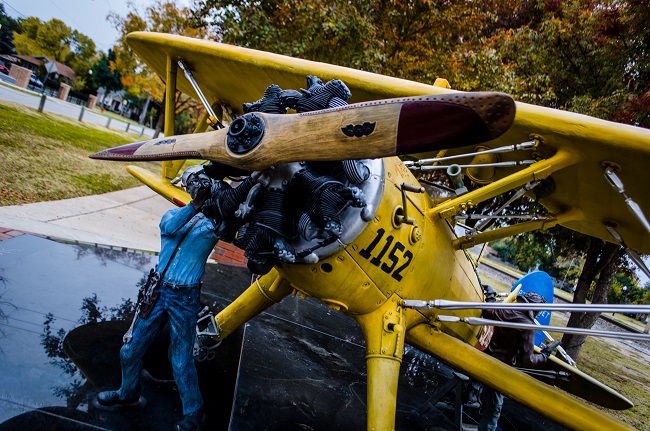
…which included more aviation themed work.
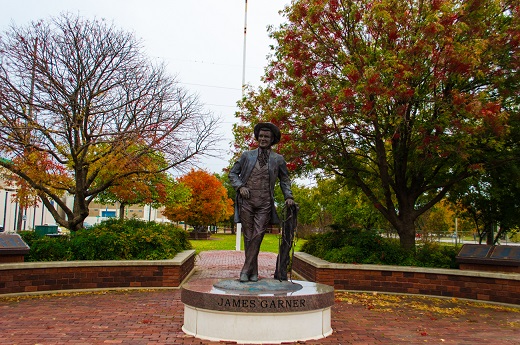
Most interesting, though, was the statue of James Garner, the star of Rockford Files and Maverick, who grew up in Norman, Oklahoma.
James Garner
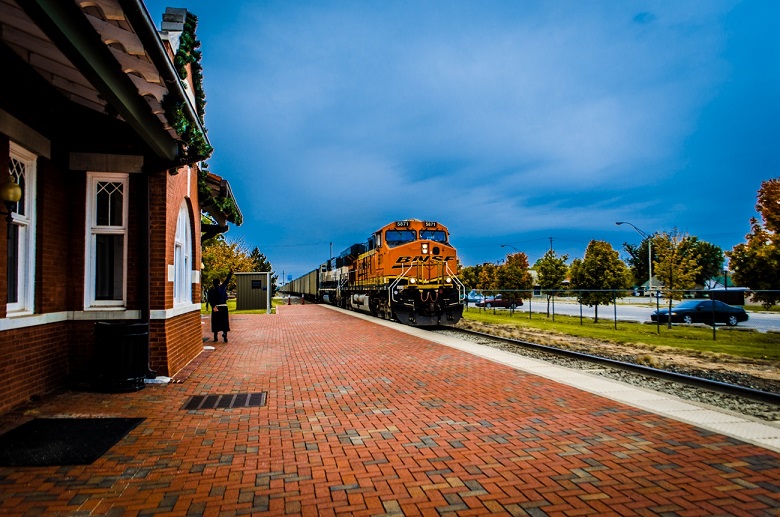
Another highlight was, strange as it sounds, was getting to see a train go by…
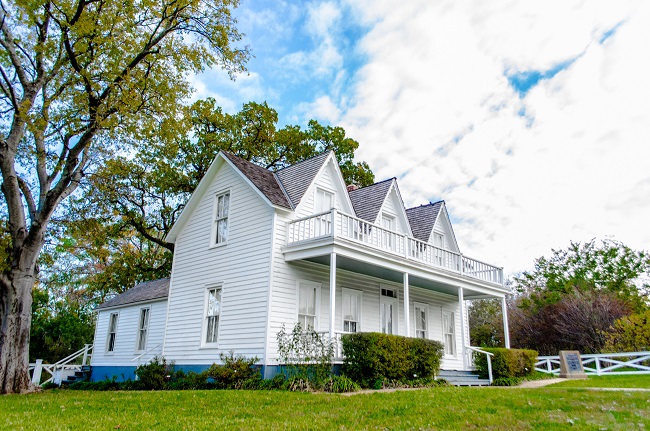
The real highlight of the day, however, was in Denison, Texas, where we visited the birth-home of Dwight Eisenhower.
Ike’s Birthplace
Eisenhower was born here in 1890, and he would be the last President to be born in the 19th century. His father worked for the railroad, which passed by about thirty yards in front of the house.
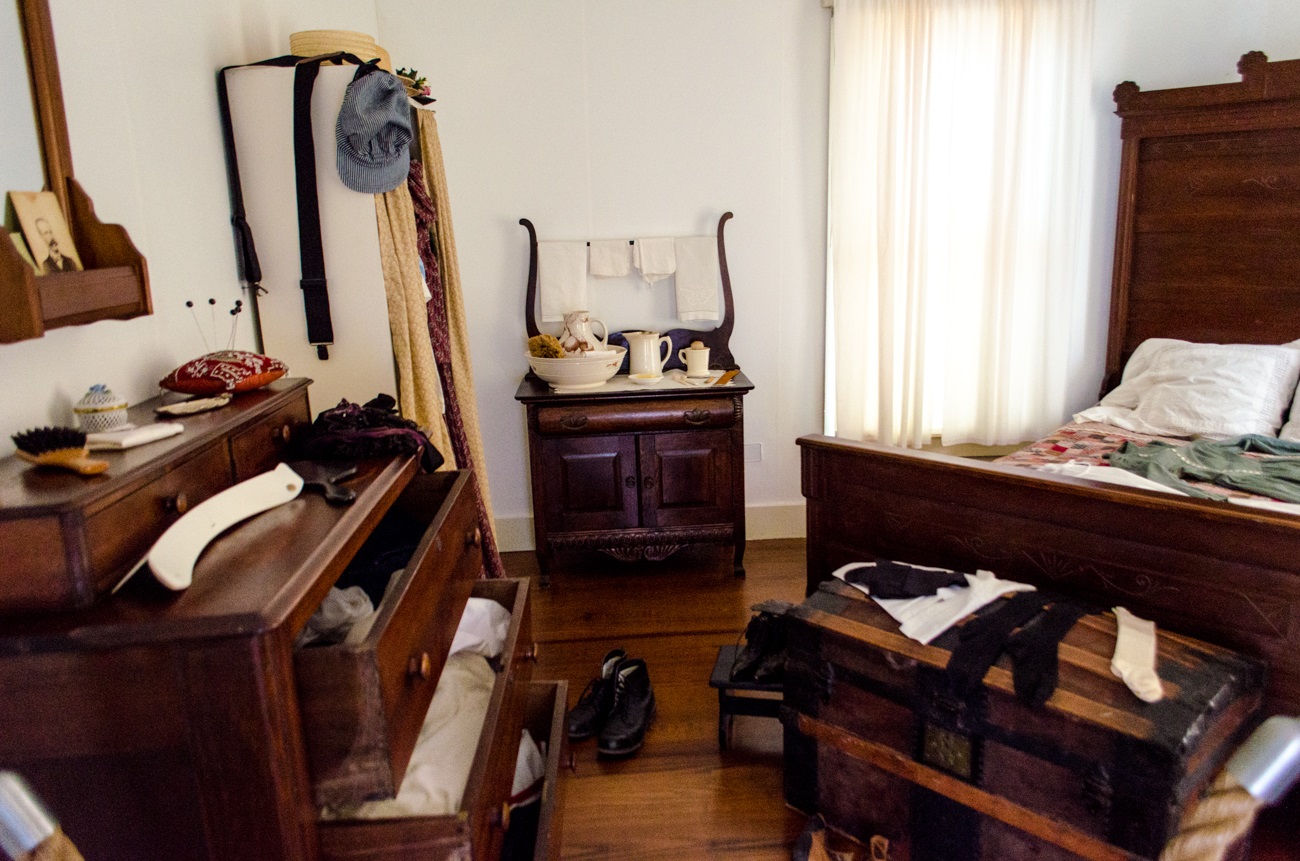
The site is run by the Department of Texas Parks and Wildlife, and we had a knowledgeable tour guide to take us through the home.
Interior of Ike’s Home
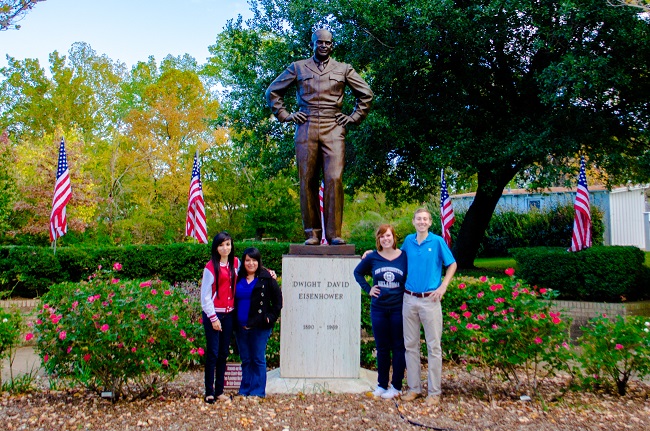
Our visit was made all the more appropriate with the arrival of Veterans Day.
Eisenhower Statue
The last day was also a day for reflecting on the trip and the different things we did. Heading home, we canvassed the group for our favorite activities, which are presented below.
Favorite Artifacts:
1) Abraham Lincoln (Cowboy Hall of Fame and OU Law School)
2) Land Run Monument (OKC)
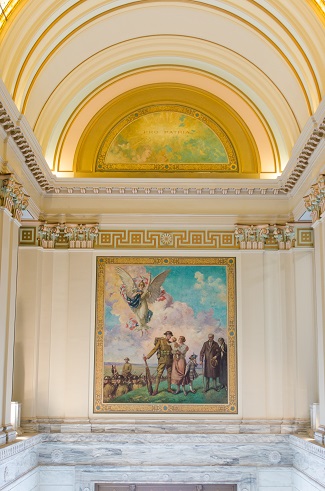
3) Capitol Artwork (OKC)
Artwork in State Capitol
Favorite Destinations:
1) OU Campus, for OPSA and OU Law School
2) Oklahoma National Memorial and Museum
3) Segway Tour
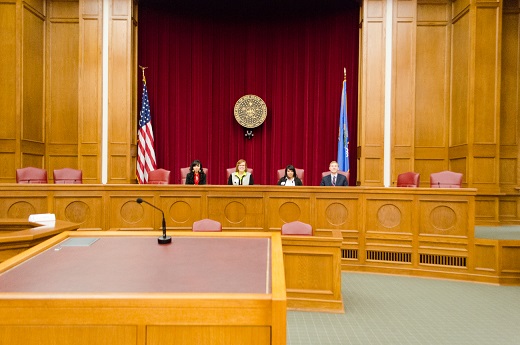
OU Law Courtroom
Favorite Presentations:
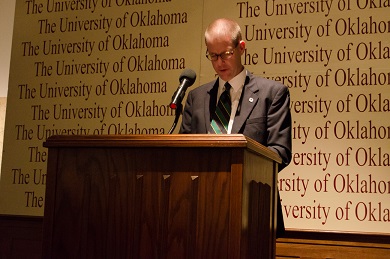
1) Southern Politics, by Scott Buchanan
2) Public Opinion, Drug Use, and Depedence, Lauren Reinke
3) Affordable Health Care, Isaac Lutz
Professor Scott Buchanan
We were very impressed with Oklahoma City, Norman, and the people we met on the trip. We’d especially like to thank the organizers of the Oklahoma Political Science Association, who were very helpful to us.
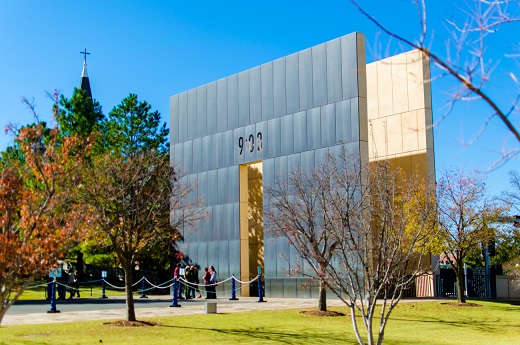
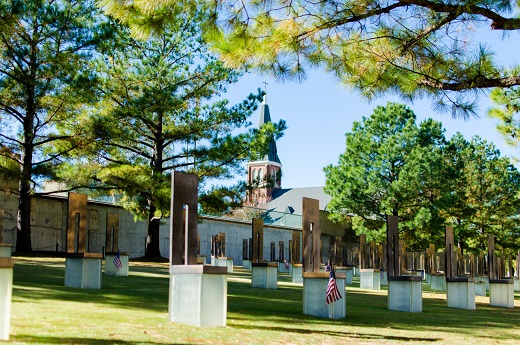
Today had to be my most anticipated day of the trip. It was packed full of activities and I could not wait to conquer all of what Oklahoma City had to offer. We began the morning with an emotionally overwhelming trip to the Oklahoma City National Memorial Museum. Learning about the devastation caused by Timothy McVeigh’s bombing of the Federal Building in 1995 was one of the most sobering things I have ever encountered. The museum captured the emotions of that April morning in such a powerful, striking way. I did not walk out as the same person that walked in.
Oklahoma National Memorial
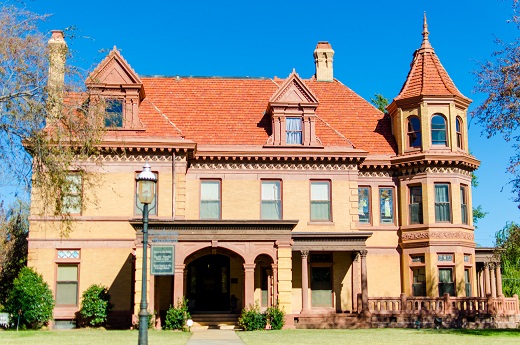
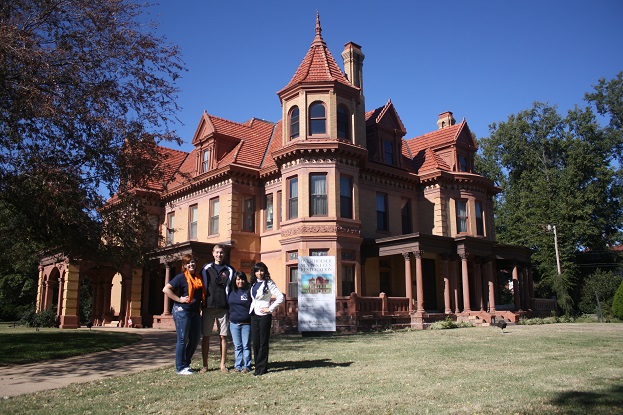
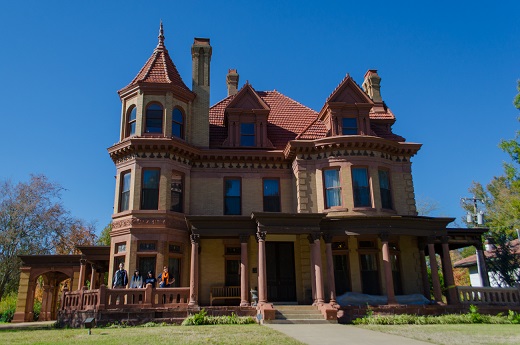
In order to decompress from the Memorial, we headed to the Overholser Mansion, located in Heritage Hills area of northern Oklahoma City. Built in 1903, the home transported us back in time.
Overholser Mansion
The tour guide and décor did a good job of helping us picture life in the early 1900s.
Overholser Mansion Interior
We learned of the wealthy Overholser family that lived there until the selling of the home in 1972 to the state of Oklahoma for education purposes. Drawn to the ornate woodworking and lavish furniture of the home, I really enjoyed living in 1903 for the hour-long tour. What it must have been like to live so extravagantly!
Following the wonders seen at the Overholser Mansion, my fellow LEAP Center students and I traveled to Cattleman’s steakhouse to enjoy some home cooking and western atmosphere. Now while it was hard to compare it to anything back home in Texas, the Chicken Fried Chicken and chocolate pie definitely made their way onto my list of best foods. Also interesting were the lamb fries we tried…
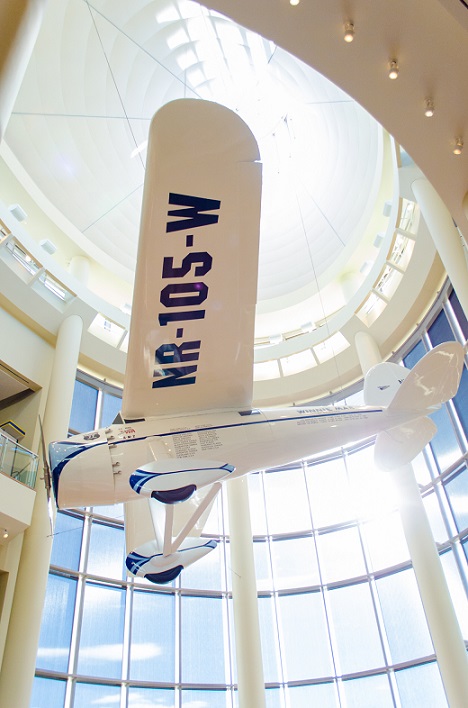
After a tasty meal, we then made our way over to the Oklahoma History Center. Even though we only had an hour and a half to enjoy it, I must say Oklahoma has never seemed so versatile. There were exhibits on cowboys and kitchens, dresses and divas, and even some history about Oklahomans in space. As a true Texan born and raised, I can still admit that through learning about the beauty and history of this state, Oklahoma now holds a place in my heart.
Wiley Post’s Plane
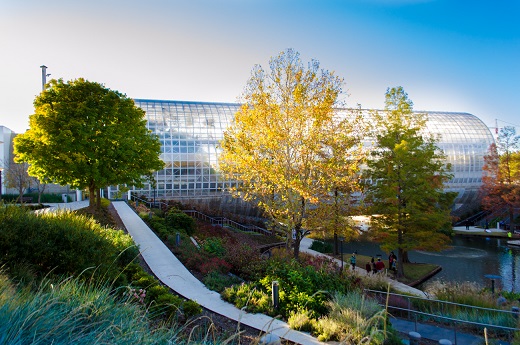
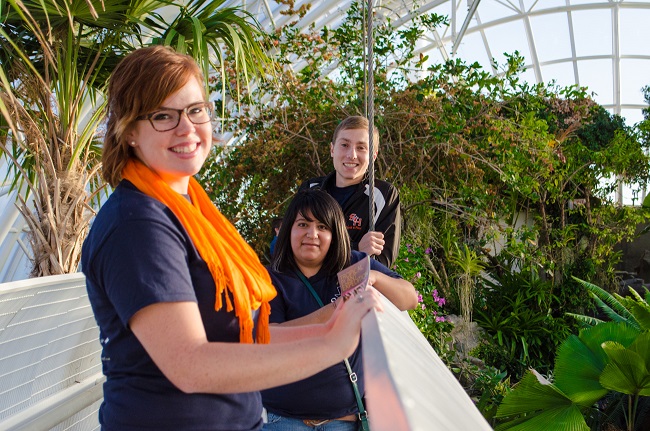
Before the sun was able to completely get away from us, we were able then to enjoy the Myriad Botanical Gardens and Crystal Bridge Conservatory in downtown Oklahoma City.
Myriad Gardens
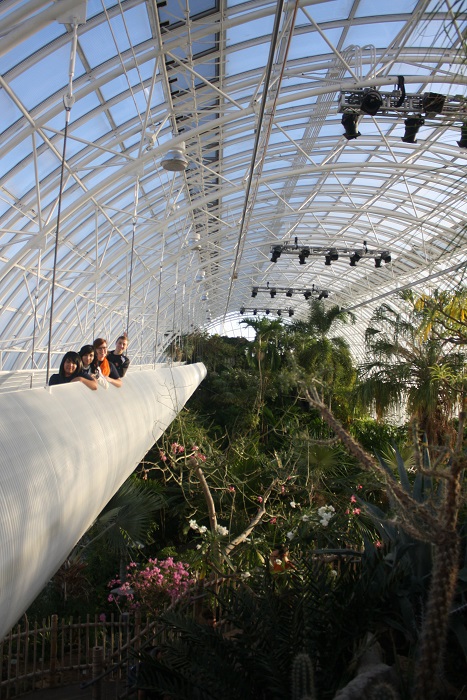
Taking in the beauty and humidity surrounding us, we spotted many exotic flowers and towering trees that would beautify any locale.
Tropical Conservancy
Upon leaving the Conservatory, we strolled the gardens outside and proceeded to spot a live wedding, some feisty ducks, and a child or two running loose. People-watching has never been so entertaining.
Before saying goodbye to Oklahoma City once and for all, we begged Professor Yawn to let us stop by an extravagant, tacky, over-the-top-sweets shop to indulge our inner-kid. Laden with bags of chocolate truffles, cupcakes, and sweet candies we reluctantly made our way back “home” to Norman to finish off the night at the University of Oklahoma’s historical campus. We discovered the campus’s old, gothic style buildings and, more importantly, the breathtaking interiors. Although younger than Sam Houston State University by a decade or so, OU’s history pervaded every step we took through the beautiful campus grounds.
Finally to finish up such an exciting day, we headed to a quaint Vietnamese restaurant. Each student tried something new, whether it was pho soup, lettuce wraps, or a banh mi sandwich. Full, exhausted, and ready to sleep our lives away, we sped back to the hotel to calculate the hours of sleep we would get before waking up to wrap up our trip tomorrow. Looking back on such a wonderful day, I realize how truly blessed I am to live in a country with so many opportunities and wonderful histories to learn.
Zach Goodlander:
Day 4 was a flurry of activity! Crisscrossing the Norman/OKC area we continued where we left off—picking up new experiences and learning more.
Our first stop was Oklahoma City Bombing Memorial, which serves as somber reminder of the tragic Murrah Federal Building bombing on April 19, 1995.
Oklahoma National Memorial
Winding through the museum you get to know the victims, discover heroes and, most important, never forget what happened that morning.
Bombing Debris
What I’ll never forget from the museum is the recording they offer of a meeting from the morning of the bombing—the audio captures the dramatic and sudden shift from casual meeting sheer panic. It left me with goosebumps.
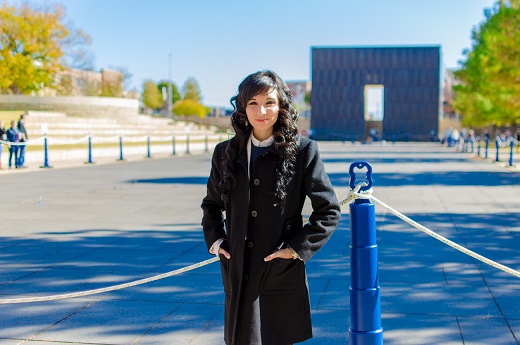
Jessica Rodriguez at Memorial
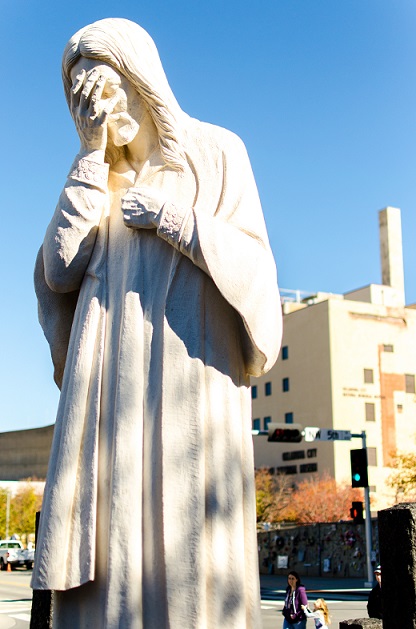
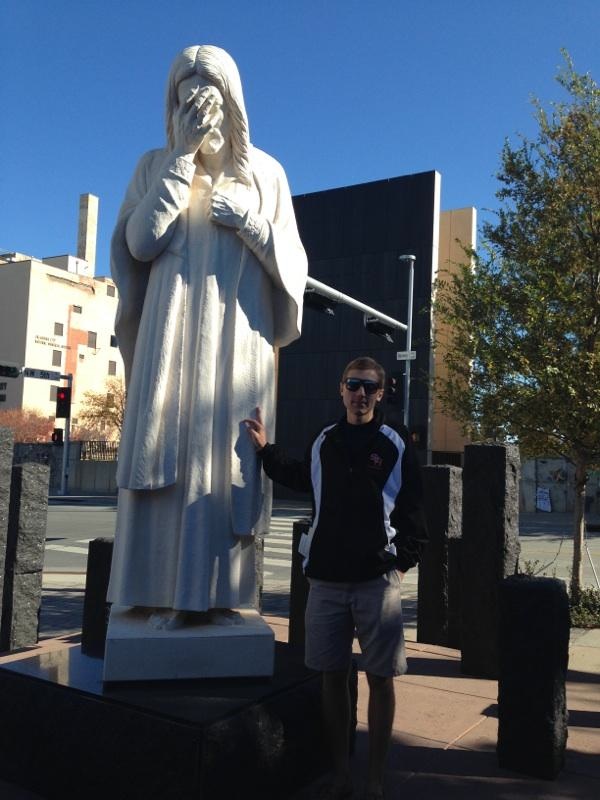
Also poignant is the “And Jesus Wept” Statue erected by St. Joseph’s Catholic Church, located across the street from the bombing Memorial.
Jesus Wept
Leaving the memorial we arrived at the Overholser Mansion, a turn of the century Victorian style home. The home was built for renowned Oklahoma City businessman and philanthropist Henry Overholser and his family.
The Overholser family lived in opulence and their lifestyle of luxury was perfectly preserved in the beautiful home.
Overholser Mansion
Lunch was the next stop, which we satisfied by going to Cattlemen’s Steakhouse in the historic stockyard area of OKC. Cattlemen’s is a continuation of the cowboy heritage and the food did not disappoint. Lamb testicles was the appetizer of choice (certainly exotic, but not overly tasty) and for the meal I had a Chopped Beef Sandwich, brought to us by a waiter who insisted on calling us “partner.”
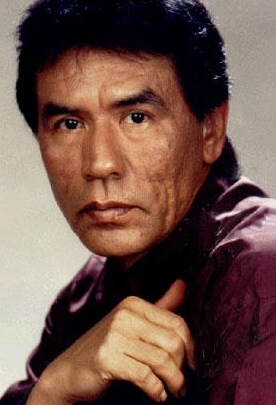
Having satisfied our stomachs, our next stop was to learn more about Oklahoma at the State History Museum. Here we learned everything about the state: its Native American cultures, contributions to film and aviation, and its history from pre-statehood through the present. It was the state’s contributions to film that I found most fascinating, where I learned one of my favorite character actors Wes Studi (Dances With Wolves, Last of the Mohicans), was born in Oklahoma.
Wes Studi
Moving on from the state’s history, we went to the Myriad Gardens towards the center of OKC. The site is fascinating for its “duck pond,” which is loaded not only with ducks, but also koi; the tropical environment within the Conservancy; and the beautifully landscaped grounds.
What was most interesting to me was that the area was part of a recent urban development plan that Oklahoma has implemented to beautify the city, raising the quality of life and attracting tourists—such as us!
We stopped at a nearby gourmet dessert boutique where I picked up some delicious peanut butter truffles, and the other students indulged equally. Jessica bought $42 worth of candy, although it should be noted that she generously offered to share.
Moving on back to Norman, we walked the campus of OU, checking out the student union, the clock tower, and the reading library…
It was a beautiful campus.
Ending the day with dinner at Coriander Cafe not far from the university we had a wonderful meal. The Vietnamese cuisine was definitely outside my normal, but this trip is all about new experiences and the Banh Mi sandwich I had was superb.
In sum, this day was the culmination of everything that’s been great about Oklahoma City and Norman, and I will be leaving Oklahoma tomorrow with a new-found appreciation for the state.
We first made our way back to the Fred Jones Art Museum for the second day of the conference where another round of panelists awaited us. The first series of panelists included research papers by undergrads and grad students from various universities in Oklahoma. Today’s research topics included:
Media focus on candidate traits by gender
Children’s perceptions of authority figures over time
Reframing substance abuse from morality to illness
Lauren Reinke on Substance Abuse
While Jessica, Zach, and Professor Yawn enjoyed a brief discussion on the transformation of higher education from online education, Dulce and Constance had the opportunity to hear from a panel that discussed the “Identity and Legitimation in Authoritarian Regimes”. Speakers Derek Steiger and David Stroup both gave insight on the effect of nationalism on maintaining the Chinese Communist Party. Both speakers conveyed their arguments in a clear, concise, and captivating manner. The next two speakers, Burcu Degirmen and Daniel Brown, spoke on the Turkish Summer and the misconception of it relating to the Arab Spring rather than the “Occupying Wallstreet” movement. An accomplished writer and expert on southern politics, Scott E. Buchanan closed out the conference over lunch with his speech about the changing electorate in the south and its implications on the nation as a whole.
Professor Scott Buchanan
The experience of the conference was uniformly positive, from the setting in the Fred Jones, Jr. Art Museum…
LEAP Students in Fred Jones Art Museum
to the hospitality of the organizers, to the chance to do some old-fashioned “telephone booth stuffing”…
Telephone Booth Stuffing
…to the chance to meet undergraduates from different institutions, to the interesting topics, this was a great opportunity, and we are grateful.
Conference Lunch
After our conference concluded we were happily surprised by gourmet cupcakes. We enjoyed various flavors including but not limited to Canadian maple bacon, bananas foster, salted caramel, and German chocolate. We also got to see some of the fall’s changing colors, something we don’t see much of in Texas.
We had to rush to meet our two o clock tour at the Oklahoma State Capitol Building, but we were impressed by its architectural significance when we arrived. The capitol beautifully captured all aspects of Oklahoma’s history and its people.
OK State Capitol
Jessica, who has been to many state capitols, enjoyed this immensely and particularly liked the Senate Chamber.
OK Senate Chamber
Zachary’s favorite part about the capitol building was how different parts of the state’s history and its people were displayed throughout the halls.
Will Rogers in OKC Capitol
Dulce’s favorite part was the recently added rotunda. Although it was added onto the capital in 2001, the dome blended seamlessly into the standing architecture of the capitol building.
OK Capitol Dome
Constance’s favorite part was learning of the history of the building from the charming tour guide, who was extensively knowledgeable in everything from architecture to political change and ramifications that have shaped Oklahoma’s history.
Indian Sculpture OK Capitol
We also learned, it’s worth noting, that Oklahoma, like Texas, has two Supreme Courts, one that addresses criminal issues and another that addresses civil issues.
OK Supreme Court
Leaving the state capitol building…
Capitol Building
…we took a short drive through Oklahoma City to reach our next destination, the National Cowboy and Heritage Museum.
Charlton Heston
With only an hour and a half to enjoy all the museum had to offer, we made our way, soaking in as much as possible in such a short amount of time.
Dulce most enjoyed the Western Performers Gallery, as she was able to test her knowledge of popular western television shows through an interactive quiz. She got a 12 out of 13, matching theme songs to television westerns, and enjoying the exhibits associated with Western Performers.
Jimmy Stewart
Constance’s favorite painting happened to be “The Quarrel” by Frederick Remington since she could almost create her own story behind the argumentative body language of the cowboys and their hostile nature.
The Quarrel, Remington
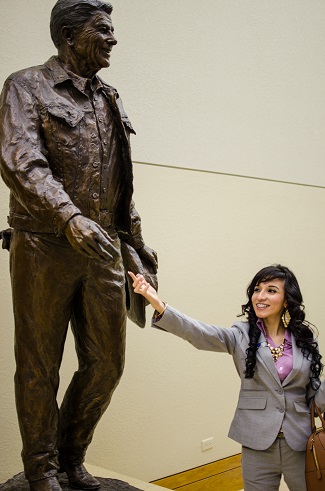
Jessica’s favorite part happened to be the Ronald Reagan statue because of his history as a president and a cowboy.
Ronald Reagan &Jessica
The John Wayne and Charlton Heston Statues stood out most to Zach.
John Wayne with Zach
Everyone pretty much enjoyed the beautiful art in the Museum, the “Canyon Princess” sculpture…
Canyon Princess & Jessica
…the Lincoln Sculpture…
Abe Lincoln, by Balciar
and The End of the Trail Sculpture, the latter of which serves as the Museum’s centerpiece…
Students & End of the Trail
…and the museum grounds were pretty, too…
Museum Grounds
To wait out the hectic traffic of Oklahoma City, we enjoyed a coffee and scintillating conversation at a local starbucks. With growling bellies, stories and recommendations of restaurants were swapped until it was time to head back to Norman for dinner. Locating “Hideaway”, home of the “best pizza in the state”, we scarfed down appetizers and delicious pizza to satiate our voracious appetites after a long day of touring the city.
The day’s activities left us exhausted and in much need of an early night’s sleep. Tired as we are, we cannot wait to begin the adventure again tomorrow.
Day 2 of our trip started with us going to the OPSA Conference. The conference presentations we attended were held in an art gallery, which provided an impressive backdrop for the speakers. The gallery, named the Fred Jones Art Museum, is something we will be able to explore fully later in the conference.
There were a total of 7 speakers at the two panels we attended, and the speakers included undergraduate students, graduate students, and professors.
Presenter Isaac Lutz
Research topics included:
Ideas on reforming the Oklahoma Education Lottery
Creating and implementing an Uninsured Motorist Bill
Quality of Life issues in Oklahoma City
A cost-benefit analysis of the Affordable Care Act
A demographic look at healthcare in Oklahoma
The information provided was interesting for the most part, but it was also beneficial for us to learn the process of research and see how it unfolds at a professional conference. One of the intriguing aspects of this process was seeing undergraduates and graduate students present. This provided the opportunity to learn from others’ examples, but also as a kind of measuring stick to evaluate our own capabilities.
We were privileged to be invited by the University of Oklahoma College of Law for an in-depth tour of their law school. The tour included lunch, an actual tour of the Law School, a meeting with Dean Harroz, and even the ability to sit in on a law class by Professor Richter. We were blessed by the hospitality of both the Dean and the Admission Counselor, Trudy Sickles.
OU College of Law
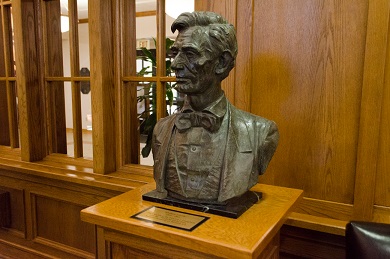
After enjoying fajitas with prospective students and current law students, we toured the College of Law, enjoying the many works of law-related art in the building, including a bust of Abraham Lincoln…
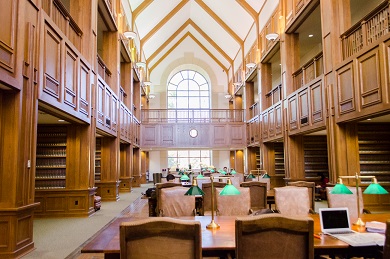
We explored the Donald E. Pray Law Library, which housed a plethora of state and federal court rulings.
OU Law Library
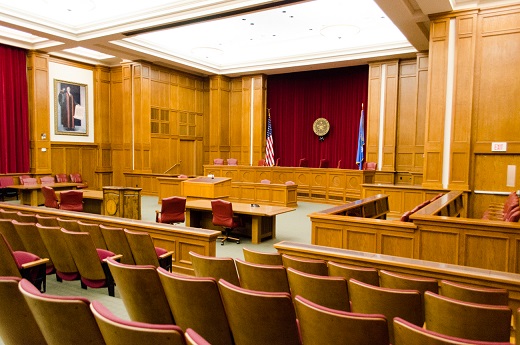
The next interesting stop was the Dick Bell Courtroom.
OU College of Law Courtroom
The courtroom not only serves as a learning tool for students but also as a host to regional mock trial competitions and actual live courtroom proceedings. As a group that brings in our own live trials (thank you Justice Tom Gray and the Texas Tenth Court of Appeals), this was particularly interesting.
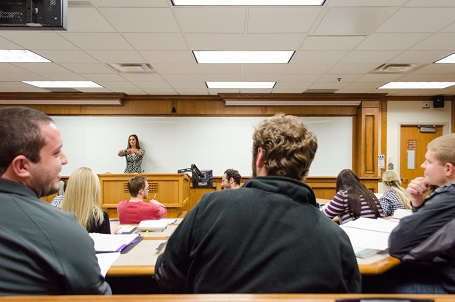
Following the tour, we sat in on a civil and courtroom procedures class taught by Professor Liesa Richter. After hearing so much about the Socratic method being taught at law school it was an intriguing experience to finally be in a classroom where it was used.
Professor Richter, OU Law
Although considered tough, Professor Richter is considered by many of the students to be one of the best professors at the University of Oklahoma. Since she spoke with such passion and enthusiasm it was easy to understand their consensus.
In reflecting on our day at OU, both for the conference and the law school, we feel blessed to have this opportunity. Professor Keith Gaddie, the OPSA Conference Chair, was wonderfully welcoming, and we were greatly impressed by how well we were treated by the OU College of Law.
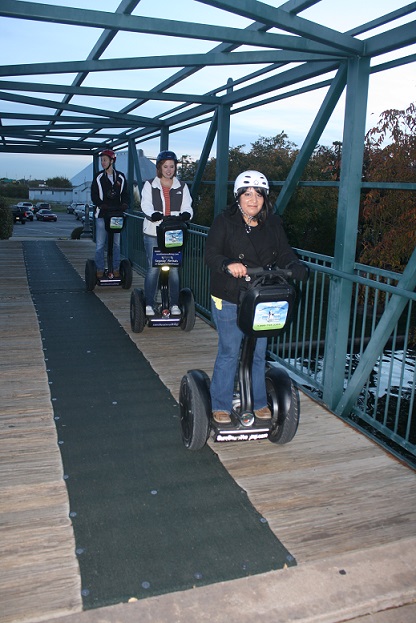
Stopping briefly for a Starbucks, we quickly moved to downtown Oklahoma City for the most free-wheeling event of the day: the Segway Tour! Segway is the best way to experience the full downtown environment. Since almost everyone, besides Constance, knew how to use a Segway and liked the experience, it was sure to be an enjoyable evening.
Segway Train
Our start was perhaps a bit slower than we thought, as Jessica seemed a bit shaky on the Segway and struggled to keep her balance while also taking pictures, but she soon got the hang of it and enjoyed it.
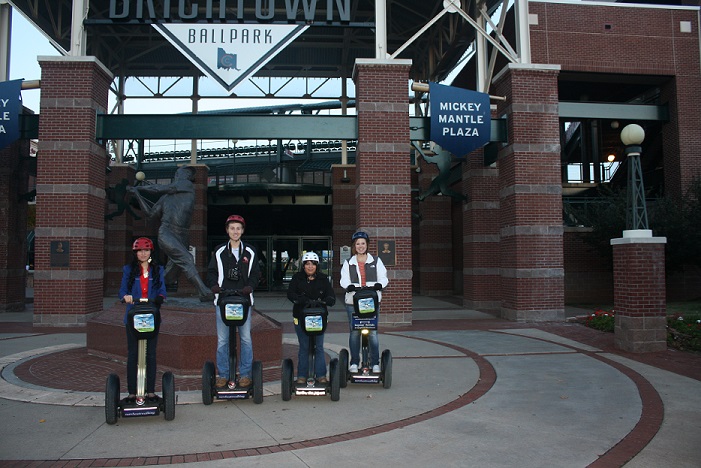
The breadth of sites we were able to see was incredible. We explored Bricktown; the OKC Riverwalk;
LEAP Students on Riverwalk
OKC Thunder stadium; OKC RedHawks stadium, which features a statue of native Oklahomans such as Mickey Mantle…
…the Land Run sculptures, which portrays the “Sooners” rushing to find land…
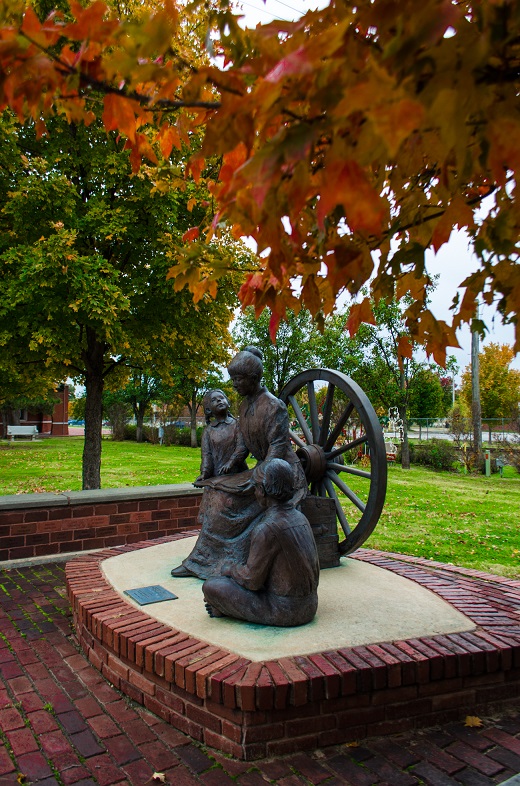
Land Run Monument
…the 1995 Federal Building Memorial, architecture by I. M. Pei, the Myriad Gardens…
LEAP Students at an OKC Fountain
…and so much more. The Segway tour provided ourselves with a new appreciation for Oklahoma City.
Highlights included the Centennial Land Run Monument at sun set, and—the one that stood out the most—the Oklahoma City Bombing Memorial. It was awe-inspiring to stand where such a dramatic and catastrophic event took place.
Oklahoma City Memorial
We left the memorial to finish up the tour at the Skirvin hotel, said to be haunted by the ghost of a hotel maid that killed herself after having an affair with Skirvin himself.
Thanks to Charlotte Crowder and “Sure Beats Walking” for setting up a great tour by Segway.
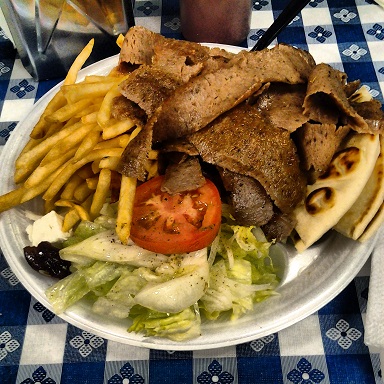
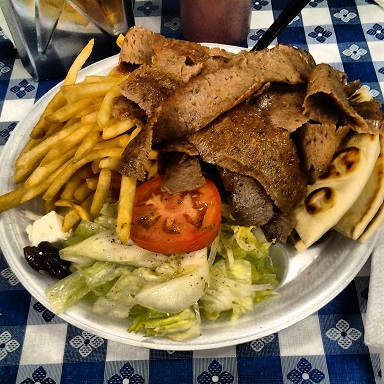
As tradition on LEAP Center trips, we drove back to Norman in search of a new and exciting meal. Jackpot was struck in the finding of a tiny, hole-in-the-wall place called “The Greek House”. Family owned, the menu consisted of four items and we all chose the Gyro Plate…
Gyros Plate at the Greek House
We proceeded to dig into a mountain of sliced lamb and french fries, stuffing ourselves with authentic Greek food.
In summary, we had terrific experiences from sunup to sundown, and we are looking forward to setting the bar even higher tomorrow.

















 Center for Law, Engagement, and Politics