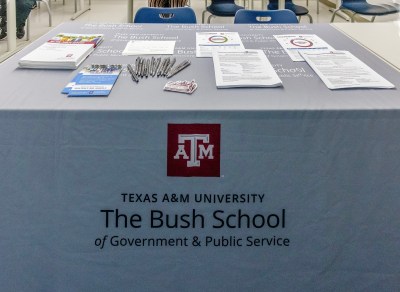
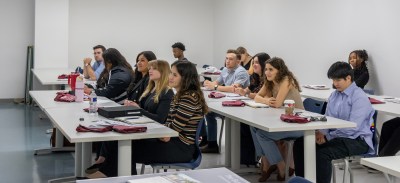
The LEAP Center had the privilege of hosting Kathryn Meyer from the Texas A&M Bush School of Government and Public Service to speak about their Master of Public Service and Administration (MPSA) and Master of International Affairs (MIA) programs. The event was an opportunity for students to learn about the many options available in public service, reinforcing LEAP’s commitment to ensuring students are aware of all the paths they can take to make a difference. Meyer, who has worked with Professor Yawn since 2007, brought a wealth of knowledge and insight to the event, offering a detailed look at the Bush School’s programs and their potential to shape careers.
She explained that the Bush School offers two distinct graduate programs, each tailored to different career aspirations.
The MPSA is designed for those interested in domestic public service roles such as non-profits, local government, homeland security, and federal agencies like the FBI or ATF. In contrast, the MIA focuses on international affairs, preparing students for careers in diplomacy, foreign aid, economic policy, and analytical roles within government agencies. For MIA students, a second language is a requirement, reflecting the global scope of the program.
Meyer also discussed the admissions process, emphasizing that the Bush School looks for well-rounded candidates with strong academic backgrounds, internships, professional development, and community service experience.
Each program admits 80-90 students annually, and remarkably, all admitted students receive scholarships, with the average award amount being $5,000. The school only accepts applications once a year, so proper planning is essential for prospective students.
A standout feature of the Bush School is its focus on practical application. Students are required to complete a summer internship, which provides hands-on experience and helps bridge the gap between academic studies and professional careers.
The school’s extensive network ensures that students are connected to opportunities that align with their goals, whether they aspire to work in city management, public policy, or international diplomacy.
Meyer highlighted the strong culture and traditions of the Bush School, describing it as a close-knit environment where students remain actively engaged through organizations and clubs. For those passionate about public service but uncertain about pursuing law school like myself, the Bush School offers an excellent alternative, blending rigorous academics with practical experiences that prepare students for impactful careers.
Meyer’s presentation prompted several questions, as well as some after-the-program discussions…
…suggesting that the concept of combining service and a graduate education resonated with the students at SHSU.
This event was a reminder of the many avenues available to students who want to serve their communities and the world. The Bush School equips its students with the tools and opportunities to make meaningful contributions, and for those who want to combine their passion for helping others with a focus on policy and administration, it’s a path worth considering.
The TX Legislature meets every other year for 140 days, packing two years of law-making into a bit more than four months. This is a predicament that calls for help, and offices are quick to reach out to SHSU for possible help.
To that end, eight students set out on a Thursday for Austin, TX, to interview in both Democrat and Republican offices. To mark this moment, the students met under Bruce Munro’s “Confluence,” an art piece that highlights the complementary nature of the Humanities and Social Sciences, a fitting metaphor for a team of Bearkats ready to help each other in their next adventure.
The Sam Houston Austin Internship Program (SHAIP) is the vehicle for this adventure. SHAIP was initiated in 2012 by President Dana Hoyt, who wanted students to have great experiences while also increasing SHSU’s presence in Austin.
And for the past 12 years, SHSU has sent students to Austin, where they have worked in diverse offices, expanded their skill set, and broadened their professional network.
The SHAIP program offers students scholarships to defray living costs; assists with the interview and placement process; and offers trainings and workshops throughout the internship. The goal, as President Hoyt envisioned and President White has extended, is to provide once-in-a-lifetime opportunities to a great group of students, while enabling them to serve the State of Texas.
After a morning devoted to taking our LSAT Prep Course, we headed out to Charleston, the capital of West Virginia. This was a chance to build on some of the relationships we had built at the Southern Legislative Conference, and also to learn about the workings of other state capitals–the latter being of particular interest to those of us interested in the Austin Internship Program.
West Virginia State Capitol Building
by Michelle Cardenas
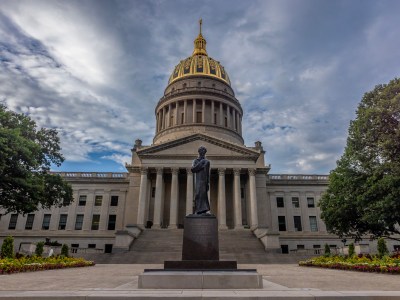
The West Virginia State Capitol Building, designed by the renowned architect Cass Gilbert, is a testament to the state’s resilience and rich heritage. Gilbert, who also designed the nation’s Capitol in Washington, D.C., which we visited during our spring break, was commissioned to construct the West Virginia Capitol in 1921. His style is unique, and you can see the similarities with many of his works.
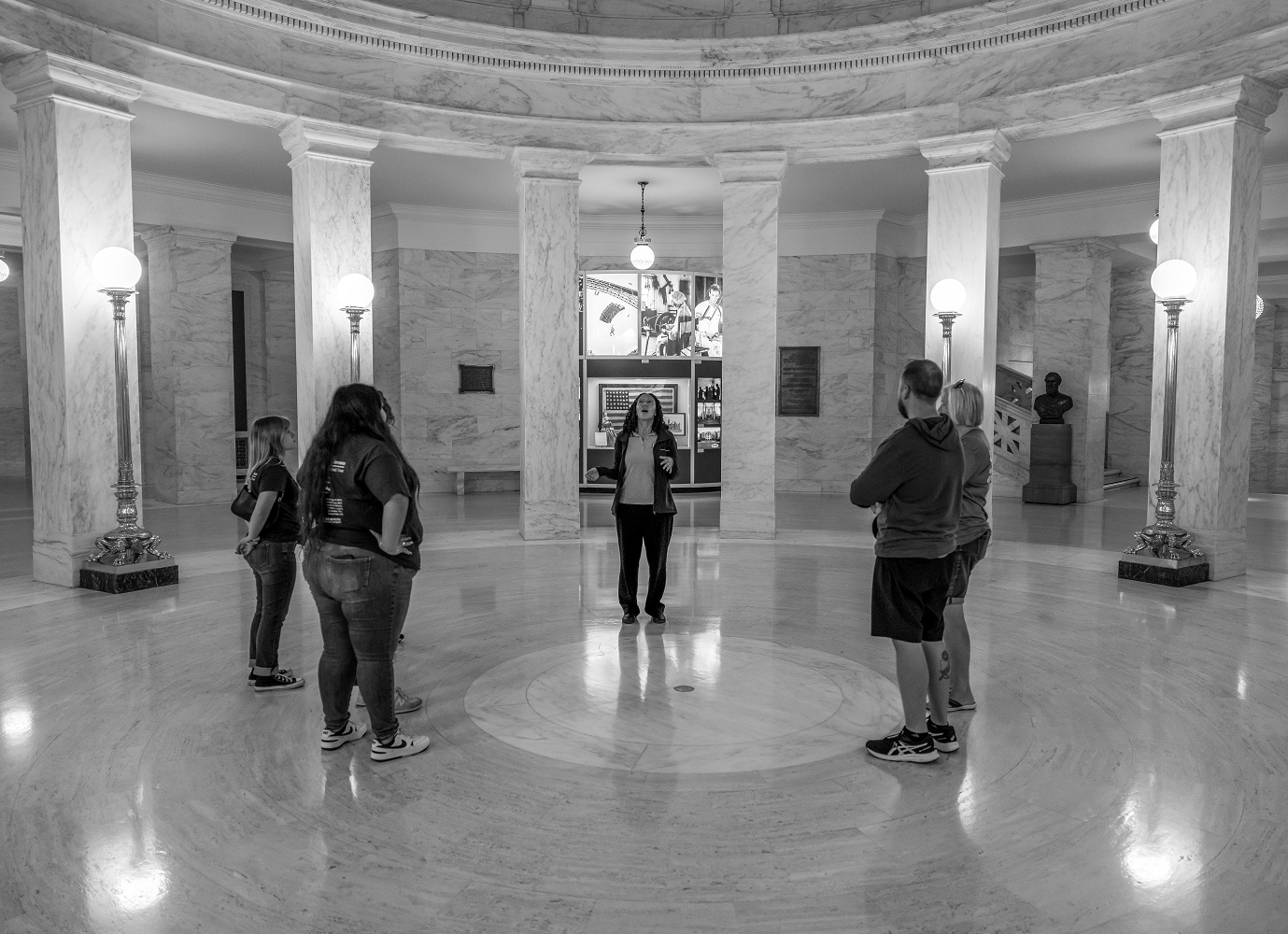
Upon entering the Capitol, we were immediately struck by the grandeur of the dome. The murals here vividly depict various significant stages in West Virginia’s timeline, including the Civil War…
…the scenic beauty of Seneca Rocks, the historical significance of Harpers Ferry, and even the contemporary state of West Virginia.
The intricate design elements throughout the Capitol reflect West Virginia’s unique character. Gold leaf is a recurring theme in the chandelier and lamps inside, mirroring the golden dome on the exterior.
Some of the ceilings are adorned with floral motifs resembling the magnolia, oak, and sugar maple trees, symbolizing the state’s natural beauty.
Our visit even included a House of Representatives and Senate tour. In the House, the room is divided by party lines and organized by committee memberships, leadership, and seniority.
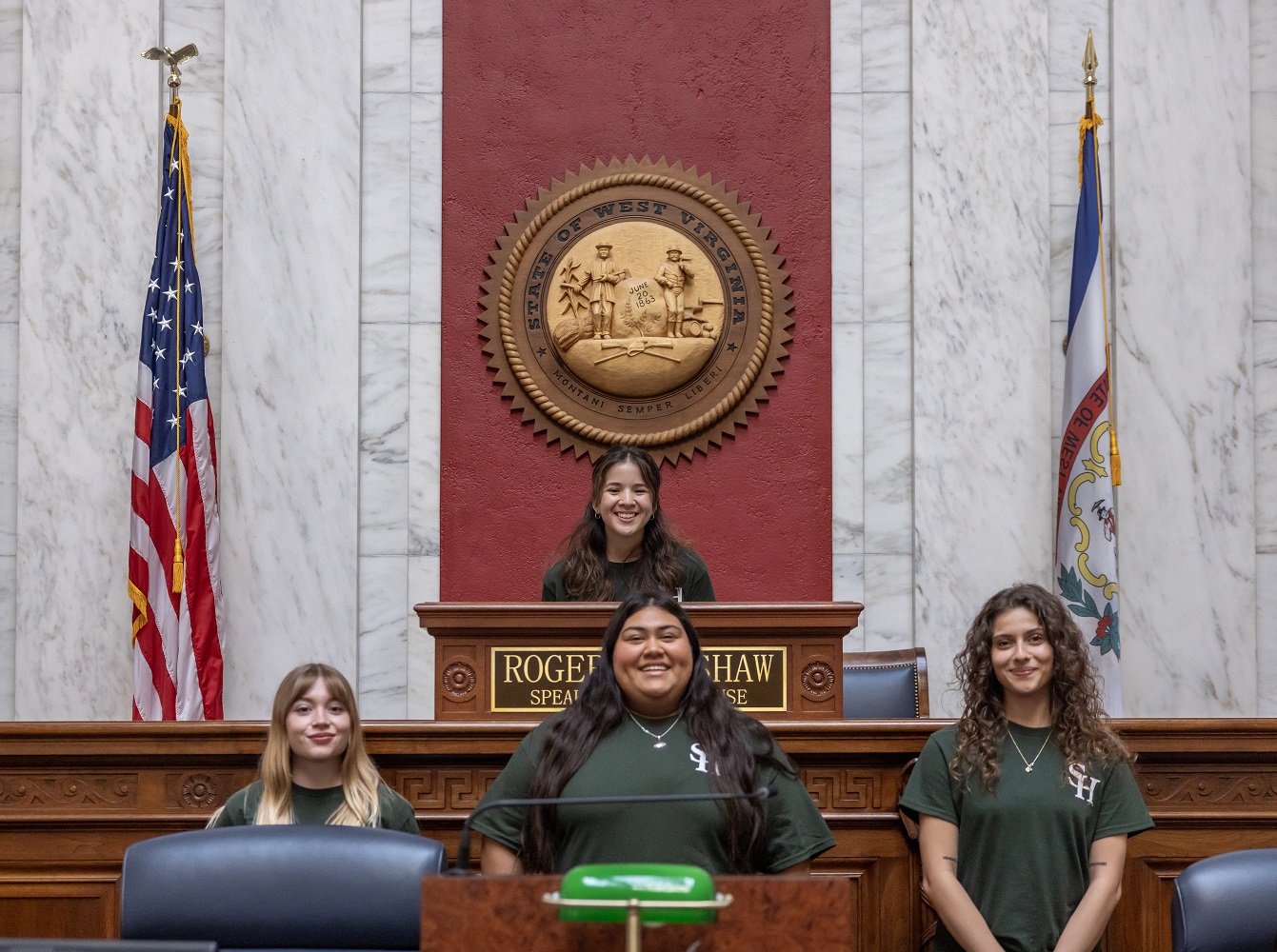
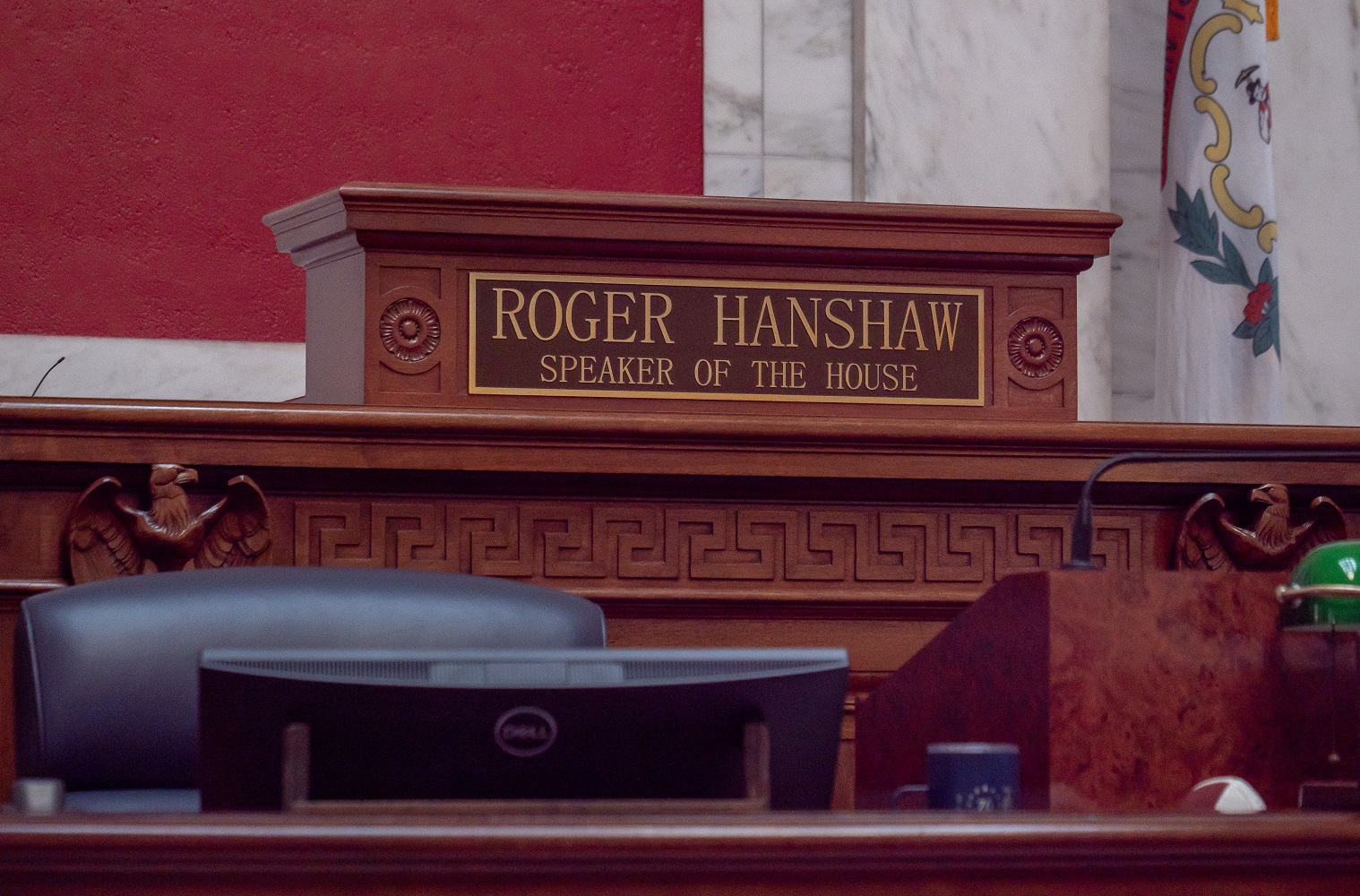
The layout and décor, including more gold leaf accents, highlight the importance and formality of the legislative process. We also had a chance to stand where Speaker Hanshaw presides over the House Chamber, a point that had special meaning since we have met Speaker Hanshaw.
The Senate chamber was equally impressive, seating a total of 34 senators.
We observed intricate decorations outside the chamber with a border on the ceiling representing various disciplines central to West Virginia’s identity: the bull symbolizes agriculture, the eagle with books represents education and art, the shield stands for coal and mining, and the scales of justice denote the legal system. We also admired their state seal, which has two figures representing agriculture and industry; the date that West Virginia was admitted to the Union; and their motto, “Mountaineers are always free.”
Adding to our understanding of West Virginia’s history, we learned that it became the 35th state due to its decision to remain loyal to the Union during the Civil War, primarily influenced by President Lincoln. Due to Lincoln’s role in the formation of the state, there is a large monument depicting the former president in front of the Capitol.
The West Virginia State Capitol has a fascinating yet tumultuous history; six buildings have served as the state’s government seat over time, and these buildings have experienced various expansions, relocations, and even two tragic fires. Each element of the Capitol, from its design to its décor, tells a part of West Virginia’s story, seamlessly connecting its storied past with its vibrant present. This rich history adds to the significance of our visit, making our exploration of the current Capitol a deeply enriching experience.
West Virginia State Museum
by Cinthia Villarreal
After visiting the beautiful West Virginia State Capitol Building, we stopped by the West Virginia State Museum. After driving through the state for the past few days, we looked forward to learning more about West Virginia’s rich and varied history.
As we entered the front doors, the museum greeted us with a magnificent exhibit of colorful quilts.
Founded in 1892, West Virginia has a storied past that reflects its resilience and unique cultural heritage.
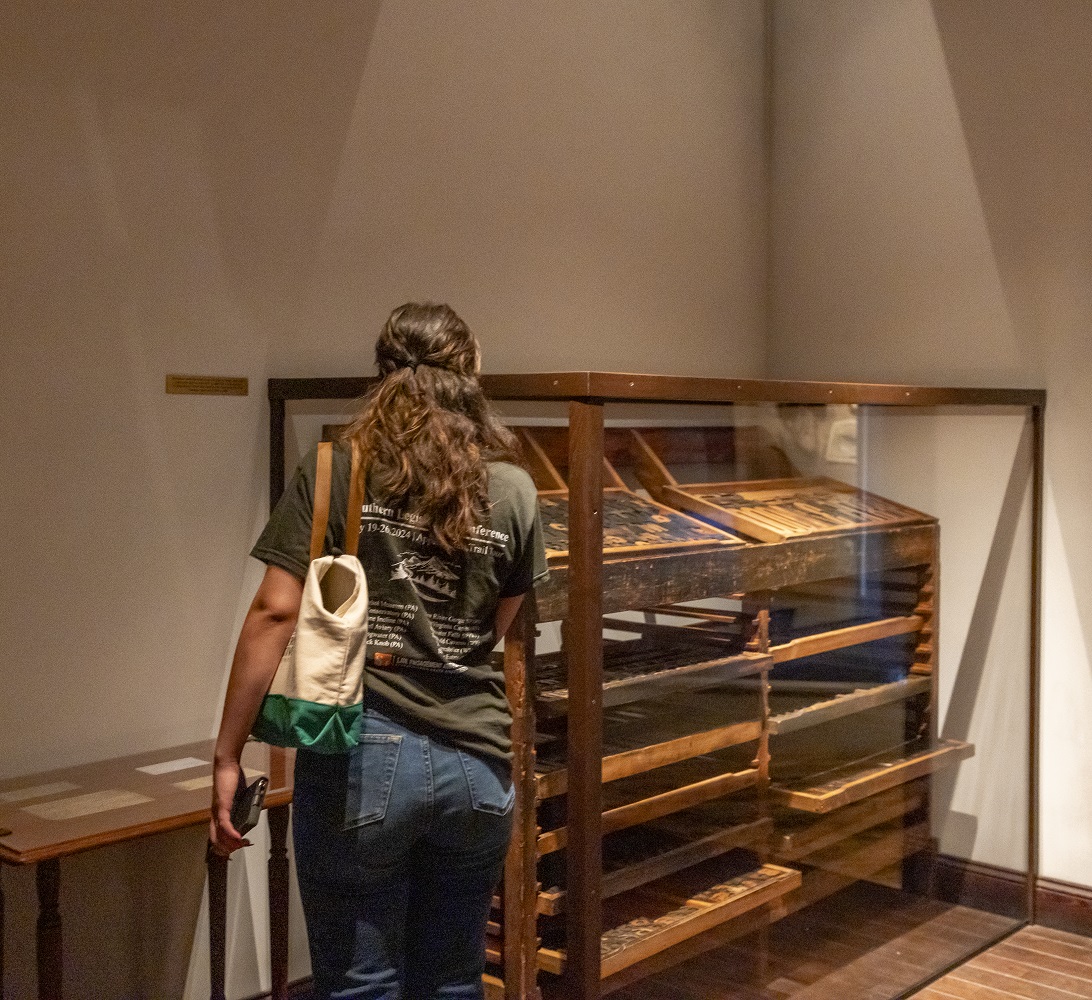
The museum meticulously chronicles this narrative, from the Native American tribes who first inhabited the land to European settlers’ arrival and the state’s eventual formation during the Civil War.
One of the museum’s exhibits pays homage to John Brown, a pivotal figure in American history and a passionate abolitionist whose raid on Harpers Ferry in 1859 marked a significant turning point in the fight against slavery. Brown’s legacy is intricately woven into West Virginia’s history, showcasing his commitment to justice and equality.
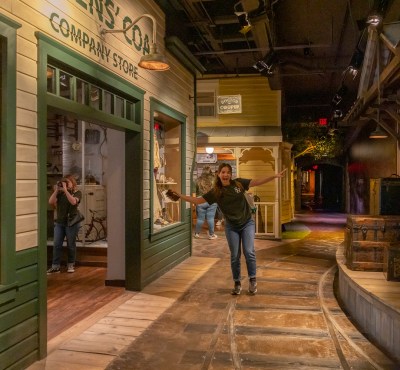
No aspect of West Virginia’s identity resonates more deeply than its connection to coal mining. From the early 19th century to today, coal has been vital to the state’s economy, fueling industrial growth and shaping communities.
The museum’s section on coal mining explores the industry’s evolution, labor struggles, technological advancements, and environmental impact, providing a nuanced perspective on its complex legacy.
A highlight is the 4,000-pound piece of coal, once enclosed in glass and used as a reception desk.
West Virginia’s blown glass industry is cherished in its cultural tapestry. The museum celebrates this tradition with a dedicated exhibit showcasing beautiful glassworks crafted by skilled artisans.
Whether you’re a history enthusiast, a nature lover, or simply curious about West Virginia’s rich past, the West Virginia State Museum highlights pivotal moments and key figures that shaped the state’s identity.
Cathedral Falls
On our return to Lewisburg, WV, we stopped at Cathedral Falls. Despite literally being a road-side stop about a mile from Gauley Bridge, it offered a great view.
The falls are approximately 60 feet, and they descend from a concave area in bluffs–likely the reason for the name “Cathedral.” We stopped for about 20 minutes, savoring the beautiful site that capped an activity-filled day.
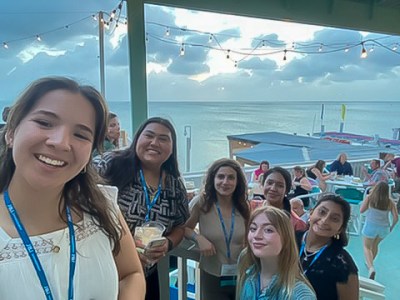
With our competition out of the way, we were determined to make the most of our remaining time at the TCMA conference. To do this, we heard from a rewarding speaker, got an Association update from the new President of TCMA, engaged in a networking lunch, and stole a few moments on the beach.
AI and City Government
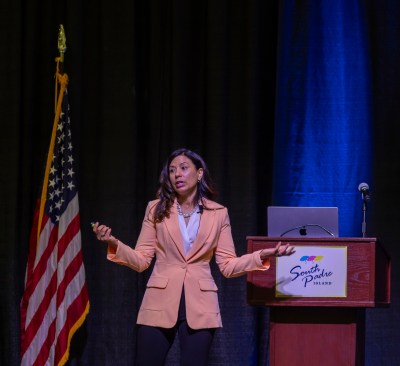
Our last true session of the conference featured, Ann Marie Sastry, a distinguished mechanical engineer and entrepreneur known for her groundbreaking work in energy systems engineering and artificial intelligence. She earned her bachelor’s degree in mechanical engineering from the University of Delaware and a PhD from Cornell University.
Following a career in academia, Dr. Sastry co-founded Sakti3, and she currently serves as President and CEO of Amesite, an AI software company. She brought this work home to us by noting that the days of City Managers being able to ignore AI in their communications and analyses are over. She went so far to say that any company who doesn’t begin use of AI in the immediate future won’t be in business in 2030, comparing such a decision to a business in 1995 choosing not to use computers.
Her talk was well received, and for us, two things stood out, both of which are relevant to what we do. One, she mentioned that AI could write a blog in 8 seconds, which is significantly shorter than the time we take! Second, she noted that AI can easily do a PowerPoint for free; but free AI cannot do an excellent PowerPoint. And while this was a suggestion from her that City Managers should look closely at which AI companies they use, it was a reminder to us to put some old-fashioned thought and sweat equity into our blogs and our PowerPoints.
Passing of the Torch: A New President of the TCMA
The last day of the conference, Sunday, June 23, began by foreshadowing the 2025 conference in San Antonio…
…with a nice promotional video that stirred some excitement among the audience.
It also marked the passing of the torch from President Opal Mauldin-Jones to Jay Abercrombie, City Manager of Henderson.
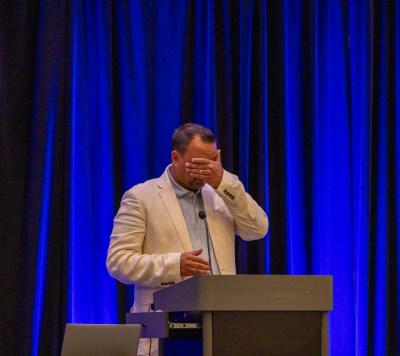
Mr. Abercrombie became emotional as he thanked his family, Association members, and noted the passing of his father.
But he composed himself quickly, making a joke about his inability (the day before) to pronounce the word “academician.” With much fanfare, he demonstrated a successful pronunciation of the term.
In an animated speech, he highlighted some features of the Association…
…ensured everyone was aware of next year’s meeting in San Antonio, and encouraged members not to become cliquish which, he noted, they have a “tendency to do.”
And with that admonishment, the Conference ended…
…with members mingling (uncliquishly), and reflecting on a positive and productive conference.
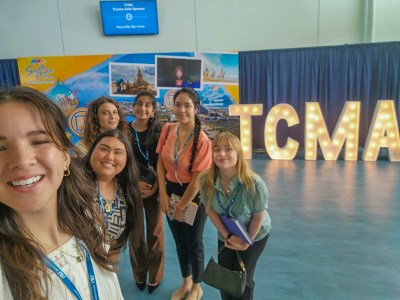
Among those members were a group of six SHSU students, all newly minted TCMA members!
The TCMA annual conference is designed for current and aspiring city managers to gain professional development and to network. But as a way of cultivating the next generation of city managers, they sponsor a “InterCollegiate Bowl” (ICB).
The ICB involves numerous components, which are described here and here, but our focus today was to highlight our (1) community service project and (2) capstone project. Our team was led by Team Captain, Olivia Discon, and members Cinthia Villarreal, Yajaira Gutierrez Marin, Chrissy Biello, Victoria Medrano, and Michelle Cardenas.
Our competition included teams of Master of Public Administration students from around the state, many of them seasoned professionals in the public admin world.
In short, we expected stiff competition, and that’s what we got!
For our Community Service project, we decided to highlight our Citizenship Preparatory Course, which was conducted in April. The five-week course, helping local immigrants learn how to pass the naturalization exam, proved to be a resounding success! With a 121% improvement in the local immigrants test scores, our project reflected the resilience of our community and a job well done. But there was an implicit success that can’t be measured, which are the relationships made through this course. Many of the people we’ve met have become friends and have come to have a true stake in the Huntsville community. Following the course, 9 of the 22 students attended a Huntsville City Council Meeting, where they were recognized by City Council for their efforts.
We approached our Capstone as we do with everything in LEAP: as a cross-disciplinary learning opportunity with the goal of serving others. Addressing issues such as infrastructure, marketing, quality of life, strategic planning, and workforce development, the project reflected individual internship experiences at the City of Huntsville to showcase substantive projects that ultimately benefitted the community.
What we hadn’t realized is that through our capstone, we caught a glimpse into what it is like to be a City Manager. Overseeing multiple projects that overlap with one another was an extraordinary learning experience that cannot be taught in the classroom.
Our opportunity to showcase these projects occurred on Saturday morning, from 7:30-10am. The presentations, which took place in the front hall, involved numerous people stopping by to learn more about our projects, and some of these were “mystery graders.” These mysterious types were actually city managers who were part of a team assessing our projects.
Following these components of our grading, we were in first place, having completed these aspects of the Bowl with about 99 percent of the possible points. Only the Jeopardy contest was left.
Jeopardy
In the final portion of the ICB, worth 750 points, was a Jeopardy-style game all about local government. To prepare for this component of the contest, we studied some 250 terms and concepts associated with city management. This was a bit of overkill, because we were not told of the categories until the first day of the conference. Once we learned these, we refined our studying to these areas: Budget & Taxes; Planning & Zoning; Economic Development; City Council and; Human Resources.
But even with the preparation, we learned some new information at the last minute. For example, our entrance was done “spirit style,” with strutting and intro music, a prospect that made us nervous.
The lead-in to the competition was done up right by TCMA, with teams showing their spirit as they came in.
SHSU entered last, a grand entrance, befitting our first-place (at the time…) status.
Whooping it up is not our style, but we did our best, with Olivia as our official team captain and Michelle as our “team spirit leader.”
It was our first time in this competition, and our inexperience was telling.
Many of the opposing teams had returning members, who not only knew the format, but also knew key tactics and, surprisingly in some cases, the questions.
This learning curve got us, and while we did not excel in this contest, we were satisfied knowing that while we might not have been the first to hit the buzzer…
…we did know the answers to about eighty-five percent of the questions (we did learn, on the spot, what a “claw-back provision” is….). And we had fun.
In the end, we finished third. The top three were close, with UNT Masters of Public Administration leading the way (1020 points), TAMU’s Masters of Public Service team in second (976 points), and the LEAP Center’s undergraduate team in third, with 930 points.
UTSA’s Masters program finished fourth with 530 points, and SFA’s Masters program served as the caboose.
Takeaways
Our goals for this contest were not related to points or placement. Rather, our goal was to do the best we could do on the individual components. We wanted to network with city officials, learning from them, and developing relationships. We wanted a broad-based curriculum in our coaching, which we accomplished, setting up meetings with a City Manager, two City Secretaries, a City Attorney, an HR Director, and a Police Chief. And we served our community by completing our volunteer project, while also learning a lot about city government, even if the Jeopardy contest didn’t fully reflect our learning. What was most important to us is that we achieved these goals while doing, we hope, good things for the community and others.
In preparing for the ICB, we had many coaches and mentors along the way, all of whom are experts in their discipline. Brian Beasley, Director of HR for the City of Huntsville provided us with a great Mock Interview; Thomas Leeper, City Attorney of Bryan generously spent time answering questions about legal aspects of municipal government; Stephanie Fors, Former City Secretary of Huntsville discussed the politics of a changing council for a charter officer (and served as a great “Team Mom”); Miranda Estrada, Economic Development Specialist of Huntsville served as a mentor and supporter; Fabrice Kabona, City Manager of Madisonville taught us much about Madisonville and City Management; Chief Kevin Lunsford, Former Police Chief of Huntsville educated us on policing and politics; Kristy Doll, City Secretary of Huntsville instructed us on agendas, organization, and parliamentary procedure; Sam Masiel, Assistant City Manager of Huntsville was a key supporter and; Aron Kulhavy, City Manager of Huntsville asked some excellent questions in a preview session. Each provided invaluable guidance for our team of young professionals. We truly appreciated the time each of these individuals put into shaping our paths for the better, and while we may not have won the TCMA ICB, we came home feeling like winners!
Our third day at the TCMA was to be our longest, at least with scheduled events. We had a full day of conference sessions, a networking dinner, and, of course, some final practice on our presentations and study for our knowledge contest. Accordingly, we were up early and, more or less, ready to take the day on.
Opening General Session: Transforming Workplace Dynamics
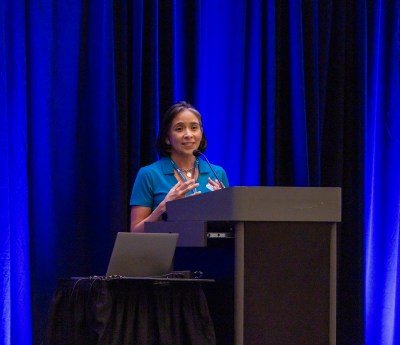
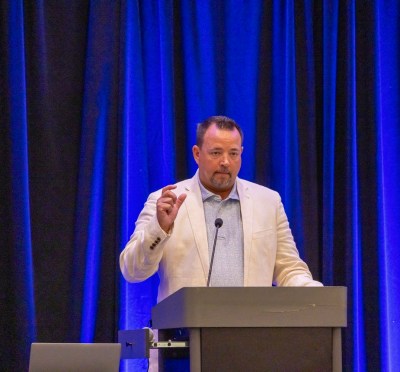
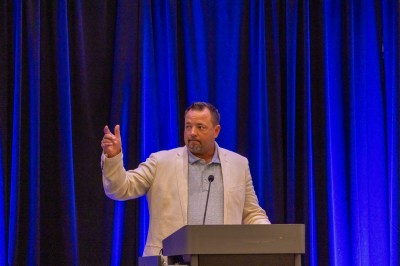
The conference kicked off with a compelling keynote by Michael Bush, CEO of Great Place to Work, who shared findings from a global workplace survey.
He highlighted key elements essential for a healthy work environment: high trust, pride in meaningful work, and strong camaraderie.
Drawing parallels with conquering Mount Everest, Bush emphasized the importance of believing in one’s capabilities to achieve seemingly impossible goals.
Bush classified leaders into various types, ranging from unintentional leaders who lack clarity in their roles to Level 5 leaders inspired by Jim Collins’ concept of comprehensive leadership. He underscored the transformative impact of AI on workplaces, urging attendees to embrace and leverage AI capabilities proactively.
Building a Workplace Culture for Innovation, Productivity, and Sustainability: Leading with Love
In the first of the concurrent sessions, attended by Yajaira, Michelle, Victoria, and Cinthia, the students heard from Dr. Church, whom they had met with the night before over dinner.
Dr. Church emphasized the importance of cultivating a workplace culture that fosters innovation, enhances productivity, and promotes sustainability. Executives are increasingly challenged with retaining top talent, developing future leaders, and maintaining a positive employment brand that resonates with their employees and the public.
For this to be successful, companies must leverage employee values for enhanced productivity and loyalty, implementing effective motivation techniques, and fostering a culture conducive to innovation and knowledge creation. It’s important for leader to ensure that employees’ personal goals and organizational values are in alignment, a situation that increase productivity, with people working together toward team goals.
The New City Manager: Navigating Challenges and Opportunities
Another of the concurrent sessions, “The New City Manager,” was one of our favorites, providing invaluable insights from experienced leaders stepping into new roles:
James Attaway of Quitman advised new managers to trust their teams while verifying details, stressing the importance of building a supportive organizational culture.
Terrell Smith from Marshall regretted not immediately focusing on understanding building codes and city charters, highlighting the importance of foundational knowledge. He encouraged realistic expectations about city resources and confident negotiation of their value.
Ashley Wayman from Rollingwood emphasized recognizing personal value and impact as a new manager. She highlighted the significance of understanding key stakeholders in the community for effective navigation of city dynamics.
Moderator Mayra Cantu shared a community engagement success story from Bartlett, illustrating the power of transparency and collaboration in gaining community support for city projects.
Losing the Chair: Lessons in City Management
In the session “Losing the Chair,” experienced city managers Hector Forestier and Jared Miller shared candid insights about the prospects of losing your job in the volatile city-management business:
Hector Forestier emphasized the importance of networking and understanding contracts, reflecting on his early career without a contract and the subsequent lessons learned from peers.
Jared Miller echoed similar sentiments, stressing the necessity of contract negotiation awareness and shared personal experiences, including the negotiation of favorable terms and benefits.
Paul Parker, who mentored both Forestier and Miller, provided additional guidance on navigating city management challenges and contract negotiations.
Interestingly, Forestier was the City Manager of Willis, TX, and he started an internship program there.
His first intern was Zach Goodlander, a LEAP Ambassador. Goodlander is now the acting City Manager of Fulshear, TX.
Awards
As part of our networking efforts, we attended the awards luncheon, and we were happy to see UNT Professor Robert Bland…
…receive a service award. The University of North Texas not only has an excellent reputation for their MPA program (especially City Management), they have also (spoiler alert) won every ICB ever held at TCMA. Many thanks to Professor Bland for his service.
Also, SHSU Alum and Manager in Residence, Laurie Brewer–Assistant City Manager for Georgetown–won the Mentor Award for her great service. She has been a friendly face and wonderful supporter of our team, and we congratulate Ms. Brewer.
Key Takeaways and Reflections
The conference was a great way to learn about the challenges that face city managers and other city staff, while also learning some leadership styles to overcome those challenges. We are very appreciative of the support we’ve seen here, and for the tips provided that may make us more productive and effective leaders in the community.
Each year, the Texas City Management Association hosts a conference, for high-ranking public officials to learn more about the challenges facing (and solutions for) local government. One of the goals of the TCMA is to attract, recruit, and develop young professionals who might seek a career in government. To that end, they sponsor the “InterCollegiate Bowl (ICB)”, allowing college students to compete for the title of “Best Public Administration School in Texas.”
Competitors:
Our participation in this contest was unique, in that we are the only undergraduate team competing–indeed, as far as we know, we are the only undergraduate team to ever compete. This year, the competitors included:
Sam Houston State University (The LEAP Center)
UTSA (MPA Program)
TAMU (Bush School’s MPA Program)
SFA (MPA Program)
UNT (MPA Program)
It is a little intimidating, because our competition is generally older (our mean team age is 20) and more professionally experienced. But our goal is not necessarily to win (although we aren’t averse to the idea…), but to do the best we can do. And what we know we can control is our preparation and our professionalism, and we want to excel in those areas.
Contest Components:
The contest consists of five broad components:
Networking: involving developing fully a LinkedIn profile, making connections in City Government, and attending a regional TCMA meeting;
Coaching: working with city professionals to learn the careers in the field;
Community Service: a specific project that benefits the community;
Capstone Project: A research project that can benefit the communtiy;
A knowledge contest: A Jeopardy-style game reflecting the knowledge of the students about city government.
The networking, coaching, and community service aspects of the contest were largely completed prior to the event, and we submitted our completed folder early on Day One of the TCMA.
Our capstone was also completed, but the grading of that component is done at the conference on Day 3. Thus, we stayed late on Day 2, and we set up our presentation so we would be ready for the morning session.
There is much to do before our “showdown day,” which is Saturday, June 22, but we’ve done what we can do, and the results show it!
Of course, the other teams will catch up and get very close to our score before the Jeopardy-Style knowledge contest, but at this early stage, our preparation has paid off!
Following our day of travel and storm-related adventure, we were ready to get down to business in preparation of our “Intercollegiate Bowl.”
The contest is part of the larger Texas City Management Association Conference, in which City Managers (and other managers and stakeholders) come together to learn about trends in urban governance. While all the attendees will be attending sessions on employee retention, staff morale, and urban planning, we, the students, will also be preparing for the ICB.
We were greeted with a much better weather day than yesterday, for which we were grateful.
We were also thankful for the networking lunch, where we learned a bit more about the contest from Crane Petty, and we met with students from other Universities participating in the ICB. It is valuable to us meet with the other students–all of whom are graduate students, and most of whom are already in the professional field.
This was followed by a session led by “young professionals,” in which we had the chance to break into group discussions. Our group were asked questions such as “What is the biggest issue facing your community?” Or “when is a good time to bring up an issue to City Council?” Responses to the latter included comments such as, “when they understand their role better,” “when we get a new city manager,” and “when we can convince them they thought of it.”
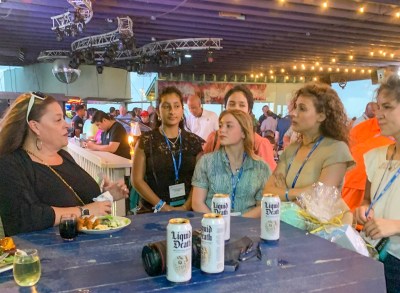
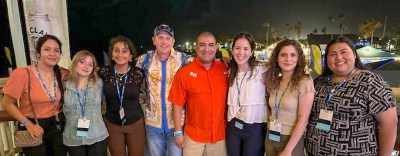
The culmination of the day was dinner at “Louie’s Backyard,” where the opening reception was held.
We were fortunate to share a table with Trish Kordas and Dr. Maria Church, the latter of whom is speaking at the conference.
Both were interesting, and they provided tips on networking, public speaking, and promoting a culture of leadership. We are looking forward to Dr. Church’s talk!
As our first day wound down, we found new ways to enjoy it. Olivia won a gift basket, we listened to the band play oldies, and we spent time with friends and mentors, such as Aron Kulhavy and Sam Maisel, while meeting other professionals in the field.
Of course, the City Managers and other City staff did not have an ICB to prepare for, so we left a bit earlier than the others. Following a debriefing at the hotel, we renewed our studying for the Jeopardy contest, which will likely decide the ultimate winner of the title, “The Best Public Administration Program in Texas.”






























 Center for Law, Engagement, and Politics