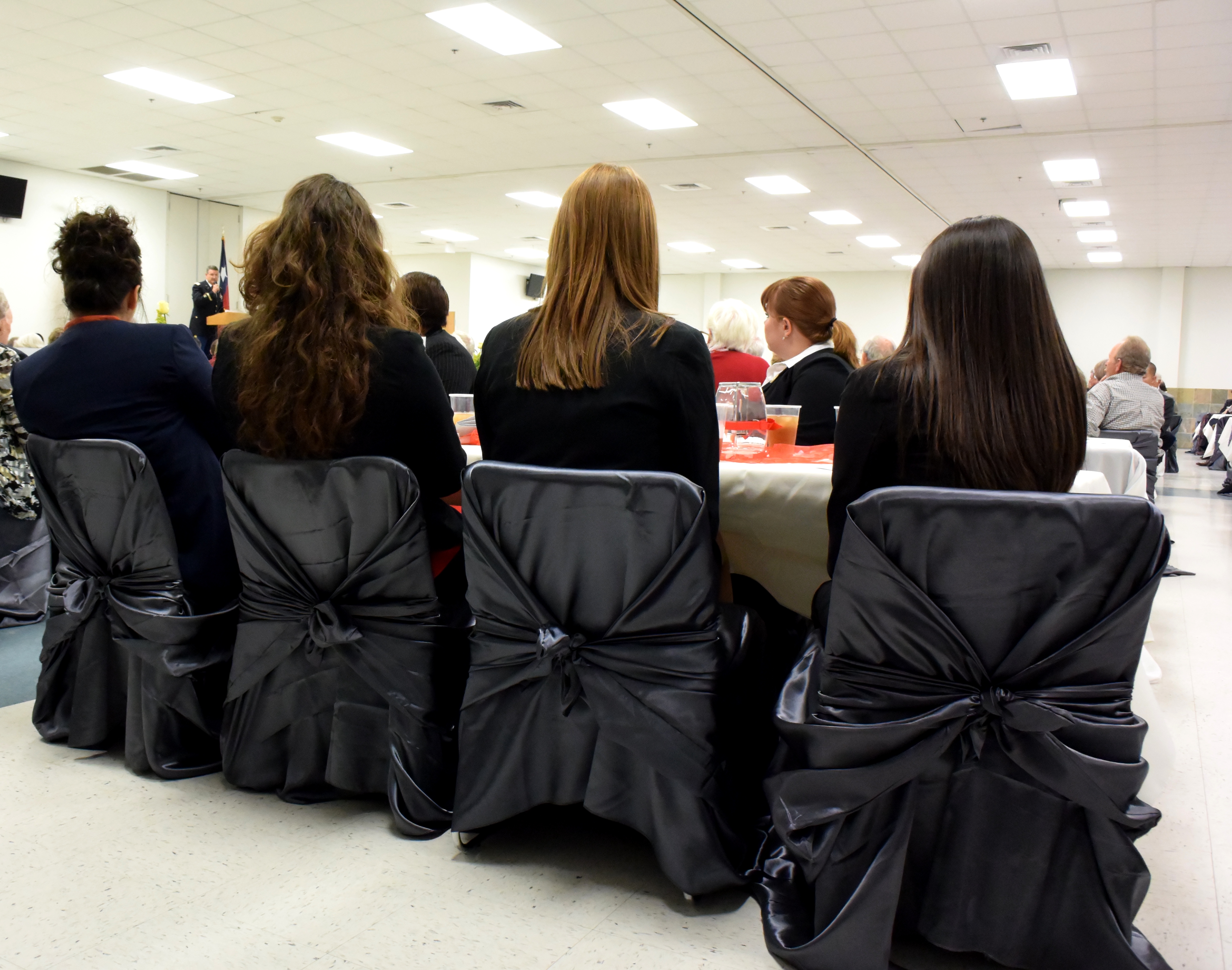
The HEARTS Veterans Museum held their 15th Annual Veteran’s Day Banquet, appropriately, on Veterans Day, November 11, 2014. A silent auction, catered dinner, and a short but moving program rounded out the evening. We were fortunate to be asked to help in greeting attendees as they arrived, assisting with the silent auction, and meeting community members and leaders, and learning more about veterans and their sacrifice.
LEAP Center Students Listen to Champe Miller Discuss Veterans Day
It was heartening to see soldiers, former and current, old and young, men and women, from all walks of life, stand while the Huntsville Community Men’s Choir performed a rendition of the Armed Forces Medley. All five branches of our nation’s armed forces were represented by local veterans. Air Force, Army, Coast Guard, Marine Corps, and Navy veterans and current soldiers stood during their service’s song. You didn’t have to look far to see that not all eyes were dry.
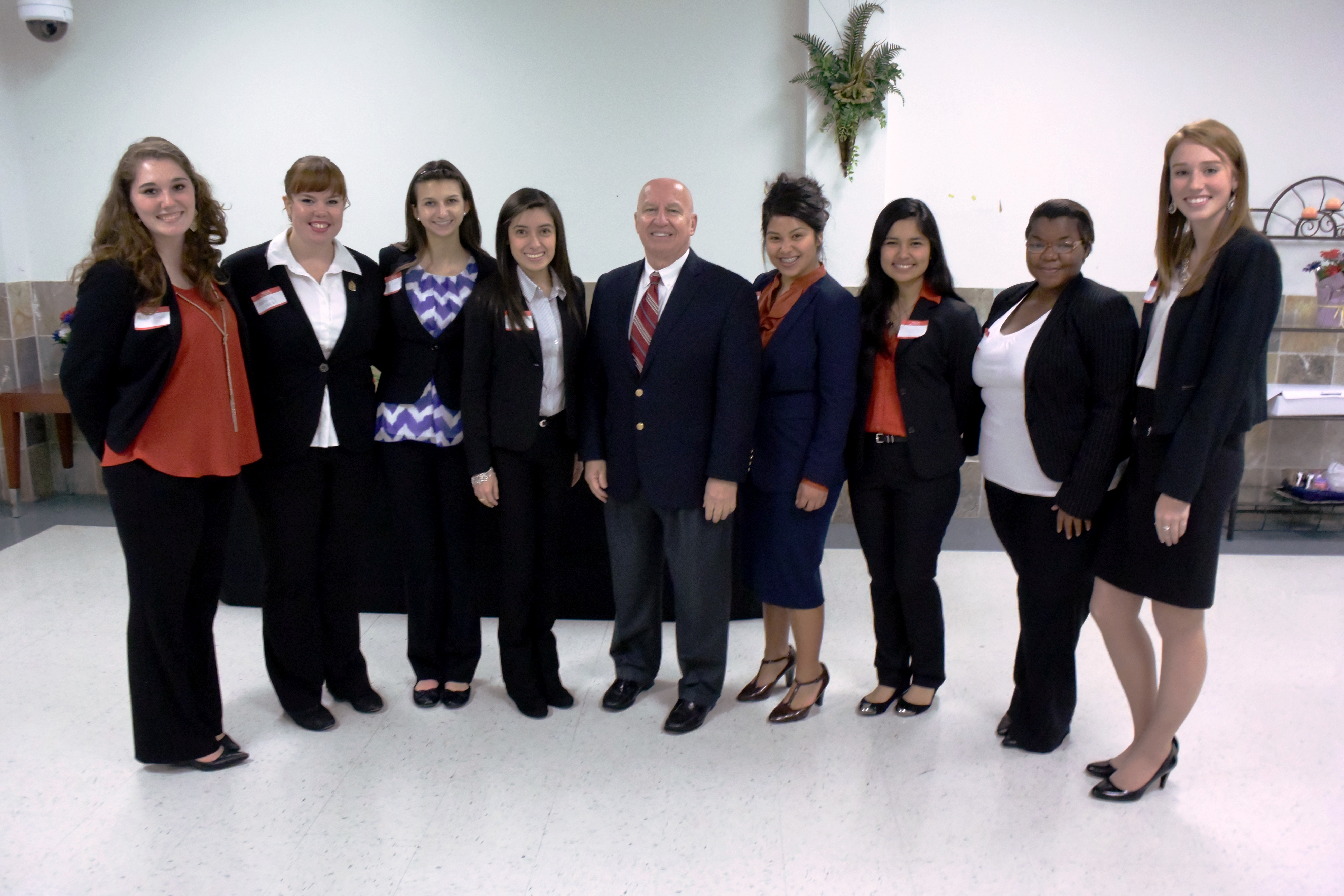
There was a short presentation on putting the various services for Texas veterans in the palm of their hands – à la the new “Texas Veterans App” (free, available on iPhone and Android devices) by former TX Representative Suzanna Hupp. We were also able to meet several elected officials who took the time to honor those who have served to defend and protect our freedoms, including Congressman Kevin Brady.
Congressman Brady & LEAP Students
It was a great evening, for a great cause – honoring our heroes and our history. For more information on the history of Veterans Day, see the U.S. Department of Veterans Affairs website.
The LEAP Center brought students to the Annenberg Conference Center at the Bush Presidential Library to celebrate the 25th Anniversary of the fall of the Berlin Wall.
Among those on hand was Dr. Jeffrey Engel, Director of SMU’s Director of the Presidential History Center. Although Dr. Engel is a distinguished scholar, he was not the most distinguished person in the room. Within a dozen feet of the students sat former Bush (43) Chief of Staff Andy Card, former Bush (41) National Security Advisor Brent Scowcroft, Barbara Bush, and President George H. W. Bush.
(L-R) Brent Scowcroft, Barbara Bush, President Bush, and Dr. Engel
President Bush received an award for his work in promoting freedom throughout the world…
…and the LEAP Center students received the treat of being in close of proximity of former President Bush.
Although she’s been to numerous Bush Presidential Library events, it was the first time Jessica Rodriguez has seen President Bush. “It was so nice to be able to see him. It was particularly nice to have a lecture on presidential history while sitting next to one of history’s makers. I enjoyed it very much.”
It was the fifth president Rodriguez has met while at SHSU while participating in LEAP Center events.
Each semester, the LEAP Center partners with Kaplan Testing to offer SHSU students a Mock LSAT–a real LSAT test that provides students with an evaluation of their current performance on the test. This semester, some 50 students took the practice test.
SHSU Mock LSAT
There were a couple of unusual factors about this semester’s exam. First, Ryan Brim, a 15 year old, took the test, and he performed quite well. In fact, he scored in the top half of the group. Second, Jamey Portina, an SHSU freshman, scored a 175, probably the highest score ever recorded from an SHSU student.
The LEAP Center and Kaplan will offer another practice test in early February, followed by an LSAT Prep course on campus this spring. The classes will take place on Tue and Thu, with the first class being Tue, March 17. Students will attend two meetings a week through Thu, April 16. This provides seven core learning classes of four hours each and three practice tests. By offering such courses on SHSU’s campus, the LEAP Center hopes to provide students with the resources needed to improve their scores, build a network of aspiring lawyers, and promote education about the legal field.
Students who would like to sign up for the course should go to Kaplan’s website. SHSU students will receive a discount. Students interested in the discount or additional details may contact Kaplan’s Regional Manager Kayla Briel: kayla.briel@kaplan.com.
After an exciting afternoon meeting David Berg, attorney and author of Run, Brother, Run, we packed up two cars and headed for Nacogdoches! We could feel the excitement build the closer we got to Nacogdoches, anticipation of our observation of a Moot Court Scrimmage and, more immediately, an adventurous evening of zip lining.
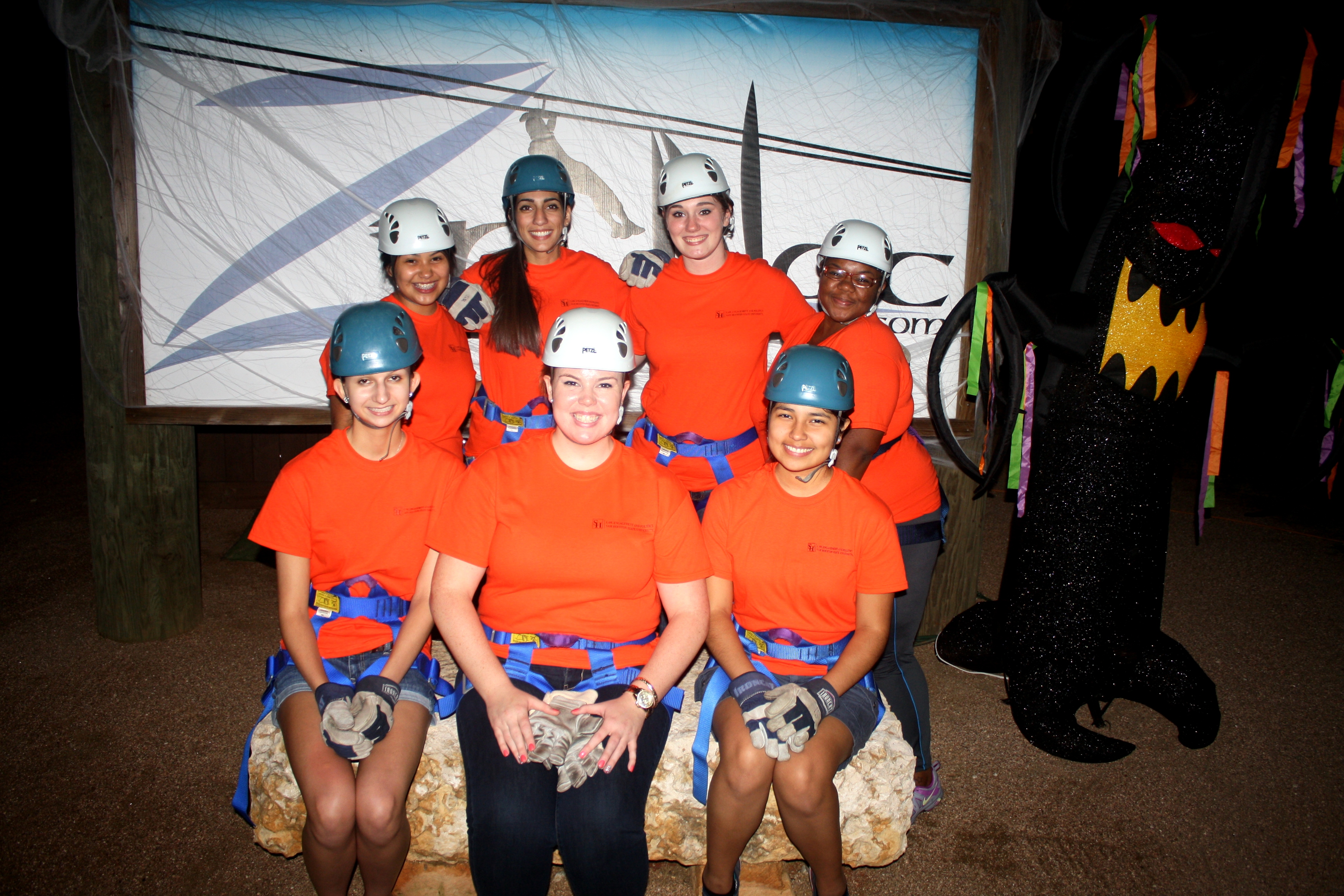
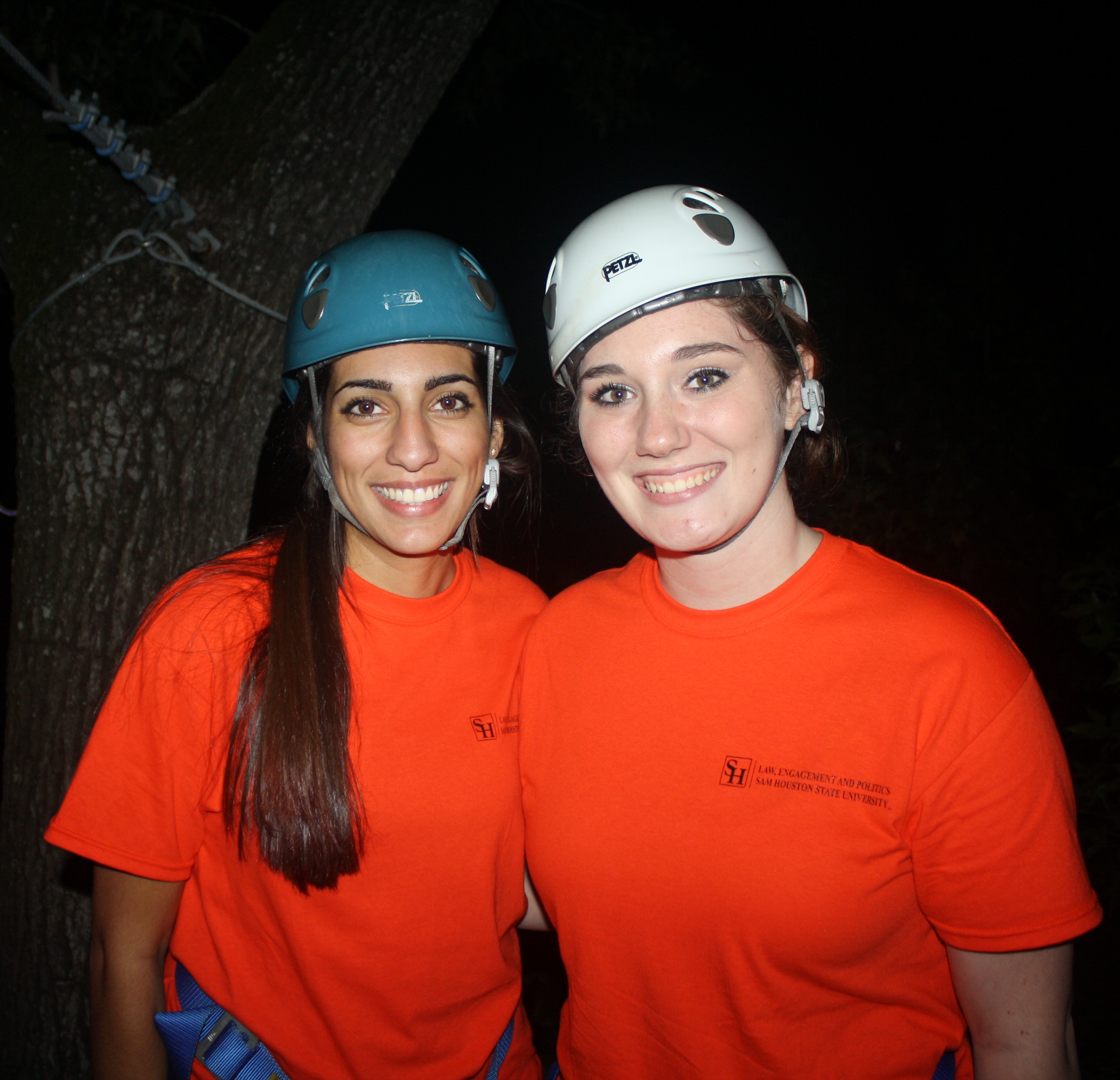
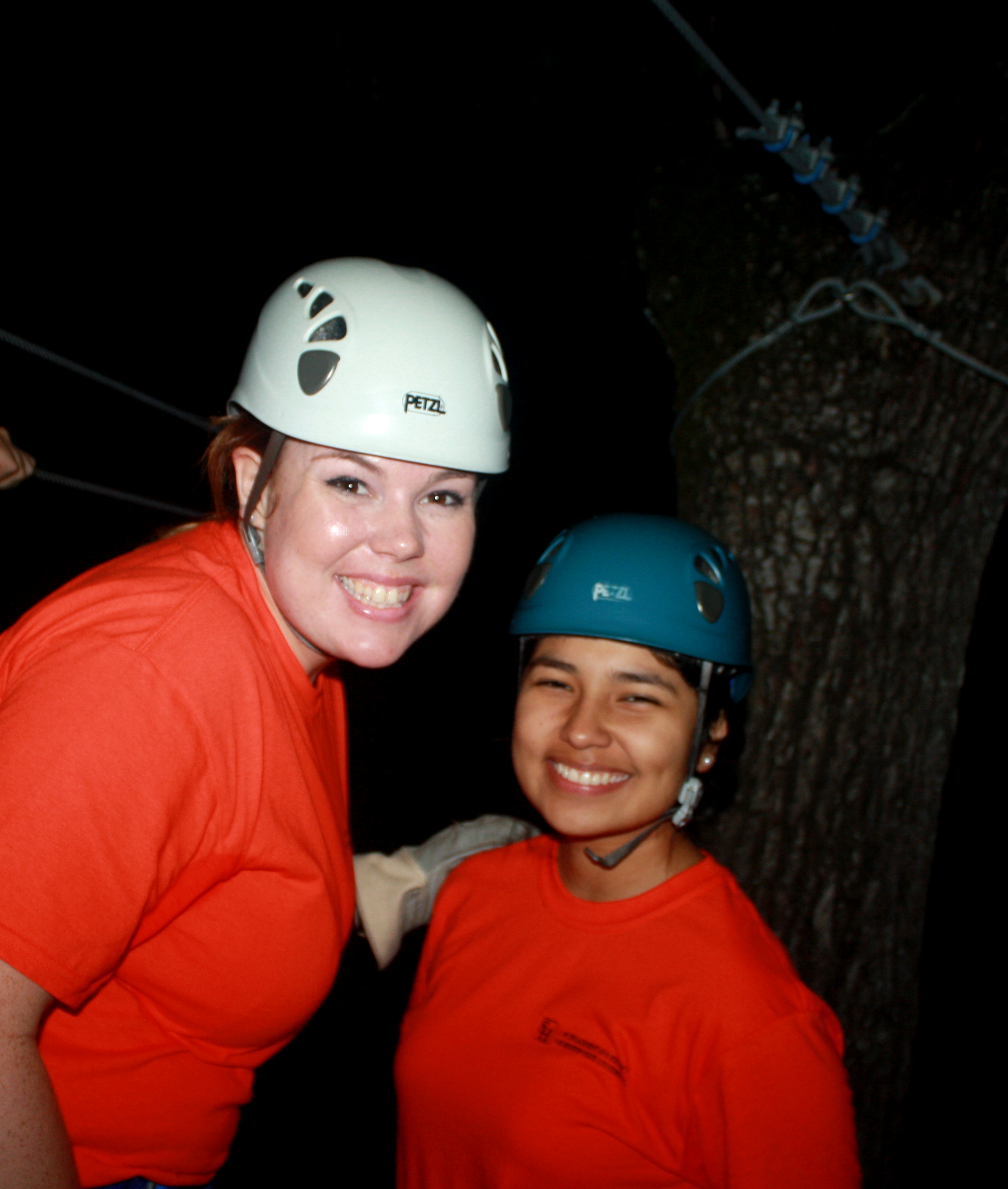
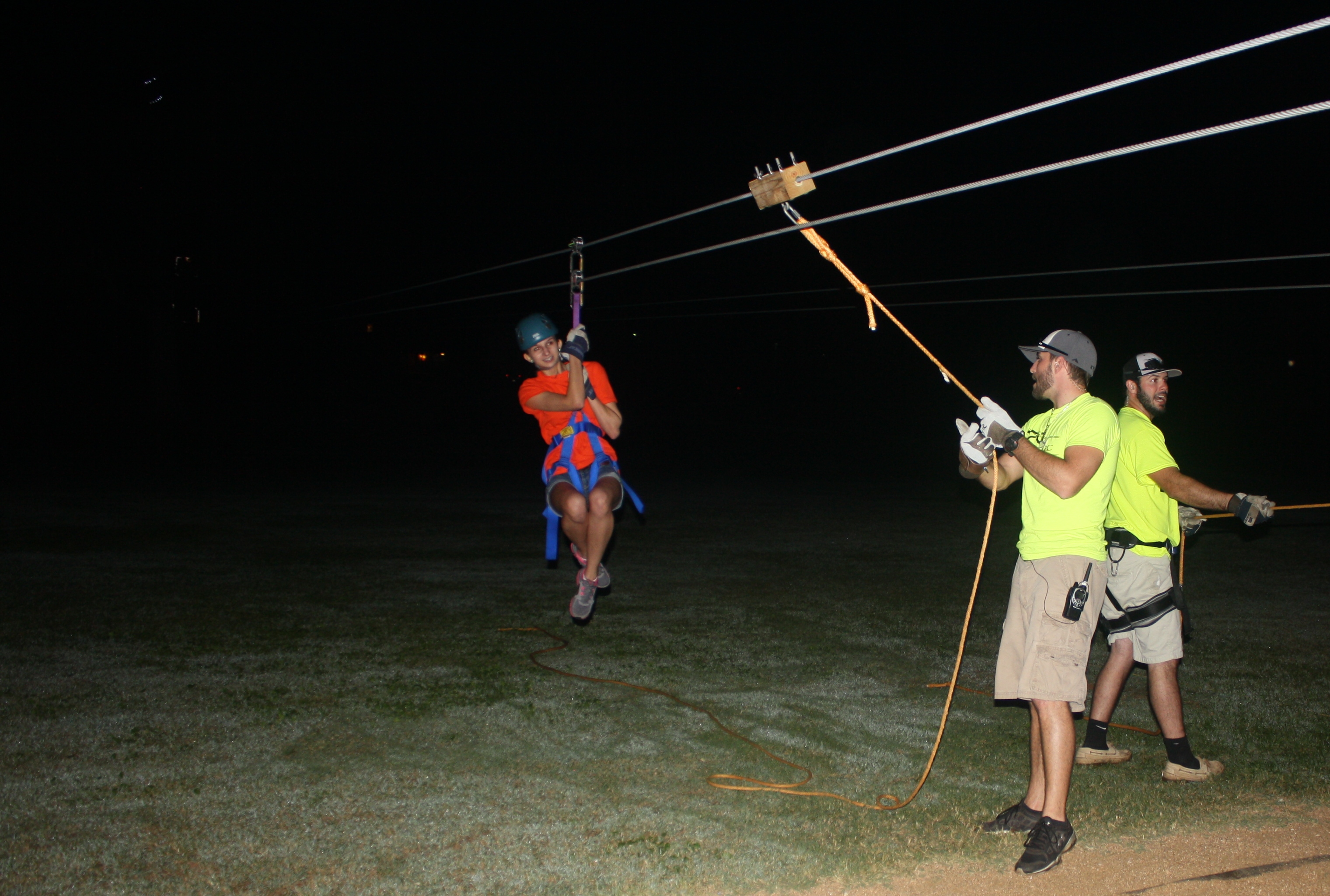
We arrived in Nacogdoches around 7:10pm and headed for the Zip Line course, ZipNac. The tour guides quickly suited us up and instructed on how to use the equipment safely and the proper procedures for a fun zip line. It was exciting to say the least.
LEAP Center Students Ready to Zip Line!
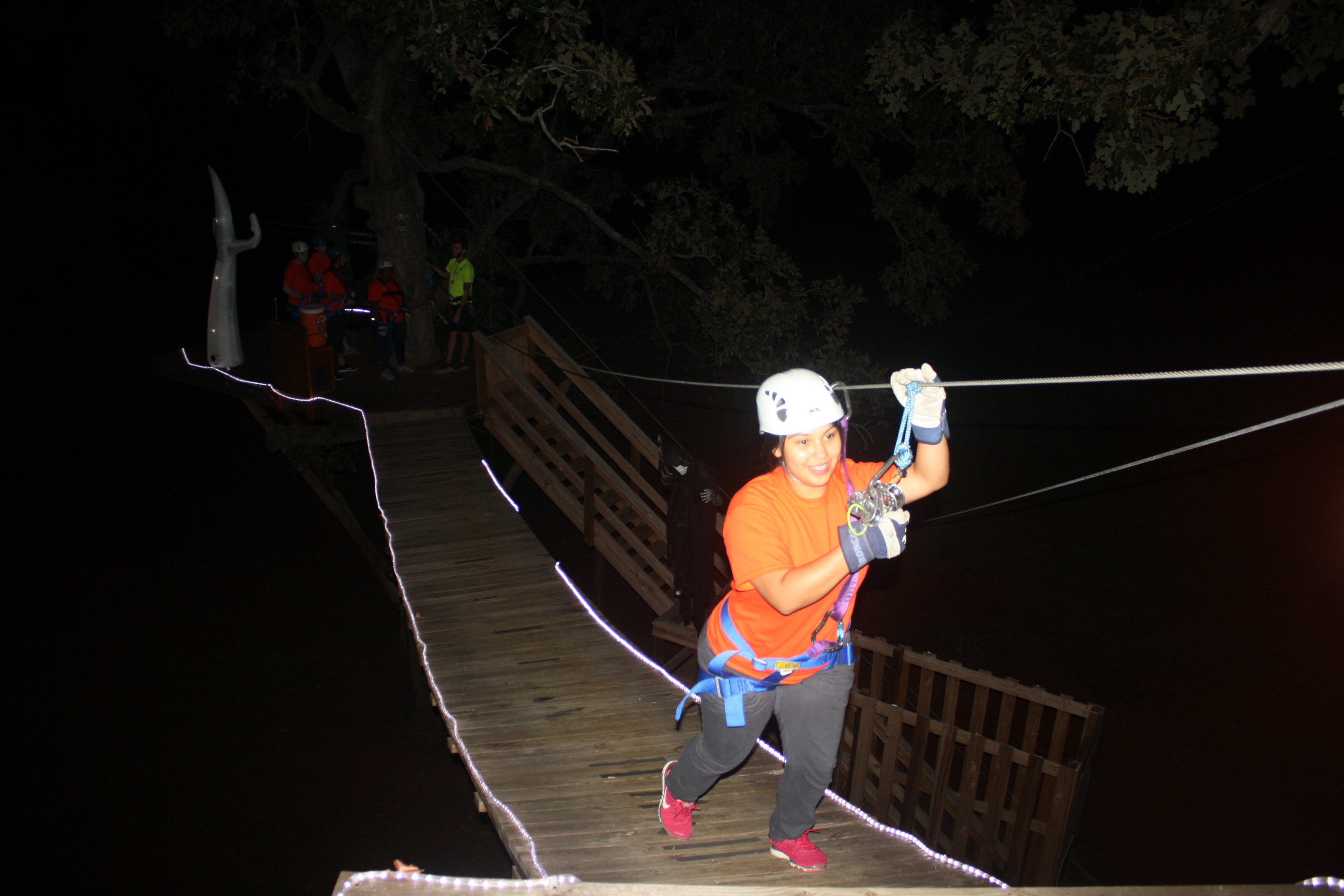
I won’t forget the adrenaline rush I felt on that first drop down or walking over a suspension bridge in the dark.
Megan Chapa on the Bridge
Or the fun time we were able to spend together, whether it was Sura Omar and Ariel Traub…
Sura Omar and Ariel Traub
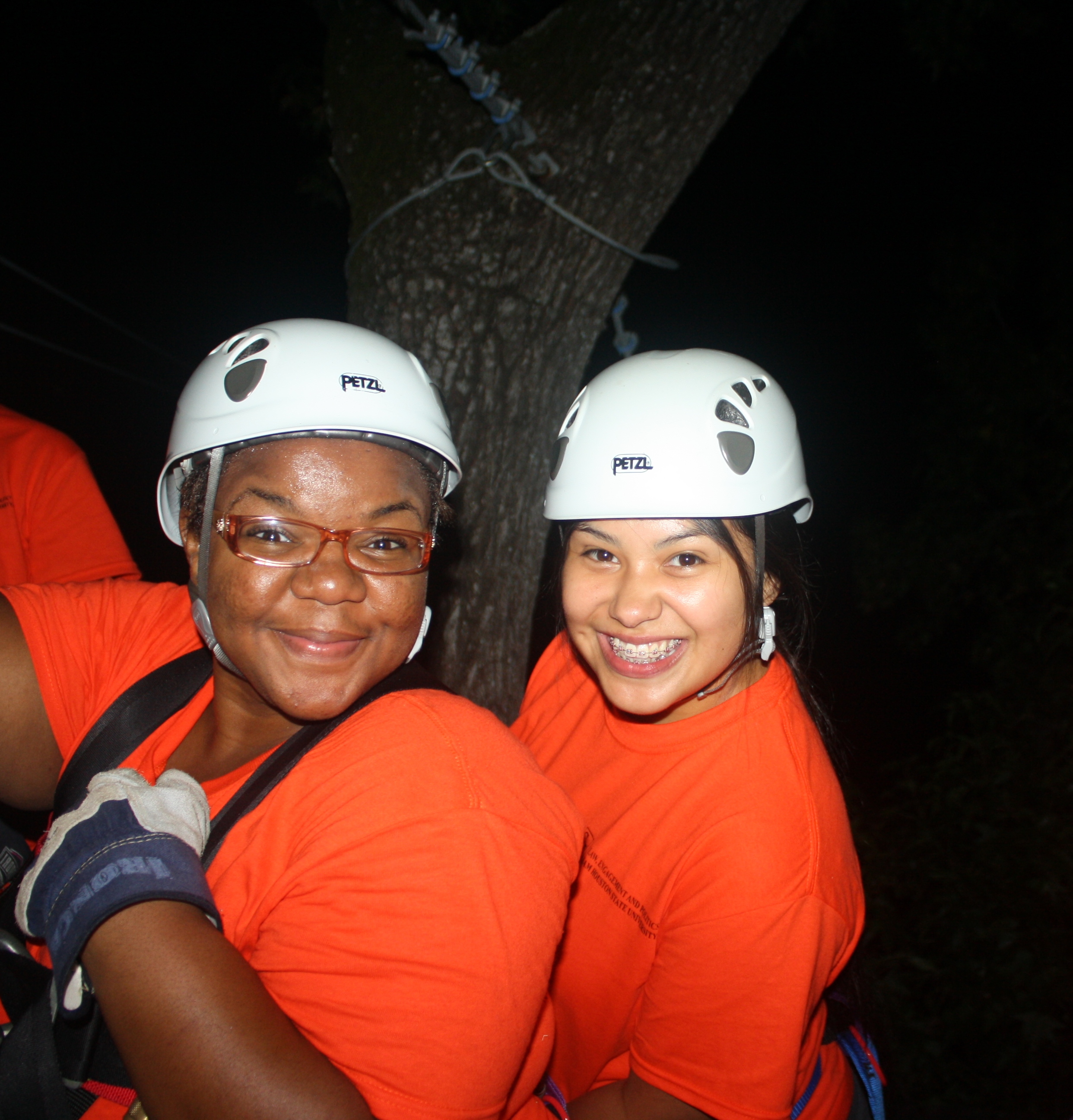
…or Constance Gabel and Jessica Martinez….
Constance Gabel & Jessica Martinez
…or Jasmine Moss and Megan Chapa…
Jasmine Moss & Megan Chapa
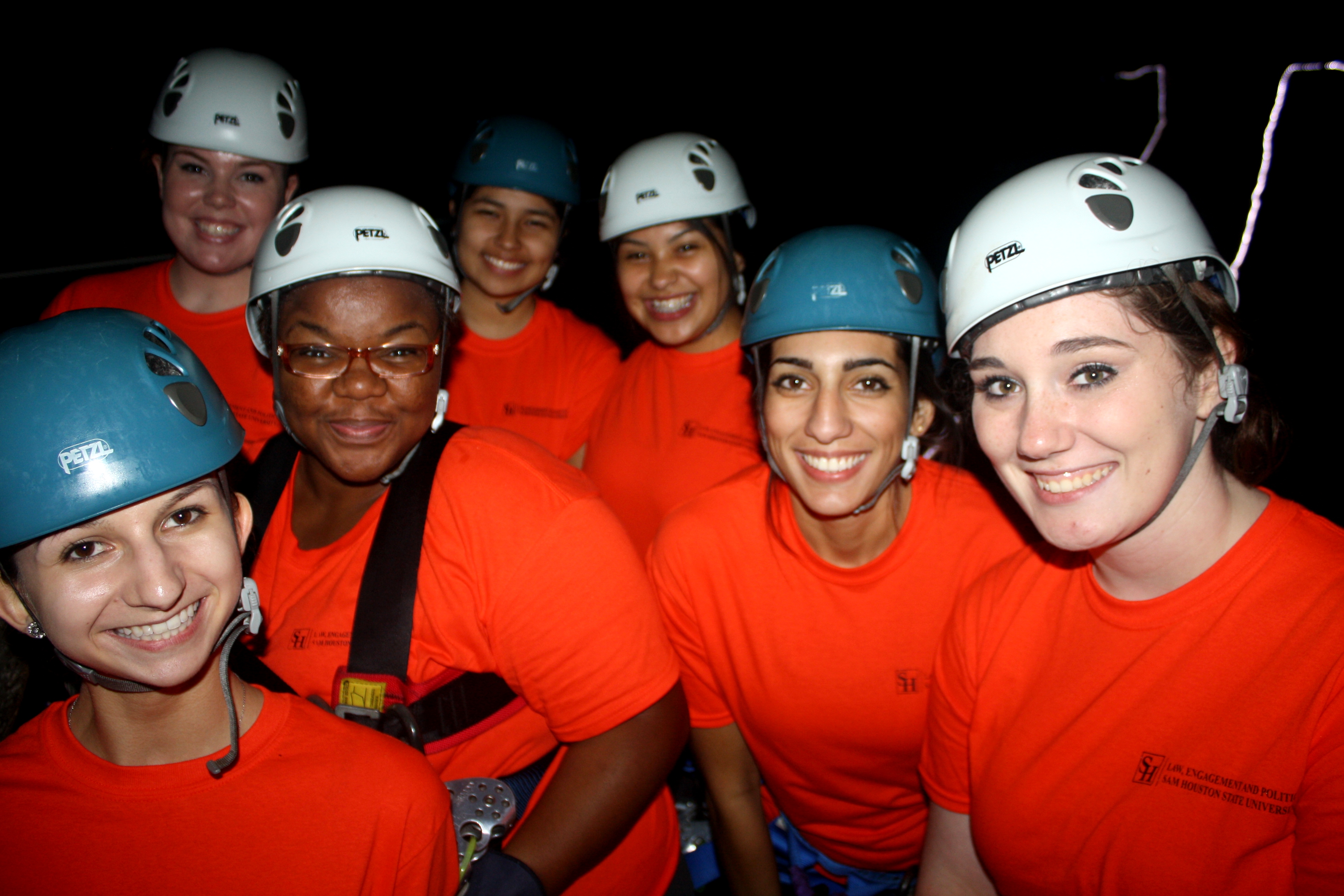
…or the whole group….
…or whether it was Kaitlyn Tyra flying home in record time…
Kaitlyn Tyra’s Finale
…we all had a great time.
After zip lining we made our way to a local restaurant called Jalapeno tree, to enjoy a nice Mexican dinner. The appetizers consisted of chips, salsa and queso. My main course was chicken enchiladas, homemade rice and charro beans. The food was authentic and very delicious. At the restaurant we met with Gene Roberts, an attorney who is the Director of Student Legal Services at SHSU. He is in Nacogdoches to judge the Moot Scrimmage, and he will be helping us understand what to expect at the scrimmage, how the performances are judged, and tips for law school.
I am looking forward to another exciting day tomorrow watching the Moot Scrimmage and looking back at the wonderful memories made. It is moments like these that make me appreciate all that the LEAP center and Sam Houston State University do for us…
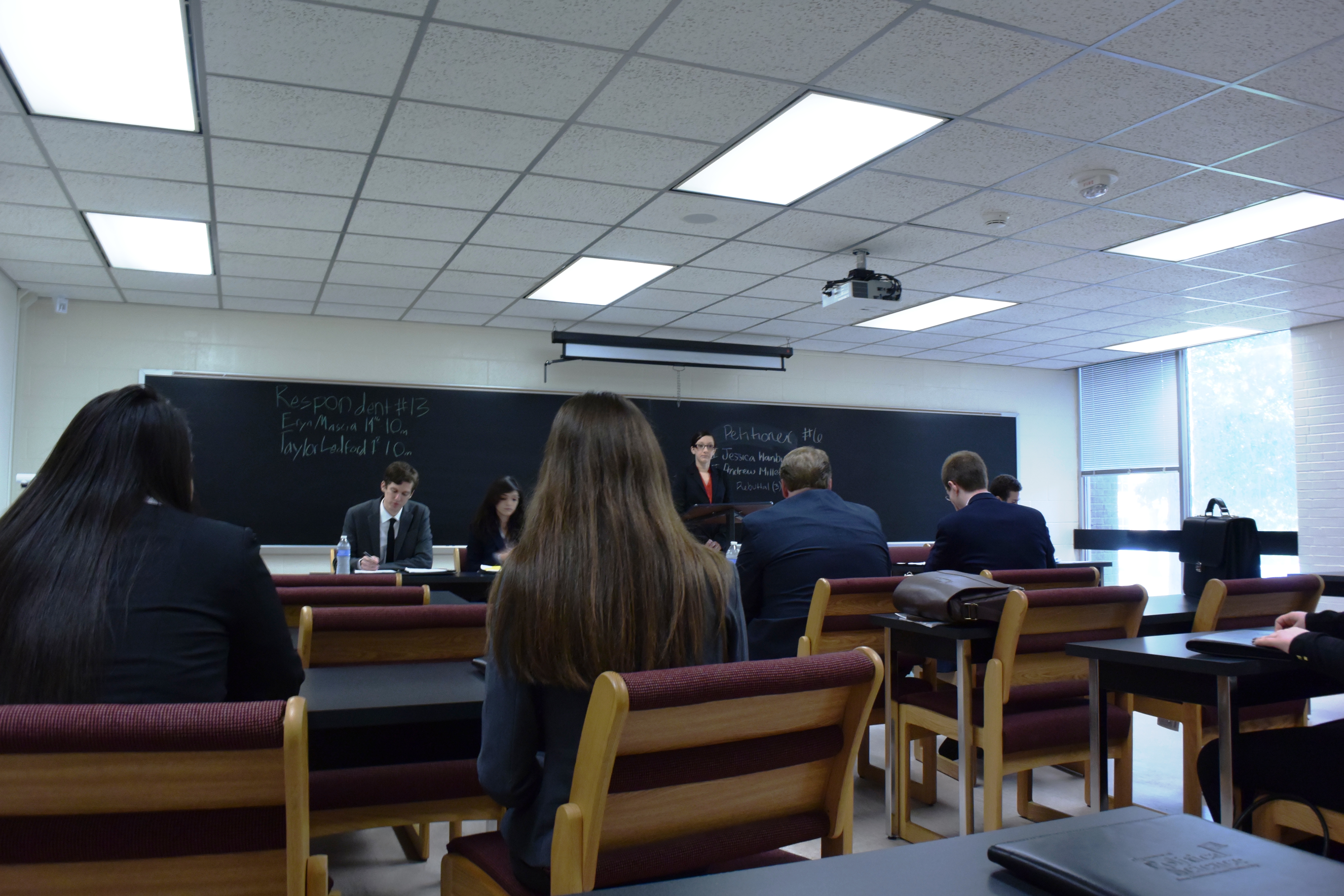
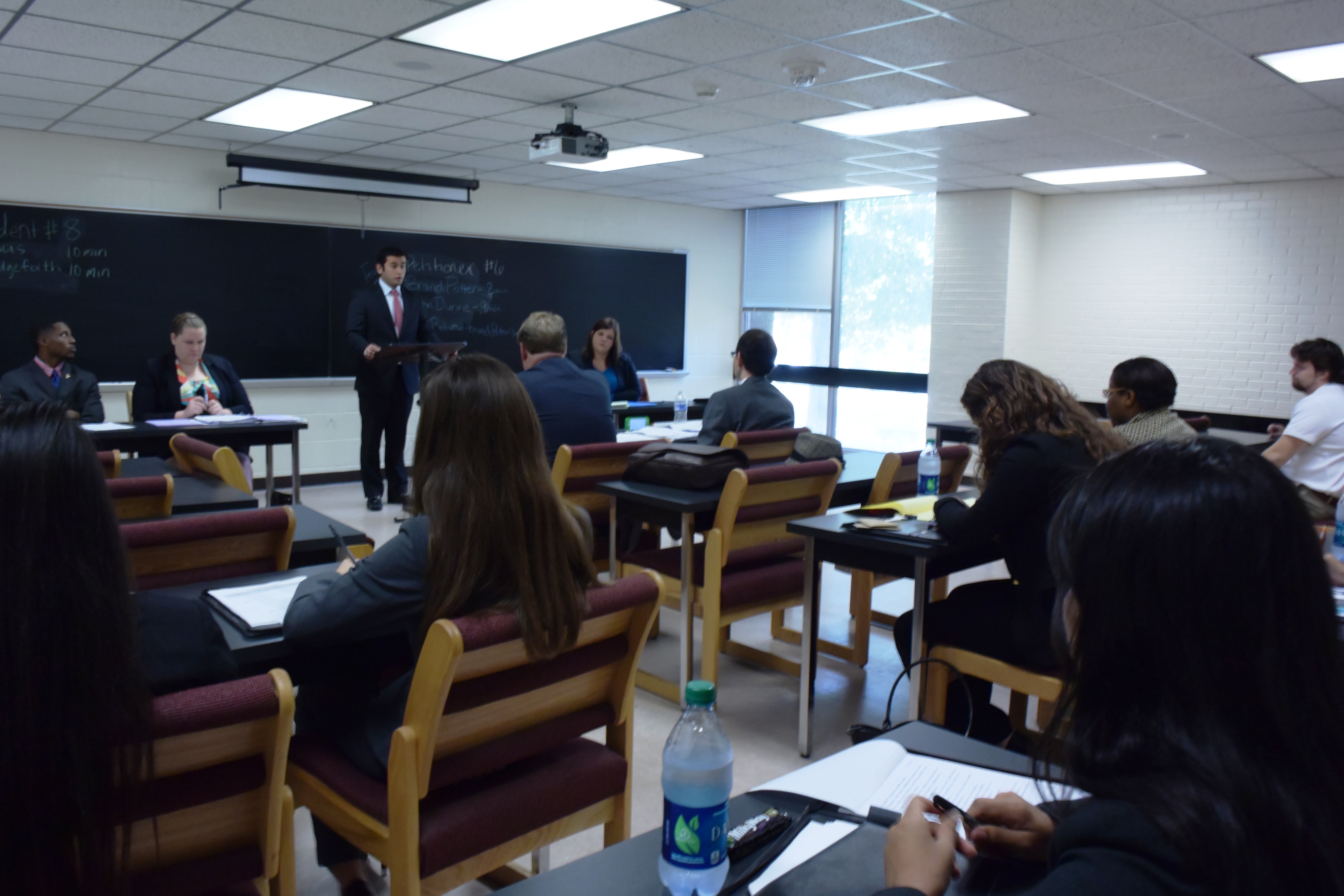
…After a short night of sleep, we were able to watch numerous Moot Court Scrimmages, which turned out to consist of a series of intriguing contests.
In all, we watched four contests. The morning contest was the most competitive. The students were highly skilled and very knowledgeable. The speakers displayed knowledge of the material, confidence, and spoke articulately about the legal matters they have been given to study. It could have been intimidating.
The second panel wasn’t as intimidating. The students struggled at times to articulate their ideas and occasionally seemed to struggle with the facts of the case. We learned later that we had seen the most and least prepared of the students, giving us a strong sense of the range of competition at these events.
A moot court competition is designed to mimic the appeals court process. Incidentally, the LEAP Center hosts four trials from the 10th Court of Appeals on campus every year, so many of us had seen that action. What we hadn’t seen was students try to replicate the work of appeals attorneys. Even the students who struggled helped us understand the process and, as always, we sympathized with those who have speak in public, a difficult task in almost any circumstance.
The afternoon groups fell within the range we had seen in the morning, and all of the teams taught us something about the law, the process of the moot court scrimmage, and ourselves. We are particularly grateful for Dr. Donald Gooch, the pre-law advisor at SFA, and Gene Roberts.
Following our observation, the general consensus was that we should form a Moot Court team at SHSU, and that many of us were game for the competition!
David Berg has been an attorney for more than four decades, becoming an internationally renowned specialist in white-collar crimes. But as he became more successful legally, he found himself reflecting more on the death of his brother, which occurred when he was a fledgeling Houston attorney in 1968. Alan Berg was killed, according to David, by Charles Harrelson (the father of Woody Harrelson) but never convicted.
David revisited the events leading up to the murder in his non-fiction book, “Run, Brother, Run,” which received very favorable reviews by the New York Times, the Christian Science Monitor, NPR, and others. He also dropped by SHSU to discuss the book and the murder with SHSU faculty, staff, students, and local citizens.
David Berg Speaking at SHSU
Berg mixed his presentation with a discussion of crime, law, family relationships, and boom days of Houston, Texas, providing substance for everyone in the audience. Many in the crowd had their own recollections of Harrelson, who spent time in Trinity and Huntsville (in and out of prison). Eventually, Harrelson was convicted of murdering Judge John Wood in San Antonio in 1979. It was the first assassination of a federal judge in the 20th century.
Afterward, Berg spent time speaking with the crowd, giving encouragement to pre-law students…
The last day of our Midwestern Tour arrived, and we were able to visit the beautiful Crystal Bridges Museum of American Art in Bentonville, Arkansas. The beautiful museum was designed by Israeli architect Moshe Safdie, and the funds for the museum were provided by Alice Walton, the Walmart heiress. Although open for fewer than ten years, the Museum is one of the most ten visited museum in the United States—despite being location off a major highway, and hours from a major airport.
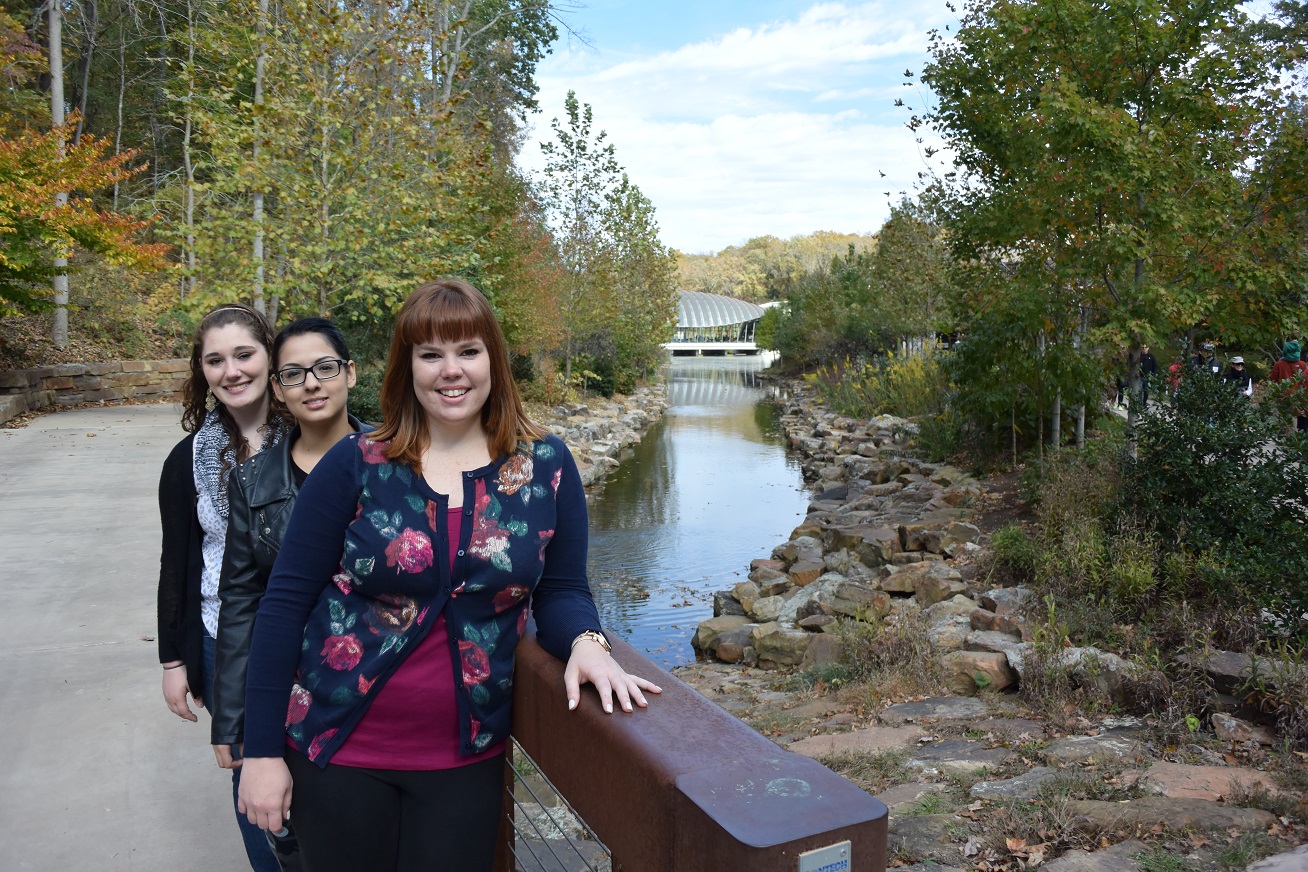
But it is worth the effort to get there. The Museum grounds are beautiful…
..and the art was amazing.
Among the favorites were political works, such as Charles Wilson Peale’s famous portrait of George Washington…
..and a piece by an artist who is becoming a favorite of ours, Georgia O’Keefe:
Radiator Building, O’Keefe
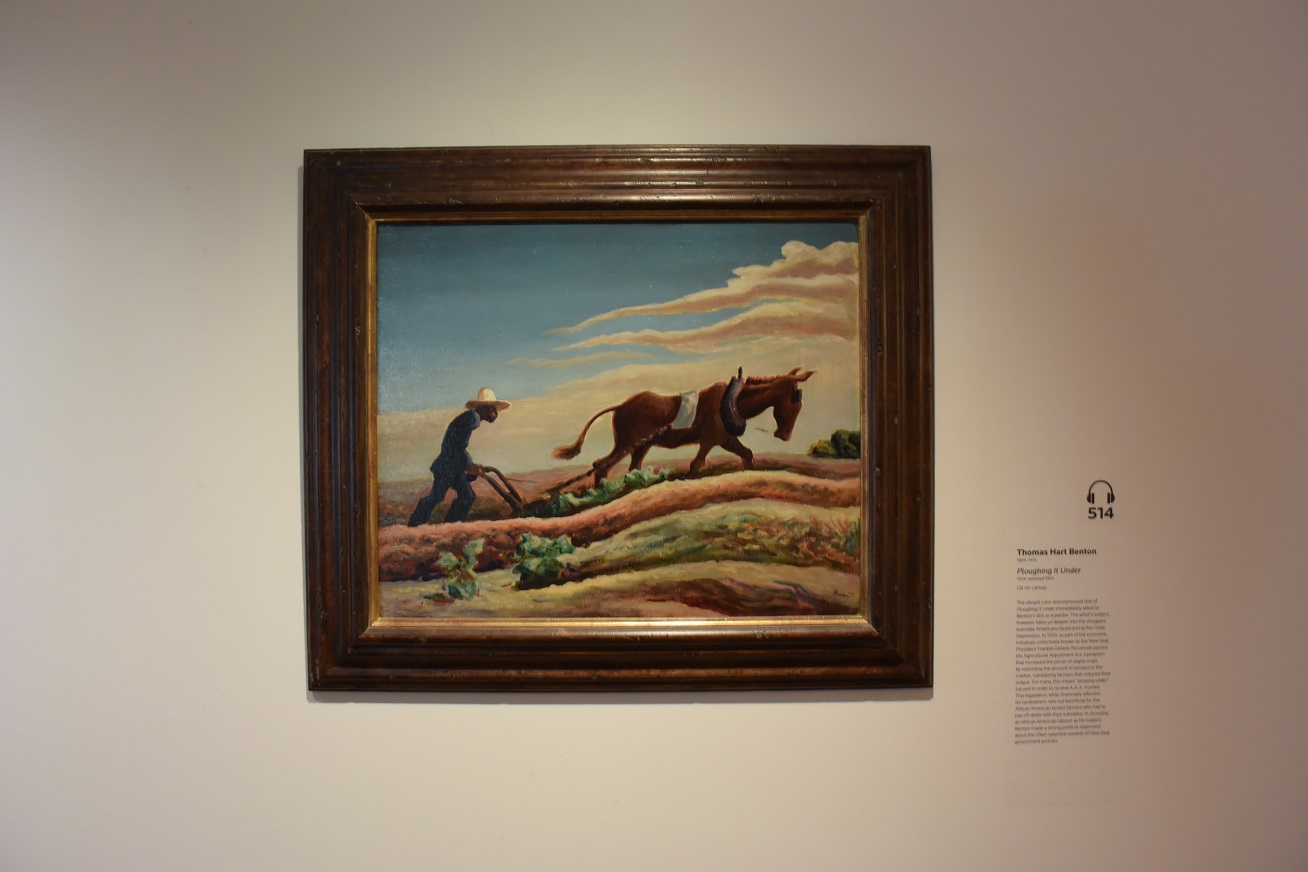
Not only is there no entrance fee to the Museum, but the Museum offers free audio guides, which highlight hundreds of works of art, providing background and instruction for those of us who are not already art connoisseurs. In the piece above, for example, we were able to see connections in the white crown of the Radiator Building with many of O’Keefe’s work focusing on the southwest, particularly animal skulls, which take on a similar color and shape.
We learned how Benton used similar contour lines depict the sky, human/animal life, and the ground to make a connection between life and its environment, a connection hat would have been particularly salient in the 1930s in the midwest.
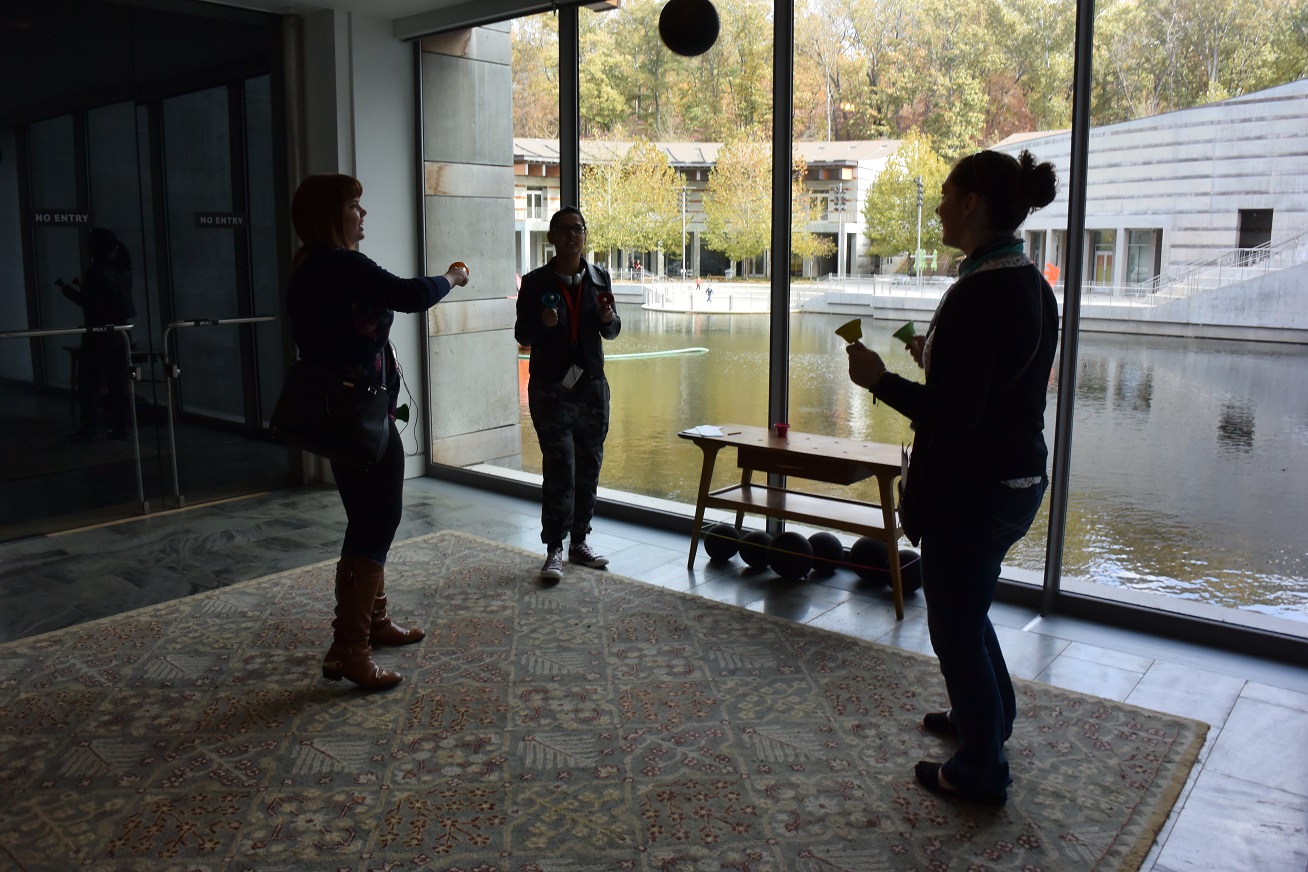
The Museum also allowed us the opportunity to engage in some “performance art”…
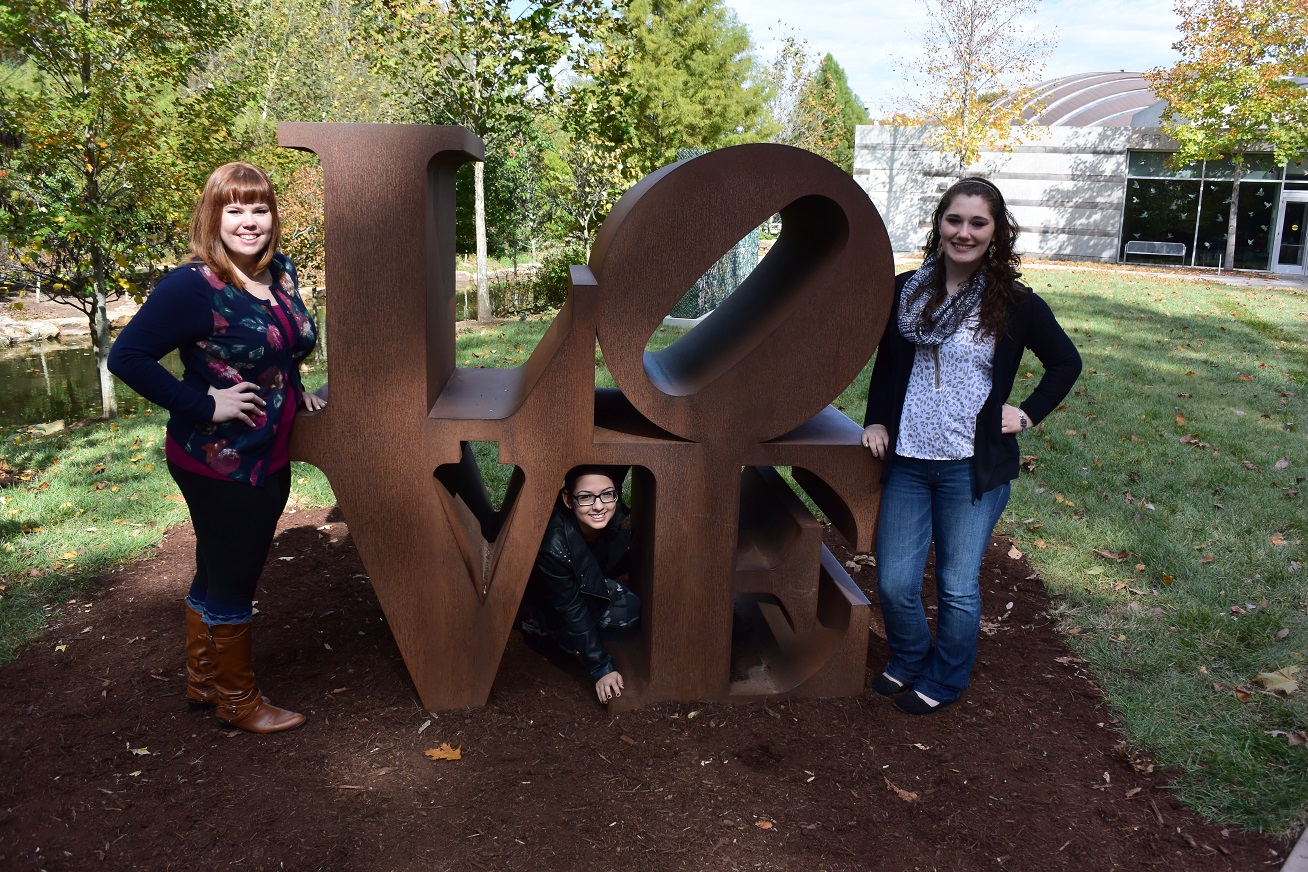
…and pose next to (and in) Robert Indiana’s famous “LOVE” sculpture.
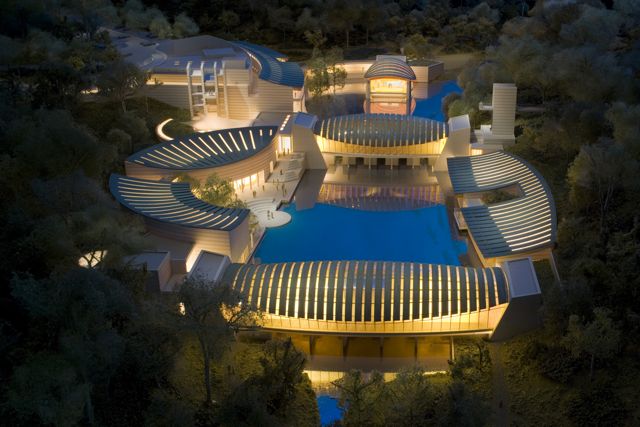
It was sad as we ended the trip, with a final look at the Museum…
Crystal Bridge Art Museum
The end of the trip, however, also offered a time of reflection on what we learned and experienced. Accordingly, we voted on our favorites, with the following results:
In general, our favorite cities were (1) Madison, WI, (2) Kansas City, and (3) a tie among Chicago, Bentonville, Little Rock, and Spring Green. Madison was the big surprise, impressing us all with its beauty and many shops and amenites.
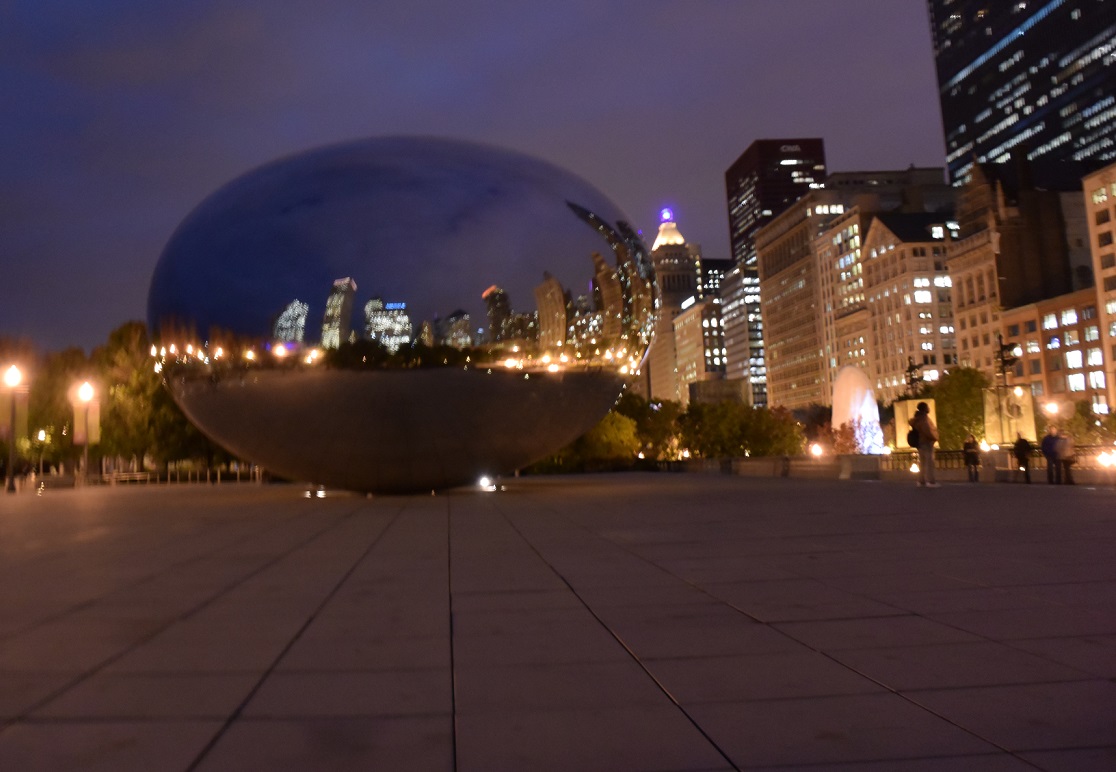
Identifying our favorite sites was more difficult. The Bean in Chicago’s Millennium Park was a favorite…
…with Talieisin, the World War I Museum, and Union Station receiving votes.
Union Station, KC
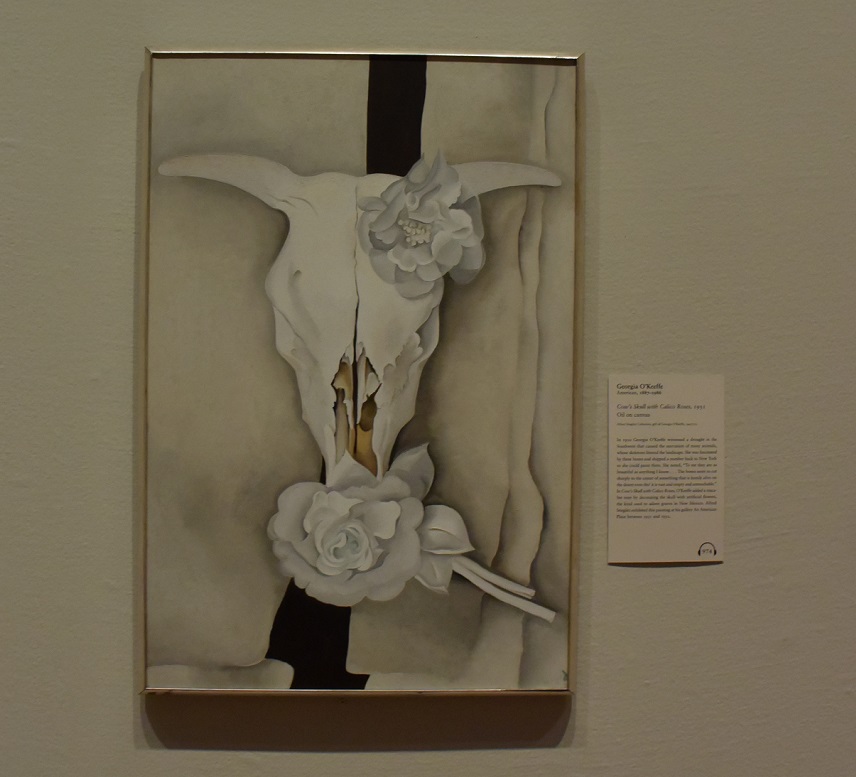
The many art museums allowed us to develop an appreciation for art in general and specific artists. Our group favorite was Georgia O’Keefe…
Cow Skull, O’Keefe
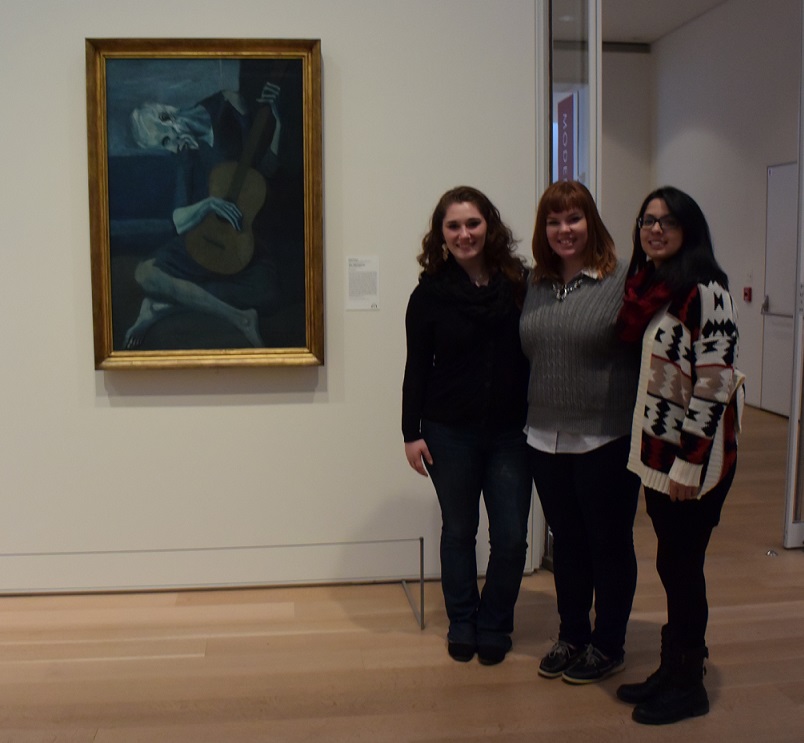
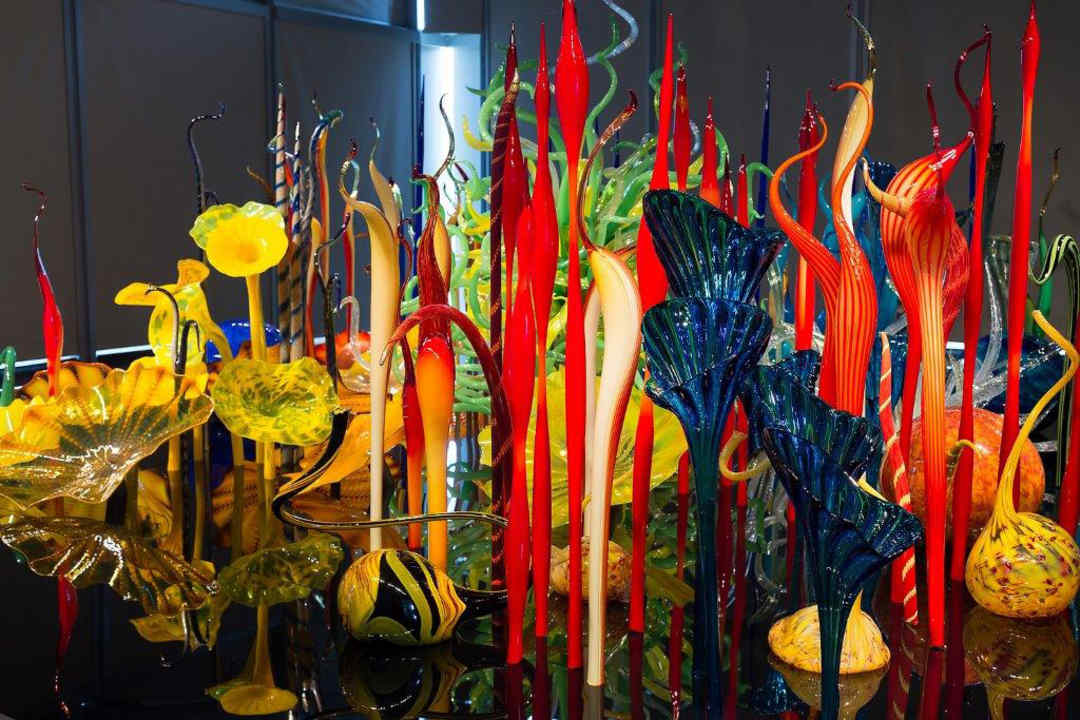
But we also enjoyed seeing original art works by Picasso, Van Gogh, Monet, Rockwell, Rembrandt, and Rodin. A favorite of ours was the work of Dale Chihuly, who kept popping up in all sorts of places.
Chihuly Exhibit, Clinton Library
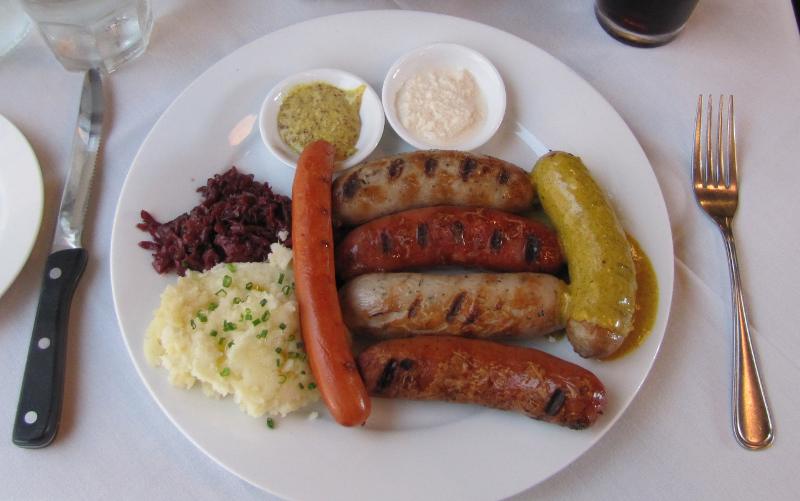
One of our favorite parts of the trip was the food. The one restaurant everyone included on their favorite list was Grunauer, an Austrian restaurant in Kansas City.
So it was with expanded tummies and horizons that we returned to Texas, ready to return to school work and looking forward to the next LEAP Center trip.
We started our day in Independence, Missouri, with hot chocolate, mocha, coffee, and various pastries at Home Sweet Home Bakery in town. The hostess was welcoming, had an interesting haircut, and was very helpful.
Following breakfast, we headed to the Harry S. Truman Presidential Library, starting with a short movie that introduced us to how Truman came to be, from his life in Independence as a young boy up until his career as 33rd President of the United States.
The Library features various exhibits, including parts of his personal diary, and pictures from his presidency.
Harry Truman Library, With Mural by Thomas Hart Benton
One favorite picture of the group was the famous “Dewey Defeats Truman” news headline in which Truman holds the Chicago Daily Tribune with an erroneous headline that indicated Dewey had defeated Truman in the 1948 election. Truman is laughing in the picture, clearly celebrating his victory and ready to begin his second term. The Library also features an original of the newspaper that was published in 1948.
The Library’s largest exhibit is “The Presidential Years,” featuring videos, Truman’s personal diary, newspaper covers, and other artifacts depicting his presidential years. One interesting feature of the Library was the replica of the Oval Office during Truman’s presidency. Also interesting was a documentary on the Cold War, which was very informative.
Another favorite exhibit, also of the newspaper variety, included a display of enlarged newspaper covers, presented in chronological order, and featuring headlines such as “ROOSEVELT IS DEAD: TRUMAN TAKES OATH,” and “FIRST ATOMIC BOMB DROPPED ON JAPAN.” Finally, we took pictures with Truman’s statue…
…and we visited the graves of him and his wife, Bess Wallace.
After visiting the Library, we headed to the Truman Home. Even though the Trumans were not wealthy, the house is far from modest. In fact, the house belonged to Bess’s family, which was wealthy. A wraparound porch surrounds most of the house, and stained glass windows front the house.
The guide led us into the kitchen, which is very modest, with furniture and wallpaper that reflect 1950s style. The chairs, counters, table, and cupboards are all painted apple green, a popular color at the time.
The rest of the house is filled with wooden furniture and golden interiors. The second floor is closed to the public, so we only visited the dining room, Truman’s studio, the two living rooms, and the main hallway. In the larger living room, used for special occasions and guests, is a portrait of Harry, while in the family living room hangs a portrait of Bess. The portrait liked most was in the main hallway, of Margaret Truman, their daughter and only child. At the end of the tour, more pictures in front of the house, and then on to our next destination, Kansas City.
It was lunchtime, and we had to eat Kansas City style barbecue! Our research led us to try Oklahoma Joe’s Kansas City Barbecue, rated the number one place for barbecue in KC. We arrived at a very long line outside the restaurant and decided to utilize our backup plan. We headed to Fiorella’s Jack Shack.
Fiorella’s Jack Shack was voted by The Zagat to be one of the best places to eat in Kansas City; but, we were not impressed. We faced a wait of 30 minutes, at least that was the story according to the waittress. An hour and fifteen minutes later, and after some slight vocalization of our displeasure, we were seated. Overall, the food was average. The sliced pork was above average and the beans were good, but the bulk of the meats were no better than you can find in Huntsville.
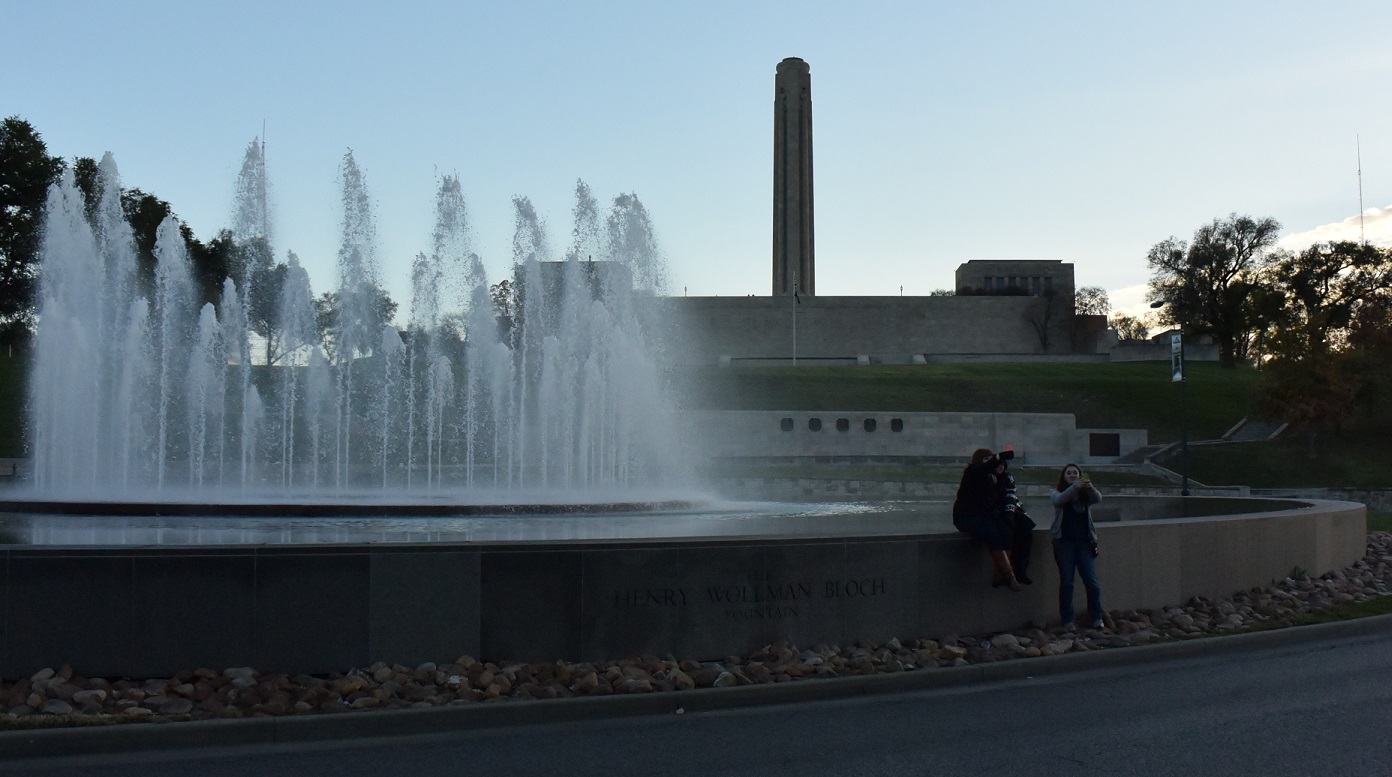
We had a negative experience at lunch, but we would not let lunch defeat us! We headed over to the World War I Museum with full stomachs, armed with curiosity. The Museum was beautiful and showcased the Monument in a spectacular way.
The inside of the Museum had a glass floor that led from the main entrance to the museum exhibits, showcasing poppies commemorating those fallen in World War I. Each of the 9,000 poppies in the display represented 1,000 fallen soldiers. Walking across the glass floor and seeing the poppies below really demonstrated the vastness and destruction of World War I.
There were several great exhibits. One of the most interesting and informative was on wartime weapons development. The war started with very basic weapons; however, many developments were made in terms of weaponry and battle strategy. One particularly effective strategy was camouflage. The British would paint their ships in various patterns that they pulled from Cubist paintings to confuse enemies and make it harder to track the ship’s speed and course.
In terms of weaponry, countries were still in the early development stages. The first machine guns were poorly designed and very slow – but the Germans developed the German Maxim machine gun that performed fast, concise and very well. Grenades were also introduced in World War I and made trench warfare brutal. Various gases were used as well, making World War I a chemical war. Other developments such as tanks and submarines changed transportation for troops during the war and helped improve reconnaissance efforts.
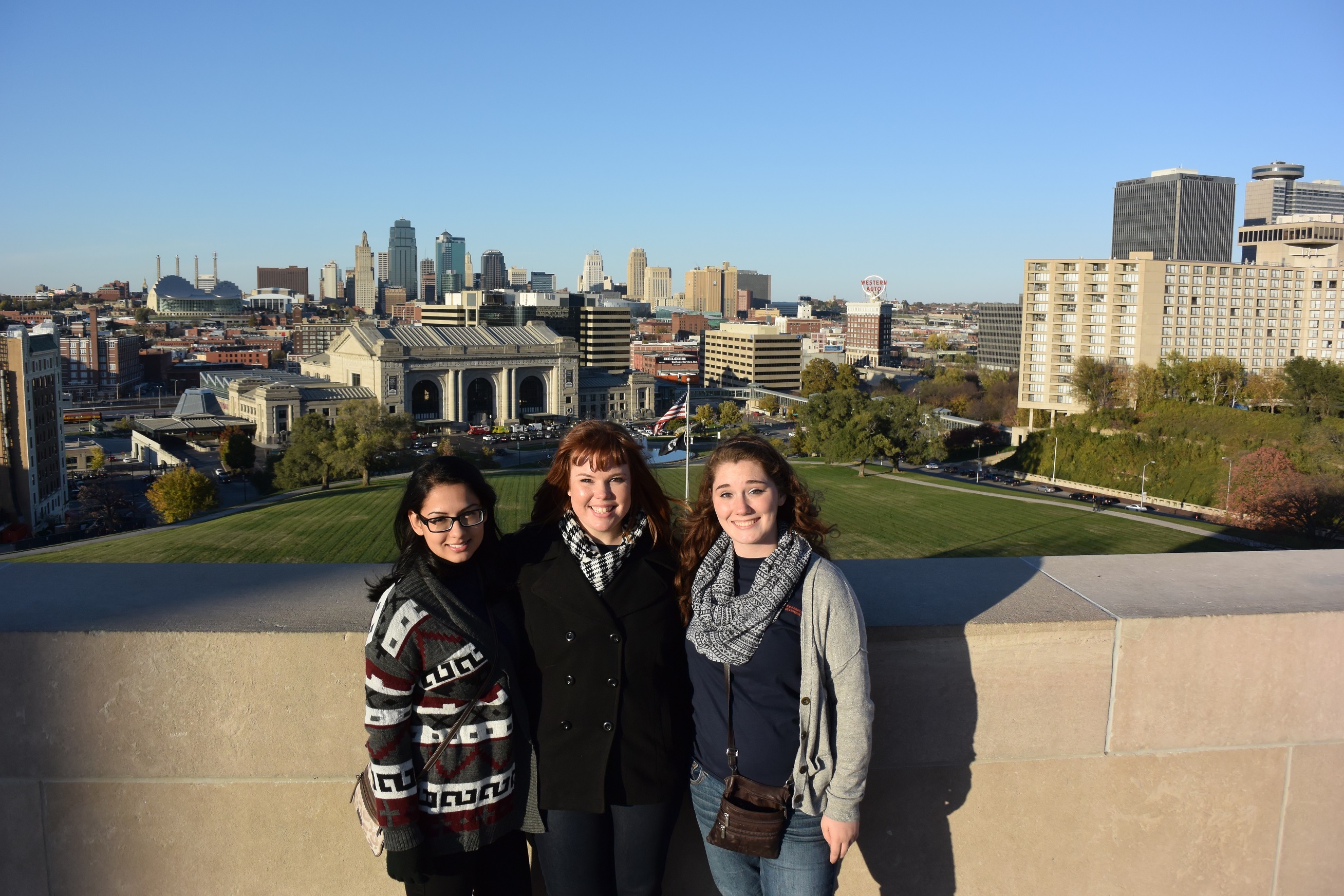
We closed down the World War I Museum and continued our exploration of KC starting from the top of the museum, which is the bottom of the 265-foot tall Liberty Memorial. We walked up the stairs to the Liberty Memorial and were astonished at the view: the entire skyline of Kansas City.
After taking several pictures of the skyline (selfies and groupies), we walked the several blocks to Union Station. On our walk, we encountered a large field of grass with an American Flag in the middle: the perfect place for a race. We had tried a race the night before, but because Professor Yawn left Silvia in the dust, he agreed to run backwards against her this time. It was much closer this time, and Silvia edged out Yawn in a photo finish.
The Race!
During the race, though, we stumbled upon a beautiful tree in full fall foliage, displaying red, orange and brown leaves like a proud peacock. The tree served as a perfect backdrop for more pictures of us as a group…
…and individually…
We finished our stroll in the brisk Kansas City air at Union Station, an historic train station. Built in 1914, the train hub is home to Amtrak, museum exhibits like Science City, and theaters. Awed by the extravagant architecture and design of the interior, it was interesting to learn that after being closed in 1985, $20M was spent on restoration of the building to recover it from its solitude and dilapidation. Intriguingly, it’s still an active train station.
Historically, the KC Union Station was the second to be built in the country and followed Second Empire Style and Gothic Revival. After consuming all available space in the 1878 location and eventually flooding, the decision was made to move the station to its current location. Designed by Jarvis Hunt, the great hall with three massive chandeliers and ornate ceiling adornments is what we see today.
We were fortunate enough to be spectators to all the 100th year celebrations the Saturday evening held for Union Station. Drinking our coffee, we watched patron after patron stroll past, determination in their eyes, dressed in authentic 1920’s regalia. Unsure of what was happening, we followed a few to find, to our surprise, swing dance lessons going on. We watched, thankful for such perfect timing for something so entertaining.
With the sun setting…
…we hightailed it out of the enormous train station and headed back to the car in search of the Kemper Museum of Contemporary Art. Sighting a Chihuly, we knew we had arrived at the home to many inspiring pieces of modern art.
We wandered through the museum, admiring exhibits such as Summoning Ghosts: The Art of Hung Liu, full of poignant, politically vocal pieces about communistic China, and Miss Your Mark, which sought to allow artists to make their mark using the manipulation of different materials.
We even explored the museum’s café, full of art by Frederick James Brown, which paid tribute to many artists throughout time. Our artistic appetite not quite satisfied, we left the Kemper and walked to the Donald J. Hall Sculpture Park, to appreciate the pieces by moonlight. Among those seen, our favorites included Shuttlecocks by Claes Oldenburg and Rodin’s Thinker. Although we had filled one appetite, our hunger made an appearance, so we left in search of sustenance.
An all-time favorite of our own Professor Yawn, we walked into Grunauer’s, not knowing what to expect. We quickly learned of the many Austrian delicacies available but had trouble narrowing it down to just a few. We began the meal with an assortment of sampler appetizers, including different kinds of cheeses, bratwursts, meats, and breads. Some of the unusual choices included currywurst, liverwurst, and brie. We downed the wonderful, new foods in preparation for the main course. Among some of the delectable entrees we enjoyed were Hungarian Beef Goulash, Cordon Bleu, Kasespatzle (noodles and cheese), and Fisch im Strudelteig-a fish baked in pastry adorned with spinach and mushrooms.
Stuffed to the gills, we surprisingly found room for apple strudel, chocolate cake, and nutella crepes for dessert, much to our full bellies’ dismay. Such an enjoyable end to an exciting day, we loaded up in the car to make our way to Bentonville, Arkansas for our final day of the Midwestern Tour.
Today was the second day of the 2014 Film & History Conference. As yesterday, the featured panels were many, and the titles all appeared to be interesting topics. What appealed to me the most was a panel titled “Jimmy Stewart for president and Ronald Reagan for best friend: Star Image and Political Campaigning,” by Amit Patel. Amit began his presentation by introducing Ronald Reagan’s initial career as a B movie star. In fact, he starred in low-budget films such as Love is on the Air and Santa Fe Trail. In 1942, the film Kings Row finally gave him some recognition as a movie “star.” Interestingly, Reagan was initially a Democrat, but later switched to the Republican party. In 1976, he embarked in a campaign for the Republican presidential nomination against incumbent Gerald Ford. Amit focused on Ronald Reagan’s use of Jimmy Stewart in his campaign. In fact, Stewart strongly supported Reagan, and even participated in a political ad were he stated that Ronald Reagan was his friend, therefore, the American public should vote for him. Reagan lost the nomination, but campaigned again in 1980, and became president. I thought it was an interesting panel because a candidate’s image is probably the most important thing during a campaign, and if the candidate was a known public figure beforehand then that plays in his favor. In addition, the use of famous actors or public figures to support a political candidate is common nowadays, and it is interesting that it was used in Reagan’s campaign, too.
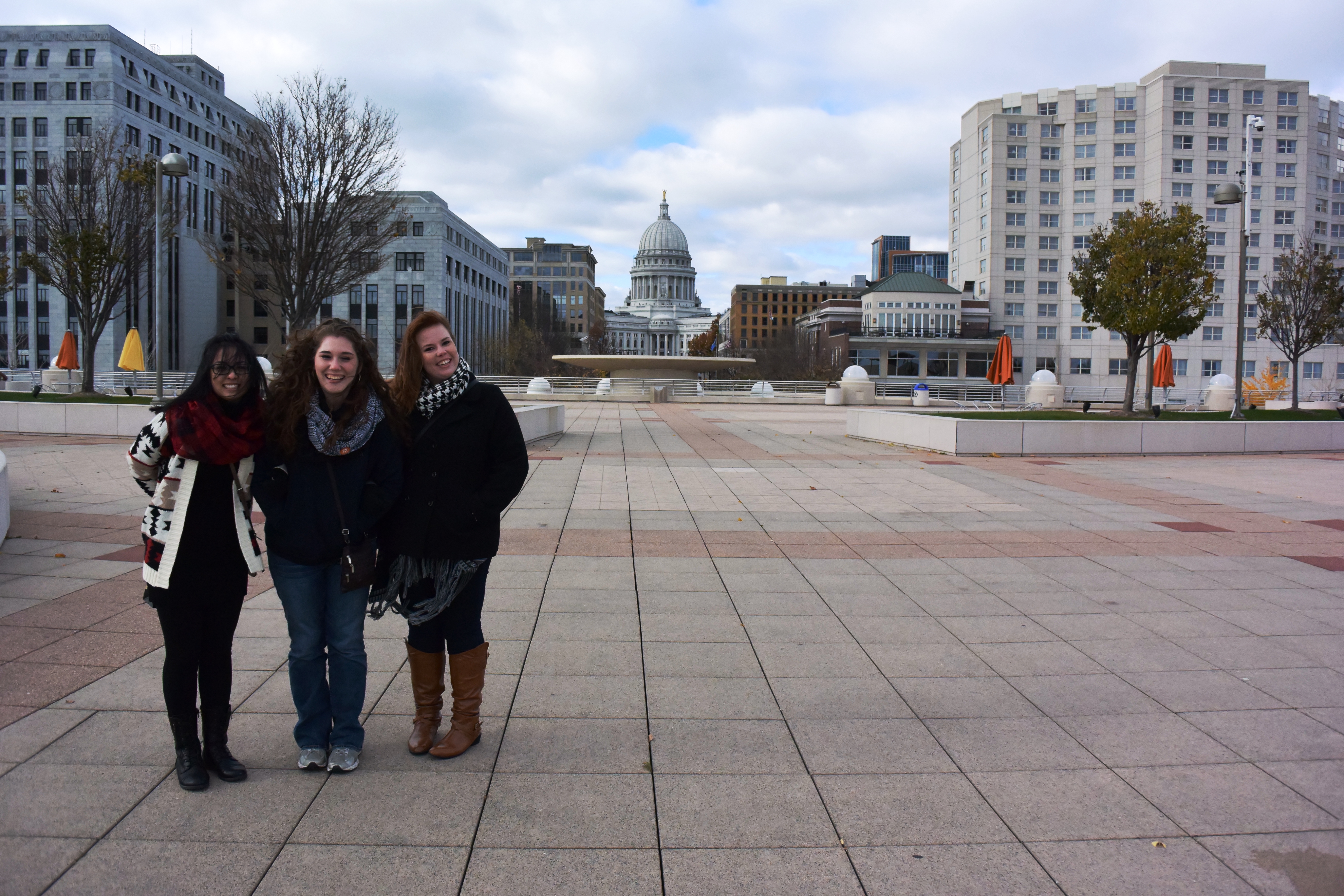
After attending the Film & History Conference, in the morning, we headed to the Wisconsin State Capitol, in Madison.
Wisconsin Capitol Building
A tour guide showed us the most important features of the Capitol, and shared the details of its construction. What interested me most was that Madison had previously had other two state capitols, but they both burned down. The second time around, the Capitol had recently discontinued its fire insurance, so the state did not have enough money to rebuild it. Ingeniously, the state had the idea to tax railroads that were passing through Wisconsin at the time, and with that revenue, they rebuilt the Capitol between 1906 and 1917. The architecture of the capitol is mesmerizing, featuring marble from many different countries, such as Greece, Italy, France, and Germany, as well as some beautiful mosaics.
Wisconsin Capitol, Interior
Perhaps most interesting, the capitol staff apparently have a very liberal speech code in the building. Numerous exhibits were posted around the capitol rotunda protesting the performance of Governor Scott Walker, and one impressively vocal protester’s shouts could be heard throughout the building.
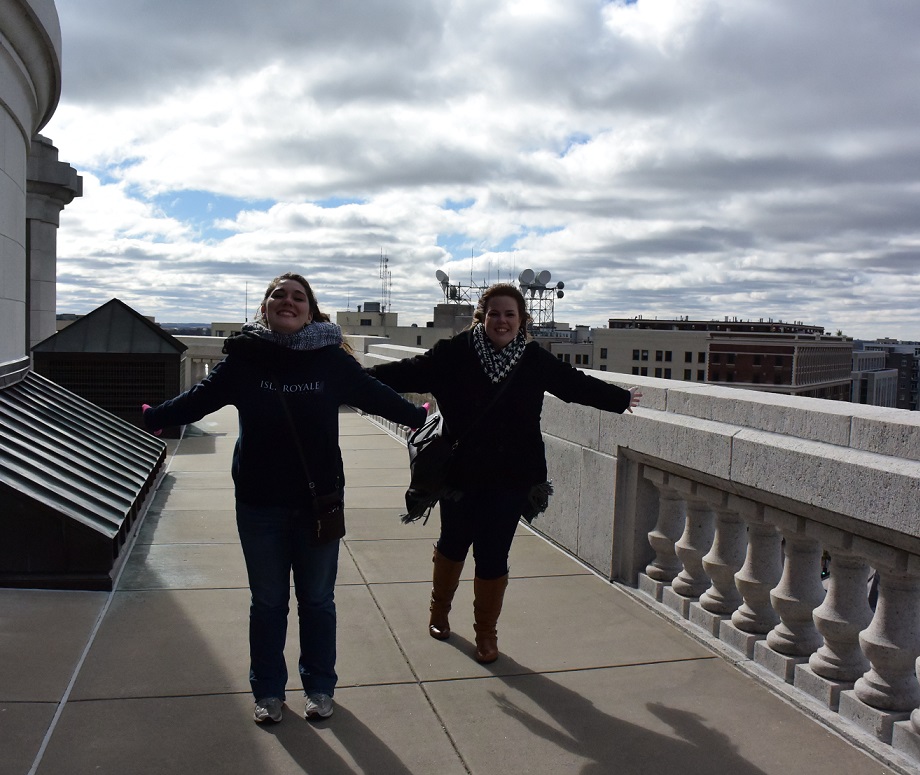
After the tour, we decided to go to the observation deck at the top of the building, and experienced true cold for the first time on our trip.
The winds were so strong that it was hard even to close the door behind us. Nonetheless, it was worth it because the view was beautiful.
Leaving the Capitol, we took a stroll in the brisk Wisconsin air to find ourselves some nourishing lunch. We finally settled on Marigold’s, a local deli, where we reveled in the many options available. Among the delights we delved into were lavender white mocha and grilled ham and cheese with a hint of strawberry jelly. Packed with locals, Marigold’s was definitely a winner.
Out into the invigorating weather we went again to make our way to another of Frank Lloyd Wright’s masterpieces, the Monona Terrace. Opened in 1997, the Terrace was built posthumously and served as the cause of much strife and contention during his career. Using Wright’s design of the exterior, Wisconsin contractor J. J. Findorff and Son Inc. carried out the great architect’s dream, while his previous apprentice, Anthony Puttnam, designed the interior.
Once inside Madison’s event center, we explored the gift shop full of Wright memorabilia before embarking on a tour with guide, John.
Frank Lloyd Wright Bust
Pointing out certain Wrightian things, such as the dome on the west side of the building and the arches in the grand ballroom, John proved to be a formidable docent as he never ran out of interesting facts and stories to regale. Braving the gusty winds, we had the chance to view Lake Monona, which Monona Terrace balances precariously over, thanks to the intricacies of Wright’s design.
Awed by the view and many selfies taken, we headed inside to embrace the warmth it offered and finish our tour.
Seeing it was getting late, we rushed back to the car in order to make it to a few last minute shops, original to Madison. Among those, we re-caffeinated and browsed a wonderful cheese boutique, Fomagination. Overwhelmed by the many options and tastes, we took in Wisconsin’s finest and tried to contain our enthusiasm at all that was available. It was incredibly exciting to see so many things unavailable in the great state of Texas. We loaded up on cheeses and cheese accessories before tumbling back into the car to begin the final leg of our trip.
We admired the beautiful fall landscape of Wisconsin; the rolling hills and deep yellows, greens, and reds created the perfect ambiance for our drive to Dubuque, Iowa. There, we enjoyed the Fenelon Place Elevator, or Dubuque Incline, claimed to be the shortest and steepest railroad in the world.
Gripping the seats…
…up we went on the side of the hill to eventually reach one of the most inspiring views of the trip so far. Known as “the magic hour” in film circles, we caught the sun setting on the horizon, creating beautiful red and orange tones in the sky and on the trees off in the distance.
Proud to say we had viewed three states at once (Iowa, Illinois, and Wisconsin) from the top of the incline, we got back in the cable car built in 1882 to return to our vehicle and carry on to the next leg of the journey.
After a short drive, we arrived at our final destinations: The John and Mary Pappajohn Sculpture Park and the Des Moines capitol building. The 4.4-acre sculpture garden is unique and home to 28 sculptures from 22 different artists. Various paved paths provided a route for us to take through the garden, however, curiosity and the lure of new art, propelled us forward.
Man of Letters, Jaume Plensa
Many of the sculptures were created by artists that were foreign to us, however, one sculpture in particular provided us with the comfort of familiarity: Painted Steel by Mark Di Suvero. Di Suvero also has an art piece called “Proverb” in Dallas, Texas, which we were able to relate to. “Painted Steel” was made out of steel and painted in the same red that “Proverb” is painted. Both statues have similar characteristics, but varying dimensions and structure.
Another interesting sculpture that we saw was, “Back of Snowman (Black)” and “Back of Snowman (White).” These sculptures were created by artist Gary Hume and were located side-by-side in the middle of the park and held a spectacular gleam given off from the surrounding lights. Each of the statues consisted of two round pieces of bronze covered in enamel, one in white enamel and one in black. These statues were especially appealing because each round piece of bronze was perfectly symmetrical and smooth, giving the piece a unique trait of looking seamlessly perfect.
The last sculpture that really caught our eye and our interest was “The Thinker on a Rocky” created by Barry Flanagan. This piece was a large rabbit sitting upon a boulder in the same pose as Rodin’s “The Thinker.” The piece was clearly a satire on Rodin’s famous statue, which only added to its appeal!
While the statue garden was a fantastic experience, we had to continue our night and head to the Des Moines capitol building. The Renaissance style capitol, designed by John Cochrane and Fred Piquenard, was absolutely stunning! The capitol building featured a 23 carat gold dome in the middle of the building and was accompanied by two smaller domes on either side of the building. The capitol took expansive resources and large amounts of time to build and open to the public. The building took fifteen years and a staggering amount of $2,873,294.59 to complete. On June 29,1886, the capitol was ready to be open for use!
Iowa Capitol
Both the capitol and the sculpture garden trips were the perfect ending to day five of the trip!

















 Center for Law, Engagement, and Politics