Skip to content

Center for Law, Engagement, and Politics

Leap At SHSU!

  • About LEAP
  • LEAP Ambassadors
Center for Law, Engagement, and Politics

LEAP in DC: Day 4

Tuesday, 20200310

NLC Conference: General Session (MD)

LEAPsters faced another early morning for the closing day of the National League of Cities’ Congressional City Conference.

SHSU, LEAP Center, Center for Law Engagement And Politics, National League of Cities Congressional City Conference

NLC Second Vice President and Mayor of Union City, Georgia, Vince Williams, called the session to order.SHSU, LEAP Center, Center for Law Engagement And Politics, National League of Cities Congressional City Conferenc, Vince Williams

The session opening featured a panel discussion on homelessness with representatives from the Washington Metro Police Department and the National Alliance to End Homelessness as well as elected officials. Ending homelessness has become a high priority in recent years as the homelessness population continues to grow. Local and federal governments have been searching for a solution to this growing problem, and the experienced panel offered possible housing solutions, including shelters, affordable housing, and low income and veterans’ housing options. They also covered diversion programs, which divert the homeless with substance abuse or mental health problems to a health department instead of the police department.

SHSU, LEAP Center, Center for Law Engagement And Politics, National League of Cities Congressional City Conference

The (knowledgeable and clearly passionate) panel also discussed implementation of education and workforce development programs as a longer-term solution, and ultimately, about the importance of providing a safe and healthy living environment to all residents.

SHSU, LEAP Center, Center for Law Engagement And Politics, National League of Cities Congressional City Conference

A “town hall meeting” on COVID-19 with Dr. E. Oscar Alleyne, Senior Advisor for Public Health Programs, National Association of County and City Health Officials, closed out the morning general session.

SHSU, LEAP Center, Center for Law Engagement And Politics, National League of Cities Congressional City Conference

Through an extremely informative Q&A format, Alleyne discussed the difference between COVID-19 ad the flu, and updated the audience on the current (but ever expanding) status of the COVID-19 outbreak in both the US and foreign countries.

SHSU, LEAP Center, Center for Law Engagement And Politics, National League of Cities Congressional City Conference

Alleyne was able to convert medical and science jargon into easily absorbed information, thankfully.  It was a bit scary, though, to learn about the coming microbial-resistance of future viruses because of the overuse of sanitizers and soaps in our everyday use.

SHSU, LEAP Center, Center for Law Engagement And Politics, National League of Cities Congressional City Conference

On that note, we all sanitized our hands (maybe a bit sheepishly) and headed to the next session!

NLC Conference: Cybersecurity: City Data and the 2020 Census (EM)

SHSU, LEAP Center, Center for Law Engagement And Politics, National League of Cities Congressional City Conference

With the country’s change to an online census and the upcoming presidential election, this panel provided some great advice to prevent cyberattacks within their cities at a low cost.

SHSU, LEAP Center, Center for Law Engagement And Politics, National League of Cities Congressional City Conference

Some advice included the following items, along with a reference to https://www.dhs.gov/be-cyber-smart:

  • Enabling multi-factor authentication (MFA) to guarantee you’re the only person that has access to your log-ins.
  • Avoiding automatic updates and an all-access pass containing personal information on installed applications.
  • Setting privacy preferences to a restrictive setting by disabling geotags that will give your followers the ability to see your location.
  • NOT clicking on any link sent by a suspicious email address.

It is difficult to find a “one-size fits all” solution to address cybersecurity. And, accountability for cybersecurity is ultimately everyone’s responsibility—to understand and adopt preventative measures. According to the website referenced above, 47% of American adults have been attacked by a cybercriminal for their personal information.  Notably, Miranda asked a question at this session.

SHSU, LEAP Center, Center for Law Engagement And Politics, National League of Cities Congressional City Conference, Miranda Estrada

NLC Conference: Closing General Session, with Lunch (ME)

All attendees headed into the ballroom for the closing session,…

SHSU, LEAP Center, Center for Law Engagement And Politics, National League of Cities Congressional City Conference

…which included a catered lunch—Caesar salad, chicken with vegetables and rice, and a large slice of rich chocolate cake–that turned out decent!

SHSU, LEAP Center, Center for Law Engagement And Politics, National League of Cities Congressional City Conference

NLC President Joe Buscaino kicked off the closing session with a few words, followed closely by officials who spoke on greenhouse emissions and plans to pass comprehensive legislation for regulating those emissions that should be based on science, and without partisan politics.  They emphasized that, while this is an important issue, much misinformation abounds regarding efforts to reduce emissions. They indicated that several states have had success reducing their footprint, with Georgia making tremendous gains with a 22% reduction, and that the US is the global leader in reducing these emissions.

Buscaino next introduced Ms. Una Garvey, the Convention Center and Tourism Director for the City of Tampa, Florida. Tampa will host NLC’s annual City Summit this fall.   Garvey invited everyone to the conference and shared a video from Mayor Jane Castor, who encouraged everyone to attend the Summit and immerse themselves into all the city had to offer from food to entertainment.  Following that video, Buscaino presented the “President’s Award” to Congresswoman Anna Eshoo (not present) for her tireless efforts on the Hill to advocate for cities and local government.  

Buscaino then introduced our keynote speaker as “the woman who needs no introduction,” current Speaker of the House Nancy Pelosi. Pelosi walked onstage to a standing ovation.

SHSU, LEAP Center, Center for Law Engagement And Politics, National League of Cities Congressional City Conference, Nancy Pelosi

She started by thanking the crowd for their efforts for their public service, and spoke about how not only are public servants the eyes and ears of their cities but that their success was America’s success. Speaker Pelosi spoke on Congress’ commitment to working with local governments, especially considering the COVID-19 outbreak, by recently passing an economic response package that allocates funds directly to assist state and local governments. Pelosi also spoke about infrastructure needs affecting our communities, gun control (being adamant that it not be about politics or party but about keeping the future safe), and ended her time commenting on how it is our moral responsibility to be good stewards of this planet.

SHSU, LEAP Center, Center for Law Engagement And Politics, National League of Cities Congressional City Conference

Washington National Cathedral (EM) [https://cathedral.org/]

We next found ourselves on the grounds of the Cathedral Church of Saint Peter and Saint Paul in the City and Diocese of Washington, better known as the Washington National Cathedral.  We were fascinated by the exterior of the architecture, and of course, could not resist posing in front!

This slideshow requires JavaScript.

Before our tour, we visited the gift shop where a LEGO replica of the Cathedral was being built, and where which we could purchase and install a LEGO brick.  (Of course we did!)

SHSU, LEAP Center, Center for Law Engagement And Politics, Washington DC, National Cathedral

During the 2011 earthquake the Cathedral suffered extensive damage, and the LEGO installation is helping fund repairs.

SHSU, LEAP Center, Center for Law Engagement And Politics, Washington DC, National Cathedral

Repairs continue as funding become available; current estimates put the completion at 2-3 more years. Phase I repairs to the Cathedral interior were completed in June 2015; Phase II will pivot towards the damaged pinnacles of the central tower and to the various chapels found throughout the Cathedral.

During our tour, we learned that it cost $65B to the build the Cathedral, completely from donations, and that it took 83 years to complete. The Washington National Cathedral is the sixth largest cathedral in the world and the second largest in the United States. Approximately 418,000 worshippers and tourists visit the Cathedral annually.

SHSU, LEAP Center, Center for Law Engagement And Politics, Washington DC, National Cathedral

We were in awe when we caught sight of one of the Cathedral’s showpieces, the Rose Window, a 26-foot window made of over 10,500 pieces of stained glass, created by artisan Rowan LeCompte and fabricated by Dieter Goldkuhle.

SHSU, LEAP Center, Center for Law Engagement And Politics, Washington DC, National Cathedral

Another favorite among the 215 stained glass windows was the Space Window, donated by former NASA astronaut Thomas O. Paine.  Photographs taken during the Apollo 11 space flight inspired the design for the Space Window, and amazingly, the Space Window actually contains a small piece of moon rock.

SHSU, LEAP Center, Center for Law Engagement And Politics, Washington DC, National Cathedral

The Cathedral contains many other interesting finds, such as:

  • The Canterbury Pulpit, carved from stone from the Canterbury Cathedral in England; from which many have preached, including Reverend Martin Luther King Jr., who preached his last Sunday sermon before his assassination from there;
  • A Children’s’ Chapel, donated by parents who had lost their six-year-old son;
  • A Chapel dedicated to the wars of the world;
  • A Chapel with paintings completed by renowned American painter N.C. Wyeth; and
  • President Woodrow Wilson’s tomb.

SHSU, LEAP Center, Center for Law Engagement And Politics, Washington DC, National Cathedral

We saw many carvings, stained glass windows and beautiful chapels and did not even begin to cover the other areas of the Cathedral.  Inspired to return for the “behind-the-scenes” tour someday, we headed back to the hotel, joined by even our taxi driver in proclaiming just how beautiful the Cathedral truly is.

SHSU, LEAP Center, Center for Law Engagement And Politics, Washington DC, National Cathedral

 Ted’s Bulletin, Capitol Hill (ME) [https://www.tedsbulletin.com/]

We took the Metro (being experts by now) to try a DC favorite, Ted’s Bulletin, on the recommendation of one of our two special guests, former Junior Fellows Ademide Adedokun and Justin Veillon.  Ademide and Justin both live and work for different governmental agencies in the DC area.

Over appetizers (Candied Nueske Bacon, Loaded Tots, and Pretzel Bites), we learned a little more about their journeys to DC. Both Ademide and Justin had interned and/or worked for Congressman Kevin Brady (our Huntsville Rep!) and although they had different paths, they each found their way to Capitol Hill. They also shared their internship experiences – both had interned with the City of Huntsville, a connection we could all make and talk about, as former & current interns and part-time employees.

We quizzed Ademide and Justin about how D.C. works, and without job-specific detail, they each described a typical day: the commute; the day-to-day work (sometimes explosively interesting, sometimes soul-grinding, but somehow always interesting); and the importance of maintaining a life-work balance. Ademide provided a little more background on transitioning between different positions and agencies, and how she has been successful navigating some of the DC “waters.”  She recently bought a house, so we all congratulated her on that.  Justin recently started a new position and, while his days are long, he shared that he does love about his work that he is in an environment of people who work hard and tirelessly every day.

Over our entrees (a variety of burgers and chicken dishes), we also shared our after-graduation plans and took in any advice offered. Ademide and Justin were great in offering insight on our different career paths.  One thing they insisted on, though, is that no one ever has it figured out, and if you’re willing to take a LEAP at opportunities, sometimes you can find something you really enjoy.

SHSU, LEAP Center, Center for Law Engagement And Politics, Washington DC

Either way we leaned—wanting to move to DC, or maybe just planning another visit—we truly appreciated their insight. (And we really appreciate Justin dropping us at the National Mall – we got to chat a little more on the drive, and we were spared one Metro ride – thanks again, JV!)

National Mall, Monuments @ Night (MD)

Our first stop was the Lincoln Memorial.

SHSU, LEAP Center, Center for Law Engagement And Politics, Washington DC, Lincoln Memorial

We had heard that the National Mall is exceptionally popular (and pretty) at night, with the monuments lit. On our arrival at the Lincoln Memorial, we headed up the intimidating steps, surprised by the sheer size of the statue and monument. Lucky for us, there was lull in tourists taking pictures at the base of the statue, so we stepped in for a few shots.

A little on the Lincoln Memorial: President Abraham Lincoln was assassinated on April 15, 1865. Following his assassination, Congress created the Lincoln Monument Association to build a memorial for the former President and his legacy. On February 12, 1914 the Lincoln Memorial was dedicated and construction began the following month. On May 30, 1922, a dedication ceremony was held with Lincoln’s only surviving son in attendance.

We next walked through the Vietnam Veterans Memorial. The Vietnam Veterans Memorial Wall was commissioned to Maya Lin, an American designer and architect most known for her work on this Memorial, completed in 1982.

SHSU, LEAP Center, Center for Law Engagement And Politics, Washington DC, Vietnam Memorial

“The Wall” memorializes American veterans who died in the Vietnam War. Veterans’ names are listed in the order that they died or became unaccounted for while overseas. Symbolically, Lin designed the wall to appear as a “wound that is closing and healing,” and is a form of land art that was popular in the 1960s. Built on a 125-degree angle, one wall points toward the Lincoln Memorial and the other points towards the Washington Monument. We visited all three “parts” to the Memorial, including The Three Soldiers and the Vietnam Woman’s Memorial, but we all agreed that The Wall was the most impressive.

Finishing up the night, we arrived at the WWII Memorial, which includes 56 pillars representing the United States and territories involved in WWII. One side of the memorial represents the “Atlantic” and the other side the “Pacific,” symbolizing the global impact and extent of WWII. Because of the season, the fountain and reflecting pool had been drained, but we could still feel the impact of the Memorial, dedicated by President George W. Bush on May 29, 2004.

SHSU, LEAP Center, Center for Law Engagement And Politics, Washington DC, World War II Memorial

Luckily, we got some pictures before our visit was cut short by rain!

SHSU, LEAP Center, Center for Law Engagement And Politics, Washington DC, Lincoln Memorial

+ + + + +


Unknown's avatarAuthor mikeyawnPosted on September 6, 2020Format AsideCategories Art, Civic Engagement, Civil Rights, Food, Law, Politics, TravelTags Center for Law Engagement And Politics, LEAP Center, National League of Cities Congressional City Conferenc, SHSU, Washington DCLeave a comment on LEAP in DC: Day 4

LEAP LEADs: Opening Session

By Madison Villarrial

Upon entering this semester, things were looking rather grim due to the current state of our country as we continue to battle a harsh pandemic and civil unrest across the country. The only thing that really had me excited upon entering the semester was LEAP Leads and the opportunities that my peers and I were about to receive. Finally, September 2nd came, and we got to begin a program we hope will be amazing.

As soon as the night began, the energy was already invigorating. Being around students who have similar goals and work ethics was extremely refreshing and humbling. Everyone was  easy to talk to and we all got along from the get go.

We started off with a short introduction from Professor Yawn, which was basically a rundown of what to expect from the program and what he hopes we get out of it.  The program is designed to introduce us to the community (University and local government communities), the structure of large organization, and the styles of leadership and structures used to navigate these structures.

We also were introduced to each other and talked about our career goals. Most of us want to be lawyers, however there was a fun mix of law enforcement and Chief of Staff type goals also.

Then, Ms. Fors led us into some icebreakers, so we could get to know the people we would be spending a lot of time with over the course of this semester.

SHSU, LEAP Center, Center for Law Engagement And Politics, LEAP LEADs

These were quite interesting as we got to learn about everyone’s personality and interests, as well as a few silly tidbits. For example, we learned that Jayelynn really wants a new car and that Iriyana has a weakness for strange cuisines.

SHSU, LEAP Center, Center for Law Engagement And Politics, LEAP LEADs, Ava Garrett

Our food from Carbonero then arrived and we got to chow down. I personally had never had this type of food and was nothing short of delighted at how delicious my Tacos al Carbon were.

During dinner, we tuned into the opening night of the Texas Tribune Festival, introduced by Evan Smith….

SHSU, LEAP Center, Center for Law Engagement And Politics, LEAP LEADs, Texas Tribune Festival, Evan Smith

…and featuring Susan Rice, the keynote speaker.

SHSU, LEAP Center, Center for Law Engagement And Politics, LEAP LEADsSHSU, LEAP Center, Center for Law Engagement And Politics, LEAP LEADs, Texas Tribune Festival, Susan Rice

Susan Rice is a Democratic policy advisor as well as a former ambassador for the United Nations under the Obama administration. Notably, she was also on the short list for Vice President under Joe Biden and will possibly be Secretary of State or Attorney General if Biden wins the upcoming election. The session was characterized by her disdain at the current state of the country, and how she believes the root of the problem is a president that encourages violence and hatred in order to further his political agenda. She also spoke about how she herself would take on the issues of our country by increasing testing/ contact tracing in terms of COVID-19 as well as increasing “national service” in order to overall reunite the country and move on from the hardships 2020 has brought.

Interestingly, the LEAP Ambassadors had met her in person…

SHSU, LEAP Center, Center for Law Engagement And Politics, LEAP LEADs, World Affairs Council Houston, Susan Rice

…but with the exception of Quinn…

SHSU, LEAP Center, Center for Law Engagement And Politics, LEAP LEADs, World Affairs Council Houston, Susan Rice

…this evening’s virtual introduction was our first time to meet her.  Overall, her session was exciting and inspiring to me, as I dream to one day be like her.

The first night of LEAP Leads left me, and I hope my peers, feeling extremely hopeful and excited for the rest of the semester. The other things we have coming up have so much promise to be amazing, and in the wake of the pandemic, I couldn’t ask for much more.

SHSU, LEAP Center, Center for Law Engagement And Politics, LEAP LEADs


Unknown's avatarAuthor mikeyawnPosted on September 5, 2020September 7, 2020Format AsideCategories Civic Engagement, Civil Rights, Food, PoliticsTags Center for Law Engagement And Politics, Evan Smith, LEAP Center, LEAP LEADs, SHSU, Susan Rice, Texas Tribune FestivalLeave a comment on LEAP LEADs: Opening Session

LEAP In DC: Day 3

 NLC Conference: Opening General Session (EM)

Kathy Maness, first vice president for National League of Cities and current council member for Lexington, South Carolina, welcomed us to the 55th annual National League of Cities (NLC) Congressional Cities Conference, accompanied by singing of the national anthem and the presentation of the colors by students from St. John’s College High School. She touched on the 2020 census, concerns about the coronavirus, federal authorities’ involvement in local government, and the importance of development and infrastructure at the local level.

SHSU, LEAP Center, Center for Law Engagement And Politics, Washington DC, National League of Cities, Congressional City Conference 2020, Kathy Maness

Like many speakers during the opening session, Maness expressed the impact and importance of local government in our country.

Following Maness, Bryan Barnett, President of the United States Conference of Mayors (USCM) and Mayor of Rochester Hills, Michigan, took the stage. Barnett spoke on the lack of trust between constituents and federal governmental agencies, claiming that the federal level of mistrust is much higher than at the local level.

SHSU, LEAP Center, Center for Law Engagement And Politics, Washington DC, National League of Cities, Congressional City Conference 2020

Instead, he stated that local and federal governments need strength and trust to achieve goals, over any partisanship.

Next up, Joe Buscaino, NLC President and Los Angeles District 15 Councilmember, came to the stage to much applause.

Buscaino, a 15-year veteran of the Los Angeles Police Department, led his talk with his role in creating in 2011 LAPD’s Teen Community Police Advisory Board, an entity that provides teens the opportunity to resolve issues between teens and police.

Buscaino was a favorite speaker amongst the group for the day!

SHSU, LEAP Center, Center for Law Engagement And Politics, Washington DC, National League of Cities, Congressional City Conference 2020

Similar to Barnett, Buscaino brimmed with passion about partnerships to help obtain grants and resources from the federal government, frequently citing the motto “Lead with urgency.” He encouraged the officials present to lead to building sustainable infrastructure, to creating a skilled workforce, and to ending homelessness – the NLC’s current priorities. He continued to express the importance of strengthening leadership through knowledge and building local innovation, with a bent toward preventing unemployment.

Then he went off script (he announced he was doing so).  His presentation took on a visible emotional change when he brought up on stage Brent Jaramillo, NLC Board of Director member and Councilmember from Questa, New Mexico.  He unveiled Jaramillo’s dedication to NLC despite battling cancer, and that Jaramillo recently had found out he was cancer-free.

SHSU, LEAP Center, Center for Law Engagement And Politics, Washington DC, National League of Cities, Congressional City Conference 2020

Two brief presentations then followed: one by Peter Wright, Assistant Administrator for the United States Environmental Protection Agency (EPA), who spoke on the EPA’s plans to prevent a water crisis and recent changes in recycling; and then a short welcome from the Mayor of Washington, D.C., Muriel Bowser who invited and encouraged us to visit our historical and beautiful capital.

SHSU, LEAP Center, Center for Law Engagement And Politics, Washington DC, National League of Cities, Congressional City Conference 2020, Mayor Muriel Bowser

The opening session’s keynote speaker finally took the stage.  Former Speaker of the House, Paul Ryan, held a moderated conversation with NLC’s Executive Director and CEO, Clarence Anthony.

SHSU, LEAP Center, Center for Law Engagement And Politics, Washington DC, National League of Cities, Congressional City Conference 2020, Speaker Paul Ryan

Anthony introduced the former Speaker, citing programs that made an impact while he served that role: reforming taxes, rebuilding our national defense system, addressing the opioid crisis, reforming the criminal justice system, and promoting economic opportunity. Ryan spoke briefly of his mentor, Jack Kemp, former Secretary of Housing and Urban Development (HUD), and the major influences that shepherded Ryan into politics. He answered a number of questions about local governments’ involvement with the federal government, among other topics, but keeping to the ideal of a pay for performance model, in which local governments develop a proven structure before seeking funding.

SHSU, LEAP Center, Center for Law Engagement And Politics, Washington DC, National League of Cities, Congressional City Conference 2020, Speaker Paul Ryan

It was a great opening session!  But, it was time for us to move to the second session for the day…

NLC Conference: Practical Tools for Fighting Preemption (ME) [https://ccc.nlc.org/seminar/practical-tools-for-fighting-preemption/]

One of our first sessions tackled an issue local governments everywhere face: preemption. While preemption is a neutral, legal tool, and it can be used for both “good” and “bad” reasons, recently, state and federal legislators and policymakers practicing preemption have caused major restrictions on local entities. While no one agency is inherently the “bad guy,” the three levels of government must work together to put citizens’ and community residents’ needs first. Local government officials are the most trusted of government officials; their citizens rely heavily on them and need to know that their (the citizens’) interests are a priority.

SHSU, LEAP Center, Center for Law Engagement And Politics, Washington DC, National League of Cities, Congressional City Conference 2020, Premption

Several panelists spoke of the impact of preemption in their cities.  Most of these issues primarily affect lower classes, with some of the preemption policies put in place make it nearly impossible to improve living conditions for a large amount of residents. Mayor of Chattanooga, Tennessee, Andy Berke spoke on the issues of installing broadband and/or raising the minimum wage.

SHSU, LEAP Center, Center for Law Engagement And Politics, Washington DC, National League of Cities, Congressional City Conference 2020, Preemption

Kim Haddow explained that hundreds of communities are facing a power struggle between the state and local governments.  Along with NLC researcher Dr. Christy McFarland, Haddow has suggested updates to “home rule” municipalities. They created the project to help cities and especially to comply with heavily populated cities.

SHSU, LEAP Center, Center for Law Engagement And Politics, Washington DC, National League of Cities, Congressional City Conference 2020

NLC Conference: Investing in a Skilled Workforce: WIOA Reauthorization (SF) [https://ccc.nlc.org/seminar/investing-in-a-skilled-workforce-wioa-reauthorization/]

This panel, moderated by Katie Spiker, Director of Government Affairs for the National Skills Coalition, focused on training or learning on the job, a current hot topic, and any effects, if any, that could be ascertained about the (recent) Workforce Innovation and Opportunity Act (“WIOA”).

Katie Spiker

Passed in 2014, final regulations were not developed until 2016, so implementation was truly not effective until 2017.  Given the long timeframe from passing to implementation, and turnover in Congress, one ongoing challenge has been to educate the original intent of the legislation.

Of the three speakers on this panel, who each were well-spoken and notably passionate about their work and their roles in promoting technical skills trades, on-the-job-training and a host of other options (“college is not for everyone and everyone is not for college”), the most passionate was an elected official who was actually a substitute for the initial speaker.

Mayor Lioneld Jordan of Fayetteville, AR (so this was an extra surprise, as former LEAP “friend of” Ryan Brim attends the University of Arkansas and works for the City of Fayetteville), spoke most passionately about what the City is doing to promote skills training programs in Fayetteville, a major city in northwest Arkansas. He cited his own background, which made him the perfect spokesperson for this topic—with no finances for college, Jordan attended an apprentice program at UA, accrued 1400 hours of OTJ training, and after four years, was given a certificate to operate as a licensed journeyman carpenter.  He ran for office in 2000, and has since become Fayetteville’s first-ever three-time mayor.

Office of the Mayor | Fayetteville, AR - Official Website

So what is Fayetteville doing?  Apparently, a lot.  The audience of elected officials clapped numerous times as he explained they passed a $226M bond in 2019, with $1.5M dedicated to workforce training.  With a low unemployment rate (only 2.6%), Fayetteville has recognized a serious problem with having a high (18-20%) poverty rate.  He stated that these funds are going to help pay for skilled trades and technology jobs, in “getting back to the basics”; that it should help those who can’t otherwise obtain funding for trades schools (as it isn’t as easy as for attending college). He received hearty applause for stating, “You have to give people hope for their future – and start where they are.  Not everyone is going to college, folks, but everyone needs to be able to earn a wage.”

Main points made by the two other speakers included:

  • The State of New York is trying to align economic and workforce development – ensuring that the law remains local (that local agencies know what to do and have local flexibility and responsibility), especially in the light of the vast majority of jobs being created in NY start at less than $32K; and
  • Northern Virginia Community College has been successful at creating programs that allow for a lot of “transfer” in or credit for certificate programs by forming partnerships with companies and remaining highly flexible (quoting multiple changes per year to the program, a pace relatively unheard of in higher education).

Naanwise (ME) [https://www.naanwise.com/]

With a short break for lunch, we headed to Naanwise, to have some traditional Indian dishes. As we walked in, the aroma of spices and fresh baked pita greeted us. For lunch, Maggie and Stephanie opted for the bountiful buffet; Esme was daring and tried the hottest dish – the chicken vindaloo with potatoes in a thick tangy gravy; and Miranda stuck to her all-time favorite – Chicken Korma. We also enjoyed three different types of Naan (original, garlic, & cheese) with our entrees.

This slideshow requires JavaScript.

Stuffed, we trudged back up the hill to the conference.

NLC Conference: Legal Updates: How Action from the Supreme Court and Lower Courts Impact Cities (MD)

Lisa Soronen led this presentation.  As Executive Director of the State and Local Legal Center, her primary roles is to file amicus curiae briefs to the Supreme Court on behalf of the “Big Seven” (National Governors Association, National Conference of State Legislatures, Council of State Governments, National League of Cities, United States Conference of Mayors, National Association of Counties, and International City/County Management Association).

SHSU, LEAP Center, Center for Law Engagement And Politics, Washington DC, National League of Cities, Congressional City Conference 2020, Lisa Saronen

She started with an introduction to the Supreme Court Justices and their role and tenure on the Supreme Court, going into detail on the significant leadership role played by the Chief Justice (John Roberts, since September 2005). According to Soronen, 50% of cases heard by the Supreme Court are unanimous, while 20% of cases garner a 5-4 vote. It was clear that Soronen had spent time researching chief justices’ voting history and habits. I enjoyed hearing about partisan habits of chief justices as well as interpretation techniques admirable in a chief justice. As Soronen described, a perfect chief justice is “pragmatic, moderate, and conservative.”

Se dedicated the second part of the session to an overview of previous and current legislation brought before the Supreme Court where results have had an impact on local and state municipalities. These topics ranged from controversial issues like abortion, to complicated issues like the relationship between social media and elected officials, to the Clean Water Act and other environmental legislation.  The Supreme Court can closely–and quickly–affect our local government and government leaders.

NLC Conference: University Communities Council Meeting (ME)

Our last session of the day focused directly on communities home to small and large universities, just like our Huntsville. The council meeting featured updates and notices on upcoming events from several Board of Directors and the International Town and Gown Association.

SHSU, LEAP Center, Center for Law Engagement And Politics, Washington DC, National League of Cities, Congressional City Conference 2020

With the 2020 election fast approaching along with the start of Census 2020, the Chair invited NLC Fellow Gianna Judkins to speak about her initiative, Cities Vote, which engages cities to encourage voter turnout among college students. The Cities Vote program tackles issues like voter accessibility with transportation to polls and encouraging voting for local elections.

Then, Amy Cohen, Executive Director of the Honey W. Nashman Center for Civic Engagement and Public Service at George Washington University, spoke about her work engaging student voter turnout that involved educating students on not only candidates but also how to use the US Postal System, a challenge for the Millennials, and now especially the Generation Z-ers.

Amy Cohen, Executive Director of the Honey W. Nashman Center for Civic Engagement and Public Service at George Washington University

We learned more about several other programs: Turbo Votes, used to identify areas that need the most help; NLC’s progress on advocating for the Leading Together plan; and Moving Together, a program for  advocating for infrastructure improvement support in the form of grants for smaller cities.

Several officials spoke passionately on a major topic affecting university cities, the rise of short-term rentals (aka STRs), when single-family homes are turned into rental units, such as through Air-BNB. STRs are usually not profitable for cities because occupants do not pay hotel occupancy taxes, nor do they usually have to pass the city inspections that hotels do. STRs can also cause a strain to the housing market, but cities are also facing preemption from the state level about banning these kinds of arrangements. Different cities cited using a variety of methods including requiring permits, but many cities lack the resources to tackle this growing issue effectively.

Following these sessions, on our way to the Metro, we discussed what we learned and whether or not the City of Huntsville could/should expect to see soon these issues that other communities are facing.

Smithsonian – National Portrait Gallery (EM) [https://npg.si.edu/home/national-portrait-gallery%5D

After today’s conference, we were off to the National Portrait Gallery, housed in the Smithsonian American Art Museum.  We had a goal to recognize our favorite artist works, with a list to work from…

SHSU, LEAP Center, Center for Law Engagement And Politics, Washington DC, National League of Cities, Congressional City Conference 2020, National Portrait Gallery

The Museum is one of the largest collections of American art!  From Folk Art to Modernism and America’s Presidents, the museum offers an array of exhibits that highlights great American art, with an obvious emphasis on portraiture. Even so, there was great diversity throughout the museum—different forms of art through various periods of time, and different styles–from Impressionism to Modern and more, each that gave us a better sense of art history.

After quizzing each other on the different artists throughout the various exhibits, we were able to locate several familiar artists’ works throughout the Museum: Claes Oldenburg, Chuck Close…

SHSU, LEAP Center, Center for Law Engagement And Politics, Washington DC, Smithsonian American Art Museum, SAAM,

…Thomas Hart Benton, Georgia O’Keeffe…

SHSU, LEAP Center, Center for Law Engagement And Politics, Washington DC, National League of Cities, Congressional City Conference 2020, National Portrait Gallery, Okeeffe

Alexander Calder, and James Surls (from SHSU)….

SHSU, LEAP Center, Center for Law Engagement And Politics, Washington DC, National League of Cities, Congressional City Conference 2020, National Portrait Gallery, James Surls

…to name a few.

We saw work by Kehinde Wiley (famous for doing President Obama’s questionable portrait)…

SHSU, LEAP Center, Center for Law Engagement And Politics, Washington DC, National League of Cities, Congressional City Conference 2020, National Portrait Gallery, Kehinde Wiley

…as well as work by one of our favorites: Deborah Butterfield.

SHSU, LEAP Center, Center for Law Engagement And Politics, Washington DC, National League of Cities, Congressional City Conference 2020, National Portrait Gallery, Deborah Butterfield


We also saw the Sam Houston bronze bust made by Henry Dexter in 1860!

SHSU, LEAP Center, Center for Law Engagement And Politics, Washington DC, National League of Cities, Congressional City Conference 2020, National Portrait Gallery, Henry Dexter, Sam Houston


The Way Back to the Hotel: Compass Coffee, Ford’s Theater, & Roti Mediterranean (SF) [https://www.compasscoffee.com/; https://www.fords.org/; https://roti.com/]

At Compass Coffee, we regrouped & planned for the rest of the evening, buying coffee for one of DC’s SWAT team members, in line in front of us, getting coffee before heading across the street to help with security for the evening’s WWE event (no, not on our itinerary!).  The coffee was great, and the pastries were good, too.  We have noticed that the “lavender latte” craze seems to predominate the local DC coffee shop menus, but we have liked both hot and cold versions.

Filtering through the multi-block long line of WWE fans, we headed toward the nearest Metro station.  We made sure, though, to wind our way through the streets to pass by Ford’s Theater, the site of President Abraham Lincoln’s assassination, and just across the street, the house where President Lincoln was taken after being shot, and where he died.

SHSU, LEAP Center, Center for Law Engagement And Politics, Washington DC, National League of Cities, Congressional City Conference 2020, Ford's Theatre

It was a bit sobering to know we were in that place where such a monumental event in the country’s history took place.  As everything was closed, we only had time for a quick snap before moving on.

On our final leg to the hotel, we stopped around the corner for a quick bite to eat at Roti Modern Mediterranean, where we picked up Mediterranean “bowls.”

SHSU, LEAP Center, Center for Law Engagement And Politics, Washington DC, Naanwise

We took them “to go” as we had some catching up on blogs, Spring Break assignments, and (hopefully) some sleep!

+ + + + +


Unknown's avatarAuthor mikeyawnPosted on August 28, 2020August 28, 2020Format AsideCategories Art, Civic Engagement, Civil Rights, Law, Politics, TravelTags Center for Law Engagement And Politics, Chuck Close, Congressional City Conference 2020, Deborah Butterfield, Ford's Theatre, Georgia O'Keeffe, James Surls, Kehinde Wiley, LEAP Center, National League of Cities, National Portrait Gallery, Sam Houston, SHSU, Washington DCLeave a comment on LEAP In DC: Day 3

Washington, DC: Day 2

LEAP: NLC in DC, Day 2

We had a slightly more restful start to DC – Day Two, with a hearty breakfast and plenty of caffeine.  We jumped right into the day, with the hopes of more learning opportunities and some wonderful weather to accompany the activities on our itinerary.

NLC Conference: Making Robert’s Rules Work for You (MD)

SHSU, LEAP Center, Center for Law Engagement And Politics, Washington DC, National League of Cities, Congressional City Conference 2020

The LEAPsters started the morning with a 9:00am seminar on Robert’s Rules of Order led by Ann Macfarlane, who serves as a Professional Parliamentarian for Jurassic Parliament.

SHSU, LEAP Center, Center for Law Engagement And Politics, Washington DC, National League of Cities, Congressional City Conference 2020, Ann McFarland, Jurassic Parliament

The three-hour seminar addressed proper procedures for running an efficient meeting; board chair and member expectations; and how small board should adopt rules of order.

SHSU, LEAP Center, Center for Law Engagement And Politics, Washington DC, National League of Cities, Congressional City Conference 2020, Ann McFarland, Jurassic Parliament

Ann started with an introduction and room activity, where attendees read from a script, prompting working through expected debate in a regular meeting.

Macfarlane provided a thorough handout and went into even more depth in her presentation. Throughout the session, she took questions from the audience about their specific situations, offering tailored parliamentary advice. Promoting group interaction within our table, we read scripts about calling a point of order, improper remarks, and even included a script for an entire meeting.

Towards the end of the seminar, Macfarlane facilitated an activity where we all moved around the room, choosing a corner that allowed us to “vote” on the most important part of running an effective meeting.

SHSU, LEAP Center, Center for Law Engagement And Politics, Washington DC, National League of Cities, Congressional City Conference 2020, Ann McFarland, Jurassic Parliament

Options were “the chair is a servant,” “no one may speak again before others have had a chance,” “courtesy and respect are required at all times,” and “one thing at a time.” Most of the attendees, LEAPsters included, chose “courtesy and respect are required at all times.” We agreed that showing courtesy and respect would intuitively lead to the other three fundamental principles.

SHSU, LEAP Center, Center for Law Engagement And Politics, Washington DC, National League of Cities, Congressional City Conference 2020, Ann McFarland, Jurassic Parliament

Lunch – Food Trucks on the National Mall (MD)

Following the conference session, we stopped at the hotel for a quick change before heading to the National Mall for lunch. Annie Jamarik met up with us again as we perused the various food truck options that line the Mall area, especially on days with such wonderful Spring weather.  Esme and Maggie decided on WasSub DC, a bright food truck featuring Asian fusion, selecting Beef Bulgogi and Chicken Teriyaki bowls. Miranda chose a food truck further down the line, ordering a Philly cheesesteak with avocado.

SHSU, LEAP Center, Center for Law Engagement And Politics, Washington DC, National League of Cities, Congressional City Conference 2020

National Museum of American History (ME)

Washington D.C. is home to 17 of the 20 Smithsonian museums. Although we would not be able to see all 17, today we had the opportunity to visit the National Museum of American History. The Museum is full of iconic treasures that fill three floors and offer unique aspects of our country’s history. The Smithsonian Institute recommends taking two days to see one museum; we were limited on time but determined to see the biggest and most pertinent attractions.

SHSU, LEAP Center, Center for Law Engagement And Politics, Washington DC, National League of Cities, Congressional City Conference 2020, National Museum of American History

We started our journey through the Museum at the exhibit displaying Dorothy’s iconic ruby red slippers from The Wizard of Oz. The shoes are on display in a dimly lit room, which helps conserve the sparkling slippers. This was a childhood dream come true for some Ambassadors (Miranda) who grew up watching the slippers lead Dorothy down the yellow brick road.

SHSU, LEAP Center, Center for Law Engagement And Politics, Washington DC, National League of Cities, Congressional City Conference 2020, National Museum of American History, Wizard of Oz

We then visited “The First Ladies” exhibit, which highlights the current and former First Ladies, demonstrating changes in fashion and home decorating through several inaugural gowns and china patterns.

SHSU, LEAP Center, Center for Law Engagement And Politics, Washington DC, National League of Cities, Congressional City Conference 2020, National Museum of American History, Nancy Reagan

The exhibit also features a section entitled ‘Changing Times, Changing Ladies” that features first ladies who contributed in large part to their husband’s administration through their own initiatives and programs, featuring First Ladies such as Mary Todd Lincoln and Lady Bird Johnson.

While we could have admired the gowns longer..

SHSU, LEAP Center, Center for Law Engagement And Politics, Washington DC, National League of Cities, Congressional City Conference 2020, National Museum of American History, Jackie Kennedy

…moved to the adjacent section highlighting the highest elected position one can hold in our country: The President of the United States. “The American Presidency: A Glorious Burden” explores the lives and decisions of the past 44 Presidents. The exhibit expands to cover every aspect of what a President may face, including a round room that highlights all of the roles our president plays from party leader to commander-in-chief. The exhibit also explores life at the White House, impeachment, and the unfortunate times around a President’s passing. Home to over 900 artifacts, our favorites included: the top hat worn by President Lincoln, and a sample original Teddy Bear, named after President Theodore “Teddy” Roosevelt.

“The Price of Freedom: Americans at War” was the last exhibit we had time to see; it explores the chronological progression and growth of our country’s armed forces. In the exhibit, we saw a very familiar face and (rightfully) favorite soldier and statesman, Sam Houston.

SHSU, LEAP Center, Center for Law Engagement And Politics, Washington DC, National League of Cities, Congressional City Conference 2020, National Museum of American History, Sam Houston

We learned about the development of weapons and vehicles used in combat, and particularly enjoyed seeing the section on World War II, comparing the displays and soldiers’ stories to those we saw at The National WWII Museum in New Orleans when we visited last summer.  There were additional items from Vietnam and even 9-11.

SHSU, LEAP Center, Center for Law Engagement And Politics, Washington DC, National League of Cities, Congressional City Conference 2020, National Museum of American History, 9-11

We neared the exit, but detoured briefly…we just couldn’t leave without seeing *the* Star-Spangled Banner, our country’s flag. The flag on display was raised over Fort McHenry and signaled the American victory over the British in the Battle of Baltimore on September 14, 1814. The sight of the flag inspired Francis Scott Key to write the National Anthem. The flag was kept in a private collection and pieces were cut off and given as mementos, but what remains of the flag now is on display for thousands of people to see.  It is one of the most treasured artifacts at the Smithsonian.

National Gallery of Art – Sculpture Garden (SF) 

The warm weather, which had closed down the Garden’s central skating rink, was perfect for a walk.  The footpath took us past a number of early-budding trees that were the subject of numerous photographers, and more importantly, past pieces by several modern artists, some of which LEAPsters have seen in numerous museums in different states:

  • Roy Lichtenstein

SHSU, LEAP Center, Center for Law Engagement And Politics, Washington DC, National Gallery of Art Sculpture Garden, Roy Lichtenstein

  • Alexander Calder

SHSU, LEAP Center, Center for Law Engagement And Politics, Washington DC, National Gallery of Art Sculpture Garden, Alexander Calder

  • Sol LeWitt

SHSU, LEAP Center, Center for Law Engagement And Politics, Washington DC, National Gallery of Art Sculpture Garden, Sol Lewitt

  • Roxy Paine

SHSU, LEAP Center, Center for Law Engagement And Politics, Washington DC, National Gallery of Art Sculpture Garden, Roxy Paine

  • Ellsworth Kelly
  • Louise Bourgeois
  • Claes Oldenburg
  • Joel Shapiro

SHSU, LEAP Center, Center for Law Engagement And Politics, Washington DC, National Gallery of Art Sculpture Garden, Joel Shapiro

One favorite of nearly all cohorts of Ambassadors, though, is Robert Indiana, whose work we’ve seen in Philadelphia, PA; NYC, NY; Bentonville, AR; San Antonio, TX; and many more places! (But what’s not to LOVE about his work?)

SHSU, LEAP Center, Center for Law Engagement And Politics, Washington DC, National Gallery of Art Sculpture Garden, Robert Indiana

The 39 Steps at Constellation Theatre (EM) 

Our next stop for the day was Constellation Theatre, tickets in hand for The 39 Steps.

SHSU, LEAP Center, Center for Law Engagement And Politics, Washington DC, The 39 Steps, Constellation Theatre

Some background on The 39 Steps, the play version – it is a combination of John Buchan’s original novel (1915) and Alfred Hitchcock’s movie (1935). The story is about a typical London civilian, Richard Hannay, who becomes entangled in a spy organization after he meets at a woman, who is stabbed to death in Hannay’s home the night they first meet.  Hannay becomes the prime suspect for her murder, and ends up attempting to complete her spy work, making his way (on the lam) to the Scottish Highlands to find the master behind the 39 Steps, save his country, and bring justice about for Schmidt’s murder. It is humorous in its chaos, especially after you realize that all characters are played by four actors (but really three, as the main character only plays the lead!).

The Constellation Theatre is centrally located in DC’s “historic and vibrant U Street Corridor.” The Constellation Theatre Company’s 4-person cast for this show (the Company is led by Founding Artistic Director Allison Arkell Stockman and Managing Director A.J. Guban) gave a most enthusiastic performance that reached into the intimate setting (only 100 seats!) and kept the audience laughing. The spare (but creative) use of props matched perfectly the minimalist black-box theatre.

Dinner – Ben’s Chili Bowl (EM) [https://benschilibowl.com/]

Since we were in the neighborhood, we made a quick stop for a bite to eat at the famous Ben’s Chili Bowl. Ben’s Chili Bowl opened in August 22, 1958 in a converted pool hall. While we waited for our “chili smokes,” we checked out Ben’s “Celebrity Wall,” which included photos of Barack Obama, Jesse Jackson, Steve Harvey, and many more. Along with their famous chilidogs, we ordered “thick n’ creamy” milkshakes, sampling both chocolate and cherry.  (They did not disappoint.)

We wrapped up our evening of fun with a train ride back to the hotel – ready to rest up and prepare for the next day’s events.


Unknown's avatarAuthor mikeyawnPosted on August 7, 2020Format AsideCategories Art, Civic Engagement, Civil Rights, Food, Politics, TravelTags Ann McFarland, Center for Law Engagement And Politics, Congressional City Conference 2020, Jurassic Parliament, LEAP Center, Museum of American History, National Gallery of Art Sculpture Garden, National League of Cities, Robert Indiana, Roberts Rules of Order, Sam Houston, SHSU, The 39 Steps, Washington DCLeave a comment on Washington, DC: Day 2

Washington, DC: Day 1

LEAP: NLC in DC, Day 1

Saturday, 20200307

While we technically arrived Friday night, landing at Ronald Reagan Washington National Airport at 11:45pm or so, we started our “Day One” in DC full of hope and anticipation and, despite a short night of sleep, excitement to be in the nation’s capital – a first-time visit for all of us students!  We conferred over coffees at the Starbucks just steps away from our hotel, then headed out.

NLC Conference: Conflict Resolution (ME)

LEAPsters are in DC with the opportunity to attend the National League of Cities’ Congressional City Conference (“Advocating for local priorities at the federal level”!) in Washington D.C.

SHSU, LEAP Center, Center for Law Engagement And Politics, Washington DC, National League of Cities, Congressional City Conference 2020, Mt Vernon

This conference allows elected and appointed local government officials an opportunity to come together and collaboratively discuss issues and solutions that their communities may face. Government officials also attend specialized trainings that allow them to grow leadership skills necessary to lead their communities.

Our preconference session, “Leading Together Bootcamp: Conflict Resolution,” led by President & CEO of The Elim Group, Mike Conduff, and author & founder of “Amazing Cities,” Jim Hurt, navigated the importance of conflict and the best approaches to succeed.

SHSU, LEAP Center, Center for Law Engagement And Politics, Washington DC, National League of Cities, Congressional City Conference 2020, Mt Vernon

Before the presentation began we were able to speak with Mr. Conduff, who gifted the LEAP Center a copy of his book “Democracy at the Doorstep, Too!,” which features stories from women who are local elected officials and the lessons and challenges they’ve overcome.  As all three LEAPsters attending the conference are either interning or working part-time at the City of Huntsville, Texas, it was a real treat to hear from someone with such experience in local government, and from so close to home. To say we each were impressed would be a huge understatement.

When people think about conflict, most tend to shy away from the subject, presumably thinking the worst outcomes. However, great teams and council should embrace conflict. Mr. Conduff explained that diversity embraces differences, and differences can create conflict; however, that conflict breeds and allows opportunities to flourish.

Communities without those opportunities present would be dramatically different. To illustrate his point, Mr. Conduff called on an audience member to participate in a demonstration involving an arm wrestling match. As they struggled against each other, they began to alternate amounts of strength, allowing both to win. This was a representation of how, across City Councils, no one person wins–as a Council, your triumphs and defeats belong to everyone. Success in solving conflict is also interdependent. Utilizing the “dialogic practice” method, Mr. Conduff walked us through some best practices for resolving conflict. Quoting Stephen Covey’s “The 7 Habits of Highly Effective People,” and particularizing that a large part of resolving issues is to “seek first to understand,” he explained that this means taking the time to understand not only the issue at hand but also the person and reasoning behind so. We accomplish this by assuming good intentions and asking for the person’s reasoning behind their decision (or in the case of a Councilmember, their vote).

SHSU, LEAP Center, Center for Law Engagement And Politics, Washington DC, National League of Cities, Congressional City Conference 2020, Mt Vernon

This also includes watching not only what we say but also how we say it.  He shared a communication chart noting that a large part of how people perceive communication is body language and tone, with 10% being the actual words you say. In these situations, it is important to always be kind, and to never blame one another even if it is warranted. While each Council is bound to have disputes, it is important that members remember to “disagree without being disagreeable.”  Ensuring that one takes these steps will (hopefully) lead to resolution while also gaining a different perspective.
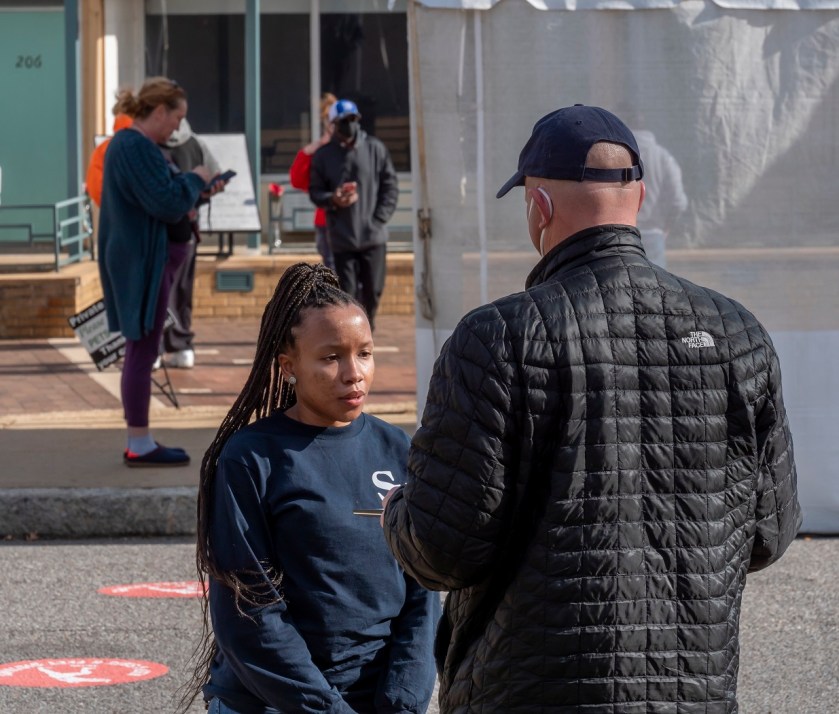
After our session, Mr. Hurt was gracious to pose with us for a quick picture before we headed to Virginia for a bite to eat before our next stop.

SHSU, LEAP Center, Center for Law Engagement And Politics, Washington DC, National League of Cities, Congressional City Conference 2020, Mt Vernon

Lunch – Bozzelli’s (ME)

Our choice of restaurant was out of this world…well, at least, the city was. The LEAPsters headed to Virginia to eat at Bozzeli’s, and with their space-themed “vibe” and motto “Make Space for Pizza”…

SHSU, LEAP Center, Center for Law Engagement And Politics, Washington DC, National League of Cities, Congressional City Conference 2020, Mt Vernon


…we were excited to try a favorite of many “since 1978.” Bozzelli’s offers a variety of pizzas, sandwiches, and salads. Esme tried the “Bizarro,” which featured meatless meatballs, vegan sausage, sun-dried tomatoes, and vegan mozzarella. Maggie and Miranda shared a “MIC MAC,” a combination of macaroni and cheese, mozzarella, and sharp cheddar, with spicy Calabria peppers – on a pizza.

SHSU, LEAP Center, Center for Law Engagement And Politics, Washington DC, National League of Cities, Congressional City Conference 2020, Mt Vernon

After carbo-loading for the afternoon, we headed to our first president’s home, Mount Vernon.

Mount Vernon (EM) 

Mount Vernon, the 18th-century estate of President George and Martha Washington, is one of the most iconic homes among all historic sites. The elegant mansion is located 13 miles south of Washington, D.C. along the Potomac River. Built by Washington’s father in 1734, Augustine Washington, the home was inherited by Washington’s half-brother, Lawrence Washington, and at that time, was known as Little Hunting Creek. Lawrence renamed the home in honor of British Admiral Edward Vernon.

SHSU, LEAP Center, Center for Law Engagement And Politics, Washington DC, National League of Cities, Congressional City Conference 2020, Mt Vernon

In 1761, George Washington moved into the home after the death of Lawrence’s widow, Ann Fairfax Washington Lee. Washington expanded the 6-bedroom, 2,000-acre estate to an exaggerating 21 bedrooms, with 8,000 acres, 4 gardens, and more than a dozen historic outbuildings. However, Washington’s time at Mount Vernon was limited due to his service in the American Revolution.

SHSU, LEAP Center, Center for Law Engagement And Politics, Washington DC, National League of Cities, Congressional City Conference 2020, Mt Vernon

For more than 200 years, visitors from all over the world have visited this historic estate. During our tour, we admired the fine furnishings and national treasures. Through the tour guides stationed in various rooms throughout the mansion, we learned interesting facts about the different rooms, their purposes, and occasionally an interesting piece of furniture or gadget from the time — Washington was a “gadget man,” according to the tour guide stationed in his office, pointing out the chair with an attached fan operated with a foot pedal.

SHSU, LEAP Center, Center for Law Engagement And Politics, Washington DC, National League of Cities, Congressional City Conference 2020, Mt Vernon

We strolled through grounds and the large gardens of trees, flowers, and plants that provided food for the mansion. It was a cold but clear day, and the crowd was light, so we were able to easily wander through and read about many of the estate’s outbuildings as well.  And, nestled at the foot of one of the gardens, and facing (what is now) a wooded area, we were able to pay our respects at the tomb holding the final resting place for both George and Martha Washington.

SHSU, LEAP Center, Center for Law Engagement And Politics, Washington DC, National League of Cities, Congressional City Conference 2020, Mt Vernon

The Mount Vernon site also boasts an education center, museum, and of course, a gift shop. In the education center, we learned several interesting facts about Washington…

https://washington.org/dc-neighborhoods/national-mall

…from his adolescence to his role as the Commander of the American Forces during the Revolutionary War…

SHSU, LEAP Center, Center for Law Engagement And Politics, Washington DC, National League of Cities, Congressional City Conference 2020, Mt Vernon

…and of course, his becoming the new country’s first president. There was also an interesting exhibit in the form of a 4-D theater, with a film focused on the Revolutionary War and Washington’s national achievements.

SHSU, LEAP Center, Center for Law Engagement And Politics, Washington DC, National League of Cities, Congressional City Conference 2020, Mt Vernon

And of course, any visitor to Mount Vernon has to get a glimpse of Washington’s dentures!

Our trip to Mount Vernon was an educational experience like no other.

SHSU, LEAP Center, Center for Law Engagement And Politics, Washington DC, National League of Cities, Congressional City Conference 2020, Mt Vernon

As the day drew to a close, we made our way back to D.C. for a fulfilling evening of our first day in the nation’s capital.

National Mall (MD) 

Despite the chilly temperature, we decided to burn off some lunch calories by walking the half-mile from our hotel to Union Station. An historic landmark, Union Station opened in 1907 and was an essential stop in the early 1940’s, a “thriving transportation hub.” In 1981, Congress passed the Union Station Redevelopment Act, preserving the history and redeveloping the transportation and railway operations. We took a quick look around the main (retail!) floor and the food court, making note of a few things to explore further, later in the trip, given time.

From Union Station, we headed towards the United States Capitol where we met 2019 SHAIP Intern and current Running Start Fellow, Annie Jamarik. Annie has spent this spring semester working in Congresswoman Kay Granger’s office through the Running Start/Walmart Star Congressional Fellowship program.

After a significant number of pictures and selfies outside of the Capitol…

SHSU, LEAP Center, Center for Law Engagement And Politics, Washington DC, National League of Cities, Congressional City Conference 2020, Mt Vernon

…we wandered west of the Capitol and across the National Mall to see what we could see…from checking out the location and perspective of Presidential Inaugurations that JF/LEAPsters have had the opportunity to attend, to traversing the (now empty!) Capitol Reflecting Pool, to identifying artists’ works “through the bars” of the then-closed National Gallery of Art – Sculpture Garden. (More on this later, too – although it was rewarding to recognize a number of artists!)

The National Mall stretches over two miles from the US Capitol to Lincoln Memorial. We knew we would not make it through the entire Mall, but we wanted to get started. Our morning cab driver told us the best time to see the Mall was at night, and that advice did not fail.  We were drawn to Washington Memorial, a true beacon in the midst of the Mall, passing and taking note of the many Smithsonian galleries and museums and other stops still on our itinerary, and (finally!) we arrived! Lit up in the dark sky and surrounded by American flags fluttering in the cool breeze, the Monument astounded us. Along with many other DC sightings, LEAP Ambassador Miranda Estrada was momentarily speechless upon arrival. (But just momentarily!)

Dinner – District Taco (MD)

After another round of pictures and selfies, we trekked our way back across the Mall in search of a place to eat. District Taco, an Atlantic coast chain of about 13 restaurants featuring Yucatan-style (fast food) cuisine, was not only close enough to walk to, but also received a positive recommendation from Annie who, of course, would recommend fast food.

https://www.districttaco.com/

Over a quick dinner, we caught up with Annie about her Running Start fellowship and responsibilities as a Congressional Intern before parting ways for the evening.  It was nice to catch up, and nice to get the up close and personal perspective!

SHSU, LEAP Center, Center for Law Engagement And Politics, Washington DC, National League of Cities, Congressional City Conference 2020, Mt Vernon

Unknown's avatarAuthor mikeyawnPosted on August 4, 2020Format AsideCategories Art, Civic Engagement, Food, Politics, TravelTags Center for Law Engagement And Politics, Congressional City Conference 2020, LEAP Center, Mt Vernon, National League of Cities, SHSU, Washington DCLeave a comment on Washington, DC: Day 1

Celebrating Civil Rights: The Americans With Disabilities Act at 30

Thirty years ago, President Bush signed the Americans with Disabilities Act into law.  In the speech announcing the enactment, President Bush noted that “We will not accept…discrimination in America” and his desire to  “take a sledgehammer to another wall,” effectively equating this legislation to the end of Communism as a marker for freedom.

SHSU, LEAP Center, Center for Law Engagement And Politics, Americans with Disabilities Act, President George H. W. Bush, Bush School at TAMU

Surrounded by disabled Americans who had worked on the legislation, President Bush empathized: “prejudices,” he noted, “separated Americans from a freedom they could glimpse but could not grasp.”  He closed by exhorting businesses to help make this a success by complying with the law and its requirements, and encouraged all Americans to help ensure that the “shameful wall of exclusion” will “come tumbling down.”

That was 30 years, but near the anniversary of the signing (which was on July 26, 1990), the Bush School at TAMU brought in PBS News Hour journalist Judy Woodruff to moderate a great panel–all of whom had something to do with the Act’s passage.

Indeed, the Bush School thought this so momentous an occasion that they invited President Obama to introduce the event…

SHSU, LEAP Center, Center for Law Engagement And Politics, Americans with Disabilities Act, President George H. W. Bush, Bush School at TAMU

…because the first section addressed a new documentary–produced by the Obamas–called “Crip Camp,” about one of the few places in the 1960s-1970s that allowed the disabled freedom to be who they were and participate in what most Americans consider everyday things.

SHSU, LEAP Center, Center for Law Engagement And Politics, Americans with Disabilities Act, President George H. W. Bush, Bush School at TAMU

The co-directors, Jim Lebrecht (who attended the camp) and Nicole Newnham…

https://www.imdb.com/title/tt8923484/?ref_=fn_al_tt_1

…were on hand to discuss it.  You can learn more about the film here, and you can watch it here.

Woodruff then brought in one of the Senate heroes of the bill: Senator Bob Dole, who had just celebrated his 97th birthday.

SHSU, LEAP Center, Center for Law Engagement And Politics, Americans with Disabilities Act, President George H. W. Bush, Bush School at TAMU

Dole is now in a wheelchair, but his disabilities stem back some 80 years, when he was in World War II.  He was shot by a machine gun, which hit his shoulder and right arm. Soldiers who found him expected him to die, but they administered morphine and, using Dole’s blood as ink, wrote “M” on his forehead, so that in the event he was found by medics, they would not administer a second (and potentially fatal) dose of the medicine.

Dole survived, but barely.  He was in a body cast for 9 months, paralyzed from the waist down.  When he got out of his cast, the 6′ 3″ former athlete weighed 110 pounds.  He would recover movement in his lower body, but the right side of his body would be partially immobilized for the rest of his life.

Dole said a few words, and then turned over the discussion to Carolyn Osolinik (former Chief Counsel for Senator Ted Kennedy) and Audrey Coleman (archivist at Robert J. Dole Institute of Politics) who discussed the strategies of getting the bill through the US Senate.  Osolonik called the bill a “sea change,” and emphasized that the bill was about “empowerment.”  It was not a bill to give away things; it was a bill to remove barriers so they could achieve what they were capable of.  Senator Kennedy called it the “emancipation proclamation for people with disabilities.”

SHSU, LEAP Center, Center for Law Engagement And Politics, Americans with Disabilities Act, President George H. W. Bush, Bush School at TAMU

Kennedy’s Counsel: “sea change” “empowerment.”  Kennedy called it “emancipation proclamation for people with disabilities”

Serving his first time in the US Senate during this time was Tom Harkin, the Chair of the Senate Policy Committee, who ultimately introduced the bill on the Senate floor.  For part of the introduction, he introduced the bill in sign language so that his brother, who is deaf, could follow along.  Harkin joined the panel to discuss his recollections…

SHSU, LEAP Center, Center for Law Engagement And Politics, Americans with Disabilities Act, President George H. W. Bush, Bush School at TAMU

…noting that the bill had four main goals:

    • Full participation of disabled in US society;
    • Equal opportunity;
    • Independent living;
    • Economic self sufficiency.

Harkin noted that the bill was ambitious: “we wanted these things to be the norm, the baseline, not an aspiration.”  To this end, he noted, “President Bush never wavered.  He stood behind the bill from the very beginning.”

Tony Coehlo, who helped engineer the bill’s passage in the House, was also on hand.

SHSU, LEAP Center, Center for Law Engagement And Politics, Americans with Disabilities Act, President George H. W. Bush, Bush School at TAMU

The bill encountered much more resistance in the House, where it was actually assigned to five different committees (typically a delaying tactic by leadership).  The bill did not lack support from rank-and-file members–it would eventually pass with 252 sponsors, but in the legislature, leadership is crucial, and without that support, passage was delayed.

One way to break through legislative logjams is through White House support, so Woodruff invited C. Boyden Gray (White House Consel), Lex Frieden (a disabled activist), and John Sonunu (White House Chief of Staff) to the show to discuss these efforts.

SHSU, LEAP Center, Center for Law Engagement And Politics, Americans with Disabilities Act, President George H. W. Bush, Bush School at TAMU

Frieden, interestingly, was scheduled to meet with President Ronald Reagan in 1986, to provide a recommendation of a bill such as ADA.  That day, however, the Space Shuttle Challenger exploded on liftoff, and the meeting was “rerouted” to the Vice President.  While this was no doubt disappointing to Frieden and the other activists on hand, it turned out to be fortuitous.  Vice-President Bush discussed his sympathies with the bill’s sentiment, and he said he thought the bill could become the “voice for 36 million Americans.” When he became President two years later, the passage of the bill became a potential reality.   And a year and a half after he became President, the bill was signed into law.

SHSU, LEAP Center, Center for Law Engagement And Politics, Americans with Disabilities Act, President George H. W. Bush, Bush School at TAMU

This bill was different than other civil rights legislation in that it imposed proactive requirements on businesses, governments, and non-profits.  It was seeking simply to remove impediments; it was requiring bearing actual costs: building ramps, adding elevators, reconfiguring buildings.  In some cases these costs were enormously expensive, and it took much political will to convince people that it was the correct thing to do.

Of course, the bill’s passage has not ended the barriers that the disabled face.  To discuss these challenges, Woodruff invited former Governor Tom Ridge (he also served as Director of Homeland Security) to discuss his role as Chair of the National Organization on Disability.

SHSU, LEAP Center, Center for Law Engagement And Politics, Americans with Disabilities Act, President George H. W. Bush, Bush School at TAMU

He was joined by Carol Glazer (President, National Organization on Disability), who argued that the most progress has been made in physical accessibility, symbolic areas (as more people with disabilities achieve positions of prominence), but, as expected, fighting people’s prejudices is the most difficult aspect of achieving progress.  The work ahead, she noted, will deal with fighting the “stigma” of disabilities, the “locked-in stereotypes,” and the “tyranny of low expectations.”

With Glazer and Ridge were William “Tipper” Thomas, an engineer, and actor Danny Woodburn.  Thomas was “4 or 5” when this passed, but in his senior year in high school, he was the innocent victim of a shooting, one which ended his football career and relegated him to a wheelchair.  He is now the principal engineer for Northrop Gruman Corporation.

SHSU, LEAP Center, Center for Law Engagement And Politics, Americans with Disabilities Act, President George H. W. Bush, Bush School at TAMU

Danny Woodburn is a little person and an actor (IMDB here), with, as he describes it, “strikingly good looks.”  When he was born, his doctor told his parents: “You’re son is a midget, like what you see in a circus.”  Woodburn noted much progress, but also said that there is little engagement with the disabled in civil rights conversations, noting that he’s often told, “We’re going to focus on cultural or racial diversity.”

Jack Chen (Product Counsel for Google) and Moeena Das (Chie of Staff, National Organization on Disability) also discussed their experiences navigating the still-difficult post-ADA waters.

SHSU, LEAP Center, Center for Law Engagement And Politics, Americans with Disabilities Act, President George H. W. Bush, Bush School at TAMU

Chen, for example, noted that while he works in the field of technology, which can make things better for people, it can also exacerbate inequalities, something most people don’t consider.

To conclude the program, Judy Woodruff invited former President George W. Bush on.  This, too, was fitting, because in the early 2000s, the Supreme Court ruled against some of the requirements of the ADA, and the way to help the law fulfill its original objectives was to amend the legislation in a manner that met Court scrutiny.  President Bush signed those amendments into law, with his dad (far left) looking on…

SHSU, LEAP Center, Center for Law Engagement And Politics, Americans with Disabilities Act, President George H. W. Bush, Bush School at TAMU

George W. Bush said that he believed the bill was what his father was most proud of accomplishing, and described his father as a “man of enormous compassion, who cared about all people, and the ADA reflected that spirit.”

SHSU, LEAP Center, Center for Law Engagement And Politics, Americans with Disabilities Act, President George H. W. Bush, Bush School at TAMU

By the end of his life, President George H. W. Bush was also disabled.  Parkinsons disease had attacked his body, and he began using a walker and then a wheelchair.  But that didn’t stop him from parachuting out of a helicopter at the age of 90!

SHSU, LEAP Center, Center for Law Engagement And Politics, Americans with Disabilities Act, President George H. W. Bush, Bush School at TAMU


Also of note, Director of the Bush Foundation, Andy Card…

SHSU, LEAP Center, Center for Law Engagement And Politics, Americans with Disabilities Act, President George H. W. Bush, Bush School at TAMU

…came on to note that, with the help of Lex Frieden (which he called the “conscious” of the ADA), they would be issuing  a new Bush Medal to “those making a difference to the disability community.”

SHSU, LEAP Center, Center for Law Engagement And Politics, Americans with Disabilities Act, President George H. W. Bush, Bush School at TAMU

In the midst of coronavirus and civil unrest, which in many ways have hit the disabled community the hardest, this program on the ADA and the progress made was a welcome reflection.

SHSU, LEAP Center, Center for Law Engagement And Politics, Americans with Disabilities Act, President George H. W. Bush, Bush School at TAMU

Many thanks to the Bush School at TAMU for the opportunity to experience these programs.  You can see this event in its entirety here.


Unknown's avatarAuthor mikeyawnPosted on July 30, 2020Format AsideCategories Civic Engagement, Civil Rights, Law, PoliticsTags Americans with Disabilities Act, Bush School at TAMU, Center for Law Engagement And Politics, LEAP Center, President George H. W. Bush, SHSULeave a comment on Celebrating Civil Rights: The Americans With Disabilities Act at 30

Pandemics in 2020: A Discussion from the Scowcroft Institute

Each year, the Scowcroft Institute the Bush School hosts a summit on pandemics, which brings together experts who discuss the biggest challenges to successful responses to pandemics.

SHSU, LEAP Center, Center for Law Engagement And Politics, Bush School at Texas A&M University, Scowcroft Institute, Dr. Christi Blackburn, Dr. Gerald Parker, Professor Andrew Natsios, Dr. Oyewale Tomori, Pandemics

And each year, they prepare a white paper summarizing and extending the discussions at the summit.  This year, they marked the release of the White Paper with a FB Live event featuring Dr. Oyewale Tomoroi (Senior Fellow at Scowcroft Institute and Professor of Virology in Nigeria); Dr. Gerald Parker (Director for the Pandemic and Biosecurity Policy Programs at the Scowcroft Institute and administrator in many government divisions, including the Department of Homeland Security and Health and Human Services), Andrew Natsios (Executive Professor at the Scowcroft Institute; and manager of reconstruction programs in Afghanistan, Iraq, and Sudan); and moderated by Christi Blackburn (Deputy Director of the Scowcroft Institute’s Pandemic and Biosecurity Policy Program).

After introducing the guests, Dr. Blackburn…

SHSU, LEAP Center, Center for Law Engagement And Politics, Bush School at Texas A&M University, Scowcroft Institute, Dr. Christi Blackburn, Dr. Gerald Parker, Professor Andrew Natsios, Dr. Oyewale Tomori, Pandemics

…posed a number of questions to the panelists.  Dr. Tomori led off, noting the importance of responding to pandemics with speed and quality information and resources, and that this is especially true in remote areas, where resources may be scarce.

Dr. Parker then tackled the thorny problem of vaccinations.  He emphasized the importance of having development and dissemination plans.  While there has been much discussion of a vaccination for COVID, vaccinations are not typically easy to develop, nor are they often developed quickly (although not discussed here, I have read that the shortest time in history for the development of a vaccine is four years).

SHSU, LEAP Center, Center for Law Engagement And Politics, Bush School at Texas A&M University, Scowcroft Institute, Dr. Christi Blackburn, Dr. Gerald Parker, Professor Andrew Natsios, Dr. Oyewale Tomori, Pandemics

The keys are: (1) developing sufficient supplies, suppliers, and training to ground-level forces, and (2) distribution, which is the most difficult (“the final mile is the hardest”).  In the latter phase, Parker emphasized that vaccines are distributed all at once.  Vaccines have to be developed, and the supplies take time to get to everyone, so who gets the vaccine first?  Parker suggests, of course, health care workers, but a whole prioritization list needs to be developed for the entire rollout.  Also key is a plan by developed countries to get the vaccine to less wealthy countries, something that is both logistically difficult and sometimes politically fraught.

Professor Natsios elaborated on this with some interesting facts. First, he noted that the Russians were active on social media, using bots to spread messages both pro and con for vaccinations.  They know that, in a democracy, if you can confuse people to what the truth is, you can thrown democratic processes into confusion.  Further, polls show that approximately 30-50 percent of Americans indicate they are hesitant to avail themselves of a COVID vaccination.

The solution, according to Natsios, is to work with local leaders–religious, community, medical, even sports–and do publicity campaigns for vaccinations.

SHSU, LEAP Center, Center for Law Engagement And Politics, Bush School at Texas A&M University, Scowcroft Institute, Dr. Christi Blackburn, Dr. Gerald Parker, Professor Andrew Natsios, Dr. Oyewale Tomori, Pandemics

Dr. Blackburn switched topics, going to how to develop effective early warning systems in pandemics.  Natsios, who had extensive experience with detecting and responding to famines from his government days, also fielded this topic.

Noting that satellite photos could determine crop health and allow advance warnings for famines, Natsios pointed out that the same tools can be used for pandemics.  In a fascinating discussion, he pointed out that satellite photos of Wuhan, China from August of last year show increased vehicular ( (a measure that includes bicycles) occupancy in China hospitals.  Intelligence agencies have complemented this with social media content analysis, which shows a significant uptick in questions about symptoms–symptoms correlating strongly with those produced by COVID–at the same time.  The conclusion, of course, is that COVID was probably hitting Wuhan in August of last year, before the world–and probably even China–knew about it.  These remote sensing tools (which include monitor of cemetery and crematoria activity) can be useful in detecting pandemics early.

Natsios concluded by emphasizing the importance of early detection, noting that if the pandemic is caught in time, its contagion can be extraordinarily curtailed.

Dr. Blackburn then fielded questions from the audience, which included:

    • Is there a single agency in charge of biosecurity?
      • No, although one is desperately needed.  Both Parker and Natsios agreed that, unless a directive was sent straight from the White House, most agencies wouldn’t implement with the efficiency needed, often because of interdepartmental conflicts.  The discussion of interdepartmental conflicts–conflicts which apparently included Parker and Natsios while they were in different departments, let to some humorous recollections.SHSU, LEAP Center, Center for Law Engagement And Politics, Bush School at Texas A&M University, Scowcroft Institute, Dr. Christi Blackburn, Dr. Gerald Parker, Professor Andrew Natsios, Dr. Oyewale Tomori, Pandemics
    • How do we balance Technology and Privacy?
      • Although this wasn’t answered directly, the information provided was interesting.  Natsios noted that Germany had very good privacy laws, but shifted topics somewhat by noting that the US had a “frontier mentality,” which affected its balancing of individual vs. collective rights.  Because of this “frontier mentality,” many argue that the government has no right to ask them to wear a mask–a belief contradicted by court rulings dating back to at least 1820.
    • How do we deal with unknown pandemics?
      • All agreed that all pandemics are unknown–even if they come from known diseases, they are often a mutated or novel version.  The panel agreed on increased spending, and, perhaps befitting employees of Texas A&M, home of one of the best Veterinary Schools in the US–suggested the importance of studying zoonotic diseases.  Natsios noted that 70 percent of the new diseases in the past 40 years have come from animals, with HIV being, obviously, the most notable example.

This fascinating and timely discussion can be viewed here in its entirety and the white paper can be found here.  Thanks again to the Bush School for its wonderful programming!


Unknown's avatarAuthor mikeyawnPosted on July 26, 2020Format AsideCategories Civic Engagement, Health, PoliticsTags Bush School at Texas A&M University, Center for Law Engagement And Politics, Dr. Christi Blackburn, Dr. Gerald Parker, Dr. Oyewale Tomori, LEAP Center, Pandemics, Professor Andrew Natsios, Scowcroft Institute, SHSULeave a comment on Pandemics in 2020: A Discussion from the Scowcroft Institute

An Introduction to The World, with Richard Haass and the World Affairs Council

One of our favorite activities is to be part of a World Affairs Council event, and thanks to the magic of Zoom, we can continue our participation in the age of COVID.

This program was particularly special, as it featured Richard Haass, whose unparalleled career has included stints at the Department of Defense, Department of State, National Security Council, Council of Foreign Relations, Harvard’s Kennedy School of Government, Brookings Institute, and is a recipient of the Presidents Citizens Medal.  He is widely regarded as one of the most knowledgeable public figures on foreign policy.

SHSU, LEAP Center, Center for Law Engagement And Politics, World Affairs Council Houston, WAC Houston, Richard Haass

Accordingly, Haass set out to write an accessible book about international affairs and foreign policy.  Ronan O’Malley, Program Director at WAC, moderated the discussion with Haass and focused on the ideas in The World: A Brief Introduction.

The book begins with the year 1648 and the Peace of Westphalia, which established the idea that countries are sovereign and control affairs within their borders.  This, Haass believes, helps us understand the modern nation state, while also being aware of how some things have changed.  In an era of globalization, what happens within a country’s borders can have global consequences–whether it be the destruction of Brazil’s rainforests, the rise of militant and terrorist organizations such as the Taliban, or the spread of a virus.  While they may begin within a country’s sovereign borders, they are likely to have world-wise ramifications.

SHSU, LEAP Center, Center for Law Engagement And Politics, World Affairs Council Houston, WAC Houston, Richard Haass

Haass sets out to establish a framework in which we can maintain the positive aspects of sovereignty, without allowing a country’s sovereign actions to encroach negatively on another country’s sovereignty.

The author was motivated, in part, by a world he saw becoming increasingly in disarray, largely a result of the United States’ lack of engagement with the world, a phenomenon he refers to as “American Abdication.”  Noting that President Obama began “pulling back” in mid 2010s, President Trump has taken disengagement even further.

Haass argues what might seem obvious: (1) the World matters, and (2) Isolation is not a workable response.

SHSU, LEAP Center, Center for Law Engagement And Politics, World Affairs Council Houston, WAC Houston, Richard Haass

While engagement is appropriate, Haass also notes that the solution is not an over reliance on presidential personality.  Haass noted that “there’s a long history” of presidential hubris, from FDR believing he understood Stalin and his goals, President George W. Bush saying he looked “into Putin’s soul,” and Trump taking things into a whole new level with his association with autocrats.  The key, he argues, is to have workable coalitions and structural frameworks that allow for long-term solutions and equilibria.

O’Malley also conveyed a series of questions from the audience:

    • What to do about NATO?  Keep it, strengthen it, but don’t enlarge it;
    • Nuclear proliferation? We have a new arms race with the Russians, we have lost hope of containing North Korea’s nuclear development, but we may still be able to work with Iran on limiting what they have done;
    • Globalization and Trade: He’s for fair trade, which in his eyes, means being less concerned with trade imbalance and more about not manipulating currencies, removing tariffs.  Further, he argues that job losses are not from trade agreements, but from increases in productivity in the US, mostly having to do with robotics, computers, and artificial intelligence.  Haass believes that these trends will accelerate with COVID-19, and argues that the US needs to begin an aggressive retraining program.
    • Chinese and Russian Disinformation Campaigns: Haass argues that China’s disinformation isn’t that effective, but that Russia’s program is more developed and has had a greater impact, arguing that Russia is seeking to “change the context in which the UY

SHSU, LEAP Center, Center for Law Engagement And Politics, World Affairs Council Houston, WAC Houston, Richard Haass

O’Malley ended with a political question, asking Haass if he had thoughts about Biden’s Vice-Presidential selection.  Haass noted that Biden had already committed to picking a woman, and that there are “many qualified women to choose from.”  He argued that Biden will likely use three criteria: (1) Who would make a good president? (2) Who can he partner with to run the government? (3) And who will help him get elected?  Haass also noted the importance of the pick–although he did not broach Biden’s age–by noting that the Vice-Presidency has grown in importance since the 1990s.


SHSU, LEAP Center, Center for Law Engagement And Politics, World Affairs Council Houston, WAC Houston, Richard Haass

It was another great program by the World Affairs Council, and, indeed, a great introduction to “The World.”

Unknown's avatarAuthor mikeyawnPosted on July 21, 2020Format AsideCategories Civic Engagement, PoliticsTags Center for Law Engagement And Politics, LEAP Center, Richard Haass, SHSU, The World: An Introduction, WAC Houston, World Affairs Council HoustonLeave a comment on An Introduction to The World, with Richard Haass and the World Affairs Council

Posts pagination

Previous page Page 1 … Page 83 Page 84 Page 85 … Page 164 Next page

LEAP Ambassadors Are Involved!

This slideshow requires JavaScript.

Follow Us On Facebook!

Follow Us On Facebook!

Catch Up With Us

  • A Culinary Education: Champion Chili January 11, 2026
  • A M*A*S*H* Wrapup December 24, 2025
  • Understanding Globalization: Lessons from a Leading Journalist December 22, 2025
  • Crafting for a Cause December 18, 2025
  • Exploring The Shining: A Kubrickian Journey December 15, 2025

Join The Conversation!

The Civic Leadership… on Foundational Activities of the…
The Civic Leadership… on The Philosophical Foundations…
LEAPing Into Action… on The Philosophical Foundations…
Jada Cook's avatarJada Cook on SHSU Students LEAP Across Five…
Reflections from the… on Kicking off the Semester Right…

Find Previous Posts

We also have Twitter!

My Tweets

LEAPing Into LEARNing

This slideshow requires JavaScript.

  • About LEAP
  • LEAP Ambassadors
Center for Law, Engagement, and Politics Blog at WordPress.com.
  • Subscribe Subscribed
    • Center for Law, Engagement, and Politics
    • Join 487 other subscribers
    • Already have a WordPress.com account? Log in now.
    • Center for Law, Engagement, and Politics
    • Subscribe Subscribed
    • Sign up
    • Log in
    • Report this content
    • View site in Reader
    • Manage subscriptions
    • Collapse this bar
 

Loading Comments...