NLC Conference: Opening General Session (EM)
Kathy Maness, first vice president for National League of Cities and current council member for Lexington, South Carolina, welcomed us to the 55th annual National League of Cities (NLC) Congressional Cities Conference, accompanied by singing of the national anthem and the presentation of the colors by students from St. John’s College High School. She touched on the 2020 census, concerns about the coronavirus, federal authorities’ involvement in local government, and the importance of development and infrastructure at the local level.

Like many speakers during the opening session, Maness expressed the impact and importance of local government in our country.
Following Maness, Bryan Barnett, President of the United States Conference of Mayors (USCM) and Mayor of Rochester Hills, Michigan, took the stage. Barnett spoke on the lack of trust between constituents and federal governmental agencies, claiming that the federal level of mistrust is much higher than at the local level.

Instead, he stated that local and federal governments need strength and trust to achieve goals, over any partisanship.
Next up, Joe Buscaino, NLC President and Los Angeles District 15 Councilmember, came to the stage to much applause.

Buscaino, a 15-year veteran of the Los Angeles Police Department, led his talk with his role in creating in 2011 LAPD’s Teen Community Police Advisory Board, an entity that provides teens the opportunity to resolve issues between teens and police.
Buscaino was a favorite speaker amongst the group for the day!

Similar to Barnett, Buscaino brimmed with passion about partnerships to help obtain grants and resources from the federal government, frequently citing the motto “Lead with urgency.” He encouraged the officials present to lead to building sustainable infrastructure, to creating a skilled workforce, and to ending homelessness – the NLC’s current priorities. He continued to express the importance of strengthening leadership through knowledge and building local innovation, with a bent toward preventing unemployment.
Then he went off script (he announced he was doing so). His presentation took on a visible emotional change when he brought up on stage Brent Jaramillo, NLC Board of Director member and Councilmember from Questa, New Mexico. He unveiled Jaramillo’s dedication to NLC despite battling cancer, and that Jaramillo recently had found out he was cancer-free.

Two brief presentations then followed: one by Peter Wright, Assistant Administrator for the United States Environmental Protection Agency (EPA), who spoke on the EPA’s plans to prevent a water crisis and recent changes in recycling; and then a short welcome from the Mayor of Washington, D.C., Muriel Bowser who invited and encouraged us to visit our historical and beautiful capital.

The opening session’s keynote speaker finally took the stage. Former Speaker of the House, Paul Ryan, held a moderated conversation with NLC’s Executive Director and CEO, Clarence Anthony.

Anthony introduced the former Speaker, citing programs that made an impact while he served that role: reforming taxes, rebuilding our national defense system, addressing the opioid crisis, reforming the criminal justice system, and promoting economic opportunity. Ryan spoke briefly of his mentor, Jack Kemp, former Secretary of Housing and Urban Development (HUD), and the major influences that shepherded Ryan into politics. He answered a number of questions about local governments’ involvement with the federal government, among other topics, but keeping to the ideal of a pay for performance model, in which local governments develop a proven structure before seeking funding.
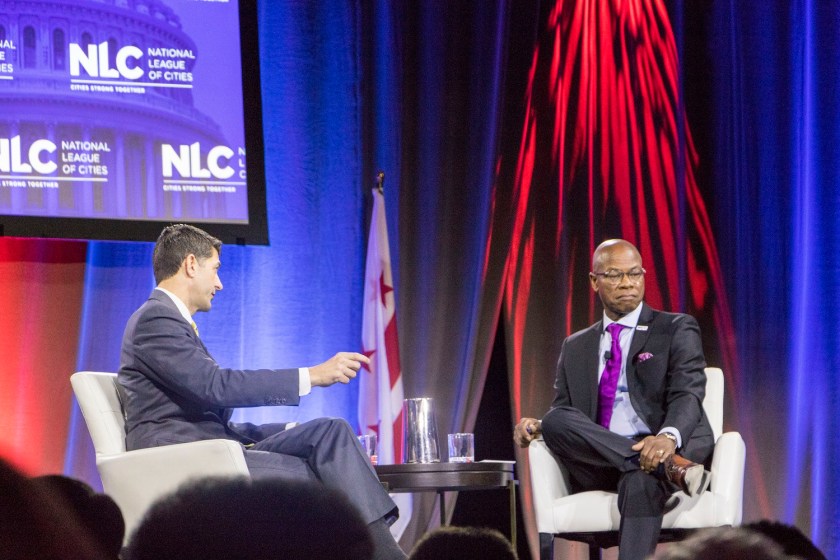
It was a great opening session! But, it was time for us to move to the second session for the day…
NLC Conference: Practical Tools for Fighting Preemption (ME) [https://ccc.nlc.org/seminar/practical-tools-for-fighting-preemption/]
One of our first sessions tackled an issue local governments everywhere face: preemption. While preemption is a neutral, legal tool, and it can be used for both “good” and “bad” reasons, recently, state and federal legislators and policymakers practicing preemption have caused major restrictions on local entities. While no one agency is inherently the “bad guy,” the three levels of government must work together to put citizens’ and community residents’ needs first. Local government officials are the most trusted of government officials; their citizens rely heavily on them and need to know that their (the citizens’) interests are a priority.

Several panelists spoke of the impact of preemption in their cities. Most of these issues primarily affect lower classes, with some of the preemption policies put in place make it nearly impossible to improve living conditions for a large amount of residents. Mayor of Chattanooga, Tennessee, Andy Berke spoke on the issues of installing broadband and/or raising the minimum wage.

Kim Haddow explained that hundreds of communities are facing a power struggle between the state and local governments. Along with NLC researcher Dr. Christy McFarland, Haddow has suggested updates to “home rule” municipalities. They created the project to help cities and especially to comply with heavily populated cities.

NLC Conference: Investing in a Skilled Workforce: WIOA Reauthorization (SF) [https://ccc.nlc.org/seminar/investing-in-a-skilled-workforce-wioa-reauthorization/]
This panel, moderated by Katie Spiker, Director of Government Affairs for the National Skills Coalition, focused on training or learning on the job, a current hot topic, and any effects, if any, that could be ascertained about the (recent) Workforce Innovation and Opportunity Act (“WIOA”).

Passed in 2014, final regulations were not developed until 2016, so implementation was truly not effective until 2017. Given the long timeframe from passing to implementation, and turnover in Congress, one ongoing challenge has been to educate the original intent of the legislation.
Of the three speakers on this panel, who each were well-spoken and notably passionate about their work and their roles in promoting technical skills trades, on-the-job-training and a host of other options (“college is not for everyone and everyone is not for college”), the most passionate was an elected official who was actually a substitute for the initial speaker.
Mayor Lioneld Jordan of Fayetteville, AR (so this was an extra surprise, as former LEAP “friend of” Ryan Brim attends the University of Arkansas and works for the City of Fayetteville), spoke most passionately about what the City is doing to promote skills training programs in Fayetteville, a major city in northwest Arkansas. He cited his own background, which made him the perfect spokesperson for this topic—with no finances for college, Jordan attended an apprentice program at UA, accrued 1400 hours of OTJ training, and after four years, was given a certificate to operate as a licensed journeyman carpenter. He ran for office in 2000, and has since become Fayetteville’s first-ever three-time mayor.

So what is Fayetteville doing? Apparently, a lot. The audience of elected officials clapped numerous times as he explained they passed a $226M bond in 2019, with $1.5M dedicated to workforce training. With a low unemployment rate (only 2.6%), Fayetteville has recognized a serious problem with having a high (18-20%) poverty rate. He stated that these funds are going to help pay for skilled trades and technology jobs, in “getting back to the basics”; that it should help those who can’t otherwise obtain funding for trades schools (as it isn’t as easy as for attending college). He received hearty applause for stating, “You have to give people hope for their future – and start where they are. Not everyone is going to college, folks, but everyone needs to be able to earn a wage.”
Main points made by the two other speakers included:
- The State of New York is trying to align economic and workforce development – ensuring that the law remains local (that local agencies know what to do and have local flexibility and responsibility), especially in the light of the vast majority of jobs being created in NY start at less than $32K; and
- Northern Virginia Community College has been successful at creating programs that allow for a lot of “transfer” in or credit for certificate programs by forming partnerships with companies and remaining highly flexible (quoting multiple changes per year to the program, a pace relatively unheard of in higher education).
Naanwise (ME) [https://www.naanwise.com/]
With a short break for lunch, we headed to Naanwise, to have some traditional Indian dishes. As we walked in, the aroma of spices and fresh baked pita greeted us. For lunch, Maggie and Stephanie opted for the bountiful buffet; Esme was daring and tried the hottest dish – the chicken vindaloo with potatoes in a thick tangy gravy; and Miranda stuck to her all-time favorite – Chicken Korma. We also enjoyed three different types of Naan (original, garlic, & cheese) with our entrees.
This slideshow requires JavaScript.
Stuffed, we trudged back up the hill to the conference.
NLC Conference: Legal Updates: How Action from the Supreme Court and Lower Courts Impact Cities (MD)
Lisa Soronen led this presentation. As Executive Director of the State and Local Legal Center, her primary roles is to file amicus curiae briefs to the Supreme Court on behalf of the “Big Seven” (National Governors Association, National Conference of State Legislatures, Council of State Governments, National League of Cities, United States Conference of Mayors, National Association of Counties, and International City/County Management Association).

She started with an introduction to the Supreme Court Justices and their role and tenure on the Supreme Court, going into detail on the significant leadership role played by the Chief Justice (John Roberts, since September 2005). According to Soronen, 50% of cases heard by the Supreme Court are unanimous, while 20% of cases garner a 5-4 vote. It was clear that Soronen had spent time researching chief justices’ voting history and habits. I enjoyed hearing about partisan habits of chief justices as well as interpretation techniques admirable in a chief justice. As Soronen described, a perfect chief justice is “pragmatic, moderate, and conservative.”
Se dedicated the second part of the session to an overview of previous and current legislation brought before the Supreme Court where results have had an impact on local and state municipalities. These topics ranged from controversial issues like abortion, to complicated issues like the relationship between social media and elected officials, to the Clean Water Act and other environmental legislation. The Supreme Court can closely–and quickly–affect our local government and government leaders.
NLC Conference: University Communities Council Meeting (ME)
Our last session of the day focused directly on communities home to small and large universities, just like our Huntsville. The council meeting featured updates and notices on upcoming events from several Board of Directors and the International Town and Gown Association.

With the 2020 election fast approaching along with the start of Census 2020, the Chair invited NLC Fellow Gianna Judkins to speak about her initiative, Cities Vote, which engages cities to encourage voter turnout among college students. The Cities Vote program tackles issues like voter accessibility with transportation to polls and encouraging voting for local elections.
Then, Amy Cohen, Executive Director of the Honey W. Nashman Center for Civic Engagement and Public Service at George Washington University, spoke about her work engaging student voter turnout that involved educating students on not only candidates but also how to use the US Postal System, a challenge for the Millennials, and now especially the Generation Z-ers.
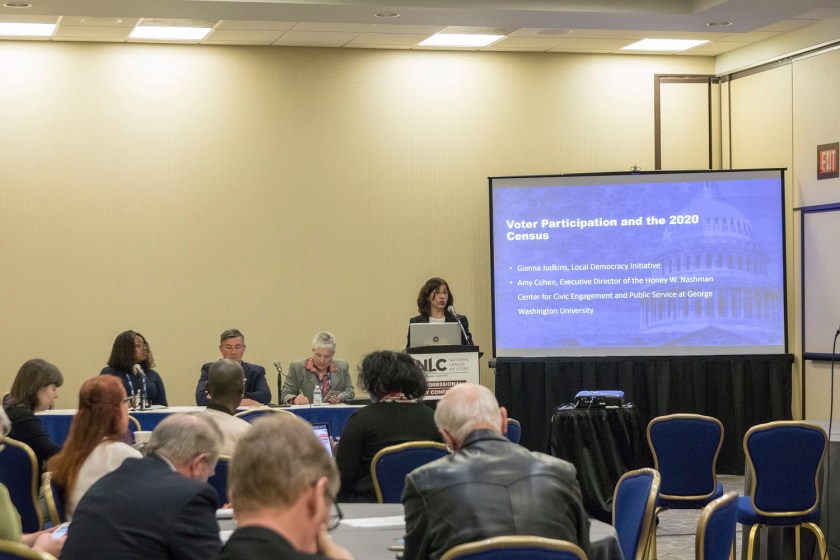
We learned more about several other programs: Turbo Votes, used to identify areas that need the most help; NLC’s progress on advocating for the Leading Together plan; and Moving Together, a program for advocating for infrastructure improvement support in the form of grants for smaller cities.
Several officials spoke passionately on a major topic affecting university cities, the rise of short-term rentals (aka STRs), when single-family homes are turned into rental units, such as through Air-BNB. STRs are usually not profitable for cities because occupants do not pay hotel occupancy taxes, nor do they usually have to pass the city inspections that hotels do. STRs can also cause a strain to the housing market, but cities are also facing preemption from the state level about banning these kinds of arrangements. Different cities cited using a variety of methods including requiring permits, but many cities lack the resources to tackle this growing issue effectively.
Following these sessions, on our way to the Metro, we discussed what we learned and whether or not the City of Huntsville could/should expect to see soon these issues that other communities are facing.
Smithsonian – National Portrait Gallery (EM) [https://npg.si.edu/home/national-portrait-gallery%5D
After today’s conference, we were off to the National Portrait Gallery, housed in the Smithsonian American Art Museum. We had a goal to recognize our favorite artist works, with a list to work from…

The Museum is one of the largest collections of American art! From Folk Art to Modernism and America’s Presidents, the museum offers an array of exhibits that highlights great American art, with an obvious emphasis on portraiture. Even so, there was great diversity throughout the museum—different forms of art through various periods of time, and different styles–from Impressionism to Modern and more, each that gave us a better sense of art history.
After quizzing each other on the different artists throughout the various exhibits, we were able to locate several familiar artists’ works throughout the Museum: Claes Oldenburg, Chuck Close…

…Thomas Hart Benton, Georgia O’Keeffe…

Alexander Calder, and James Surls (from SHSU)….

…to name a few.
We saw work by Kehinde Wiley (famous for doing President Obama’s questionable portrait)…

…as well as work by one of our favorites: Deborah Butterfield.

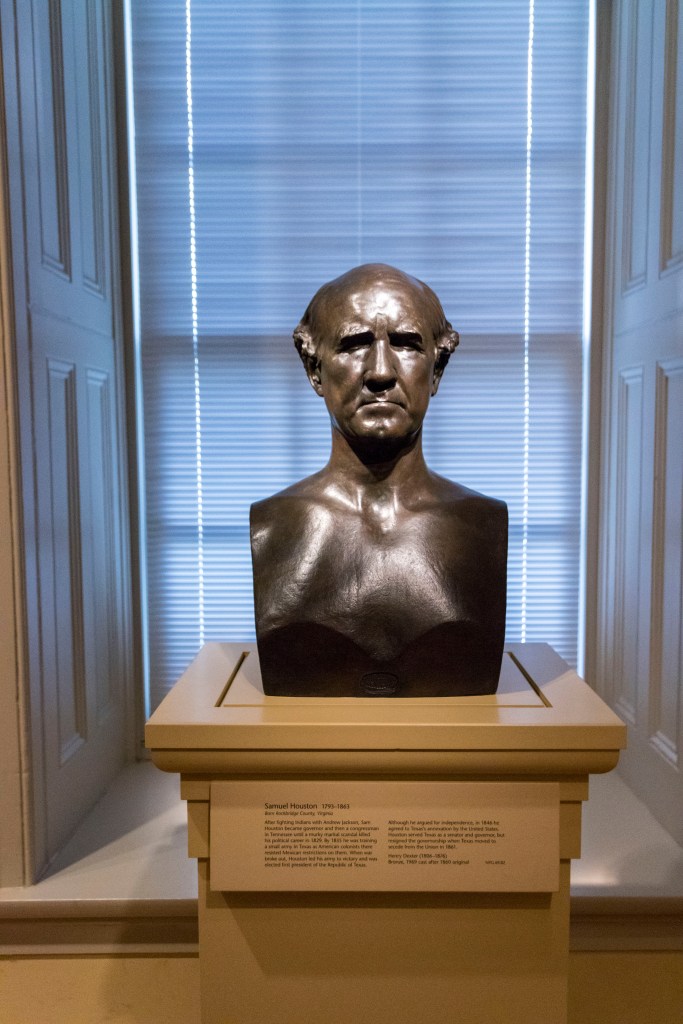
We also saw the Sam Houston bronze bust made by Henry Dexter in 1860!
The Way Back to the Hotel: Compass Coffee, Ford’s Theater, & Roti Mediterranean (SF) [https://www.compasscoffee.com/; https://www.fords.org/; https://roti.com/]
At Compass Coffee, we regrouped & planned for the rest of the evening, buying coffee for one of DC’s SWAT team members, in line in front of us, getting coffee before heading across the street to help with security for the evening’s WWE event (no, not on our itinerary!). The coffee was great, and the pastries were good, too. We have noticed that the “lavender latte” craze seems to predominate the local DC coffee shop menus, but we have liked both hot and cold versions.
Filtering through the multi-block long line of WWE fans, we headed toward the nearest Metro station. We made sure, though, to wind our way through the streets to pass by Ford’s Theater, the site of President Abraham Lincoln’s assassination, and just across the street, the house where President Lincoln was taken after being shot, and where he died.

It was a bit sobering to know we were in that place where such a monumental event in the country’s history took place. As everything was closed, we only had time for a quick snap before moving on.
On our final leg to the hotel, we stopped around the corner for a quick bite to eat at Roti Modern Mediterranean, where we picked up Mediterranean “bowls.”

We took them “to go” as we had some catching up on blogs, Spring Break assignments, and (hopefully) some sleep!
+ + + + +








 Center for Law, Engagement, and Politics