The Law School Experience at SHSU

By Victoria McClenden-Leggett

Many students are faced with the daunting challenge of whether to continue with their education once they graduate or simply enter the workforce. For those wanting to continue their education, they often wonder if they’ll actually be able to handle the workload–particularly if that continuation involves law school. On March 30, a select group of students at Sam Houston State University had the opportunity to experience a mock law class taught by South Texas College of Law Professor Val Ricks.
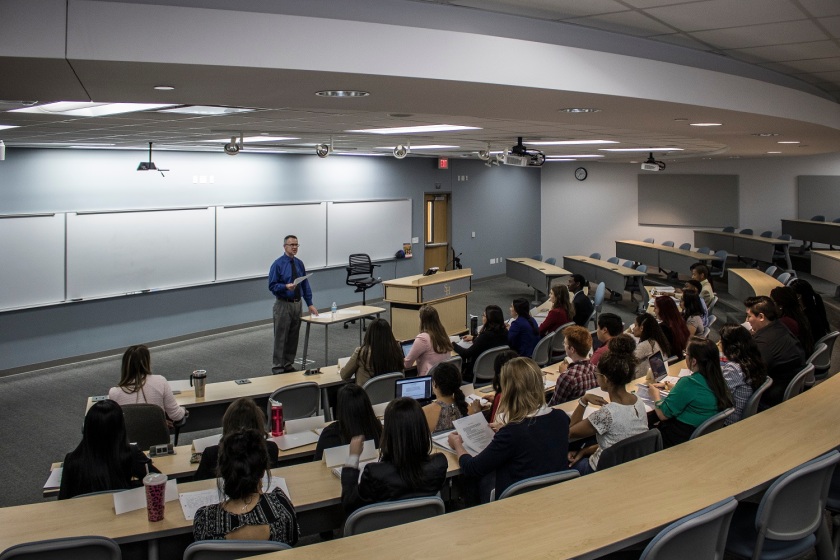
South Texas College of Law--Houston, STCL, LEAP Center, Center for Law Engagement And Politics, Mock Law Class, SHSU, Val Ricks

Professor Ricks was cheerful and patient with all of his students…even when such patience was pushed.
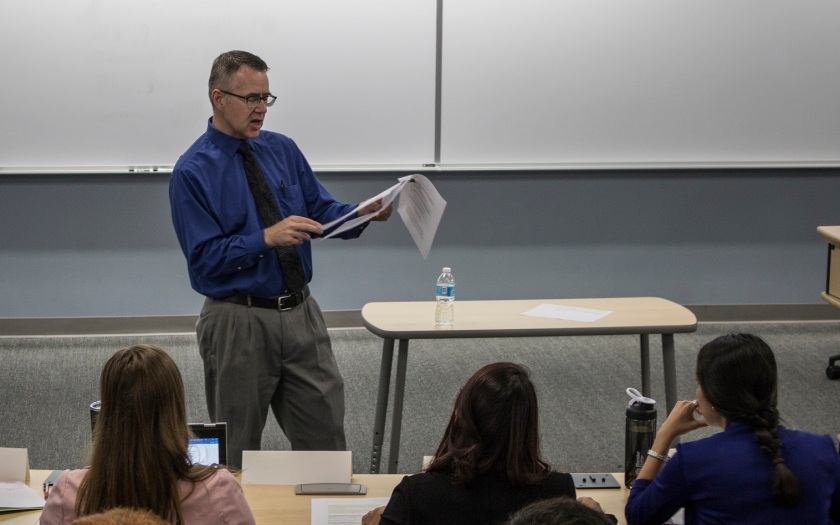
South Texas College of Law--Houston, STCL, LEAP Center, Center for Law Engagement And Politics, Mock Law Class, SHSU, Val Ricks

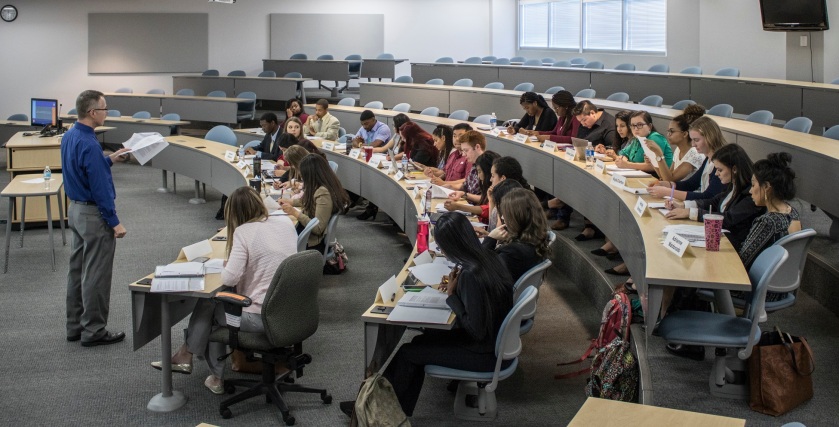
Professor Hicks ran the mock class in much the same way that he’d run one of his own at South Texas College of Law.
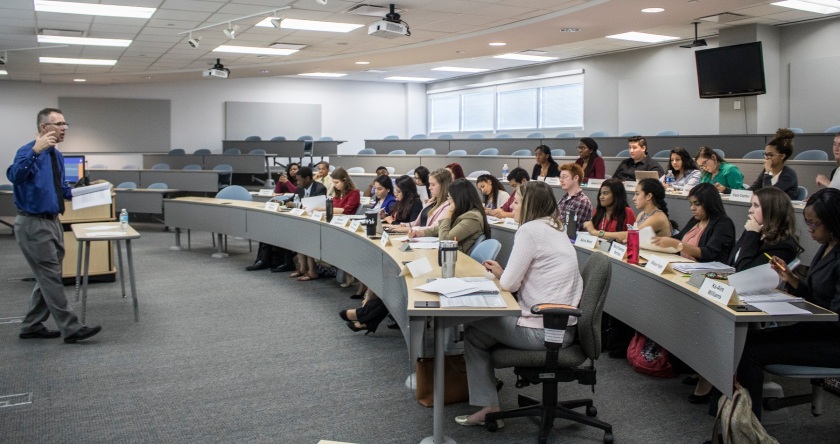
http://www.stcl.edu/

The students were expected to be familiar with the details involving two different contract cases. In each of cases the contract was declared invalid by the court, and it was the students’ job to use the rules included in the case brief to figure out exactly why. He called on students at random…
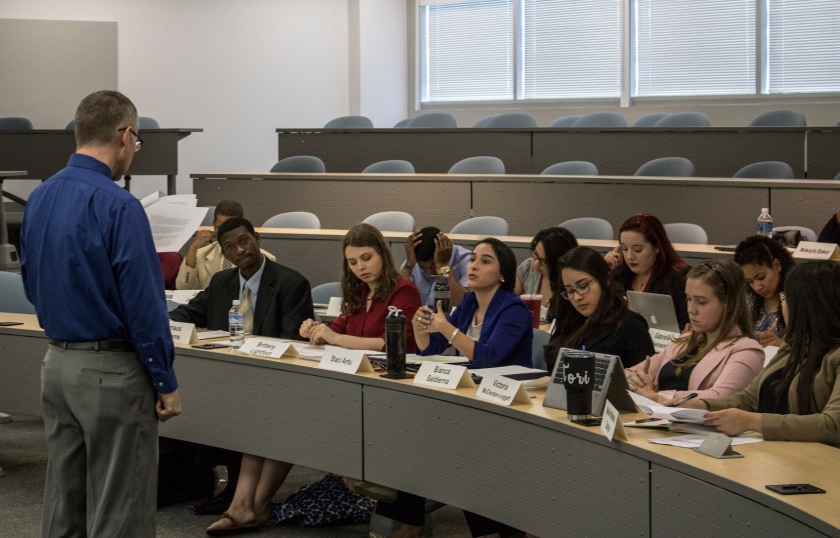
South Texas College of Law--Houston, STCL, LEAP Center, Center for Law Engagement And Politics, Mock Law Class, SHSU, Val Ricks, Staci Antu

…asked them about the various facts of the case, why they thought the case resulted in that particular outcome, and what principle of law applied to each.

South Texas College of Law--Houston, STCL, LEAP Center, Center for Law Engagement And Politics, Mock Law Class, SHSU, Val Ricks

He also presented some hypothetical cases and asked the students to apply the principles they had just learned to them.
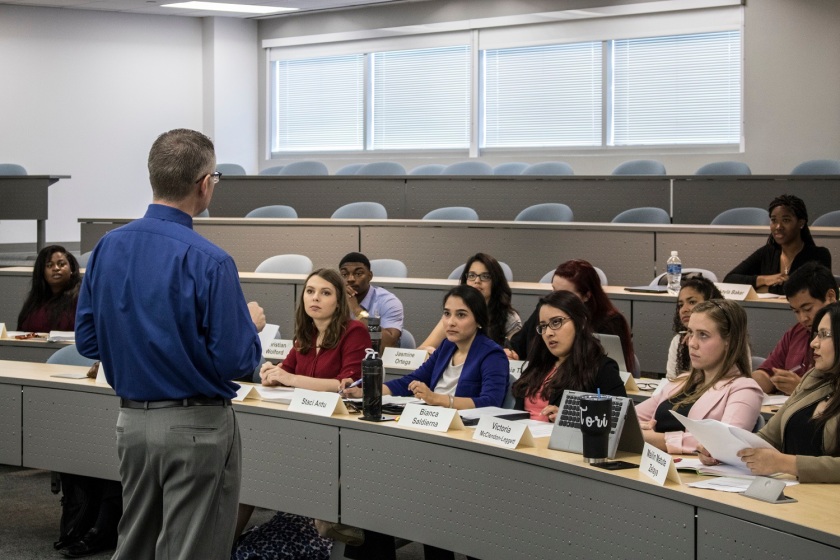
South Texas College of Law--Houston, STCL, LEAP Center, Center for Law Engagement And Politics, Mock Law Class, SHSU, Val Ricks

All in all, we had a great time getting a taste of what their future law school experiences could be like, and we learned some valuable lessons.

First, we should speak up when answering or asking questions…
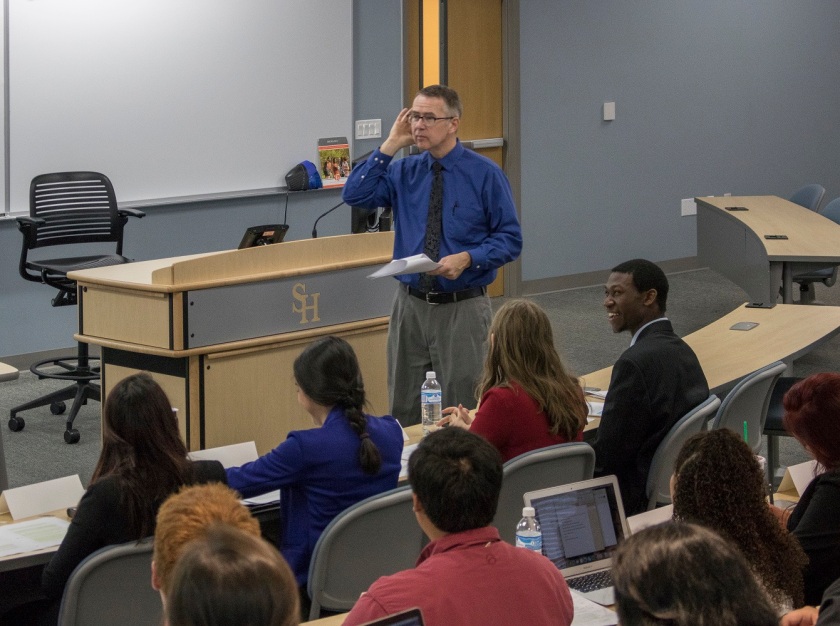
South Texas College of Law--Houston, STCL, LEAP Center, Center for Law Engagement And Politics, Mock Law Class, SHSU, Val Ricks

Second, read outside of class.  Having a large vocabulary and understanding usage will be helpful.  Otherwise, we’ll get turned around….
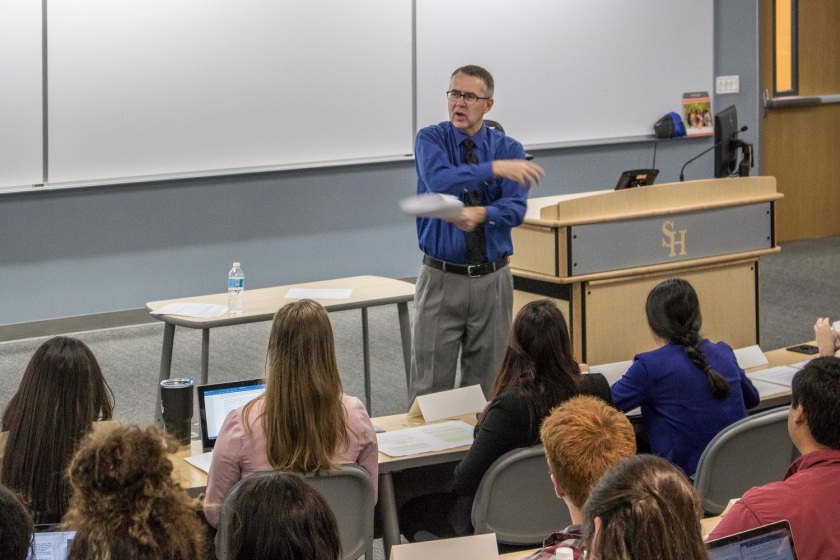
South Texas College of Law--Houston, STCL, LEAP Center, Center for Law Engagement And Politics, Mock Law Class, SHSU, Val Ricks

Third, we should ask questions when we are confused.  The alternative is just to carry our confusion with us as the Professor is lecturing, instead of identifying the material we need.
South Texas College of Law--Houston, STCL, LEAP Center, Center for Law Engagement And Politics, Mock Law Class, SHSU, Val Ricks

They were able to ask Professor Hicks questions about class sizes, test formats, and bar passage rates, and he happily answered them all. The students were able walk away from the mock law class with a much better understanding of exactly what they could expect once they made it to law school.
Law School Informational: Texas Tech Law

By Beatriz Martinez

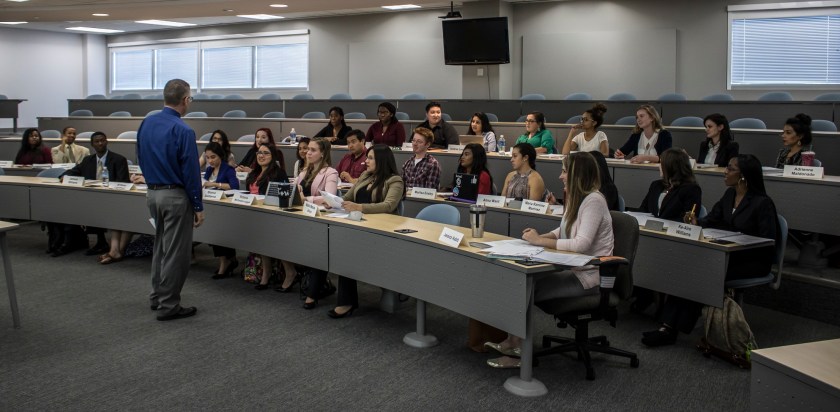
Thirty or so bright- eyed students attentively paid attention to Danielle Saveedra, the Associate Dean of Recruitment for Texas Tech University’s School of Law.  She was presenting information on the next stage these aspiring attorneys-to-be were contemplating: applying to law school. Crucial questions such as where to start when considering law school, the application process, and what to look for in a law school, were  all discussed during the presentation and absorbed by the students.

TX Tech Law School, LEAP Center, SHSU

Ms. Saveedra had come to SHSU to guide us through the process of preparing for law school.  In a nutshell, she walked us through:

  • A timeline for law-school preparation
  • Taking the LSAT
  • Deciding which law schools to send applications
  • Applying to Law School, including
    • sending in transcripts, reference letters, the resume, and the personal statement

This may sound quite simple, however it is in fact considerably challenging. A law school’s environment whether cut-throat or nurturing, emphasis on certain types of law, and cost of living, Ms. Saavedra told us, will influence where a student may decide to go. Decisions on what law schools to apply to (each application has a fee), or choosing between a good law school that costs less versus a more prestigious at a higher cost can pose challenges even to a well-prepped student.

tx_tech_law_informational_3_web

However, all of these decisions were weighed and measured during the law school informational. Ms. Saveedra covered every single possible piece of information needed to be successful in law school and gave constructive tips. Every prospective attorney left reeling with information, but departed knowing they were now better prepared for the challenging journey ahead. Law school will now be less intimidating, allowing students to further their education in the legal field.

On the Road to Success: LEAP Offers Mock LSAT

As it does every semester, the LEAP Center again collaborated with Kaplan testing to offer a free Mock LSAT, an opportunity for students to assess their performance on one of the keys to being admitted to law school.

The LSAT is a different test than the SAT or ACT because it tests different skills than what students were exposed to in high school and, to some extent, college.  It takes intelligence, grit, and a lot of practice for students to do sufficiently well to get into the school of their choice.

The LEAP Mock LSAT is traditionally offered from 9:30-2:00pm on a Saturday and this semester was no exception.  A bit before 9:30am, students began filing into the classroom, and we listened to Randy, our prep course instructor.  He was enthusiastic and charismatic, and he captured our attention as we learned how the Mock LSAT is structured.  The sections include: Logical Reasoning (2 such sections), Analytical Reasoning, and Reading Comprehension.  The actual LSAT also has a writing section and an experimental section. Each section allows 35 minutes for completion.  And with that intro, we began.

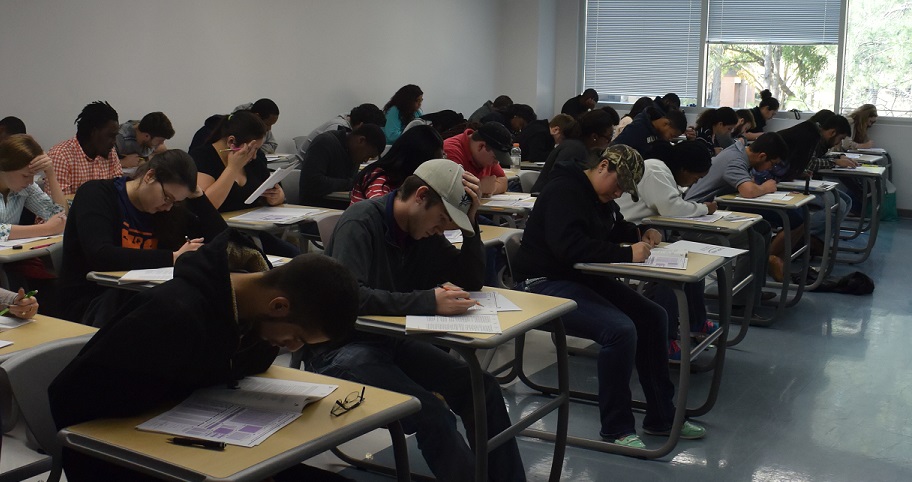
If anyone were to look into that room at that moment, they would have seen 20+ students with their heads bent down, faces scrunched in extreme concentration.  As it turns out, Professor Yawn did exactly that…

Mock_LSAT_February_2016_Web

Some were scribbling furiously, while others were staring intently at their paper. All of us were intensely focused, ready to take charge of this challenge. At the second to last section, we were able to take a 15 minute break, where we were provided chocolate chip cookies to give us some much needed energy. Once the 15 minutes were up, we were all energized and I was ready to start the exam again to finish the last section.

Finally, at around 2 p.m. we finished the last section. Randy then started to explain how to complete various questions from some of the toughest sections. He explained it in such a way that I could not believe I did not understand it the first time around.

It was time for the results. We all walked to the computer lab where we were able to receive the scores we got. Emotions varied with each score but everyone was happy that they had taken this test as it had bee worth it. Overall, I enjoyed the experience. Even though it was my second time taking it, the Mock LSAT still makes me nervous but by having the opportunity to take it before the real deal helps me feel more prepared. This experience has boosted my self-confidence and helped me make new goals for myself.

Law School Information Session–TAMU School of Law

For the pre-law students at SHSU, there are some tough questions to ask as they prepare for law school. What should I include in the personal statement? Who should I ask for letters of recommendation? What should those letters say? What schools should I apply to, given my GPA and LSAT score? When should I take the LSAT?

Those questions were answered last week at the LEAP Center’s “Law-School Information Session,” featuring a visit by Katherine Sims, of Texas A&M University School of Law. Ms. Sims is the Admissions Coordinator at TAMU Law, and she put her knowledge on full display, to the benefit of the students.

TAMU_Presentation_Web
Speaking to 25 motivated students, she went through the process, offering the following advice:

  • Take the LSAT the year prior to your enrollment in law school. The LSAT is offered in February, June, October, and December. For students interested in going to law school in the Fall of 2016, for example, students should probably shoot for a June, October, or December LSAT. In a pinch, a February LSAT might work, but that’s typically after law schools begin making enrollment decisions.
  • The best people to ask for a letter are people who know you and your skills, particularly in the areas of writing, critical thinking, and communication. Typically, these are professors, but a letter from an employer or intern supervisor can also work.
  • For the personal statement, students should try to be themselves while, of course, putting their best foot forward. Ms. Sims resisted describing a “typical successful” essay, because the essays should be appropriate for the individual applicant—and the applicants all have different experiences, strengths, and reasons for wanting to go to law school. Of course, apart from the content of the statement, the applicant’s writing skills are closely scrutinized.
  • To know which schools to apply to, students should research where their LSAT and GPA fit into the rankings, and then to examine specific aspects of the schools and their cultures to find a good fit. For TAMU, the median LSAT is 154, and the median GPA is 3.21, but Ms. Sims emphasized that all applications were examined, and encouraged all the students to apply (no application fee is charged!)

The LEAP Center Advisory Board students would like to thank Ms. Sims for her information presentation, and the 25 pre-law students who attended to learn more about law school—and their future!

LEAP Center Offers Mock LSAT

For the past seven years the Junior Fellows/LEAP Center has offered a Mock LSAT each semester to help students prepare for the real deal.  The LEAP Center encourages students of all classifications to take the Mock LSAT, which is generously sponsored by Kaplan Testing.  For freshmen and sophomores, the Mock LSAT provides an idea of what the test is like.  A lot of younger pre-law students, for example, think the test asks about the law.  It doesn’t.  It asks questions about reading comprehension, logic, and arguments.

For juniors and seniors, it provides an idea of how close they are to being prepared to take official LSAT.  This has to be planned out, because the LSAT should be taken the year before the student wishes to enroll in law school.

Forty-seven students showed up for this spring’s Mock LSAT, following a showing of 51 in the fall of 2014.  These are the largest class of Mock LSAT takers in SHSU history, a testament to the University’s growing number of pre-law students.

Mock_LSAT_February_2015

The LEAP Center will follow up this Mock LSAT opportunity with many other law-related activities:

These programs are part of the LEAP Center’s mission of helping students achieve their professional goals.  To attend any of the upcoming events, contact Professor Mike Yawn at mike.yawn@shsu.edu.