It may be summer, but that doesn’t mean we aren’t learning, and for the next two weeks, we plan to learn a lot, while also having some fun. This opportunity comes from the LEAP Center and the Southern Legislative Conference, with the latter hosting their annual conference in July in Nashville, TN. We are expanding that a bit by also visiting Asheville, North Carolina and, Atlanta, GA.

First Flight, Jessica Cuevas
It was early in the morning and the sun had not risen yet, but the LEAP students were all on their way to their closest airport, each departing from their hometown, (Houston, San Antonio, and Dallas) to catch their early flight and embark on their new journey that would begin in Atlanta, Georgia.
Having never stepped foot into an airport or airplane, I was feeling a bit nervous and overwhelmed. Thankfully, there were signs all over the airport directing me, and I also had my Morgan (flying out of DFW) and Yvette (flying out of San Antonio) as resources, and, of course, I could ask airport staff.
I made it through the luggage check, then to security, all the while experiencing a bit of anxiety and feeling a little overwhelmed. Fortunately, I was not selected for additional screening by TSA, and I made my way for some coffee. After purchasing a tall drink at the price of a grande (airports mark up prices, I learned), I settled in to wait on my flight.
As I went through the process of boarding the plane, bit became surreal, and I thought, “I really am doing this all on my own and for the first time.” I listened more intently to the safety protocols and paid attention to the plane (a Boeing B737-900), and sat in wonder during takeoff, the flight, and the landing.
It would be two hours before I stepped foot on the ground
Georgia’s State Capitol, Yvette Mendoza
Although it wasn’t my first time in Atlanta, it was my first time to really put my feet on the ground and explore, and the first place in this exploration was Atlanta’s Capitol grounds.
Part of our education as LEAP Ambassadors includes the basics of architecture, and the Capitol building was a great school room in that sense. The capitol dome is covered in 24K gold leaf, symbolizing the fact that Georgia was the site of the country’s first gold rush–in 1828 in Dahlonega. Apart from this piece of “bling,” the capitol was nicely configured in traditional Greek and Roman architectural features–pediments above entrances, grand columns (corinthian, mostly), and arched windows.

Continuing our walk into the capitol we first caught our eye on the circular, golden plate Great Seal of Georgia that displays three pillars stating their motto “Wisdom, Justice, and Moderation” and the year of the Declaration of Independence, 1776. Then, walking up the staircase we finally entered one of the grand wings of the capitol.

Seeing the overly-sized painted portraits of former Governors dating back to the 1800s was astonishing. Not only did we admire the portraits, but we took a closer look at the numerous chandelier dispersed throughout the interior, which, built in the 1890s, were designed to be used by gas or electric methods.
As is true in most capitols, the rotunda was both literally and figuratively the center of the building. This rotunda was a bit more subdued, but nice nonetheless.

In addition, we were able to stand on the glass flooring, which allows light to spread to multiple floors.

Surrounding us in the rotunda are the portraits of the founding fathers that were placed there because Georgia was a part of the 13 colonies. Walking around seeing more portraits we learned that Jimmy Carter was not only a president but a former Governor of Georgia. Alongside the portraits are offices for the Governor, secretary of state, House of Representatives, and many more.
We enjoyed the large spaces in the capitol, as well as the details amidst the largeness. The doors, for example, have the state seal intricately carved into the knob, and the seats in the House and the Senate include original desks provided to the members.

On the top floor, the Capitol have displays capturing the history of Georgia, as well as facts about the state.
Everyone knows, for example, that the official state fruit is the peach, but did you know its official bird is the brown thrasher?

Wrapping up our tour, we came across a photo opportunity: a podium with the state seal.


For a moment, we had a chance to be Governor and host our own press conferences. It was a fitting end to a fun and educational tour.

High Museum of Art, Yvette Mendoza
As we transitioned from politics and architecture to art, a heavy rainfall began, but it was unable to wash away the LEAP Ambassadors’ excitement to the works on display at the High Museum of Art. At the entrance, we were hit by an optical illusion created by Roy Lichtenstein, called House III. Painted in primary colors and in a triangular shape, the perspective changes as you move alongside it, from convex to concave and back again. This was a great introduction to the fun and engaging art in the building–and the building, by the way, was its own piece of art, designed by Richard Meier.

As a further introduction to the High, we were greeted by a lady wearing a dress clearly inspired by Piet Mondrian, with its grid and primary-color design. All of this, intriguingly, was before we got inside!

Inside, we saw work by Ellsworth Kelly and other major artists, but we beelined it to the Picasso-Calder exhibit. While their art is not typically seen as similar, their grandsons created this exhibit, which emphasized similarities in the artists’ approaches, subjects, and output. The exhibit featured dozens of pieces, including pieces large and small by both artists.
We took turns posing in front of our favorites. Morgan’s, for example, was “The Acrobat,” by Picasso…

…mine was “La Grande Vitesse” by Calder…

…and Jessica’s was the simple “The Bull,” by Picasso.

We didn’t have time to explore all the floors, but we got our fill of Picasso and Calder!
And we did see their American collection, which included many of the “decorative arts,” including works by Frank Lloyd Wright, Charles and Ray Eames, and Isamu Noguchi.
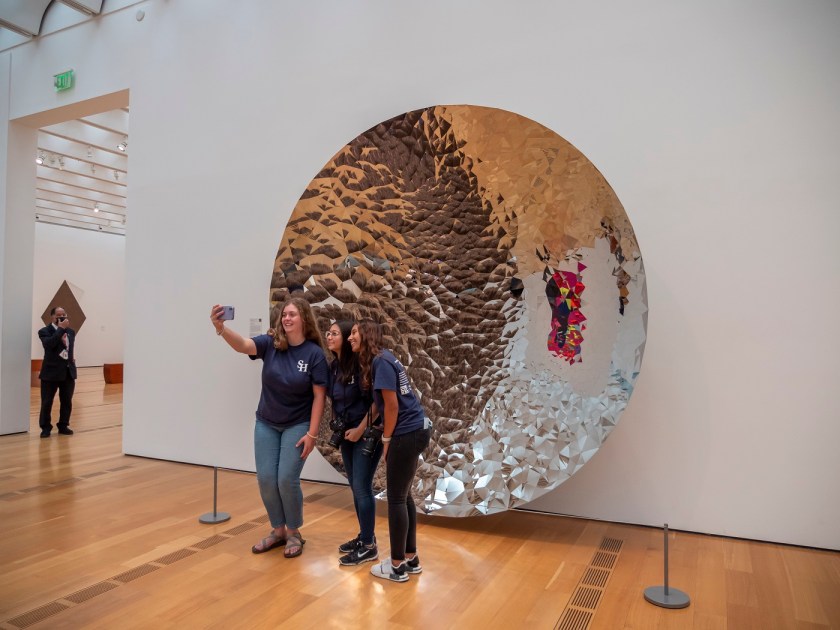
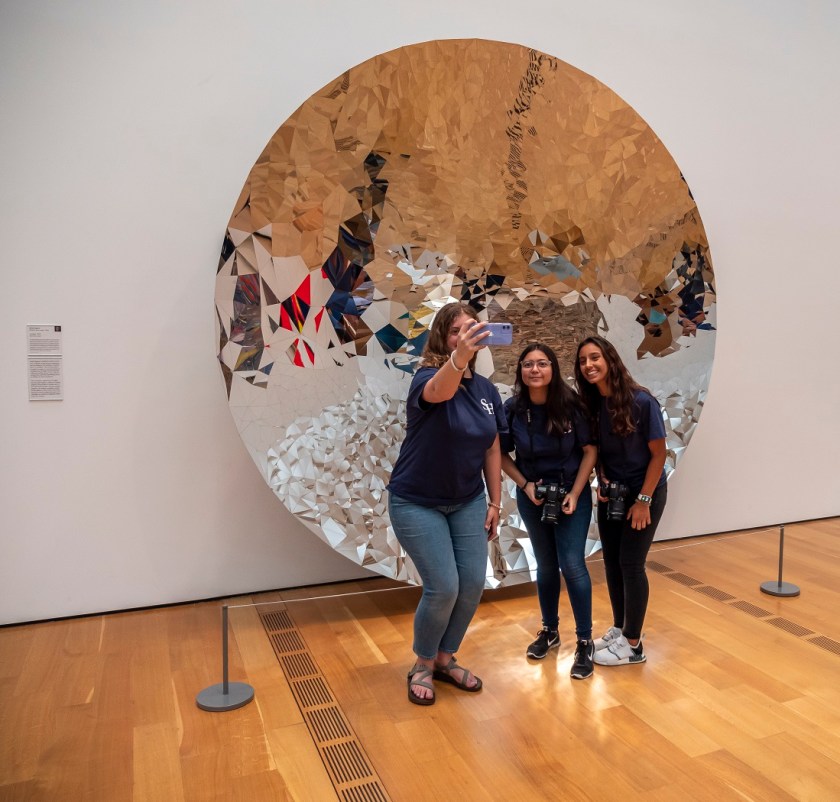
We also saw paintings by John Singer Sargent, Childe Hassam, and Georgia O’Keeffe. Among the modern artists, we were particularly struck by Anish Kapoor’s untitled piece, which had interesting aural and visual effects. This was the most popular piece in the museum.


Our last stop in the museum was the gift shop, where we continued to learn about great artists such as Frida Kahlo and Grant Wood. We bought magnets, flower vases, and postcards to help us remember the beautiful High Museum of Art!
Atlanta Botanical Garden, Morgan Robertson
The SHSU Leap Ambassadors started the afternoon off with a caffeine jumpstart from Caribou Coffee. The coffee house on Peachtree St. offered a wide variety of drinks including drip coffee, cold brew, mochas, lattes, teas, and for non caffeinated options, smoothies, shakes, and pastries. The coffee house served as a good break before heading to the Atlanta Botanical Garden.

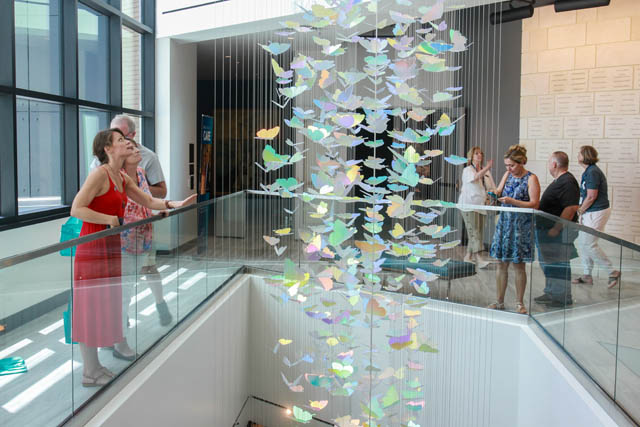
The 30-acre garden strategically lays out pathways leading you past countless landscape features and works of art (this would be a good introduction to landscaping architecture, which will learn more about at the Biltmore Estate, landscaped by Frederick Law Olmsted). Upon entering the garden, the bright gradient canopy created by Shearn looks as though it is suspended by nothing as it guides your walk on the Kendeda Canopy walk.

The hand-tied streamer-like pieces (more than 79,000 of them) flow with the wind while simultaneously curving with the treeline and the path of the 40 foot tall walkway.

The art and architecture work together in order to create vivid movement through the garden.
One of the major and most memorable works of art employs the use of 18,000 different kinds of flowers to create the Earth Goddess.

Lounging with complete serenity, the Earth Goddess extends a hand pouring water into the pond.

Taking advantage of the scenery, LEAP Ambassadors posed for a picture, some poses emulating the Goddess herself.
The garden is also home to a large collection of Dale Chihuly glass and painted pieces in the botanical garden.

After learning and hearing about his works on past trips, this was our first time seeing a Chihuly in person and our expectations were exceeded. The glass blown into shapes of flowers and different spirals and sprigs creates a mass of individual pieces working together, which fit perfectly within the garden itself.

The botanical garden mission is “to develop and maintain plant collections for the purposes of display, education, conservation, research and enjoyment.” This mission statement is employed in every aspect of the garden, especially through the most obvious way: the plants. From edible gardens, to neon flowers, and trees that make you want to guess their age, the botanical garden is a place to get lost in wonderment and adoration of something that has been around since the beginning of time.
My personal favorite collection of flowers stems from the orchid conservation lab and greenhouse.

This fragile, common house flower dominates in the climate-controlled greenhouse (72 degrees during the day, 52 degrees at night). Orchids growing in every imaginable way from wall hangings, to in the ground the collection brings a new appreciation to the flower.
Keeping with the colorful flower trend, Yvette’s favorite plant was the hydrangeas.

Commenting on how the color did not even look real, Yvette was able to snap some pictures of the beautiful flowers.

The tropical greenhouse gave an impressive depiction of a rainforest complete with the sounds of frogs and birds. Jessica admired the edible garden in which visitors are able to smell herbs such as rosemary, mint, oregano, basil, and marigolds, but have to imagine what the sweet snap peas or the juicy tomatoes would taste like.
We also had an opportunity to see 16 separate installations by Jason Gamrath, a glassmaker from Seattle–he studied art at Dale Chihuly’s school.

His pieces were large, and they complemented both Shearn’s work and the garden itself.

Between Shearn, Gamrath, and Chihuly, we were in good company throughout our walk.
The floral and green experience creates a longing to step back into nature. And even for some LEAP Ambassadors a desire to develop a green thumb.
Jackson Street Bridge, Morgan Robertson
A little while after sunset, the LEAP Ambassadors walked across the Jackson St. bridge for a picturesque view. Most known for its appearance in the tv show The Walking Dead, The Jackson St. bridge plays a distinct role in the post-apocalyptic show. As a single sheriff trots, he passes by hundreds of abandoned cars toward downtown Atlanta on a horse. The shot is taken from Jackson St. Bridge.

The bridge allows for an excellent shot of the skyline of downtown Atlanta, and a nice teaching experience for photography. Experimenting with different shutter speeds, angles and other functions, we were able to capture several images of the skyline.

Other sightseers had the same ideas about the bridge as we did. Upon walking up to the bridge there were several groups snapping always on cameras, phones, and even drones.
Culinary Adventures, Jessica Cuevas
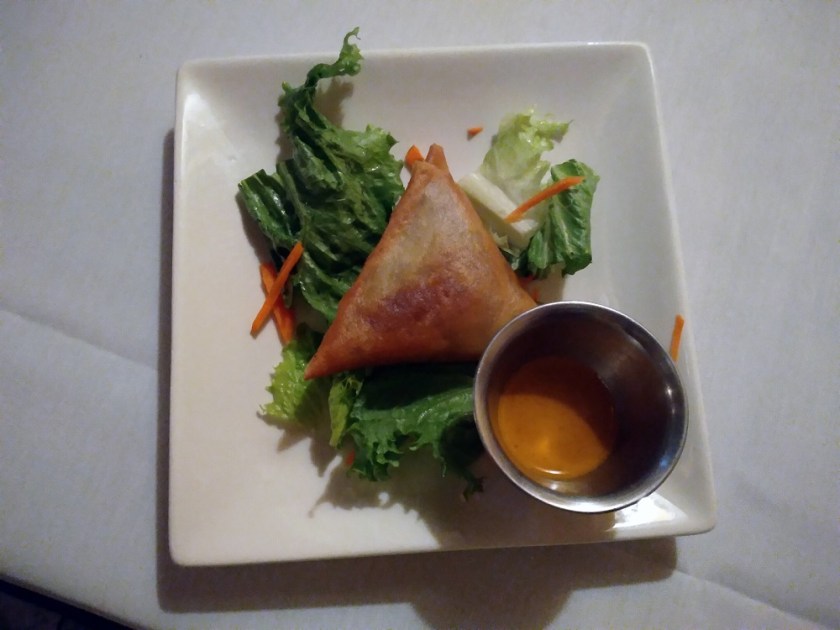
Although we rest our legs while taking a break for meals, we don’t stop exploring. Thus for lunch, we were treated to Mediterranean Food at a small local restaurant La Shish Kabab in Atlanta, Georgia. Having only eaten this cuisine twice previously (both times with LEAP), I tried the Chicken Shwarma, a simple chicken dish with rice served with pita.

Yvette got the Gyro meat platter, which had beef and lamb….

… and Morgan ordered the Beef Kafta.

Many of the flavors are not in our day-to-day diet, so it was an enjoyable experience comparing each other’s choices. It was a nice meal to tide us over for the next couple of hours.
It was past 10:00 PM and we were arriving dangerously close to not finding any open restaurant that we could dine in, with most kitchens being closed for the night early. Thankfully, we eventually found The Corner Tavern. We made our way to the restaurant where we were greeted with rain (in the parking lot) and a friendly staff (in the restaurant). To start, we ordered chips, queso, garden salsa, and fried artichoke hearts. For our entrees, Yvette ordered a burger with French fries…

…Morgan had the tavern club sandwich with Pimento mac and cheese, and I had the buffalo chicken burger with tater tots. This last meal wasn’t particularly adventurous, but by the time we were able to find an open restaurant, we were pleased just to have food before bed.
And thus with full stomachs, following a full day, we began to burn the midnight oil blogging about our day of adventure…