With our competition out of the way, we were determined to make the most of our remaining time at the TCMA conference. To do this, we heard from a rewarding speaker, got an Association update from the new President of TCMA, engaged in a networking lunch, and stole a few moments on the beach.
AI and City Government
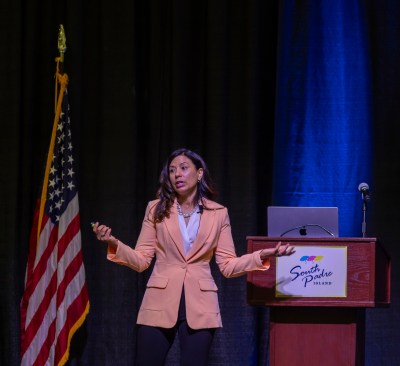
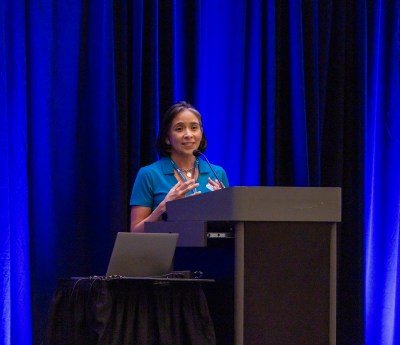
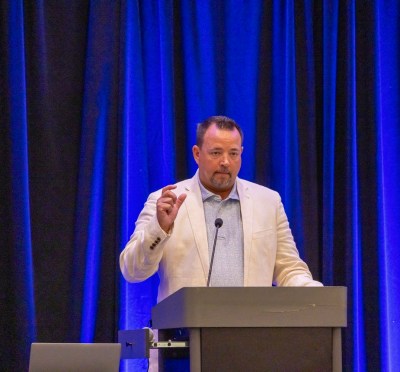
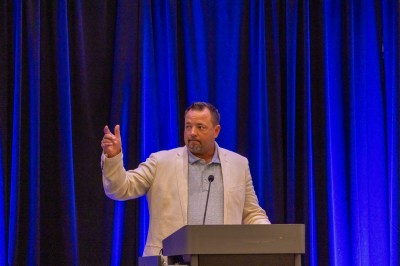
Our last true session of the conference featured, Ann Marie Sastry, a distinguished mechanical engineer and entrepreneur known for her groundbreaking work in energy systems engineering and artificial intelligence. She earned her bachelor’s degree in mechanical engineering from the University of Delaware and a PhD from Cornell University.
Following a career in academia, Dr. Sastry co-founded Sakti3, and she currently serves as President and CEO of Amesite, an AI software company. She brought this work home to us by noting that the days of City Managers being able to ignore AI in their communications and analyses are over. She went so far to say that any company who doesn’t begin use of AI in the immediate future won’t be in business in 2030, comparing such a decision to a business in 1995 choosing not to use computers.
Her talk was well received, and for us, two things stood out, both of which are relevant to what we do. One, she mentioned that AI could write a blog in 8 seconds, which is significantly shorter than the time we take! Second, she noted that AI can easily do a PowerPoint for free; but free AI cannot do an excellent PowerPoint. And while this was a suggestion from her that City Managers should look closely at which AI companies they use, it was a reminder to us to put some old-fashioned thought and sweat equity into our blogs and our PowerPoints.
Passing of the Torch: A New President of the TCMA
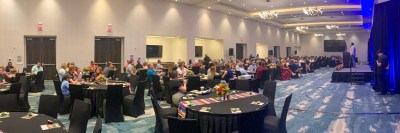
The last day of the conference, Sunday, June 23, began by foreshadowing the 2025 conference in San Antonio…
…with a nice promotional video that stirred some excitement among the audience.
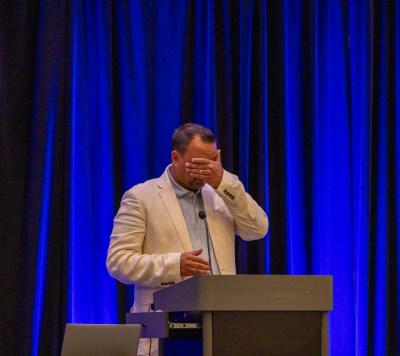
It also marked the passing of the torch from President Opal Mauldin-Jones to Jay Abercrombie, City Manager of Henderson.
Mr. Abercrombie became emotional as he thanked his family, Association members, and noted the passing of his father.
But he composed himself quickly, making a joke about his inability (the day before) to pronounce the word “academician.” With much fanfare, he demonstrated a successful pronunciation of the term.
In an animated speech, he highlighted some features of the Association…
…ensured everyone was aware of next year’s meeting in San Antonio, and encouraged members not to become cliquish which, he noted, they have a “tendency to do.”
And with that admonishment, the Conference ended…
…with members mingling (uncliquishly), and reflecting on a positive and productive conference.
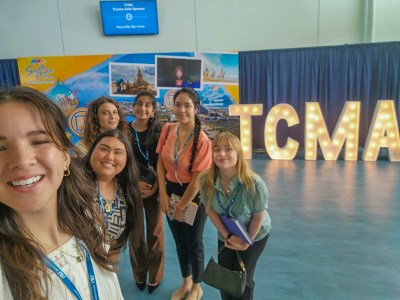
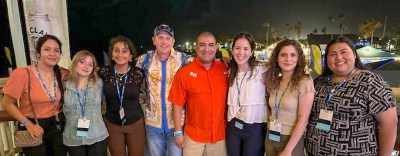
Among those members were a group of six SHSU students, all newly minted TCMA members!
The TCMA annual conference is designed for current and aspiring city managers to gain professional development and to network. But as a way of cultivating the next generation of city managers, they sponsor a “InterCollegiate Bowl” (ICB).
The ICB involves numerous components, which are described here and here, but our focus today was to highlight our (1) community service project and (2) capstone project. Our team was led by Team Captain, Olivia Discon, and members Cinthia Villarreal, Yajaira Gutierrez Marin, Chrissy Biello, Victoria Medrano, and Michelle Cardenas.
Our competition included teams of Master of Public Administration students from around the state, many of them seasoned professionals in the public admin world.
In short, we expected stiff competition, and that’s what we got!
For our Community Service project, we decided to highlight our Citizenship Preparatory Course, which was conducted in April. The five-week course, helping local immigrants learn how to pass the naturalization exam, proved to be a resounding success! With a 121% improvement in the local immigrants test scores, our project reflected the resilience of our community and a job well done. But there was an implicit success that can’t be measured, which are the relationships made through this course. Many of the people we’ve met have become friends and have come to have a true stake in the Huntsville community. Following the course, 9 of the 22 students attended a Huntsville City Council Meeting, where they were recognized by City Council for their efforts.
We approached our Capstone as we do with everything in LEAP: as a cross-disciplinary learning opportunity with the goal of serving others. Addressing issues such as infrastructure, marketing, quality of life, strategic planning, and workforce development, the project reflected individual internship experiences at the City of Huntsville to showcase substantive projects that ultimately benefitted the community.
What we hadn’t realized is that through our capstone, we caught a glimpse into what it is like to be a City Manager. Overseeing multiple projects that overlap with one another was an extraordinary learning experience that cannot be taught in the classroom.
Our opportunity to showcase these projects occurred on Saturday morning, from 7:30-10am. The presentations, which took place in the front hall, involved numerous people stopping by to learn more about our projects, and some of these were “mystery graders.” These mysterious types were actually city managers who were part of a team assessing our projects.
Following these components of our grading, we were in first place, having completed these aspects of the Bowl with about 99 percent of the possible points. Only the Jeopardy contest was left.
Jeopardy
In the final portion of the ICB, worth 750 points, was a Jeopardy-style game all about local government. To prepare for this component of the contest, we studied some 250 terms and concepts associated with city management. This was a bit of overkill, because we were not told of the categories until the first day of the conference. Once we learned these, we refined our studying to these areas: Budget & Taxes; Planning & Zoning; Economic Development; City Council and; Human Resources.
But even with the preparation, we learned some new information at the last minute. For example, our entrance was done “spirit style,” with strutting and intro music, a prospect that made us nervous.
The lead-in to the competition was done up right by TCMA, with teams showing their spirit as they came in.
SHSU entered last, a grand entrance, befitting our first-place (at the time…) status.
Whooping it up is not our style, but we did our best, with Olivia as our official team captain and Michelle as our “team spirit leader.”
It was our first time in this competition, and our inexperience was telling.
Many of the opposing teams had returning members, who not only knew the format, but also knew key tactics and, surprisingly in some cases, the questions.
This learning curve got us, and while we did not excel in this contest, we were satisfied knowing that while we might not have been the first to hit the buzzer…
…we did know the answers to about eighty-five percent of the questions (we did learn, on the spot, what a “claw-back provision” is….). And we had fun.
In the end, we finished third. The top three were close, with UNT Masters of Public Administration leading the way (1020 points), TAMU’s Masters of Public Service team in second (976 points), and the LEAP Center’s undergraduate team in third, with 930 points.
UTSA’s Masters program finished fourth with 530 points, and SFA’s Masters program served as the caboose.
Takeaways
Our goals for this contest were not related to points or placement. Rather, our goal was to do the best we could do on the individual components. We wanted to network with city officials, learning from them, and developing relationships. We wanted a broad-based curriculum in our coaching, which we accomplished, setting up meetings with a City Manager, two City Secretaries, a City Attorney, an HR Director, and a Police Chief. And we served our community by completing our volunteer project, while also learning a lot about city government, even if the Jeopardy contest didn’t fully reflect our learning. What was most important to us is that we achieved these goals while doing, we hope, good things for the community and others.
In preparing for the ICB, we had many coaches and mentors along the way, all of whom are experts in their discipline. Brian Beasley, Director of HR for the City of Huntsville provided us with a great Mock Interview; Thomas Leeper, City Attorney of Bryan generously spent time answering questions about legal aspects of municipal government; Stephanie Fors, Former City Secretary of Huntsville discussed the politics of a changing council for a charter officer (and served as a great “Team Mom”); Miranda Estrada, Economic Development Specialist of Huntsville served as a mentor and supporter; Fabrice Kabona, City Manager of Madisonville taught us much about Madisonville and City Management; Chief Kevin Lunsford, Former Police Chief of Huntsville educated us on policing and politics; Kristy Doll, City Secretary of Huntsville instructed us on agendas, organization, and parliamentary procedure; Sam Masiel, Assistant City Manager of Huntsville was a key supporter and; Aron Kulhavy, City Manager of Huntsville asked some excellent questions in a preview session. Each provided invaluable guidance for our team of young professionals. We truly appreciated the time each of these individuals put into shaping our paths for the better, and while we may not have won the TCMA ICB, we came home feeling like winners!
Following our day of travel and storm-related adventure, we were ready to get down to business in preparation of our “Intercollegiate Bowl.”
The contest is part of the larger Texas City Management Association Conference, in which City Managers (and other managers and stakeholders) come together to learn about trends in urban governance. While all the attendees will be attending sessions on employee retention, staff morale, and urban planning, we, the students, will also be preparing for the ICB.
We were greeted with a much better weather day than yesterday, for which we were grateful.
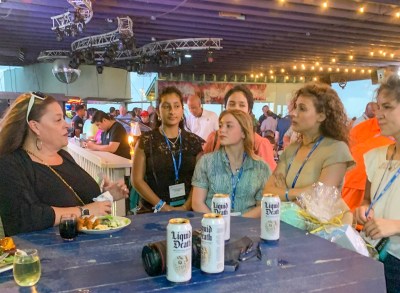
We were also thankful for the networking lunch, where we learned a bit more about the contest from Crane Petty, and we met with students from other Universities participating in the ICB. It is valuable to us meet with the other students–all of whom are graduate students, and most of whom are already in the professional field.
This was followed by a session led by “young professionals,” in which we had the chance to break into group discussions. Our group were asked questions such as “What is the biggest issue facing your community?” Or “when is a good time to bring up an issue to City Council?” Responses to the latter included comments such as, “when they understand their role better,” “when we get a new city manager,” and “when we can convince them they thought of it.”
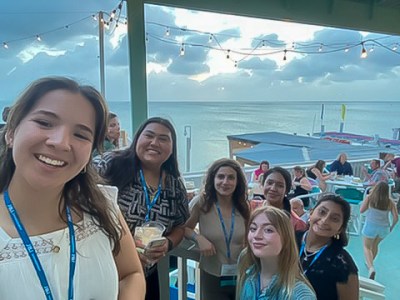
The culmination of the day was dinner at “Louie’s Backyard,” where the opening reception was held.
We were fortunate to share a table with Trish Kordas and Dr. Maria Church, the latter of whom is speaking at the conference.
Both were interesting, and they provided tips on networking, public speaking, and promoting a culture of leadership. We are looking forward to Dr. Church’s talk!
As our first day wound down, we found new ways to enjoy it. Olivia won a gift basket, we listened to the band play oldies, and we spent time with friends and mentors, such as Aron Kulhavy and Sam Maisel, while meeting other professionals in the field.
Of course, the City Managers and other City staff did not have an ICB to prepare for, so we left a bit earlier than the others. Following a debriefing at the hotel, we renewed our studying for the Jeopardy contest, which will likely decide the ultimate winner of the title, “The Best Public Administration Program in Texas.”
Our final day in the Valley was mostly a travel day, but we did have a chance to visit some Valley tourist attractions.
Although it wasn’t spring break, we did manage to step foot on South Padre Island. After “missing” a turnoff, we drove over a giant bridge, taking us to the spring-break hot spot. Our visit lasted just long enough for a photo op…
The Lighthouse was constructed because of heavy shipping traffic. It was completed in 1851 and has been standing for more than a century and a half, with a light that could be seen for almost 16 miles. During the Civil War, the lighthouse was used as an observation point and afterward, it continued to guide ships until it was permanently abandoned in 1905.
The lighthouse now serves not only as a tourist attraction, but also as a community engagement point. For the past twelve years, for example, it has hosted a cinema night, where visitors come to watch films together.
The people who show up for the movie obviously have a great tolerance for humidity, which we found somewhat oppressive. It did not, however, prevent us from waiting our turn in line to get to the top. Depressingly, the people who were exiting the lighthouse would tell us, “Gosh, it feels like a sauna up there.” This was bad news, because we felt like the bottom of the lighthouse was already sauna-like.
Undaunted, we made our trek up to the top, where we admired a view of an endless sea in some directions, touristy shops in other directions (Pirate Jack’s Gifts!), refineries in still another direction, and a view of South Padre from another.
It was the LEAP Center’s third trip to a lighthouse, the other two being at Tybee Island (next to Savannah) and Biloxi, MS. Although the Port Isabel lighthouse had a bit of charm, it lacked the local support, the scenery, and the amenities of the other two we had visited.
And, with that, we headed back to Huntsville, where we would have less than 24 hours to prepare for our venture to Austin, Texas, for a trial internship in the state’s legislature.












 Center for Law, Engagement, and Politics