Though it was the last day on our tour of the Southwest, the momentum we had from experiencing incredible hikes, interesting art and history, and a handful of slips and falls, left us feeling pumped! With the onset of the spring semester looming, we were determined to finish the trip strong.
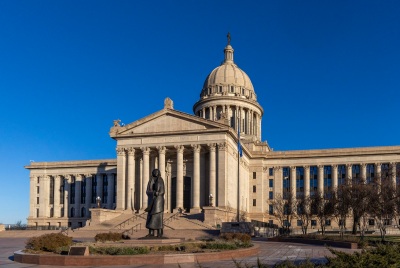
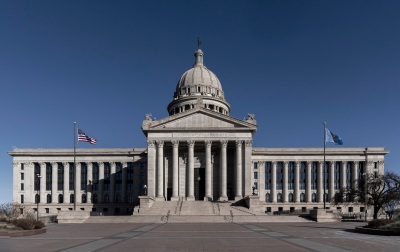
Oklahoma Capitol Building
After visiting the New Mexico Capitol and its hallways full of art, we weren’t sure that we were able to see anything nearly as colorful in Oklahoma.
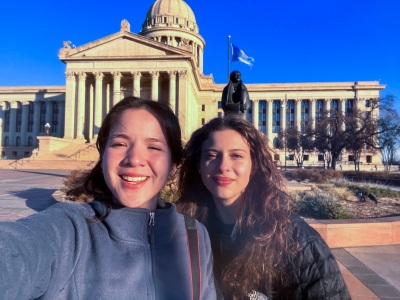
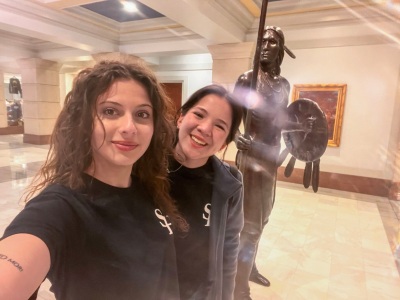
But as we approached the OK Capitol, we felt right at home–we were greeted by an Allan Houser statue!
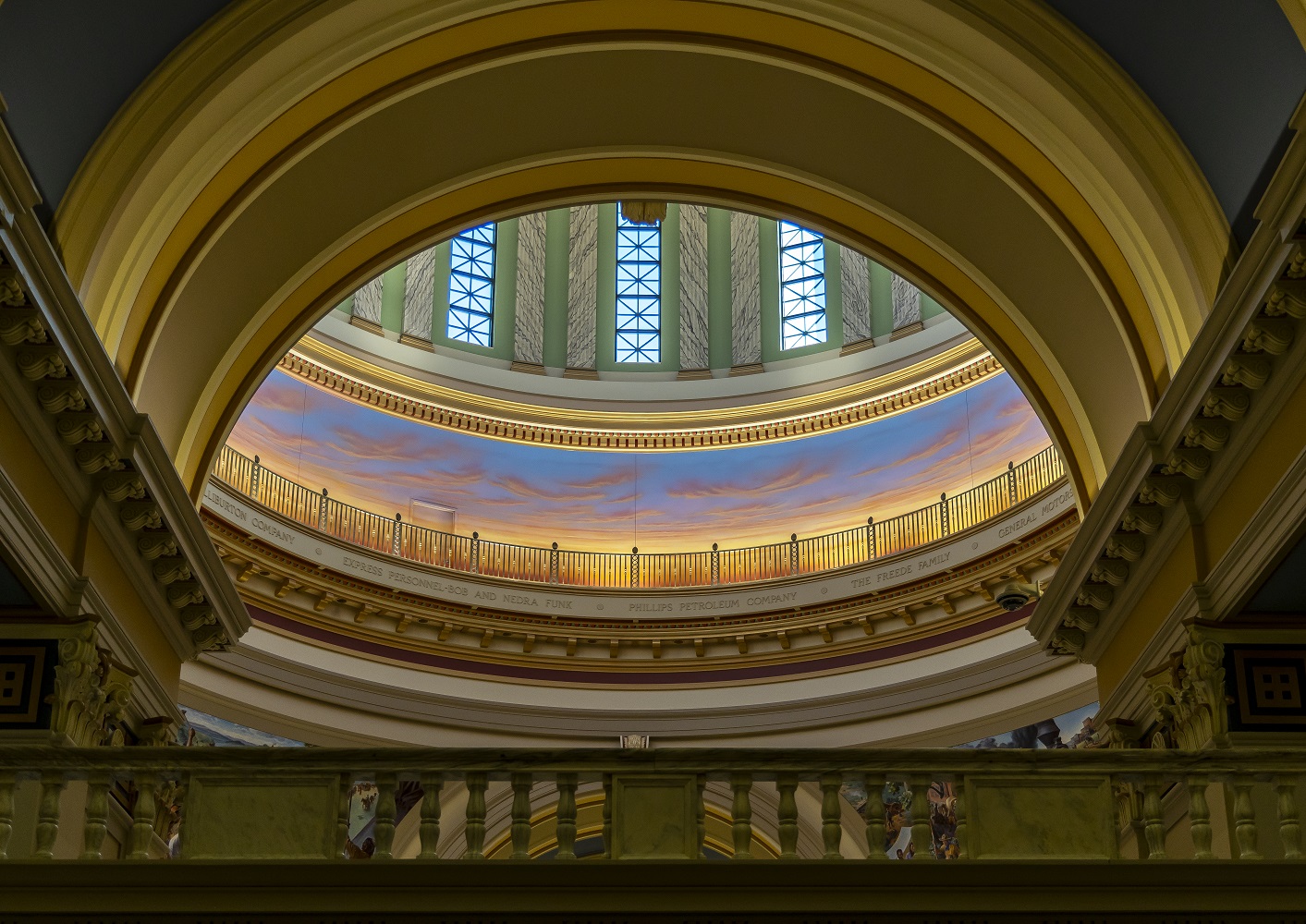
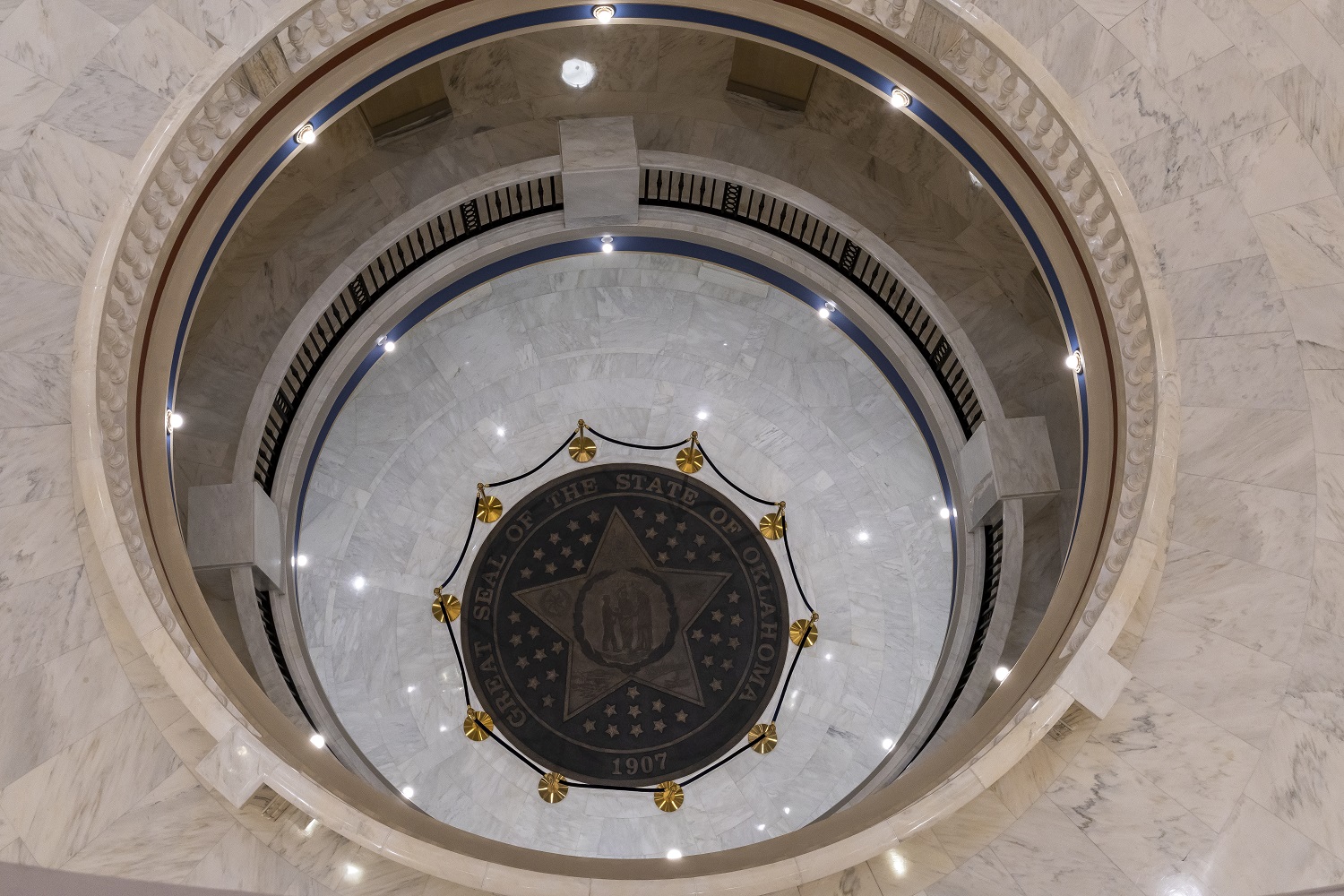
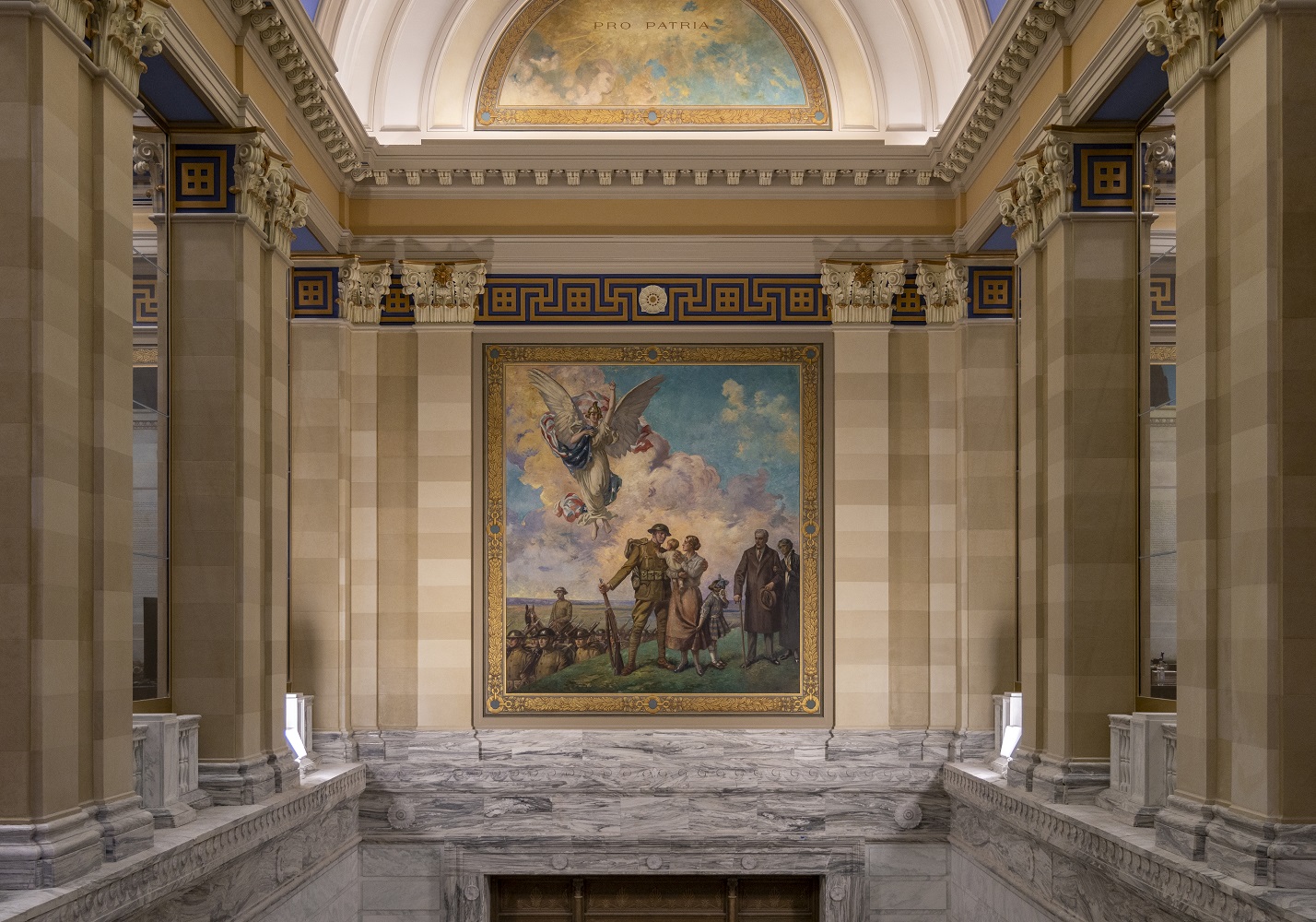
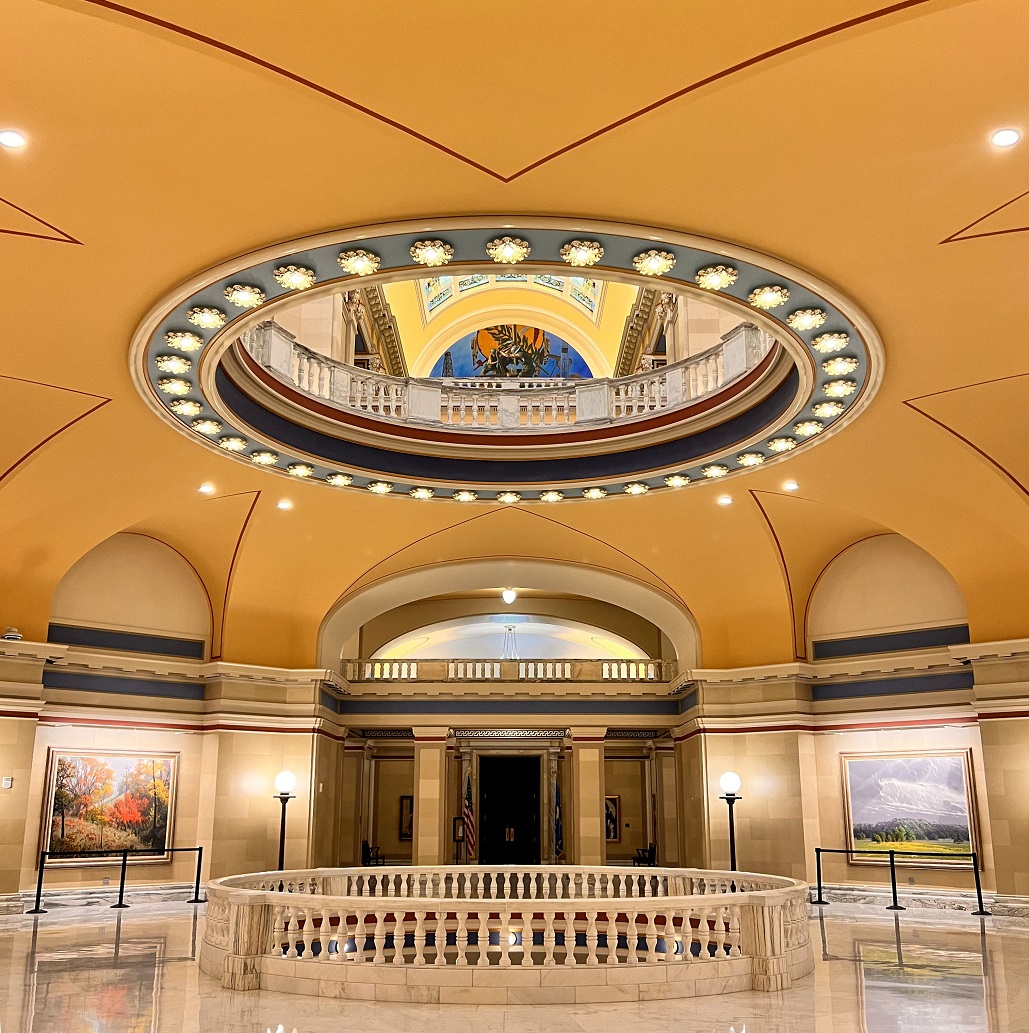
Moreover, we stood corrected about the colorfulness of the capitol! The Oklahoma Capitol is both extravagant in its composition and color, with paintings lined on every wall of the building-even the dome!
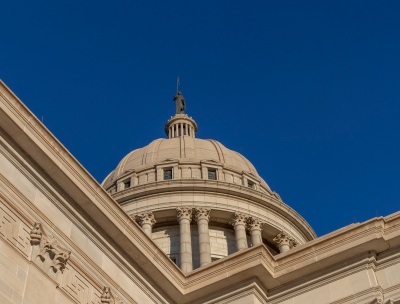
“The Guardian” graces the top of the Capitol Dome…
…and a replica of the statue is also inside.
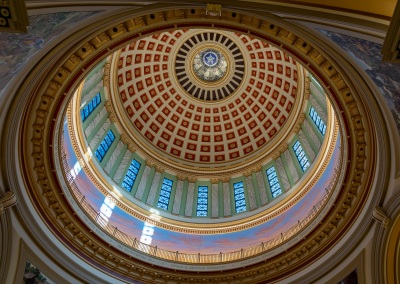
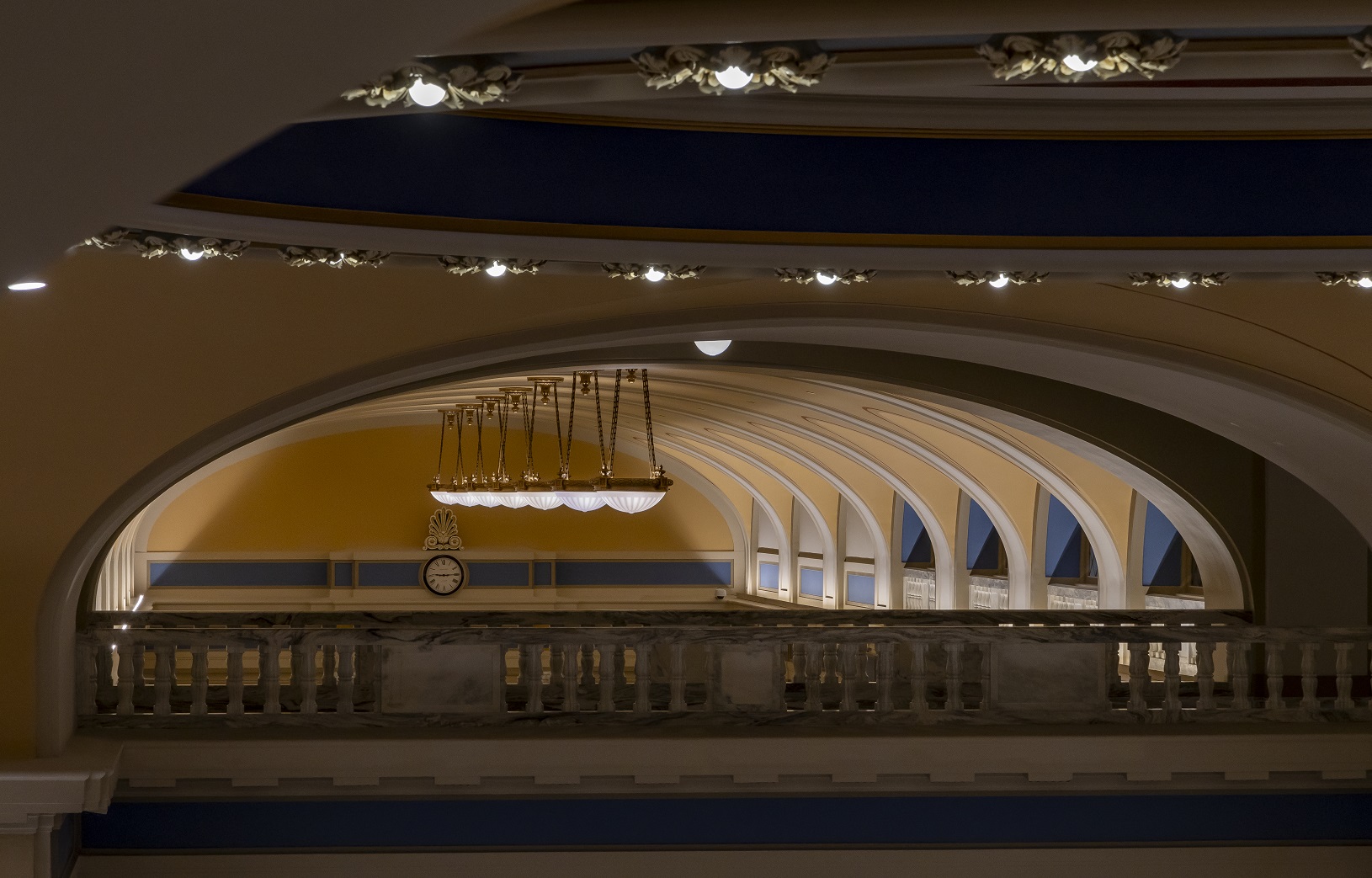
And the capitol dome’s interior was beautiful!
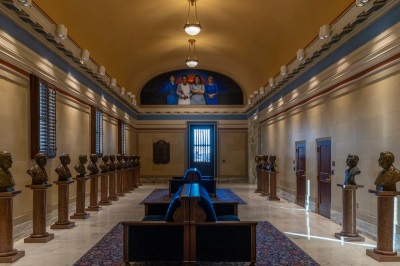
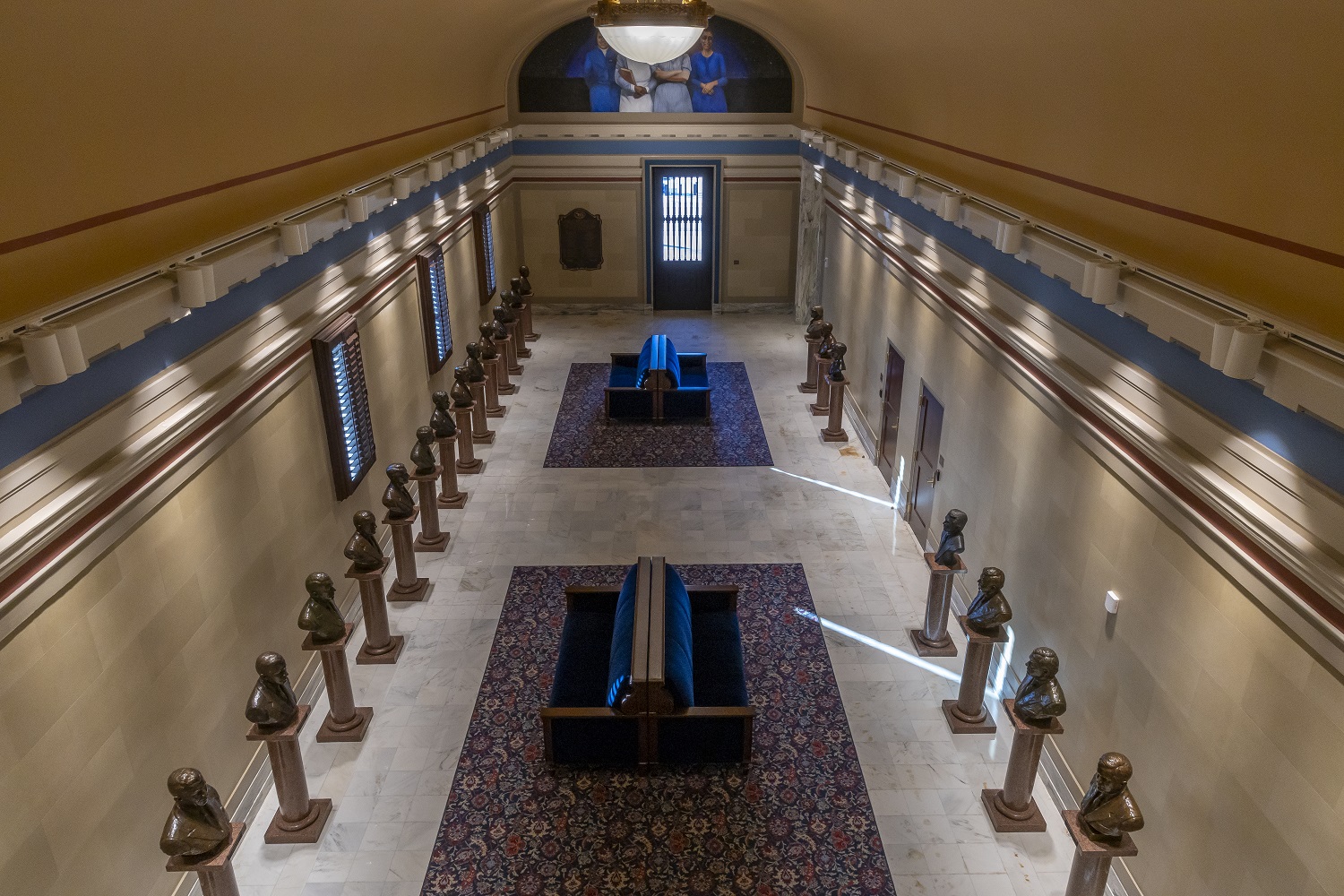
Of course, it goes without saying that there were several pieces of Oklahoma history in this building. There is something to be said, however, about the manner in which the history is represented in its art collection, which included a room dedicated almost exclusively to busts of its former governors…
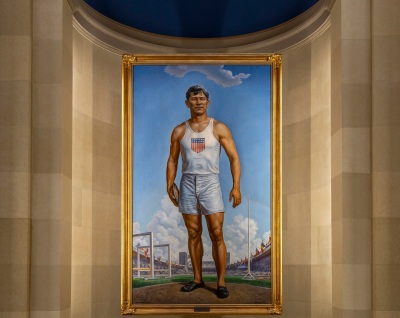
…as well as murals of some of its most impressive native sons.
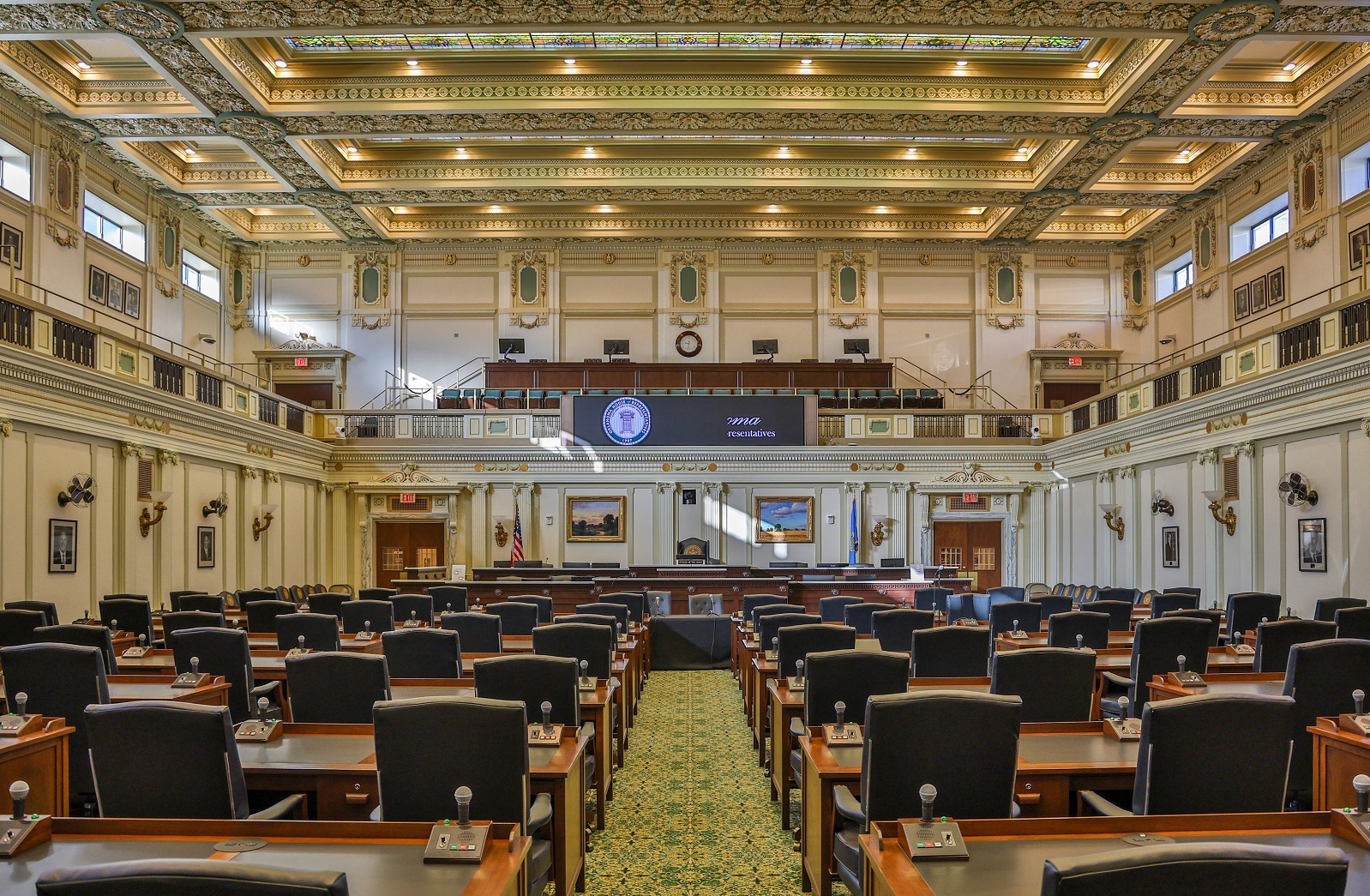
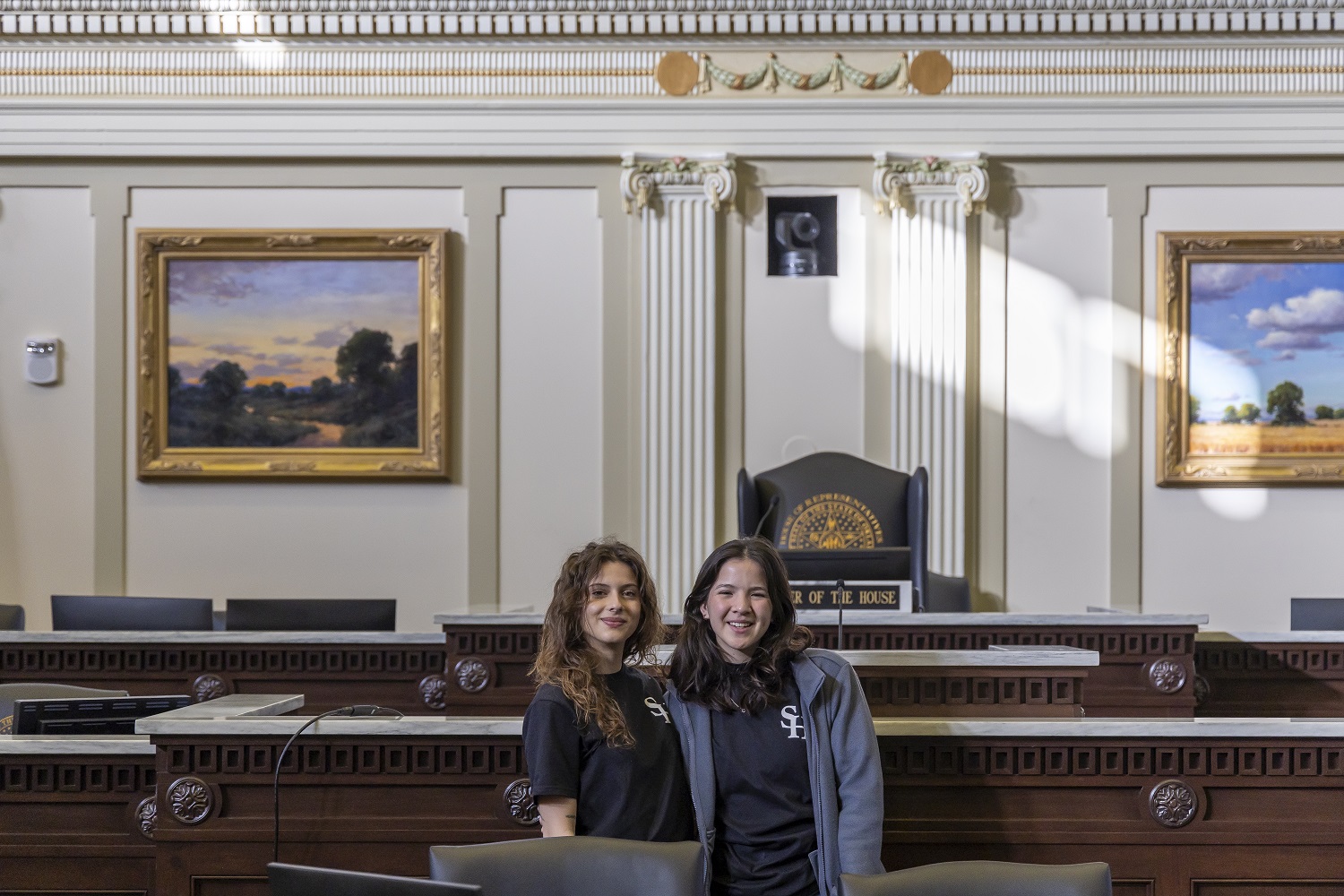
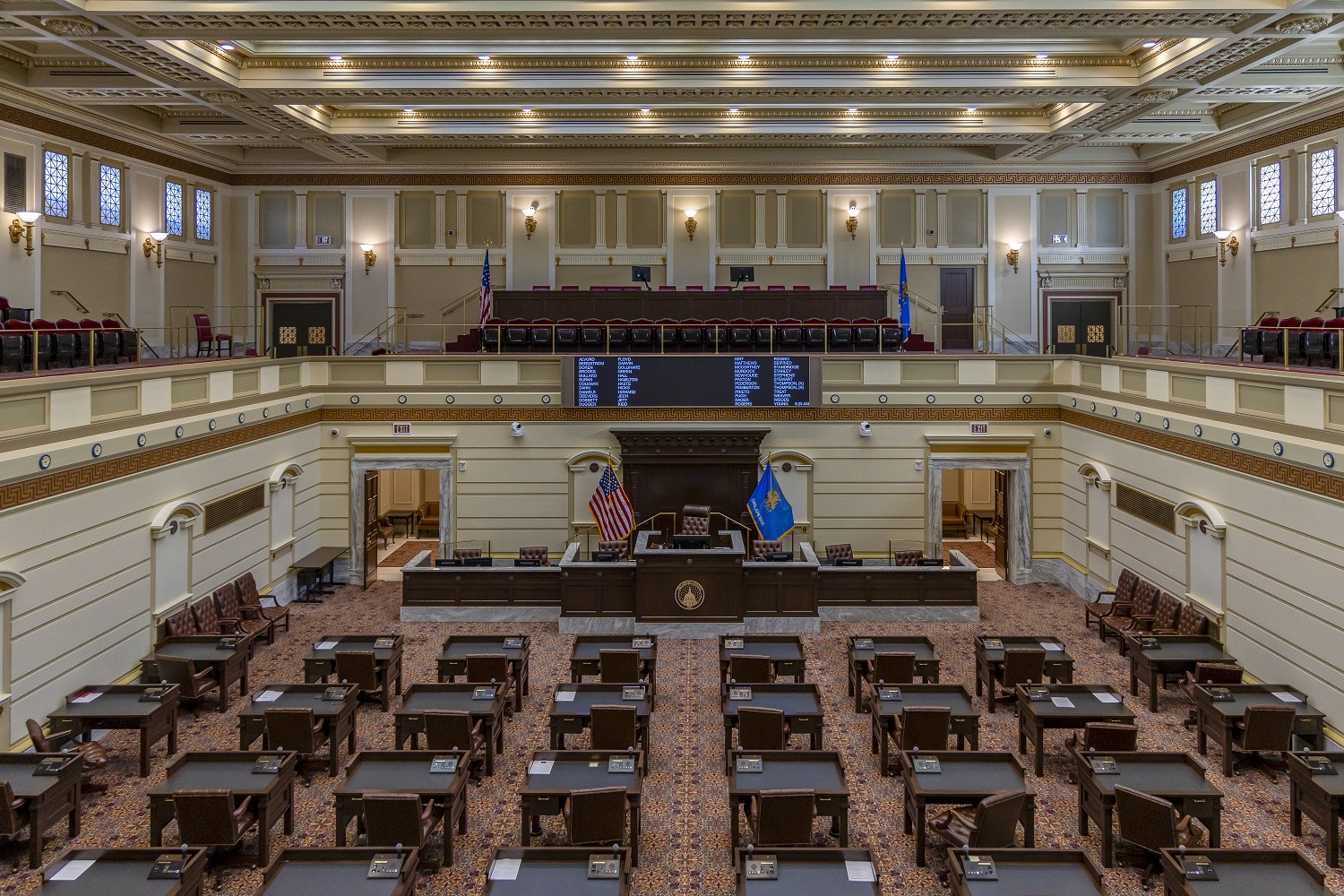
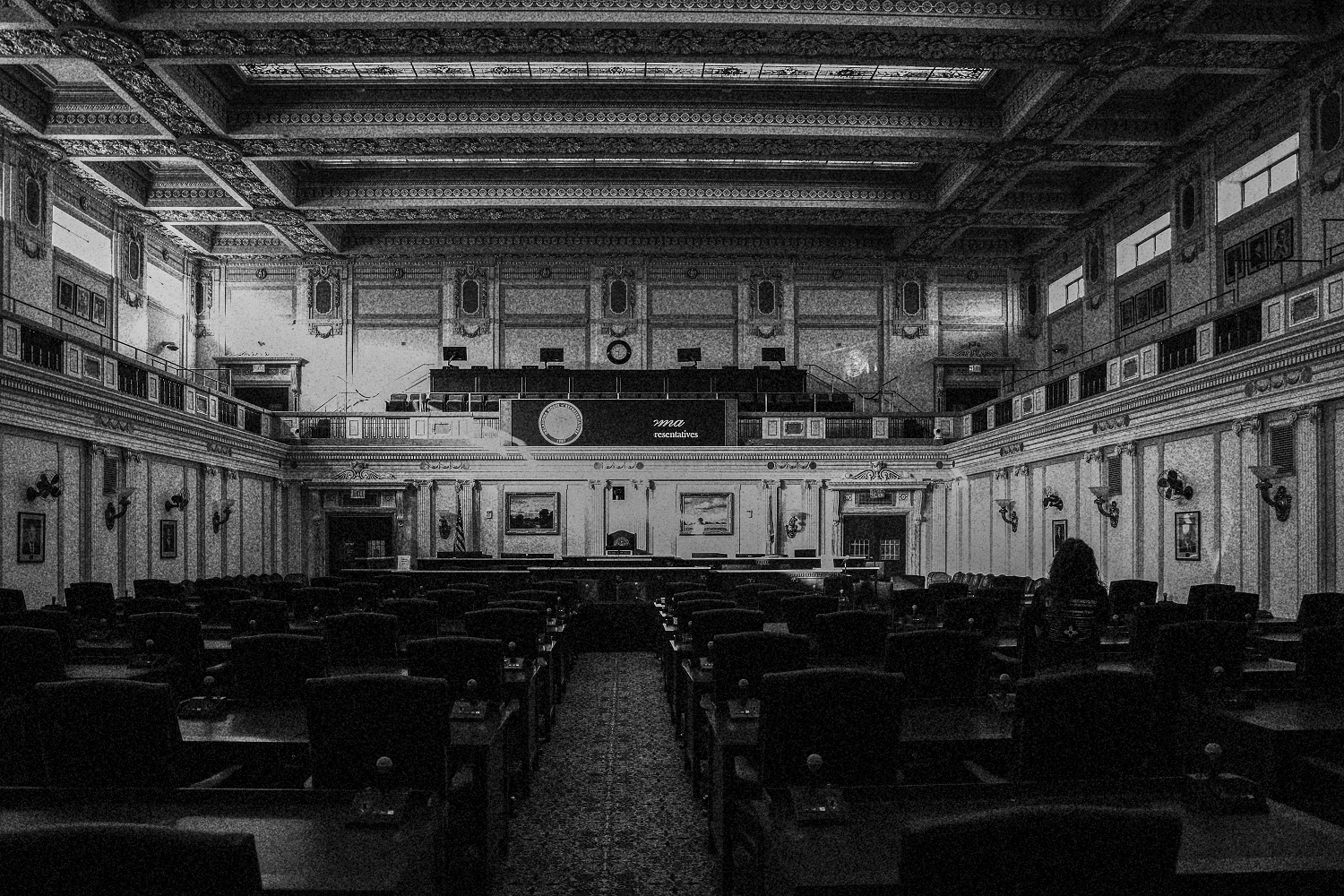
We had the chance to step into the House and Senate Chambers, both of which had their own themes. The Senate Chamber had its beautiful stained glass ceilings and brown hues, and the House had a serene ambiance, intricately carved floral ceiling tiles, and lots of green. Both, in their own right were simply stunning!
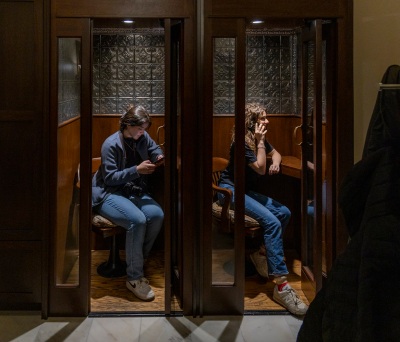
And, although we are bloggers, we don’t often feel like journalists–until today. Following some time in the chambers, we undertook another first: using a phone booth!
Although no longer equipped with phones, it still serves its purpose of giving journalists a quiet space to work or call their editors following eventful days in the state legislature. For us: we would just like to “report” that we had a fantastic time!
For Cinthia, this was her third capitol building, all visited in the past two years. For Olivia, it was her fifth capitol building, all visited in the past two years. These won’t be the last.
Following our adventure at Great Sand Dunes National Park, we made it back to the tip of the Texas Panhandle: Dalhart, TX. Our goal for today, was to get to Amarillo, then to Canyon, TX, and make our way to Oklahoma City. It was–both literally and figuratively–a whirlwind visit. We literally saw our first-ever tumbleweeds.
Cadillac Ranch
As we approached Amarillo well before noon, we stopped at Cadillac Ranch, a unique art installation. We had never seen it before, and what a sight!
Some nice people visiting loaned us some spray paint, and we left our mark!
It was a nice stop amidst the flat Amarillo landscape, made much more colorful by art.
Panhandle Plains Museum
Located on Texas A&M’s West Texas campus, the Panhandle-Plains Historical Musuem. Within the largest history museum in Texas, we had the ability to outline Texas history from indigenous settlement and conquistadors to where we are today.
A collection that served as a great conversation starter was ‘High Fashion to the High Plains’. Here we found an extensive wardrobe from high fashion designers such as Chanel and Emilio Pucci that are representative of the fashions of West Texas over time.
While this is a West Texas museum, we were most enthused with the East Texas representation in their ‘Art of Texas State Parks’ collection!
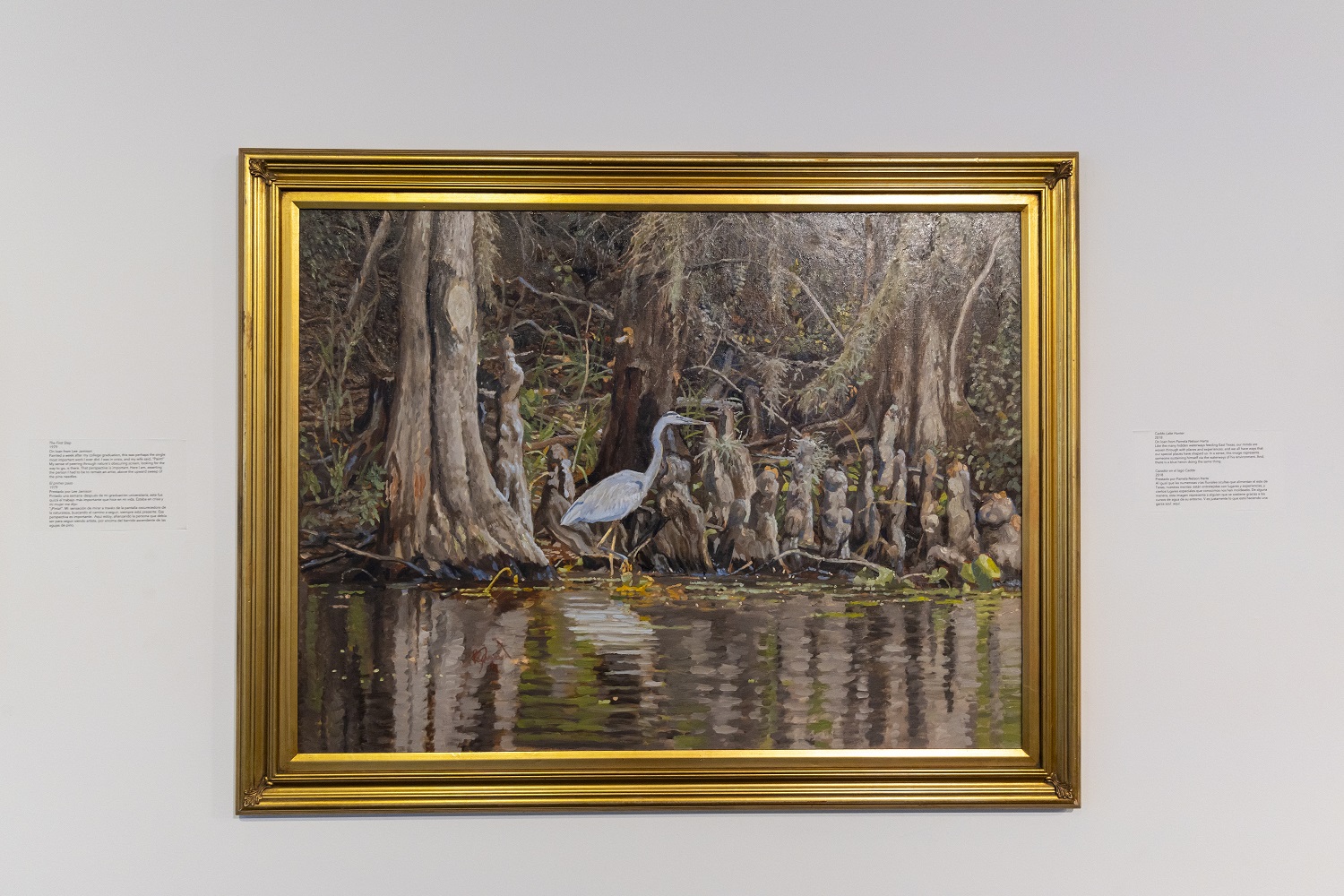
We saw artist and friend Lee Jamison’s work in the museum’s collection. While we are huge fans of all of Mr. Jamison’s paintings, our favorite one from the museum was of the Grave of Hubris, San Jacinto Battleground State Historic Site.
I thoroughly enjoy the vibrancy of the landscapes Mr. Jamison creates, whether or not the scene itself is particularly bright. His paintings serve as a reminder to appreciate even the most simple of your surroundings, as there is an innate intricacy to each of them.
Palo Duro State Canyon Park
On such a fitting note, we ventured to the Palo Duro State Canyon Park to capture the scenic views on our last outdoors trek of the trip.
It may be sheer coincidence, but we truly saved the best hike for last! There was truly so much to see while on this short trail, with a different vista under a beautiful sky at almost every turn.
Maybe it was the fact that we had previously been immersed in scenes covered in pillowy white snow, but there was something awe-inspiring about looking over the cliff to see the red-casted landscape.
Photo by Olivia Discon
We explored far more than we anticipated we would, walking out to every outcrop…
Cinthia Villarreal Enjoys the View (not so much the wind); Photo by Olivia Discon
…looking over ledges…
Photo by Cinthia Villarreal Carrillo
…and climbing as many hills as possible.
We did our best to soak it in…
Photo by Olivia Discon
…and explore the area they call “The Grand Canyon of Texas.”
In fact, we didn’t really want to leave, but we wanted to get one more hike in, so we returned to the car.
Our last hike was the “Hole in the Wall Trail,” so named for obvious reasons!
This short hike involved a walk up to a cave. Although short, it was a somewhat rugged walk, and it was also filled with colors and different types of rocks.
The area immediately outside the cave offered interesting views of the landscape.
Photo by Olivia Discon
In the cave were three different holes in the top, and these looked intriguing to us–so much so that we found a way up to the to the top of the hill.
Olivia: “I don’t think I like this.”
We made it to the top after much climbing and scrambling, and climbed a way into the hole.
We also got interesting photos through the hole, from our vantage point!
Photo by Cinthia Villarreal Carrillo
I may have been a bit apprehensive to make the climb, but Cinthia was a voice of encouragement (or perhaps she was just more confident than I), and we made it to safety.
While we already live and learn in the great state of Texas, this was a completely new and refreshing day for everyone. However, it was not time to turn back home just yet! We packed our bags and headed towards the last state of our Southwest tour, Oklahoma.
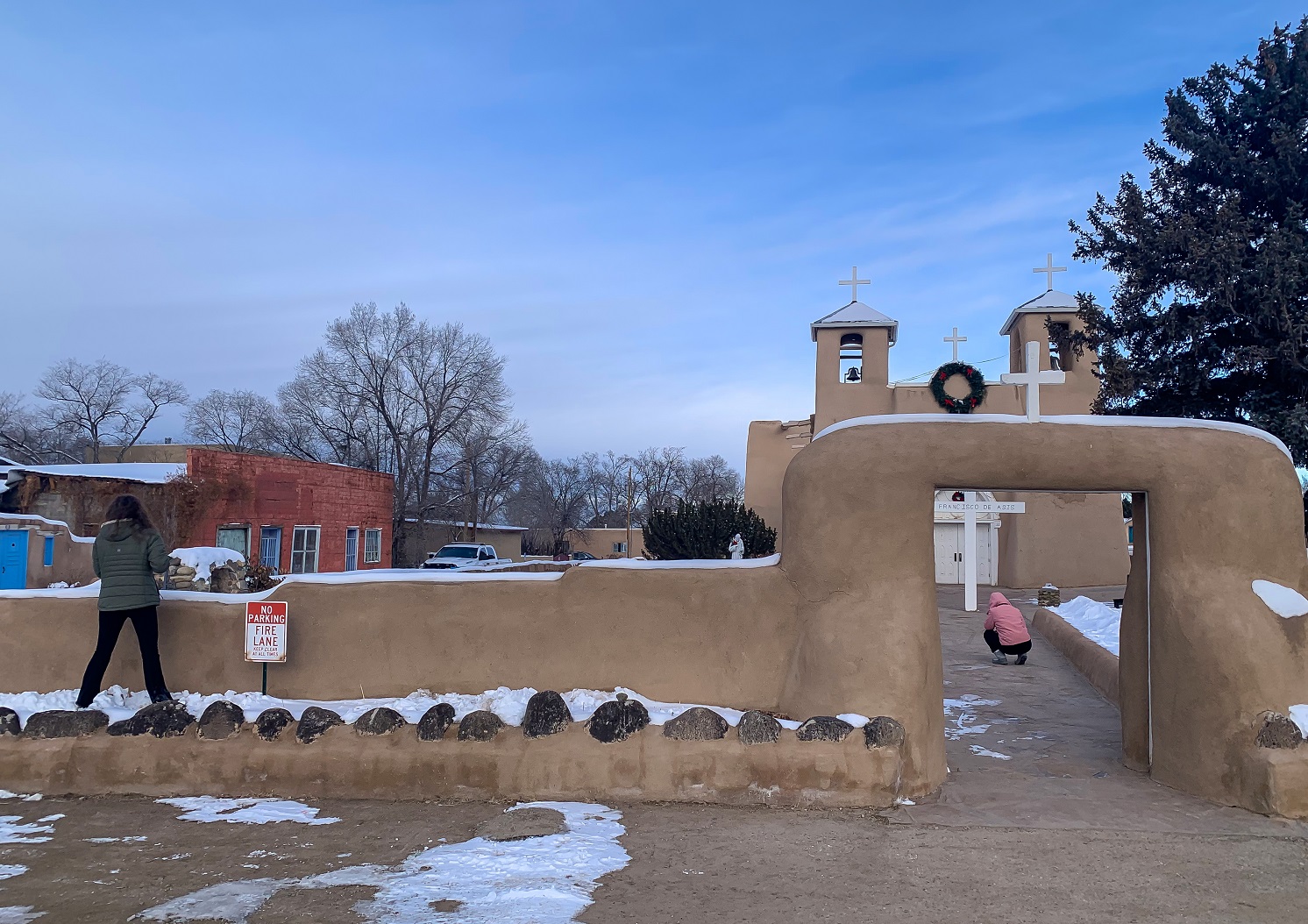
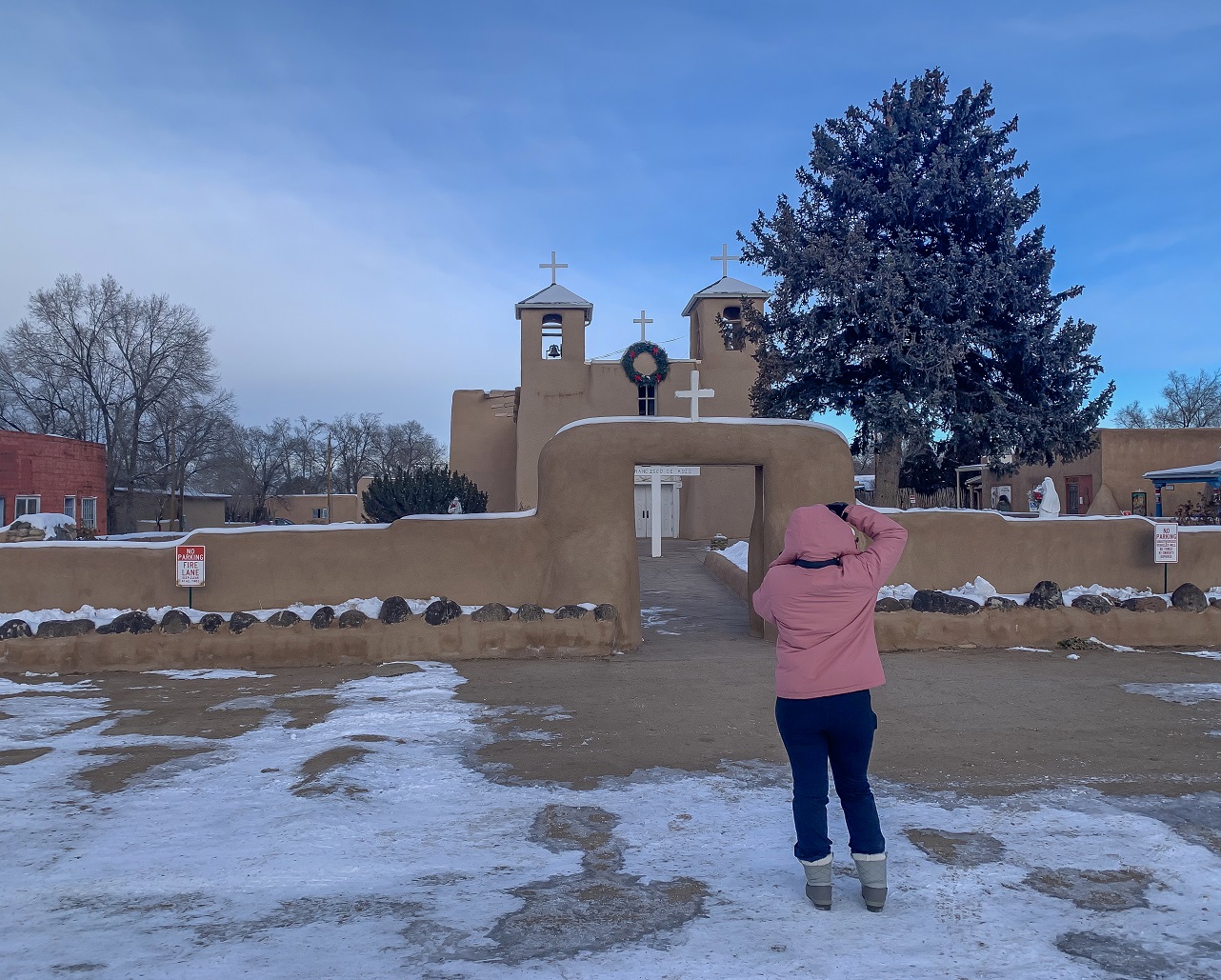
While our time in Taos was brief, we wanted to maximize our chance to photograph the famous San Francisco de Assisi Mission. Upon arriving last night, we left our hotel–in temperatures of about eight degrees–to photograph the famous mission.
Construction began in the late 18th century and was completed in 1816. The Spanish settlements featured key aspects of their mission and culture, with churches being centrally located within a plaza that was easy to defend.
Although the Mission has been endlessly photographed and painted, we haven’t seen a lot of night scenes. Part of that may be that, as we found out, is that it is difficult to photograph at night.
To the extent that the temperatures and light allowed, we did our best to photograph the building. With the many lights in the front of the building, we were drawn to the building’s rear, with its beehive buttresses and intriguing contours.
Photo by Olivia Discon
I was able to get a night shot, without some of the distracting street lights. But these lights did drown out some of the stars that we would have liked to have seen.
Fortunately, we were able to try again early the next day, just as it was being touched by the morning sun. Having the chance to view this structure in two different capacities was not only exciting to witness, but also to photograph!
Cinthia and I got the chance to be creative and capture our separate perceptions of the church and how it interacts with its landscape.
Photo by Cinthia Villarreal Carrillo
Intriguingly, the community meets every June to use a mixture of mud and straw to repair the exterior adobe. Seeing the structure in person, it’s easy to see why the community is attached to it–and why tourists, such as us, flock to it.
Photo by Cinthia Villarreal Carrillo
It’s also easy to see why artists and photographers flock to it. In fact, several people we spoke with described it as one of the most photographed churches in the United States.
San Francisco de Assisi, by Ansel Adams
That is certainly evidence from the different art galleries and museums we visited!
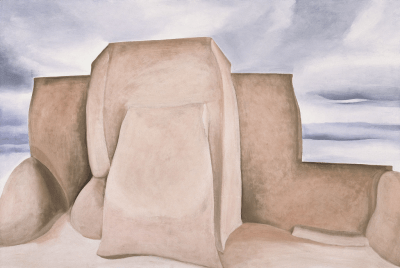
San Francisco de Assisi, by Georgia O’Keeffe
It was, in short, a beautiful way to end our time in New Mexico!
Although it was our last day in Santa Fe, it was a day packed full of eclectic adventures and learning. On tap: A tour of the New Mexico Capitol building; a tour of Allan Houser’s art studio; and a hike up Sun Mountain.
After some coffee at CrashMurderBusiness, we headed to the Capitol, where Marylynn Collins was waiting to educate us on the workings of the New Mexico government.
As aspiring participants in Sam Houston State University’s SHAIP program (where students are placed in legislative offices in the TX Capitol), this was of particular importance to us. Cinthia and I have been to 5 Capitol buildings between the two of us, so this visit allowed us to compare how the New Mexico Capitol compares to other states.
Mrs. Collins started the tour by taking us to the center of the capitol’s rotunda. In contrast to most other state capitol buildings, the New Mexican capitol is shaped in a circular manner and has no dome. The reason, Mrs. Collins explained, is to signify the circle of life portrayed in the Zia symbol. The roof of the rotunda is intricately done with stained glass, the shape of which signifies a pueblo basket and the orange and blue colors signify the earth and sky.
The Zia symbol was adapted by the New Mexican people from the Zia Pueblo tribe and, as mentioned above, it portrays a circle in the middle with four sets of four lines coming out of the circle in four different directions. Each of the sets are symbolic in four different capacities: the four seasons of the year (Spring, Summer, Fall, and Winter), the four stages of life (infancy, youth, adulthood, and old age), four times of the day (dawn, daylight, dusk, and dark), and the four cardinal directions (north, south, east, and west). The symbol is also portrayed in the state flag is seen and used throughout the state.
Something that also sets this state apart is their official state question, “Red or Green?”. This was strange to us before the trip, but New Mexico is very fond and proud of being the home of the green and red chile, which is deeply engraved in their state’s culture and which we have had the opportunity to try in a variety of dishes and restaurants along the trip. Mrs. Collins also mentioned that this is the only state with an official scent; an aroma of roasting green pepper in the air.
We then stepped into the second floor of the “Round House” where we were able to admire the huge permanent collection that filled the walls. Consisting of work from regional artists with different styles and techniques, the paintings, even though completely contrasted one to another, represent the state’s cultures throughout the centuries. While admiring the art work, we were able to see some new artists and also recognize some of the artists we have been learning about, our favorite being Anderson’s “Canyon Segundo”…
Unfortunately, we had to rush from our capitol tour to get to our next stop: Allan Houser’s studio. Even more unfortunately, we learned that because of the massive amounts of snow that had fallen, the Houser Studio was cancelling the tour. But, ever resourceful, we switched gears and visited Houser’s downtown gallery, where we saw 30-40 of the Native American artist’s works.
We had previously seen his works at the Albuquerque Museum, at the New Mexico Capitol building..
…and, in fact, at Professor Yawn’s house, so it wasn’t entirely new to us. But we appreciated seeing the diversity of his art, and the gallery generously gave us–or, rather, SHSU–a very nice book of all of Houser’s works.
With more time on our hands, we ventured over to the Loretto Chapel, where we were able to see another church and another architectural marvel.
Known around the world as the Miraculous Staircase, this winding spiral staircase has left architects in awe of the pure physics of its composition.
Taking two 360 degree turns, its impossible to say how it has managed to sustain itself with neither support beams nor nails.
As we took a moment to marvel at the beautiful chapel ourselves, we also took the time to look around the many gift shops that are connected to the chapel and picked up a few souvenirs for ourselves and our loved ones.
Santa Fe is a charming town that we have come to cherish over a mere two and a half days.
The second leg of our trip is focused on activities and individuals in Santa Fe, NM, and it was to this destination that we set out early Sunday morning. Armed with coffee (and muffins) from Que Suave, we stopped by the Old San Miguel Mission in Socorro as a way to learn more about New Mexican culture…
…but also to practice our skill at architectural photography.
San Fancisco de Assisi, Golden, NM
Leaving Socorro for Santa Fe, we opted for the “Turquoise Trail” rather than simply taking the quickest route. This allowed us a more scenic drive, while also giving us the chance to stop in some smaller towns along the way. One of these towns was Golden, NM, where we stopped to see another Church: The St. Francis de Assis Catholic Church. It’s a beautiful church, surrounded by the graves of parishioners.
We also stopped in Madrid, NM, a wonderful little town that is as charming as it is unusual. We purchased more than two pounds of chocolate at Shugarman’s. Olivia and Cinthia were not expecting to buy chocolate, but after sampling some of the intriguing flavors (e.g., Hibiscus Flowers with Lemon and Ginger), we were hooked.
Indigo Gallery
by Olivia Discon
One of the first places we visited in Madrid was the Indigo Gallery, owned by artist Jill Shwaiko. It seemed to have been the perfect day to stop in, because the artist herself was in the gallery and ready to share some of her work with us! Her work commonly features a thought-provoking goat/sheep motif, along with inspiration from the petroglyphs of indigenous people.
Ms. Shwaiko strives to capture emotions such as perseverance, strength, and frailty in her art, and this is apparent when looking at her work. She also uses vibrant colors, and she even provided us with a mini-lecture on color theory! Her work brought forth many new perspectives, and her lessons resonated with me. Most of all, she encouraged us to experience life, not just survive it. On a special, fun-filled trip such as this, what better advice could one have? We all left Ms. Schwaiko’s gallery excited for what other excellent experiences we have in store.
Olivia, Cinthia, and artist Jill Shwaiko, in Madrid, NM
Finally, we stopped by the Mine Shaft Tavern for our daily fix of food that includes green chile, a semi-must while we are in New Mexico. We had green chile stew, green chile chicken pizza, and the green chile cheeseburger–the latter of which won “the green chile burger smackdown.” The food was excellent!
Santa Fe
When we arrived in Santa Fe, we immediately went to the Plaza. The Plaza is rich with history and many other attributes, so it was a nice way to begin our Santa Fe journey. Our first stop was the Palace of the Governors, where Native Americans are given exclusive rights to sell their products as long as they meet certain requirements (one of which is that the work must be hand-made).
We bought a total of three pieces of art/jewelry from different vendors, and we very much enjoyed learning about the program and the lives of the artists.
Olivia Discon, Cinthia Villarreal, and artist Jeremiah Herrera
New Mexico Museum of Art
by Olivia Discon
To continue our pursuit of immersing ourselves in the New Mexican art scene, we stopped by the New Mexico Museum of Art on the Santa Fe Plaza. Here, we were able to discern several familiar names which we have grown accustomed to while on our tour of the southwest, especially John Nieto, Jesus Moroles, and Allan Houser. But we also had the opportunity to learn more about New Mexico through some artists we hadn’t yet familiarized ourselves with. In my case, I took to a painting by Joseph Henry Sharp, titled “The Stoic”. The size of the piece would be sufficient to capture one’s attention, but it was also captivating in its composition.
“The Stoic,” by Joseph Henry Sharp
Interestingly enough, Sharp was one of the first Americans to visit, and remain in, Taos, New Mexico, and he is regarded as the ”spiritual father” of the Taos Art Colony.”
An artist that was new to Cinthia and me was Fritz Scholder, and we saw his work in various locations and on various media. At the New Mexico Museum of Art on the Plaza, we were able to see a few paintings of his, the most interesting of which was a self portrait.
Fritz Scholder, “Self Portrait”
A close second for the group was a totem of his in the sculpture garden!
Fritz Scholder, “Totem”
The New Mexico Museum of Art on the Plaza also has an auditorium that resembles a chapel, with beautiful murals lining the walls. My personal favorite mural was “The Apotheosis of St. Francis”; a scene that personifies the humanities. Art, religion, literature, philosophy, and society can be seen as gifts of St. Francis to humanity. It was particularly enjoyable to decipher which personification matched which discipline (I implore the reader to guess themselves).
In all, this museum was the perfect place to learn further about New Mexican art, along with reinforcing some of the art that we have come to know and (mostly) love.
The Georgia O’Keeffe Museum
by Cinthia Villarreal
In case it has gone unnoticed, art is an essential part in LEAP’s interdisciplinary philosophy. Learning about different artistic styles, media, eras, and artists contributes to our broadened horizons and cultural awareness. With that, it was essential that we visited the museum of renowned artist Georgia O’Keeffe, who spent her later years in New Mexico. Not all of us are huge fans of work, but even the doubters found many works to enjoy and much to learn about.
To our surprise, the museum provides visitors with an audio tour O’Keeffe’s thought process and life happenings behind several of her works. The art works were divided by different stages throughout her life, which were seemingly different from one another. This helped us watch how she grew alongside her art. One of Olivia and my favorite pieces ended up being a watercolor painting done by O’Keeffe at just 16 years old!
Of course, O’Keeffe is specifically known for her abstracts of flowers and landscapes using bright New Mexican colors;
….nonetheless, she proved her versatility and resourcefulness by painting the skyscrapers and night sky of New York with unusual colors for her palette.
Another period in her life that really resonated with us was when she moved to New Mexico after the death of her husband, Alfred Stieglitz. The artist intensely expressed herself by using dark, ominous abstracts.
As she settled in the new state, she noticed the lack of flowers in the deserted environment around her and decided to change her portrait subjects by collecting skulls and bones. This interesting and unique idea set her apart from the rest of the artists in her time for, again, her creativity and originality.
Olivia’s favorite art work from the museum was “Black Place I” because of its looming gray landscape with some hinted red hues along the bottom of the painting. This is O’Keeffe’s depiction of the American Southwest, which she described as “a mile of elephants”.
Professor Yawn enjoyed the ‘Church Steeple,” and…
…I enjoyed the colorful abstract, “Pelvis.”
Interestingly, O’Keeffe only did three sculptures in her life, and we had the chance to see two of them. The first we saw at the New Mexico Museum of Art–a large sculpture of a spiral shape.
That shape, we learned from the O’Keeffe Museum was actually inspired by a ram’s horn…
…and it’s a figure she also painted…
The other sculpture we saw was a small, semi-abstract.
As our minds expand to appreciate and understand art from a more mindful perspective, we left the museum, but not before stopping at the gift stop for something to remind us of this great endeavor.
It was enriching day, filled with learning, new experiences, and the beauty of Santa Fe. As we left the Museum and re-crossed the Plaza, the sun set, leaving us in the “blue hour,” and it began to snow. With the remaining light of the sun’s glow, reinforced by the Christmas lights on the Plaza, we took a final photo of the day.
In today’s version of a LEAP trip, we learned a lot about art, the law, and the outdoors. And to kick things off, we did all three by heading to Texas Tech’s campus and doing a self-guided outdoor art tour, followed by a guided indoor law-school tour.
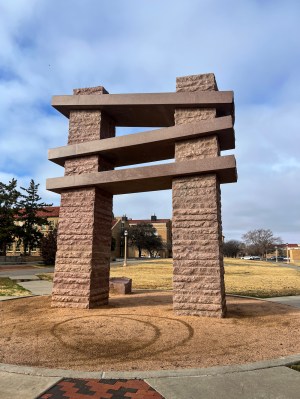
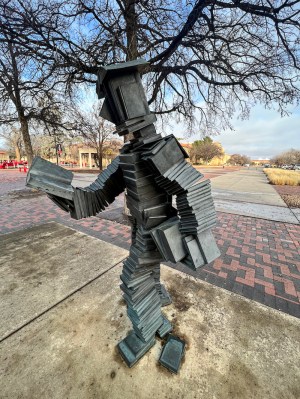
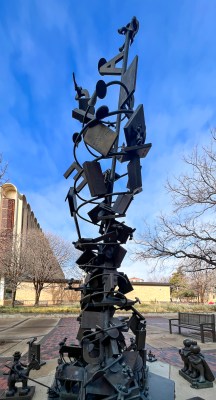
Our self-guided tour was to see what the Texas Tech Campus had to offer, and we were impressed with what we found. We saw a very large James Surls piece…
…several large Jesus Moroles pieces…
….a Deborah Butterfield horse, Terry Allen’s “Read Reader…”
…and Tom Otterness’s “A Tornado of Ideas.”
It was difficult to pick our favorite: Olivia’s was Moroles’s “Lapstrake Portal;” Cinthia’s was Butterfield’s horse.
But our primary purpose for being there was to see the law school, so at 10:30, we met our guide, Katie Moorhead, and we began our tour.
Texas Tech Law School Tour
Cinthia Villarreal
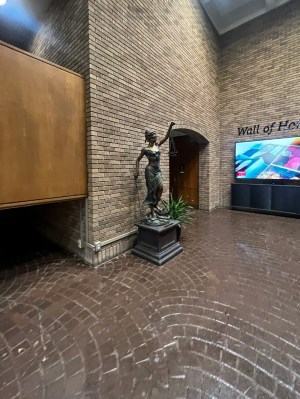
Upon entering Texas Tech School of Law (TTU Law), we were immediately welcomed by the sophisticated ambiance of the building. At this time, it was really beginning to sink in that we were looking at our future. We had the pleasure of meeting with Ms. Moorhead, the Assistant Director for Admissions at TTU Law, who gave us an excellent, in-depth tour of the law school and included her insight along the way. We started with what Ms. Moorhead referred to as “the Goldilocks Bears of classrooms”. Befittingly, there were smaller classrooms, larger classrooms seating 100 students, and regular classrooms that were “just right”!
What was unique to us is that first-year students are personally assigned a study room in the library where they can study, have lunch, or even nap. We weirdly found this custom the most exciting aspect of the building itself, which of course doesn’t even begin to explain the culture and rigor of TTU. For that information, Dwight McDonald, Clinical Instructor and Director of Community Engagement, was on hand to provide. Mr. McDonald made his case for what sets Texas Tech apart from the other law schools. He believes that Texas Tech is unique in that it supports students to practice law with a firsthand approach in TTU’s clinics and curriculum. He was as persuasive as he was collegial!
To our great surprise, we had the honor of meeting former U.S. Congressman and Chancellor of Texas Tech University, Kent Hence. He had nothing but excellent things to say about the law school, and he encouraged us to consider the school upon our graduation. It simply does not get more compelling than that!
Though we already felt incredibly lucky, the enriching tour didn’t end there! We had the chance to take a peek into a seminar on domestic violence. The auditorium was filled with practicing lawyers continuing their intellectual pursuits, and from what we were able to listen in on, the seminar raised some great points in evaluating domestic violence cases. Of course, we had to end our visit with a photo op in the Donald Hunt Courtroom with Ms. Moorhead!
We thank TTU Law for opening their doors to us, Ms. Moorhead for her assistance in coordinating this tour, and Mr. McDonald for taking the time to speak with us.
Out of this World in Roswell, New Mexico
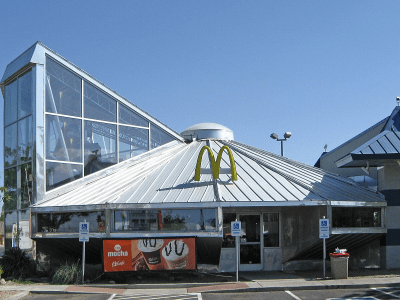
Following our wonderful tour, we grabbed food on the go so that we could get to Roswell, New Mexico. Knowledgeable readers are likely to know that Roswell is best known for what may have been an alien encounter in 1947. There was a lot of evidence of this history throughout the town, which is covered in all things alien. The street lights are alien heads; there are little plastic green men on every block; and even the McDonalds was shaped like a flying saucer.
But we did not visit Roswell just to make Cinthia feel at home. Rather, we went to this strange little town for its art. It is home to the Roswell Museum of Art, as well as the Anderson Museum of Contemporary Art—the latter of which we visited. It’s a wonderful museum.
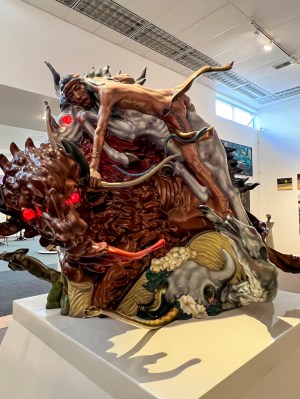
Like every contemporary art museum we have ever been to, there was art we did not care for; art that we weren’t sure if we cared for, but that made us think; and art we really enjoyed. Luis Jimenez, the most famous of the artists in the collection, had works that fell into all three categories for us.
His work is interesting, and, in fact, the AMOCA has more Jimenez pieces on display than other museum in the country…
…but Jimenez can also be out there.
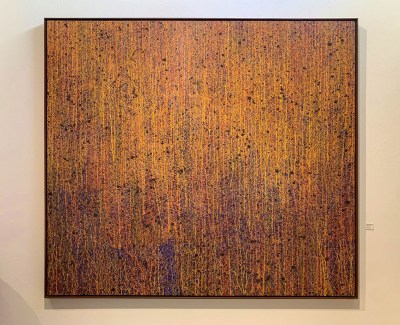
We also really liked the work of Donald Anderson, and we all had our favorites of his many pieces in the collection. In fact, it was Olivia’s favorite artist! Professor Yawn also really liked the work of Elmer Schooley;
Stephanie’s favorites were by Howard Cook; Cinthia’s favorite was Peter Zokosky’s “Skeleton in Landscape.”
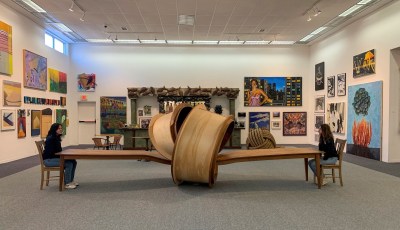
There were fun pieces, too. One artist made sharks that hung from the ceiling, which would have been terrifying, but they were made from golf bags and, in one case, a vacuum cleaner. Jason Richel’s work gravitated toward stackable food objects, including smores and toast. Moreover, as LEAP Ambassadors, we also tried to kill two birds with one stone (or, as we were taught in a training once, to “feed two birds with one scone”) by not only enjoying the art, but also by working on our communication skills. This was done by sitting at a special table designed to foster teambuilding…
It was a fun visit, and one in which we blessedly didn’t encounter even a single alien, plastic or otherwise. We did, however, have the good fortune of meeting pleasant staff and learning about some new artists.
We didn’t have a lot of time, but we wanted to try out some new (rented) camera equipment and see if we could spot some wildlife.
We were struck by the calm blue of the water, as well as the prime habitat for animals.
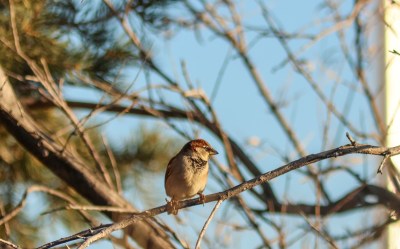
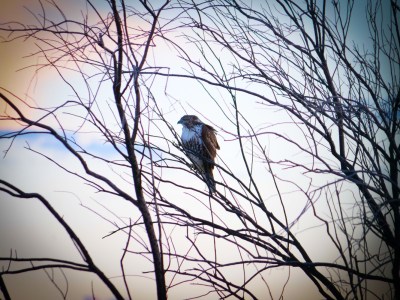
Birds were a bit scarce despite a landscape (wetlands) designed for birds, but we saw several hawks…
…sedges of sandhill cranes, flocks of red-wing blackbirds…
and the rare treat of seeing an owl—at pretty close range, at that!
Calling it a Night
We capped the evening with dinner in Ruidoso. The dinner was fine, but the real treat for these two Texas girls was seeing snow. Not the icy snow that occasionally sprinkles on Huntsville and causes havoc; nor the icy, slushy, and wet snow blown out for the Christmas Fair. This was real, recently fallen, snow! So, to commemorate this occasion, we flocked to the parking lot snow, which was dirtier and more icy than the snow on the ground, but which had the advantage of having already been piled up. Thus we were able to more quickly make the world’s most frightening snow man.
With this masterpiece under our belts, and with an early and cold morning in store for tomorrow, we called it a night.
It was an early morning for a Thursday during a Christmas break. But it was a LEAP trip, so of course it was early. With a first-day itinerary that included a law-school tour, two art museums, and an eight-hour drive, we needed to begin at dawn.
TAMU Law
By Cinthia Villarreal
As aspiring attorneys and with “Law” representing the first letter of the LEAP acronym, the first stop of our Southwest Trip was, naturally, the Texas A&M School of Law (TAMU Law)in Fort Worth.
Olivia and I walked through the front door thrilled for the tour that awaited us. I was personally elated, as this was my first time ever being in a law school. Dani Cortez, the Admission Recruitment Coordinator, was kind enough to set a tour for us with current TAMU Law Ambassador, Dalia El-Giar.
As a second year law student, Dalia was able to share a firsthand account of the law school and was candid about her journey so far, which included the typical class environment, internship opportunities, and housing.
We started at the Dee L. Kelly Law Library, which happened to be our favorite aspect of the visit; the coolest feature of this library being the motorized bookshelves! After she showed us the classrooms, courtrooms, and the lounge areas, we couldn’t resist but imagining ourselves sitting in one of those chairs as law students. Throughout the tour, we learned about the resources the school offers which range from international travel opportunities, externships, to legal clinics. TAMU Law is one of the top law schools in Texas, and getting a glimpse of the school’s culture truly made our aspirations a bit more realistic and a lot more exciting.
We then had the opportunity to talk to Mr. Cortez to address any questions about the tour and admission process. When we asked about personal statements, he emphasized the importance of showing our personality and passions through our writing. Before ending a very successful tour, it was an absolute must to visit the school bookstore and buy some matching swag! Many thanks to the A&M School of Law staff for their hospitability, Mr. Cortez for his kindness and insight into the admissions process, and Dalia for her approachableness, honesty, and eagerness to share her perspective as a student.
Architecture & Art
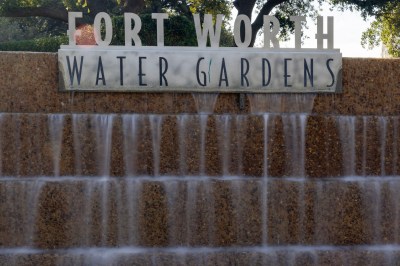
Following our wonderful tour of TAMU Law, we hustled to a couple of nearby architectural marvels. The first was Philip Johnson’s Fort Worth Water Gardens, right across the street from the law school. Designed to neighbor the Fort Worth Convention Center, the “gardens” have at least five components: an entrance…
…an “aerated” pool…
…a quiet pool, a mountain, and a sunken water garden.
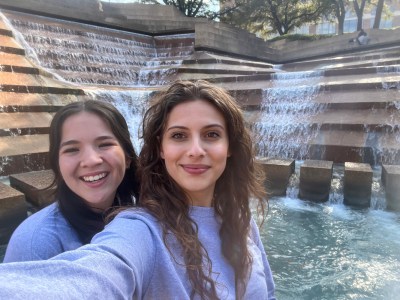
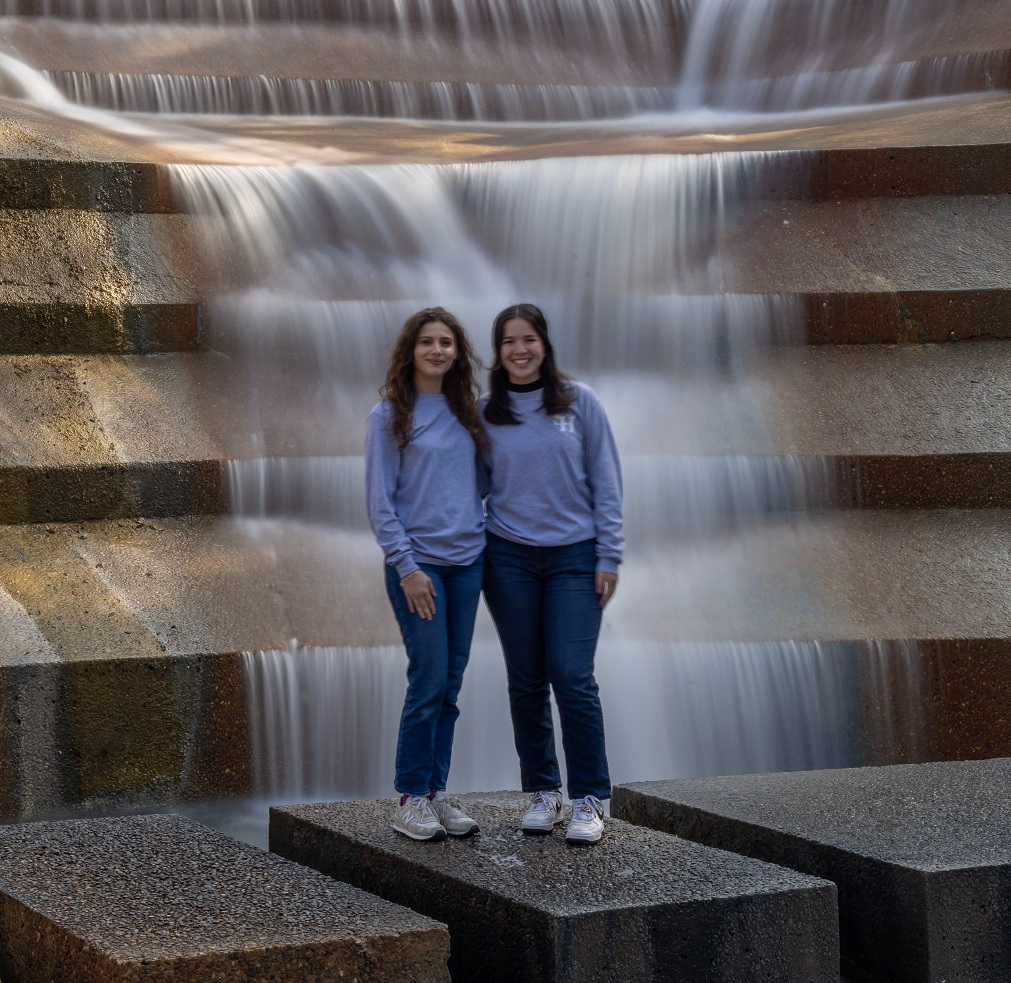
The latter element was fascinating, with its many layers and levels for water to cascade down—not to mention the steps you can skip across to access the lowest tier. It was on this tier that we posed for a long-exposure photograph—one that emphasized the cascading nature of the water (and our ability to stand still for eight seconds….).
With both of us working for the City of Huntsville, we also had to stop by Sundance Square to see the Richard Haas mural of the Chisholm Trail. This is a piece that completely transformed this area of Fort Worth, and it is also one of the pieces that prompted Linda Pease to reach out to Haas to do art work in Huntsville.
Such adventures, however, only foreshadowed our art experiences to come.
Amon Carter Museum of American Art
The first of these was the Amon Carter Museum of American Art. Here, we were able to refresh our familiarity with Frederic Remington, whose work pervaded the museum.
We saw this western motif in many of its manifestations. Much of the collection from the 19th century, which included artists such as Albert Bierstadt, Thomas Moran, and Martin Johnson Heade, involved western symbolism. Moreover, we had a chance to see several of Georgia O’Keeffe’s works, including her painting of the San Francis de Asis, which we will be seeing later this trip!
It was a great visit, a chance to brush up on some artists and learn new artists.
The Old Jail Art Center Museum
A couple of hours from Fort Worth is one of the state’s best hidden gems: Albany’s Old Jail Art Center.
Their collection, which consists of more than 2,000 pieces, includes such luminaries as Paul Klee, Picasso, Thomas Hart Benton, Amedeo Modigliani, Peter Hurd, Bror Utter, Jesus Moroles, and James Surls.
We met several of the staff, all of whom were very nice. Kellie Bellah was on hand to greet us and get us started in the Museum; Patrick Kelly, the Museum’s Director, gave us a tour; and Amy Kelly, the Museum’s Collections Curator, gave us some in-depth information about several pieces in the collection. They were nice enough to take us to the “vault,” where we had a chance to see a Benton, two Grant Woods, two Picassos, an Alexander Calder mobile, and a Charles Pebworth!
While we immediately recognized the Surls’ piece in the Museum, it took us a minute to identify the Moroles’ pieces in the courtyard. In retrospect, the pieces should have been pretty easy to identify, but they were different than the totems we have seen in the past.
We also enjoyed seeing the artists in their exhibit galleries. Leigh Merrill had some very impressive photography…
…and Karla Garcia had some thought-provoking pieces in the historic section of the Museum—the actual “Old Jail.”
Although art can be intimidating, the fact that the Museum is set in an actual historic jail made us both feel right at home!
Seriously, though, it was a great first day on our southwestern tour: law, art, and architecture–just a few of our favorite things.
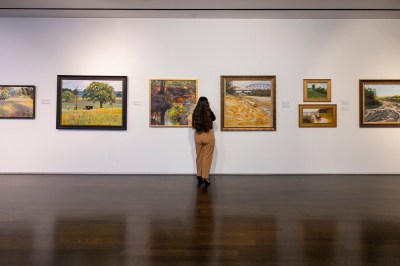
Although the semester has officially come to an end, the learning experiences for the LEAP ambassadors continue. This week we headed to the Pearl Fincher Museum of Fine Arts in Houston, Texas to indulge in “Ode to East Texas,” a beautiful art show created Lee Jamison.
Lee Jamison is currently a resident of Walker County and was kind enough to give us a personalized tour of “Ode to East Texas.”
As a native of East Texas, Jamison wanted to celebrate the true essence and culture of the region. He achieved his goal by highlighting various aspects of the lifestyle in the region such as nature, small towns, people, and even animals.
Walking into the exhibit, one is immediately captivated by the diverse array of colors and techniques used by Mr. Jamison. My attention was particularly drawn to a canvas with warm tones of autumn, one featuring a bridge, titled, “The Turning Bridge.” Interestingly, Mr. Jamison shared with me that the depicted bridge is actually located in Walker County.
During our conversation, he delved into the fascinating history behind “The Turning Bridge,” describing it as a true testament to the passage of time and a symbol of development and evolution. Mr. Jamison took us on a journey, recounting how the Trinity River once served as a port that significantly contributed to the local economy. However, as the locomotive industry gained prominence, the shipping of goods gradually diminished, becoming less and less common.
This poignant narrative woven into the artwork adds a layer of depth and historical significance, transforming “The Turning Bridge” into a powerful reflection on the evolution of the East Texas landscape.
A standout piece within this collection is the homage to SHSU’s iconic Old Main. The building was known for its stained glass, Gothic architecture, and intricate details.
The painting skillfully encapsulated the building’s beauty, but it transcended what was on the canvas. Lee Jamison’s artistic vision took us beyond the two-dimensional realm, delving into different aspects of the structure. Not only did he capture Old Main’s visual beauty, but he also carried on its subtle message to inspire dreams.
Upon closer inspection, it is evident that Jamison is a master of detail. From the intricate play of sunlight filtering through his pieces to the subtle expressions on the faces of his subjects, every element is meticulously crafted. This attention to detail serves to draw the viewer into the intimate moments that define life in East Texas.
“Ode to East Texas” by Lee Jamison is more than an art exhibit; it’s a celebration of a region’s spirit, culture, and natural beauty. Through his mastery of the canvas, Jamison invites us to embark on a visual journey, encouraging a renewed appreciation for the landscapes and stories that shape East Texas.
We express our gratitude to Lee Jamison for graciously taking the time to guide us through his remarkable collection, “Ode to Texas,” and for sharing valuable insights about his exhibition.




























 Center for Law, Engagement, and Politics