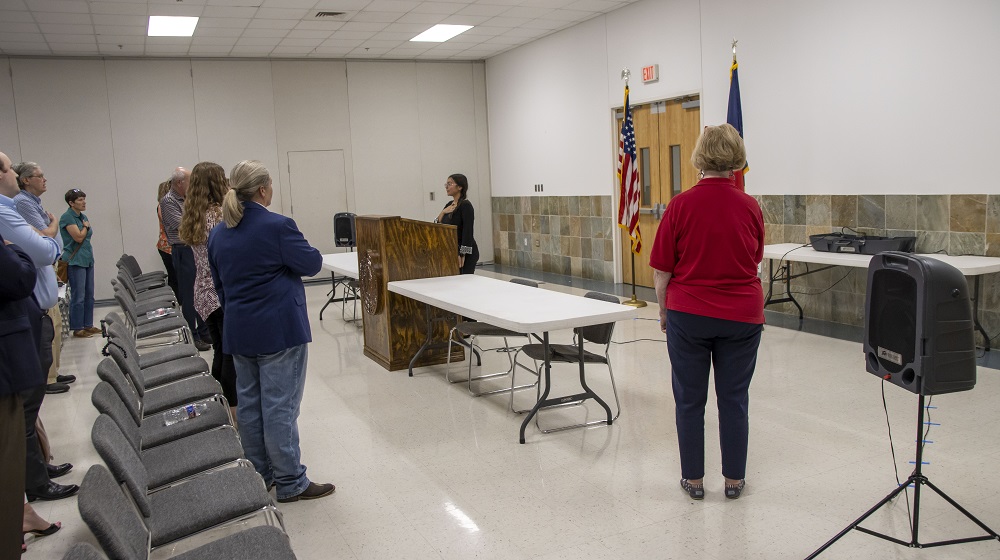
With the primary run-off elections around the corner, the Walker County Republican Party hosted a Candidate Forum for residents on May 10th at the H.E.A.R.T.S. Veteran Museum of Texas, allowing the residents of Walker County to hear from the candidates one last time. And, if residents weren’t able to attend in person, the Huntsville Item lived streamed it so that almost everyone could be informed.
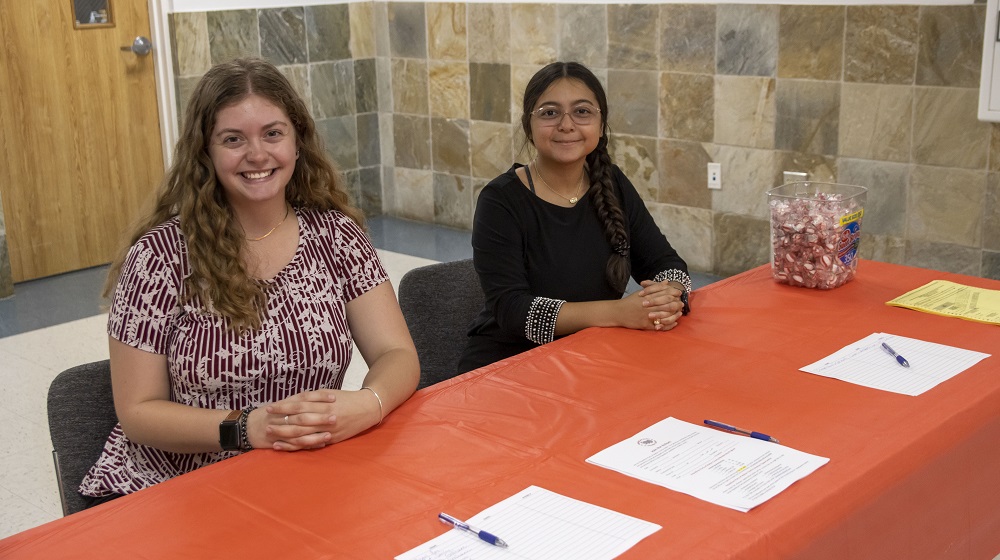
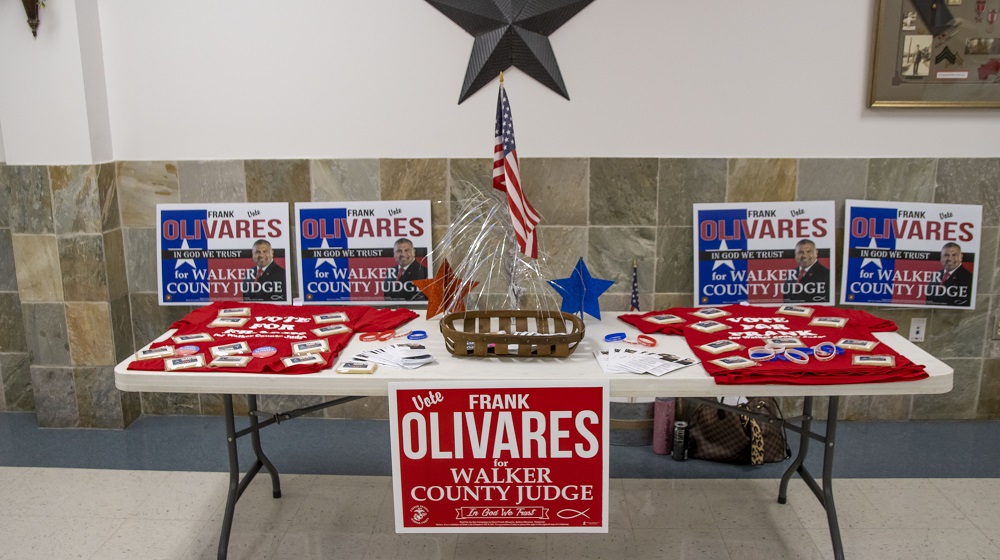
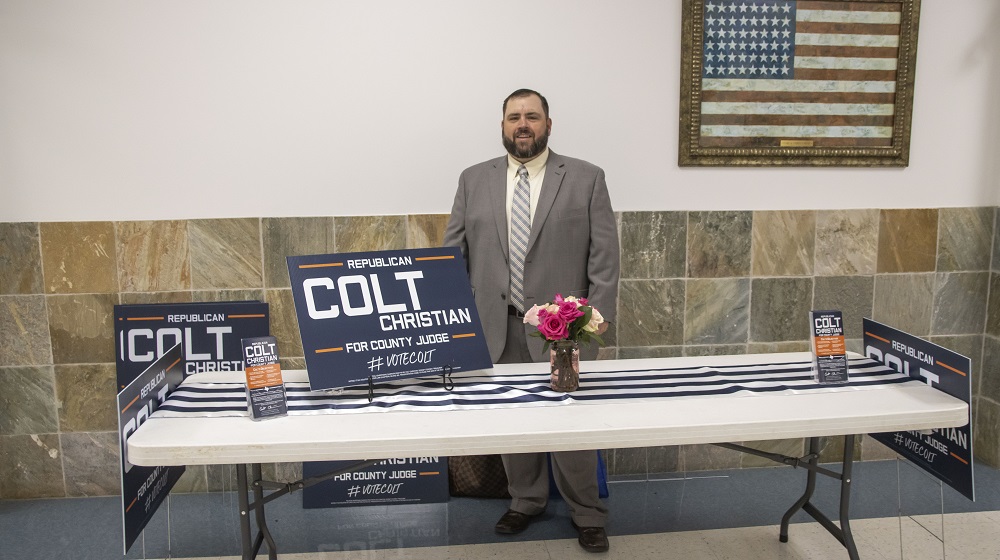
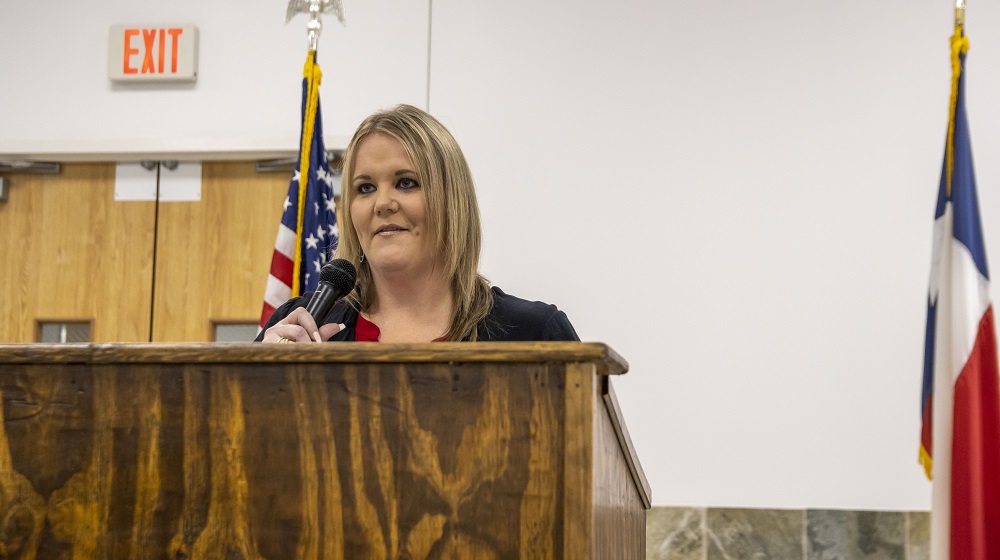
LEAP Ambassadors Morgan, Heather Erin, and I helped with check-in, while candidates also manned tables highlighting their candidacies. Ms. Mckenzie introduced things.
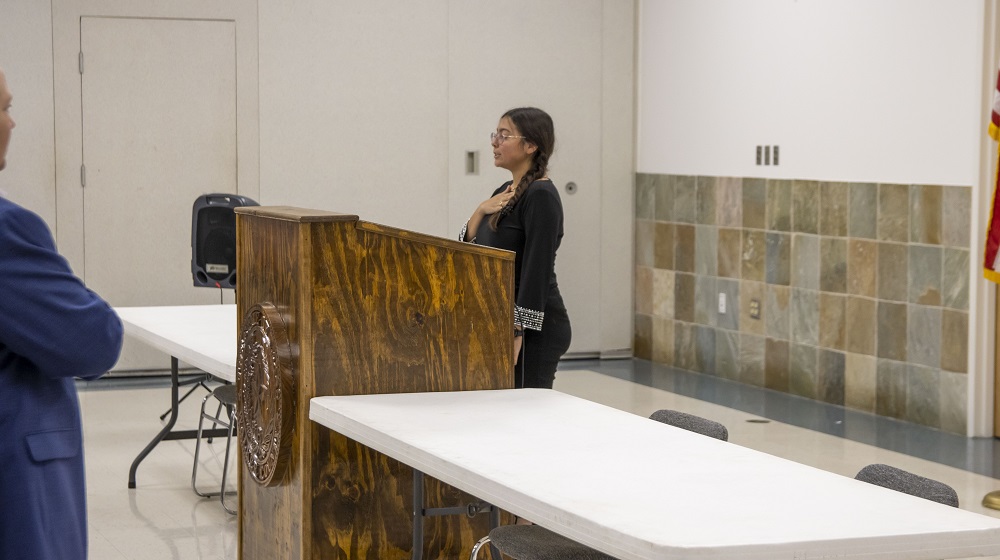
Despite being the quietest of the group–or, in fact, any group–I was asked by Ms. Mckenzie to say the pledges.
The questions for the forum were submitted by members of the community, out of which only seven were selected by a committee for each office: County Judge and District 12 State Representative.
Judge Tracy Sorensen was the moderator for both, which was nice, because we always enjoy the opportunity to see and spend time with her. In fact, she recently spoke at our Pre-Law Society and hooded our graduating members.
In this forum, each candidate had two minutes to respond to the questions. These questions varied from state and county-specific issues, depending on the race, to why they thought they were the best candidate for the position they were running for which they had three minutes to answer.
Morgan assisted in keeping time and informing the candidates how much time they had left.
The first to go were the candidates for state representative of District 12, Kyle Kacal and Ben Bius, followed by Colt Christian and a representative for Mr. Frank Olivares (Olivares was ill not able to attend personally)
Election day is on May 24th, however, why wait? Early voting opened yesterday, May 16th, and closes on Friday, May 20th. Be sure to get your vote in!
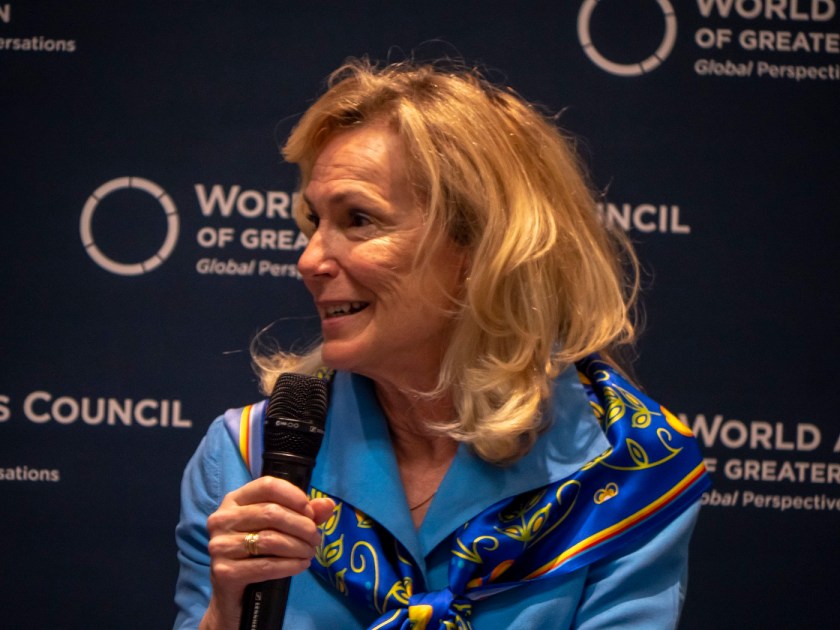
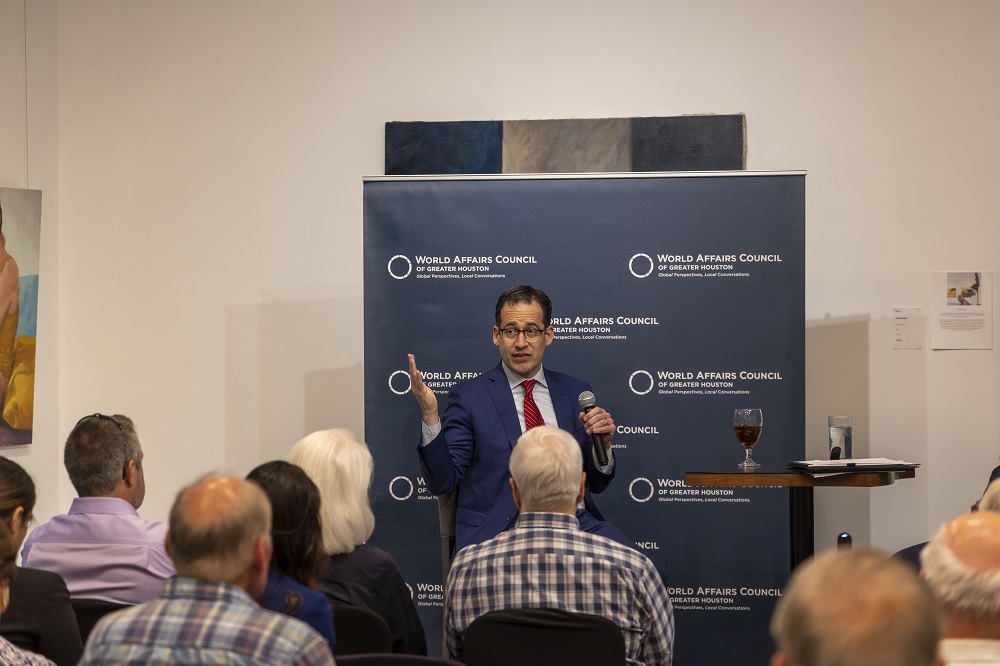
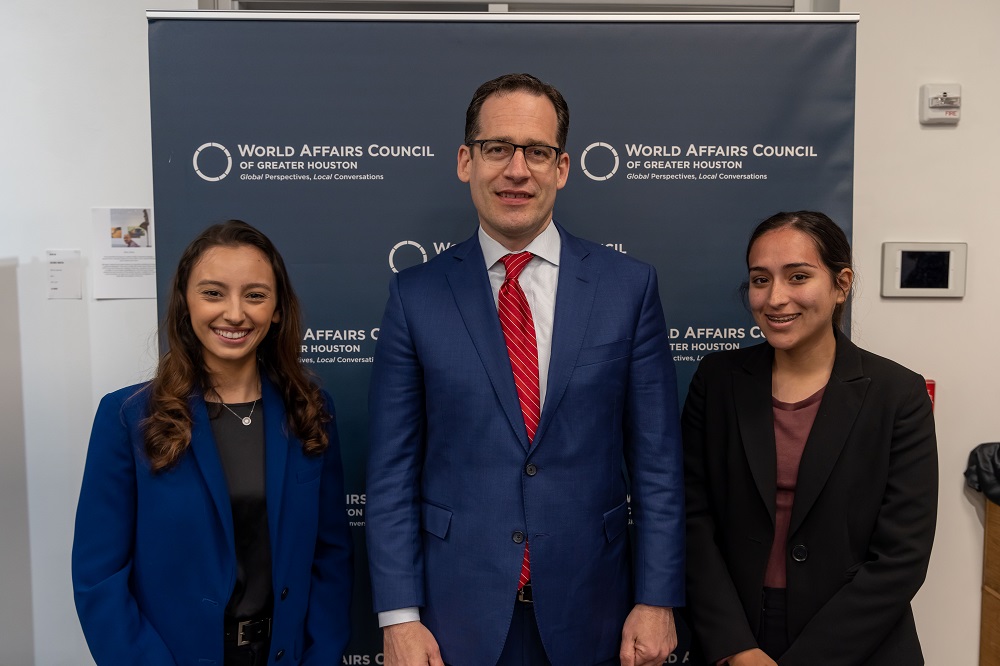
Good things happen when people work together. With that spirit in mind, the LEAP Center partnered with the Department of Population Health to attend the World Affairs Council’s panel on health, fittingly, on World Health Day, April 7, 2022, in Houston, Texas. The panel, featuring heavy health hitters such as Dr. Deborah Birx (Former White House Coronavirus Response Coordinator); Dr. Brett Giroir (16th US Assistant Secretary of Health), Michael Mizwa (CEO Baylor College of Medicine International Pediatrics AIDS Initiative), and Dr. Patricia Brock (Founder, Medical Bridges).
With majors from population health, political science, criminal justice, and history, the students were able to learn not only from the panelists, but also from each other.
According to Yvette Mendoza, a LEAP Ambassador and a veteran of many World Affairs Council panels, “getting other students’ perspectives, especially from those students who study health, allows us to see larger parts of the puzzle. It was interesting to see how all of our majors, in their own way, share the goal of making their communities healthier and stronger.”
Such service has long been a part of SHSU, central to the institution’s mission and its motto. Events like these, observes Mike Yawn, Director of the Center for Law, Engagement, And Politics , “are integral to providing students professional contacts, role models, and education outside the classroom.” For their part, the students seemed to agree: “It was incredible,” noted Mendoza, “to see so many highly-educated public officials collaborating to make the world better.”
According to the panelists, much of the progress that has occurred in medicine in the past four decades has been the result of research, development, and collaboration. Their stories—combining outreach and innovation—were alternately touching, inspirational, and sobering. Dr. Brock spoke glowingly of American medicine, but also described going to far-flung areas of the world to train in hospitals so short of resources they were forced to reuse gloves and sutures.
Dr. Birx—who, in addition to her work on COVID-19, also served as the White House’s global AIDS coordinator for both Presidents Obama and Trump—emphasized the importance of data-driven decision making. Such analysis, she argued, should allow agencies to work together rather than devolving into political squabbles. And by “talking with one another” and working together, “we can save lives and make the world healthier.”
“It was an enlightening panel.” noted Yawn. “The panelists’ message of collaborative service translates very well to education, and I think it resonated deeply with our multi-disciplinary group.”
If you have 30 promising freshmen together in one place, it’s a good bet that the Freshmen Leadership Program (FLP) is involved. If those freshmen are involved in a civic engagement exercise, the LEAP Center may be part of the proceedings. The collaboration of these two offices, under the stewardship of Lindsay Lauher and Mike Yawn, led to a Mock City Council in Council Chambers on a Wednesday afternoon late in the spring semester.
“We are always looking to push students’ leadership skills,” noted Lauher, “and civic leadership is a key component of our program.”
The Council meeting involved students adopting various roles: angry citizens, media officials, city council, and city staff—all of which involved a deep dive into public policy. In particular, the council members of Mockville, Texas, explored the possibility of “legalizing cannabis” and “implementing an extensive wellness program” for City staff. Both, as one might imagine, were controversial.
In addressing the legalization of cannabis, for example, students had to assess the health ramifications (Public Health Director), the impact such a policy would have on crime (Chief Public Safety Officer), the legality of a city moving against a state law (City Attorney) as well as the political implications (Council members) of the ordinance.
Students initially thought that a wellness program might be less controversial, but questions of privacy slowed down the proceedings. The ordinance involved “free” Fitbits provided to all City of Mockville employees, with the hope that this recourse might offer helpful reminders to stay healthy. But devices such as Fitbits also collect a lot of information about the wearer: exercise habits, sleep habits, location, and, in some cases, both dietary routines and sexual health. Putting that information in the hands of employers met with resistance among the council members.
Apart from the policy issues, however, perhaps what most impressed the students was the difference between their perceptions and the reality of a council-manager form of government. Tristen Anderson, a freshman Criminal Justice major and “Mayor” during the proceedings, was surprised at how little power the mayor had: “On television, you see these super powerful mayors, but that’s just not the case in most cities.” This realization, he noted, “changed my entire perspective on that type of politics, perhaps even to the point of seeking out such an office later in life.”
Jared Scott, a freshman Accounting major, agreed. “I enjoyed the whole experience, and although I am an Accounting major, I hope to run for City Council in whichever city I settle down in.” For one of the sessions, Scott did serve as a “Council member,” while serving as “City Manager” in the other session. Both impressed him, and, in fact, Scott was so struck by the experience, he actually attended the next City of Huntsville Council meeting, just to compare it to his experience. “All in all,” he continued, “I learned a lot from this activity, and I’m glad that both the LEAP Center and FLP are open to students of all majors.”
“It’s a pleasure to work with high-achieving students,” said Yawn, “and I think good things happen when offices on the academic side of things (LEAP) collaborate with offices on the student affairs side of things (FLP). We all have the same broad mission.”
The FLP offers rich learning opportunities to test, refine, and further develop the leadership abilities of first-year students. For information, contact Lindsay Lauher at lindsay@shsu.edu or 294-2347. The Center for Law, Engagement, And Politics offers students unique activities that promote the public good. For information, contact Mike Yawn at mike.yawn@shsu.edu or 294-1456.
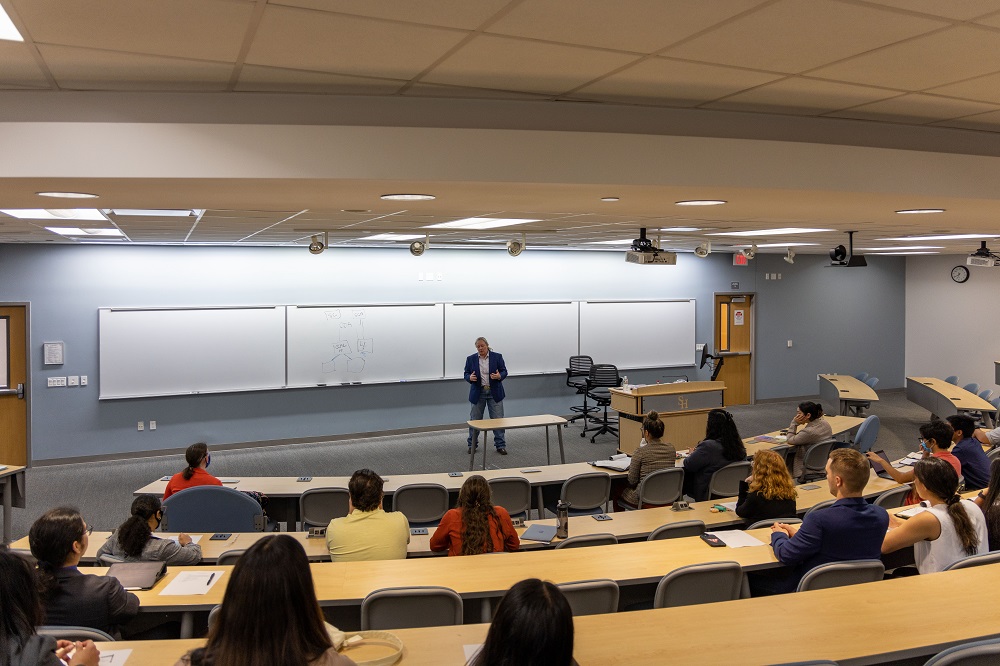
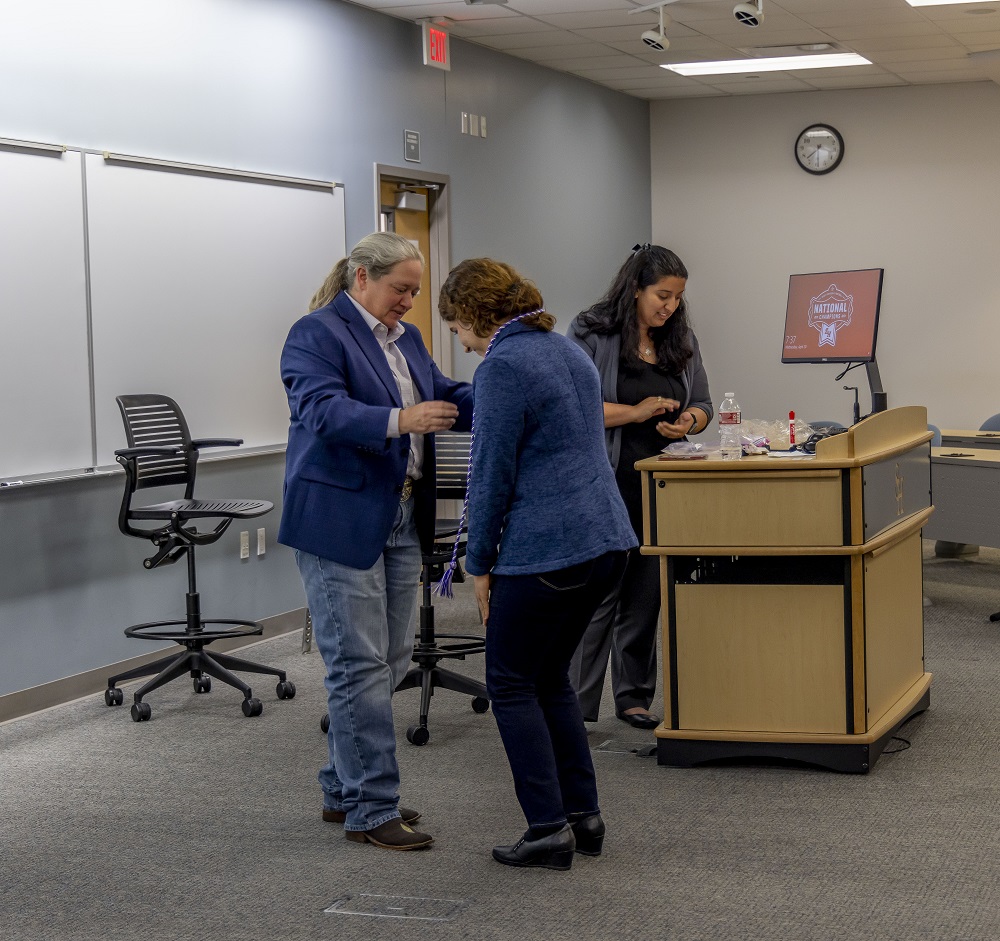
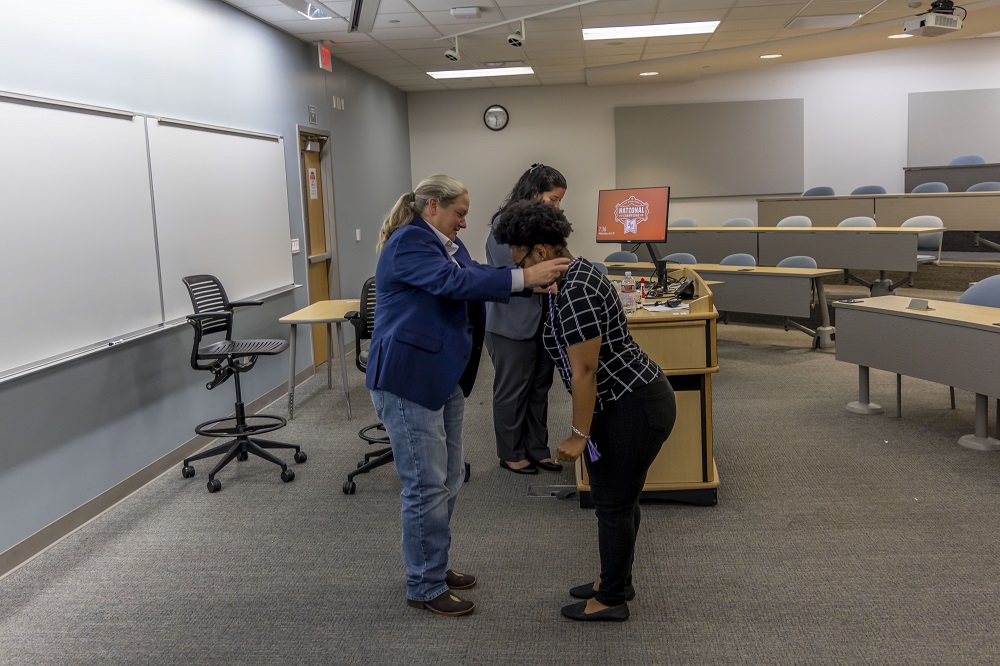
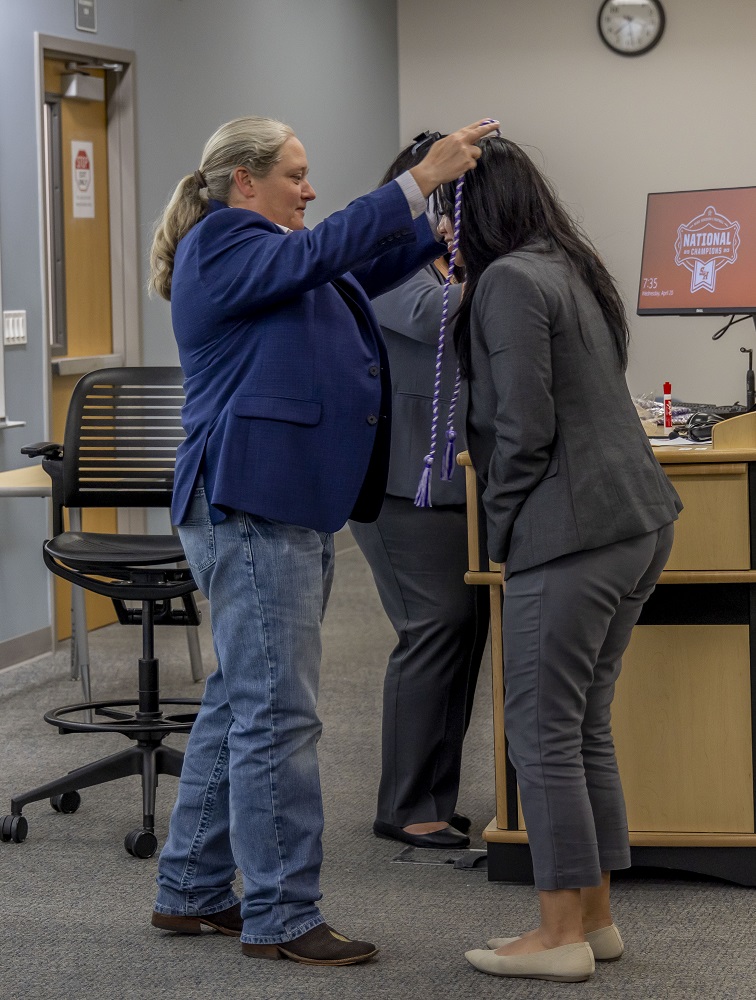
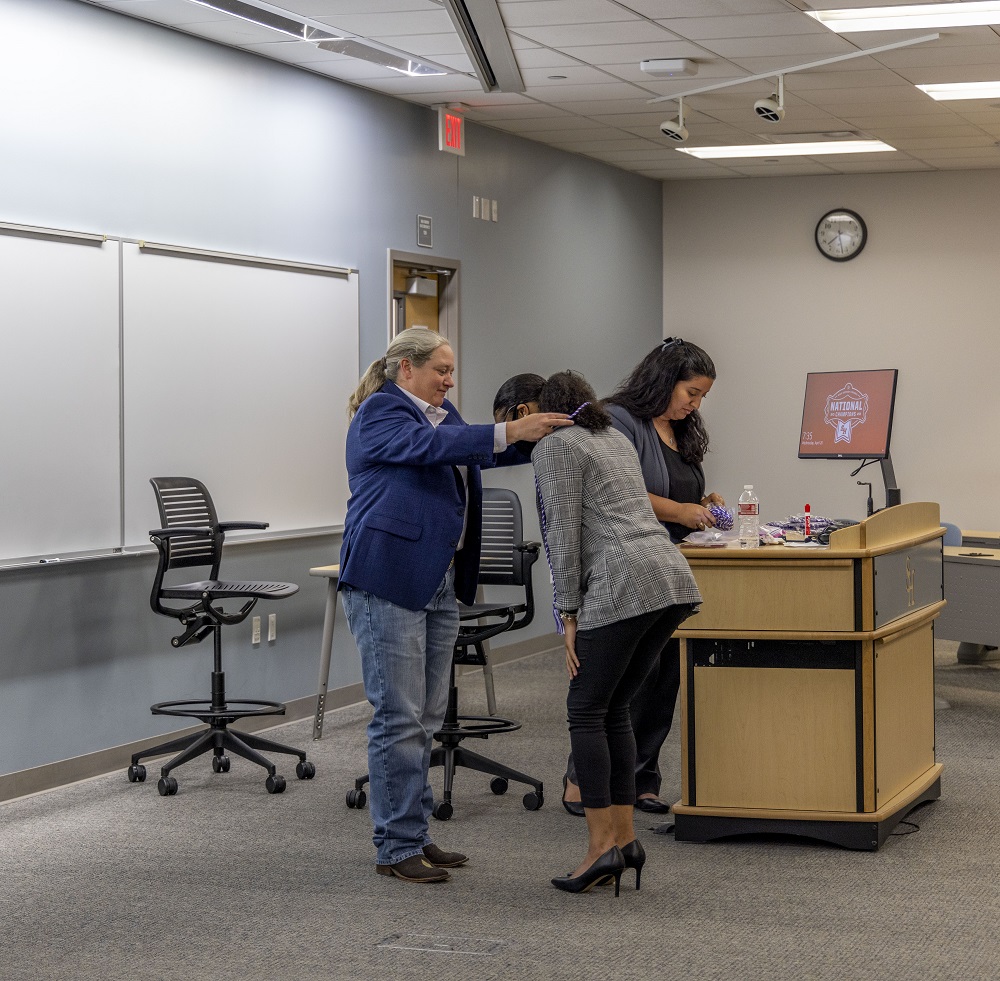
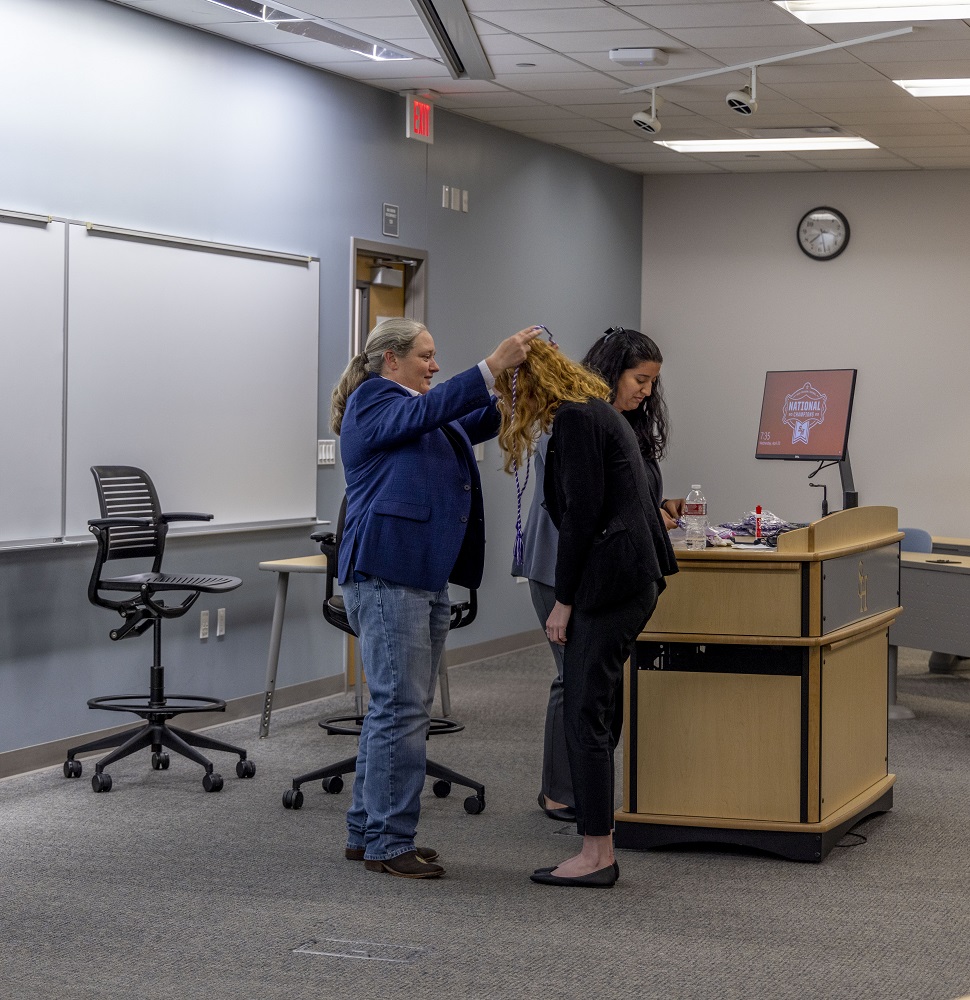
For our last meeting of the semester, we had a guest speaker, Judge Tracy Sorensen from Walker County Court at Law. In addition to presenting, Judge Sorensen also provided all of our graduating students with their stoles, and was our official lottery master for various prizes.
To start the conversation, Judge Sorensen spoke about the 10th court of appeals trials that were held here at Sam Houston last week. People were able to ask her questions about the cases and her thoughts on them, and she gave her honest, thoughtful opinion.
Judge Tracy went to South Texas College of Law, and she talked of when she began her practice. She knew she wanted to come back to Huntsville after law school. She was particularly interested in family law, so that is what she focused on. Her first contested hearing, which was in family law, made her pretty nervous, primarily because her opposing counsel was a veteran attorney who was about 6’6″, more than a foot taller than Judge Sorensen! That attorney, Don Kramer, however, ended up mentoring her and being a great friend and, later, a District Judge.
Professor Yawn served as moderator asked, “How do you have the conversation with your clients on how to dress in court?”
She tells her clients to wear their “Sunday Best,” but that does not always work… She told a story about how in a jury trial her client wore a Houston Rockets outfit and said that was what he wears to church. The court coordinator continued the case because he just could not be seen before the judge in shorts. She started telling her clients to bring what they are going to wear a week before the trial to combat this issue.
Professor Yawn then inquired, “Tell us about the times when your client has lied to you and how you dealt with it.”
This is a major problem for defense attorneys, and she has dealt with it on matters of child custody, divorce, as well as criminal matters. In some cases, you just have to have a backup plan to prepare for the worst in case they aren’t fully honest.
Richard Tran, following up on Judge Sorensen’s admission that she hadn’t been the best student, asked: “How did you move from ‘not the greatest student’ to a judge”?
Her response was a lesson in not digging a hole for yourself. She had a poor first semester, got some bad advising, and then spent the rest of her time in education digging herself out. Despite this rough start, she was offered a great job with an energy company when she graduated, but then the energy market collapsed (following the Enron debacle), and the job offer was withdrawn. And this, as it turns out, was what led her to law school.
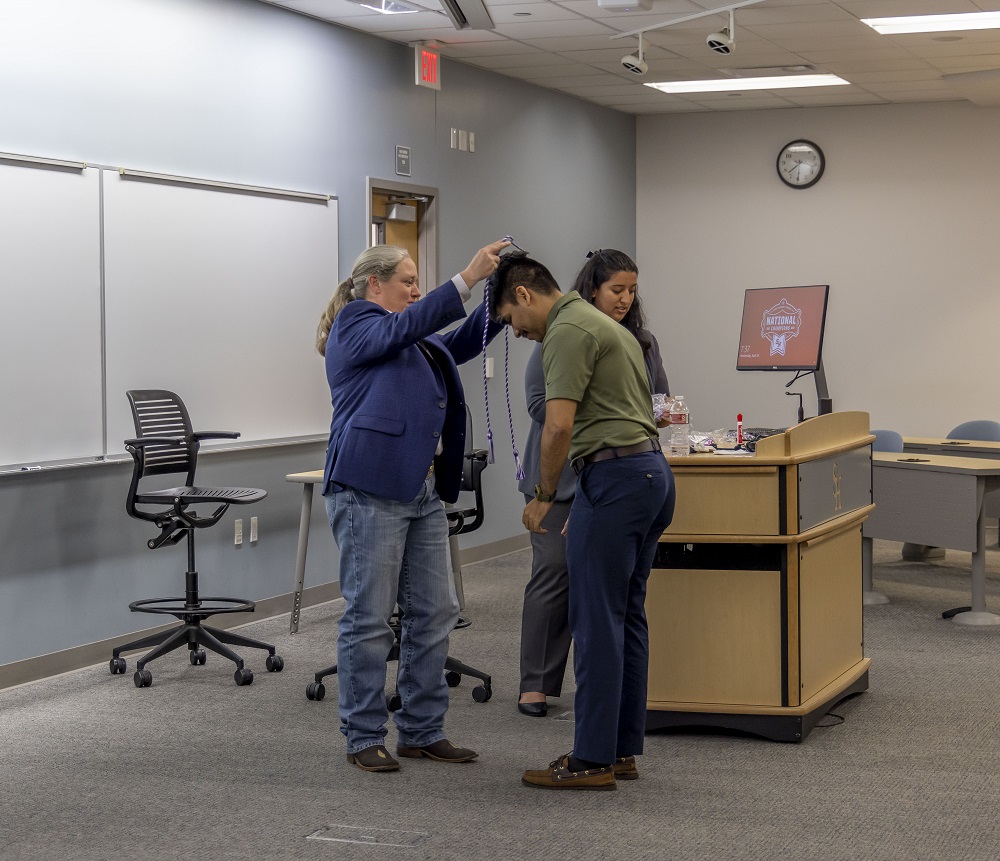
Following her wonderful presentation, Judge Sorensen did something we’ve never done before: she “hooded” our graduates.
And this included our President, Heather Barodi, who very successfully led the organization her final year.
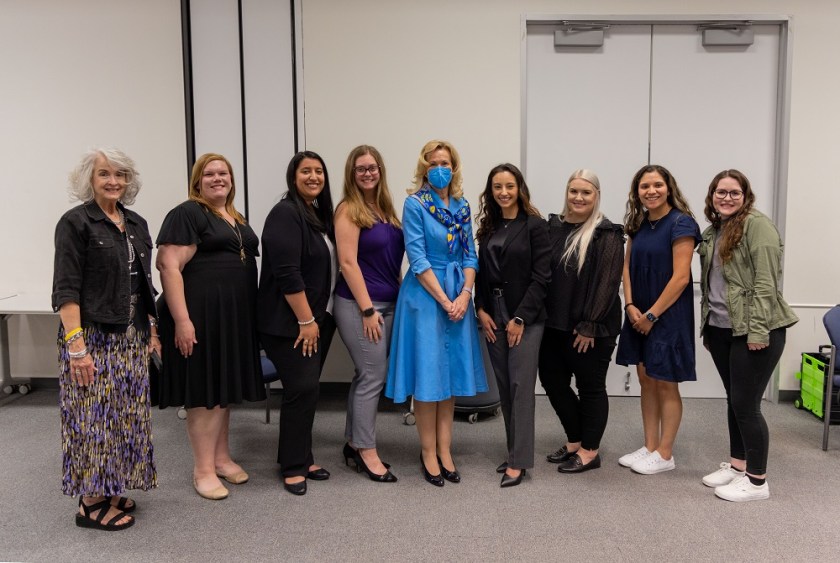
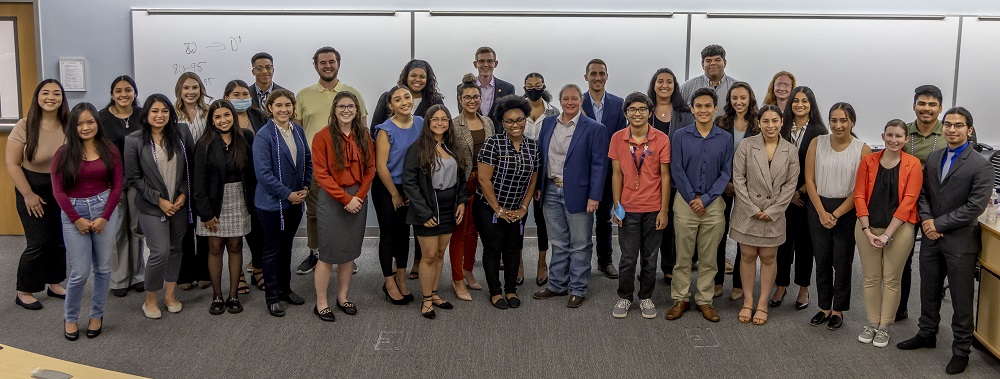
Another thing we haven’t done–at least not recently–is take a group photo. So, we did, and got our first photo since 2016!
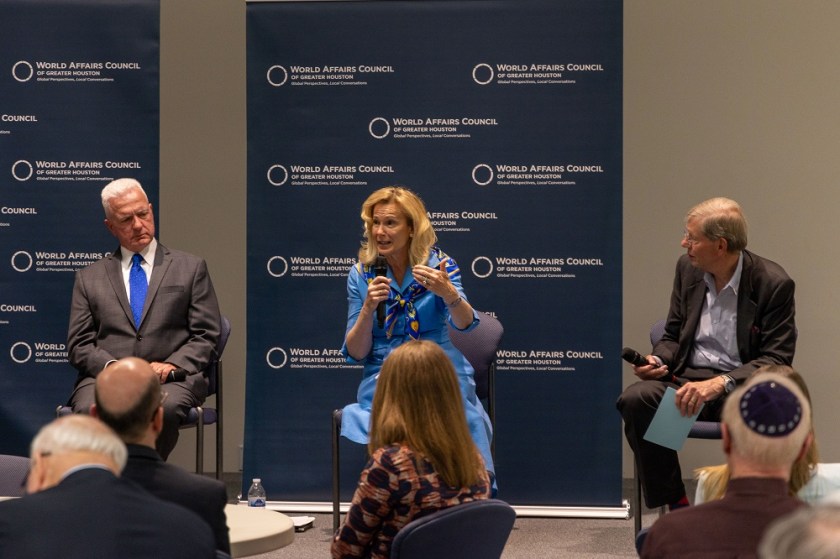
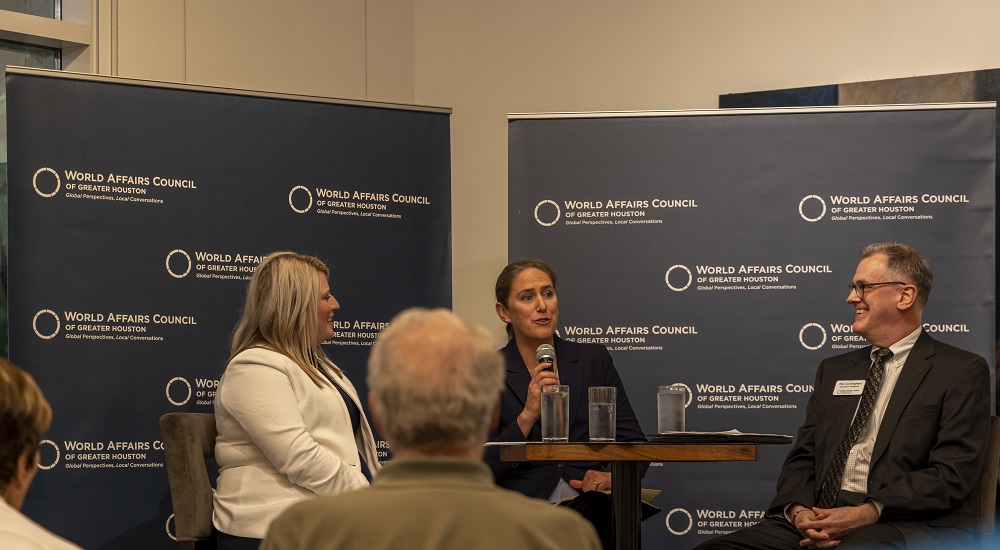
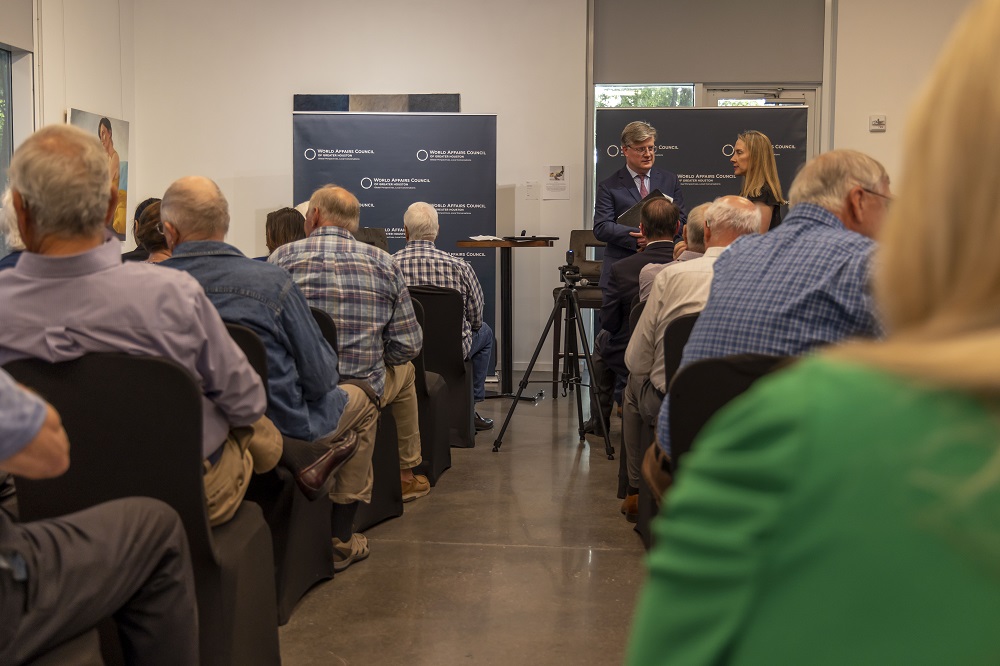
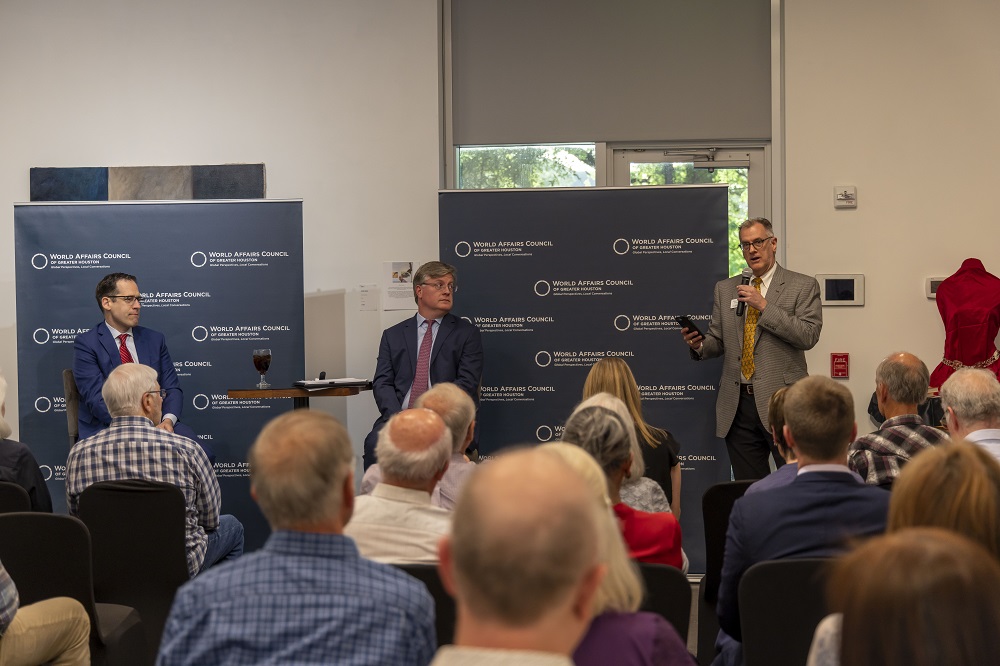
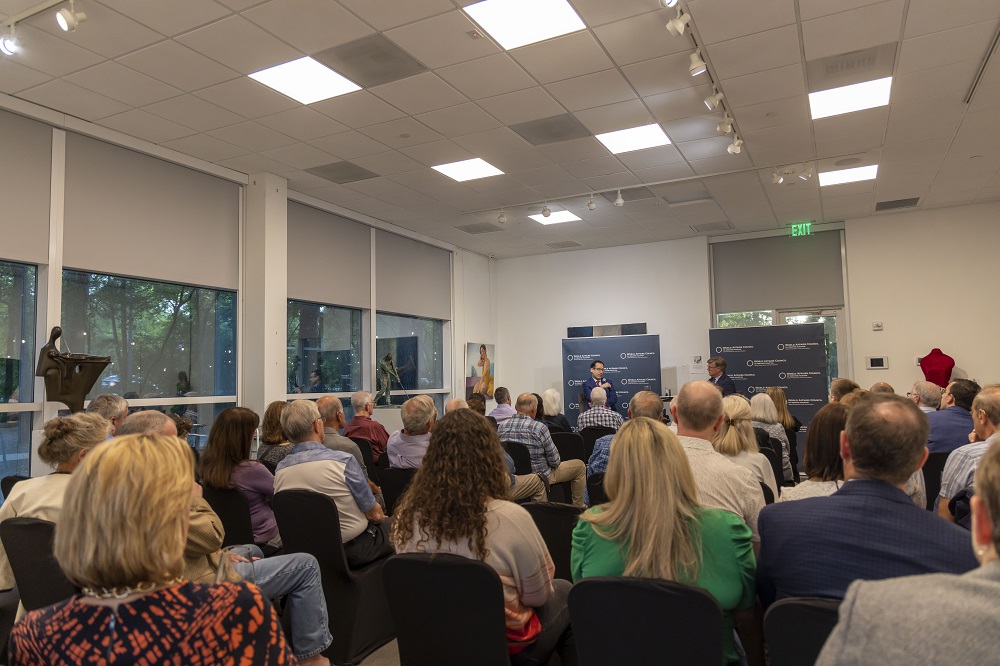
On May 4th, Jessica and I went to a World Affairs Council (WAC) event at the Glade Gallery in The Woodlands to hear from retired Lieutenant Colonel Kyleanne Hunter and Senior Fellow and Director of the Military, Veterans, and Society Program at the Center for a New American Security (CNAS), Katherine Kuzminski, speak about women in the military. Interestingly, we had previously met the CEO of CNAS, Richard Fontaine, at a previous WAC event.
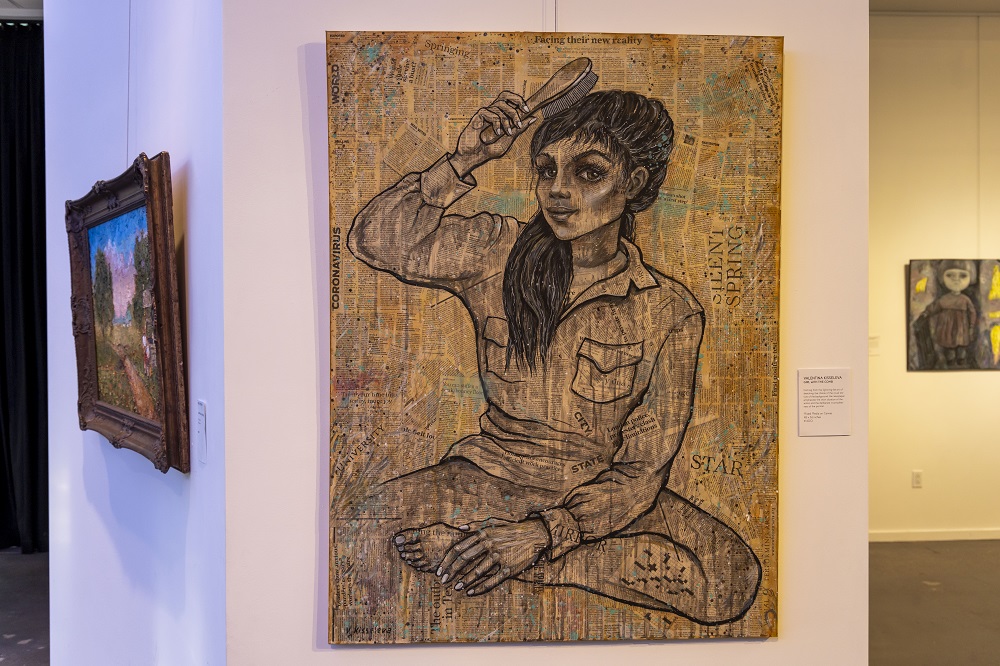
The Glade Gallery, as usual, had stunning artwork adorning its walls and upon viewing them all we were able to determine our favorite art piece.
After a brief introduction by the sponsor of The Woodlands’ series, Champion X, one of our favorite moderators, Ray Cunningham, gave us a brief introduction of who Lt. Colonel Hunter and Mrs. Kuzminski are. Kyleanne Hunter served in the Marine Corps as a Lt. Colonel and has multiple combat deployments as an AH-1W “Super Cobra” attack pilot and is now a Military and Strategic Studies assistant professor at the United States Air Force Academy. Mrs. Kuzminski was a Political Scientist at RAND Corporation where she researched military personnel policy before joining the Center for a New American Security.
Mrs. Kuzminski and Lt. Colonel Hunter discussed how it was believed that women were formerly unable to perform “manly” tasks. To begin with, there weren’t many women in the military, and those that were had limited job opportunities within. Mainly because many of the equipment and uniforms were designed for men. Although, women have served in ever-increasing capacities in support of the US military in every war the country has faced whether it is as combat nurses or four-star generals and admirals. Making up approximately 3% of those serving in the military when the draft ended in 1973.
In 2015, all combat positions were made available to females which allowed Lt. Colonel Hunter to be an AH-1W “Super Cobra” attack pilot. Prior to 2015, women in the military could not sign up to do any combat positions which is part of the reason why our “team Mom,” Ms. Stephanie, went into Linguistics despite her interest in a combat position. Both Mrs. Kuzminski and Lt. Colonel Hunter, believe that there are not enough women within the high ranks of the military.
There are multiple reasons for this such as (1) their want and desire to start a family of their own, (2) it is a male-dominated career, and (3) the occurring sexual assaults. All of these are factors that make it difficult to “recruit and retain” women in the military.
They often just serve their time and retire to start their family, which is why we are starting to see daycares available through the military for the children of those who serve.
As a male-dominated career, it used to be difficult and occasionally still is for women to move up the ranks due to the belief that a man is a better fit for those positions. However, this has started to shift with the implementation of tests that target the skills necessary for the specific ranks to help determine who is most qualified with both men and women having the same standards.
Sexual assaults in the military have been a “hot topic” on the news recently, not because there was suddenly an uprising but because women are now finding they can confide in higher-ups to follow through with a consequence for the accused. Part of this is because the most qualified are moving up and those tend to be the ones used to get overlooked but were the most trusted within their squadrons. However, there are efforts being taken to reduce the number of sexual assaults within the military like the committee that Lt. Colonel Hunter is on.
I found it most interesting when Lt. Colonel Hunter mentioned hygiene and protection as the two most important aspects of being a woman in the military. I am currently in ROTC and am considering my options within the Army, so I was curious in knowing how she dealt with these aspects. She revealed her personal choice of shaving prior to her deployment, including her hair, to be most hygienic.
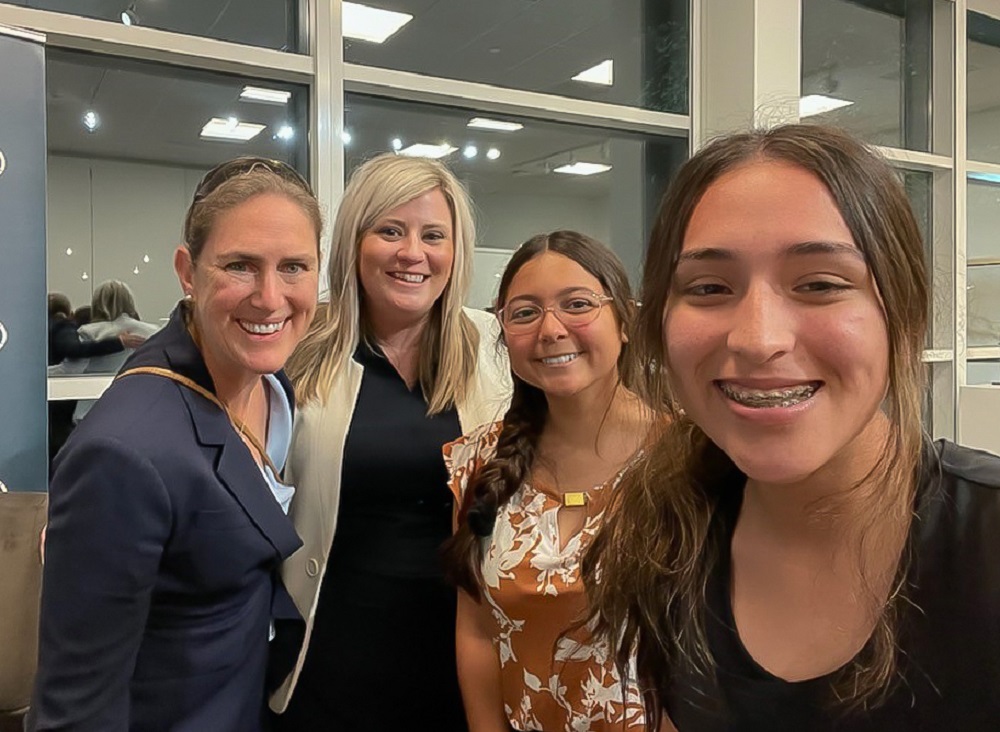
Following the presentation, I had the opportunity to ask Lt. Colonel Hunter more about her experience in the military, including how she managed to withstand the long hours of field training, ruck marches, and other arduous tasks as a woman. We are grateful to the World Affairs Council for hosting Lt. Colonel Hunter and Mrs. Kuzminski, who flew down to Texas from DC!
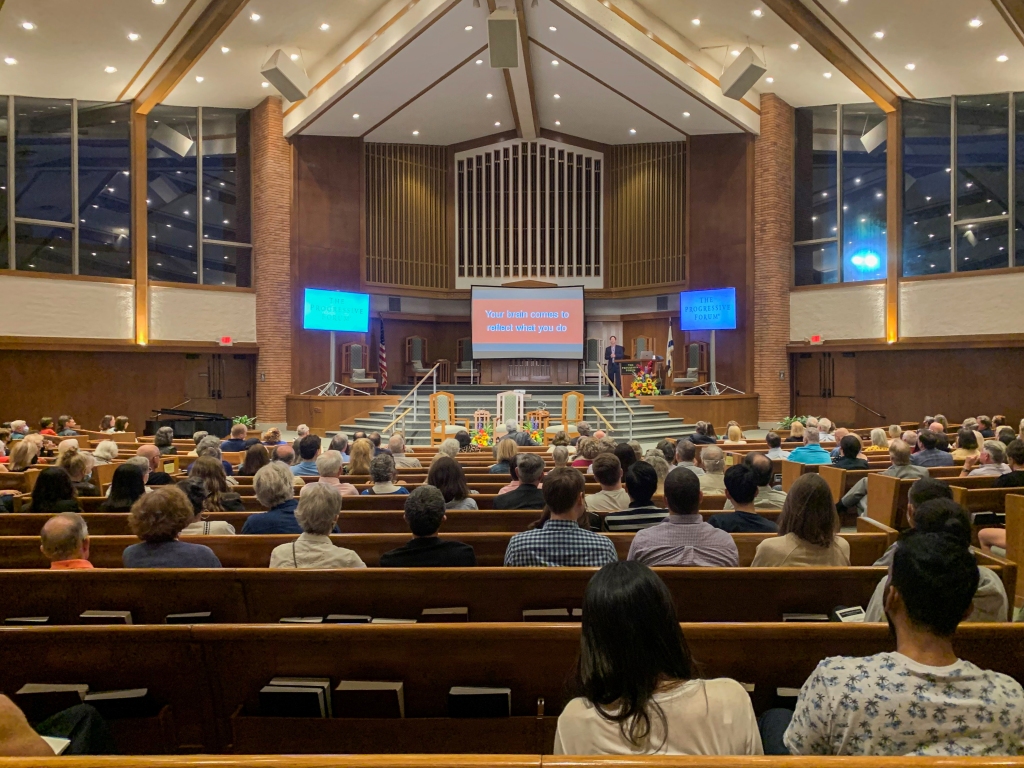
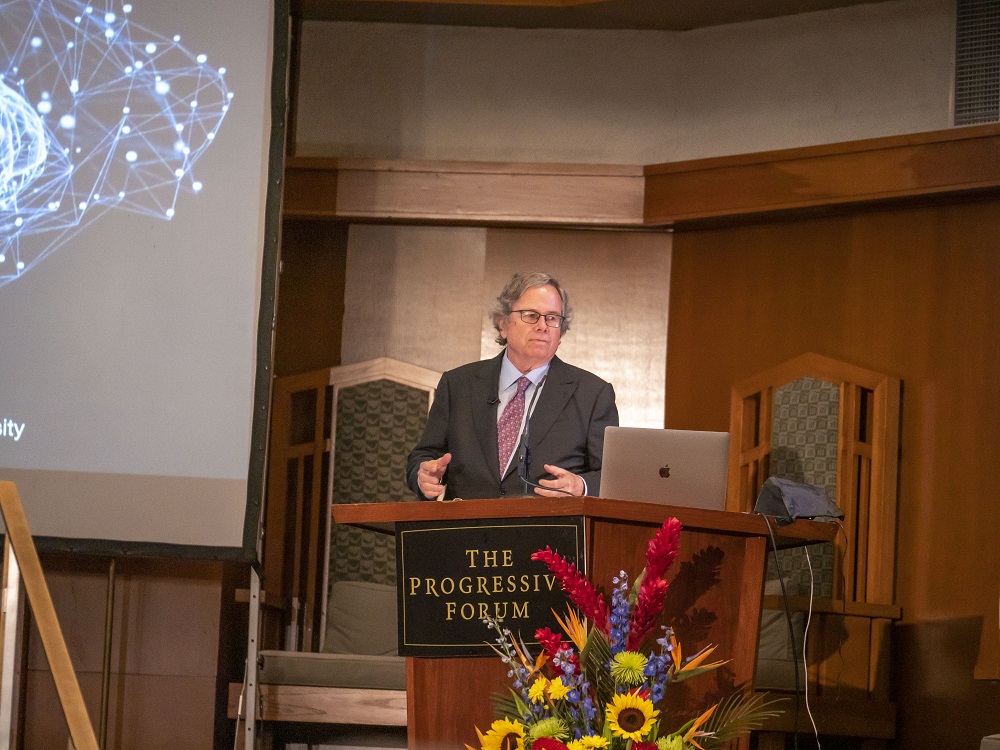
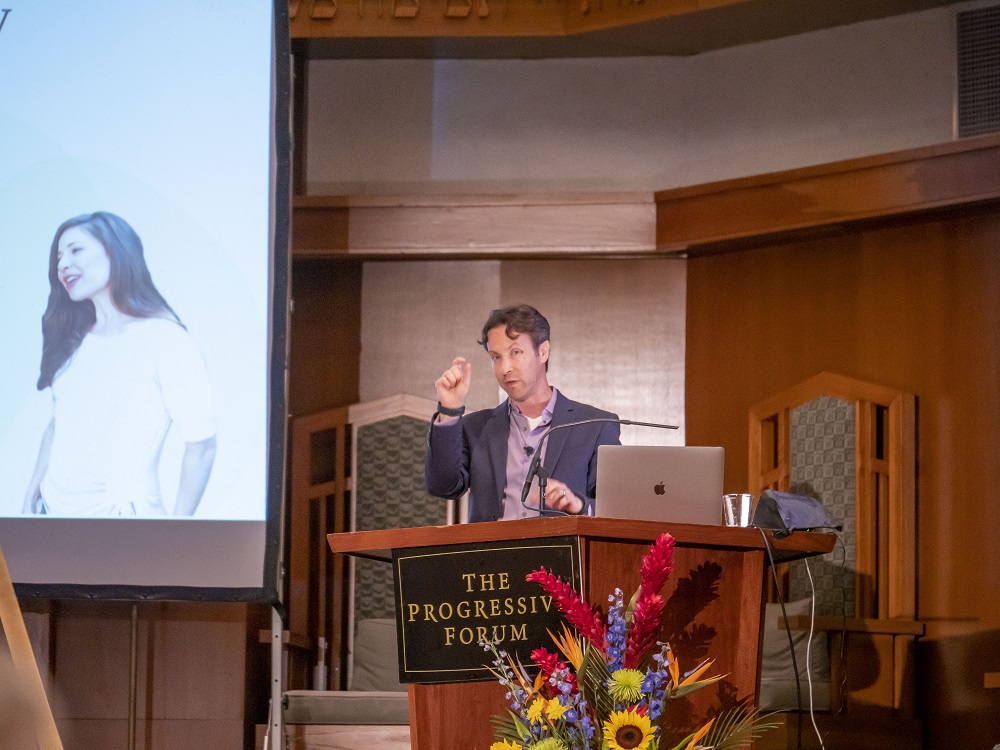
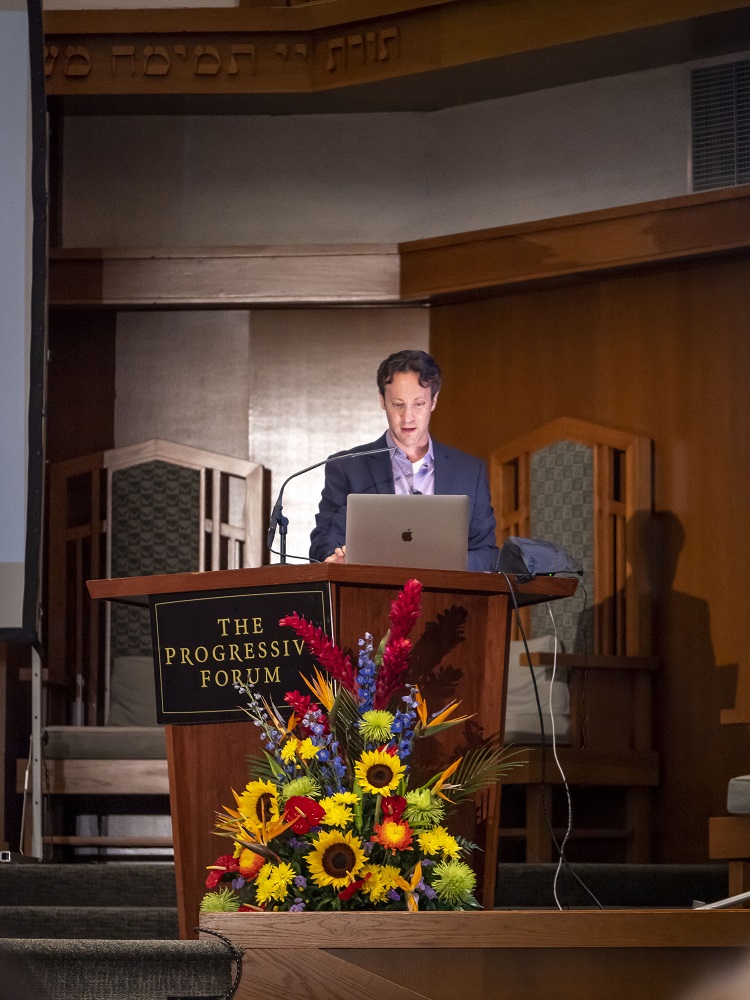
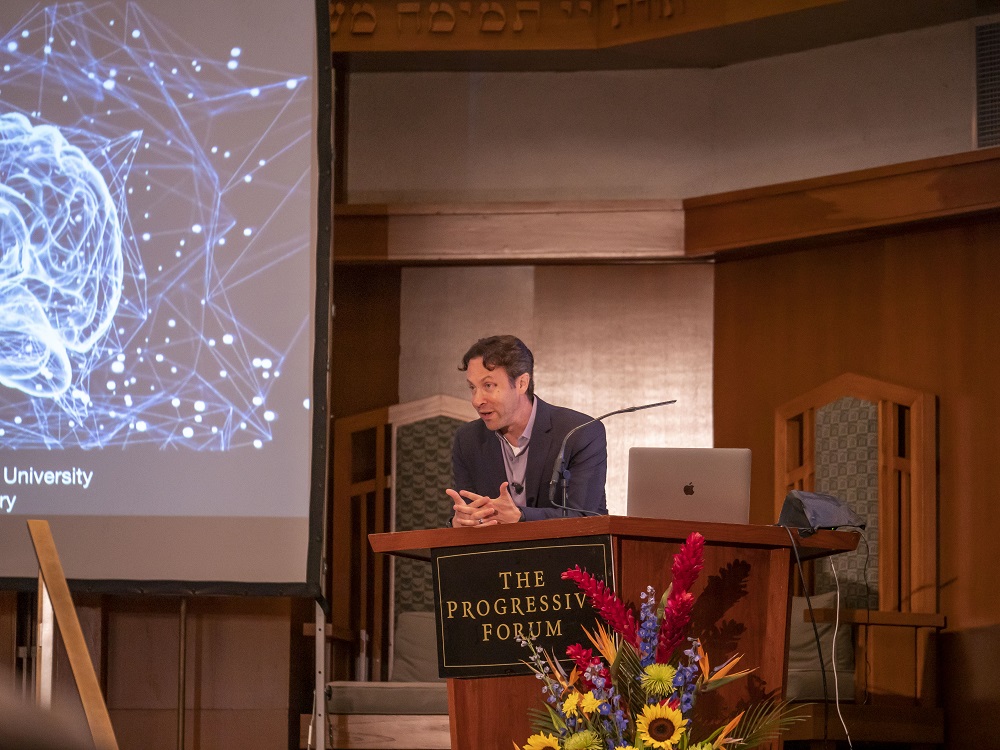
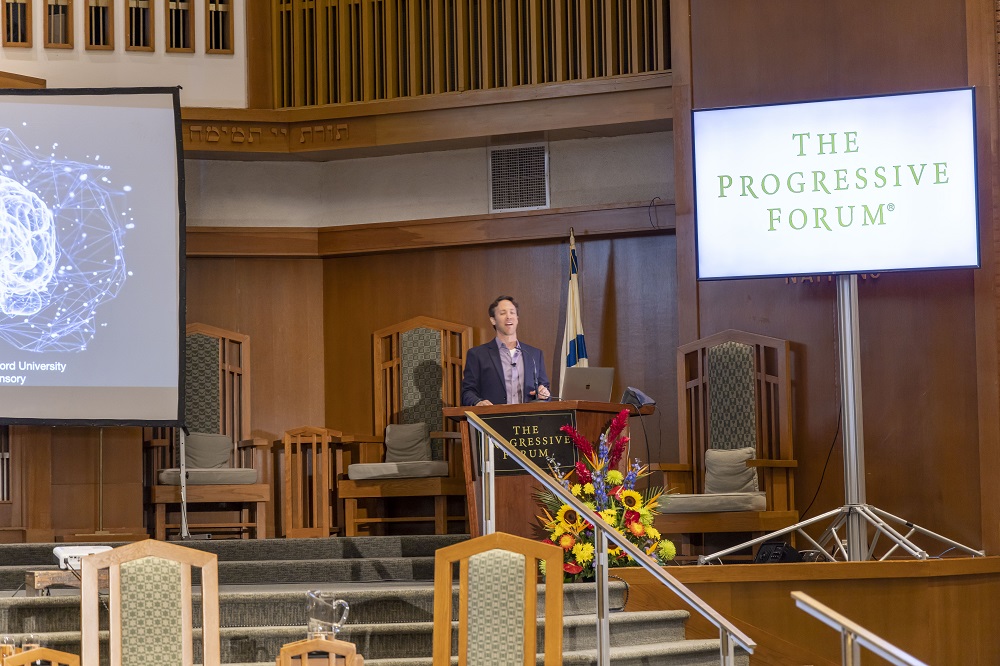
With 86 billion neurons and 500 trillion connections passing through our brain, it is the most complex organ in our body! Dr. David Eagleman is a renowned Neuroscientist who teaches at Stanford University, author, and CEO of Neosensory, so he was the perfect person to help us learn more about the brain. Thus, we travelled to Congregation Emanu El, a Synagogue in Houston, which was a new setting and experience for all of us.
Entering the beautiful synagogue, the LEAP Ambassadors were introduced to Randall Morton, the President and founder of The Progressive Forum, who then began the introduction of Dr. Aziz Shabani, a Clinical Professor at Baylor College of Medicine. Dr. Shabani provided the program attendees with medical sciences and its revolutionary take on modern-day society.
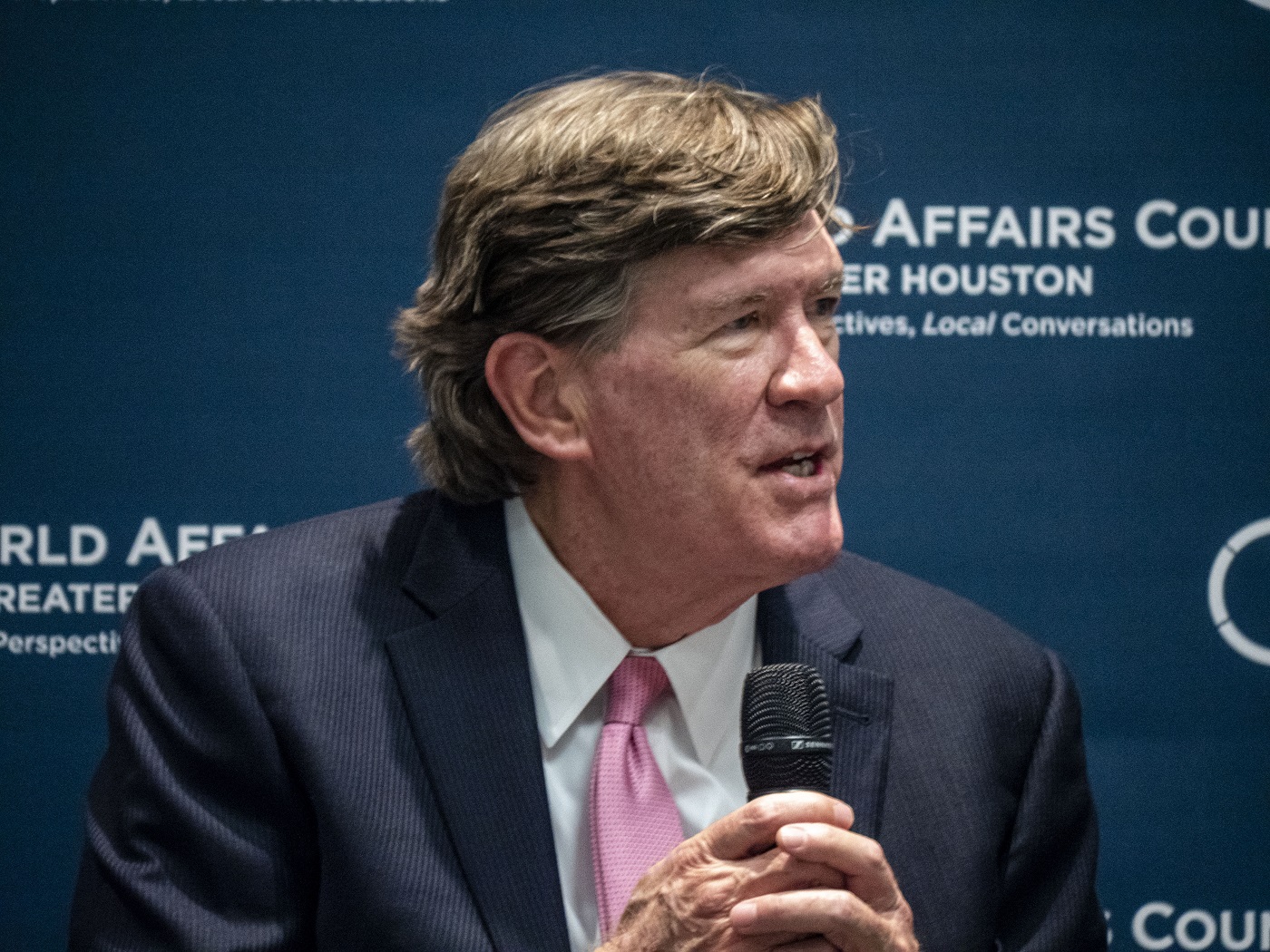
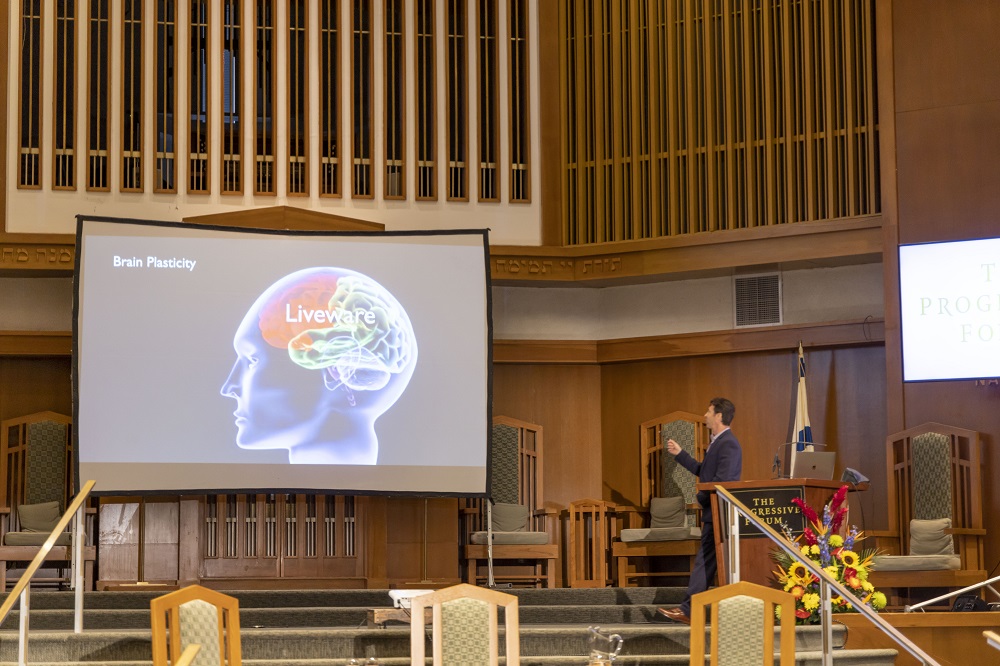
Aziz Shabani energetically and proudly introduced the man of the evening, Dr. David Eagleman! In his presentation, Eagleman explained the functions of a normal brain and gave us a short lesson on each part of the brain cortexes. In addition, he explained that, “brain plasticity” is a term used to describe the expansion of the cortexes, although he prefers the term “liveware.”
The LEAP Ambassadors were fascinated by the study and research conducted by Dr. Eagleman and his team. Their studies specifically focused on people who have sensory loss, such as loss of hearing, blindness, and people with underdeveloped limbs. As a result, Dr. Eagleman expanded greatly on his brand Neosensory, promoting an affordable replacement of cochlear ear plants and a wristband that provides senses to those who have difficulty hearing, seeing, and even touching.
After Dr. Eagleman shared his insight on the human brain and its wonders, Randall Morton, Dr. Aziz Shabani, and Dr. Eagleman gathered for a short Q&A session. The questions exchanged between the three were, “What advice do you have for self-discovery?” Dr. Eagleman answered beautifully and said, “Always go with your gut feeling, and whatever makes you get up in the morning filled with excitement, do it.” Dr. Shabani corresponded with another question asking about how our own brains expand. He answered with, “to serve your brain, we must change our routine,” implying that daily challenges will only make our brain smarter and help our longevity. He began with simple suggestions, such as changing the hand you wear your watch on, and moved to more complex routine alterations.
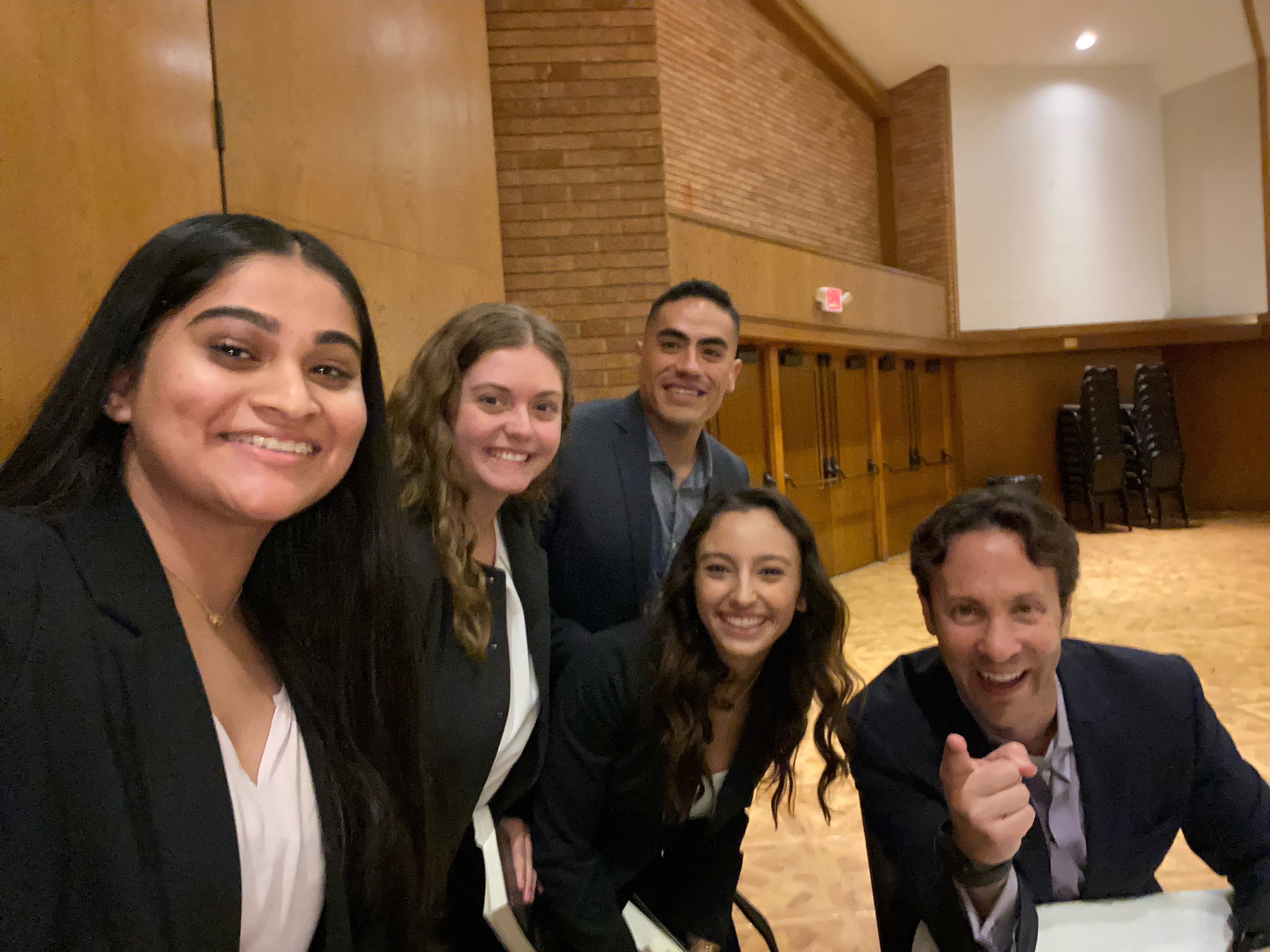
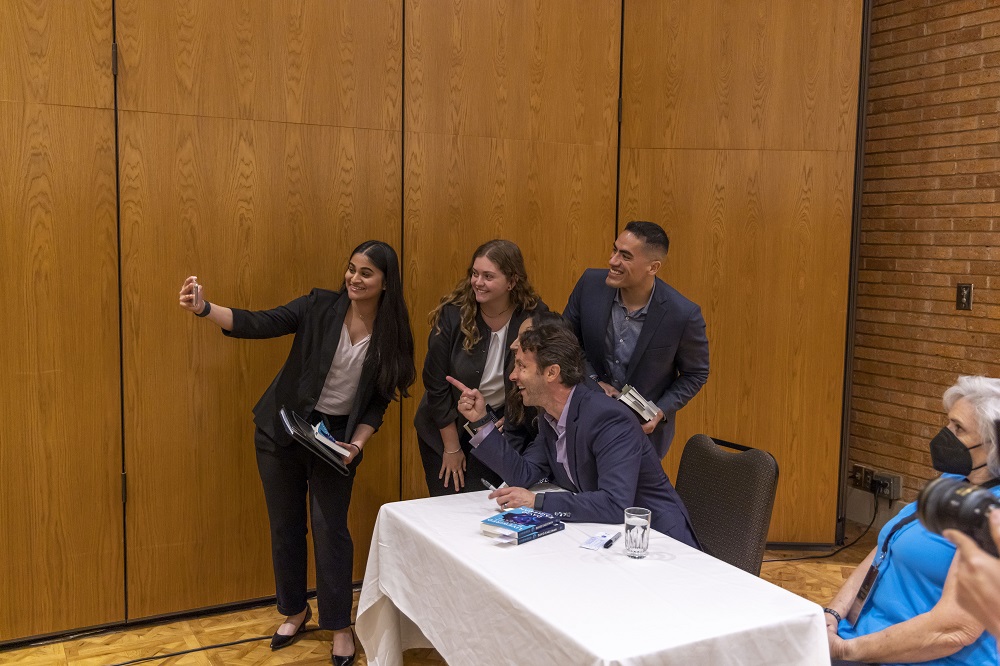
After the event, the LEAP Ambassadors were able to meet Dr. Eagleman. He even signed our copies of his book, Livewire! Dr. Eagleman then spent a few moments with us, asking where we are in our story. We were also able to take a picture with Eagleman after our conversation!
Star Pizza
Yvette Mendoza
We grew our neural plasticity by seeking new settings such as a synagogue and afterwards, an excellent restaurant called Star Pizza; a pizzeria in the heart of Houston that serves both Chicago deep-pan pizza and New York-style pizza.
Before we dove into the delicious assortments of pizzas, we had to start off with shareable appetizers. As we dug into the baked goat cheese served with olive oil, sun-dried tomatoes, and French bread, we kept wanting more. The appetizers kept coming, and our eyes widened as the waiter brought garlic bread with cheese. Everything was perfectly cooked. Even the cheese had a golden-brown tint that you could feel oozing in your mouth.
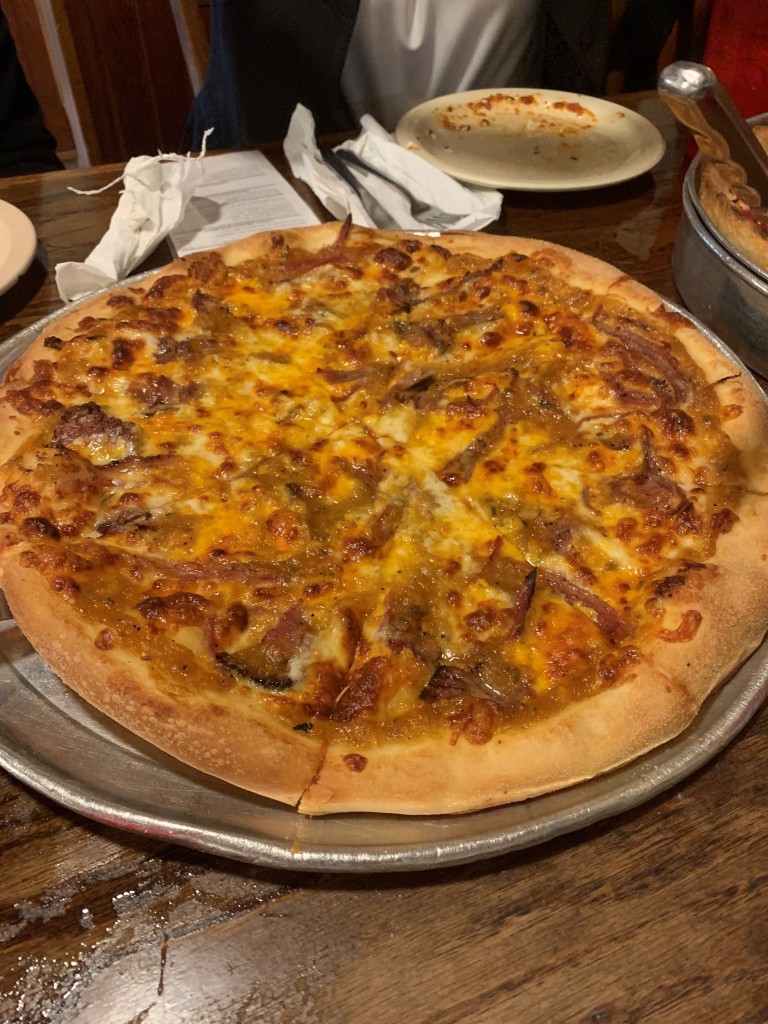
At last, we ordered the Cowbell deep dish with slow-smoked BBQ beef brisket, topped with BBQ Sauce and cheddar, provolone, and mozzarella cheese. As well as the New York-style Margherita with pineapple. Having both pizzas to try provided the perfect combination of sweet and savory. The crust was toasty, and the heart of the pizza was warm with all the BBQ flavors coming together with the cheese and the Roma tomatoes, creating an excellent combination.
We not only left with a full stomach but were also able to develop our minds by trying new things and not consuming the chain food every college student eats.
Our in-class assignments often include researching a new topic, writing an essay, or possibly presenting our findings. However, on April 28th we made an out-of-class presentation to the Huntsville Chapter of the Lions Club. Heather, Jessica, Saara, and I were excited to share information about the organization that we love.
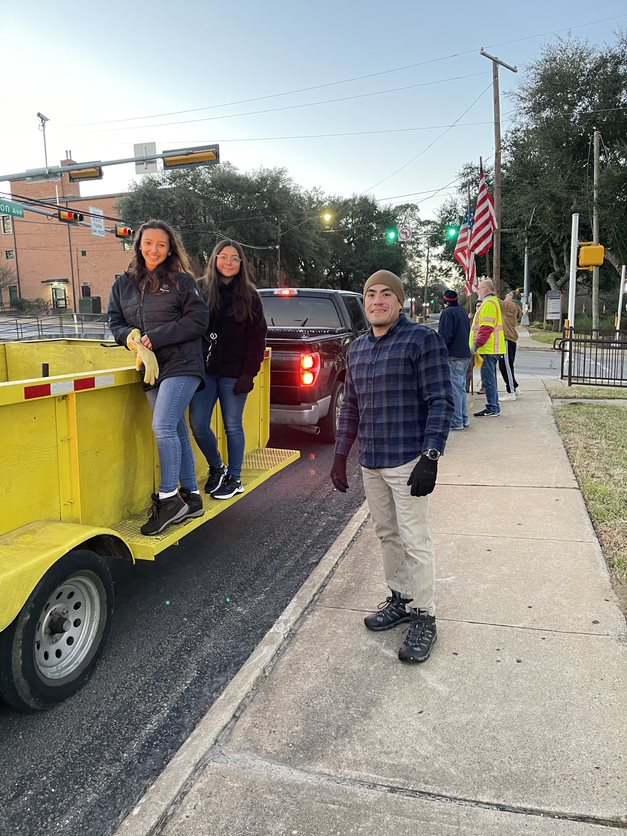
The Lions Club is an organization committed to the service of the community in which they reside. One of the service projects of the local chapter is the flag postings: for various days of remembrance or holidays, the Lions Club will line the streets with American and Texan flags, and this is something we have assisted with in the past.
Every Thursday at noon, the Lions meet at Grand Buffet for a hot meal, good company, and, of course, to take care of organizational business. We were able to enjoy nice conversations while we ate lunch with the Lions because of our past volunteerism and other connections. I learned more about the logistics behind the Flag project from Glen Schumacher. Glen has taken on the responsibility of driving the truck and trailer for those posting the flags.
After most of the Club had finished their meals and visited with fellow members, the meeting was called to order. We were introduced by Brian Blalock, who is a photographer for the university and who invited us to speak at this week’s meeting.
Because LEAP is an organization that reaches all different disciplines, we thought it best to walk the Lions through an actual week of a LEAP Ambassador.
This adventurous yet busy week began on Global Health Day, Thursday, April 7th, with our attendance at the World Affairs Council event: Global Health with Dr. Deborah Birx. Of which I elaborated on what I learned during our presentation to the Lions.
The following day, on Friday, April 8, Jessica, Saara, and I along with a few other students got to test out our modeling skills with Brian who was shooting fundraising photos for university advancement. It was an interesting experience for us since we are typically the ones taking the pictures. We even shared how most of us walked away knowing that we would not be successful in a modeling career.
Perhaps my favorite day in our week, Saturday, April 9th, was when we volunteered at the Annual Wynne Home Easter Egg Hunt. For Saara, this was her first time celebrating the Easter Holiday and she shared her experience with the Lions Club. We of course could not wait to mention our professor’s tactics for winning the Sack Races (which he denied of course), one of the many recreational activities there was for the children.
Jessica’s favorite day of this busy week was Sunday, April 10th. As we told the Lions more about LEAP, we let our personalities show as well. After we all identified Jessica as our shyest member (pre-Elvis) she told us more about her first time experiencing an Elvis impersonator. Jessica claims and defends (post-Elvis) her famous picture was just a high-five, but we are all convinced it is a hand-hug.
For Monday, April 11th, we all shared a bit about our experiences with the citizenship course. We were intrigued to learn that some of the Lions Club members had firsthand experience with the naturalization exam or knew someone who took our course.
Nearing the end of our busy week, Heather told everyone about our biweekly LEAP meetings and the office hours we are responsible for. Much like professional organizations like the Lions Club, we practice Robert’s Rules of Order and learn more about professionalism.
On the last day of the preview of a typical week for a LEAP Ambassador, Wednesday, April 13th, Heather shared more about the 10th Court of Appeals that heard three cases at the University. She even mentioned that we, SHSU, are one of only two colleges that the Court travels to and how the Court allows for student interaction.
We then took questions, as we approached the end of the meeting and were even able to give interviews for the Huntsville item!
On behalf of the LEAP Center, thank you to the Huntsville Lions Club for hosting our group. We hope that we can honor your Club motto, “We Serve” as your members do!
The LEAP Ambassadors took an evening trip to the Woodlands to attend yet another fantastic WAC event on Russia’s invasion of Ukraine at the Glades Art Gallery. Walking in, the gallery was stunning to witness as the WAC staff welcomed us. It was a wonderful combination: looking at paintings from local artists while preparing to become more educated on a global issue was a terrific opportunity.
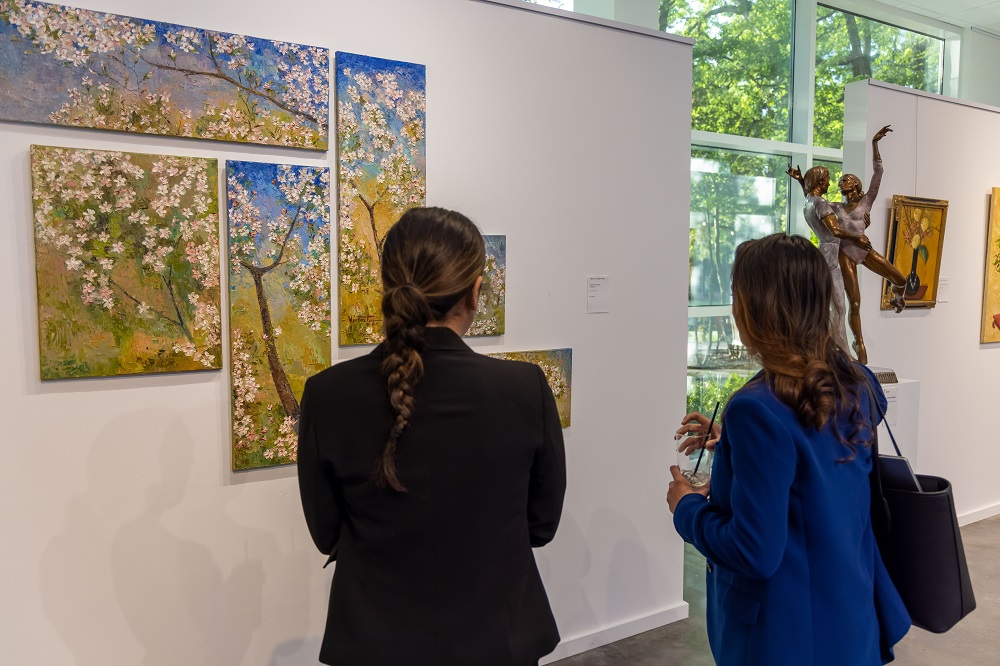
The art on display ranged from portraits and landscapes to statues. A favorite of ours was the Cherry Blossom tree that spread across six canvases by Victor Tapu. Throughout the exhibit, we connected the artwork in the Glade to similar works by renowned Masters; for example, we compared the miniature statue of a ballerina to Edgar Degas.
Moving from the art to learning about the current crisis in another part of the world, we heard from Richard Fontaine, the CEO of the Center for a New American Security, one of the world’s leading defense and geopolitical think tanks. Mr. Fontaine was also a top foreign policy adviser to Senator John McCain.
Dr. Fontaine discussed the horrific battle in Ukraine and how it could signal the start of a new post-Cold War era. Putin’s motive to overtake Ukraine was to prevent their affiliation with NATO, among many other things. The war has affected numerous countries. Poland, for example, was one Ukraine’s most significant trading partners, a relationship that will much limited until the end of the war and perhaps beyond. The war has also increased inflation in the US, while also affecting the oil supply and even food staples such as corn. China, too, is watching the war closely, seeing how it will shift the balance of power in the world and change their massive trade relationships.
One interesting fact we learned is that Ukraine has shattered the Russian government-built encrypted phone lines, compelling the Russian military to use unencrypted lines of communication. Who knew?
Hearing an update on the Ukraine-Russia war from Dr. Fontaine was eye-opening. Seeing how these impacts bordering countries of Ukraine and our homeland is heartbreaking, but this will bring us together and prepare us for future moves that may involve a more significant threat.
As always, the WAC event was enlightening and enjoyable, and we look forward to our next event!
Lama Mediterranean Restaurant
Heather Barodi
After filling our heads with new knowledge about the war in Ukraine, we stopped at Lama to expand on our understanding from outsides our country’s borders at a Mediterranean restaurant located in the Woodlands!
Our appetizers were classic Mediterranean dishes, homemade falafel, and hummus with warm pita bread. Overall, all the food was terrific, but the hummus appetizer we got was the biggest hit among the ambassadors. The entrees ranged from chicken shawarma and gyro sandwiches with sides of rice and french fries. At the end of the meal, our plates were empty from devouring each of our entrees. We had some hot tea and baklava to end our meal, which was a sweet touch to our full stomachs.


































 Center for Law, Engagement, and Politics