Skip to content

Center for Law, Engagement, and Politics

Leap At SHSU!

  • About LEAP
  • LEAP Ambassadors
Center for Law, Engagement, and Politics

Category: Health

LEAP LEADs and Pandemic Planning

Following several meetings with guest speakers such as Commissioner Bill Daugette and (virtual) Rep. Senfronia Thompson as part of our LEAP LEADs program, our educational odyssey continued with additional training and guest speakers.

Tonight, in our fifth meeting, we began with an introduction from Ms. Fors, who provided us with tips on email etiquette and how to create an email signature block. We were reminded to (1) keep emails short unless length is absolutely necessary, (2) to use a subject heading that is accurate and telling, (3) and to ensure that the email employs good grammar and correct spelling.

SHSU, LEAP Center, Center for Law Engagement And Politics, LEAP LEADS

After Ms. Fors’ extremely instructive discussion, we moved on to watch the Texas Tribune Festival’s discussion with Peter Hotez, the dean at the National School of Tropical Medicine at Baylor College of Medicine and an expert in vaccine development.

SHSU, LEAP Center, Center for Law Engagement And Politics, LEAP LEADs, Peter Hotez, COVID-19

As optimistic as we all were about the current COVID-19 situation, watching this talk with Hotez certainly put a damper on our hopes about the virus. Hotez shared that “vaccines may not be introduced until spring 2021” and that we are likely to have a third surge in COVID-19 cases–and that it could be even worse than before. Though this discussion wasn’t filled with the best of news, it most definitely provided us with new information to keep in mind as we continue to navigate through this new COVID lifestyle that we may begin to call “normal” pretty soon.

SHSU, LEAP Center, Center for Law Engagement And Politics, LEAP LEADs, Peter Hotez, COVID-19

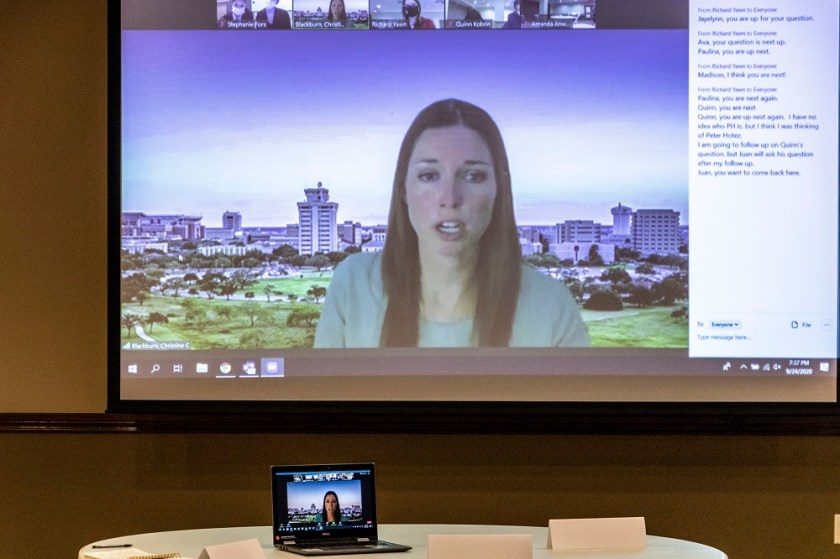
The highlight of our night was a Q&A with Dr. Christine Blackburn, the Assistant Research Scientist, lecturer, and Deputy Director of the Pandemic and Biosecurity and Policy Program at the Scowcroft Institute of International Affairs.
SHSU, LEAP Center, Center for Law Engagement And Politics, Dr. Christine Blackburn, COVID-19

During this Q&A the eight LEAP LEADs’ students were able to engage in an interactive conversation with Dr. Blackburn on her career, her advice to young people and the substantive aspects of the Coronavirus–which was very educational.

SHSU, LEAP Center, Center for Law Engagement And Politics, Dr. Christine Blackburn, COVID-19

We learned, for example, the 3-4 phases a vaccine must go through to become approved.

We, apparently, are nearing phase three trials, which means tightly controlled experiments on humans should begin.

SHSU, LEAP Center, Center for Law Engagement And Politics, Dr. Christine Blackburn, COVID-19

One of the interesting things about Dr. Blackburn is her educational background. She has an “individual interdisciplinary Ph.D.” in “Political Science, Communications, and Veterinary Science.” The idea is that, as the world becomes more specialized and silo-like, people with interdisciplinary degrees can cut across multiple domains. She persisted in this degree despite others telling her, “No one is going to hire someone with that combination of degrees.” But, of course, the ability to cut across domains is exactly what is needed in a pandemic because it affects supply chains, economics, food and, of course, health–all the while being entangled with politics.

SHSU, LEAP Center, Center for Law Engagement And Politics, Dr. Christine Blackburn, COVID-19

In conclusion, we asked Dr. Blackburn what her goals were and what she hopes to accomplish. She prefaced her response by saying it was a “cliche,” but that she went into her field just “hoping to make the world a better place.” And for a group of students who signed up for LEAP LEADs, in part, to make the world a better place, it was a validating answer.

SHSU, LEAP Center, Center for Law Engagement And Politics, Dr. Christine Blackburn, COVID-19

Finally, our eventful night ended by us getting our dinner from Farmhouse Café and talking amongst ourselves about how interesting and inspiring our talk with Dr. Blackburn was. Though it was only our fifth meeting of the semester I am excited to continue to learn and grow along side other individuals who are eager to do the same.  

Unknown's avatarAuthor mikeyawnPosted on October 3, 2020Format AsideCategories Civic Engagement, Food, Health, PoliticsTags Center for Law Engagement And Politics, COVID-19. Dr. Peter Hotez, Dr. Christine Blackburn, LEAP Center, SHSULeave a comment on LEAP LEADs and Pandemic Planning

LEAP LEADs: Education and Health

LEAP LEADS: Meeting Four

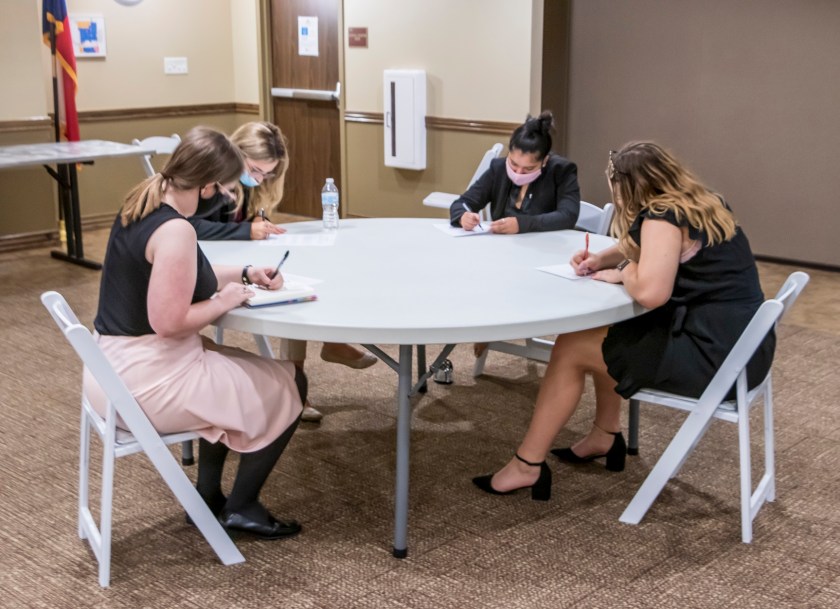
Our fourth LEAP LEADs meeting was, again, full of educational opportunities. As soon as everyone settled in, we jumped right in by discussing our potential future careers and practiced interviewing used the STAR (Situation, Task, Action, Result) method.

We separated into two groups: the interviewers and the interviewees. I love speaking, so I decided that I wanted to be an interviewer, and when the scenario began, I asked Jayelynn and Juan questions regarding the position of being a Victim’s Advocate.

SHSU, Sam Houston State University, LEAP Center, Center for Law Engagement And Politics, LEAP LEADs

As we wrapped up the interview process, we learned that the STAR method is a tried and true way to make a strong impression in an interview. By sharing an example and relating it to the interview question, you can support your answers with evidence. The best part about this exercise is that we experienced how it feels to interview and be interviewed by our peers.

This slideshow requires JavaScript.

While eating fantastic food from Mama Juanita’s, we tune into the Texas Tribune Festival. The discussion this tonight is about how COVID-19 affects higher education, with a panel featuring Chancellor Renu Khator from the University of Houston System, Chancellor J.B. Milliken from the University of Texas System, and John Sharp from the Texas A&M University System.

These systems are three of the most prominent university systems in Texas, so the respective chancellors wanted to address students’ and parents’ concerns about the next step for higher education. Each chancellor expressed their concerns regarding student and faculty health, and all of them explained that their schools have structured protocol if a faculty or student gets in contact with COVID-19.

The chancellors all confirmed that they were restricting their in-person classes to, at least in one case, to as low as 5% of their total classes.  They also stressed the need to be flexible and make necessary changes. It was interesting to find out that, while some Universities cancelled their football games (SHSU included) these three Universities did not. Chancellor J.B. Milliken explained, “…we will have social distancing guidelines for our stadium, and we will require fans to wear masks.”

SHSU, Sam Houston State University, LEAP Center, Center for Law Engagement And Politics, LEAP LEADs

Lastly, we tuned into our final Texas Tribune discussion, which addressed Public Health and the 87th Legislature in Texas.

The discussion featured Representative Senfronia Thompson (D) from Houston, Texas, and Representative James Frank (R) from Wichita Falls, Texas. Representative Thompson has the honor of being the longest-serving African American woman for the Houston area since 1972.

SHSU, Sam Houston State University, LEAP Center, Center for Law Engagement And Politics, LEAP LEADs

Representative Frank is a successful businessman in his fourth term in the Texas House of Representatives. The discussion centered around nursing homes, how they have been directly hit by COVID-19, and how the elderly are being negatively affected by the various policies and protocols in place to deal with the pandemic. Representative Thompson shared how her sister had an immediate effect on being housed at a nursing home during COVID-19, and unfortunately, she passed away due to her health conditions. While public health is currently vital in Texas, the 87th legislative session will occur on January 12, 2021.This meeting has been my favorite because I got to learn how chancellors run their university systems while learning about public health.

SHSU, Sam Houston State University, LEAP Center, Center for Law Engagement And Politics, LEAP LEADs


Unknown's avatarAuthor mikeyawnPosted on September 27, 2020September 27, 2020Format AsideCategories Civic Engagement, Health, PoliticsTags Center for Law Engagement And Politics, LEAP Center, LEAP LEADs, Sam Houston State University, SHSULeave a comment on LEAP LEADs: Education and Health

Pandemics in 2020: A Discussion from the Scowcroft Institute

Each year, the Scowcroft Institute the Bush School hosts a summit on pandemics, which brings together experts who discuss the biggest challenges to successful responses to pandemics.

SHSU, LEAP Center, Center for Law Engagement And Politics, Bush School at Texas A&M University, Scowcroft Institute, Dr. Christi Blackburn, Dr. Gerald Parker, Professor Andrew Natsios, Dr. Oyewale Tomori, Pandemics

And each year, they prepare a white paper summarizing and extending the discussions at the summit.  This year, they marked the release of the White Paper with a FB Live event featuring Dr. Oyewale Tomoroi (Senior Fellow at Scowcroft Institute and Professor of Virology in Nigeria); Dr. Gerald Parker (Director for the Pandemic and Biosecurity Policy Programs at the Scowcroft Institute and administrator in many government divisions, including the Department of Homeland Security and Health and Human Services), Andrew Natsios (Executive Professor at the Scowcroft Institute; and manager of reconstruction programs in Afghanistan, Iraq, and Sudan); and moderated by Christi Blackburn (Deputy Director of the Scowcroft Institute’s Pandemic and Biosecurity Policy Program).

After introducing the guests, Dr. Blackburn…

SHSU, LEAP Center, Center for Law Engagement And Politics, Bush School at Texas A&M University, Scowcroft Institute, Dr. Christi Blackburn, Dr. Gerald Parker, Professor Andrew Natsios, Dr. Oyewale Tomori, Pandemics

…posed a number of questions to the panelists.  Dr. Tomori led off, noting the importance of responding to pandemics with speed and quality information and resources, and that this is especially true in remote areas, where resources may be scarce.

Dr. Parker then tackled the thorny problem of vaccinations.  He emphasized the importance of having development and dissemination plans.  While there has been much discussion of a vaccination for COVID, vaccinations are not typically easy to develop, nor are they often developed quickly (although not discussed here, I have read that the shortest time in history for the development of a vaccine is four years).

SHSU, LEAP Center, Center for Law Engagement And Politics, Bush School at Texas A&M University, Scowcroft Institute, Dr. Christi Blackburn, Dr. Gerald Parker, Professor Andrew Natsios, Dr. Oyewale Tomori, Pandemics

The keys are: (1) developing sufficient supplies, suppliers, and training to ground-level forces, and (2) distribution, which is the most difficult (“the final mile is the hardest”).  In the latter phase, Parker emphasized that vaccines are distributed all at once.  Vaccines have to be developed, and the supplies take time to get to everyone, so who gets the vaccine first?  Parker suggests, of course, health care workers, but a whole prioritization list needs to be developed for the entire rollout.  Also key is a plan by developed countries to get the vaccine to less wealthy countries, something that is both logistically difficult and sometimes politically fraught.

Professor Natsios elaborated on this with some interesting facts. First, he noted that the Russians were active on social media, using bots to spread messages both pro and con for vaccinations.  They know that, in a democracy, if you can confuse people to what the truth is, you can thrown democratic processes into confusion.  Further, polls show that approximately 30-50 percent of Americans indicate they are hesitant to avail themselves of a COVID vaccination.

The solution, according to Natsios, is to work with local leaders–religious, community, medical, even sports–and do publicity campaigns for vaccinations.

SHSU, LEAP Center, Center for Law Engagement And Politics, Bush School at Texas A&M University, Scowcroft Institute, Dr. Christi Blackburn, Dr. Gerald Parker, Professor Andrew Natsios, Dr. Oyewale Tomori, Pandemics

Dr. Blackburn switched topics, going to how to develop effective early warning systems in pandemics.  Natsios, who had extensive experience with detecting and responding to famines from his government days, also fielded this topic.

Noting that satellite photos could determine crop health and allow advance warnings for famines, Natsios pointed out that the same tools can be used for pandemics.  In a fascinating discussion, he pointed out that satellite photos of Wuhan, China from August of last year show increased vehicular ( (a measure that includes bicycles) occupancy in China hospitals.  Intelligence agencies have complemented this with social media content analysis, which shows a significant uptick in questions about symptoms–symptoms correlating strongly with those produced by COVID–at the same time.  The conclusion, of course, is that COVID was probably hitting Wuhan in August of last year, before the world–and probably even China–knew about it.  These remote sensing tools (which include monitor of cemetery and crematoria activity) can be useful in detecting pandemics early.

Natsios concluded by emphasizing the importance of early detection, noting that if the pandemic is caught in time, its contagion can be extraordinarily curtailed.

Dr. Blackburn then fielded questions from the audience, which included:

    • Is there a single agency in charge of biosecurity?
      • No, although one is desperately needed.  Both Parker and Natsios agreed that, unless a directive was sent straight from the White House, most agencies wouldn’t implement with the efficiency needed, often because of interdepartmental conflicts.  The discussion of interdepartmental conflicts–conflicts which apparently included Parker and Natsios while they were in different departments, let to some humorous recollections.SHSU, LEAP Center, Center for Law Engagement And Politics, Bush School at Texas A&M University, Scowcroft Institute, Dr. Christi Blackburn, Dr. Gerald Parker, Professor Andrew Natsios, Dr. Oyewale Tomori, Pandemics
    • How do we balance Technology and Privacy?
      • Although this wasn’t answered directly, the information provided was interesting.  Natsios noted that Germany had very good privacy laws, but shifted topics somewhat by noting that the US had a “frontier mentality,” which affected its balancing of individual vs. collective rights.  Because of this “frontier mentality,” many argue that the government has no right to ask them to wear a mask–a belief contradicted by court rulings dating back to at least 1820.
    • How do we deal with unknown pandemics?
      • All agreed that all pandemics are unknown–even if they come from known diseases, they are often a mutated or novel version.  The panel agreed on increased spending, and, perhaps befitting employees of Texas A&M, home of one of the best Veterinary Schools in the US–suggested the importance of studying zoonotic diseases.  Natsios noted that 70 percent of the new diseases in the past 40 years have come from animals, with HIV being, obviously, the most notable example.

This fascinating and timely discussion can be viewed here in its entirety and the white paper can be found here.  Thanks again to the Bush School for its wonderful programming!


Unknown's avatarAuthor mikeyawnPosted on July 26, 2020Format AsideCategories Civic Engagement, Health, PoliticsTags Bush School at Texas A&M University, Center for Law Engagement And Politics, Dr. Christi Blackburn, Dr. Gerald Parker, Dr. Oyewale Tomori, LEAP Center, Pandemics, Professor Andrew Natsios, Scowcroft Institute, SHSULeave a comment on Pandemics in 2020: A Discussion from the Scowcroft Institute

Talking COVID with Dr. Blackburn: July 2020

The Scowcroft Institute at Texas A&M has been offering regular COVID updates for viewers, and this month’s update, with Dr. Christine Blackburn, featured medical officials from Brownsville, Texas, where the Coronavirus has been particularly destructive.

 SHSU, LEAP Center, Center for Law Engagement And Politics, Texas A&M Bush School, Scowcroft Institute, Dr. Christine Blackburn, Dr. Art Rodriguez, Michelle Jones, Brownsville TX     

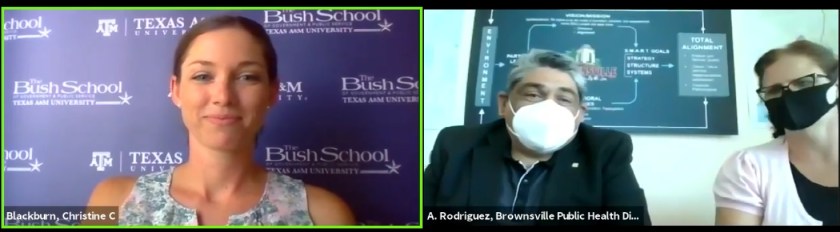
Blackburn’s guests were Michelle Jones, an epidemiologist, and Dr. Art Rodriguez.  Both live and work in the Brownsville area.\

SHSU, LEAP Center, Center for Law Engagement And Politics, Texas A&M Bush School, Scowcroft Institute, Dr. Christine Blackburn, Dr. Art Rodriguez, Michelle Jones, Brownsville TX

Dr. Blackburn, who is the Assistant Director for the Scowcroft Institute’s Pandemic and Biosecurity Policy Program, led off with updates.  In the US, we have approximately 3.3 million cases and 136,000 deaths.  In Texas, we have about 274,000 cases and 3,300 deaths.

Following her updates, Dr. Blackburn turned it over Dr. Rodgriguez and Michelle Jones.  In Brownsville, Dr. Rodriguez noted, the area is showing a surge in case positivity, with 30 percent of the tests coming back positive.  Moreover, the hospital capacity in Brownsville is 400 beds, and right now, the hospitals are at 95 percent, with ICU and ER beds being beyond capacity.

SHSU, LEAP Center, Center for Law Engagement And Politics, Texas A&M Bush School, Scowcroft Institute, Dr. Christine Blackburn, Dr. Art Rodriguez, Michelle Jones, Brownsville TX

Ms. Jones added that, one of the confounding variables in Brownsville is that there is much foot traffic between the City and Mexico, making collaboration with Mexican officials important.

SHSU, LEAP Center, Center for Law Engagement And Politics, Texas A&M Bush School, Scowcroft Institute, Dr. Christine Blackburn, Dr. Art Rodriguez, Michelle Jones, Brownsville TX

Both Rodriguez and Jones highlighted some of the steps Brownsville has taken to combat the issue.  The City of 185,000 people, has unveiled a five-level threat matrix, which offers suggestions at each stage on how to mitigate the threat; they are taking steps to double their daily testing capacity, which should be complete by next week; and they are working with the local college to lead sanitation classes, which will help educate the public on mitigation and containment strategies.

Dr. Blackburn then took questions, some of which were political, a sensitive area, especially if the questions involve your employer.  “How will Texas A&M bring back in-person classes without a spike in cases?”  This is, Dr. Blackburn noted, “a significant challenge,” which will be “very, very, very difficult.”  

And: “Why doesn’t Brazos County Office of Emergency Management report the percent of positive cases in their testing and their contact tracing more quickly?”  This is a “labor intensive process,” and Brazos County Health Department is “doing all they can, and working very hard to respond” to the community’s needs.

These questions were fielded with a smile, perhaps an acknowledgement of the difficulty of answering such questions.

SHSU, LEAP Center, Center for Law Engagement And Politics, Texas A&M Bush School, Scowcroft Institute, Dr. Christine Blackburn, Dr. Art Rodriguez, Michelle Jones, Brownsville TX

One question, which is on many minds, is the question of immunity.  How long will it last?  Dr. Blackburne noted that no one knows that yet.  Preliminary reports indicate that antibodies may not long linger in the body, limiting the amount of immunity they will provide.  But she believes that t-cells might be a fruitful research direction, noting that even if “immunity can last a year, the public could get seasonal vaccines.”

But the discussion was also sobering, with all three panelists seeing this is a long-term issue.  It’s not clear that we will return to normal in the foreseeable future, and the panelists suggested we should prepare for “hills and valleys.”  The key, Dr. Blackburne noted, is coming up with strategies that can effectively mitigate the spread and impact of COVID but “which can also be sustained.”  

Given the level of noncompliance with existing strategies (social distancing, masks), it’s not clear that sustainable and effective strategies exist for our current level of knowledge about the virus.

Many thanks to the Scowcroft Institute, Dr. Blackburn, Dr. Rodriguez, and Ms. Jones for their very informative presentation.  The program can be seen in its entirety here.

SHSU, LEAP Center, Center for Law Engagement And Politics, Texas A&M Bush School, Scowcroft Institute, Dr. Christine Blackburn, Dr. Art Rodriguez, Michelle Jones, Brownsville TX


Unknown's avatarAuthor mikeyawnPosted on July 15, 2020July 15, 2020Format AsideCategories Civic Engagement, Health, PoliticsTags Brownsville TX, Center for Law Engagement And Politics, Dr. Art Rodriguez, Dr. Christine Blackburn, LEAP Center, Michelle Jones, Scowcroft Institute, SHSU, Texas A&M Bush SchoolLeave a comment on Talking COVID with Dr. Blackburn: July 2020

Talking COVID with Dr. Gerald Parker

Dr. Gerald Parker is the Director of the Scowcroft Institute’s “Biosecurity and Pandemic Policy Program,” and he has served as the Deputy Assistant Secretary of Defense for Chemical and Biological Defense and as the Deputy Assistant Secretary for Preparedness and Response at the Department of Health and Human Services.  In short, he is qualified to discuss the Corona Virus, and that’s what he did last, giving LEAP students an opportunity to learn more about the public crisis that is, we hope, a once-in-a-lifetime event.

SHSU, LEAP Center, Center for Law Engagement And Politics, COVID, Coronavirus, TAMU, Bush School of Government and Public Service, Scowcroft Institute, Dr. Gerald Parker

Dr. Parker began by giving an overview of the ever-growing numbers of COVID cases and deaths in the US.  He also pointed out the most common victims of the virus: (1) those over 65 (in Texas, 75 percent of those who die from the virus are 65 or older); (2) those with existing health conditions; (3) those in long-term care facilities (prisons and nursing homes); and (4) those in meat-packing plants.

SHSU, LEAP Center, Center for Law Engagement And Politics, COVID, Coronavirus, TAMU, Bush School of Government and Public Service, Scowcroft Institute, Dr. Gerald Parker

And while the US may have peaked–at least in its first wave–there are numerous possible scenarios for how this may play out.  The big takeaway, is that despite the re-opening, the virus threat has not passed.  Dr. Parker saw three possible future scenarios: (1) a series of peaks and valleys; (2) a second wave in the fall; or (3) a smaller fall peak, with continuing flare ups.  In many respects, the first of these may be the most difficult, at least in terms of planning.  Of course, a second large wave could also make for strains on the health-care system.

SHSU, LEAP Center, Center for Law Engagement And Politics, COVID, Coronavirus, TAMU, Bush School of Government and Public Service, Scowcroft Institute, Dr. Gerald Parker

To make re-opening successful, Dr. Parker advocated for: (1) getting up to speed on (a) contract tracing, (b) testing, and (c) identifying hot spots, so that additional steps can be taken in those areas; (2) continuing to practice social distancing and other common-sense measures; (3) ensuring our hospitals and other institutions are prepared should another major wave occur, which Dr. Parker thinks could be likely.

Dr. Parker’s program was educational, if sobering, and we look forward to future programs from the Bush School.


Unknown's avatarAuthor mikeyawnPosted on May 11, 2020Format AsideCategories Civic Engagement, Health, PoliticsTags Bush School of Government and Public Service, Center for Law Engagement And Politics, Coronavirus, COVID, Dr. Gerald Parker, LEAP Center, Scowcroft Institute, SHSU, TAMULeave a comment on Talking COVID with Dr. Gerald Parker

Posts pagination

Previous page Page 1 Page 2

LEAP Ambassadors Are Involved!

This slideshow requires JavaScript.

Follow Us On Facebook!

Follow Us On Facebook!

Catch Up With Us

  • Crafting for a Cause December 18, 2025
  • Exploring The Shining: A Kubrickian Journey December 15, 2025
  • Interactive Experiences at Asia Society Texas: A Student’s Perspective December 14, 2025
  • A Culinary and Artistic Journey Through Houston December 13, 2025
  • Alumni Insights: Jessica Rodriguez-Wahlquist Returns to LEAP December 11, 2025

Join The Conversation!

The Civic Leadership… on Foundational Activities of the…
The Civic Leadership… on The Philosophical Foundations…
LEAPing Into Action… on The Philosophical Foundations…
Jada Cook's avatarJada Cook on SHSU Students LEAP Across Five…
Reflections from the… on Kicking off the Semester Right…

Find Previous Posts

Many thanks to Professor Lauren Clay, who led a ceramics class for LEAP students. This effort promotes the arts while fighting food insecurity through the Empty Bowls program, benefitting Meals on Wheels.

We also have Twitter!

My Tweets

LEAPing Into LEARNing

This slideshow requires JavaScript.

  • About LEAP
  • LEAP Ambassadors
Center for Law, Engagement, and Politics Blog at WordPress.com.
  • Subscribe Subscribed
    • Center for Law, Engagement, and Politics
    • Join 486 other subscribers
    • Already have a WordPress.com account? Log in now.
    • Center for Law, Engagement, and Politics
    • Subscribe Subscribed
    • Sign up
    • Log in
    • Report this content
    • View site in Reader
    • Manage subscriptions
    • Collapse this bar
 

Loading Comments...