Midwest Tour, Day 8: Kansas City, Home of the MLB Champs!

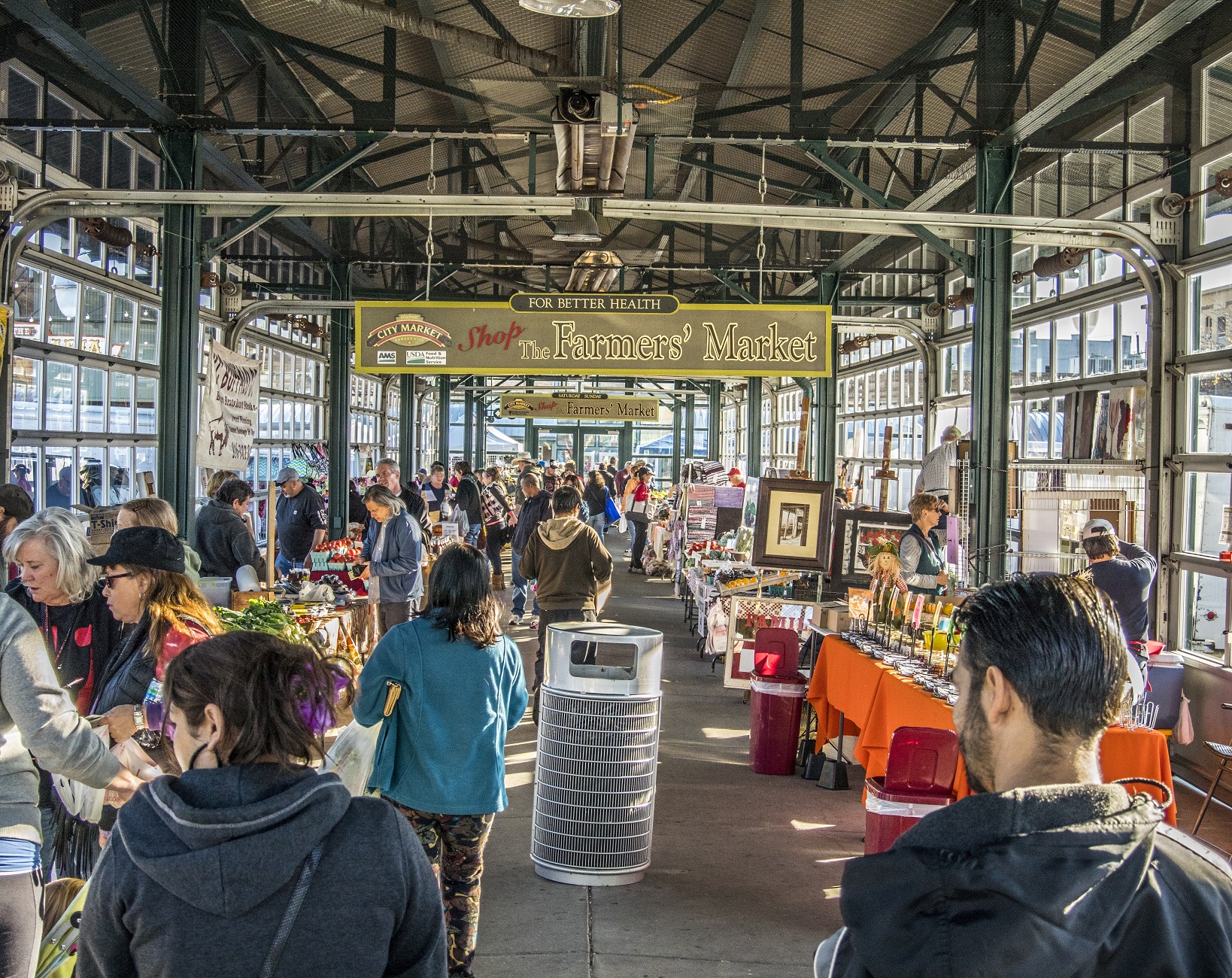
We began our Saturday morning exploring Kansas City’s own River Market. Although we arrived a bit early, we got a head start on all of the produce, cheeses, spices, and home goods that the farmers market had to offer. The brisk morning air refreshed us after a short night of sleep and we enjoyed strolling through the different vendors, smelling the fresh flowers, appreciating the colorful produce, and tasting different foods foreign to Texas.

City_Market_KC_2_Web

With just a little over an hour to explore, we tried coffee at Quay Coffee and wandered through the shops open at the early hour. With our noses exhausted from the various smells permeating the market, we left to make it to our Segway tour reservation on time.

Led by Kelly, we hopped on the available segways like pros and began the tour of downtown Kansas City.

Segway_Line_Web

We started in an area called Westport, home to bars, shops, and many a hipster. The area prides itself on preserving its history, which we observed in the established community and some of the buildings being the oldest sanding in Kansas City. Founded in 1831 by Isaac McCoy, Westport originally sat three miles south of what is today downtown Kansas City. His son, John Calvin McCoy, is credited as the “Father of Kansas City” and we observed a statue of him during the first part of our tour. We left the area of Westport to continue our tour, segwaying past pedestrians and through a few linear parks. Kansas City, known as the least dense and city with the most green space in America, is home to many beautiful parks. We had the chance to enjoy these areas, albeit, on segway. We followed Kelly along a couple creeks, walking trails, and even spotted public work out equipment along the way. We ambled upon Kauffman Memorial Garden after visiting Westport, a clear juxtaposition to the hip, bar district we had just explored.

Kaufman_Memorial_Garden_Web

The garden, quiet and serene, serves as gravesite to Ewing and Muriel Kauffman, philanthropists to the city in the mid 1960s. We left the garden to continue on our tour, only after appreciating the giant chrysanthemums in the greenhouse.

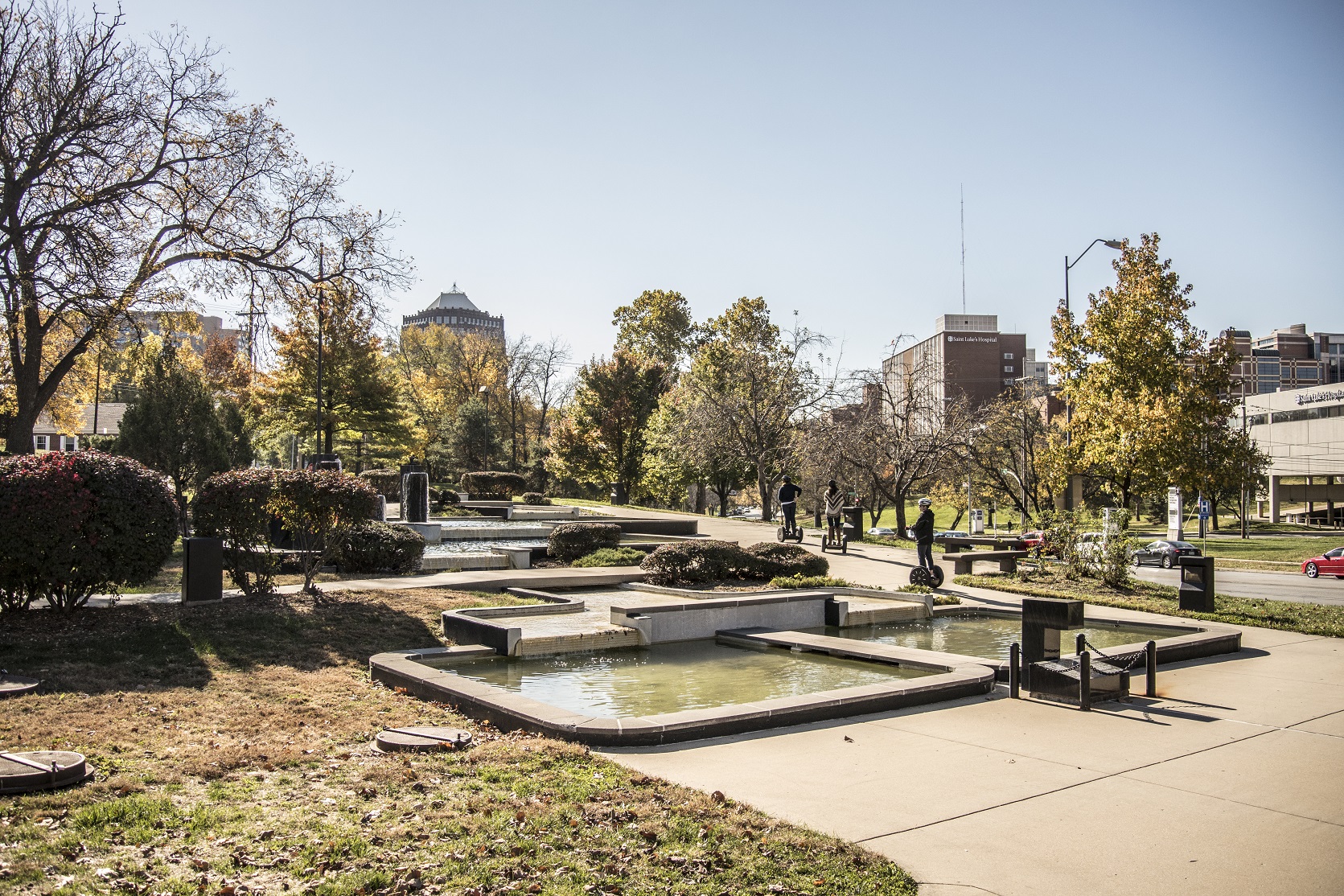
Kansas City is known as the “City of Fountains,” and one of the more interesting fountains we encountered was a memorial to the Vietnam War.  It was laid out in a series of cascading waterfalls, a reference to the U.S’s cascading involvement in the war.  It culminates in two pools of water at the end, a symbol for the split in public opinion over the war.

Segway_Vietnam_Memorial_Web

We spent the most time on our tour on the grounds of the Nelson-Atkins museum, avoiding photographers and muses as best we could. We even had the chance to explore grounds unfamiliar to Professor Yawn, home to sculptures by Ursula von Rydingsvard (Three Bowls), Henry Moore, and Roxy Paine (Ferment).

Segway_Sculpture_Garden_Constance_Alex_Moore_Paine_Web

We also had the chance to get off our segways and try out Robert Morris’ Glass Labyrinth, which we luckily made it out of without running into any of the glass walls.

Segway_Sculpture_Garden_Labyrinth_2_Web

We left the grounds, after quite a few photo opportunities, including the chance to see a Claes Oldenburg sculpture (a shuttlecock!)….

Segway_Sculpture_Garden_Constance_Alex_Shuttlecock_Web…and an unsettling sculpture titled “Standing Figures,” which is actually a sculpture of 30 headless men standing in rows.

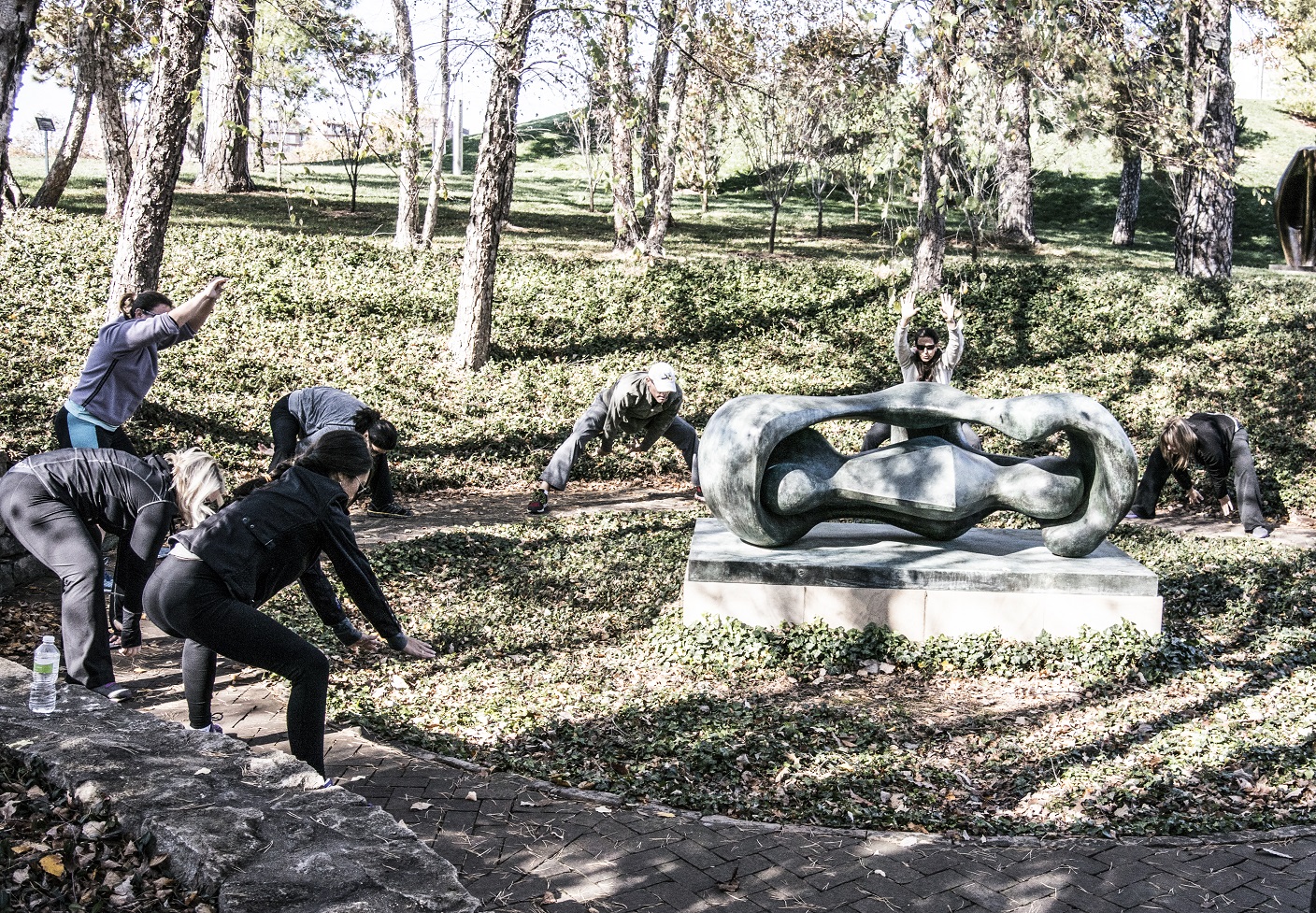
Segway_Sculpture_Garden_30_Men_Standing_WebMeandering through the parks, we also encountered some yoga practitioners, taking advantage of the peacefulness of the park (other than the speeding Segways, of course)…

Segway_Nelson_Atkins_Sculpture_Yoga_Group_Web

From there, we made it back to the Kemper Museum of Modern Art, which we had visited the evening before but had yet to observe in daylight.  We were re-acquainted with Louise Bourgeois’s “Spider”…

Segway_Kemper_Burgeoise_2_Web


…as well as Tom Otterness’s “Crying Giant.”

Segway_Kemper_Crying_Giant_WebWe had previously seen Bourgeois’s work in Iowa and in New Orleans, and we had only recently seen Otterness’s work (City Garden, in St. Louis).

That being our last stop…

…we bid adieu to Kelly and her insightful information and headed to scrounge up some lunch.

Much to the recommendation of our tour guide, we decided to eat lunch at Q39, a local Kansas City barbeque joint. We found the restaurant to be very popular and were confronted with an hour wait. With that information, Professor Yawn and Stephanie decided to let us wait and enjoy lunch while they left to grab our bags at the hotel in preparation for our departure this evening. We finally got a table, which was worth every second of the wait, once we received our appetizer of fried onion strings and meals consisting of ribs, sausage, pulled pork, and even better Kansas City barbeque sauce.

Q_39_BBQ_Web

Slightly tangy and very sweet, we enjoyed the barbeque that is so different than what we can enjoy in Texas. We left the restaurant full and ready to take on the rest of our afternoon.

We spent the first part of the rest of our afternoon exploring and learning at The National WWI Museum and Memorial. We arrived just in time to sit and watch the introductory video that left us wanting to learn more, so we ventured into the museum. We began with the WWI timeline that started with the assassination of Archduke Franz Ferdinand and led to Austria declaring war on Serbia.

WWI_Cannon_Wall_Web

This led to an entanglement of treaties and soon after, the five Great Powers were at war.

WWI_Global_War_Alex_Web

The museums timeline was easy to read and separated every year. The year of 1915 showed how the momentum of the war shifted to the east and highlighted the sinking of Lusitania by a German submarine. The year of 1916 on the timeline highlighted the Battle of Verdun and the Battle of the Somme. The timeline then moved on to the year of 1917, which is when Germany began to renew their unrestricted submarine warfare. One U-boat had cost American lives, which led to America severing its diplomatic relations with Germany and having to decide upon entering the war. The first American troops landed in France on June 25, 1917 and the spirits of France were renewed. The museum also features sections on Air warfare and others. As we walked through the museum we were able to watch another more interactive video about the war which then escorted us to the back portion of the museum that highlighted the America’s role in the War. The museum was very detailed and included many aspects of the war such as every branch of the military, a woman’s position in the war, civilian’s positions in the war, and an exhibit on war propaganda.

WWI_Propoganda_Alex_WebWe entered a reflections box where we were able to listen to voices from the War. We then took an elevator up to the Memorial where the tower commemorating the fallen soldiers stands. After enjoying the view, we walked back over the glass bridge hanging over the poppies that represent the fallen soldiers of the War.

We left the National World War I Museum to stroll down the hill in front of it, capturing the beautiful fall afternoon with a few photographs.

WWI_Constance-Tree_Closeup_Web

We loved feeling the breeze and seeing the burgundy leaves fly through the air off the trees preparing for the first winter frost.

WWI_Museum_Constance_Tree_2_Web

We walked across the street, following the museum, to enter Union Station in search of the temporary Da Vinci exhibit that the train station holds.  We found the exhibit on the bottom floor of the station and proceeded to get in line, thrilled with the anticipation of learning about one of history’s most prominent inventors and scholars. We entered the exhibit and watched an introductory video about the Renaissance man. Following, we left the compression of the video space and were awed by the expansion of the rest of the exhibit, full of Da Vinci’s inventions.

Da_Vinci_Exhibit_Wings_Web

We had the chance to read about his work in military science, flying machines, scientific diagrams about the human body, civil engineering, and inventions that would make everyday work easier and more efficient. We always knew about the inventor’s paintings, “Mona Lisa”…

Da_Vinci_Exhibit_Mona_Lisa_Alex_Web

…and “The Last Supper,”

Da_Vinci_Exhibit_Last_Supper_Alex_Web…but it was even more compelling to learn about all the musings that were found in his journals ranging from thoughts about poetry to the making of the ideal city. We even had the chance to touch multiple replicas of his inventions, like a pulley and a lock system.

Da_Vinci_Exhibit_Pulleys_Web

Following the section about his inventions, we had the opportunity to read about his artwork, which about fifteen have survived to this day due to the precariousness of Da Vinci’s experiments with new techniques. It was interesting to read about his work with the golden ration, which can be seen in his paintings and in his drawing of the Vitruvian Man. We left the exhibit awed by a man that we knew very little about before and inspired to expand our horizons just as he did during his lifetime.

We also had a chance to return to the Nelson-Atkins and see the special Thomas Hart Benton exhibit.  The theme was Thomas Hart Benton and the Hollywood epic, highlighting styles that tied in with epic films, as well as the time that Benton spent working in Hollywood.

Nelson_Atkins_Benton_Exhibit_WebWhile in the Museum, we took an opportunity to see some of the pieces we had missed the day before, such as the beautiful gardens…

Segway_Sculpture_Garden_Thinker_Web…Rodin’s “Thinker” up close…

Nelson_Atkins_Thinker_Web…and the strange, intriguing folk art of Philip Haas…

Nelson_Atkins_Phillip_Haas_Summer_Web

Before leaving KC, we returned to Union Station to grab a few souvenirs before beginning the drive out of town.

After a while on the road we stopped at Pie Five Pizza Co., in Topeka, KS, for a quick dinner. Constance and I shared the biggest Greek salad that I had ever seen and a pesto chicken Alfredo pizza that was delicious. We left the restaurant, and took advantage of our stop in Topeka to see the state’s capitol and other sites.

Kansas_Capitol_Constance_Alex_Web

We stopped at the capitol building, standing majestically in the middle of town. We weren’t able to go into the Capitol because it was late, but we did capture a few photos. Before getting back on the road we had to make one more stop. We stopped at the Brown V. Board of Education National Historic Site. Sadly it was closed by the time we arrived, but we were able to have a glimpse inside provided by the glass doors.

Brown_V_Board_Constance_Alex_2_Web

In the building we saw the labels “White” and “Color” that segregated the school. Even though we were not able to go inside, it was still a very sobering experience.

We hopped back in the van, en route to our last stop for the night, Wichita, to sleep before getting back on the road in the morning for the long trek back to Huntsville.

Midwest Tour, Day 7: Going to Kansas City, Kansas City Here We Come

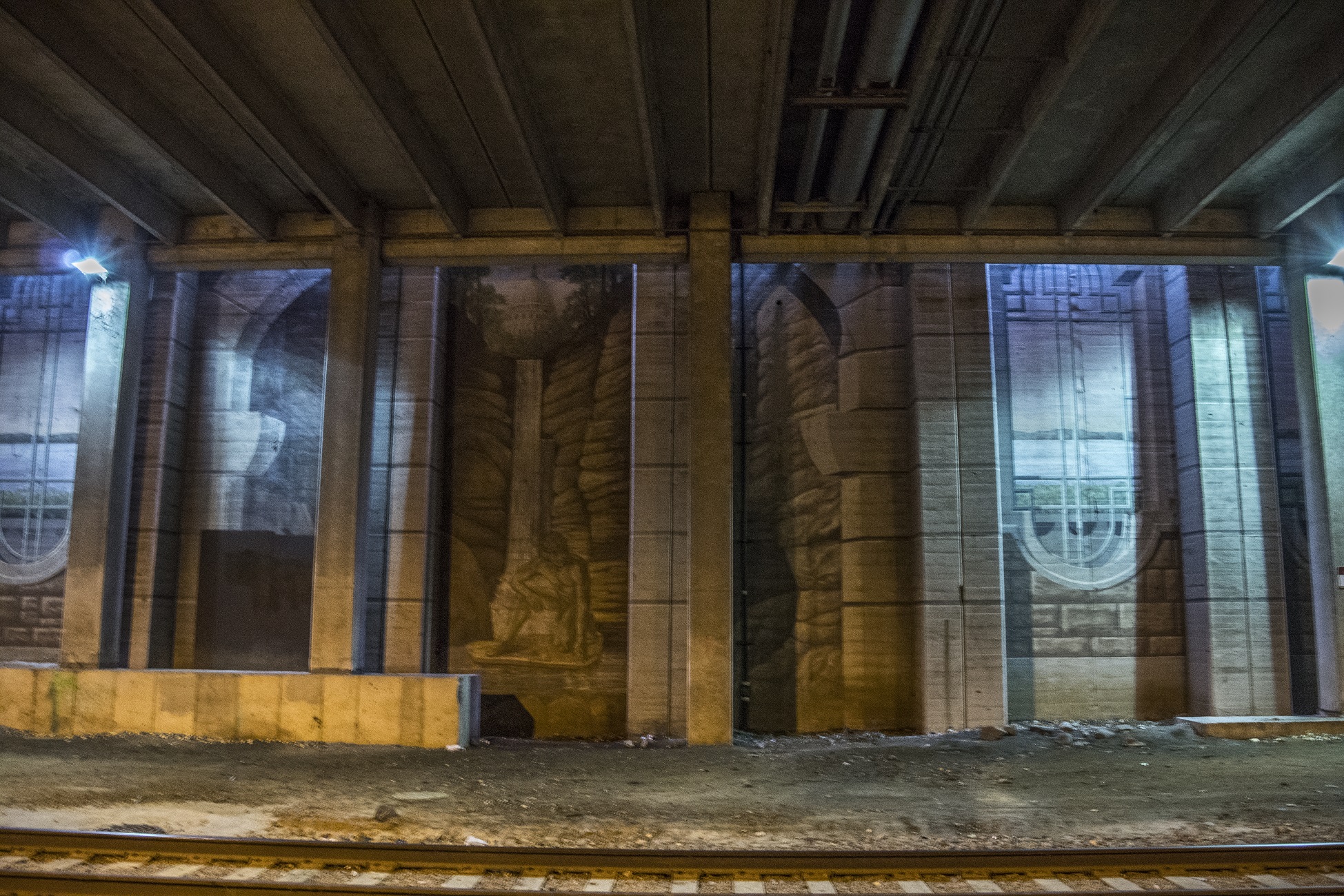
We left Madison bright and early this morning to get a head start on the day’s heavy amount of driving. Before completely departing the capitol, however, we stopped by a “lost” Richard Haas mural.  Haas completed this mural in 1987 and it beautified an already beautiful city for almost a decade.  In the 1990s, however, Madison decided to revive a Frank Lloyd Wright design for the City–Monona Terrace.  In completing the Wright design, the Haas mural was relegated to the side of a tunnel wall.  Not made to be seen in tunnel, and obscured by newly installed load-bearing columns for the overpass, the Haas mural of Wisconsin’s history is all but destroyed.  Still, we discovered vestiges of it.

Haas_Mural_Madison_WI_Web

With that sad sight in mind, we began the winding drive to Dubuque, Iowa. Dubuque, a small town along the Mississippi, was founded in 1833 and is home to an incline that gives panoramic views of the surrounding area. We arrived at the bottom of the incline, nervous (editor’s note: mostly Constance was nervous) about the rickety tram that would take us up the steep embankment.

Dubuque_Incline_Constance_Fear_Web

We piled in, however nervous we may have been, and slowly made it up the hill.

Dubuque_Incline_Tracks_Up_Web
The anticipation was worth it in the end, as we were able to look out over the Iowa hillside and appreciate the breathtaking view…

Dubuque_Skyline_Web…and take photos…

…and more photos…

Dubuque_Incline_Constance_Alex_2_Web…and more photos…

Dubuque_Incline_Constance_Alex_3_Web

…and to see how far we had come up the mountain.

Dubuque_Incline_Tracks_WebAfter a couple pictures, we rode down in the tram once more to find solace in the warmth of the minivan.

By the end, we (Constance, especially) were proud of the trip up and back!

Dubuque_Incline_Constance_Bottom_Web

We then drove to the gravesite of Dubuque’s founding father, Julien Dubuque. The grave, memorialized by a turret-like structure, sits on the edge of a mountain along the Mississippi.

Dubuque_Memorial_Web

We braved the semi-cold to appreciate the view of Dubuque and the fall colors of the area. Dubuque, who maintained a healthy relationship with the local Native American tribe, rests near the grave of Chief Peosta’s, leader of the Meskwaki tribe (and Dubuque’s father-in-law).

Dub uque_Peosta_Grave_Web

We snapped a couple pictures of the mighty Mississippi…

Dubuque_Monument_Constance_Alex_Web…with and without us…

Dubuque_Monument_Overlook_Web…and then headed back to the car for our next stop.

Dubuque_Monument_Alex_Constance_Walking_Web

After a few hours, we stopped for lunch at Her Soup Kitchen. A small, local eatery, the restaurant boasts local, fresh ingredients, which we enjoyed immensely. The cold weather made the soup even more delectable, as we warmed up from the inside, out.

Her_Soup_Kitchen_Sandwich_Soup

It was a neat place to eat, and we hope that the place thrives!

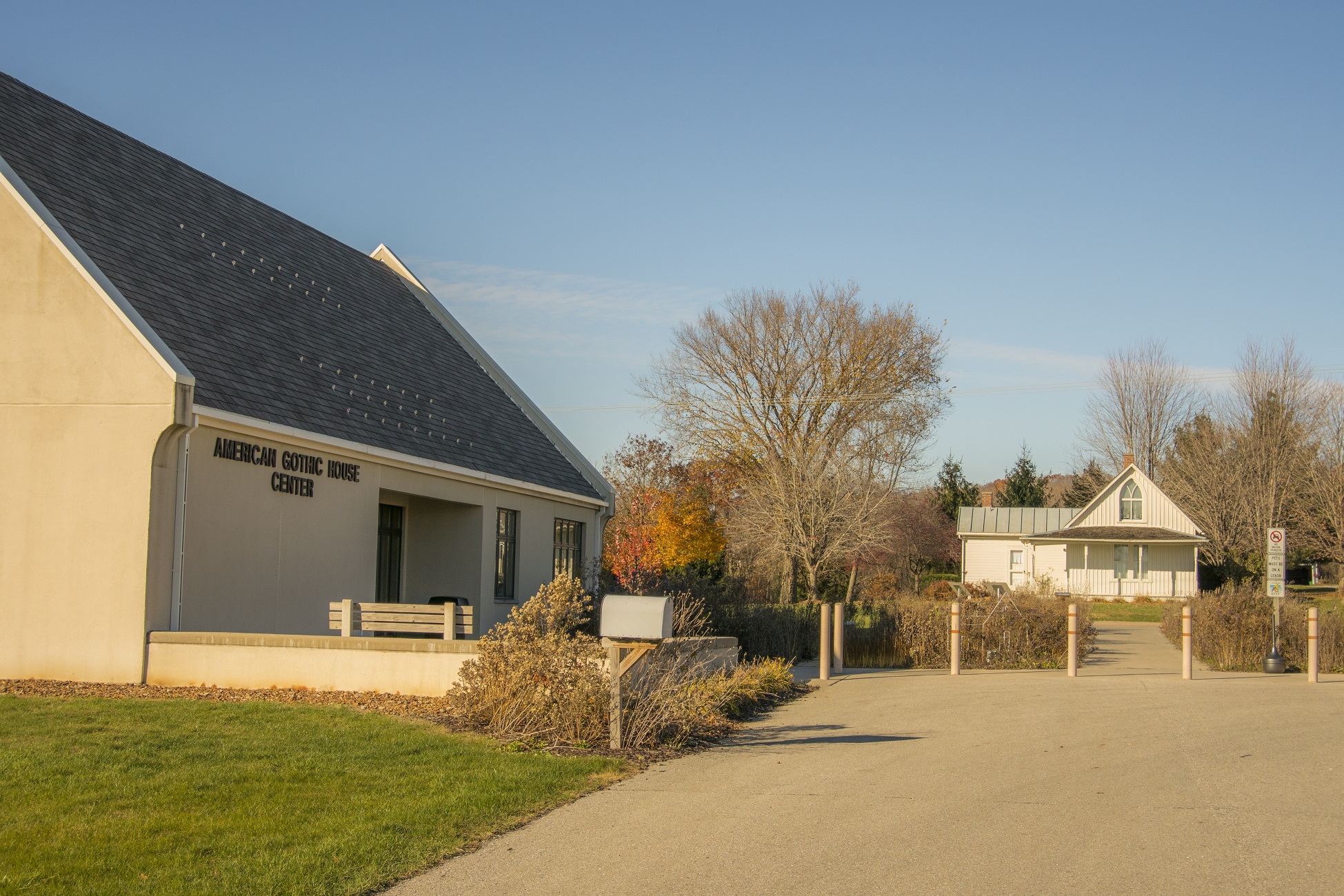
With a warm midwestern meal in our stomachs, we headed to not only an icon of the midwest, but an icon of the American scene: The American Gothic house.

American_Gothic_House_Visitor_Center_Web

Painted by Grant Wood, “American Gothic” remains a well-known art piece to Americans and foreigners alike. We were lucky enough to catch the piece at the Chicago Art Institute…

CAI_American_Gothic_Constance_Alex_3_Web

…and this made visiting the home all the more rewarding.  Although it rests in a small town, a visitor’s center and Grant Wood museum accompany the site of the home.

American_Gothic_House_Visitor_Center_Web
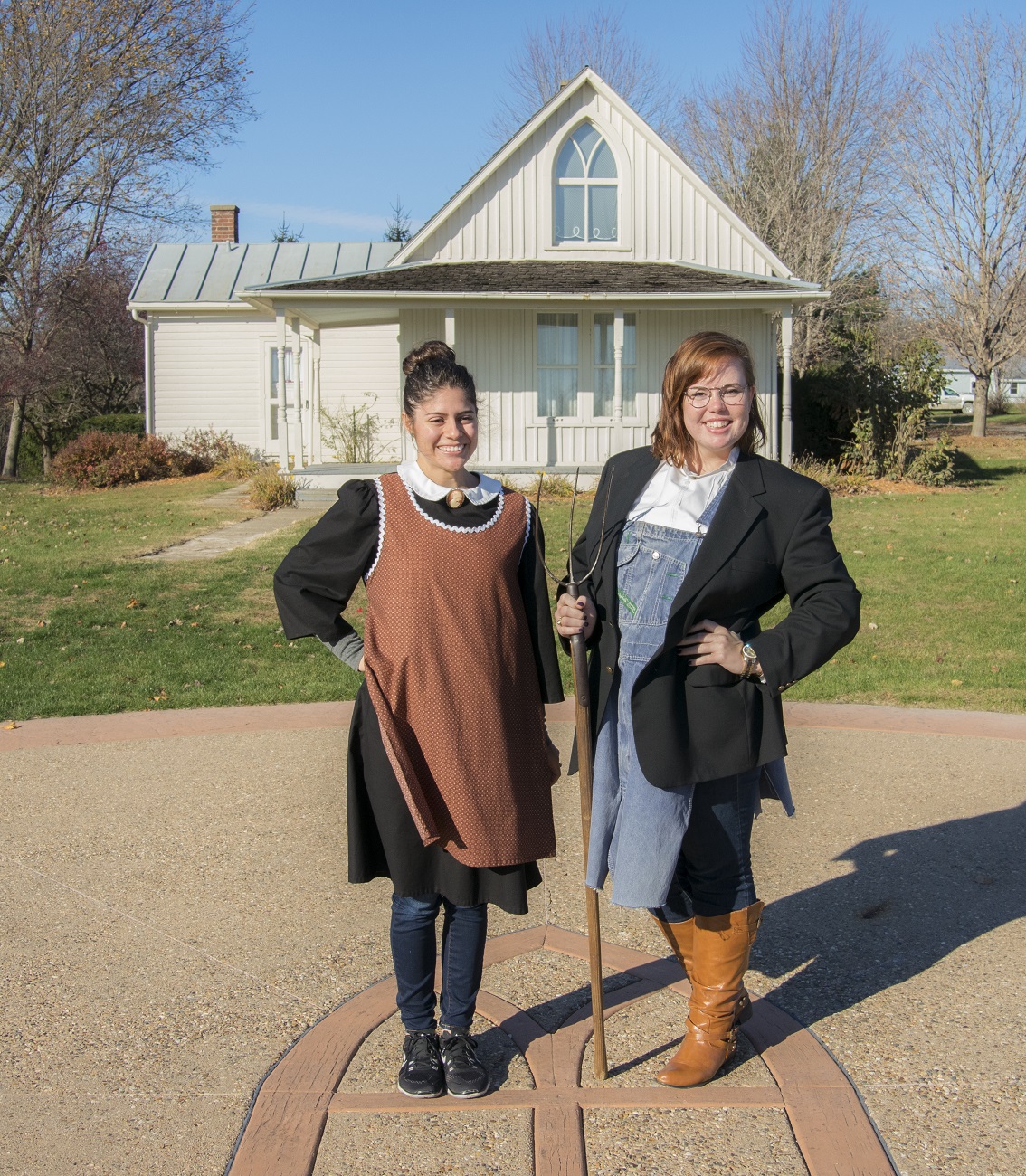
We walked in and promptly began putting on costumes to impersonate the couple in the photo. Once dressed, we posed in front of the home with the most convincing faces we could muster up which seemed a harder task than once originally expected!

American_Gothic_Alex_Constance_2_WebSwitching costumes, we continued the photo opportunity in opposite outfits but still finding it difficult to portray the seriousness Wood intended. All silliness aside, it was exciting being able to reenact history after seeing the original painting in Chicago.

We headed inside to the museum to learn a bit more about the artist himself. Born in 1891 in Anamosa, Iowa, Mr. Wood lived a very interesting life. A teacher, soldier, and artist at last, Grant Wood studied impressionism and post-impressionism in Europe and became the artist we know today under these occupations. Friend of Thomas Hart Benton and John Steuart Curry, Wood practiced the art of Regionalism with his colleagues, whom we have also had the chance of viewing at other museums this trip. Although posthumously famous, Wood lived a fairly middle-class life and supported his hometown through the Great Depression by opening the Stone City Art Colony. He married, divorced, and died one day away from fifty-one from pancreatic cancer. We left a bit more knowledgeable about the artist and having enjoyed the driving break, got back on the road to finish the drive to Kansas City.

American_Gothic_Museum_1_Web
Once we arrived in Kansas City, we took advantage of the late closing hours of the Kemper Museum of Contemporary Art and The Nelson-Atkins Art Museum. While walking up to the Kemper Museum of Contemporary Art we were greeted by one of Louise Bourgeois famous giant spider sculptures.

Segway_Kemper_Burgeoise_2_WebThe Kemper Museum of Contemporary Art had a “Dark Days, Bright Nights: Contemporary Paintings from Finland” exhibition while we were there that had a dark motif. As we walked through the temporary exhibit we had some group favorites such as “Canary” by Vesa-Pekka Rannikko ,which used ropes to complete its illusion. Another group favorite was “Cottage” by Nanna Susi.

Kemper_Nanna_Susi_Cottage_Web

Constance was pleased to see one of Georgia O’Keefe’s early paintings as well. I think that the highlight of the museum was the two Dale Chihuly pieces that were on displays at the Kemper Museum of contemporary Art.

Kemper_Chihuly_Below_Web

We then walked over to the Nelson-Atkins Art Museum’s south entrance, which featured Rodin’s “Thinker”. With the museum closing soon, we were only able to walk through a part of the massive building. Even though we only had a short amount of time, we did spot some great pieces. We were able to see some more of Georgia O’Keefe’s floral paintings…

Nelson_Atkins_Georgia_Okeefe_Apple_Blossoms_Web

and another titled “Autumn Trees”.  One of Professor Yawn’s favored pieces included “Utah Highlands” painted by Thomas Hart Benton.

Nelson_Atkins_Benton_Utah_Highlands_Web

We also found an interesting transformation piece in the Asian art gallery that showed a mountainside changing seasons. We ended our self-guided tour of the museum in the Contemporary Art gallery where we saw Andy Warhol’s very famous “Campbell’s Soup Can” along with other interesting pieces.

Neslon_Atkins_Warhol_Campbells_Soup_Web

Hungry, we raced down to Grunauer for dinner. We tried three different sausages and some pork belly before our main course.

Grunaeur_AppetizersConstance and I shared the A la Grunauer Schnitzel. The schnitzel was breaded pork stuffed with creamed spinach, and tasted amazing. Our entrees were delicious and we ended our dinner with an apple strudel.

Grunaeur_Strudel

After an amazing and very filling dinner, we walked over to Union Station.

Union_Station_Constance_Alex_Web

We were able to stand on one of the walking bridges just in time for the train to speed right below us. After exploring and taking a few pictures in the beautiful building, we were ready for a good nights rest so that we could start our morning bright and early.

Midwest Tour, Day 3: The Land of Lincoln

After a quick, “on-the-go” breakfast, Constance and I enjoyed the first part of our morning at The Abraham Lincoln Presidential Museum.  We have both been to Presidential Museums previously (Alex: Jimmy Carter and Bill Clinton; Constance: Harry Truman, George W. Bush, and LBJ), but this was our favorite!


The Lincoln Presidential Library

The museum is innovative, offering visitors an engaging, emotional and educational experience.  It is also the largest of the Presidential Museums, although it is operated by the State of Illinois, rather than the National Archives, and some do not count it as a true Presidential Library/Museum.

Alex_Lincoln_Web

Visitors experience Lincoln’s early life by walking through a replica of his childhood home–the famous log cabin.  They have a similar walk-through experience of Lincoln’s “White House” years, this one using 21st century technology to bring the 19th century to life.

Alex_White_House_Web

Visitors, for example, travel down the “Whispering Gallery,” seeing holograms of Lincoln’s rivals criticizing his decisions.  Of course, we also saw Mary Lincoln surrounded by her rivals, other women in the Capital’s social set, criticizing her appearance and behavior as first lady.

Lincoln_And_Mary_Todd_Web

Another noteworthy “replica room” included Willie’s bedroom, turned into his sickroom.  Sadly, Mary Lincoln survived the death of three of their children before they reached age eighteen due to various illnesses.  Two of her children died prior to President Lincoln’s assassination.

President Lincoln’s work on the Emancipation Proclamation was depicted through special effects with an impact. The Hall of Holograms included critics of the Emancipation Proclamation from both sides –that it went too far or didn’t go far enough. It was easy to imagine how the President must have felt while being attacked through these comments.

The Museum contrasted the media of Lincoln’s day with today’s media, offering a simulated version of what his momentous decisions would have wrought in the 24-hour news cycle.

Lincoln_News_Center_Web

We entered Ford’s Theatre, where Abraham Lincoln was assassinated, and then into the  full-scale recreation of the Representatives Hall in Springfield’s Old State Capitol. Alex reported later,  “This room was the most emotional for me. Having walked through Lincoln’s entire lifetime, I felt as if I was walking into this room to pay my respects, and not as a visitor of a museum.”

Lincoln_Dead_Sign_Web

The walk through Lincoln’s life was made all too real through the use of advanced technology in the museum. To evoke the time of a simpler day, we checked out “Mrs. Lincoln’s Attic,” a play area for younger children.

Alex_Sign_Web

While there, we learned about the types of toys that Lincoln would have played with as a child and other things that children, such as Alex, would find interesting.

Alex_Lincoln_Size_Chart_WEbWe also learned that Lincoln Logs were invented by Frank Lloyd Wright’s son, John Lloyd Wright. (We are making a lot of connections on this trip!)

Alex_Lincoln_Logs_Web

Following the tour of the Museum proper, we explored the grounds.

Lincoln_Depot_Web

The Lincoln Depot is nearby, with a statue of Lincoln commemorating the area.  Alex spent time with the wise old President…

Lincoln_Statue_Alex_Web…receiving tips on life, law, and politics…

Alex_Lincoln_3_Web…and even directions to the next destinations.

Alex_Lincoln_4_Web


The Lincoln Home

To continue our Lincoln-inspired morning, we followed Lincoln’s directions to his former home, the only home he ever owned.

Alex_Constance_Lincoln

Even though Abraham Lincoln lived in Kentucky as a boy, he spent nearly half his life living in Springfield, IL. The home is now operated by the US National Parks Service, having been sold by Lincoln’s only surviving son, Robert, for $1.  The home is part of a 12-acre historic site, in which surrounding homes have also been preserved, giving visitors a 19th-century feel.

Lincoln_Home_Exterior_Web

A Park Ranger led us on our tour through the home…

Lincoln_Home_Ranger_Web

…sharing plenty of information on the home’s interior and such trivia as the Lincoln’s humble Christmas celebrations.

Lincoln_Sitting_Room_Web

We were even allowed to use the original hand railing on the stair case that the Lincolns used! Upstairs, the master bedrooms were covered in an extravagant wallpaper,which made for some interesting pattern clashes next to, say, Lincoln’s bed.

Lincoln_Bed_Web

and the children’s rooms were located in the back of the house, over the kitchen, so the heat from the kitchen stove also heated the rooms.

One of the more interesting sites in the home was Lincoln’s desk, where he probably wrote his first inaugural address.

Lincoln_Home_Desk_WebAfter the tour of the home, we explored the grounds, where we actually had the opportunity to enter Lincoln’s outhouse.

Lincoln_Outhouse_WebThis seriously verged on TMI, but it was interesting to see the some of the more unpleasant aspects of 19th-century life, endured even by Presidents.


Lunch

Having touched the same railing as Lincoln and learned about his life, we had lunch at a home he frequented. That home is now a restaurant, Obed and Issac’s Microbrewery and Eatery, and it is owned by the great-great grandson of Obed Lewis, who knew Lincoln prior to Lincoln winning the presidency.

All the food was satisfying, but we all agreed that the award for lunch of the day went to Constance for trying the fig pizza!

Fig_Pizza

We finished lunch with bread pudding and a very sweet butter cake–too sweet for Alex, but the recipient of rave reviews from the remainder of the group.


Lincoln’s Tomb

Following lunch, we proceeded to Lincoln’s tomb.  We were happily surprised that not only was the tomb an impressive and fitting structure…

Lincoln_Tomb_Exterior_Web…but that its interior is open to the public.

The interior consists of a series of marble hallways, which contain information about Lincoln’s life and death, as well as plaques with text from The Gettysburg Address, Lincon’s farewell to the people of Springfield, and his 2nd Inaugural.

Lincoln_Tomb_Plaque_Web

Each corner is also adorned with replicas of famous statues of Lincoln.

Lincoln_Tomb_Sitting_Statue_Web

The back of the interior is Lincoln’s burial place, just a dozen or so feet away from the final resting places of Mary Todd, Willie, and Tad Lincoln.

Lincoln_Tomb_Tomb_Web

His other son, Robert, is buried in Arlington Cemetery in Virginia.

The exterior monument is 117 feet tall, and the tomb structure is the largest in the United States.

Lincoln_Tomb_Exterior_2_Web


Illinois State Capitol

We left Lincoln’s grave site to return to downtown Springfield and explore the capitol building.  Awed by the French Renaissance beauty seen from the outside, we entered the majestic building intrigued by what lay within. The external beauty held no match for what we encountered upon entering the 126-year-old capitol building. Ornate fixtures, bright colors, and grand marble surrounded us on all sides. It was hard to find a certain spot to fix our eyes as the overall busy-ness of the interior kept focal points hidden amidst the bright (some might say gaudy)  décor.

Illinois_Capitol_Dome_Lights_Web

Marble staircases, huge murals, and lavish entryways abounded throughout the capitol, which is the state’s sixth such structure. We used our time by going on a guided tour to learn as much as possible.  We visited the House of Representatives Chamber where 750-pound chandeliers hung with their original crystal, giving light to  the chamber’s 118 members.

Illinois_Capitol_Senate_Chamber_Web

Interestingly, there are more than 118 desks .  The surplus desks are there to accommodate possible future growth.  In addition, some desks have phones.  These desks are for the chamber’s leadership.

Illinois_Capitol_House_Desks_Web

We left the House to head across the building and enter the Senate, where President Obama served as  state senator until 2004.

Illinois_Capitol_House_Chamber_Girls_Back_Web

A bit less gaudy than the previous chamber, the chamber was still opulent, with beautiful chandeliers hanging from the ceiling and reflecting light off the rich mahogany walls.

Illinois_Capitol_House_Chambers_Web

Moving on, we explored the rest of the capitol and learned of its record-holding height at 361 feet, its original price tag of 4.5 million dollars (in 1889), and even some of the saga surrounding former Governor Rod Blagojevich. 

Some of the state’s history (but, thankfully, not that involving Blagojevich) was also told in a bas-relief sculpture just below the dome, including the famous “Lincoln-Douglas Debates.”

Illinois_Capitol_Bas_Relief_Lincoln_Web

And, of course, we took some photos, including one of President Lincoln…

Illinois_Capitol_Lincoln_Statue_Web

…one of the bronze statue titled “Illinois Welcoming the World,” by Julia M. Bracken, in the center floor of the rotunda…

Illinois_Capitol_Girls_Welcome_2_Web

…and Murals that adorn the walls and ceilings throughout the capitol.

Illinois_Capitol_Mural_2_Web..and even the Governor’s office.

Illinois_Capitol_Governor_Office_Web


Illinois Supreme Court

After learning so much about the generously decorated state capitol, we left in search of the Supreme Court of Illinois, stopping to pose alongside a statue of President Lincoln along the way.

Illinois_Capitol_Lincoln_Statue_Exterior_Girls_Web

Originally housed in the capitol building, the Court is now in an adjacent building on beautiful grounds adorned with beautiful fall colors.

Supreme_Court_Tree_Girls_Web

Walking in, we were escorted by a deputy marshal of security to the second floor of the building that finished construction in 1908. We explored the law library with its bright blue floors…

Supreme_Court_Law_Library_Web…the Appellate Courtroom that is no longer in use today…

Supreme_Court_Appellate_Web

…and the Ceremonial Courtroom where pictures had to be taken, of course, of both me

Supreme_Court_Constance_Web…and Alex making oral arguments…

Supreme_Court_Alex_WebIt was a beautiful room.

Supreme_Court_Courtroom_Web

Finishing up, we passed Supreme Court Justices of old and new on each side to proceed downstairs and head back out into the beautiful, unseasonably warm and unbelievably pretty Springfield afternoon.

Supreme_Court_Tree_2_Web

With just enough time to grab Starbucks, we piled into the car and began our journey to Chicago. After a quick three-hour drive, full of conversation, productive picture editing, and Stephanie’s deft driving, we arrived in a southern suburb of the Windy City.  We enjoyed dinner at A-Fusion, with selections of Chinese, Thai, and Japanese cuisine. After enjoying a hibachi show…

Hibachi_Chef

…some good food…

Chicken

and watching Alex (unsuccessfully) attack a monstrous plate of cashew chicken, we headed out.


Odds and End of the Day

We had one more planned stop.  After seeing Bella Abril’s (LEAP Center Student Worker) gopro video from The Great Muddy Escape, we decided to purchase a gopro ourselves, and we look forward to putting that into use in Chicago, tomorrow’s destination.

But little did any of us know we had one more stop to make.  As we headed toward one last stop before reaching the hotel, Constance and Alex didn’t see glances exchanged between Professor Yawn and Stephanie when they realized the Indiana state line was literally minutes away.  They tagged an extra twenty minutes to the trip and Constance and Alex both got to add one more state to their list, making a quick stop in Riverside Park in Hammond, Indiana.



Moot Court Scrimmage: Reinforcements Arrive

While SHSU’s Moot Court teams were winding up their day in Dallas, a new crew was setting out from SHSU to observe Saturday’s proceedings.  The new crew consisted of LEAP Ambassadors and potential members of next year’s Moot Court team: Megan Chapa, Constance Gabel, Karla Rosales, Beatriz Martinez, Jamaus Williams, and Brian Aldaco.

Before arriving at the hotel, they stopped at Afrah’s, a Middle Eastern restaurant.  Despite the fact that at least three of the students had never had Middle Eastern food before, they dug in with gusto, trying chicken schwarma, beef kabob, chicken  kabob, lamb kabob, hummus, babaganooj, falafel, and tzatziki sauce.

Group_DinnerAfter a long drive and good food, they settled in with the Moot Court teams, learned about the next day’s proceedings, and rested.