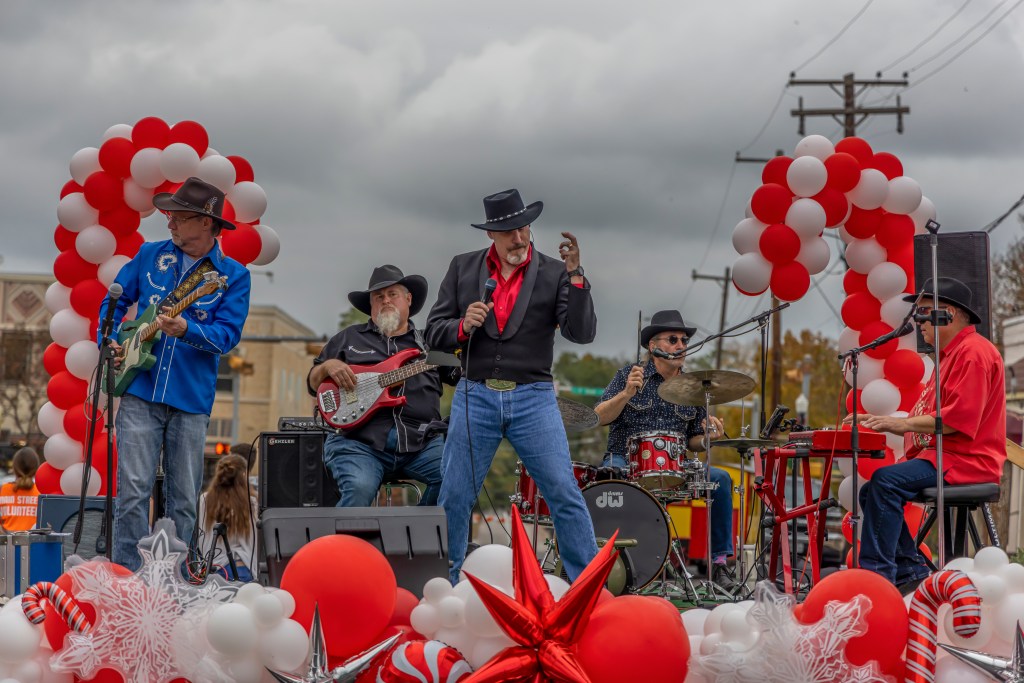
All the way from her humble beginnings in Indiana, County Music Legend, two-time CMA Female Vocalist of the year, AMC Female Vocalist of the year, and TV star, Janie Fricke took the stage at Old Town Theatre in Huntsville on Saturday, August 6.
Fricke and her band livened the Theatre with songs of her own, some that she originally sang with other artists, and even some songs from the 40s!
She and her band had hilarious banter on the stage, discussed her career a bit, and she also encouraged everyone to check out her website!
After intermission, Janie Fricke had a confession to make, in the 1980s, she robbed a bank! Fricke said that she would like to get through the show before anyone put a warrant out and her band joked that she is the only person to commit a crime and not serve the time. Fortunately for us, there is footage of Fricke robbing the bank, Janie stared as “Ginny” the bank robber on the TV series “Dukes of Hazzard.”
My favorite song she sang was one that she sang with Merle Haggard called A Place to Fall Apart. Fricke sang the song with her Keyboardist and the duet was beautiful.
Fricke worked a significant amount of her career singing jingles for major companies. She even sang some to the crowd! The audience reminisced on Dial Soap, Coca-Cola, Red Lobster, and United Airlines jingles. Janie even mentioned that she was the first jingle artist in space! Her song was what the astronauts woke up to in the space shuttle.
On behalf of the Old Town Theatre and the LEAP Ambassadors, thank you to Janie Fricke and band for an amazing show!
It was a new experience in many ways: LEAP Ambassadors attended their first light opera, they met many LEAP Alumni, and they spent an evening enjoying good company. The occasion was the summer performance from The Gilbert & Society of Houston, and with all of their performances sold out, it was a minor miracle that we were able to purchase 23 tickets to the third showing of “HMS Pinafore.”
For those who haven’t seen a Gilbert and Sullivan operetta before, it’s worth a summer jaunt to the beautiful Hobby Center to see a performance. HMS Pinafore was written in 1878, but its satirical edge and comedy rang true 144 years later. The opera tells the story of three sets of star-crossed lovers, with each pair being thwarted in their loving ambitions by the British class system. This leads to much shiply shenanigans: an attempted suicide, mystic omens, an aborted midnight elopement, and a dungeon jailing–all chorused by a crew of “sisters, cousins, and aunts.”
We had different favorites, but there was a general consensus that the cast outdid themselves with “Never Mind the Whys and Wherefores,” in which the production deviated sharply from the libretto. The orchestra got involved in the hijinks, Admiral Joseph (played by Alistair Donkins) engaged in much madcap, and Josephine made the most of her many encores. Donkins, who for the past forty years has flown in from England to perform with the Houston Gilbert & Sullivan cast, is retiring. We wondered whether these scenes were written specifically as a scene-stealing sendoff to the most reliable of the performers.
Neither of the Ambassadors had seen an opera, even a “light opera,” and several of the former Ambassadors had also never seen such a performance. Their novice status, however, didn’t prevent them from posing like pros after the production–and, in fact, one pro did pose with us!
The fists-up pose derives from the lyric to “A British Tar.” A “tar” is a nickname for a sailor, possibly as an abbreviation of tarpaulin, and the song–one of two patriotic tunes from HMS Pinafore–celebrates the stoutness of a British sailor:
A British tar is a soaring soul, As free as a mountain bird, His energetic fist should be ready to resist A dictatorial word.
His nose should pant, And his lip should curl, His cheeks should flame, And his brow should furl, His bosom should heave, And his heart should glow, And his fist be ever ready for a knock-down blow.
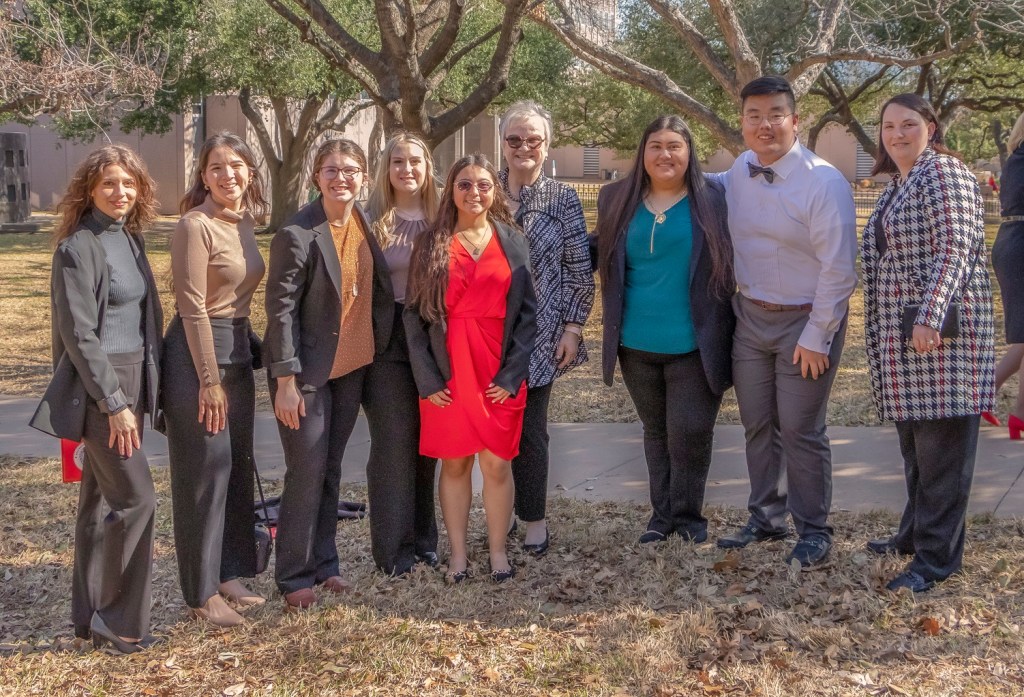
Other than the playful fists, the tone of the evening was one of amicability. Bryan Phillips, who was involved in LEAP from 2010-2012, was the most senior former student. Bianca Saldierna (2017-2018), Staci Antu (2017-18), Esme Mata (2019-20), Quinn Kobrin (2019-2021) joined the current LEAP Ambassadors, providing insight and catching everyone up on their impressive accomplishments post-graduation.
Dr. Bill Hyman and his wife, Carol, were there, too. Maggie Padilla and her husband, Roman (who somewhat resembled the Captain of Pinafore) attended. And Jean Loveall, Program Coordinator for LEAP, also joined us. Of course, Stephanie and our advisor, Professor Mike Yawn, were there. Yawn is an excellent advisor to the organization: “Bad language or abuses / He never, never uses.“
Well, hardly ever.
We had the chance to meet these wonderful folks over dinner at Black Walnut, where the casual atmosphere provided the perfect place to talk–as well as good food!
Professor’s/Editor’s Note: Many thanks to the former LEAP Ambassadors who attended. Their ongoing willingness to meet with current students and provide mentorship is a huge part of the LEAP program. Also, special thanks to Bill and Carol Hyman and Roman and Maggie Padilla whose presence made the evening even more enjoyable.
Our local CASA organization has an important mission, which is to have a safe, permanent, nurturing home for every child. Accordingly, every summer, CASA hosts Christmas in July, a fundraiser that we had the opportunity to attend and, in a small way, help positively impact children’s lives. Thanks to sponsorships by Wes and Karen Altom of Postcards Magazine and Professor Mike Yawn, we were able to attend–dressed in our Christmas and luau attire, we got ready to play (and hopefully win) bingo!
At my table, I had the honor to sit with TX Representative Kyle Kacal and his wife Marci Kacal, who were joined by Richard and Dorothy Yawn and Mac and Leanne Woodward.
To the right of us, LEAP Ambassadors Morgan and Jessica sat with School Board Trustee Ken Holland and his wife Nicole Holland; Michelle (Director of Boys and Girls Club) and Winston Spencer; and Becca (Director of Communications for Academic Affairs at SHSU) and Miles Griffin. In between bingo rounds, we learned from each of them about how their jobs impact Huntsville!
Rob Hipp with KSAM was the bingo caller for the night, and he did a wonderful job of keeping the crowd involved and entertained. By the last round of bingo, with some practice and prompting, we were pros whenever Mr. Hipp shouted “lets play…” we all answered: “BINGO!”
We all enjoyed the food provided by the City Hall Café, and we were able to participate in the raffles, silent auctions, and biddings. Unfortunately, although I put all my tickets in the drawing for a free spa, I was not very lucky.
On the other hand, Mrs. Michelle Spencer was the luckiest of us all! Just before the final round of bingo, Mrs. Spencer won a game! The prize for the win was, a free Airbnb travel package and gas card. (Photographer’s note: for those of us at her table, it was a very suspenseful few calls until the winning combo was called. We were able to snap a few candids of the Spensers before and after they won!)
As the night went on, more games were played and more winners were announced. The room was buzzing with anticipation whenever someone stood up, signifying there were only one number away from a win. “BINGOs” were heard around the room and prizes were awarded by amazing sponsors.
What we all agreed to find more enjoyable, along with the bingo of course, was the live bidding. I have personally never seen one before. This bidding was very special since the auction items were paintings created by the children who are part of the CASA program. Each painting delivered a strong message. The one I fell in love with was the painting of a silhouette of a person speaking, and the words drawn outside of the shape were “I’m fine.” Within the profile were words of how the child actually felt not having a home and being mistreated.
As the bidding went higher, some even up to $5,000, our jaws dropped, and our hearts were filled gratitude for how kind and generous the citizens of Huntsville are.
As we wrapped up the last game of bingo, we were told by the end of the night how much money was raised from this event, and once they said over $106,000, the room was filled with joy, knowing that we all were able to give back to children in need.
Many thanks to our table mates, the wonderful community of Huntsville, and, of course, many congratulations to CASA for such a successful night.
With four cities to see in one day, we had to hustle after seeing the OKC Memorial & Museum and the National Cowboy and Western Heritage Museum. Ashlyn and I ran by the Oklahoma City (OKC) Museum of Art to see a single piece: a beautiful (and large) work by glass artist Dale Chihuly.
Following that stop, we drove by the Oklahoma State Capitol building. We picked up our cohorts and food, and had lunch in the car. The lunch from Kitchen 324 was very good.
Philbrook Museum of Art
by Morgan Robertson
After a grab & go lunch, we ventured out of OKC, heading northeast toward Tulsa and the Philbrook Museum of Art. Before becoming a museum, the Philbrook Italian Renaissance Villa was once a once a home to a wealthy oilman and his family. In 1938, it was gifted by the owners to the City of Tulsa to be an art center. And what an amazing space it is!
Despite the heat, some of the more persistent flowers were still in bloom across the 25 acres of gardens at the home. Water features and angled sidewalks cast a viewer’s eye directly towards the gazebo at the base of the hill.
We descended through the gardens while capturing photos. (And I made sure to snap a few of my favorite, sunflowers!)
Almost hidden in the greenery, was an Allan Houser statue of a Native American with outstretched arms, gazing towards the sky.
We had intended to find this and were pleased that we did!
We had to make our visit at the Philbrook brief, but we still made time to see some important pieces. Displayed with glass vases and other small sculptures, Yvette found her favorite: an early James Surls that was a wooden axe!
The museum exhibits and pieces varied widely: an exhibition on Mexican art, several regionalist pieces, and even a Picasso – one of Jessica’s favorites.
In addition, we saw works by Thomas Moran, our newly discovered Kehinde Wiley, and Alexandre Hogue.
Sometimes, our own Ambassadors think they are a work of art…
…really, though, they are just a piece of work.
Sometimes, though, they created some art of their own, as in this cool photograph by Yvette.
Bartlesville, Oklahoma (Jessica Cuevas)
Frank Lloyd Wright’s Price Tower and the Price Tower Arts Center
Frank Lloyd Wright (“FLW”) was a unique and famous architect, mostly known for his revolutionary approach to American architecture, which incorporated timeless aspects of geometry into his work as well as site-specific structures that blended with the environment.
So, after our short stop at the Philbrook in Tulsa, we made our way to Bartlesville, Oklahoma, to see and tour the only skyscraper designed by Wright. Yes, you read that right—in Bartlesville, Oklahoma!
Wright’s definition of a skyscraper was a building that met several requirements. It had to have residential spaces; retail spaces; and commercial spaces, as well as reach a certain number of stories…all of which the Price Tower had when it opened, and it still has to this date!
Designed in 1952, with construction starting in 1953, the Price Tower didn’t open its doors until 1956. We toured three of the 19 floors of the Price Tower, getting a good look at the first…
…17th, and 18th floors, with lots of detailed information on the architectural elements by our tour guide, Mr. Price Conner.
As is usual with Wright’s designs and commissions, Price Tower went considerably over budget. Wright was nothing if not true to his design, so once he had an idea or design, there was no deviation. This can even be seen in the (tiny) elevators.
We rode a small honeycomb-shaped elevator up (in groups of three, so it took two rides), to see two spaces – an apartment and a corporate office. Wright liked to hide or minimize things that distracted from his intent of a space, even if it made them less functional, so the apartment’s kitchen and powder room, staircases, and other things were made as small as possible. The office, meanwhile, had its own impeccable designs, including wall art that complemented the motifs of the building.
With the Price Tower, Wright heavily used and reinforced use of the triangle, both inside and outside, along with other motifs.
The Price Tower was designed to emulate a tree on the plains. No side of the skyscraper is the same, but somehow the whole remains cohesive. Compared to the surrounding area, the Price Tower stands like an ancient tree, weathered by time.
We then strolled (through Unity Square) to the Bartlesville Community Center. The public outdoor space contains a small sculpture garden featuring Robert Indiana’s 66, along with xeriscaping, and a modern statu3 that may have caused some consternation when it was installed.
Although not a Frank Lloyd Wright design, the Community Center has similar architectural elements, probably because it was designed by one of Wright’s protégés, William Wesley Peters (who also became FLW’s son-in-law). Peters, who was chief Architect at Taliesin West, designed the Community Center, infusing the interior design with round, circular shapes throughout, bringing in the exterior shape to the interior, including the door handles, windows, and staircases.
The Center’s director, Liz Callaghan, provided a lovely tour with many little stories of the not-little space – it soars with wonderful details.
(We were only able to peek into the main stage, as rehearsals were going on, but we were all amazed at the space. The Bartlesville Community Center can seat 1,692 people, five times our own Old Town Theatre seats!)
We enjoyed making many other comparisons and connections between the Community Center and the Price Tower and other FLW spaces we’ve seen, taking in the detail and uniqueness of the Center. (Wright demanded nothing less than his own ideas for his students, so it’s no wonder that a student and scholar of Wright’s would pay attention to such detail!) As one small example, the mural in the lobby of the Community Center, designed by Heloise Swaback, was designed to complement the color scheme of the Price Tower, while reinforcing the colors of the Bartlesville Community Center space and its own curvilinear shapes. It is the “world’s largest cloisonne art work, a mural that is 25-feet long which depicts a stylized northeastern Oklahoma landscape“.
The Community Center has certainly been doing its job: providing space and events and activities to bring the town together!
At Ms. Callagher’s suggestion, we wended through the park to return to our car. We had fun with the landscape, enjoying it’s beauty, and the unique way the park, the Price Tower, and the Bartlesville Community Center beautified–and strengthened–a welcoming community.
The LEAP Center tries to plan trips around specific learning experiences–in this the Midwest Council of State Governments’ Conference–and then builds multi-disciplinary learning opportunities around that central event. So, on this day, we learned about art, terrorism, architecture, community assets, and, in our last stop of the day, the natural environment. Thus it was that we found ourselves at the beautiful Great Plains Nature Center, nestled in Wichita, KS.
The Park is almost 300 acres, and it has 2.5 miles of paved trails–and we covered a good portion of them! The setting was beautiful…
…and it brought us across bridges, into wooded areas, across water features, and into restored prairies.
It also brought us into view of wildlife. We saw a snake, a turtle, an Great Horned Owl, many ducks, and a heron.
We also saw several deer, at least one of which seemed to not care that we were walking within a few steps of its space.
Yvette had managed a beautiful shot of a Red-Tailed Hawk earlier in the day…
…. and the cumulative experience of the day had provided us with a fairly comprehensive education–a theme, we hope, that will continue throughout the trip.
Late afternoon on Friday, we loaded the car and embarked on our journey to the Midwest! Our destination for the first half of our week is Wichita, Kansas, for the 76th Annual Meeting of the Midwestern Legislative Conference. Leaving late afternoon, though, we only made a few hours on the road before our first stop.
On the museum grounds, we were introduced to a new (to us) artist, Richard Serra, known for his massive bronze sculptures. His abstract works develop a “patina” over time, meaning that the metal changes color. Since its creation in 2002, we could clearly see how the coloring of Vortex has changed over time.
We snapped a few shots and made our way to another nearby outside piece, Hina, by another new (to most of us) artist, Deborah Butterfield. Butterfield also works in bronze, but her horses look like they’re made of wood!
Chatting about the different techniques, we made our way inside to meander through the modern pieces, on the lookout for more new and inspiring artists and works.
The minimal and modern building blended perfectly with the landscape and the works inside. The interior layout is designed to display prominent exhibits, with soaring ceilings and a lot of glass, and it is an appropriate motif for minimalist works such as those by Donald Judd.
The east and north sides overlook a reflecting pool, across which stands a gleaming Roxy Paine with interweaving branches entitled Conjoined.
Yvette quickly identified the distinct squares and colors of Josef Albers and Jessica spotted her favorite part of the museum, a collection of Andy Warhol flowers, and we were pleased to see that we would be rewarded with other Warhol works as well.
True to the nature of modern art, the pieces were not limited to paint and canvas. Steel and fiberglass adorned the center of one gallery, while interesting messages displayed on LED signs followed a vertical and uniform pattern in another. Of particular interest were Nancy Graves’ Inside-Outside and Jenny Holzer’s Kind of Blue, which we spent a lot of time on, pondering and (trying to) photograph.
Ashlyn best liked a rather unique photograph that featured a simple middle-class home balanced upon a pair of legs, Laurie Simmons’ Walking House. She was drawn to the piece for how it “stood out” and could be interpreted on multiple levels.
We made our way (rather quickly because of the temperature) through the sculpture garden which, in addition to the Paine, featured a KAWS…
Professor Yawn’s favorite piece was one by Martin Puryear, titled “Ladder for Booker Washington.” While we didn’t understand the reference, Yawn discussed it and offered several interpretations for this intriguing piece.
The more dynamic pieces allowed us to practice creating interesting and unusual photographic compositions and ultimately resulting in some nice shots.
The Modern Art Museum of Fort Worth was a good start to what soon will be a week worth of art, history and politics!
La Cena at Salsa Limón
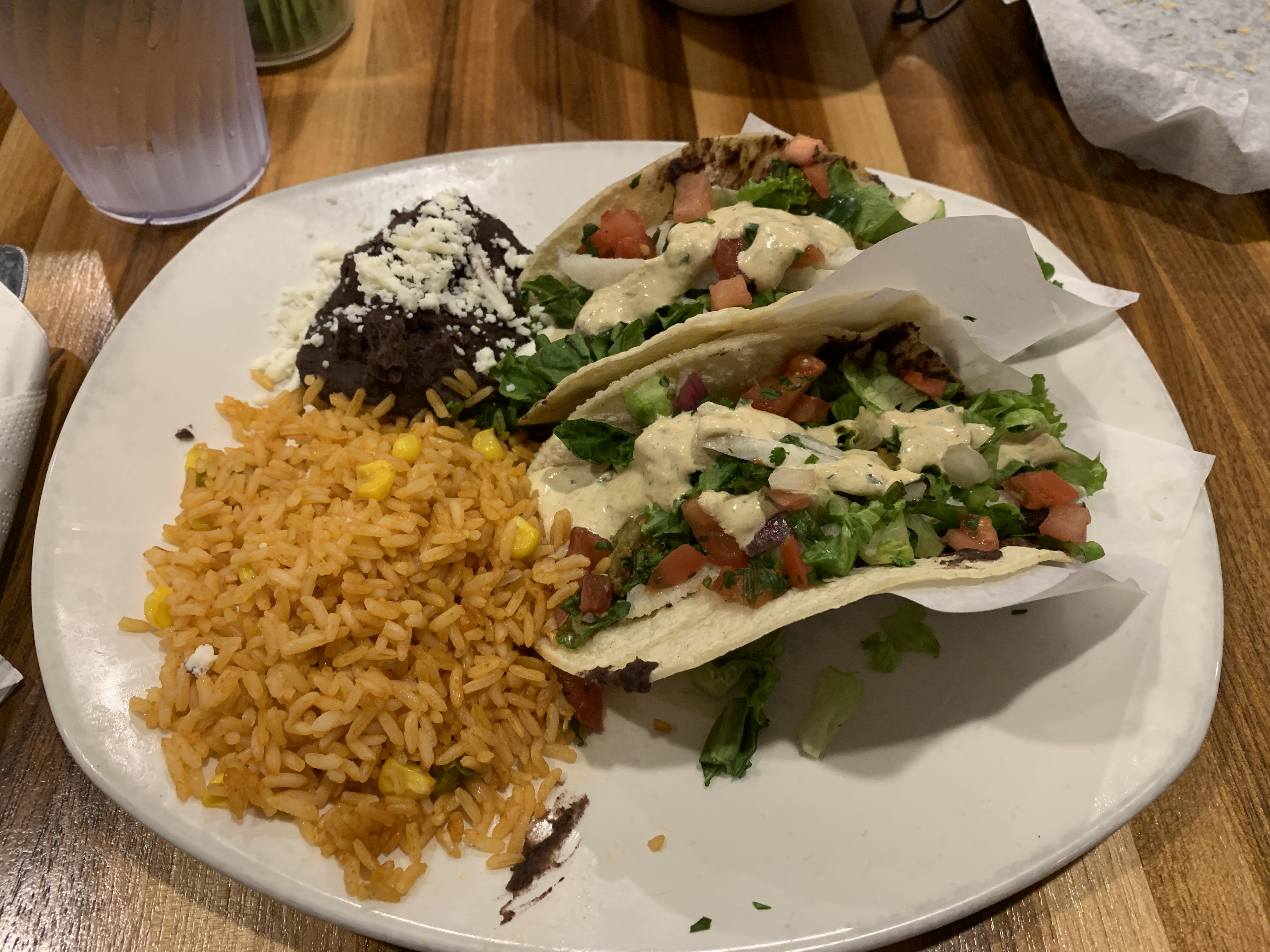
With Oklahoma City in our sights, we chose somewhere quick (that turned out to be just right!) for dinner—Salsa Limón. We made our selections, while attempting to create a variety of options (which in my opinion, is becoming increasingly more difficult since our tastes sometimes converge). Jessica and Morgan chose similarly (boring burritos!) with pastor and chorizo, respectively, Ashlyn had a chicken molco bowl (“Just what I was expecting!”), and Yvette, Professor Yawn and Stephanie had an assortment of tacos, from barbacoa, to mushroom & cheese, to pastor, to black bean & avocado.
It was a good and light meal, energizing us for the final leg of our day’s travels.
It’s not every day you get to hear from a Nobel Peace Prize nominee, but LEAP students had just that chance yesterday. Dr. Peter Hotez, Professor of Pediatrics and Founding Dean of the National School of Tropical Medicine at Baylor College of Medicine—and, most recently, developer of a vaccine against COVID—discussed the role of expertise and politics in addressing global pandemics in another interesting event hosted by the World Affairs Council.
Hotez has been in the trenches fighting the COVID-19 pandemic, while also conducting perhaps 1,000 television, radio, and podcast interviews since the spread of COVID. Remarkably, he’s also had time to work with his co-researcher, Dr. Maria Elena Bottazzi, Associate Dean of the National School of Tropical Medicine, in developing CORBEVEAX, a low-cost vaccine that protects against COVID. Notably, Hotez and Bottazzi did not patent the vaccine—foregoing millions in income to assure lower pricing for the medicine.
Hotez’s discussion was wide-ranging, but he stressed three major points: the origin of COVID, the politicization of medicine, and the future of pandemics.
Hotez believes it’s important to uncover the origins of COVID, but he finds conspiracy theories to be misguided. While it is possible, he notes, that COVID escaped from a lab in China, there’s no evidence for that theory, and pursuing it with much vigor is likely to distract researchers from the most likely answer, which is that COVID either developed from—or was spread through—a wet market in China.
What most clearly distresses Hotez, however, is the politicization of COVID…
…a thread skillfully navigated by the World Affairs Council moderator, Ronan O’Malley.
While prior to the COVID-19 pandemic, anti-vaxxers could be found on the left and right, more or less equally, the right-wing of the Republican Party seemed to embrace conspiracy theories not only about the origin of COVID, but also about almost any US government efforts to combat COVID.
Some believed that COVID itself was a hoax wrought by the US government, while others accepted the threat of COVID, but believed that any medicine promoted by the government was part of a deep state/big pharma conspiracy for profits, leading to the misguided use of Ivermectin and other nostrums. Hotez noted that such beliefs led to more than a quarter of a million deaths of people who could have been vaccinated, but weren’t.
Hotez called this movement an aggressive, anti-science faction, and he considers this dangerous, not only as it relates to COVID, but also how it relates to the next pandemic. “Nature”, Hotez noted, “is not coy.
It’s sending us a clear message.” That message, it seems, is humans need to get it together, which involves not only identifying the origins and spreads of viruses such as COVID-19, but also winning an informational war about science itself. Fighting pandemics is difficult, but it’s infinitely more difficult when a significant portion of the population refuses to adopt common-sense approaches to fighting the pandemic.
Following the event, Dr. Hotez briefly met with us, asked us about our majors (History, Biology, and Political Science), and he suggested that it was about time he get to Sam Houston State University to speak, a point on which all of us agreed.
Meru’s Grill
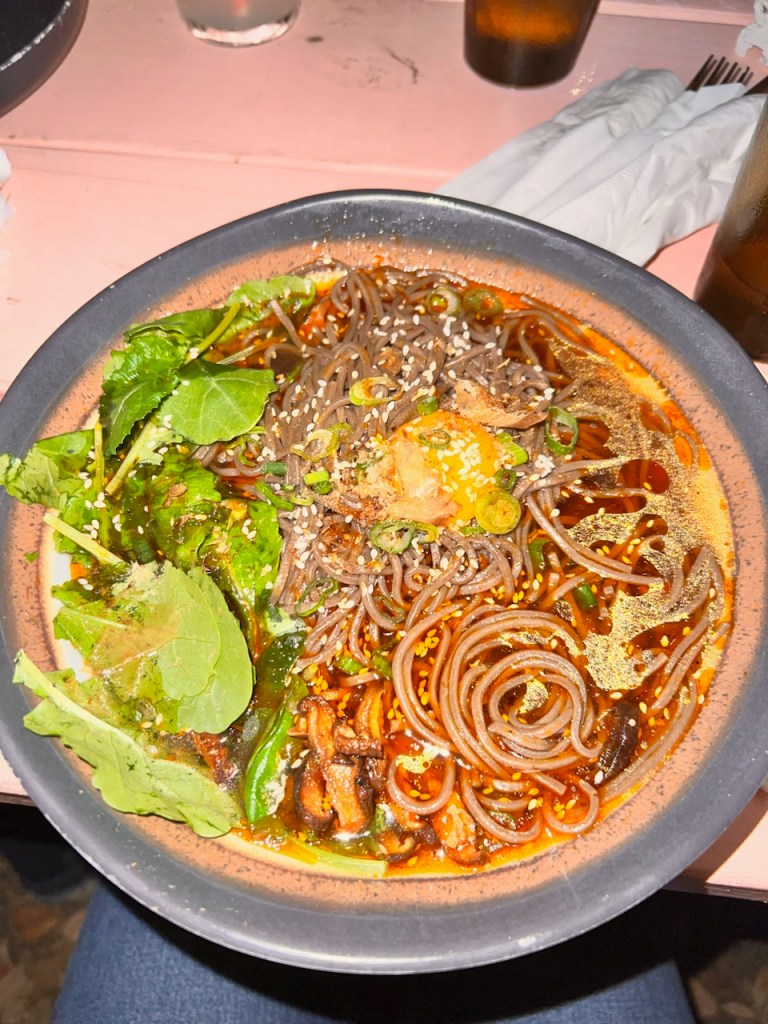
Following the event, with much on our mind, we went to Meru’s Grill nearby, and we discussed much of what we learned. None of us had been to Meru’s, but it was a great find: the staff were friendly and knowledgeable, the ambience was inviting, and the food was amazing. The appetizers, which included the “Avocado Bomb” and the “Smoked Salmon,” were refreshing and innovative.
The avocado bomb, for example, had raw Hawaiian Tuna, avocado (of course), a dressing, and possibly pineapple, a combination we weren’t expecting, but couldn’t get enough of. Our appetizers included two shrimp dishes, a Thai salad, and a burger, all of which were truly excellent in both taste and presentation.
Perhaps our favorite part of the meal, however, was the carrot cake dessert, recommended to us by our excellent server, and a truly delicious delicacy in the form of a square “slice” of cake, with icing unsurpassed in texture, flavor, and volume.
Meru’s Grill isn’t part of the medical field, but it definitely eased our worries and improved our spirits, topping off a wonderful night of education, good company, and great food.
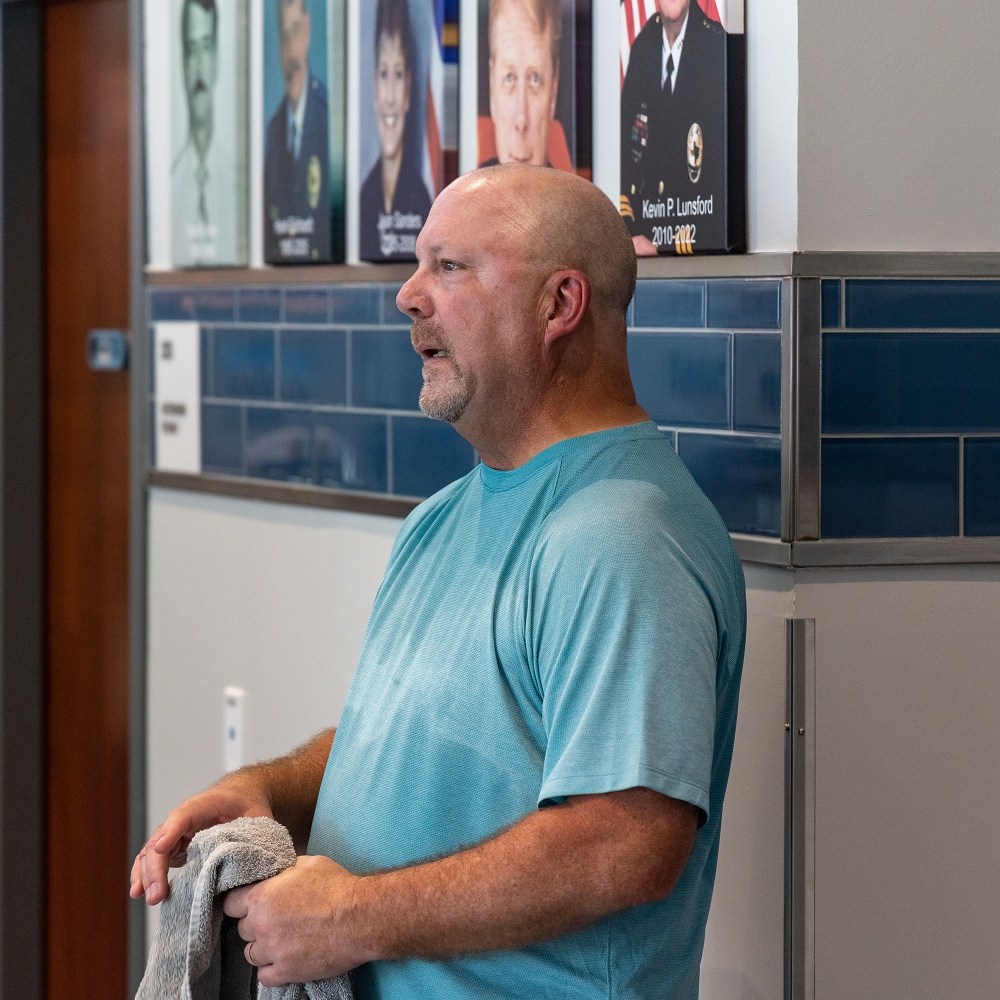
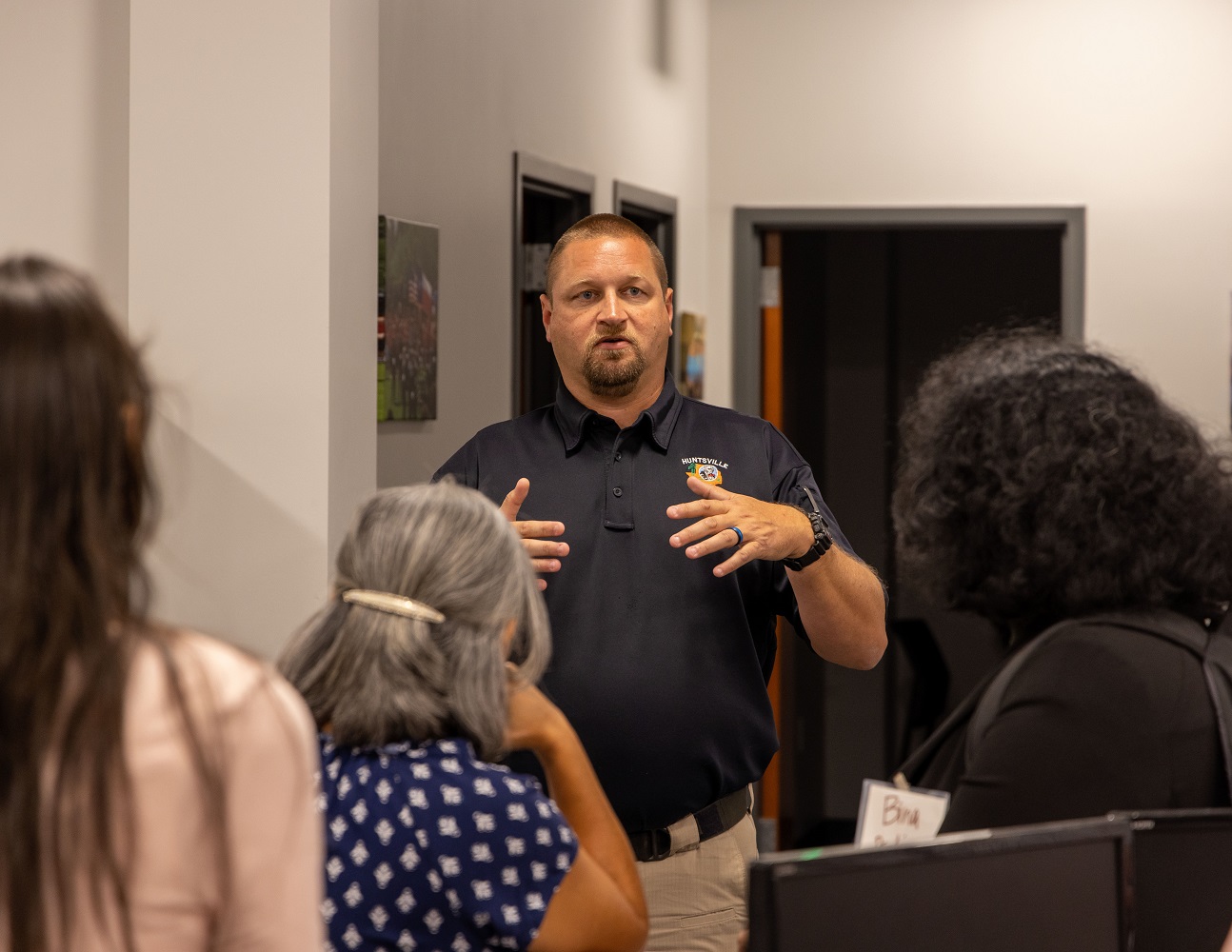
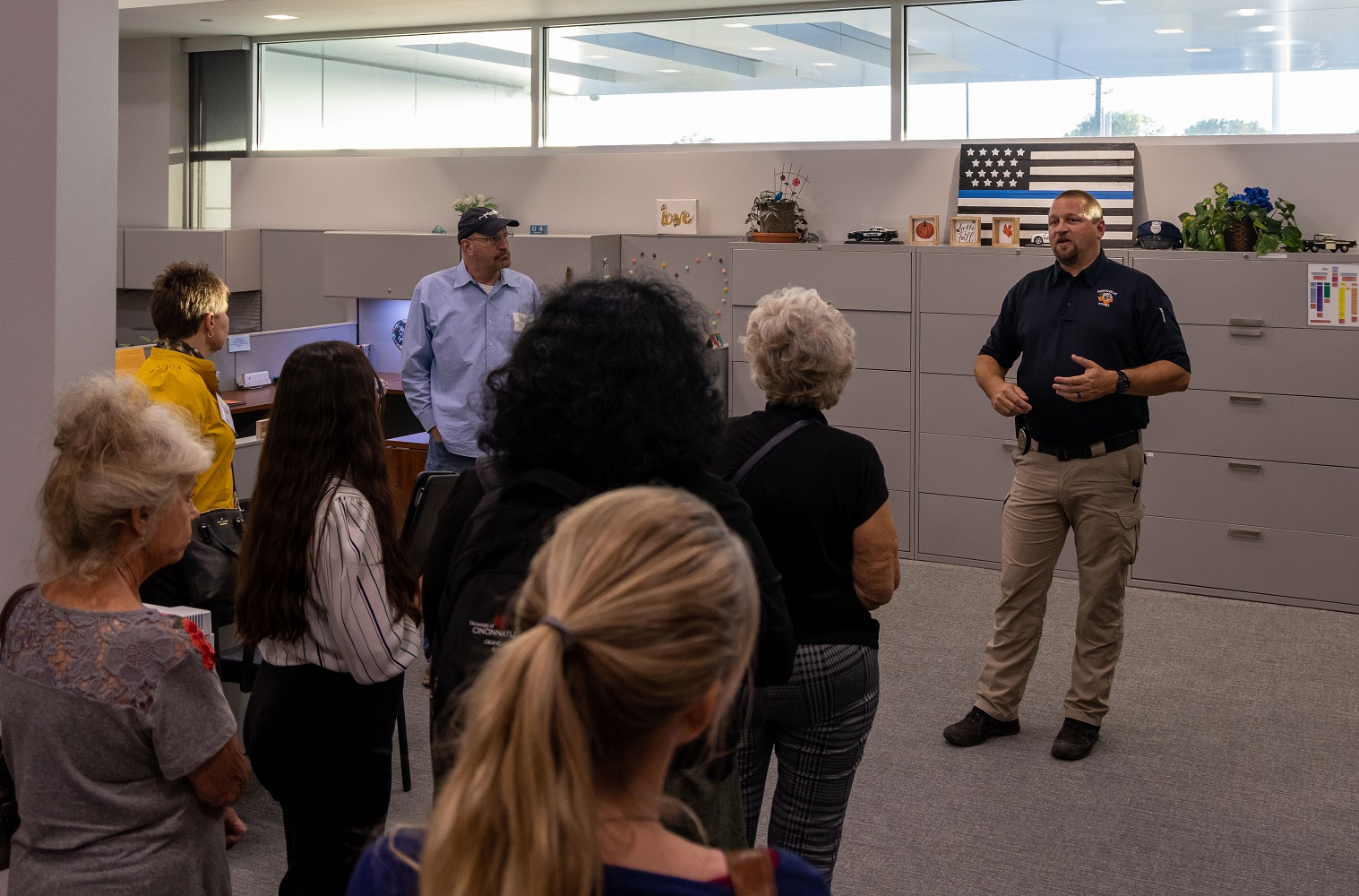
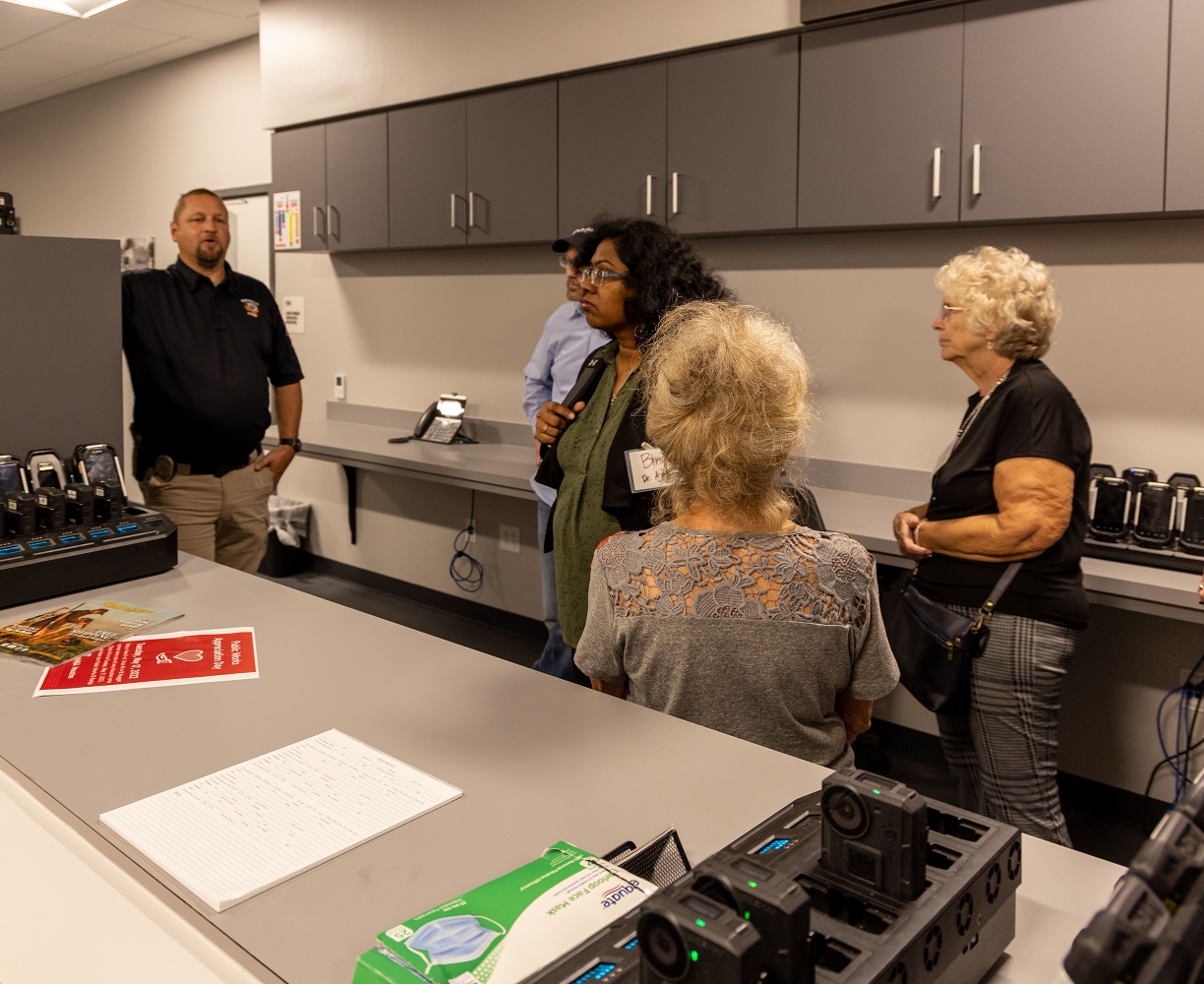
Typically, you only think about the fire department when there’s an emergency. But on a calm day in Huntsville, Chief Greg Mathis took SHSU students from the LEAP Center on an informative tour of the Huntsville Fire Department.
We began our tour in the lobby of the fire station where they have a 1927 restored Huntsville fire truck on display. Chief Mathis gave us the history of the fire truck, as well as the history of some of the pictures and antique fire equipment they also had on display. Interestingly, he had a black-ball lottery device, which determined–way back in the day–whether an individual would be hired. The firemen all voted on the potential new hire, and if they voted yes, a white ball was put into the receptacle; a black ball was a no vote. A single no vote would prevent a hire–hence the term “black-balled.”
Our next stop on the tour was the Training Room. The room is designed to serve as a back-up emergency services center, if needed, and it is fully wired for electricity, backup power, wi-fi, and high-speed cable.
We also had a chance to see the residential area, and this is where many of our questions were asked. The department, including this room, is entirely ADA compliant, a television area that was very inviting, and an industrial kitchen with a hand-made dining table, where holiday dinners take place.
The area also has a dorm-like living arrangement for when the firemen need to sleep. There are bunk rooms with sliding barn doors and four closets in each room. While each fire fighter gets his/her own room for that shift, the room may be used the next night (and the next, and the next) by different firefighters, hence the need for separate closets for clothes and linens and such. It’s a great place to sleep, but even if it invites deep sleep, the firemen all awake when an alarm goes off, alerting the personnel to what might be called an emerging situation.
A typical shift is one-day on, three days off, although occasionally personnel have to work an extra 12-24 hours overtime.
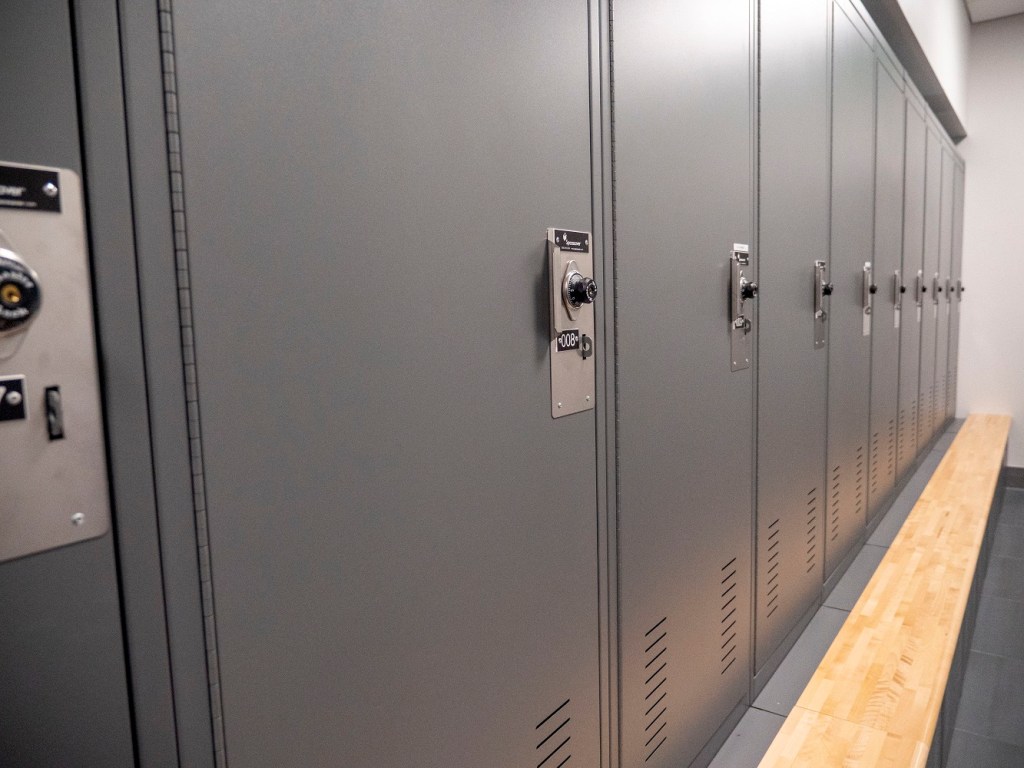
While some of the dangers of being a firefighter are obvious, there are other, less obvious, threats, one of which is cancer. On the job, you get exposed to numerous cancerous chemicals, which makes firefighters roughly 15% more likely to die from cancer compared to the general population. Because of this, the fire station provides free routine cancer checks to their crew. In addition, numerous precautions are taken: the crew must leave their gear in the locker room (which is separated from the main quarters), take a shower, and generally keep contaminated items out of clean areas.
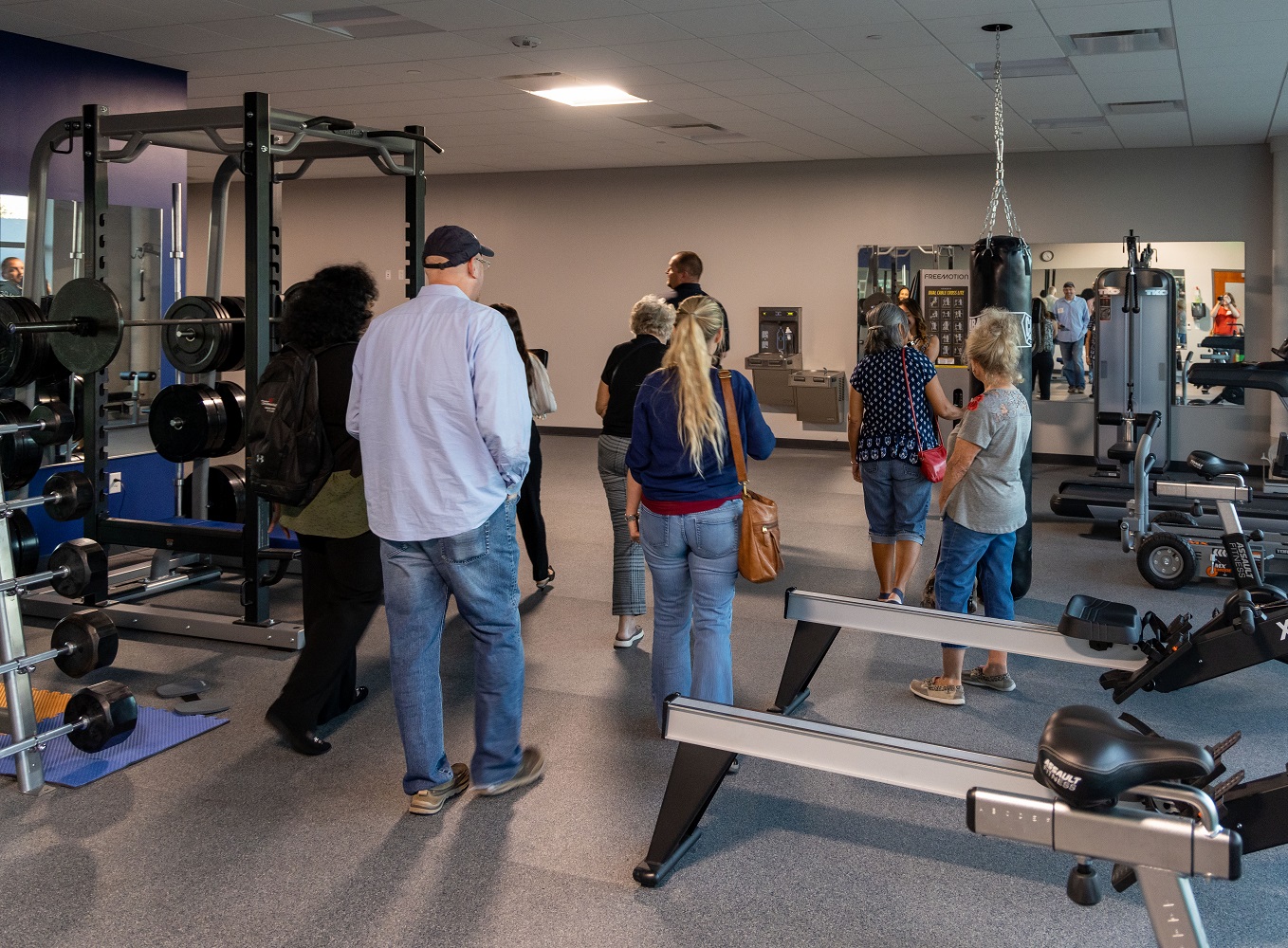
The firefighters also get access to a private gym in the fire station. This gym is supplied with equipment like a rowing machine, treadmill, and a Jacobs Ladder. A gym is provided in-house, and the crew are allowed one-hour a day “on the clock” (assuming other work in the station is not immediately needed). This helps the firefighters with both mental and physical health–the latter being particularly important for their job duties.
Of course, you can’t visit a fire station without seeing the big trucks!
We got to learn about how the firetrucks work and even got to press the siren button, although the siren doesn’t work when the truck isn’t on. Who knew?
We also got to see some of the heavy high-tech gadgets they have for opening, pushing open, or cutting pieces of metal that would otherwise remain stuck–the jaws of life.
We learned that some of us are probably capable of handling this equipment….
…and others probably aren’t….
This was one of our favorite parts of the tour, and we were grateful for our great tour guide.
We finished a fun photo in front of the firetruck with Chief Mathis, who was super generous with his time, knowledge, and our lack of knowledge on all things fireman!
As community members in Huntsville gathered at Kate Barr Ross Park to celebrate July Fourth, smiles glistened off children’s faces, and relaxation ran through the parents’ bodies, knowing their children would have a safe and fun July fourth. There was fun for the LEAP Ambassadors as well, but our primary job was to volunteer for the City’s annual Fourth of July festivities.
We were working under the supervision of our friend, Isabel Behm, who has a City internship, and who was, in turn, working under the supervision of Kristy Wheeler and Penny Joiner. And there was a lot of supervision to give–hundreds of people came out to join the fun–fun that included a selfie station, face-painting, a rock wall, a bouncy house, candle-making, food vendors, and a dunking booth.
In fact, we took advantage of some of the fun. Before we got sweaty–or, before we got too sweaty–we made use of the selfie station, taking photos with props…
….and without props.
Others also took advantage of this station throughout the day.
Another big crowd pleaser was the rock-climbing wall. Reaching the top was quite an accomplishment, providing a workout, a lot of fun, and the sense that you could touch the clouds!
If citizens wanted to take out some aggression, they could also try the dunking booth. Local celebrities such as Glenn Edwards (KSAM), Aron Kulhavy (City Manager), Greg Mathis (Fire Chief)…
…and Penny Joiner (Director of Parks and Recreation) sat in the water seat, and for a dollar, people could get three tosses of a softball for an attempted dunking. Few people besides Kristy Wheeler hit the target honestly…
…but a lot of people took the opportunity to run up and use their hands to dunk the celebrity.
It’s possible that we did that to Aron Kulhavy a couple of times….
Thankfully, however, Mr. Kulhavy does not hold grudges, and he even took a selfie with us afterward–photobombed by a police officer!
Perhaps the most rewarding aspect of the day was seeing the kids have fun at the event. Indeed, once they were cleared by us to go, they overflowed with excitement and headed straight to the fun activities. A fan favorite was the watermelon-eating contest…
…where one young person actually won twice!
Of course, the Ambassadors couldn’t sit out this event. Morgan and I were nervous and excited for this event, and it lived up to its billing. We dove into this event, doing our best to keep our hands behind our back, while not making too much of a mess. This was only partially successful.
Of course, it took me almost no time to recover from the loss and massive intake of watermelon; within seconds I was on my phone!
Although we lost the competition, we and the entire LEAP program got to see how different departments work together to build a better Huntsville community.
Of course, the watermelon contest wasn’t the only event. There was also face-painting by Lacy Wilkinson…
…leather-working…
…balloon animals…
…candle making.
Another fan favorite was the bouncy-houses, which the kids loved (it’s possible some of us slid down the slide…).
And what do you think could top that entire afternoon? Fireworks, of course! The City put on a great show for the 1,000+ people who came out, and it was quite a show, building up to a grande finale.
It was a day to remember for us: the smell of fresh burgers, the fun of rock-climbing, the joy springing from each family that entered the park, and the beautiful fireworks helped bring a community spirit that is a part of living here.