The last day of our Midwestern Tour arrived, and we were able to visit the beautiful Crystal Bridges Museum of American Art in Bentonville, Arkansas. The beautiful museum was designed by Israeli architect Moshe Safdie, and the funds for the museum were provided by Alice Walton, the Walmart heiress. Although open for fewer than ten years, the Museum is one of the most ten visited museum in the United States—despite being location off a major highway, and hours from a major airport.
But it is worth the effort to get there. The Museum grounds are beautiful…
..and the art was amazing.
Among the favorites were political works, such as Charles Wilson Peale’s famous portrait of George Washington…
..and a piece by an artist who is becoming a favorite of ours, Georgia O’Keefe:
Radiator Building, O’Keefe
Not only is there no entrance fee to the Museum, but the Museum offers free audio guides, which highlight hundreds of works of art, providing background and instruction for those of us who are not already art connoisseurs. In the piece above, for example, we were able to see connections in the white crown of the Radiator Building with many of O’Keefe’s work focusing on the southwest, particularly animal skulls, which take on a similar color and shape.
We learned how Benton used similar contour lines depict the sky, human/animal life, and the ground to make a connection between life and its environment, a connection hat would have been particularly salient in the 1930s in the midwest.
The Museum also allowed us the opportunity to engage in some “performance art”…
…and pose next to (and in) Robert Indiana’s famous “LOVE” sculpture.
It was sad as we ended the trip, with a final look at the Museum…
Crystal Bridge Art Museum
The end of the trip, however, also offered a time of reflection on what we learned and experienced. Accordingly, we voted on our favorites, with the following results:
In general, our favorite cities were (1) Madison, WI, (2) Kansas City, and (3) a tie among Chicago, Bentonville, Little Rock, and Spring Green. Madison was the big surprise, impressing us all with its beauty and many shops and amenites.
Identifying our favorite sites was more difficult. The Bean in Chicago’s Millennium Park was a favorite…
…with Talieisin, the World War I Museum, and Union Station receiving votes.
Union Station, KC
The many art museums allowed us to develop an appreciation for art in general and specific artists. Our group favorite was Georgia O’Keefe…
Cow Skull, O’Keefe
But we also enjoyed seeing original art works by Picasso, Van Gogh, Monet, Rockwell, Rembrandt, and Rodin. A favorite of ours was the work of Dale Chihuly, who kept popping up in all sorts of places.
Chihuly Exhibit, Clinton Library
One of our favorite parts of the trip was the food. The one restaurant everyone included on their favorite list was Grunauer, an Austrian restaurant in Kansas City.
So it was with expanded tummies and horizons that we returned to Texas, ready to return to school work and looking forward to the next LEAP Center trip.
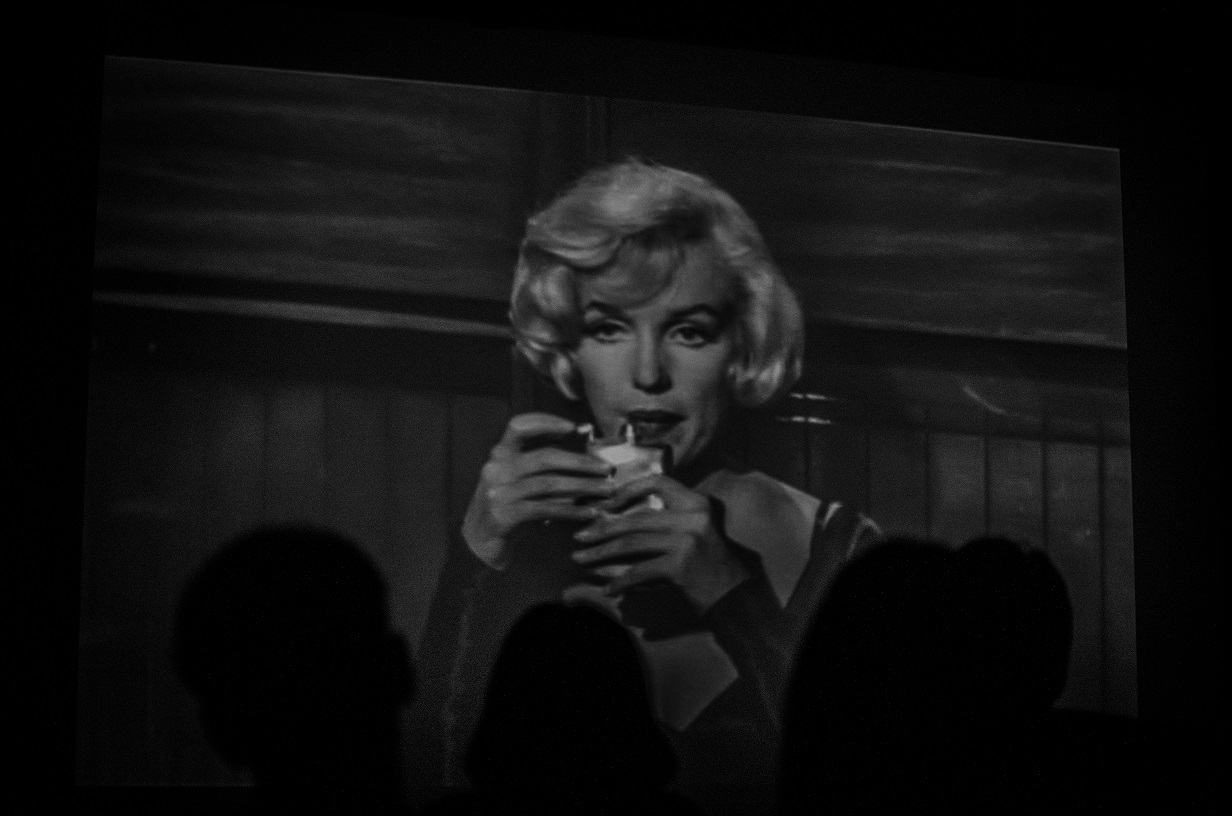
Today was the second day of the 2014 Film & History Conference. As yesterday, the featured panels were many, and the titles all appeared to be interesting topics. What appealed to me the most was a panel titled “Jimmy Stewart for president and Ronald Reagan for best friend: Star Image and Political Campaigning,” by Amit Patel. Amit began his presentation by introducing Ronald Reagan’s initial career as a B movie star. In fact, he starred in low-budget films such as Love is on the Air and Santa Fe Trail. In 1942, the film Kings Row finally gave him some recognition as a movie “star.” Interestingly, Reagan was initially a Democrat, but later switched to the Republican party. In 1976, he embarked in a campaign for the Republican presidential nomination against incumbent Gerald Ford. Amit focused on Ronald Reagan’s use of Jimmy Stewart in his campaign. In fact, Stewart strongly supported Reagan, and even participated in a political ad were he stated that Ronald Reagan was his friend, therefore, the American public should vote for him. Reagan lost the nomination, but campaigned again in 1980, and became president. I thought it was an interesting panel because a candidate’s image is probably the most important thing during a campaign, and if the candidate was a known public figure beforehand then that plays in his favor. In addition, the use of famous actors or public figures to support a political candidate is common nowadays, and it is interesting that it was used in Reagan’s campaign, too.
After attending the Film & History Conference, in the morning, we headed to the Wisconsin State Capitol, in Madison.
Wisconsin Capitol Building
A tour guide showed us the most important features of the Capitol, and shared the details of its construction. What interested me most was that Madison had previously had other two state capitols, but they both burned down. The second time around, the Capitol had recently discontinued its fire insurance, so the state did not have enough money to rebuild it. Ingeniously, the state had the idea to tax railroads that were passing through Wisconsin at the time, and with that revenue, they rebuilt the Capitol between 1906 and 1917. The architecture of the capitol is mesmerizing, featuring marble from many different countries, such as Greece, Italy, France, and Germany, as well as some beautiful mosaics.
Wisconsin Capitol, Interior
Perhaps most interesting, the capitol staff apparently have a very liberal speech code in the building. Numerous exhibits were posted around the capitol rotunda protesting the performance of Governor Scott Walker, and one impressively vocal protester’s shouts could be heard throughout the building.
After the tour, we decided to go to the observation deck at the top of the building, and experienced true cold for the first time on our trip.
The winds were so strong that it was hard even to close the door behind us. Nonetheless, it was worth it because the view was beautiful.
Leaving the Capitol, we took a stroll in the brisk Wisconsin air to find ourselves some nourishing lunch. We finally settled on Marigold’s, a local deli, where we reveled in the many options available. Among the delights we delved into were lavender white mocha and grilled ham and cheese with a hint of strawberry jelly. Packed with locals, Marigold’s was definitely a winner.
Out into the invigorating weather we went again to make our way to another of Frank Lloyd Wright’s masterpieces, the Monona Terrace. Opened in 1997, the Terrace was built posthumously and served as the cause of much strife and contention during his career. Using Wright’s design of the exterior, Wisconsin contractor J. J. Findorff and Son Inc. carried out the great architect’s dream, while his previous apprentice, Anthony Puttnam, designed the interior.
Once inside Madison’s event center, we explored the gift shop full of Wright memorabilia before embarking on a tour with guide, John.
Frank Lloyd Wright Bust
Pointing out certain Wrightian things, such as the dome on the west side of the building and the arches in the grand ballroom, John proved to be a formidable docent as he never ran out of interesting facts and stories to regale. Braving the gusty winds, we had the chance to view Lake Monona, which Monona Terrace balances precariously over, thanks to the intricacies of Wright’s design.
Awed by the view and many selfies taken, we headed inside to embrace the warmth it offered and finish our tour.
Seeing it was getting late, we rushed back to the car in order to make it to a few last minute shops, original to Madison. Among those, we re-caffeinated and browsed a wonderful cheese boutique, Fomagination. Overwhelmed by the many options and tastes, we took in Wisconsin’s finest and tried to contain our enthusiasm at all that was available. It was incredibly exciting to see so many things unavailable in the great state of Texas. We loaded up on cheeses and cheese accessories before tumbling back into the car to begin the final leg of our trip.
We admired the beautiful fall landscape of Wisconsin; the rolling hills and deep yellows, greens, and reds created the perfect ambiance for our drive to Dubuque, Iowa. There, we enjoyed the Fenelon Place Elevator, or Dubuque Incline, claimed to be the shortest and steepest railroad in the world.
Gripping the seats…
…up we went on the side of the hill to eventually reach one of the most inspiring views of the trip so far. Known as “the magic hour” in film circles, we caught the sun setting on the horizon, creating beautiful red and orange tones in the sky and on the trees off in the distance.
Proud to say we had viewed three states at once (Iowa, Illinois, and Wisconsin) from the top of the incline, we got back in the cable car built in 1882 to return to our vehicle and carry on to the next leg of the journey.
After a short drive, we arrived at our final destinations: The John and Mary Pappajohn Sculpture Park and the Des Moines capitol building. The 4.4-acre sculpture garden is unique and home to 28 sculptures from 22 different artists. Various paved paths provided a route for us to take through the garden, however, curiosity and the lure of new art, propelled us forward.
Man of Letters, Jaume Plensa
Many of the sculptures were created by artists that were foreign to us, however, one sculpture in particular provided us with the comfort of familiarity: Painted Steel by Mark Di Suvero. Di Suvero also has an art piece called “Proverb” in Dallas, Texas, which we were able to relate to. “Painted Steel” was made out of steel and painted in the same red that “Proverb” is painted. Both statues have similar characteristics, but varying dimensions and structure.
Another interesting sculpture that we saw was, “Back of Snowman (Black)” and “Back of Snowman (White).” These sculptures were created by artist Gary Hume and were located side-by-side in the middle of the park and held a spectacular gleam given off from the surrounding lights. Each of the statues consisted of two round pieces of bronze covered in enamel, one in white enamel and one in black. These statues were especially appealing because each round piece of bronze was perfectly symmetrical and smooth, giving the piece a unique trait of looking seamlessly perfect.
The last sculpture that really caught our eye and our interest was “The Thinker on a Rocky” created by Barry Flanagan. This piece was a large rabbit sitting upon a boulder in the same pose as Rodin’s “The Thinker.” The piece was clearly a satire on Rodin’s famous statue, which only added to its appeal!
While the statue garden was a fantastic experience, we had to continue our night and head to the Des Moines capitol building. The Renaissance style capitol, designed by John Cochrane and Fred Piquenard, was absolutely stunning! The capitol building featured a 23 carat gold dome in the middle of the building and was accompanied by two smaller domes on either side of the building. The capitol took expansive resources and large amounts of time to build and open to the public. The building took fifteen years and a staggering amount of $2,873,294.59 to complete. On June 29,1886, the capitol was ready to be open for use!
Iowa Capitol
Both the capitol and the sculpture garden trips were the perfect ending to day five of the trip!
Our Midwestern Trip second day was especially busy. After a short night and a hearty breakfast, we headed to the Ulysses S. Grant National Historic Site, located in Webster, Missouri.
First, we watched a short video that covered Grant’s life and career, emphasizing the loving relationship between him and his wife Julia, as well as covering his military and presidential careers.
US Grant
Grant was originally from Ohio, and later graduated from the United States Military Academy at West Point, where he met his roommate and future brother-in-law, Fred Dent. He actually resigned from the military to be closer to his family but re-entered when the Civil War began. He rose to prominence with excellent military skills and led the Union to victory. A few years later, he was elected President of the United States.
The National Historic Site features White Haven—his residence—which, incidentally, is green.
White Haven
It was Julia’s childhood home, and home to Ulysses and Julia for many years of their marriage. Julia’s father, Fredrick Dent, named it White Haven in honor of another property he had; subsequent caretakers of the house during Grant’s ownership painted it green. Inside, as we walked through the halls and rooms filled with pictures and quotes from the Grant family, we imagined how life was over a century ago.
After lunch we ventured deep into St. Louis to tour the Gateway Arch. The closer we got to the Arch, the more intimidating the monument became – it was stunning, elegant. The panes reflected the light so as to make it look iridescent.
We made our way underground to the visitor’s center where we bought our tickets to ride to the top. The Gateway Arch was designed by the Finnish architect Eero Saarinen; it took $13M and a little over three years to complete. Comprised of stainless steel, it reaches a staggering 630 feet high, making it the world’s tallest arch. To get to the top of the Arch – and the spectacular views – we traveled in a small pod (emphasis on small) that offered a rocky trip up the arch.
After checking out the beautiful views…
St. Louis from the Arch
…it was, back down to the visitor’s center to begin our next adventure to the Old Courthouse.
The Courthouse looked much like a capitol in that it had a large dome and several levels that were separated by beautiful spiraling staircases.
On a more substantive level, this is the building in which Dred Scott sued for his freedom, winning in state court, but losing when his case made it to the Taney-led Supreme Court.
This much we knew going into the building, but what we didn’t know is that Mr. Scott was granted his freedom by his “owner” and, although he died a short year later, he died a free man.
Ariel Traub, the Old Courthouse, and Dred Scott
Feeling rather free and adventurous ourselves, we walked through several local parks, took a picture with the “running man…”
The Running Man and the Standing Girls
…and, of course, took selfies…
…and then ventured through several historical buildings. We saw the Wainwright Building, which was constructed in 1981 by Ellis Wainwright and designed by Louis H. Sullivan, who would go on to mentor Frank Lloyd Wright. The Wainwright Building became the father of the contemporary skyscraper and was a turning point in architectural history.
The Wainright Building
We learned about the difference between modernism, which has an accompanying slogan that “less is more,” and post-modernism, with the slogan that “less is a bore.” Modern buildings consist largely of glass windows and steel, whereas post-modern buildings have unique designs and shapes—often incorporating many styles from the past—that make the buildings one-of-a-kind.
Regaining energy with a Starbucks break, we left to further our learning in the state of Illinois. We arrived in Springfield just in time to eat and take a nighttime tour. We mollified our hunger at Lake Pointe Grill where, according to Silvia, there is such a thing as too much arugula on a pizza. Lake Pointe Grill boasts the only wood-burning grill in Springfield, clearly showcased by the delicious fare we enjoyed. We did not dally at dinner, as the Capitol was drawing us in, in all its glory.
Our first night stop was in front of the Capitol building, where our architecture lessons continued. Showcasing a French Renaissance style, the building lit at night seemed spectacularly imposing. The current capitol building happens to be the sixth Capitol building since Illinois became a state. Designed by Cochrane and Garnsey out of Chicago, the immensity of the building begged exploration. Even though we were not able to enter, we were successful in taking a photograph with Abe Lincoln before making a regrettable leave to our next stop.
Lincoln’s influence in his hometown does not end at the Capitol. Mr. and Mrs. Lincoln’s home sits smack in the middle of town. After searching the park full of many historical homes, we finally found the former President’s home on the corner of Eighth Street. The home clearly fit the spacial needs of the Lincoln family, compared to its original (smaller) size when they bought it from Rev. Charles Dresser.
To finish our nighttime explorations of Springfield, Illinois, we juxtaposed the very proportionate and grand architecture of the state house with a Frank Lloyd Wright home. Mr. Wright built the early 1900s home for Dana Thomas, with imposing walls and sunken bricks representing the change from the open, trusting social life to the more guarded, private lives of the early 1900s. Even though it was dark, we could clearly make out his trademark hidden front door, taunting us with what is inside. So different from the vertically enhanced capitol building, Wright’s horizontal home seemed to sink into the ground and succeeded in representing the plains of America.
Back in the van, we headed to Chicago to continue our journey in the “Windy City.” As we ended another long day, we anticipated a chilly, activity-packed day –to hopefully fulfill our goal to learn more about the art and architecture the White City has to offer.
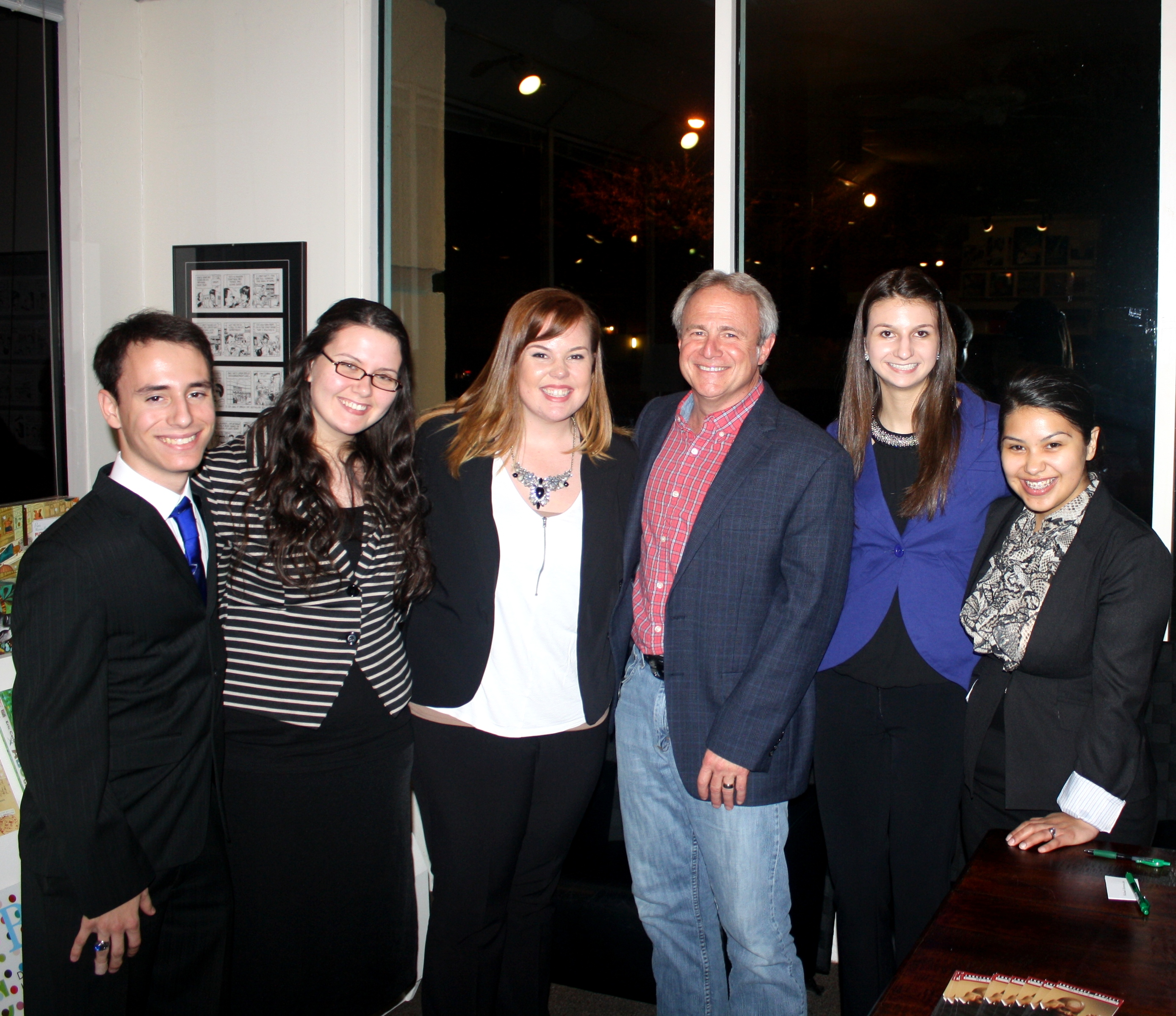
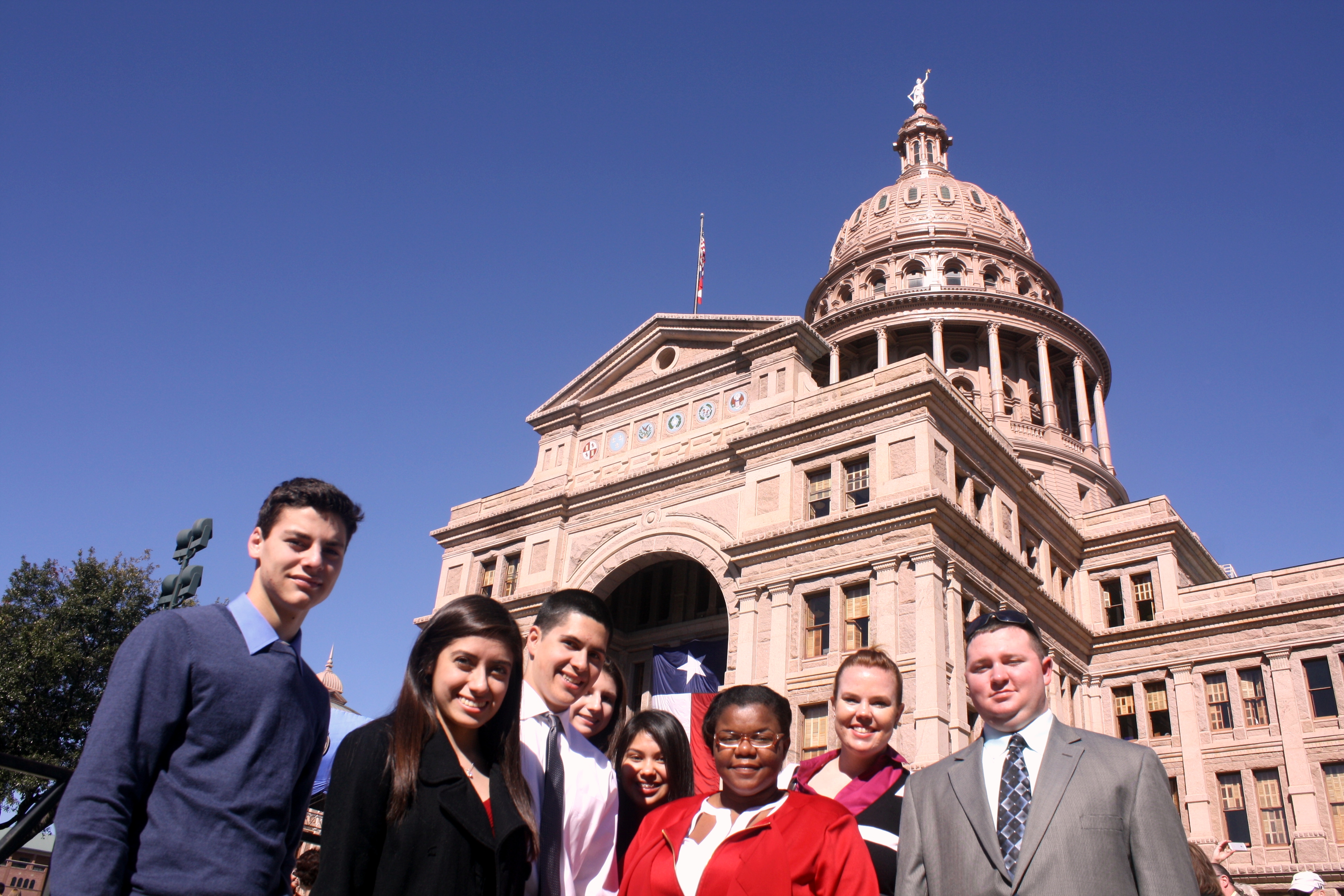
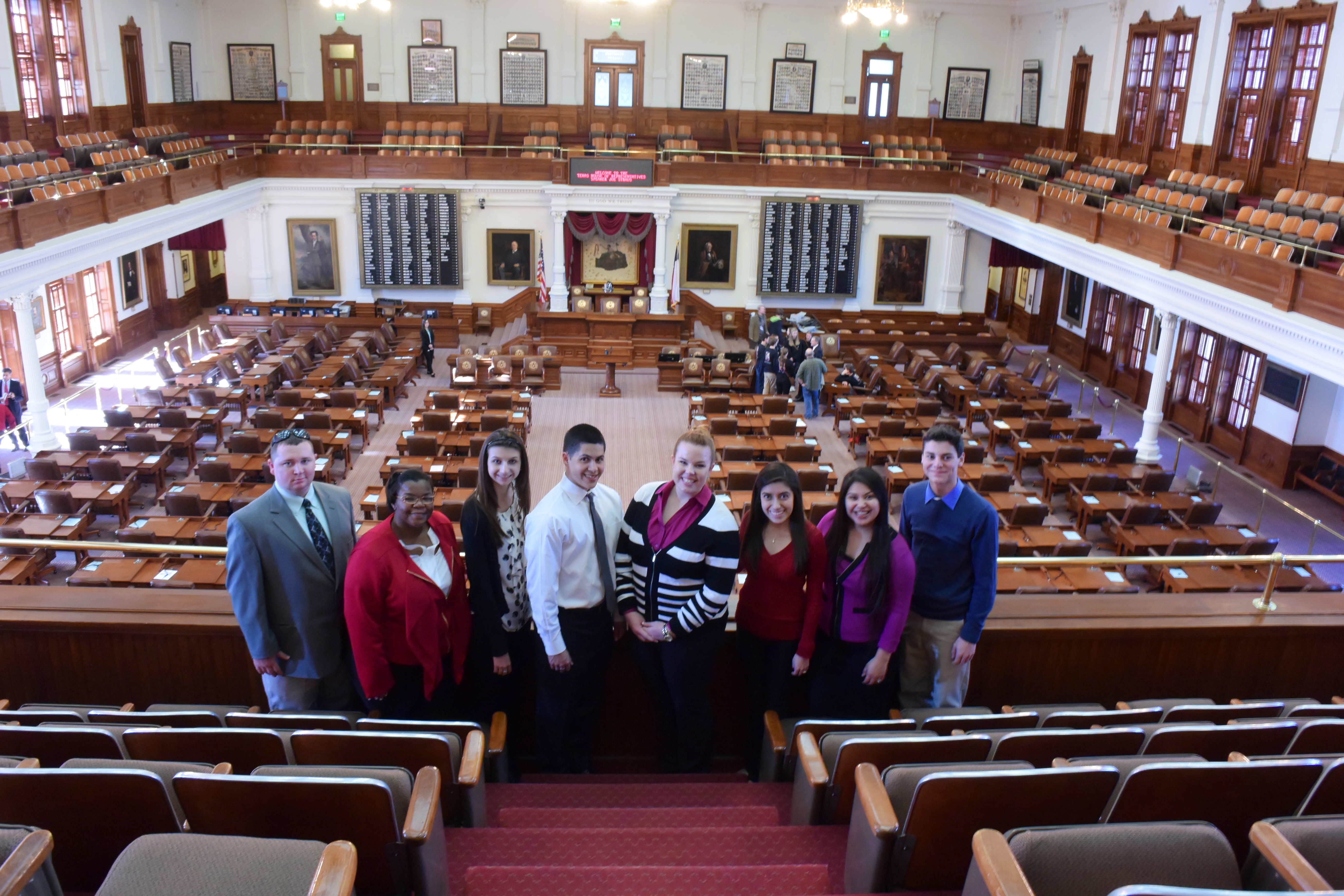
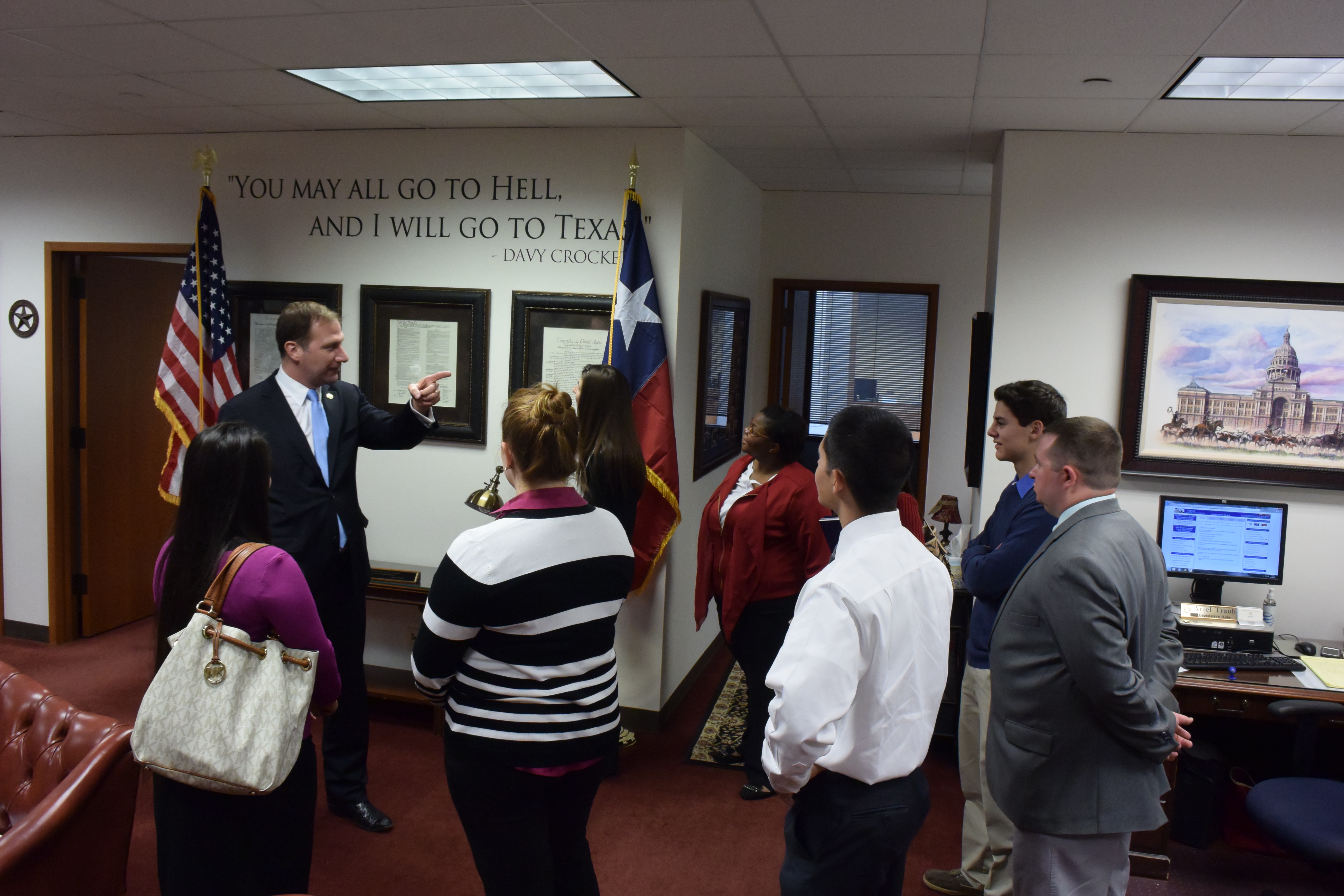
It was a nice day at the Capitol building. LEAP Center students visited the Texas Legislature to learn more about the operation of the Texas Legislature. With the help of Scott Jenkines, Representative Armando “Mando” Martinez’s Chief of Staff, they learned quite a lot.
Most House offices, according to Jenkines, have a Chief of Staff positions, a District Director/Administrator, a Policy Director, and a Staff Associate, although these positions may be fully filled only during the session. There are also committee staff positions available. Senators, with five times the number of constituents as House members, have additional staff. Both the House and the Senate offices offer internships, and an SHSU student, Bianca Kyle, worked for Jenkines during the last session (Spring 2013).
Jenkines spent considerable time discussing expectations of interns and their duties. He praised Kyle, whom he indicated was more of a “Staff Associate than an intern,” noting that she was “a natural” with constituents. Jenkines, who has worked with more than sixty interns in the legislature, expects interns to be on time, to be professionally dressed, and to maintain a good attitude with both staff and the public.
As Chief of Staff, Jenkines allows interns to represent the office at various functions and even attend committee meetings on behalf of the office (Rule: “If you go, you have to stay the entire time”.) For more technical skills, he trains the student and, in fact, typically offers them the chance to initiate research in a policy area.
SHSU Business Major Jessica Rodriguez, who is interested in becoming an Austin Intern, asked Jenkines what kind of policy work a student might be engaged in. Jenkines allows interns to attend Committee hearings, but he does have a rule: “If you go, you have to stay the whole time.” Moreover, Jenkines typically allows students to initiate research in a policy area.
“We’ve had great support from the offices in which we’ve placed interns,” noted Mike Yawn, Director of the Austin Internship Program. “Students have had the chance to work on policy, plan events, and see the process up close. We’re very grateful for the offices that have helped us place the SHSU interns.”
Note: Sam Houston’s Austin Internship Program, which began in the 2013 session, has placed students in the following offices:
Our final day involved presentations by national figures from the campaign world as well as our own presentations of our hypothetical campaigns. Compared to previous years, Sunday’s day was longer, giving us more time to work on our campaigns and to present them to our panel of judges. To cap the weekend off, we were treated to a mini-job fair, with representatives from ten or so state campaigns on hand to accept applications.
Joycelyn—Our fourth day in Austin was filled with a mixture of emotions. Some of us were anxious about presenting our mock campaigns, a fact exacerbated by the fact that we had still work to do. We did, however, get up early, grabbed our most professional suits, and headed to the Belo Center for New Media.
The teams presented their proposed campaigns in different manners. My group went first, followed by Makeebba’s. My focus was on the finance and fundraising section of the campaign, while Makeebba discussed the dynamics of campaign messaging. (Jake and Lupe’s groups presented at a separate session, so I was not able to see them present.)
Following our presentations, we retired to a “reflection room,” where we shared experiences, goals, and tribulations, while also discussing people who had influenced us in the field of civic engagement.
At the end of the Campaign Bootcamp, awards were handed out to outstanding groups. Makeeba’s group won first place in overall presentation. Although I was not part of her groups, I was very glad she and her group were recognized. After all, I knew she had worked very hard. Lastly, we also had the opportunity to exchange business cards with campaign recruiters.
The Campaign Bootcamp was a wonderful opportunity to have hands-on experience in many aspects of the political campaign process. Over my four years at SHSU (I graduated in May) I learned an immense amount of information in class, but I’ve also learned extensively by practicing what has been taught to us.
Makeebba—Today’s session was pretty intense. Our first session over research, which was pretty interesting, but a difficult one for us given that we were focused on our presentations. Following lunch, we had additional time to prepare for our presentations.
We only had six members on our team (compared to other teams, which had eight), so we had a bit of double duty. But things came together about thirty minutes before “game time,” and things worked! Our team won! I was very pleased, and I learned a whole lot about not only campaigning, but also about life. I can apply these skills that I’ve learned to almost any job or to life situations.
Lupe—The last day of campaign bootcamp consisted of one last workshop over research, along with group presentations, followed by tips on job opportunities. At crunch time, we were given the scoop on how to find last-minute facts, data, and other information on the opponent.
We used a vast array of public sources to find information that could be useful to our candidate, and we spent about an hour to get with our group and put the final touches on our campaign.
Feeling confident about my team and our hard work we waited for our time to shine. Unfortunately we ran out of time during our presentation! Our team had an amazing introduction and opening segments, but they ran a bit long. Still, we received honorable mention for our field plan, and I was very proud of that.
Following presentations, our mentors gave us on tips on how to be involved and potential careers in campaigning. We also had a mini-job fair, with many campaign representatives present and advertising opportunities that were available.
I gained a wonderful experience of working in a team with strangers, putting aside our different views, and working together as a team.
All—It was a wonderful four-day program. It’s hard to believe that we began it on Thursday night by watching “The Foreigner,” and following it the next day with a tour of the Bob Bullock Museum. The three-days of presentations, hands-on learning, and exposure to students from across the state was a formative experience. It encouraged professional growth, broadened horizons, and provided a lot of fun!
Our third day in Austin was the busiest. We began the day at 8:30am and got back to the hotel a little before 11:00pm, spending the whole day in “Campaign Bootcamp.” Fortunately, the day flew by, filled with learning, hands-on activities, and group interaction—much like people involved in real campaigns. With so much to learn over such a long day, we each had our own favorites and lessons we took away.
Jake Rivera: One of the great things about the NPF Bootcamp is that all the speakers have specialties which they share with students over the course of the weekend, providing students with a comprehensive look at campaign work. Today was our busiest day, with about 11 hours of presentations followed by three hours of teamwork. Our primary mentor, Parag Mehta, taught us the importance of taking care of campaign volunteers.
On the other end of warm and fuzzy, Michael Beach taught us the importance of enhancing communications technology. Beach’s style, which is reserved, may be a little less captivating to some of the students, but the substance of what he said was enormously important and, to me, very interesting.
In reflecting on his concepts, it’s easy to see why his consulting firm is successful. Rounding out the day were seminars on fundraising, earned and paid media, social media, voter contact, and political pitches.
One of the things that dawns on you as you move through a program like this is that, in addition to learning the content of the seminars, you are also acquiring skills, especially in the hands-on section. Fundraising is about communication skills and persuasion; working with volunteers is about organization and management; polling is about research and statistics; and cutting across all of these topics is the skill of teamwork.
Of course, we had some of these skills and, in fact, the four of us—me, Joycelyn, Makeebba, and Lupe—came here as a team. Ironically, by working with other teams in Austin, we’ll return to SHSU as an even more effective team.
Lupe Cuellar: There were so many fascinating topics and captivating presenters today that deciding on a favorite could be difficult. For me, however, Ms. Liz Chadderdon stood out as a favorite. Her topic was “messaging” and her style was energetic, engaging, and heavy on opinions. She was passionate about her topic, and it came through as she detailed specific strategies for communicating directly to voters (go for mail!).
My team, which consists of one high school and several college students, has diverse political beliefs. We’ve turned this diversity into a strength, however, incorporating multiple ideas and strategies into a cohesive strategy. I’m hoping it will carry us to victory on mock-election day, tomorrow.
Makeebba Deterville: We had seven speakers today over about eleven hours. It made for a long day, but it also made for a wonderful learning opportunity. Whether it was Parag Mehta discussing campaign volunteers…
…or Michael Beach discussing communications, we got inside the machinery of a successful campaign. The most interesting to me, however, was Liz Chadderdon, who spoke about crafting a campaign message that motivated sufficient voters to win a campaign. She has a unique style, sometimes cursing, occasionally screaming, and always passionate.
At the end of the evening, we broke into our groups and worked on our own campaigns. Although we spent three hours working in a group, it’s not enough time to put together a winning campaign, so I’ll need to turn from the blog and focus on the final touches of our campaign.
Joycelyn Ovalle: The New Politics Forum campaign bootcamp is all about learning—from the importance of volunteers, to crafting a message, to targeting voters, to polling…
…and there is no doubt that by the end of the day our brains were full of significant strategies and knowledge. But the Bootcamp is designed to go beyond filling your head with knowledge; the NPF staff also asks us to put those ideas into action, to apply our knowledge. Accordingly, we followed our many seminars with a three-hour session of teamwork, assisted by our mentors: Luke Marchant, Parag Mehta, and Pasha Moore.
They helped us crunch numbers, finesse strategies, craft messages, target specific demographics, and improve our campaign skills.
The venue for this event was the Belo Center for New Media on the University of Texas’s campus. It’s a large venue, giving campaign groups to move around and settle in different areas. But many of the groups interacted or were sufficiently close such that the conversations trespassed group boundaries. This allowed me to observe how the groups worked together, how they listed to one another and strategized. The teamwork was impressive. If congress could work like that, we would all be very fortunate!
Overall, the day was intense and rewarding, allowing us to learn, apply, observe, and reflect—education at its finest!
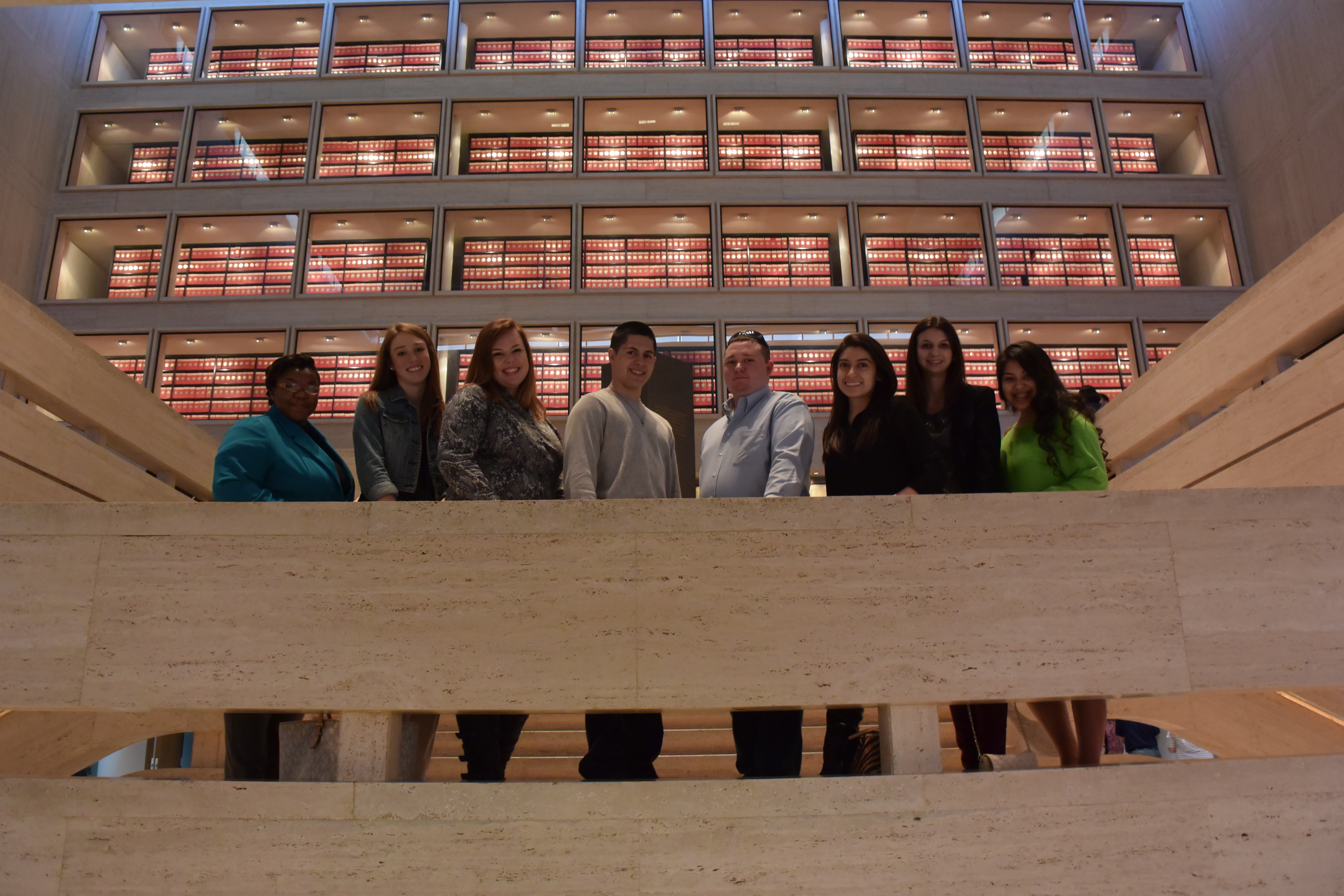
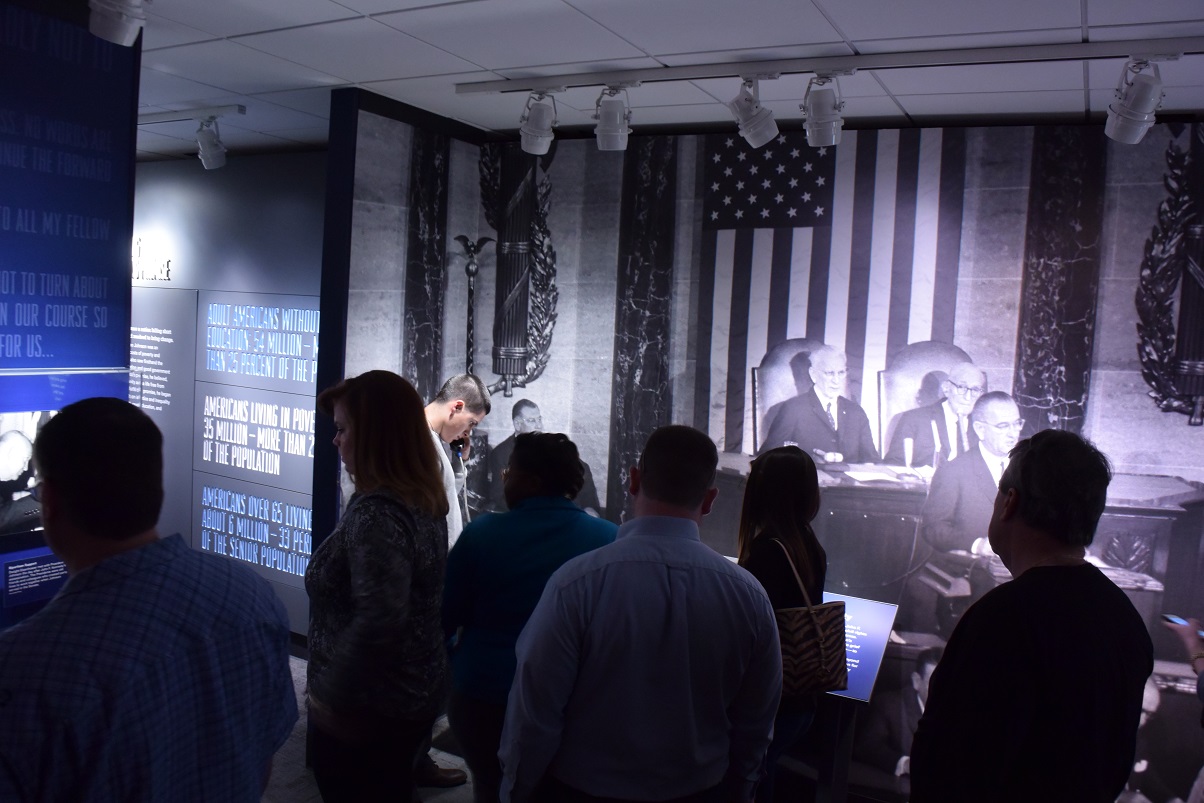
May 31–Our Austin agenda is packed, and Friday morning was no different. We visited the Bob Bullock State History Museum, which covers hundreds of years of Texas history—from Spanish explorers to Apollo 13 landing on the moon and reporting back to Houston. With so many interesting facts about the state, it was impossible to learn about all the exhibits and artifacts. But we each had our favorite, lingering over important documents, old fashion tools, jewelry, many weapons, and large-scale displays.
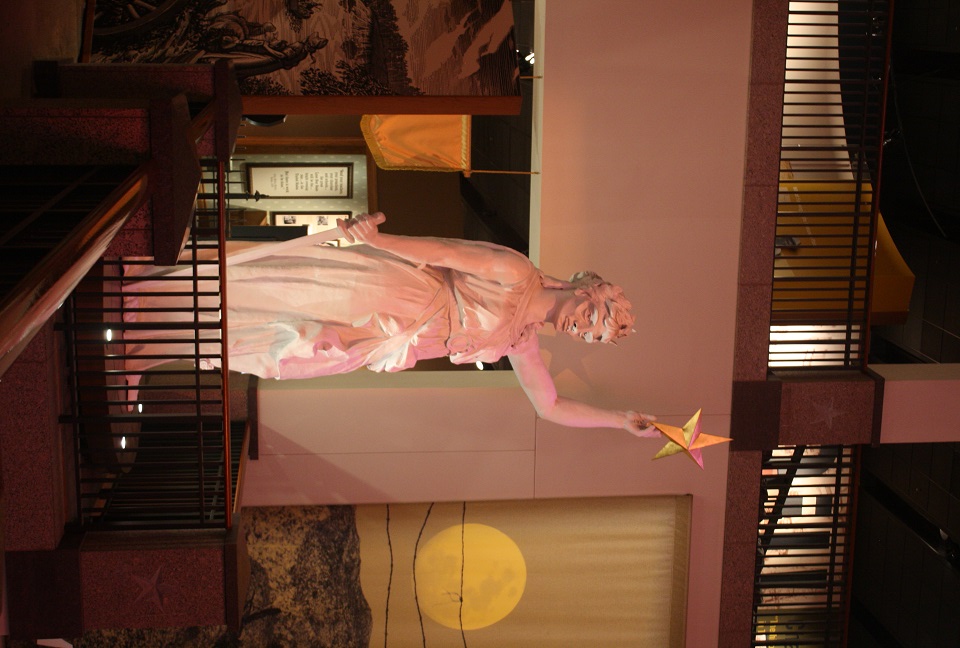
Perhaps the most intriguing of the exhibits to our group was the “Goddess of Liberty.” The exhibit allows you to get close to a full-sized replica of her, and her features were over-large and unflattering.
The reason, according to the Museum, was so that the facial features would be noticeable from 310 feet away, which is the height of the Capitol Building. Rumor has it that she was placed atop the capitol building to make it just a bit taller than the US Capitol. My favorite exhibit, however, was Lone Star flag, which included a quote from Sam Houston, who noted that the flag is a “symbol of heritage that marks who we are as a people, who the land has made us, and who we will become…” It was a fitting quote for our group from SHSU, the University which marks us as a group and will influence who we will become.
After feeding our brain with knowledge of Texas history, we were also introduced to new spices, flavors, and foods. For lunch, we tried the Noble Sandwich, where a long line for the food attested to the popularity of the restaurant. The line also gave us the opportunity to discuss the menu options, which culminated with Jake deciding on the Noble Pig Sandwich (pulled pork, bacon, spiced ham, and provolone) and the ladies sticking together and ordering the delicious Turkey Chop (red onion, cucumber, fresh herbs, and lemon coriander vinaigrette. Professor Yawn opted for the Smoked Duck Pastrami, which consisted of duck, sauerkraut, and Russian dressing.
We also expanded our palates by trying a double fudge cookie, a coconut cookie, a maple and pecan cookie, and an exotic chocolate bacon tart!
We ended the night with a visit to Quack’s 43rd Street Bakery. We greatly enjoyed a lively conversation, as well as desserts, coffee, and tea. Lupe and Jake finished off a piece of Peanut Butter Fudge cake and a double chocolate brownie, while Joyce and Makeebba shard a Vegan Lemon Blueberry cupcake, and we all enjoyed ginger cookies, a specialty of the bakery.
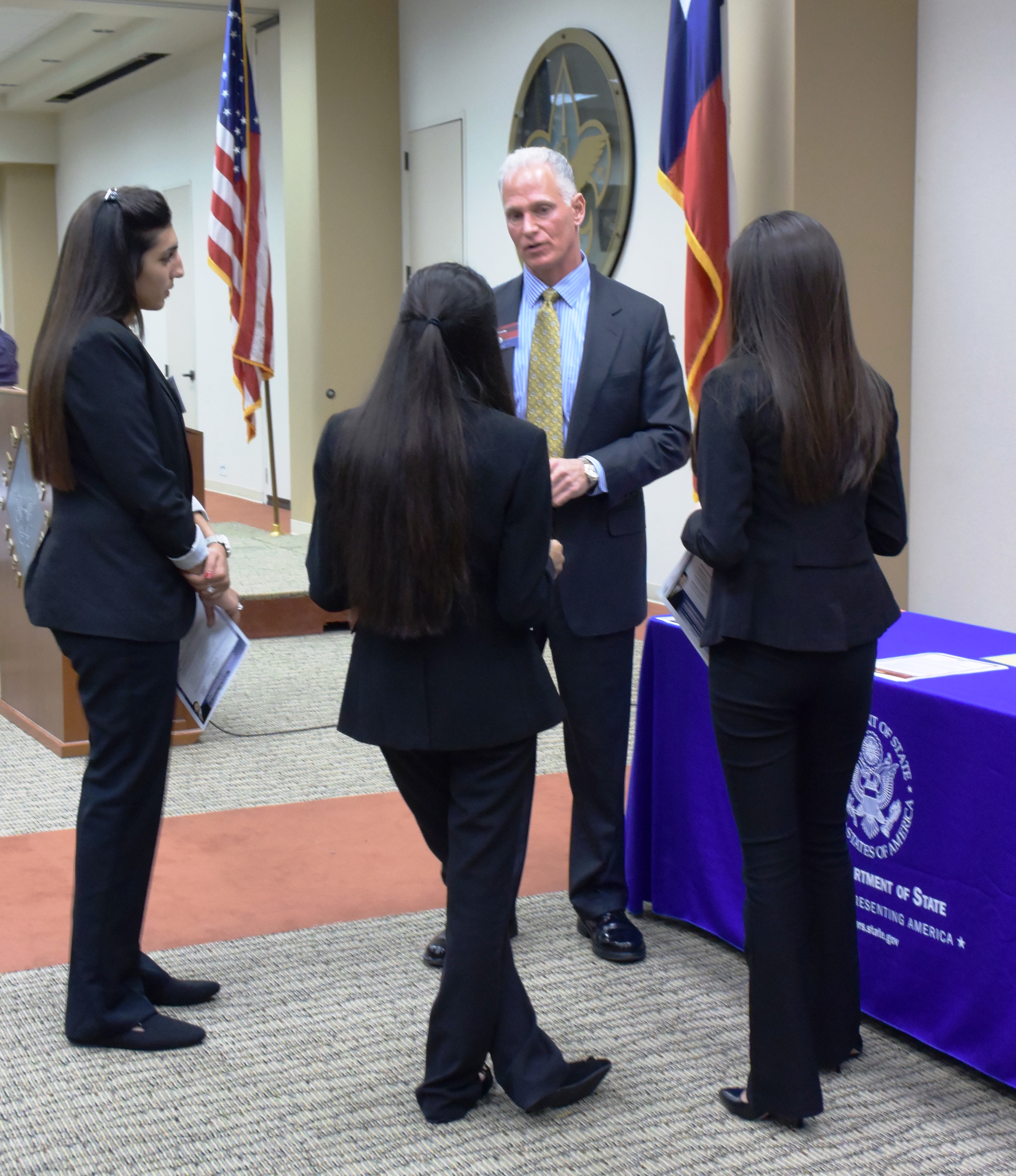
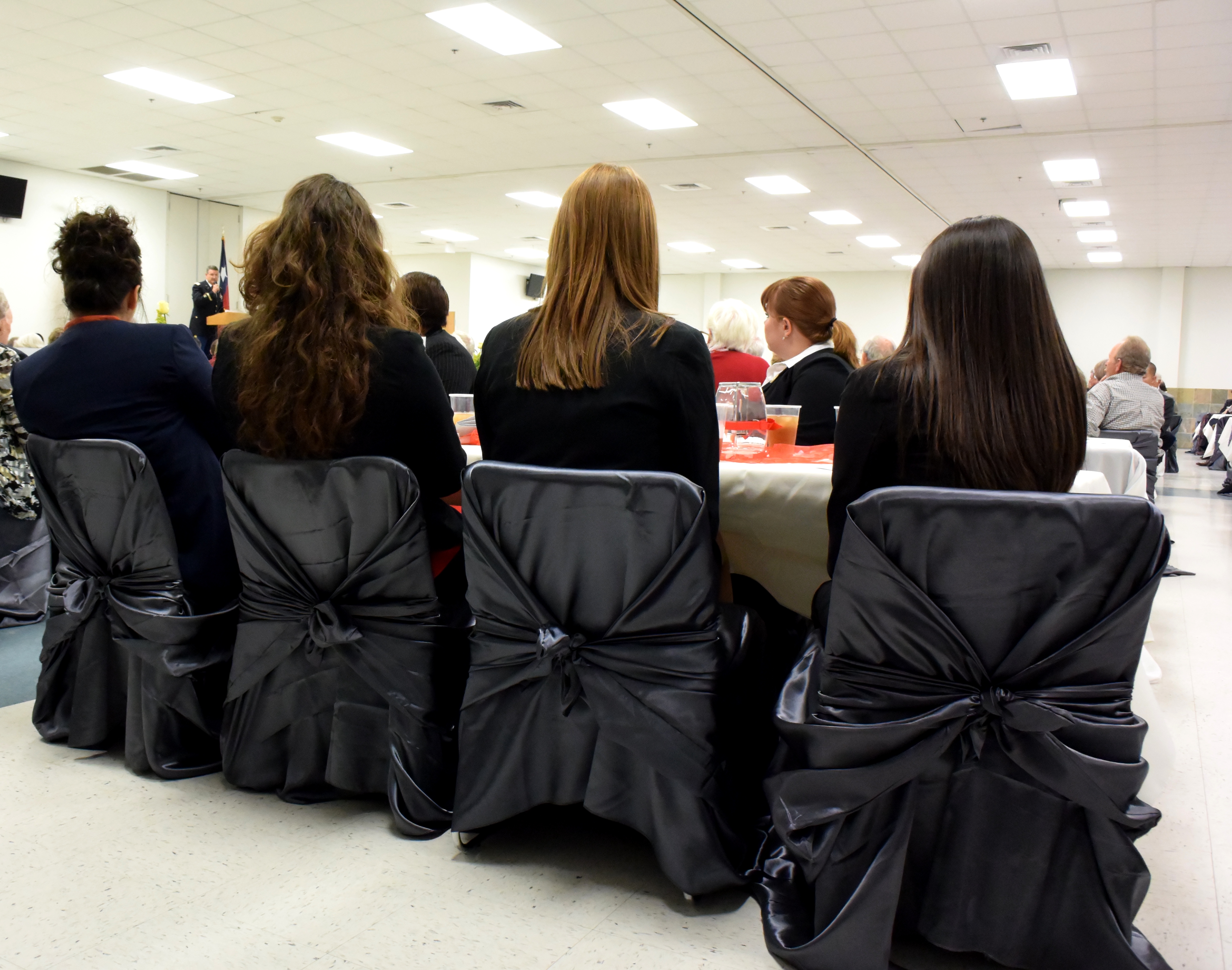
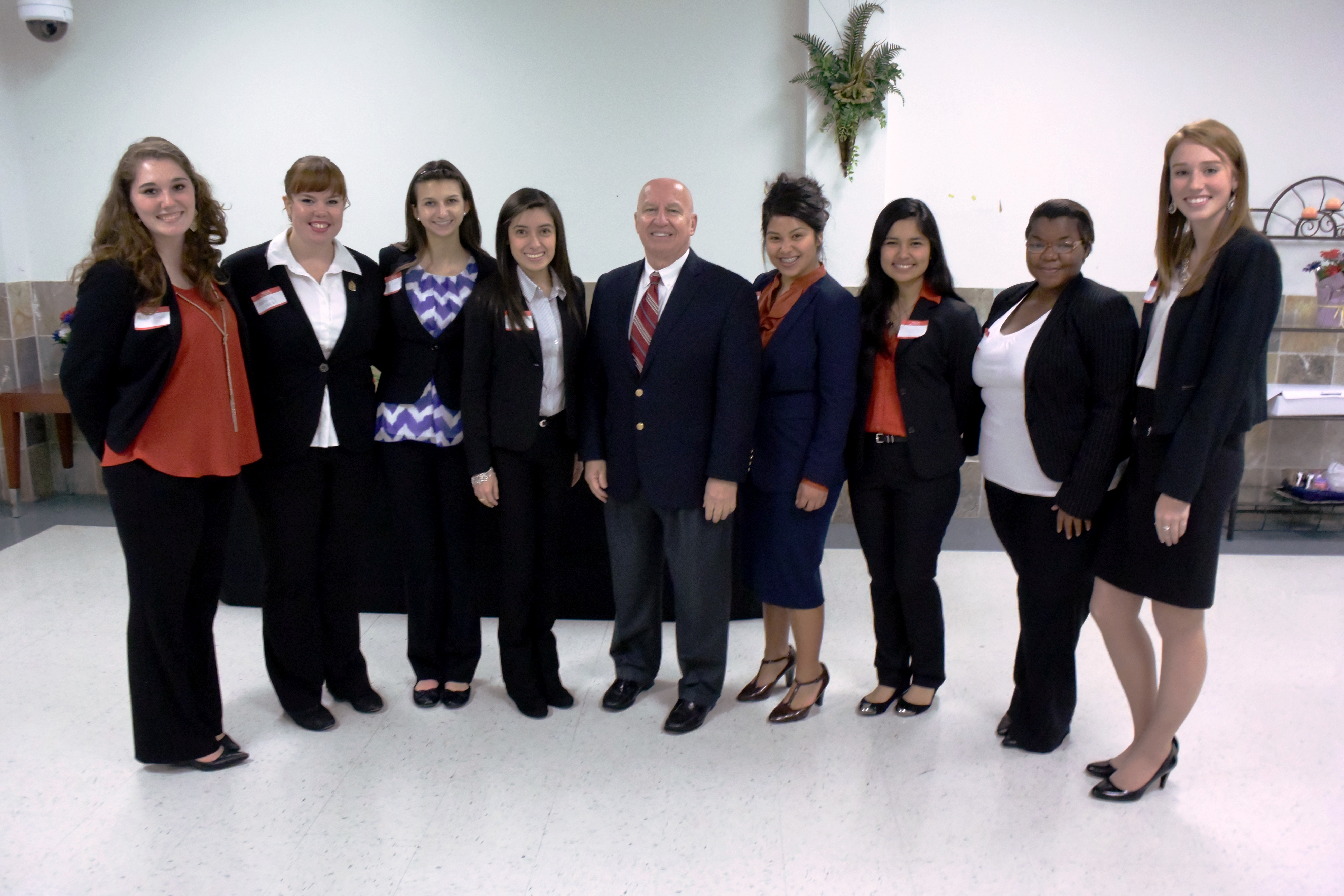
In between lunch and our late night snack, we spent a full day at the New Politics Forum’s “Campaign Bootcamp.” We met students from all over Texas, students from the University of Texas, Texas State, Texas A&M, Rice, and University of Houston. We weren’t sure what to expect, but we were eager to learn from veteran campaign staff, who serve as presenters and mentors on topics such as fundraising, campaign management, volunteer recruitment, message shaping, crisis control, getting out the vote, and social media. Emily Einsohn, the Coordinator of the New Politics Forum, offered introductions, and she helped establish a welcoming environment, allowing us to focus on the substantive topics.
Our first presenter, Parag Mehta, was the Outreach Coordinator for the Barack Obama Presidential Transition Team, and he led off with a poem for an introduction. It was a nice icebreaker.
Dr. Regina Lawrence, the Director of the Annette Strauss Institute began with a discussion of statistics, helping us know how to target vote totals.
We also heard from Luke Marchant, the Republican mentor, and Parag Mehta, the Democratic mentor—both have worked for high-level elected officials.
At least one of us found the campaign management seminar, led by Rob Johnson and Ed Espinoza, to be the most informative. It was a great overview of the process, and appropriate for our first day.
We also broke into our groups and were given a hint of our hypothetical scenarios, in which we work to ensure victory for our hypothetical candidate. One of the nice—and fun—aspects of the campaign is that the scenarios bring together Democrats, Republicans and Independents together to work on the same team. We’ll see how that goes!
Lupe Cuellar and Joycelyn Ovalle–Our destination was Austin, a trip made to engage in a “campaign bootcamp,” but we headed out a day early to enjoy the many attractions in Austin, Texas. Actually, we enjoyed the trip before we even arrived in Austin, particularly our dinner in Elgin, Texas, where we enjoyed some delicious barbecue. Elgin is a small town just outside of Austin that is known for its savory sausage. Meyer’s restaurant provided a range of barbecue favorites such as smoked beef brisket, barbecue chicken, barbecue smoked turkey breast and pork garlic sausage. With so many mouthwatering choices, making a decision on one thing was not easy. However, I could not pass up trying the smoked pork ribs. My entry consisted of four flavorful smoked pork ribs that were dipped in rich original barbecue sauce. It also included two sides, which consisted of creamy cheesy macaroni and fresh coleslaw. I could have not asked for a more delightful meal. The rest of the group came up with a sampling of other food options: brisket, turkey, pulled pork, and sausage.
And while their choices may have differed, the group’s conclusion was the same: the food was delicious!
After enjoying some delicious barbecue, we headed to the Austin Playhouse Theater to watch the play–“The Foreigner” by Larry Shue. After all, laughter is the best calorie burner! It was interesting to learn that the cast was not only composed of professional actors and actresses, but also members of the Austin Community. People volunteer their time and skills to provide live entertainment for people of all ages.
The key character in the play was “Charlie,” the titular “Foreigner,” and he was the group’s favorite. But we also enjoyed Cyndi Williams’ performance as Betty Meeks, the operator of a fishing lodge and resort. If her Georgian accent and “old South” expressions didn’t provide sufficient humor, her interactions with the “foreigner” made for plenty of laughs.
At the end of the day we realized that our first day in Austin was a success. Barbecue, Site seeing and Comedy are great partners!
Makeebba Deterville and Jake Rivera–Today is the first day of SHSU classes, but we embarked on a different education in Austin, Texas—a bit of site-seeing on top of a three-day campaign bootcamp hosted by the Annette Strauss Institute.
Our journey began with a visit to the unique Meyer’s Barbeque, in Elgin, Texas. I ordered the BBQ brisket with a side of potato salad and macaroni and cheese, while the other students opted for turkey, ribs, pulled pork, and sausage. One of the fun things about the restaurant is sampling their two types of BBQ sauce—the “original” and the “honey mesquite.”
The restaurant was recently covered in the Dallas Morning News, which addressed the ongoing debate over whether Meyer’s Barbeque is better than its main in-town rival: Southside. Having never visited Southside, we cannot decide the matter, but this gives us something to explore on the way back to Huntsville…
But we are getting ahead of ourselves. We landed in the great city of Austin, Texas with a welcoming view of the city’s skyline—including, of course, the beautiful Texas capitol building.
Of course, we followed that up by seeing the less-than-beautiful Highland mall, which is where the Austin Playhouse (a new venue is in the works).
None of us knew what to expect from Larry Shue’s “The Foreigner,” which was our night’s entertainment. We were, by far, the youngest people in the place, which was too bad, because the play served as wonderful entertainment for people of all ages. There were some very funny lines, but much of the humor was conveyed non-verbally as well. One scene, reminiscent of the Marx Brothers mirror scene in Duck Soup, which involved the characters Charlie (the “Foreigner”) and Ellard (a half-wit) at breakfast, and was particularly memorable.
Also attending the play with us was Blake Roach, an SHSU alumnus, who is now working for Attorney General Greg Abbott. It was great to meet SHSU alums, sharing laughter, and kicking off what we will hope to be a great weekend!