As the semester concluded, what better way to celebrate than volunteering for the Walker County Republican Women’s Christmas Party! Hosted at Dr. and Mrs. Deahl’s home, the party provided the opportunity for (Republican) members of LEAP to socialize and reminisce about the year while enjoying an array of tasty treats. LEAP ambassadors served as greeters as the guests arrived, served punch, and replenished food throughout the night.
To add to the atmosphere, a jazz band played throughout the evening adding soft background music.
For the ambassadors who attended, it was wonderful to mingle with many elected officials and familiar faces throughout the evening. The main event occurred when the new officers for the Republican Women were sworn in for the upcoming year by County Court At Law Judge Tracy Sorenson: President- Ms. Terry Stivers, Vice President – Ms. Sally Kelly, Secretary- Ms. Carol Hayes, PAC Treasurer- Ms. Mert Gribble. As the party resumed, we took the opportunity for a few photos with the stunning Christmas tree.
Thank you to Mr. and Mrs. Deahl for hosting the Christmas Party and to Ms. Stivers for inviting the LEAP Ambassadors to volunteer. We are thankful for the many opportunities to participate in Republican Women’s events throughout the year. Congratulations to the new officers for 2016 and Merry Christmas from the LEAP Ambassadors!
Over a two-day period, students with the Center for Law, Engagement, And Politics (LEAP) heard from some of the brightest minds around. Mayors Annise Parker (Houston) and Harry LaRosiliere (Plano) talked local government with Councilmembers Bill Spelman (Austin) and Jungus Jordan (Fort Worth); Representative Larry Gonzalez talked the state legislature with Senator John Whitmire; and a host of policy experts explored corrections, privacy, human resources, public administration, and health care. The conference was presented by Governing Magazine, and the discussions served to trumpet many of the “best practices” used by government leaders across the country. Below, the students who attended discuss the panel each found most interesting.
Jake Rivera: “Deploying Data & Performance Metrics to Achieve Results”
This panel featured Brian Anderson (Information Security Officer at Texas A&M-San Antonio), Bill Bott (Consulting Partner, Change & Innovation Agency), and Jerry Madden, for the Representative in the Texas Legislature; and the moderator, Dustin Haisler (Governing Magazine). These men discussed the difficulties that public officials have of evaluating their own programs, a fact compounded by concerns about privacy and even foreign espionage. They also discussed some interesting new technologies (e.g., an app that points drivers to empty parking spots) that could make governance more efficient and customer oriented.
Jessica Rodriguez: “The Local Perspective”
How do you spark connections between elected officials and their constituents? You couldn’t do better than to ask Harry LaRosiliere (Mayor of Plano), Annise Parker (Mayor of Houston), Bill Spelman (City Council, Austin), and Jungus Jordan (City Council, Fort Worth). Although unrehearsed, they each emphasized infrastructure—from basics such as the roads to cutting-edge innovations designed to bring citizens closer to each other and to those that represent them. Perhaps the most intriguing example of these types of connections is the “Food 4 Kids” program in Plano, Texas, in which the City partners with the North Texas Food Bank and local businesses to provide lunches on the weekends for children. The panelists also seemed to be in agreement that local government, while not the most glamorous of the elected positions in the country, was the closest to the people: “If you want to be a [local] official,” noted Mayor Parker, “you have to care about the potholes in the streets, whose trash didn’t get picked up, and toilets being able to flush properly.”
Local Government Leaders
All: “The Legislative Perspective:Empowering Reform in Service Delivery.”
In this panel, Senator John Whitmire and Representative Larry Gonzales had a free-wheeling and far-ranging discussion of issues facing Texas: crime, transportation, mental health, and education.
Senator Whitmire
This was probably the most invigorating of the discussions, with the experts on the stage being given time to explore fully various alternatives. Nothing was off the table. How about an income tax? How about legalizing marijuana? The panel didn’t necessarily try to answer some of those questions, but they raised a number of intriguing possibilities, offering discussions that lingered with us beyond the conference.
Representative Gonzales
Ariel Traub: “Workforce and Management Strategies:”
Featuring star panelists Joyce Wilson (CEO of Workforce Solutions, Upper Rio Grande Valley; former City Manager of El Paso), Bob Lavigna (Vice-Chancellor of the University of Wisconsin), and John Keel (Texas State Auditor), this session brought to light numerous intriguing ideas for attracting, training, and retaining professional employees in government. Citing the difficulties government has competing with private businesses on salary, the panelists suggested combining the following strategies to sweeten the deal for potential and current employees:
Offering school loan forgiveness
Providing tuition flex time or work-at-home days
Ensuring fair evaluation methods
Promoting workforce morale through reward and recognition programs
Working with working mothers and fathers to provide flexible leave programs for workers with children
Although many of these programs have been published elsewhere, the panelists offered interesting twists. Joyce Wilson, for example, noted that it was difficult for many employees to pay for tuition up front and wait to be reimbursed. She suggested that companies bear the up-front costs rather than reimbursing employees. Moreover, all of the panelists noted that, in addition to offering specific benefits to individuals, the proposals also had community-wide salutary effects. Flex-time and work-at-home opportunities, for example, not only provide flexibility to employees, but these policies also cut down on traffic and pollution. Leave programs for mothers and fathers promote strong and stable families. Tuition programs promote greater productivity and employee self-actualization. And so on.
Although the panel was specific to HR strategies, it offered an example of strong approaches to build a stronger organization across all departments.
Tara Cobler: “Investing in Talent: Developing the Workforce to Sustain and Grow Texas’s Economy.”
This panel took a more macro look at the workforce, discussing the outlook on Texas employment. The panelists were well qualified, featuring Betty Harvey (Manager, Texas Workforce Development, Fort Worth Chamber), Alan Miller (Executive Director, Workforce Solutions Capital Area Workforce Board), Bill Purcell (former Mayor of Nashville and lawyer at Jones, Hawkins, and Farmer), and Dr. Mark Funkhouser moderating (Publisher of Governing Magazine and former Mayor of Kansas City).
Any discussion of future employment opportunities has to involve in training and education, and these panelists covered these topics thoroughly. One interesting problem that was broached by an audience member was the issue of Texas’s large prison population. Texas prisons hold more than 150,000 people, the largest prison population in the United States. Accordingly, there is also a large population of ex-inmates, and even more relevant, many people convicted of lesser crimes who were not actually sent to prison. These previous convictions are huge impediments to gaining employment. Some former offenders go through extensive training programs (many of them state funded), only to find that they cannot be licensed in their field with a conviction. The result is a triple loss: (1) the prospective employee remains unemployed, (2) taxpayers have spent thousands of dollars on training to no avail, and (3) the prospective employee is often left dependent on other forms of public assistance.
The panel suggested that criminal histories should be contextualized more fully, giving more ex-offenders the opportunity to gain employment, when appropriate. The program was not only enlightening, but it was also important because it illuminates how public officials can gain knowledge and sympathy to the plights encountered by those who are most affected by public policy.
Alan Garcia: “Closing Remarks: Adrian Garcia”
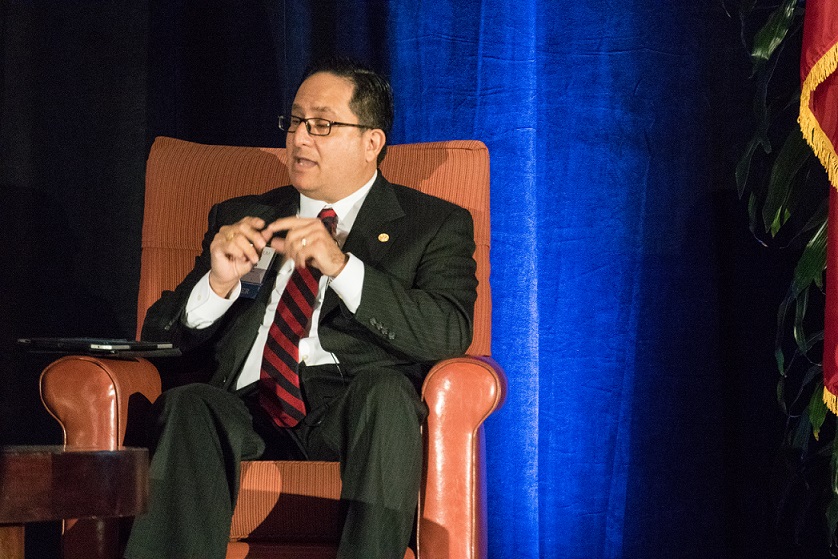
As a citizen who grew up in Harris County, I expected a great speech from Sheriff Adrian Garcia–and he delivered. He did an excellent job with his closing remarks, tying together the themes of previous speakers and providing an inspirational coda to the day’s panels.
Sheriff Adrian Garcia
Echoing the sentiments of previous speakers, Sheriff Garcia noted the importance of electing officials who truly care about citizens. Slick candidates may be able to appeal more effectively to voters, but the day-to-day governing activities require dedicated and devoted public servants. Similarly, Garcia reiterated the importance of community institutions such as family, non-profits, and public-private partnerships (“P3s”). Garcia drew on his personal experiences and background to illuminate the different factors that led to his success, and it provided a microcosm for community success. Like Sheriff Garcia, I am a first-generation American, the youngest child in my family, and–like Sheriff Garcia–I hope to be a successful public figure in the United States while also honoring my Mexican-American heritage.
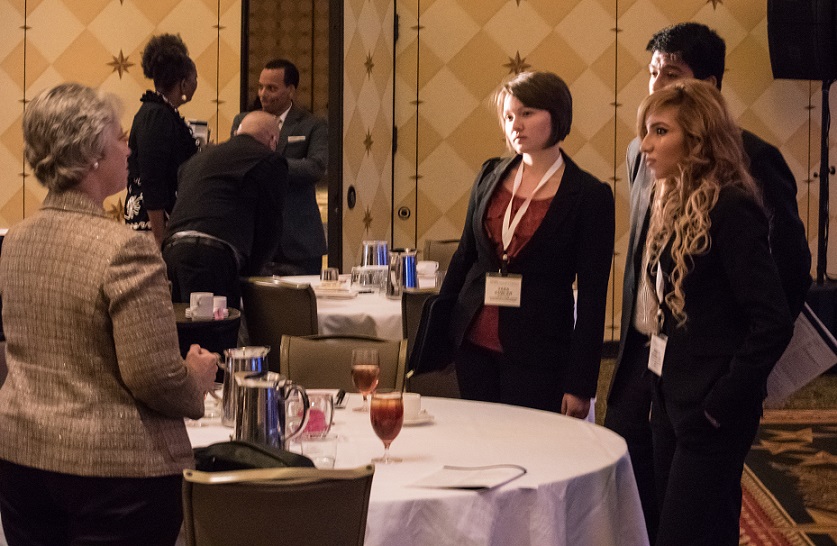
The conference was a wonderful learning opportunities for us, and we are grateful to Governing Magazine for this opportunity. In addition to hearing from the panelists, we had numerous opportunities to speak with professionals from across the state. This is a wonderful program for current professionals and a great opportunity for aspiring professionals, and we are grateful to both Governing and SHSU for providing this opportunity for us.
As this is my first trip with the Center for Law, Engagement, And Politics (LEAP), I honestly have no idea what adventure is in store. But the first day has been intriguing, insightful, and more importantly, easy! Now while I do not expect the rest of the trip to be this languid I am definitely enjoying the six-hour drive to Norman, Oklahoma.
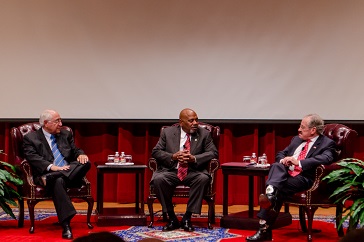
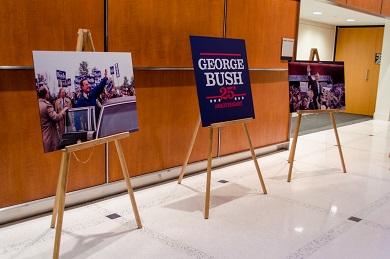
This afternoon, we left the Walker Education Center in Huntsville, with a few extra LEAP Center students in tow, for College Station and the Bush Library to attend the kickoff event for the twenty-fifth anniversary celebration of President George H. W. Bush’s election. Moderated by the CEO of the Bush Presidential Foundation, Fred McClure, we had the pleasure of sitting in on the discussion by President Bush’s former personal photographer, David Valdez, and President Bush’s campaign manager for the northeast area, Ron Kaufman.
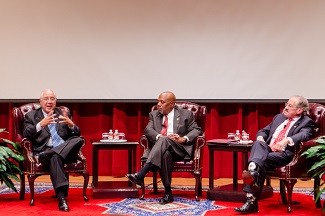
David Valdez, Fred McClure, & Ron Kaufman
Through their storytelling it was clear they both deeply respect and admire President Bush. Mr. Valdez spoke of how even though the former President was a naval pilot in World War Two and could use that to win votes in his campaign, he was reluctant to do so. He was also similarly reluctant to use showcase his religious beliefs to appeal to the emerging Evangelical vote. Both speakers knew the details of President Bush’s life and testified to his character during the campaign. It was a great experience to hear first hand the stories about a man who did much for this country!
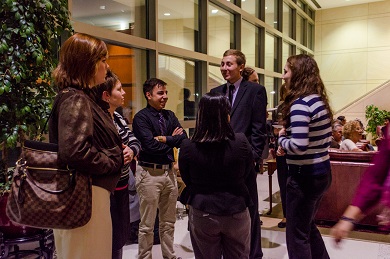
It was also a pleasure to spend time with some students who couldn’t make it on the trip. Joey Medrano, Ariel Traub, Quan Hall, and Clinton Morrison, also attended the event, had dinner with us, and then returned to Huntsville. And we were especially pleased that Gene Roberts, Director of Legal Services at SHSU, came with us for the evening’s festivities.
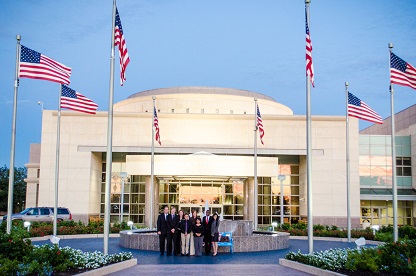
LEAP Students Outside the Bush Library
Now, after enjoying a filling meal from Blue Baker on a chilly November evening, we make our trek towards the University of Oklahoma to attend the Oklahoma Political Science Association Annual Conference. If today is any indication of how the rest of the trip will go, I am stoked! We should arrive at the hotel around three am to wake up and get going again around six. Looks like I better enjoy the relaxation while it lasts.
Looking forward to tomorrow’s stimulating adventures!
Day One: Jessica Rodriguez
As temperatures were dropping below 50 degrees in Huntsville and our excitement for this new learning adventure built up, we commenced the first day of our trip to Oklahoma with a quick visit to the George W. H. Bush library. The Library was celebrating the 25th anniversary of the election of George W. H. Bush as President of The United States of America. Upon entering the library grounds I noticed the beautiful “The Day the Wall Came Down” installation of five horses was taking with the reflection of the sunset.
The Day The Wall Came Down
We were politely greeted by neatly uniformed students of the Bush School and directed towards the auditorium. Ariel, Zachary, and I sat in the third row right behind the reserved spots which were occupied by the State of Texas Supreme Court judges, the College Station Mayor, and a couple of State Representatives. The program began with a slideshow of historical and energizing photographs of Bush Sr. and his loved ones through his campaign. Then we heard a moderated talk with David Valdez, the former Presidential photographer, and Ron Kaufman, Bush’s campaign manager of the northeast region. They both emphasized the approachable and sincere personality of W. H. Bush, but they also pointed out some of the bumps on the road they crossed. For example, when the then President elect was confronted by Dan Rather in 1988, a mini-controversy erupted.
Dan Rather and George H. W. Bush
This event, according to Kaufman, helped turn the 1988 campaign around and helped Bush win the election.
We were also fortunate to have time to speak with Valdez, and he expressed interest in visiting SHSU at some point, a prospect that excited all of us.
David Valdez with LEAP Center Students
We concluded the night by arriving to Norman, Oklahoma at about 3 am with even lower temperatures than Huntsville on the mid 30’s.
Day One: Dulce Martinez
We commenced our five-day trip to Oklahoma by making a small detour at the George H. W. Bush Presidential Library in College Station, Texas. The George Bush Presidential Library Foundation kicked-off a yearlong celebration of the 25th Anniversary of then Vice President George H. W. Bush winning the Presidency in November 1988. The event featured two key speakers who played a key part in the election of President H. W. Bush. One was the northeast regional political director of the Bush Campaign, Ron Kaufman. He operated in Boston, Massachusetts, home of Michael Dukakis, Bush’s opponent.
Kaufman gave great insight on the strategy in keeping a headquarters in Boston. He explained it was a way of prompting Governor Dukakis into thinking he could lose his own state, forcing Dukakis to spend a large amount of time in Massachusetts.
David Valdez, the second speaker, was the personal photographer for President George H. W. Bush. Valdez documented every step of the election with photography.
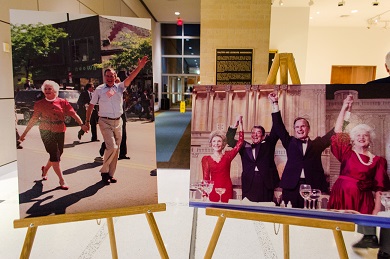
Photos from 1988
He spoke about how the campaign struggled with the media, most interesting the showdown between Dan Rather, CBS reporter, and Bush. During the interview, Rather attacked Bush on the controversy of the Iran-Contra incident under the Reagan Administration. The live televised interview helped the campaign because it showed critics that Bush was not “soft,” but an actual contender who would fight back when attacked. Both the speakers did a fantastic job in giving glimpse of what went on behind the scenes of the election, and we are grateful to the Bush Library for the great job they did putting the event together.
Post-Event Discussions
Day One: Zach Goodlander
Day one of our whirlwind trip is now in the books. Our fist stop as part of our trip to Oklahoma was in College Station to an event at the Bush Library. The focus of the event was a 25th anniversary celebration of President Bush’s ’88 election victory.
Photos from 1988
The two speakers were David Valdez, Bush’s personal photographer and Ron Kaufman, a longtime campaign adviser.
Valdez, McClure, & Kaufman
In the audience with our group were some other notable dignitaries, including multiple Texas State Supreme Court Justices, Texas Congressmen and local city councilman. These dignitaries bring their own perspectives and stories, which really add to the discussion as well.
The two main speakers were perfectly suited for the discussion, with each bringing a different perspective of the campaign. Valdez let the audience in on personal stories about himself and Vice President Bush. Meanwhile, Kaufman described the campaign in a larger context.
Now, having made the most of our trip to the Bush Library it’s now time to drive though the night to Oklahoma City, another day of opportunity awaits in the morning.
“The goal of the CIA is to learn other nations’ secrets,” noted General Michael Hayden, and he should know. Hayden was the Director of both the CIA (2006-2009) and the National Security Agency (1999-2005) and, most recently, a “guest lecturer” to a group SHSU students who traveled to Houston, Texas to learn more about intelligence operations. The lecture, hosted by the World Affairs Council, covered wiretapping, prioritizing threats, presidential performance, and balancing work and family.The most pressing question from students focused on wiretapping, a topic that General Hayden seemed to anticipate. Hayden ensured students that the government did not record their calls, but acknowledged that the government did document the calls, taking note of who called whom and how long each call lasted—logging, as General Hayden referred to it, some 3 billion “phone events” per day.
Brian King, Zach Goodlander, and Other SHSU Students Listen to General Hayden
This massive data collection comes in handy when other information falls into place. Hayden provided the example of the government capturing “Ali Bin Badguy” and confiscating “Mr. Badguy’s” phone which, in turn, allows them to locate his calls off the “phone-event” database and identify other potential terrorist connections. Hayden emphasized, however, that the government did not record calls made by citizens, at least not without a warrant.
SHSU Senior Coby Steele veered away from the popular wire-tapping issue and asked about operational management. “How,” he wanted to know, “do the multiple acronym agencies work together to prioritize threats?” General Hayden acknowledged that it was a problem, but not for the reasons people think. “The problem,” he noted, “is that we have so much data. It’s difficult to ‘connect the dots’ when there are so many dots that the page is black. But that’s because we are good at collecting data and working together.”
Steele Asks Gen. Hayden About Priorities
Hayden, who worked directly for Presidents Clinton, Bush, and Obama, noted that it wasn’t just the intelligence agencies working together. He praised President Bush and Obama for putting aside their differences and maintaining a consistent policy on intelligence: “There were fewer changes in 2009 when the Obama administration took over from Bush than there were in 2005, when Bush transitioned from his first term to his second.”
Brian King, a senior at SHSU, moved away from policy issues altogether and asked about the personal life of a CIA employee. “How,” asked King, “do you balance a family while running the CIA?” Hayden acknowledged the difficulties but said that he and his wife took “vacations together and traveled together for work,” unless he was heading into a war zone, in which case he traveled alone.
Zach Goodlander, General Hayden, and Brian King Discuss American Security
Although the SHSU students had almost an hour with General Hayden, not all of the SHSU students asked questions. Ashley Richardson, an Accounting major and first-semester freshman from Magnolia, Texas, learned through listening. “This is an amazing real-world educational experience with the former CIA Director,” noted Richardson. “You just don’t get these types of experiences in high school.”
King agreed, noting, “I’m not sure you get these opportunities at any other college. The CIA Director can listen to our conversations whenever he wants,” King added, tongue-in-cheek, “but how often can students listen to his conversations—let alone participate in them?”
SHSU Students with General Hayden
The opportunity to interact directly with General Hayden was coordinated between the World Affairs Council and SHSU’s Center for Law, Engagement, And Politics (LEAP), which promotes learning across diverse disciplines. In the past month, students have met the former President of Mexico, Felipe Calderon; discussed career paths with a half dozen Texas legislators; and attended a presentation by former Senior Advisor to President Obama, David Axelrod; met former White House Chief of Staff Andy Card—while also attending law-school related activities and engaging in volunteer service across the community.
“Our goal,” noted Mike Yawn, Director of the LEAP Center, “is to provide opportunities that open new worlds for the students. SHSU faculty work hard to do that in the classroom, the University provides institutional support for similar outcomes outside of the classroom, and that combination will help us produce the next generation of public leaders in the state of Texas.”
Their advice was to the point and useful. Karissa Morrissey provded a helpful overview of the LSAT and GRE, offering a timeline for preparing for graduate school or law school. High points included:
The LSAT ranges from 120-180; The GRE ranges from 130-170
The LSAT is offered four times a year (Feb, Jun, Oct, Dec), while the GRE offers more frequent tests
The LSAT should be taken approximately a year prior to when the students wants to enroll in Law School.
The Princeton Review offers Prep Courses at SHSU in the spring of each year.
Dean Stephen Perez stressed the importance of the LSAT Scores and a student’s GPA, while pointing to Tech’s strong rates on bar passage, employment, and the excellent performance of students in Moot Court and Mock Trials. Also, the National Jurist magazine ranked Tech among the top 10 in the country in both “overall value” and “student satisfaction.” Perhaps not surprisingly, more SHSU students are enrolling in Tech, with four Bearkats matriculating last year. Dean Perez seems to be intent on duplicating that success this year, offering the students who attended the seminar fee waivers to apply to Texas Tech.
Perez Discusses Law School Admissions
Kathryn Meyer caught students’ attention when she discussed the programs of the Bush School of Public Service. The Bush School is a top 35 Public Administration across the country, featuring broad programs in Administration and International Affairs and endeavoring to keep students’ costs low. SHSU boasts more graduates at the Bush School than any other University in the nation with the exception of Texas A & M.
Thomas Leeper’s discussion bridged both law and public affairs. Leeper has served as an attorney in private practice, a city attorney, and a political appointee. Leeper discussed life in law school (giving particular attention to the Socratic Method), the kind of work that attorneys do, and the importance of public service.
The Center for Law, Engagement, And Politics (LEAP) promotes learning opportunities across diverse disciplines at SHSU. Over the past seven years, SHSU has significantly increased its efforts in the pre-law field, doubling the number of students accepted to law schools in the United States. Moreover, last year, SHSU moved in the top five percent nationally in the Law School Admissions Council’s (LSAC) ranking of “Law School Feeders.”
On September 20th, 2013, seven students (including myself) from Sam Houston State University’s L.E.A.P. (Law, Engagement, and Politics) Program departed from Huntsville, Texas en route to Dallas, Texas for the New Politics Forum Event, which takes place on Saturday, September 21st. This event is geared toward college undergraduates and graduates, who are interested in a future career within the field of politics.
Despite the windy, rainy weather during our travel, we successfully managed to stop for lunch at the Woodbine Hotel / Restaurant in Madisonville, Texas. Madisonville, as some of you know, is the mushroom capital of Texas, so it wasn’t surprising that many of the fine entrees came with mushrooms. The lunch also offered the chance for us to know one another. We had an International Business major, a Criminal Justice major, and, of course, Political Science majors, but we were all united in our desire to be engaged in civics. The Woodbine also offered us a chance to see interesting antiques, the most interesting of which was an antique phone booth.
Continuing through the rough weather and mild traffic, the students arrived in Dallas, Texas around 4:30pm and went to the Sixth Floor Museum, located at Dealey Plaza in Downtown Dallas.
Dealey Plaza Marker, Dallas
The Sixth Floor Museum examined the life, times, death, and legacy of President John F. Kennedy. I really enjoyed the museum’s depiction of John F. Kennedy, along with the countless photographs and memorabilia from the time of his presidency.
Following the Sixth Floor Museum tour, the students ventured to the Spaghetti Warehouse for dinner. At the restaurant, we continued to talk about political and school related affairs, as well as who our favorite presidents were. Some students liked Abraham Lincoln, Theodore Roosevelt, and Calvin Coolidge, while I opted for Franklin D. Roosevelt.
After dinner, the students embarked to the Dallas Museum of Art, which offered a special late night tour. Throughout the Dallas Museum of Art, I admired the American Art, as well as the Egyptian Art. Leadbelly, by Michael Owen Jr., is an example of one of the sculptures I enjoyed, especially given the background of the sculpture only taking a month to create.
Huddie Ledbetter, AKA Leadbelly
I should also note that this piece has a connection to my adopted hometown of Huntsville, Texas, which features a mural of Leadbelly on a downtown storefront.
Coffin of Horankh, representing a coffin in the form of a human body, also caught my attention. This body of art was common within the Egyptian culture, as a means of “magically” assuring eternal life.
Coffin of Horankh
Overall, I enjoyed the first day of the New Politics Event Forum trip, from the Chicken Caesar Salad at Woodbine Hotel / Restaurant to the aspect of engaging in different cultures at the Dallas Museum of Art. Finally, I look forward to sharing my experience from the New Politics Conference tomorrow at Southern Methodist University.











 Center for Law, Engagement, and Politics