Day of the Dead or Dia de los Muertos is a Mexican tradition that celebrates lost loved ones in a an intimate way, and it is celebrated at the Wynne Home Arts Center annually. For each individual lost loved one, family and friends build an altar that reflects the life they lived. The altar is composed of favorite foods, flowers, candles, and objects that they cherished. Those who celebrate this holiday believe that during the night the deceased will come and enjoy what they have left for them.
Similarly, the Wynne Home built two altars for the lost loved ones that made a great impact in Huntsville, Texas: Jesus Moroles and Barbara Tyson. The two artists have both done work for the Wynne Home as well as in the community. With both of the artists passing this year, the Wynne Home wanted to honor and commemorate their lives by building them altars. The altars will be on exhibit until November 12, 2015.
The Wynne Home provided tamales, traditional rice, and charro beans—foods that are popular for this holiday. There was also face-painting…
…coloring and art activities…
…and a showing of “The Book of Life” for children.
LEAP is very proud to volunteer at They Wynne Home—a place that advocates cultural diversity and art. It was a joy to see so many locals take part in this tradition that is cherished by many!
If you signed up for an event called the Great Muddy Escape, why would you care if it rained?! You wouldn’t! The mud and rain are part of the fun, and fun it was at the 5th annual “Great Muddy Escape.”
The Great Muddy Escape is a partnership between the YMCA and the Huntsville Memorial Hospital, with a threefold mission: (1) to increase awareness of fitness and health, (2) to offer a fun, healthy family activity, and (3) to raise funds for two organizations that promote healthy communities–the YMCA and the Huntsville Memorial Hospital Auxiliary.
The LEAP Center has been peripherally involved in this fundraiser since its inception, offering volunteers and participants. So, while some of the LEAP Ambassadors competed at the Moot Court competition in Lubbock this weekend, a few members and friends endured the rain and mud at the fifth annual Great Muddy Escape 5K in Huntsville on Saturday morning. Arriving before sunrise and smiling…
…LEAP Center students checked in volunteers, set up tables and snacks, and made sure packets were ready for when runners arrived. Amidst volunteers from different student organizations and community groups–all led by the indomitable Margaret Gulledge– LEAP students worked hard to make sure everything was perfect before all 250 competitors arrived and began to tackle the course’s dozen obstacles.
Once snacks and packets were prepared, volunteers headed down to the starting point to see runners stretching…
…eager to begin the race. Twelve obstacles awaited them, including walls, slides, and huge mud pits, and from the looks on their faces, it appeared that LEAP Center student Bella Abril was much more excited about this than this than POLS major Paul Oliver…
After a few minutes of anticipation and a pep talk by Mayor Mac Woodward…
…runners began with the sound of the blow horn.
As the runners sprinted past the starting line…
…all one could see were the teams…
…in a blur of tutus, tennis shoes, and tight pants on athletes enthusiastically running towards what could end up being their demise.
Paul Oliver (Orange Shirt) Dashes Onward
Would they escape? One could only hope to see an equal number participants cross the finish line after withstanding all that the obstacle course had to throw at them.
LEAP students Megan Chapa and Brian Aldaco had the opportunity to photograph runners as they climbed walls…
…trucked through the mire, and swung across perilous pits of doom, or simply mugged for the camera.
Meanwhile, Constance Gabel and Karla Rosales checked runners in as they crossed the finish line, covered in mud, making sure to count the amount of wristbands they acquired at each accomplished obstacle. Little did we know, runners took their effort very seriously and much competition made our jobs difficult to say the least. Students Bella Abril and Paul Oliver ran the race with fierceness and completed with all wristbands intact. In fact, Bella even videoed herself with a gopro camera!
Meanwhile LEAP President Megan Chapa trudged with her boyfriend, Taylor Martin…
…through the mud…
…where even superheroes fear to go…
Even more fun was the waterslide, where some tried to traverse by running…
…some by sit-sliding…
…some by diving head-first…
…actually, a lot of people diving head first!
This slideshow requires JavaScript.
Some by being pushed…
…but mostly by falling!
But always smiling while doing so…
The smiles reflect the event’s mission, to “test your resilience, strength, stamina, quick decision making skills, and ability to laugh in the face of adversity.”
The smiles did, in fact, reflect the immense fun of the event, but perhaps no photo captures the fun better than Bella’s gopro video.
Despite holding a gopro camera for the duration of the event, Bella managed to finish the 3.2 mile event, through mud, rain and obstacles, in about an hour. Paul Oliver finished 7th in the men’s category, completing the course in under 40 minutes. Megan Chapa and Taylor Martin opted for the untimed event.
Overall, the male winners in the 5K were Will Butler (27:26), Ty Stubblefield (28:20), and Bryan Cruz (29:50). The female winners in the 5K were Angelina Santos (33:16), Stephanie Brock (33:24), and Angie Pecina (33:29).
Win or lose, though, it was a great day for both the participants…
…the super participants…
…and the volunteers…
…and for the Huntsville Memorial Hospital Auxiliary and the YMCA, the recipients of the money raised. Over the past five years, more than $40,000 has been raised for these worthy causes, and the LEAP Center has been proud to be a part of the program over this span.
About Huntsville Family YMCA
The Huntsville Family YMCA strives to provide families a safe outlet for their children with special needs where they can experience the joy and benefits of participating in sports and physical activities. Programs are available for youth ages 4 and up in baseball, volleyball, basketball, flag football and soccer.
About Huntsville Memorial Hospital
Huntsville Memorial Hospital is a 123-bed, private, non-profit community hospital, providing health care services for the residents of Walker County and the surrounding area since 1927. We are devoted to the health and well-being of our regional communities by providing exceptional care to every patient every day with a spirit of warmth, compassion and personal pride.
After considering the question for about 2/7ths of a second, a majority of students thought it would be a good idea to leave Lubbock, Texas on Saturday afternoon, rather than spend another night in Lubbock. Thus it was at 4:30pm that we drove home from Lubbock and into the path of a Tropical Storm.
Before we left, we stopped at One Guy’s Pizza, which was very good! It was fortunate that the portions were large because, as it turned out, we wouldn’t be eating again for a long time.
As it turns out, Lubbock looked just fine in our rear view mirror.
Austin, for example, was fascinated by the windmills…
…although the real windmills actually paled in comparison to Jesus Moroles’s granite windmill at Lubbock’s National Ranching Heritage Center.
As we moved to central and then east Texas, however, the weather turned stormy. It was raining heavily by the time we got to Eastland, and the water level rose further as we approached I-45. Ominously, as we came within 10 miles of 45, we noticed that side roads were closed, with officers blocking them. Sadly, this was also true when we arrived at I-45.
To get around what we thought was construction, we drove about 20 miles east, toward Seven Points, then southwest to intersect again with 45. Our plan worked. We took the ramp to 45 and headed south–at 11:30pm, we were less than two hours from home!
Our joy dimmed somewhat when we realized we were the only ones on the highway. This, we surmised, was unlikely under normal circumstances. Within ten miles, we saw that I-45 was completely blocked. This time we asked the officer what was going on, and he said the highway was closed because of flooding. He advised that we drive north to Corsicana, then drive west to Waco, then drive south to Bryan, then drive east to Huntsville.
Thirty minutes after being less than 2 hours from home, it was now midnight, and we were almost four hours from home.
But we dutifully slogged our way home. Of course, just outside of Bryan we were stopped at a Railroad Crossing, waiting for what Austin called “the world’s longest train.”
A little after 3:30am, we got to the green lot, and we scattered in separate directions, going home after a long, but successful trip to Lubbock, Texas.
For all of SHSU’s teams, the opportunity to participate on the moot court team has helped us each become well-rounded and develop skills to help prepare us for law school and our careers as attorneys. Each person grew as a result of our moot court preparation and the guidance we received from our coach, Jean Loveall. Half of the team will graduate soon, while the other half is already anticipating next year’s moot court competition. Many thanks go to the Texas Undergraduate Moot Court Association for organizing the competitions each year, Texas Tech Law School for hosting the competition, the LEAP Center for providing the opportunity to compete in Moot Court this year, and our Coach Ms. Loveall who has helped each of the team members grow and learn in preparation for our regional competition.
We knew coming into the tournament that we’d be at TTU Law on Saturday. What we didn’t know was whether we would be participating. Late Friday night, after three rounds of competition, we found that one of our teams (Kristyn and James) would, in fact, be competing on Saturday. They had made a “play in” for the last spot in the “Sweet Sixteen” and their competition was scheduled for 8:00am.
They were scheduled to face a team from TCU, consisting of Luke Erwin and Becca Michelson. We arrived at about 7:20 that morning, so there was some waiting to do, which we spent preparing for the contest…
We also took this time to teach Alex how to use the camera (a fortuitous time given Alex’s impending trip to Wisconsin next week).
…and she took some good photographs, including this one, which Austin photobombed!
We also spent some time waiting for the opposing team to change and otherwise prepare, so we remained flexible while the judges also waited.
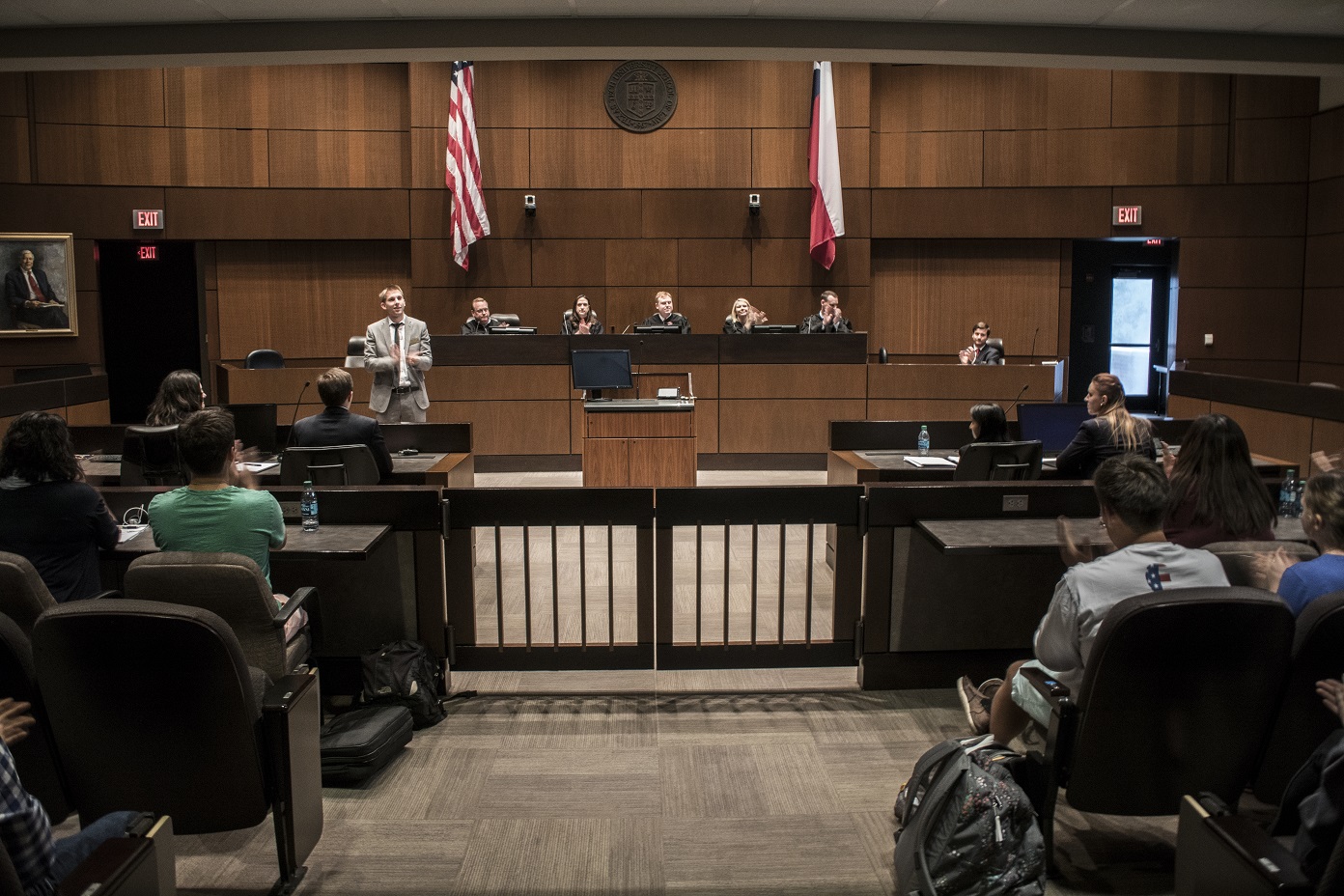
As with all of the contests, the “debate” lasted 40 minutes, with both sides splitting the time for arguments. Kristyn led off for SHSU’s team…
…and James closed…
When the debate was over, the students left the room to await the verdict. A few minutes later it came: With two judges voting in favor of SHSU, the Bearkat team advanced!
This made for an exciting morning, which was amped up further when the students had just a few minutes to get to their next contest. Their 9:00 am contest was against the number one ranked team from Texas A&M. Coached by Ph.D. candidate Nick Conway and consisting of competitors Kristina Smith and Lakshmi Achari, the TAMU team had prepared extensively. It showed.
The Bearkats worked hard and turned in an impressive argument, but the judges opted for the Aggie team.
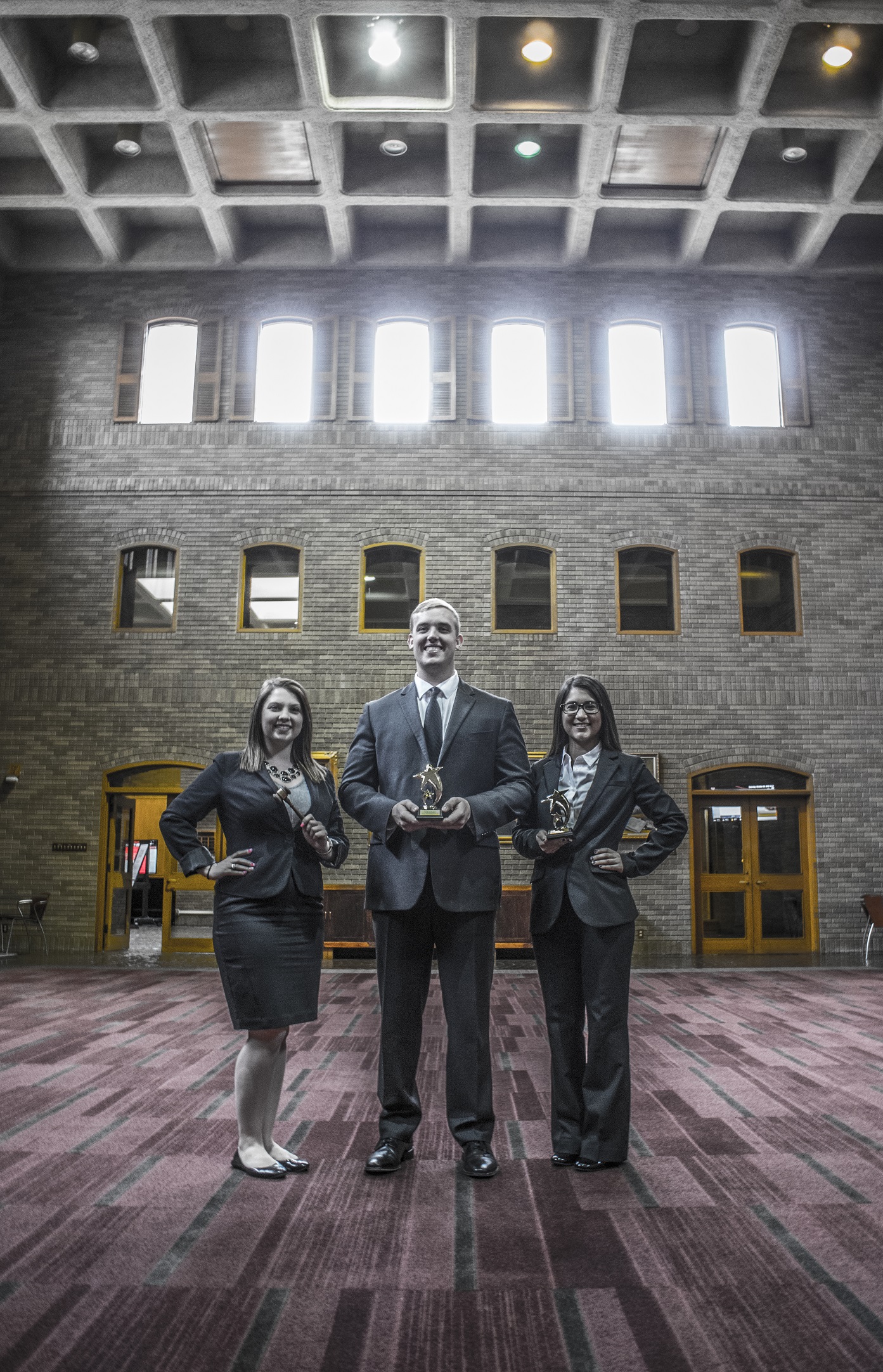
With this defeat, the SHSU teams were officially out of the race, but there was still much to do. Tournament officials gave trophies to those participating in the “Sweet Sixteen” and James and Kristyn were presented with theirs.
Other competitors also received trophies.
This slideshow requires JavaScript.
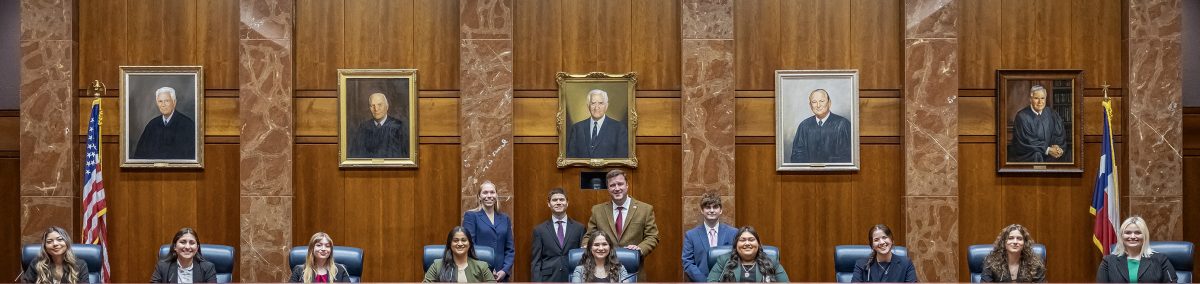
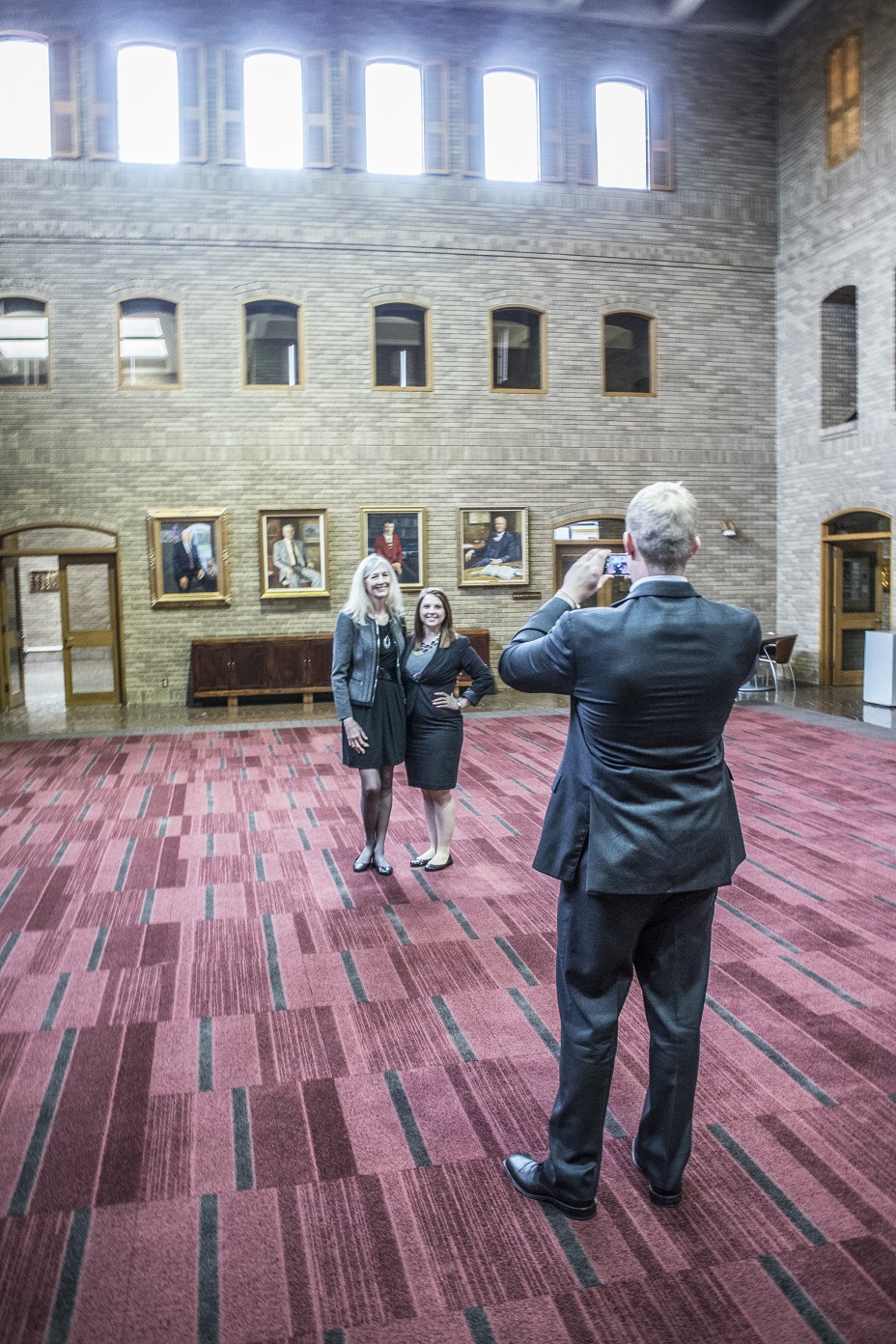
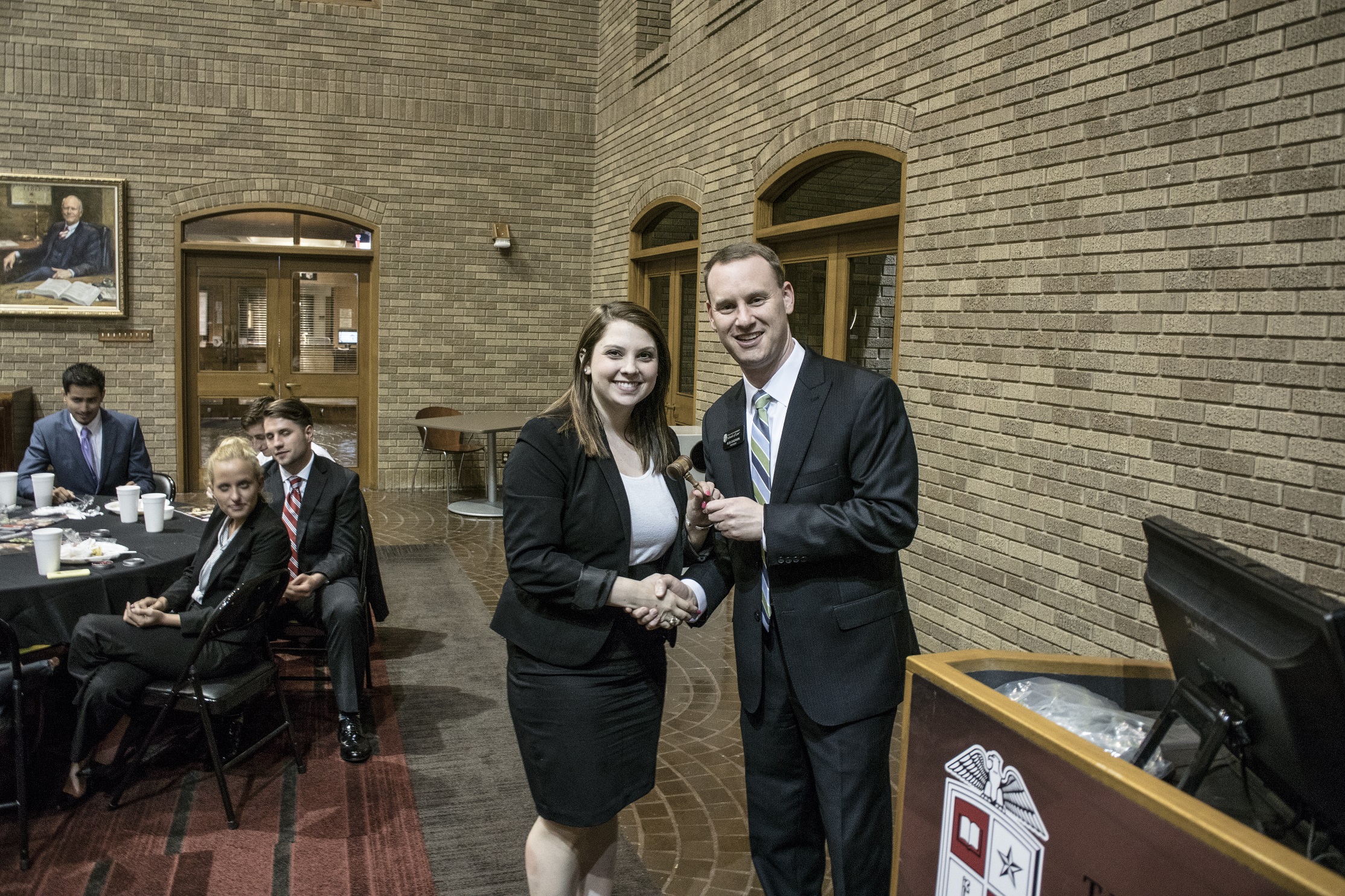
All the SHSU participants then retired to one of the law-school rooms for photos, where they took photos…of Chelsea with her gavel
…Kristyn with her trophy…
….Chelsea with her coach, Jean Loveall…
…”Sweet Sixteen” participants James and Kristyn….
…Chelsea, James, and Kristyn…
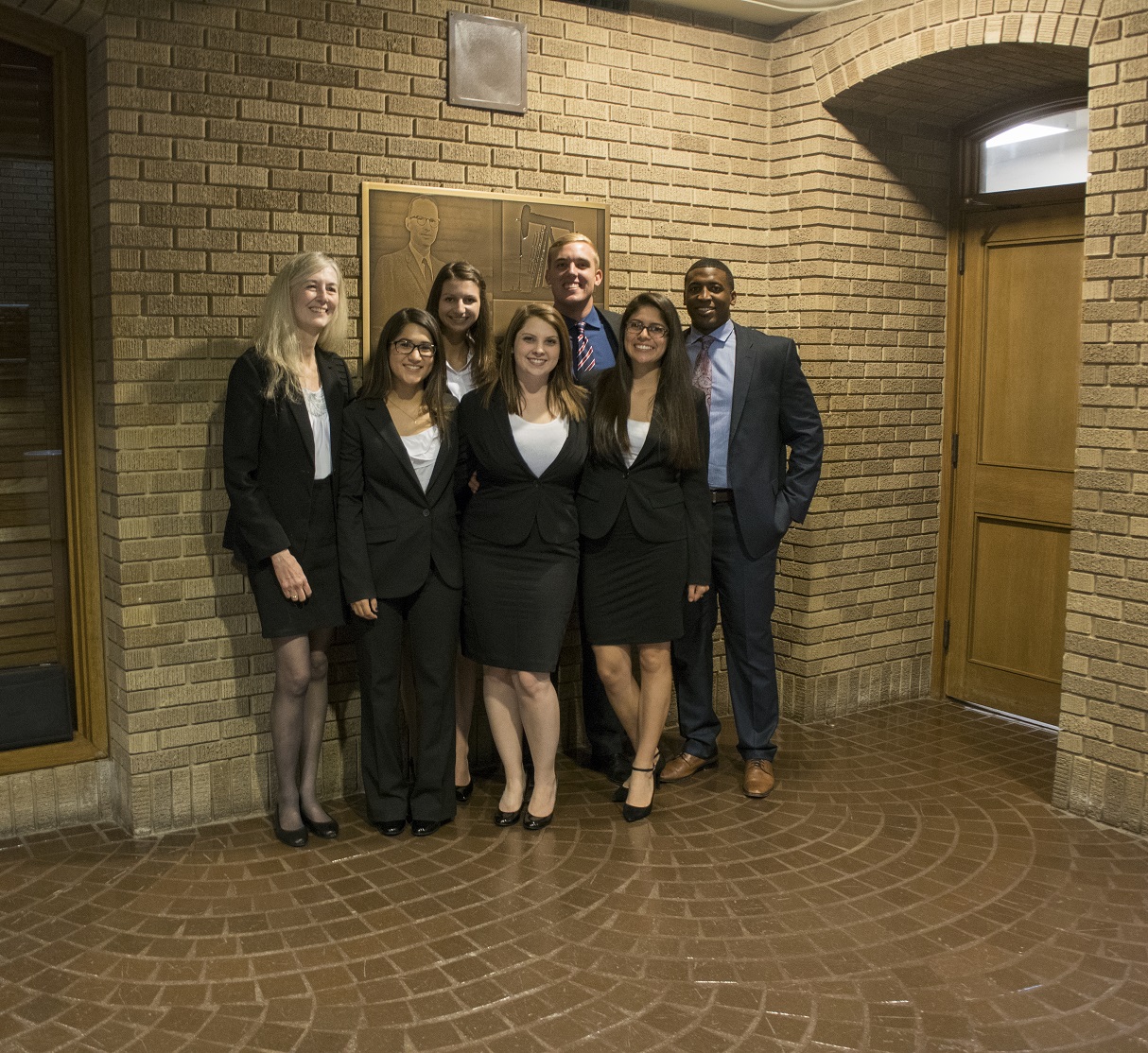
…and the entire team!
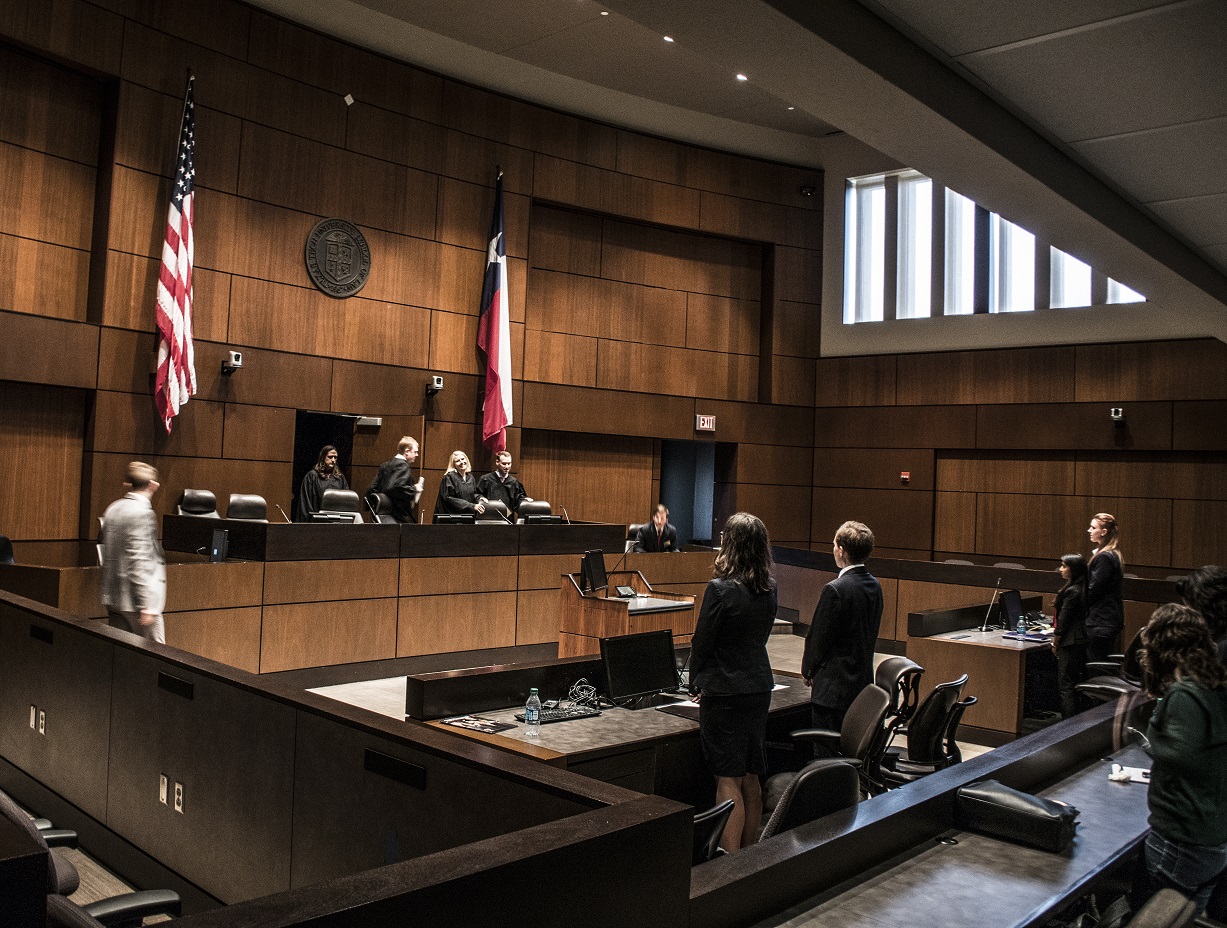
As it turned out, the Aggie team–which had defeated James and Kristyn–made it to the finals against one of three UTD teams present. The finals were formal, with the judges entering as everyone rose…
The Tournament Director, Professor Robert Sherwin, served as one of five judges in the final rounds, and Tech students introduced all the judges and made some comments before the final competition.
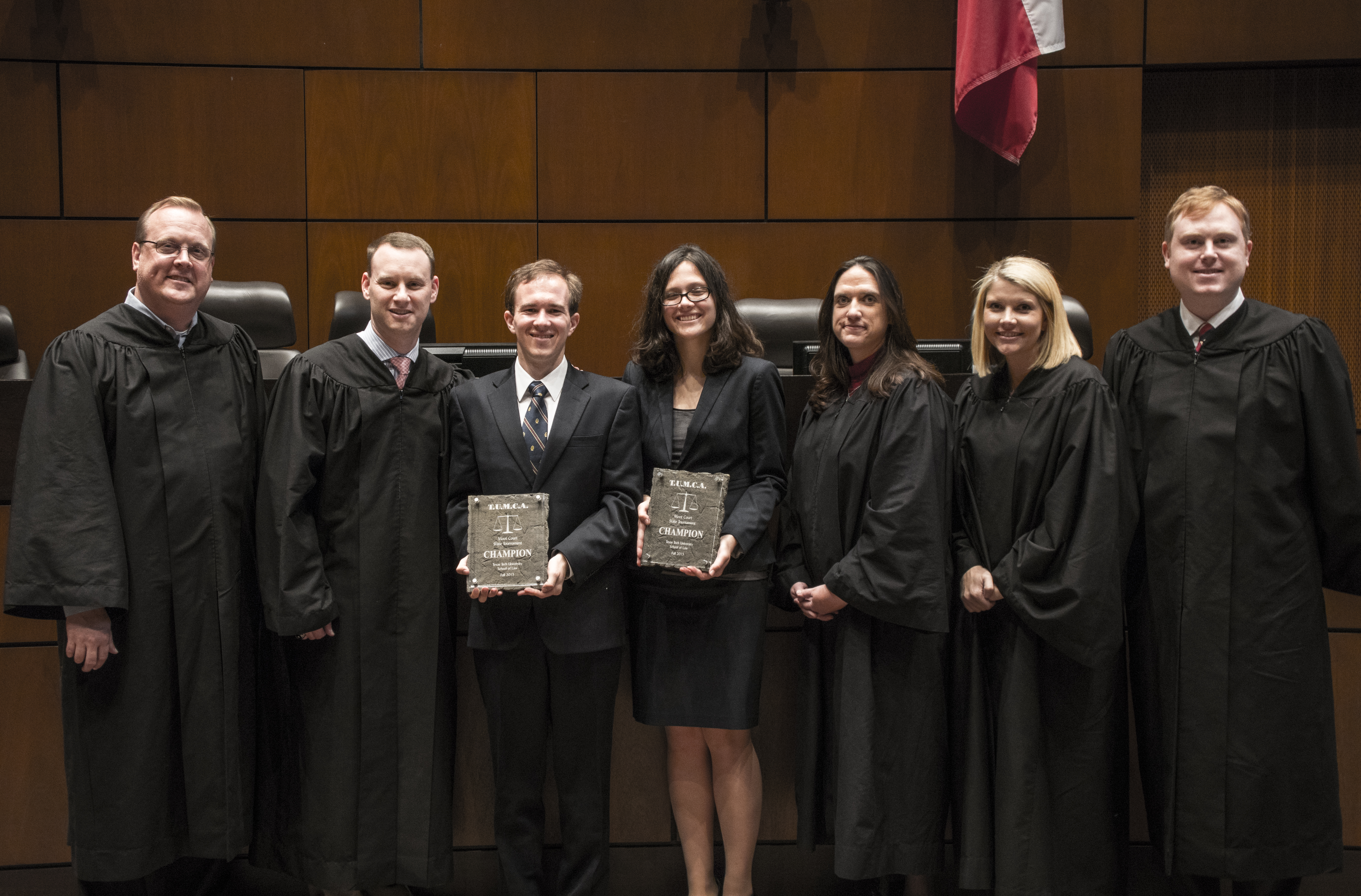
All the competitors in the final deserved to be there, presenting themselves well. In the end, TAMU fell just short in a very close contest. The UTD team, consisting of Alexandra Noll and Blake Eaton and coached by Anne Dutia, had actually been defeated by SHSU in the UNT Scrimmage two weeks ago, but they were better prepared today, and their preparation paid off with the title of tournament champions!
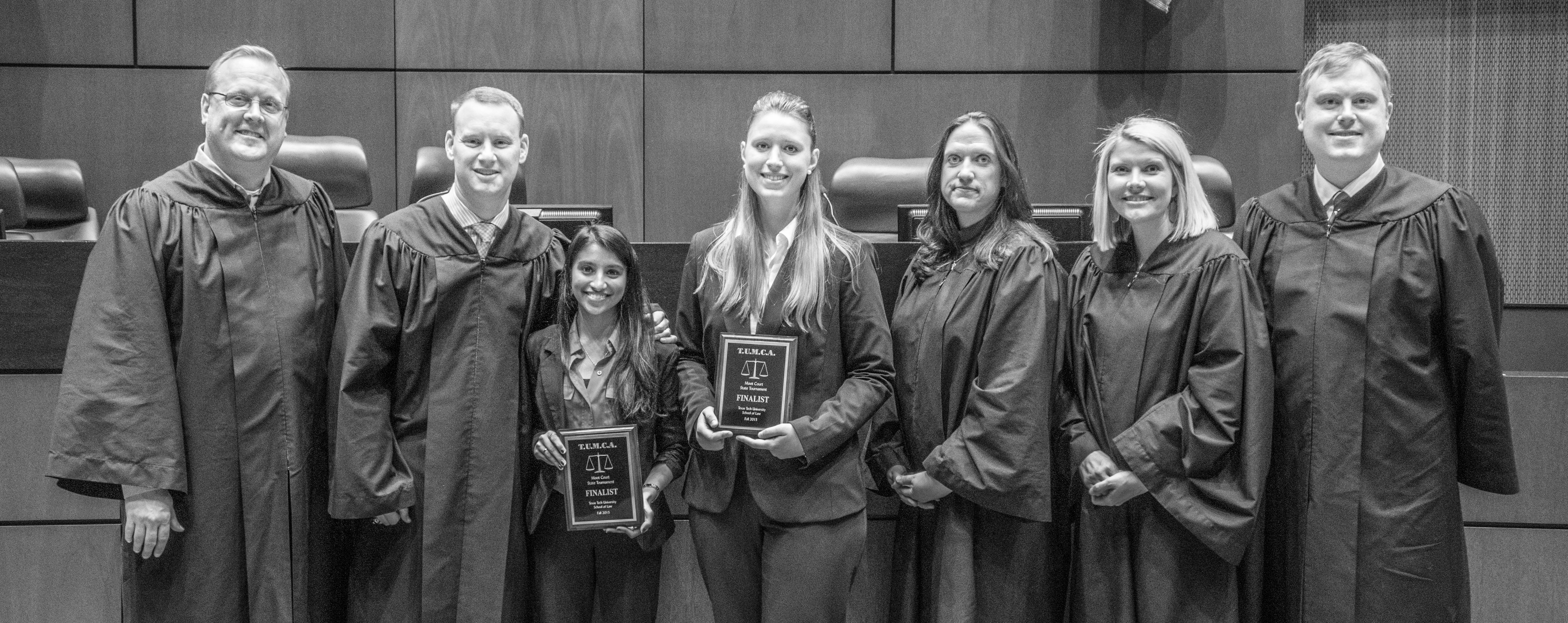
The end of the tournament was a time of photo-taking, with the runner-ups also getting photos with the judges…
…and a group photos of the champions and runner ups…
…and a variety of combinations of winners, coaches, and judges.
This slideshow requires JavaScript.
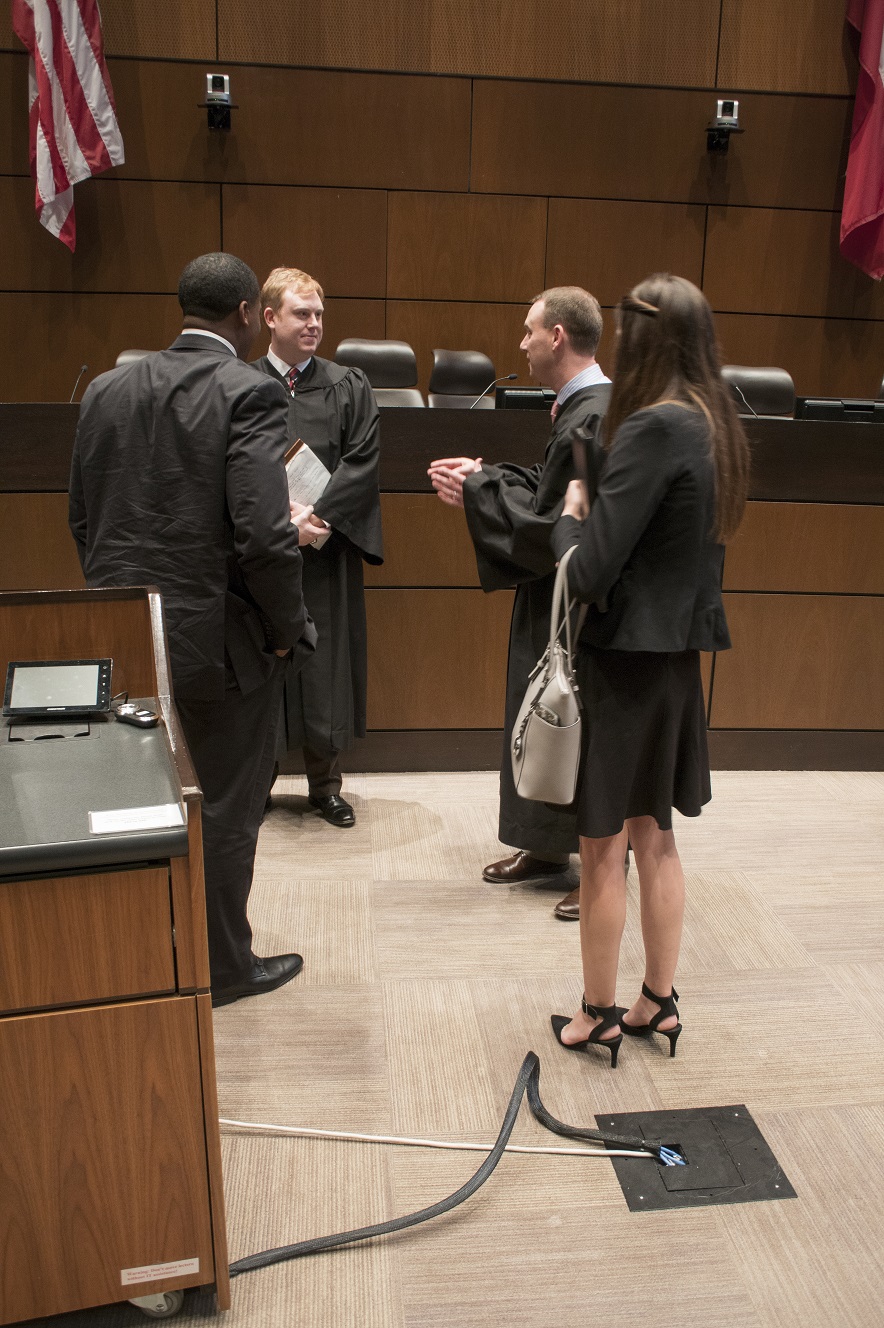
The SHSU students got in the action a bit, speaking with some of the judges and TTU faculty/staff.
The end of the competition marked the end of SHSU’s first-ever moot court team’s first competition in the American Moot Court Association’s tournament process. It was a great experience, exposing us to a fine law school, current law students, and some great pre-law undergraduates from across the state of Texas (and beyond)!
Even though the competition started at two, most of us started Friday early. We began preparing for the events, while one of our coaches scouted out the venue (Texas Tech Law School!) and explored some of the Jesus Moroles’ sculptures on campus.
But by the early afternoon, after countless hours of preparation, our nerves were beginning to set in. So, we ate. Our restaurant was a burger place called Spanky’s, recommended by former Junior Fellow Brandon Reese, who also happens to be an alum of Texas Tech Law School.
Spanky’s advertises its “world famous fried cheese,” and after the server told us that one basket is “only six sticks,” we ordered two baskets. What we didn’t know is that they cheese sticks are the size of a log.
But we got them down, along with some burgers, and that helped quell some nerves.
Armed with food in our stomachs, we headed to Texas Tech Law School. With the intensity of competition weighing on our shoulders, we had a few extra minutes to practice and prepare before the competition began.
After competing at the UNT Scrimmage a few weeks ago, our team had a better idea of what to expect; however, there are many unknown variables that a competitor cannot control such as: who your opposing team is, who the judges are, or what questions the judge’s will ask you. Today’s preliminary rounds consisted of three rounds where each team argued once on each side (petitioner and respondent) and a final coin toss round to determine which side each opposing team would argue.
The performances in these three rounds will then be used to determine who competes tomorrow, with the top sixteen teams advancing. Armed with that mission, we awaited the call to compete.
When the time came to disperse to our respective rooms for competition, our team felt prepared because we knew we invested a substantial amount of time into learning the problem case, developing our arguments, and refining our presentation skills. My co-counsel, Alejandra Galvan, and I argued on the petitioners’ side of the case in our first round.
For us, the petitioner’s side of the case is more challenging than the respondent’s argument. After each round, the judges provide feedback to the teams giving them the opportunity to improve in the following rounds. This proves to be a useful tool in going forward in the competition. As each round progressed, confidence among the group grew because the judge’s feedback was constructive and positive.
This slideshow requires JavaScript.
After completing the final round, Texas Tech Law School catered dinner for us which allowed for a reprieve from the stress of the day while we waited on the final results and scores.
Participating in Moot Court has numerous benefits, one of which is getting to tour law schools during the competition. Dinner allowed us the opportunity to meet and interact with Texas Tech Law students to gain insight on their law school experience. We also had the chance to meet the Associate Dean of Admissions, LJ Bernhard, who gave us advice on law school applications. In addition to the skills you can acquire and refine, making connections and getting information is a benefit to the Moot Court experience.
Texas Undergraduate Moot Court Association gives awards to the top twenty speakers for the preliminary rounds.Our entire team was excited when Chelsea King won overall twelfth speaker.
Also, James Perry and Kristyn Couvillion, tied for the sixteenth spot giving them the opportunity to compete in a “play-in round” (equivalent to the wildcard in sports playoffs) tomorrow morning to determine who will win the sixteenth spot.
Following a happy first day of competition, we took lots of photos…
…including one in the very cool atrium, below a Thomas Jefferson quote…
We also got pictures of the group from UNT, a group led by Dr. Kimi King, who organizes the tournament.
UNT has been long-time participants and, as expected, their competitors did very well.
We also relaxed a bit…
…and enjoyed reflecting on the day while winding down. Well, James and Kristyn didn’t relax so much, but the rest of us did!
For SHSU’s Moot Court team members, this weekend promised to be a full one. We headed to Lubbock on Thursday, leaving campus around 1:00pm. With a tournament on Friday and Saturday, the weekend was sufficiently stressful, but half the team members were also set to get their LSAT scores, adding a bit of stress and spice to a long weekend.
The weekend’s tournament is being held at Texas Tech Law School. Thirty teams from Texas (plus the powerhouse US Air Force team) will be on hand to compete. As a sign of the rigor involved, 43 teams originally signed up, but more than a third of these teams dropped out in the week prior to the competition, despite having already paid admission fees. Preparation for this competition involves reading 19 cases (approximately 20 pages each), and practicing extensively on body language and speech delivery. We may not win, but all of us are better speakers and more knowledgeable about the law as a result of our work.
With that in mind, we headed west after our Thursday classes. There’s not a lot between Huntsville and Lubbock, Texas, and that made for a long drive, although this did give us some study/prep time, helped on by our coach, Jean Loveall.
The drive was made longer by bad weather most of the way.
And then the drive got more stressful around 6pm, when our three senior members got emails indicating their LSAT scores were available. Well, this made the drive much more interesting! After some group discussion, the three seniors decided to postpone opening their emails until they got to the hotel.
Around 8pm, we pulled in to Perini Ranch steakhouse, which is in Buffalo Gap, Texas (about six miles south of Abilene). The steakhouse’s origins date back to 1973, when Tom Perini began catering for private affairs. He opened his steakhouse in 1983. The restaurant did well, but business took off in 1995, when the New York Times recognized his steaks as the “mail-order gift of the year.” With that recognition, profiles in Texas Highways and Texas Monthly followed, and at the beginning of the G. W. Bush presidency, Perini was asked to serve steaks to members of congress from the White House lawn. It was a memorable day–not because of the steaks, but because it was scheduled for Tuesday, September 11, 2001. The “steakout” didn’t happen, at least not on that day, as the history-altering terrorist attacks forced a cancellation. More happily, Tom and Lisa Perini were invited back to the White House the next year, and the event proved successful.
Thankfully, our dinner lacked international dramatics and, despite the looming LSAT score discovery process, we were able to try some new foods and enjoy the steak. For appetizers, we all tried “Quail Legs,” which was a new dish for about half of us. For the entree, we all ordered steaks, which we split. The steaks have a great flavor, a product of, among other things, a great “streak rub” (which, incidentally, is for sale online and in the restaurant store). For dessert, we had bread pudding (great!), chocolate cake (I didn’t sample, but it got good reviews), and in an experimental flourish, “Jalapeno Cheesecake.” It was very good!
Special mention should be made of the fact that Austin ate three whole jalapenos during dinner. There was no real explanation for this act of self-torture, other than some sort of behavioral distraction from his impending LSAT discovery. On a related note, Austin also drank six glasses of water at dinner.
After the obligatory pose at the giant armadillo outside of Perini Ranch…
…we settled in for our final stretch. We got in at midnight, when the students wasted no time accessing their LSAT scores. The students have worked hard to position themselves for law schools, and their work has paid off. Armed with solid to strong LSAT scores and excellent grades, their work has been a model for the younger members of the team.
And on that happy note, we moved on to our rooms, hoping to get some rest prior to our competition on Friday!
For the past five years or so, the LEAP Center/Junior Fellows have teamed with Kaplan Testing to offer a Mock LSAT every semester. It is part of a larger set of offerings–and informational resources–that SHSU provides to help students fulfill their law-school goals.
Taking the Mock LSAT serves at least two functions: (1) It prepares them for a testing environment, making them more comfortable when they take the real thing, and (2) gives them a better idea of where they stand on the test and, therefore, how much more studying they need to do.
With those objectives in mind, 34 students showed up for the Mock LSAT on Saturday, October 17, 2015. Ricky Kaplan, an instructor from Kaplan Testing, joined them, providing the test and, afterward, a few pointers.
The actual test is approximately four hours long. There are five sections of the test, and each is 35 minutes long, with a short break in between. One of the five section is “experimental,” meaning that only four of the sections count, but the takers do not know which one is real and which is experimental. At the end, there is a 35 minute writing section. The writing section doesn’t count toward the LSAT score (120-180 scale), but it is sent to the law schools.
The Mock LSAT doesn’t have the experimental section or the writing section, but it is the closest thing that students are likely to get to the real test. Often, students take the test at home under less-than-realistic conditions (untimed or generously timed sections, frequent breaks) and then score much lower on the real test.
The LSAT is offered four times a year: in February, in June, in late September (or early October), and in December. Planning ahead is a key factor for students. The December test, for example, occurs the Saturday before finals. The February test occurs after some law schools’ application deadlines. Planning your college career such that you will be able to prepare for the LSAT, take it during a fortuitous time, and still get all applications in is part of the law-school success story.
Not surprisingly, according to national data, students with better GPAs and LSAT tend to apply earlier in the application process, with lower scorers and lower GPA-students applying well into the spring. To elaborate, about half of the students apply before January 15 of the year they want to be admitted. Of the students who apply by January 15, the mean LSAT/GPA is about 157/3.28. Of those who apply in March/April, the mean LSAT/GPA is less than 150/3.1. In short, students who have prepared more fully throughout their college careers tend not to procrastinate, have less need to retake the LSAT, and can more easily get letters of recommendation and other materials together.
One other set of facts that might be interesting. What majors are most likely to get into law school? The information below provides students’ majors, the percentage of students with that major accepted to law school, and the total number of students with that major accepted to law school. Political Science again leads the way, with about three times as many POLS students admitted to law school as any other major.
As expected, the results tend to track with the breakdown of LSAT scores by major. At the top of the rung, you have majors such as Philosophy (157.4 mean LSAT), English, and POLS. The bottom four, all coming in below the national average, include Sociology, Communications, Business Administration, and Criminal Justice.
The results aren’t surprising. Majors with the most reading involved (Philosophy, Classics, History, POLS, English) have acceptance rates above 80%. Bright, intellectually curious students tend to be attracted to these majors, and the majors tend to encourage (require!) lots of reading and critical thinking.
More hands-on oriented majors such as Criminal Justice and Business tend to perform less well on the LSAT and, by extension, tend not to get into law school at the same rates. The same is true for the “soft” social sciences, such as Sociology and Social work.
Of course, this doesn’t mean that switching your major will help you get into law school. The best strategy is to follow the field you love, and you’ll likely study more and make better grades. But if that field doesn’t require a lot of reading (or a lot of rigorous reading) or much in the way of critical thinking and writing, then you may wish to add an academically rigorous minor and/or to supplement your formal curriculum with much leisure reading and some organizational work that will require genuine critical thinking (e.g., Moot Court).
Over the past ten years, law school applications have generally declined. The number of applicants ten years ago, for example, was 37% higher than this past year across the nation. But that has not been true at SHSU. In fact, law school applications from SHSU have gone in the opposite direction. In 2005, 67 people applied to law school. Since then, applications have increased 50%, and the number of SHSU students accepted to law school has tripled.
As a result, no doubt in part because of the Mock LSAT and other preparatory offerings at SHSU, the University is now one of the “Top 240 Feeder Schools” as measured by the law school admissions council. After moving onto the list in 2009, SHSU now ranks 156 in the country, in the top six percent nationally.
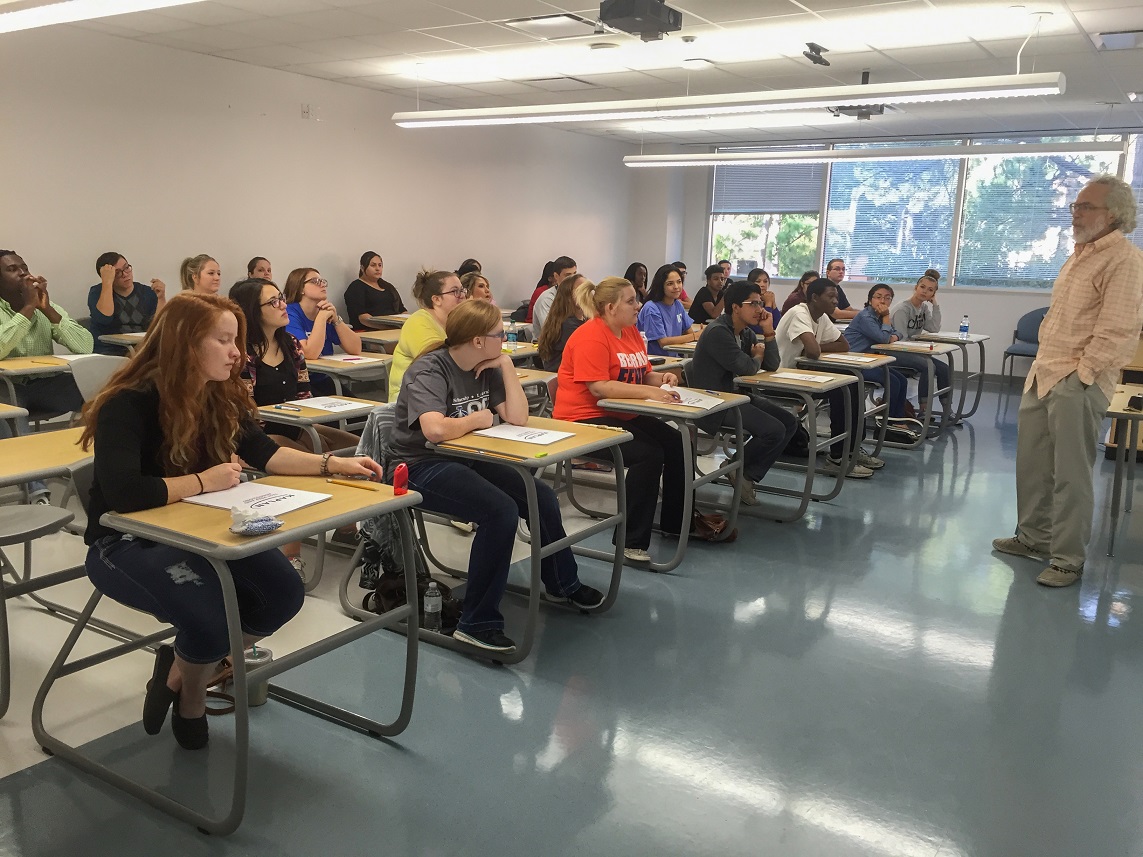
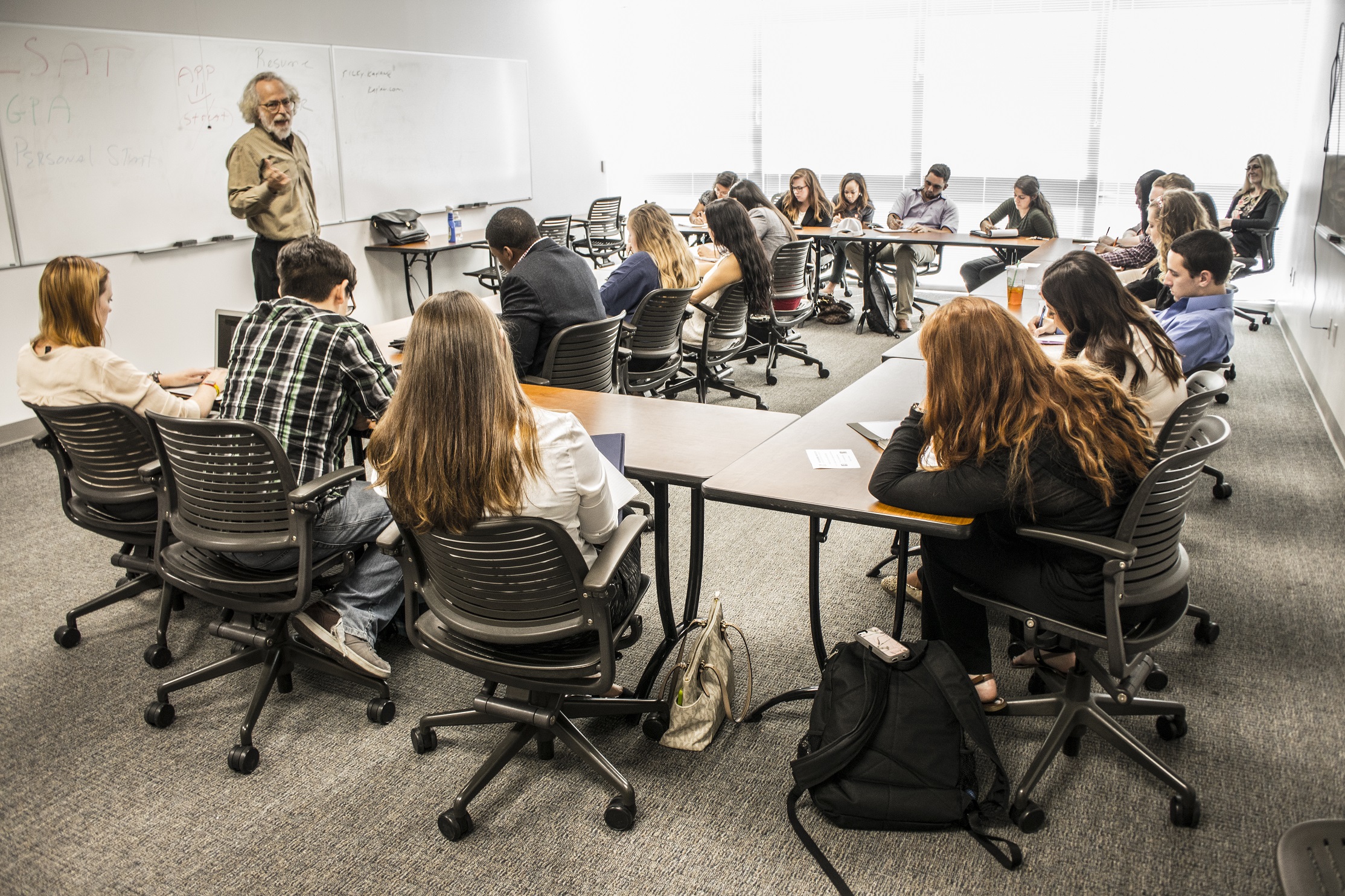
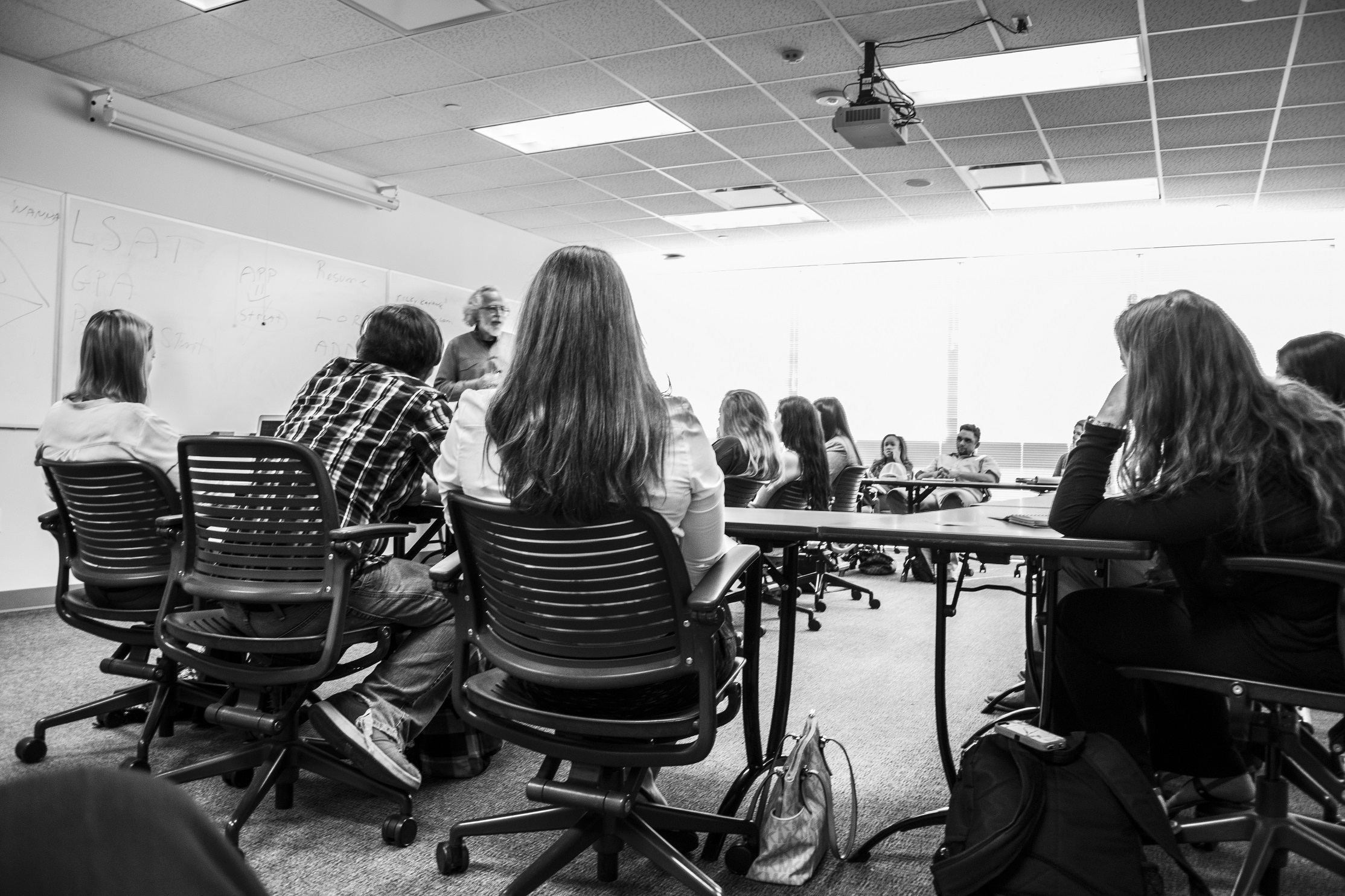
Twenty-five SHSU students just moved closer to enrolling in law school, thanks to an appearance by Ricky Kaplan at the LEAP Center’s first-ever “law-school workshop.” Kaplan, a consultant and instructor for Kaplan Testing, also served as Legislative Counsel for the state of Oregon, Assistant Attorney General for the state of Illinois, and Assistant Attorney General for the state of Texas. He also has a BA from U of Minnesota, a Masters from Northwestern, and a law degree from U of Minnesota. He knows about law.
And he shared it with SHSU students last week, kicking off the workshop with the major factors that law schools look at when deciding whether to admit a student. The factors are:
LSAT
GPA
Personal Statement
Letters of Recommendation
Resume
Background
He purposefully led with LSAT because, whatever its flaws, “it is the only measure the law schools have that is consistent across every student in the US, and it does a pretty good job of predicting first-year law school success.”
The LSAT and GPA guide students in which law schools to apply. If a law school, say Texas Tech, has a mean LSAT of 155 and a mean GPA of 3.4, then a student with a 156 and 3.5 is probably going to get in. A student with a 149 and a 2.9 probably won’t.
While the numbers for schools vary from year to year, the following numbers generally reflect the law-school “means” of Texas law schools:
While these two measures (LSAT and GPA) are the most important factors in getting into law school, the personal statements, letters of recommendation, and the resume can also make a difference in a close case. His advice for the personal statement was to be genuine, to emphasize narratives, and to emphasize the positives about yourself. When stuck with writer’s block, he encourages students to forget they are writing a personal statement and write four-five stories about their life. These often reveal something meaningful about the person and can subsequently form the basis of a compelling personal statement.
For personal statements, go with people who know you and your work. Professors are probably best, but for people out of college for several years, employers can write the letters. Avoid “friends of the family” or folks you think are important but aren’t directly familiar with your critical thinking, writing, and communication.
After arming us with advice, Kaplan took a break and then worked with individual students on their personal statements, answering questions about addenda to the applications, and how best to prepare for the LSAT.
Such advice may not get students into the University of Minnesota or Northwestern, but it will maximize the chances they have of getting into the best law school available to them.

 …coloring and art activities…
 …and a showing of “The Book of Life” for children.















 Center for Law, Engagement, and Politics