Skip to content

Center for Law, Engagement, and Politics

Leap At SHSU!

  • About LEAP
  • LEAP Ambassadors
Center for Law, Engagement, and Politics

Tag: TAMU

How to Catch a Spy: The Art and Future of Counter Intelligence with James Olson

by Makayla Mason

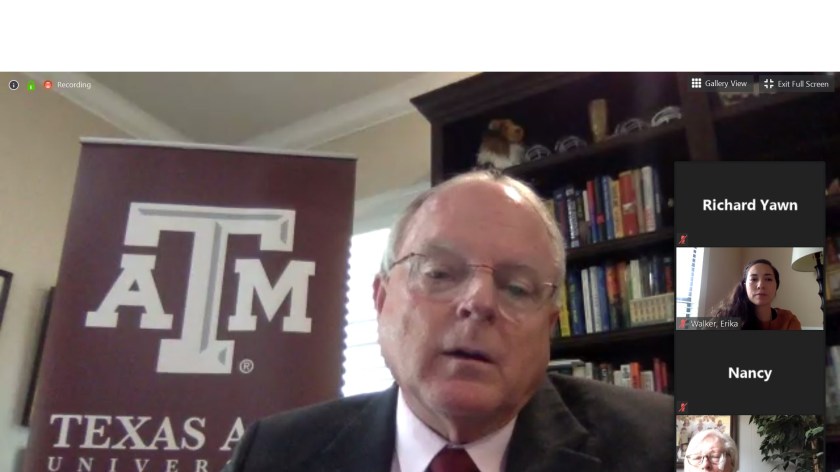
 I always enjoy and look forward to World Affairs Council events, but I was particularly excited about this webinar. I have been reading James Olson’s book Fair Play: The Moral Dilemma of Spying. and he has recently come out with a new book: To Catch a Spy: The Art of Counterintelligence. I have also had the opportunity to see Mr. Olson speak in person multiple occasions at the Texas A&M Bush School; I was even able to speak to him after an event a couple of years ago….

SHSU, LEAP Center, Center for Law Engagement And Politics, TAMU, World Affairs Council Houston, Jim Olson

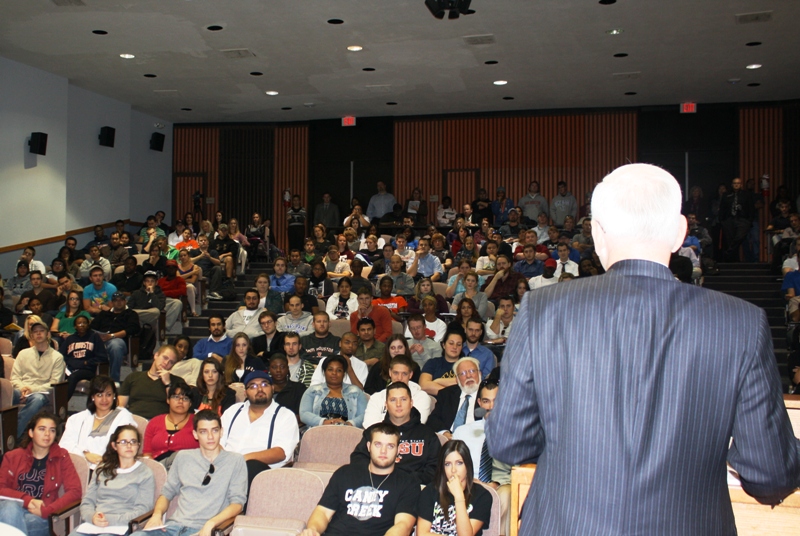
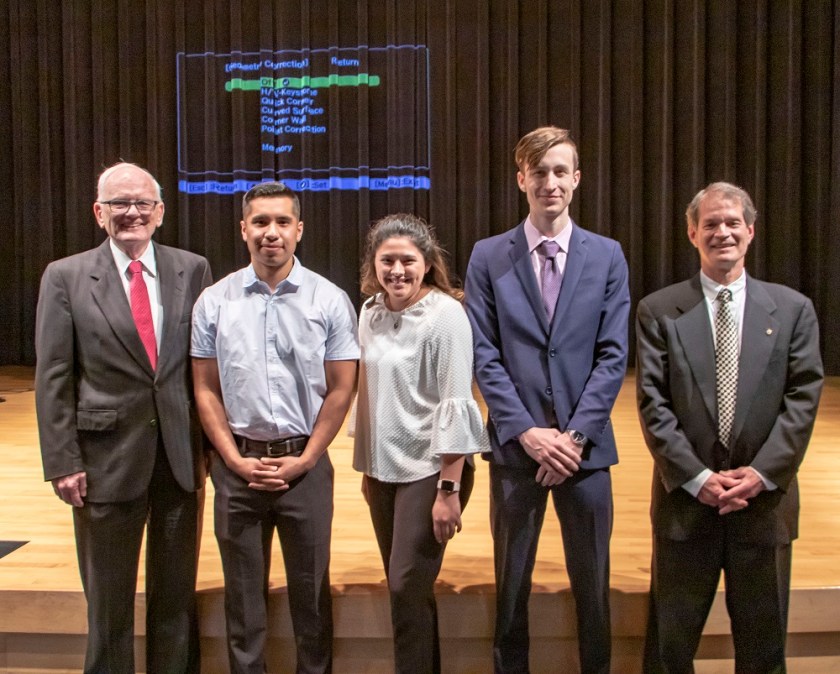
…and Olson was generous enough to come to SHSU and speak at a program hosted by LEAP–which resulted in a packed house.
SHSU, LEAP Center, Center for Law Engagement And Politics, Jim Olson, CIA, Spying

The webinar began with a brief introduction by World Affairs Council’s Sandjia Bayot.

SHSU, LEAP Center, Center for Law Engagement And Politics, TAMU, World Affairs Council Houston, Jim Olson

She informed us that over 700 people were registered for the event! She of course introduced the man of the hour, James Olson.

Mr. Olson served for over thirty years as the Directorate of Operations for the Central Intelligence Agency (CIA). He is currently a professor, teaching intelligence and counter intelligence, at the Texas A&M Bush School of Government and Public Service.

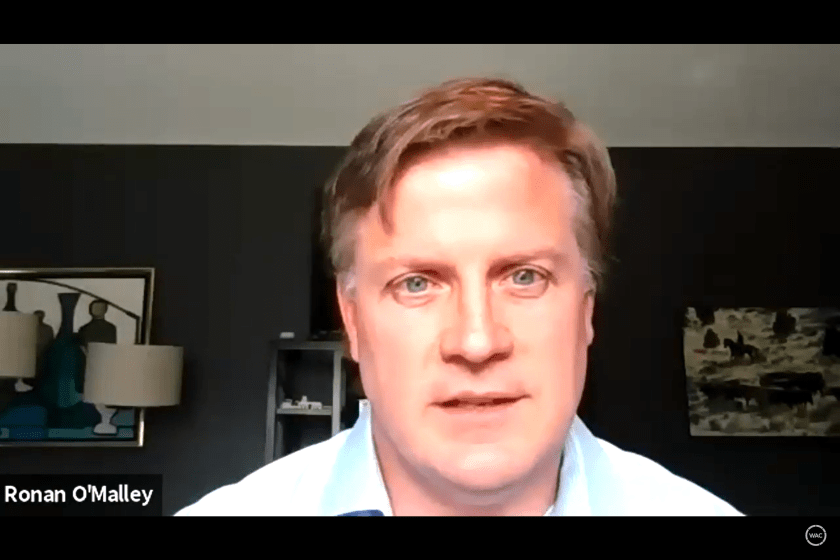
The moderator for the event was World Affairs Council’s Ronan O’Malley.
SHSU, SHSU, LEAP Center, Center for Law Engagement And Politics, TAMU, World Affairs Council Houston, Jim OlsonCenter, Center for Law Engagement And Politics, TAMU, World Affairs Council Houston, Jim Olson

Ronan dove right in, asking about the three most threatening nations to the United States: China, Russia, and Cuba, with a particular emphasis on China.

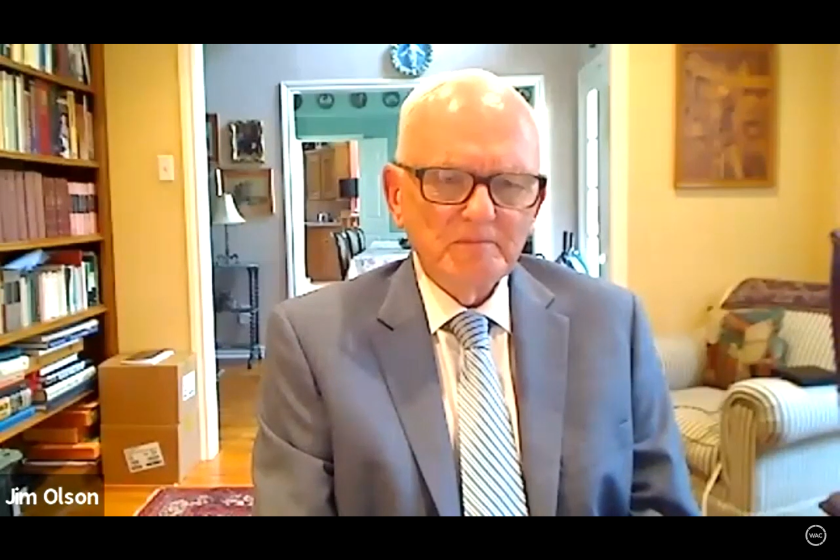
Professor Olson described China as having a level of threat higher than he has ever seen before. Stating that China is overwhelming our defenses and stealing anything that could benefit them in any way. It is cheaper for them to steal from us than come up with their own ideas. The biggest thing they are wanting to steal from us is our technology. We are currently losing this counter intelligence war.
SHSU, LEAP Center, Center for Law Engagement And Politics, TAMU, World Affairs Council Houston, Jim Olson

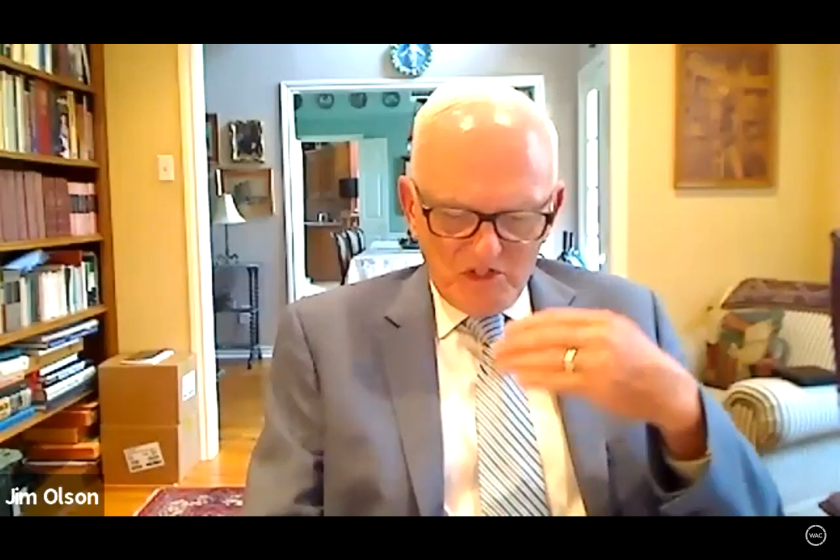
Mr. Olson then described how the Chinese use their exchange students aggressively to steal information. These students can get offers from high level jobs, receive green cards, and after 5 years of having a green card, can become citizens.  The Chinese Government then infiltrates these Chinese Americans and appeals to their sense of loyalty to their home country, sometimes leveraging the former students’ families (in China) to add additional pressure.
SHSU, LEAP Center, Center for Law Engagement And Politics, TAMU, World Affairs Council Houston, Jim Olson

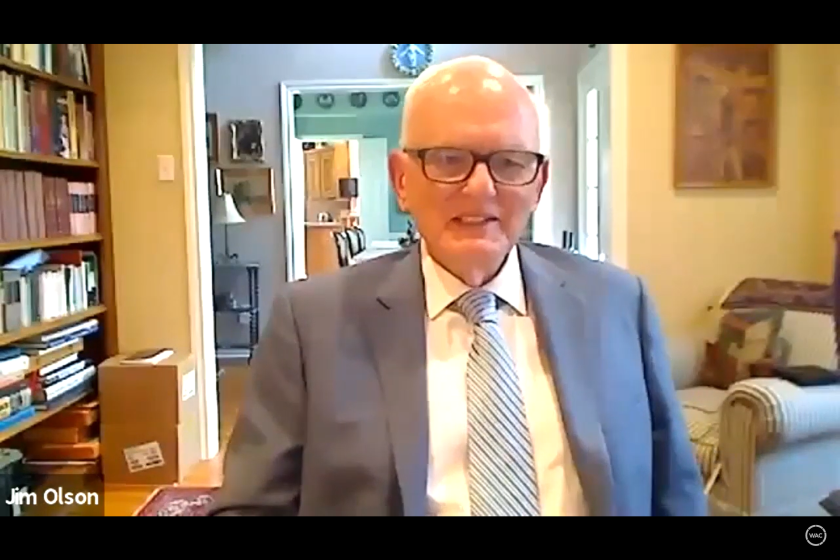
When asked what he would recommend to end the counter intelligence war with China, Mr. Olson said the most important thing to do is be offensive. We cannot sit back and try to protect our secrets. We need to have more frequent double agents. He stated that if he was still in-charge, he would flood China with double agents. The best counter intelligence is penetration, and double agents are gold in counter intelligence.
SHSU, LEAP Center, Center for Law Engagement And Politics, TAMU, World Affairs Council Houston, Jim Olson

The second threat is Russia.

Mr. Olson stated that there is more Russian spying now than during the Cold War and that Vladimir Putin is very interested in influencing our politics and our elections. In the 1950s, some Americans still shared Communist “ideals,” perhaps cultivated during the 1930s, during the Great Depression.  By the 1980s, however, agents who spied for Russia were doing so just for money, not for Communist ideals.

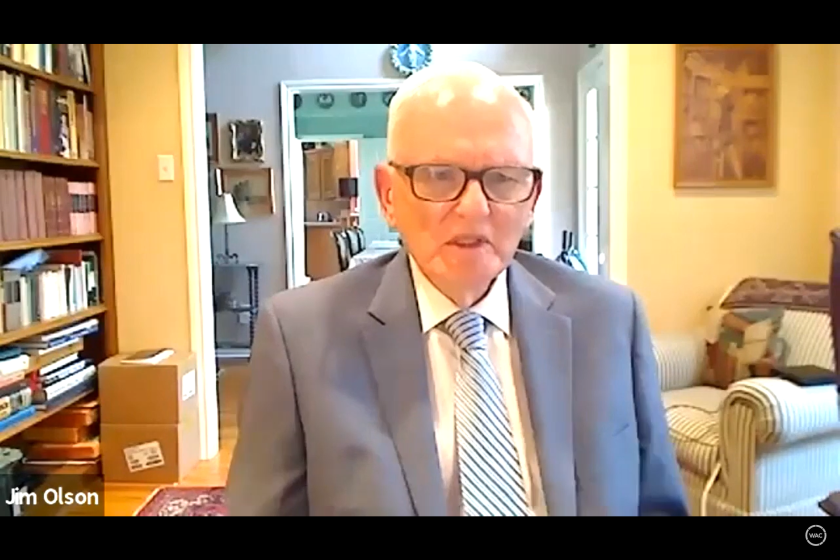
When discussing the cultural disadvantages that the US has compared to China and Russia, Mr. Olson stated that we have ethics and a high standard of proof to meet. The US cannot access any kind of employment records, financials, or physically surveillance of individuals until there is probable cause, and he is proud of that.
SHSU, LEAP Center, Center for Law Engagement And Politics, TAMU, World Affairs Council Houston, Jim Olson

The third threat to the US is Cuba, but Mr. Olson said he would rank Cuba as #1 in terms of “obnoxiousness.”

Mr. Olson described Cuba’s intelligence as better than the KGB’s and more disciplined. At the height of Castro’s power, Cuba had 38 Cuban double agents working against the US.
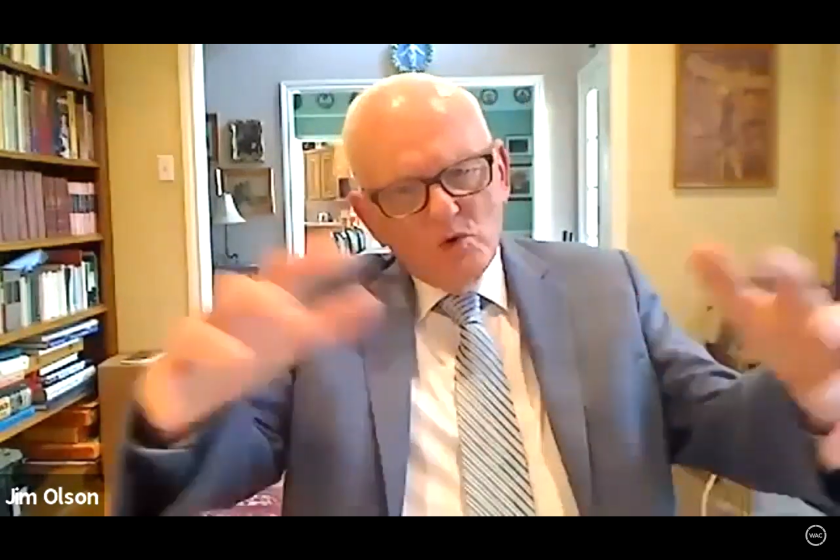
SHSU, LEAP Center, Center for Law Engagement And Politics, TAMU, World Affairs Council Houston, Jim Olson

Ronan then mentioned polygraph tests, which Mr. Olson very much favors. He sees polygraphs as quite useful in finding double agents, as well as for screening new employees. More individuals, he notes, are removed from the hiring process due to the polygraph than the background check. He admits that polygraphs are not perfect, but they are a valuable counter intelligence tool.
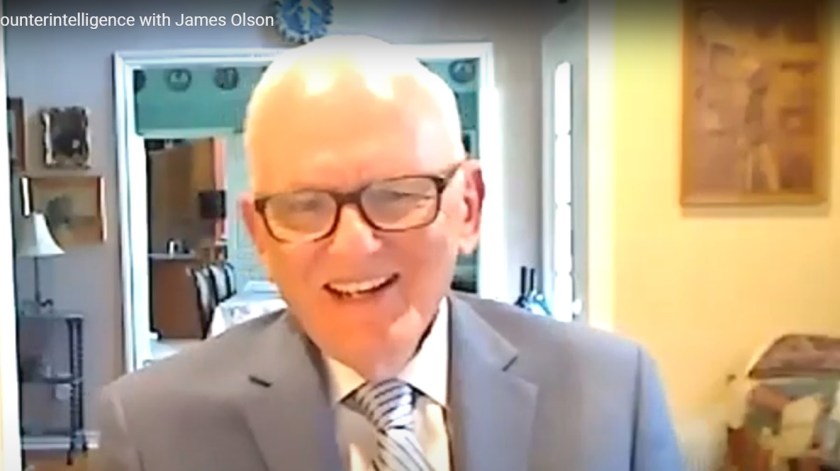
SHSU, LEAP Center, Center for Law Engagement And Politics, TAMU, World Affairs Council Houston, Jim Olson

Mr. Olson was asked what are some of the ideal qualities they are looking for in hiring federal agencies. He said the number one quality for federal agents and law enforcement across the board is character. He also finds it ironic that they hire people who are honest, reliable, and have good morals, but then train them to lie, cheat, and steal. We want people who know where the line is, and will do their job for the US, not against the US. If there are warning signs in the hiring process, he sticks with the motto: “When in doubt, keep them out.”

SHSU, LEAP Center, Center for Law Engagement And Politics, TAMU, World Affairs Council Houston, Jim Olson

As the webinar wrapped up, Mr. Olson had a few more things to say about spying: You have few friends in the intelligence world. Everyone spies on everyone. Everyone is in the business of stealing from America. Many countries who we consider allies have been caught spying on us. When you catch an ally spying on you, call them out, give them a slap on the wrist, but do not end the relationship.

Mr. Olson declared that his true love is spy catching, and that if he and his wife (who also worked for the CIA) could start all over again, they would get into the China program and learn Mandarin, because they are currently the #1 threat.

Mr. Olson ended the webinar by stating that the first line of defense is an informed public–which, as a former LEAP Ambassador, I agreed.
SHSU, LEAP Center, Center for Law Engagement And Politics, TAMU, Jim Olson


Unknown's avatarAuthor mikeyawnPosted on June 13, 2020June 13, 2020Format AsideCategories Civic Engagement, Civil Rights, PoliticsTags Center for Law Engagement And Politics, Jim Olson, LEAP Center, SHSU, TAMU, World Affairs Council HoustonLeave a comment on How to Catch a Spy: The Art and Future of Counter Intelligence with James Olson

Talking COVID with Dr. Gerald Parker

Dr. Gerald Parker is the Director of the Scowcroft Institute’s “Biosecurity and Pandemic Policy Program,” and he has served as the Deputy Assistant Secretary of Defense for Chemical and Biological Defense and as the Deputy Assistant Secretary for Preparedness and Response at the Department of Health and Human Services.  In short, he is qualified to discuss the Corona Virus, and that’s what he did last, giving LEAP students an opportunity to learn more about the public crisis that is, we hope, a once-in-a-lifetime event.

SHSU, LEAP Center, Center for Law Engagement And Politics, COVID, Coronavirus, TAMU, Bush School of Government and Public Service, Scowcroft Institute, Dr. Gerald Parker

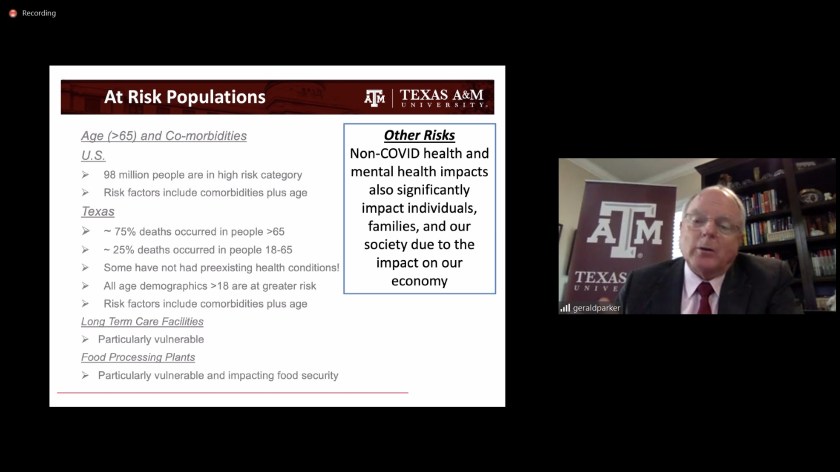
Dr. Parker began by giving an overview of the ever-growing numbers of COVID cases and deaths in the US.  He also pointed out the most common victims of the virus: (1) those over 65 (in Texas, 75 percent of those who die from the virus are 65 or older); (2) those with existing health conditions; (3) those in long-term care facilities (prisons and nursing homes); and (4) those in meat-packing plants.

SHSU, LEAP Center, Center for Law Engagement And Politics, COVID, Coronavirus, TAMU, Bush School of Government and Public Service, Scowcroft Institute, Dr. Gerald Parker

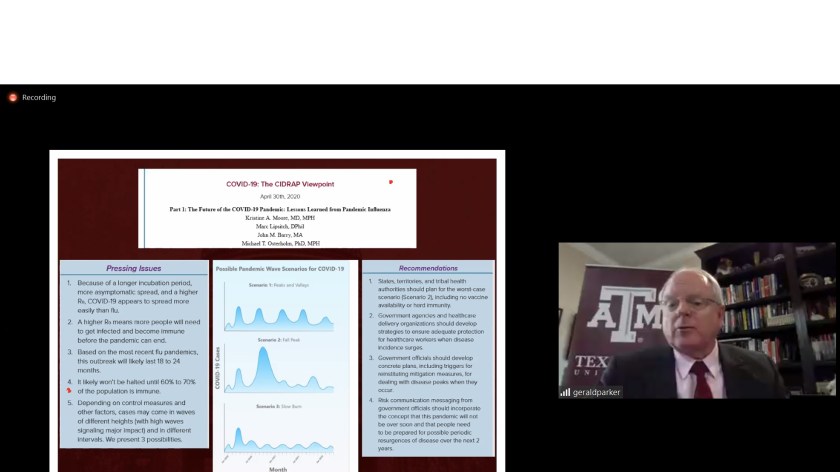
And while the US may have peaked–at least in its first wave–there are numerous possible scenarios for how this may play out.  The big takeaway, is that despite the re-opening, the virus threat has not passed.  Dr. Parker saw three possible future scenarios: (1) a series of peaks and valleys; (2) a second wave in the fall; or (3) a smaller fall peak, with continuing flare ups.  In many respects, the first of these may be the most difficult, at least in terms of planning.  Of course, a second large wave could also make for strains on the health-care system.

SHSU, LEAP Center, Center for Law Engagement And Politics, COVID, Coronavirus, TAMU, Bush School of Government and Public Service, Scowcroft Institute, Dr. Gerald Parker

To make re-opening successful, Dr. Parker advocated for: (1) getting up to speed on (a) contract tracing, (b) testing, and (c) identifying hot spots, so that additional steps can be taken in those areas; (2) continuing to practice social distancing and other common-sense measures; (3) ensuring our hospitals and other institutions are prepared should another major wave occur, which Dr. Parker thinks could be likely.

Dr. Parker’s program was educational, if sobering, and we look forward to future programs from the Bush School.


Unknown's avatarAuthor mikeyawnPosted on May 11, 2020Format AsideCategories Civic Engagement, Health, PoliticsTags Bush School of Government and Public Service, Center for Law Engagement And Politics, Coronavirus, COVID, Dr. Gerald Parker, LEAP Center, Scowcroft Institute, SHSU, TAMULeave a comment on Talking COVID with Dr. Gerald Parker

COVID-19 and the Food Supply Chain

With finals underway, our  numbers dwindle, but some hardy LEAP Ambassadors tuned in to the Bush School‘s/Scowcroft Institute’s weekly COVID-19 update, with this one focusing on the food supply chain.

Dr. Blackburn led off the show…

SHSU, LEAP Center, Center for Law Engagement And Politics, BUSH School of Government and Public Affairs, Scowcroft Institute, TAMU, COVID-19

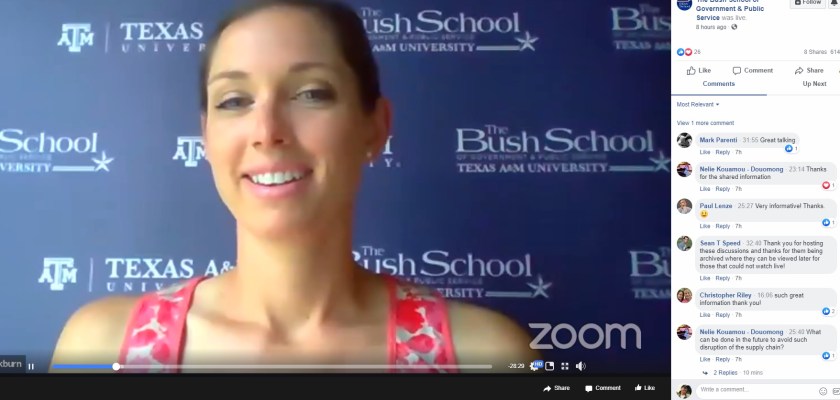
by introducing Brittany Segundo, a Fellow at the Scowcroft Institute specializing in supply chains (and a Ph.D. student studying engineering).   Segundo discussed meat products, and the spike in coronavirus illnesses among food workers.  This is largely a product of the lack of social distancing in the plants, but it’s also possible that the workers need the N95 Respirator masks instead of just the less stringent masks.

SHSU, LEAP Center, Center for Law Engagement And Politics, BUSH School of Government and Public Affairs, Scowcroft Institute, TAMU

Segundo stressed that there really shouldn’t be a substantive shortage. Rather, we might see a bit of a bump in prices and less variety.  Some stores might put a limit on the number of, say, meat packages a customer can buy, but that’s not because of a shortage.  It’s more to prevent a run on meats, much as there was over purchasing of toilet paper early in the pandemic.

SHSU, LEAP Center, Center for Law Engagement And Politics, BUSH School of Government and Public Affairs, Scowcroft Institute, TAMU, COVID-19

Another factor is that with the government shutdowns, the demand for many agricultural products has dropped, leading to reports of farmers ‘dumping’ some of the produce.  Some have asked, “Why can’t those food items be donated to non-profits and food banks?”  One of the reasons for this is that it costs a lot of money to re-distribute those items to new locations and, often, in new packaging.  Suppliers who are already losing money cannot readily incur additional costs associated with the logistics of donating to new venues.

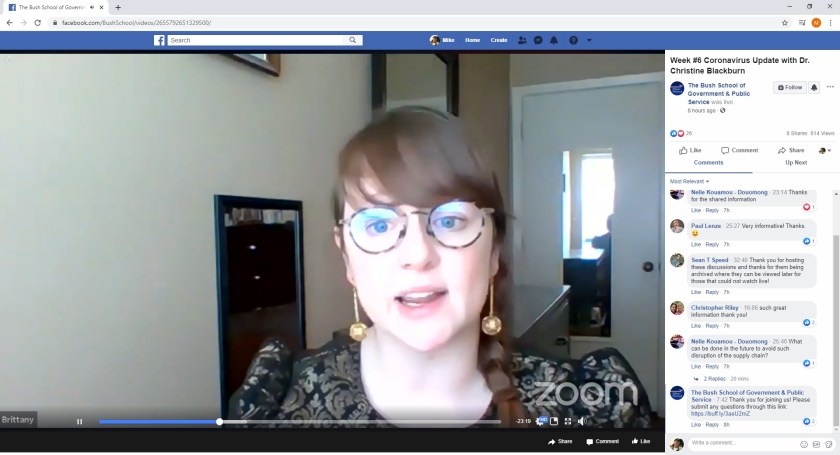
Dr. Christine Blackburn then stepped in to discuss the effect of COVID-19 on high-value commodities0–fruit and vegetables and other items that are labor intensive to harvest.

SHSU, LEAP Center, Center for Law Engagement And Politics, BUSH School of Government and Public Affairs, Scowcroft Institute, TAMU, COVID-19

One difficulty there is that the labor for these products often comes from international sources.  These workers are often either undocumented or require H2A visas, and, because of COVID-19, fewer of these visas were issued this year.  This has resulted in a reduction of labor.

Additionally, many of these workers live or work in tight spaces, making social distancing difficult.  This results in a higher rate of absenteeism, another factor impeding production and distribution. So, for consumers, we may see higher prices and more limited products, but the real impact will be on farmers and those who work for farmers, whose incomes are being affected.

Blackburn and Segundo then took questions.

SHSU, LEAP Center, Center for Law Engagement And Politics, BUSH School of Government and Public Affairs, Scowcroft Institute, TAMU, COVID-19

One important question involved whether we are any closer to achieving “herd immunity”?  This is a difficult question, and according to Dr. Blackburn, we still don’t know if having the disease produces immunity. If it doesn’t, then we won’t achieve herd immunity.  If it does, the medical community will need to determine how long the immunity lasts.  Additionally, it’s possible that a certain amount of antibodies are needed to achieve immunity, and the tests may not be sufficiently sensitive to determine this.  Finally, there is the issue of false positives.  If the false positive rates are high, then you have people who think they are immune, but aren’t actually immune. That makes them more vulnerable for future infections.

The big question was: is this the right time for the shutdown to end?  Dr. Blackburn struggled with how to answer this, noting that the answer to this depends on factors relating to health, economics, and social aspects of our lives. She also mentioned that she has friends who are out of work, parents struggling with children at home, and she understand the impact of the shutdown.

SHSU, LEAP Center, Center for Law Engagement And Politics, BUSH School of Government and Public Affairs, Scowcroft Institute, TAMU, COVID-19

But looking at it from a health-only perspective–from a “disease-containment standpoint,” as she said it–“now is not the right time” to end the shutdown.  Blackburn noted that Texas has an increase in cases over the past two weeks, and she expects in 3-4 weeks, we’ll see much larger numbers of cases in Texas, and 3-4 weeks after that, we’ll see a larger number of deaths.

She further pointed out that different specialists look at different areas: economists look at the economic impact of a government shutdown and/or disease; health experts look at the health impact.  Elected officials have to weigh those and make good decisions.


Unknown's avatarAuthor mikeyawnPosted on May 6, 2020Format AsideCategories Civic Engagement, Food, PoliticsTags Bush School of Government and Public Affairs, Center for Law Engagement And Politics, COVID-19, LEAP Center, Scowcroft Institute, SHSU, TAMULeave a comment on COVID-19 and the Food Supply Chain

COVID-19 at the Local Level

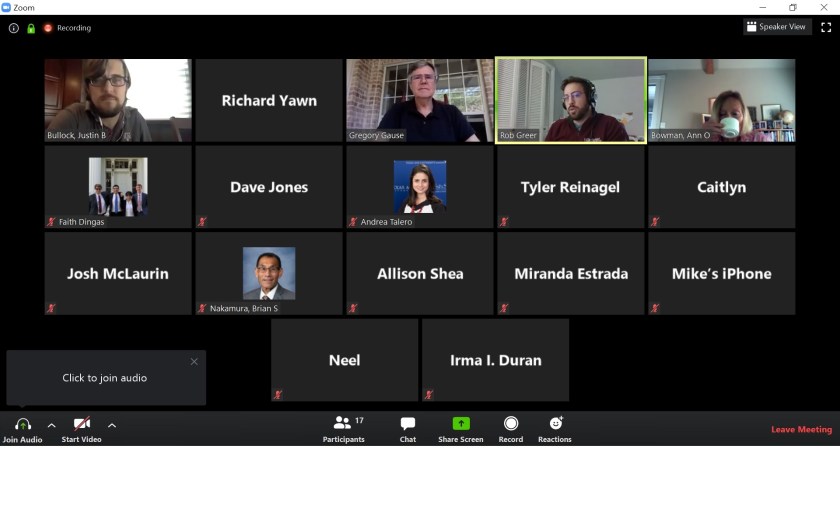
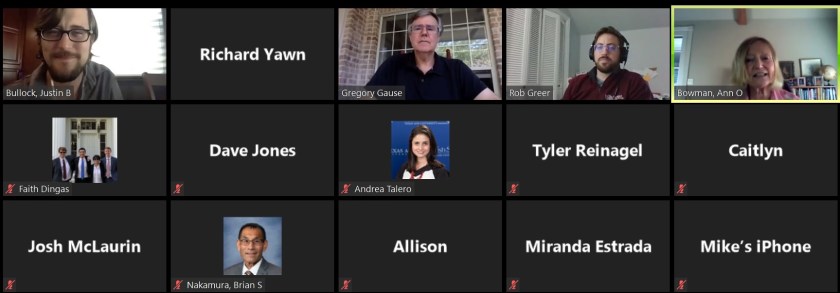
If there’s one thing we’ve learned about a pandemic, it’s that it hits every level of government.  So the Bush School at TAMU hosted experts on local government in the latest episode of “Uncorked:” Dr. Ann Bowman and Dr. Robert Greer.  As usual, the program was hosted by Justin Bullock and Dr. Gregory Gause.

SHSU, LEAP Center, Center for Law Engagement And Politics, COVID-19, TAMU, Bush School Uncorked, Dr. Ann Bowman, Dr. Robert Greer, Justin Bullock, Dr. Gregory GauseThe panel got into more politics than usual this time, but they still managed an informative session, focusing on the impact of the COVID-19 pandemic on local and state governments.

As Dr. Greer noted, the pandemic has hit local and state governments in two ways: (1) rapidly rising costs, and (2) decreased revenues.  For states such as Texas–which, with no property or income tax, relies heavily on sales tax–the decline in revenue is especially severe.

Right now, researchers have projected that state governments will face a shortfall of 500 billion dollars.  Although many states have a rainy-day fund, even fully suing this fund would leave a shortfall of 360 billion dollars, and this shortfall is before many of the costs of COVID are factored in.  So, clearly the states are in a fiscal jam.

When states and municipalities face challenges, the US economy faces challenges.  When there is a budget shortfall, states and localities layoff workers and, as Dr. Greer noted, about 13 percent of the US workforce is made up of state and local workers.

SHSU, LEAP Center, Center for Law Engagement And Politics, COVID-19, TAMU, Bush School Uncorked, Dr. Ann Bowman, Dr. Robert Greer, Justin Bullock, Dr. Gregory Gause

So, what can the federal government do?  All agreed that a unified, consistent message would be helpful.  They also seemed to agree that the CARES act, which provided assistance to local and state governments, as well as large and small businesses, was a step in the right direction.

SHSU, LEAP Center, Center for Law Engagement And Politics, COVID-19, TAMU, Bush School Uncorked, Dr. Ann Bowman, Dr. Robert Greer, Justin Bullock, Dr. Gregory Gause

Additional funds will be needed, and where that money goes and how it will be allocated were concerns.  Greer mentioned money to the unemployed–of whom there are now record numbers–is a good way to pump the economy.  With little or no income, these workers will spend the money they receive, which multiplies through the economy.

The panel also responded to audience questions, at least one of which asked about the food supply.  This was a particularly timely question, inasmuch as Tyson has had to shut down several plants owing to large numbers of employees falling prey to the COVID virus.  At this point, the meat supply to the nation has dropped precipitously: production of pork, beef, and chicken, has fallen 30 percent, 15 percent, and 10 percent, respectively.  While this shortfall has yet to hit the stores (because of existing stockpiles), it will hit soon.  Indeed, today, President Trump indicated he would invoke the Defense Protection Act and order those plants to remain operational.

SHSU, LEAP Center, Center for Law Engagement And Politics, COVID-19, TAMU, Bush School Uncorked, Dr. Ann Bowman, Dr. Robert Greer, Justin Bullock, Dr. Gregory Gause
While Trump’s decision was, obviously, a federal action, cities, counties, and states play a role, too.  Most of our food inspection, for example, is done at the local level and, of course, the labor pool comes from cities and counties across the country.  In the case of these meat plants, the labor pool comes often from small cities and counties, where the meat plant may be a primary employer.

This is a new angle to the COVID-19 pandemic, one not much covered by the national media but, arguably, more important than the topics that are often covered.  In short: it was another educational program hosted by the Bush School at TAMU.


Unknown's avatarAuthor mikeyawnPosted on April 29, 2020Format AsideCategories Civic Engagement, Jobs, PoliticsTags Bush School Uncorked, Center for Law Engagement And Politics, COVID-19, Dr. Ann Bowman, Dr. Gregory Gause, Dr. Robert Greer, Justin Bullock, LEAP Center, SHSU, TAMULeave a comment on COVID-19 at the Local Level

LEAP Ambassadors Are Involved!

This slideshow requires JavaScript.

Follow Us On Facebook!

Follow Us On Facebook!

Catch Up With Us

  • A M*A*S*H* Wrapup December 24, 2025
  • Understanding Globalization: Lessons from a Leading Journalist December 22, 2025
  • Crafting for a Cause December 18, 2025
  • Exploring The Shining: A Kubrickian Journey December 15, 2025
  • Interactive Experiences at Asia Society Texas: A Student’s Perspective December 14, 2025

Join The Conversation!

The Civic Leadership… on Foundational Activities of the…
The Civic Leadership… on The Philosophical Foundations…
LEAPing Into Action… on The Philosophical Foundations…
Jada Cook's avatarJada Cook on SHSU Students LEAP Across Five…
Reflections from the… on Kicking off the Semester Right…

Find Previous Posts

Fun parts of preparing for an office anniversary: working with these three. True story: @megface purposefully composed this photo so that Professor Yawn was most near the ‘ol’ in the sign.

We also have Twitter!

My Tweets

LEAPing Into LEARNing

This slideshow requires JavaScript.

  • About LEAP
  • LEAP Ambassadors
Center for Law, Engagement, and Politics Blog at WordPress.com.
  • Subscribe Subscribed
    • Center for Law, Engagement, and Politics
    • Join 487 other subscribers
    • Already have a WordPress.com account? Log in now.
    • Center for Law, Engagement, and Politics
    • Subscribe Subscribed
    • Sign up
    • Log in
    • Report this content
    • View site in Reader
    • Manage subscriptions
    • Collapse this bar
 

Loading Comments...