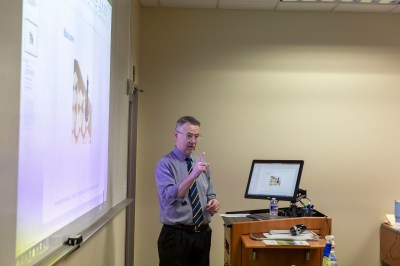
Mike Yawn teaches at Sam Houston State University. In the past few years, he has taught courses on Politics & Film, Public Policy, the Presidency, Media & Politics, Congress, Statistics, Research & Writing, Field Research, and Public Opinion.
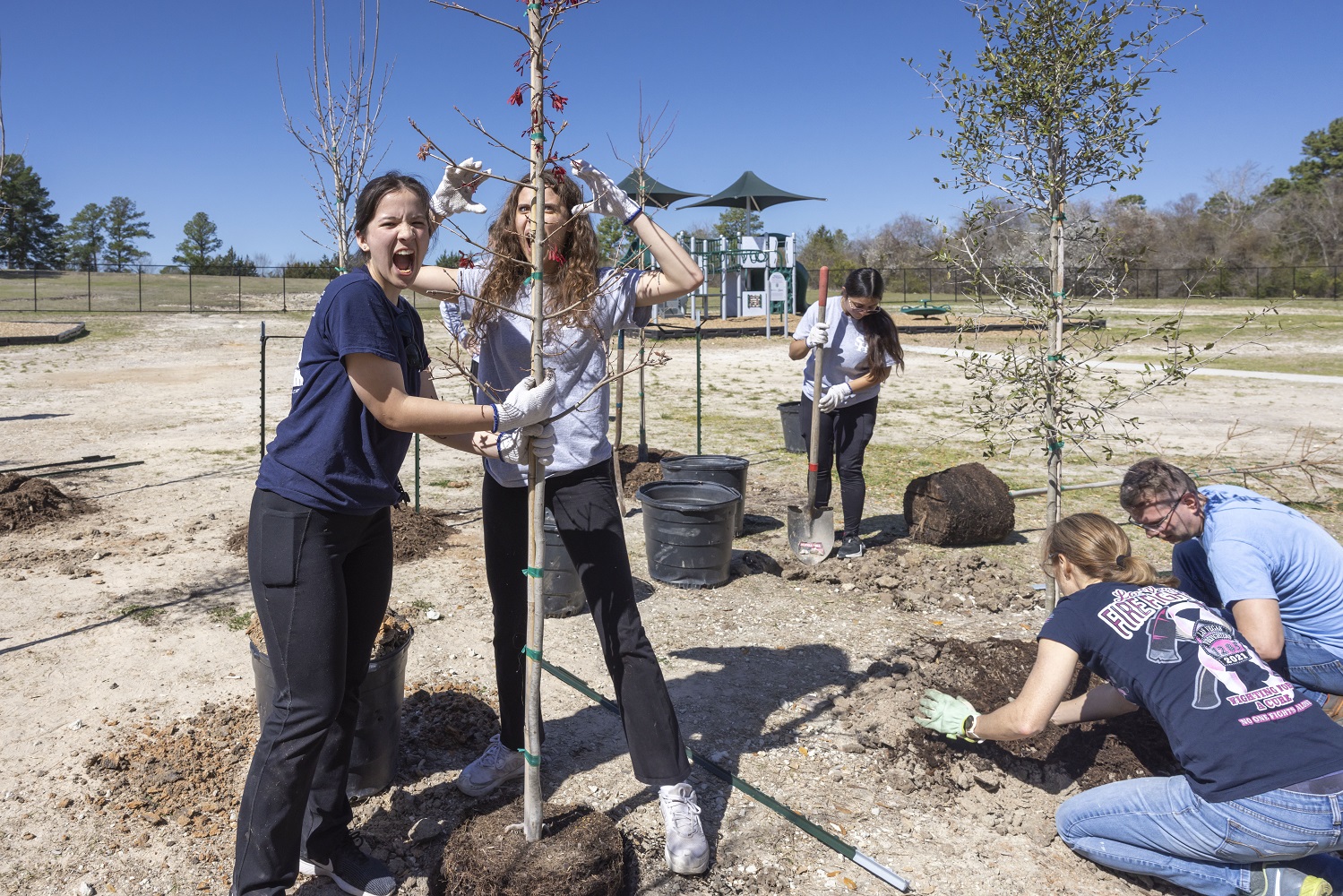
He has published academic papers in the Journal of Politics, Political Behavior, Social Security Quarterly, Film & History, American Politics Review, and contributed a chapter to the textbook Politics and Film.
He also contributes columns, news analysis, and news stories to newspapers such as the Houston Chronicle, San Antonio Express News, Seattle Post-Intelligencer, Stamford Advocate, Greenwich Time, Huron Daily Tribune, Laredo Morning Times, Beaumont Enterprise, Connecticut Post, and Midland Reporter Telegram.
Yawn is also active in his local community, serving on the board of directors of the local YMCA and Friends of the Wynne. Previously, he served on the Huntsville's Promise and Stan Musial World Series Boards of Directors.
In 2007-2008, Yawn was one of eight scholars across the nation named as a Carnegie Civic Engagement Scholar by the Carnegie Foundation.
Following our adventure at Great Sand Dunes National Park, we made it back to the tip of the Texas Panhandle: Dalhart, TX. Our goal for today, was to get to Amarillo, then to Canyon, TX, and make our way to Oklahoma City. It was–both literally and figuratively–a whirlwind visit. We literally saw our first-ever tumbleweeds.
Cadillac Ranch
As we approached Amarillo well before noon, we stopped at Cadillac Ranch, a unique art installation. We had never seen it before, and what a sight!
Some nice people visiting loaned us some spray paint, and we left our mark!
It was a nice stop amidst the flat Amarillo landscape, made much more colorful by art.
Panhandle Plains Museum
Located on Texas A&M’s West Texas campus, the Panhandle-Plains Historical Musuem. Within the largest history museum in Texas, we had the ability to outline Texas history from indigenous settlement and conquistadors to where we are today.
A collection that served as a great conversation starter was ‘High Fashion to the High Plains’. Here we found an extensive wardrobe from high fashion designers such as Chanel and Emilio Pucci that are representative of the fashions of West Texas over time.
While this is a West Texas museum, we were most enthused with the East Texas representation in their ‘Art of Texas State Parks’ collection!
We saw artist and friend Lee Jamison’s work in the museum’s collection. While we are huge fans of all of Mr. Jamison’s paintings, our favorite one from the museum was of the Grave of Hubris, San Jacinto Battleground State Historic Site.
I thoroughly enjoy the vibrancy of the landscapes Mr. Jamison creates, whether or not the scene itself is particularly bright. His paintings serve as a reminder to appreciate even the most simple of your surroundings, as there is an innate intricacy to each of them.
Palo Duro State Canyon Park
On such a fitting note, we ventured to the Palo Duro State Canyon Park to capture the scenic views on our last outdoors trek of the trip.
It may be sheer coincidence, but we truly saved the best hike for last! There was truly so much to see while on this short trail, with a different vista under a beautiful sky at almost every turn.
Maybe it was the fact that we had previously been immersed in scenes covered in pillowy white snow, but there was something awe-inspiring about looking over the cliff to see the red-casted landscape.
Photo by Olivia Discon
We explored far more than we anticipated we would, walking out to every outcrop…
Cinthia Villarreal Enjoys the View (not so much the wind); Photo by Olivia Discon
…looking over ledges…
Photo by Cinthia Villarreal Carrillo
…and climbing as many hills as possible.
We did our best to soak it in…
Photo by Olivia Discon
…and explore the area they call “The Grand Canyon of Texas.”
In fact, we didn’t really want to leave, but we wanted to get one more hike in, so we returned to the car.
Our last hike was the “Hole in the Wall Trail,” so named for obvious reasons!
This short hike involved a walk up to a cave. Although short, it was a somewhat rugged walk, and it was also filled with colors and different types of rocks.
The area immediately outside the cave offered interesting views of the landscape.
Photo by Olivia Discon
In the cave were three different holes in the top, and these looked intriguing to us–so much so that we found a way up to the to the top of the hill.
Olivia: “I don’t think I like this.”
We made it to the top after much climbing and scrambling, and climbed a way into the hole.
We also got interesting photos through the hole, from our vantage point!
Photo by Cinthia Villarreal Carrillo
I may have been a bit apprehensive to make the climb, but Cinthia was a voice of encouragement (or perhaps she was just more confident than I), and we made it to safety.
While we already live and learn in the great state of Texas, this was a completely new and refreshing day for everyone. However, it was not time to turn back home just yet! We packed our bags and headed towards the last state of our Southwest tour, Oklahoma.
Heading into the third state of our Southwest road trip, we knew exactly how to spend our time, starting with a hike at Zapata Falls! After our short hike at Sun Mountain, we now consider ourselves hiking aficionados.
As we embarked on our short but rewarding hike, Colorado’s natural landscapes rewarded us every step of the way by providing beautiful views of snow, forests, and mountains.
The hike consisted of roughly one mile covered in snow and ice. For our final approach to the waterfall, we made our way along a frozen river, which we traversed gingerly.
Walking deeper into the creek and on top of a few rocks, we were able to witness the power of nature. The delicate, yet forceful-looking waterfall captivated all of us, leaving us with no words. In fact, both Olivia and I audibly gasped at the sight of it.
Being even more adventurous, we decided to carefully climb a step of the river into a magnificent cave where we could see the whole waterfall. Witnessing the power and beauty of nature startled us. The waterfall, once loud and unstoppable, stood still and completely frozen in time.
Great Sand Dunes National Park
After the one-of-a-kind adventure, we headed to the Great Sand Dunes National Park. This was first time Olivia or I had ever visited a national park; to say we were excited would be an understatement.
We had to stop at the Visitor Center to buy souvenirs–and even our own National Parks Passport, which we stamped with a seal provided by the center.
As we walked over to the dunes, we realized that the small-looking hills we saw on our way were misleading. The dunes were hundreds of feet high, and they towered over us.
With some determination, lots of doubts, and a huge amount of persuasion from Professor Yawn, Olivia and I walked one dune after another, getting higher and higher each time.
This was a true test of our endurance since our feet kept digging into the sand…
….with each step we took which would make us take even more steps and consequently tire us even more. But getting to the top also made us feel something like champions!
We made sure to capture the moment.
Despite the unanticipated workout, we were overwhelmed by the magnificent features the dunes possessed, how thin coats of snow would rest them, and the golden, transcendental-like appearance the light of the sun would give it.
As we started the long walk back to the car, the wind picked up to about 40 miles per hour, and, even though we were as cold as we had ever been, we were mesmerized by the way the snow would dance with the breeze on top of the sand, making patterns and moving through waves like it knows exactly what it is doing.
With sand in our shoes and frostbite on our faces, we were able to close out another successful day of firsts for us.
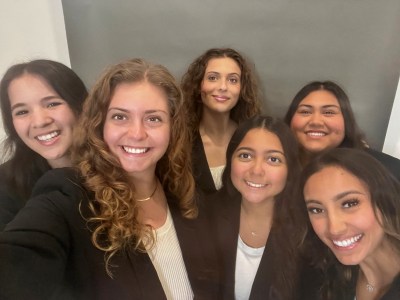
As LEAP Ambassadors we have been on a mission to get to know Huntsville better and have expanded our knowledge by visiting its various businesses and attractions. This month we decided to tackle the one aspect of Huntsville we hadn’t really explored; it’s delicious food. Therefore Olivia, Jessica, Cinthia, Allie and I set forth on a mission to find a delicious restaurant for lunch: Sandra’s Kitchen!
Sandra’s Kitchen definitely surpassed all of our expectations with its delicious Mexican cuisine. Located on 12th Street, Sandra’s Kitchen has proved to be very popular amongst the Huntsville community with its colorful decor, wonderful food, and amiable staff.
As soon as we walked in the door we were greeted with warm welcomes and smiles from all the staff. We were quickly seated and presented with baskets of warm chips and salsa which were gone in a matter of minutes. After reading their delicious menu for a couple of minutes we all finally decided on our main entrees for the afternoon. Jessica and Olivia both had the quesabirria tacos with a side of delicious beans consome for dipping. Allie had the chicken quesadilla and Cinthia the classic fajita burrito. I opted for another classic, the 3 fajita tacos platter, served with a side of beans and rice.
It is safe to say we all enjoyed our meals judging by all the empty plates at the table. We were all extremely satisfied and pleased with our service. This little restaurant proved to have big character and most importantly delicious food! This place is perfect for a nice hot freshly cooked meal that can sometimes be hard to obtain as college students. Its cuisine reminded me a lot of home and its aura is simply spectacular. Sandra’s Kitchen is the perfect place to see some of the delicious and diverse cuisines in Huntsville!
While our time in Taos was brief, we wanted to maximize our chance to photograph the famous San Francisco de Assisi Mission. Upon arriving last night, we left our hotel–in temperatures of about eight degrees–to photograph the famous mission.
Construction began in the late 18th century and was completed in 1816. The Spanish settlements featured key aspects of their mission and culture, with churches being centrally located within a plaza that was easy to defend.
Although the Mission has been endlessly photographed and painted, we haven’t seen a lot of night scenes. Part of that may be that, as we found out, is that it is difficult to photograph at night.
To the extent that the temperatures and light allowed, we did our best to photograph the building. With the many lights in the front of the building, we were drawn to the building’s rear, with its beehive buttresses and intriguing contours.
Photo by Olivia Discon
I was able to get a night shot, without some of the distracting street lights. But these lights did drown out some of the stars that we would have liked to have seen.
Fortunately, we were able to try again early the next day, just as it was being touched by the morning sun. Having the chance to view this structure in two different capacities was not only exciting to witness, but also to photograph!
Cinthia and I got the chance to be creative and capture our separate perceptions of the church and how it interacts with its landscape.
Photo by Cinthia Villarreal Carrillo
Intriguingly, the community meets every June to use a mixture of mud and straw to repair the exterior adobe. Seeing the structure in person, it’s easy to see why the community is attached to it–and why tourists, such as us, flock to it.
Photo by Cinthia Villarreal Carrillo
It’s also easy to see why artists and photographers flock to it. In fact, several people we spoke with described it as one of the most photographed churches in the United States.
San Francisco de Assisi, by Ansel Adams
That is certainly evidence from the different art galleries and museums we visited!
San Francisco de Assisi, by Georgia O’Keeffe
It was, in short, a beautiful way to end our time in New Mexico!
With an impending departure from Santa Fe looming, we wanted to get in one more experience: a hike. We had considered the challenging Picacho Peak and the easy Hondo Arroyo, but we opted for a middle option.
Sun Mountain Trail is listed as a 1.6-mile round trip hike that is still challenging–a function of its 734 feet elevation gain.
And from what we’ve read, the hike offers impressive views from the top of the trail.
The hike begins in a semi-residential area, and it soon grows steep.
For Texans such as ourselves, the thin air is a challenge. Denver may be famous as the “mile-high” city, but Santa Fe is a 1.4 miles above sea level. Houston, by comparison, is about 50 feet above sea level, so between the exertion and the thin air, we were breathing heavy.
Photo by Olivia Discon
Stopping for breath had other virtues.
The trail wends its way up the mountain, offering periodic views of the community below, the mountains on the horizon, and the snow that had recently blanketed the area.
As you approach the top, you go through a series of switchbacks which can be difficult, but which offer even better views.
As you might imagine, it’s windy at the top, but it’s beautiful, especially at sunset.
Photo by Cinthia Villarreal Carrillo
It was cold, but we stayed in the wind and cold so we could see the sun drop below the horizon, soak in the blue hour, and enjoy the feeling of accomplishment. For Cinthia and Olivia, this was the highest elevation ever reach: 7,920 feet.
It was, we decided, a great vantage point from which to say au revoir to Santa Fe, knowing we will be back one day.
In our first week back in class, we felt compelled to start the Spring semester off with our favorite way to learn about the state of global politics, the World Affairs Council of Greater Houston. This evening, we had the pleasure of hearing from Yaroslov Trofimov, a chief foreign affairs correspondent at the Wall Street Journal. Born in Ukraine, Trofimov not only has a seasoned perspective as a journalist, but a personal understanding as a Ukrainian.
Moderated by Ronan O’Malley, the discussion began with this complex duality of Trofimov’s insights on the Ukraine War. As a correspondent on world affairs, Trofimov’s position requires an objective, multifaceted perspective when educating the public. As a Ukrainian, however, he must consider how his family and culture is to survive the present.
The Ukraine War has been a hot-button topic in United States’ politics, mostly concerning whether the U.S. should financially support Ukraine in their efforts to fight off Russia or not. Trofimov’s key argument, shared by the Americans who support Ukraine in their efforts against the Putin regime, is that this war does not exist alone, but is in fact completely representative of democracy everywhere. He closed his response with a quote that deeply resonated with us: “We are fighting this war so you (Americans) don’t have to”.
Though this war has resulted in numerous casualties, Ukrainians still hold onto a fierce hope that they will persist against what appears to be insurmountable odds. “Russia’s propaganda is stronger than Russia’s army”, Trofimov remarked.
While Jessica has just started her last semester at Sam Houston, this was her first time at the Junior League of Houston. This building’s interior design is reminiscent of the Victorian era, and its elegance and vibrancy is mesmerizing to both newcomers and those who have visited previously. We left Houston as we do after most WAC events; with new perspective, great discussion, and a diversified understanding of the world around us.
Although it was our last day in Santa Fe, it was a day packed full of eclectic adventures and learning. On tap: A tour of the New Mexico Capitol building; a tour of Allan Houser’s art studio; and a hike up Sun Mountain.
After some coffee at CrashMurderBusiness, we headed to the Capitol, where Marylynn Collins was waiting to educate us on the workings of the New Mexico government.
As aspiring participants in Sam Houston State University’s SHAIP program (where students are placed in legislative offices in the TX Capitol), this was of particular importance to us. Cinthia and I have been to 5 Capitol buildings between the two of us, so this visit allowed us to compare how the New Mexico Capitol compares to other states.
Mrs. Collins started the tour by taking us to the center of the capitol’s rotunda. In contrast to most other state capitol buildings, the New Mexican capitol is shaped in a circular manner and has no dome. The reason, Mrs. Collins explained, is to signify the circle of life portrayed in the Zia symbol. The roof of the rotunda is intricately done with stained glass, the shape of which signifies a pueblo basket and the orange and blue colors signify the earth and sky.
The Zia symbol was adapted by the New Mexican people from the Zia Pueblo tribe and, as mentioned above, it portrays a circle in the middle with four sets of four lines coming out of the circle in four different directions. Each of the sets are symbolic in four different capacities: the four seasons of the year (Spring, Summer, Fall, and Winter), the four stages of life (infancy, youth, adulthood, and old age), four times of the day (dawn, daylight, dusk, and dark), and the four cardinal directions (north, south, east, and west). The symbol is also portrayed in the state flag is seen and used throughout the state.
Something that also sets this state apart is their official state question, “Red or Green?”. This was strange to us before the trip, but New Mexico is very fond and proud of being the home of the green and red chile, which is deeply engraved in their state’s culture and which we have had the opportunity to try in a variety of dishes and restaurants along the trip. Mrs. Collins also mentioned that this is the only state with an official scent; an aroma of roasting green pepper in the air.
We then stepped into the second floor of the “Round House” where we were able to admire the huge permanent collection that filled the walls. Consisting of work from regional artists with different styles and techniques, the paintings, even though completely contrasted one to another, represent the state’s cultures throughout the centuries. While admiring the art work, we were able to see some new artists and also recognize some of the artists we have been learning about, our favorite being Anderson’s “Canyon Segundo”…
Unfortunately, we had to rush from our capitol tour to get to our next stop: Allan Houser’s studio. Even more unfortunately, we learned that because of the massive amounts of snow that had fallen, the Houser Studio was cancelling the tour. But, ever resourceful, we switched gears and visited Houser’s downtown gallery, where we saw 30-40 of the Native American artist’s works.
We had previously seen his works at the Albuquerque Museum, at the New Mexico Capitol building..
…and, in fact, at Professor Yawn’s house, so it wasn’t entirely new to us. But we appreciated seeing the diversity of his art, and the gallery generously gave us–or, rather, SHSU–a very nice book of all of Houser’s works.
With more time on our hands, we ventured over to the Loretto Chapel, where we were able to see another church and another architectural marvel.
Known around the world as the Miraculous Staircase, this winding spiral staircase has left architects in awe of the pure physics of its composition.
Taking two 360 degree turns, its impossible to say how it has managed to sustain itself with neither support beams nor nails.
As we took a moment to marvel at the beautiful chapel ourselves, we also took the time to look around the many gift shops that are connected to the chapel and picked up a few souvenirs for ourselves and our loved ones.
Santa Fe is a charming town that we have come to cherish over a mere two and a half days.
The second leg of our trip is focused on activities and individuals in Santa Fe, NM, and it was to this destination that we set out early Sunday morning. Armed with coffee (and muffins) from Que Suave, we stopped by the Old San Miguel Mission in Socorro as a way to learn more about New Mexican culture…
…but also to practice our skill at architectural photography.
San Fancisco de Assisi, Golden, NM
Leaving Socorro for Santa Fe, we opted for the “Turquoise Trail” rather than simply taking the quickest route. This allowed us a more scenic drive, while also giving us the chance to stop in some smaller towns along the way. One of these towns was Golden, NM, where we stopped to see another Church: The St. Francis de Assis Catholic Church. It’s a beautiful church, surrounded by the graves of parishioners.
We also stopped in Madrid, NM, a wonderful little town that is as charming as it is unusual. We purchased more than two pounds of chocolate at Shugarman’s. Olivia and Cinthia were not expecting to buy chocolate, but after sampling some of the intriguing flavors (e.g., Hibiscus Flowers with Lemon and Ginger), we were hooked.
Indigo Gallery
by Olivia Discon
One of the first places we visited in Madrid was the Indigo Gallery, owned by artist Jill Shwaiko. It seemed to have been the perfect day to stop in, because the artist herself was in the gallery and ready to share some of her work with us! Her work commonly features a thought-provoking goat/sheep motif, along with inspiration from the petroglyphs of indigenous people.
Ms. Shwaiko strives to capture emotions such as perseverance, strength, and frailty in her art, and this is apparent when looking at her work. She also uses vibrant colors, and she even provided us with a mini-lecture on color theory! Her work brought forth many new perspectives, and her lessons resonated with me. Most of all, she encouraged us to experience life, not just survive it. On a special, fun-filled trip such as this, what better advice could one have? We all left Ms. Schwaiko’s gallery excited for what other excellent experiences we have in store.
Olivia, Cinthia, and artist Jill Shwaiko, in Madrid, NM
Finally, we stopped by the Mine Shaft Tavern for our daily fix of food that includes green chile, a semi-must while we are in New Mexico. We had green chile stew, green chile chicken pizza, and the green chile cheeseburger–the latter of which won “the green chile burger smackdown.” The food was excellent!
Santa Fe
When we arrived in Santa Fe, we immediately went to the Plaza. The Plaza is rich with history and many other attributes, so it was a nice way to begin our Santa Fe journey. Our first stop was the Palace of the Governors, where Native Americans are given exclusive rights to sell their products as long as they meet certain requirements (one of which is that the work must be hand-made).
We bought a total of three pieces of art/jewelry from different vendors, and we very much enjoyed learning about the program and the lives of the artists.
Olivia Discon, Cinthia Villarreal, and artist Jeremiah Herrera
New Mexico Museum of Art
by Olivia Discon
To continue our pursuit of immersing ourselves in the New Mexican art scene, we stopped by the New Mexico Museum of Art on the Santa Fe Plaza. Here, we were able to discern several familiar names which we have grown accustomed to while on our tour of the southwest, especially John Nieto, Jesus Moroles, and Allan Houser. But we also had the opportunity to learn more about New Mexico through some artists we hadn’t yet familiarized ourselves with. In my case, I took to a painting by Joseph Henry Sharp, titled “The Stoic”. The size of the piece would be sufficient to capture one’s attention, but it was also captivating in its composition.
“The Stoic,” by Joseph Henry Sharp
Interestingly enough, Sharp was one of the first Americans to visit, and remain in, Taos, New Mexico, and he is regarded as the ”spiritual father” of the Taos Art Colony.”
An artist that was new to Cinthia and me was Fritz Scholder, and we saw his work in various locations and on various media. At the New Mexico Museum of Art on the Plaza, we were able to see a few paintings of his, the most interesting of which was a self portrait.
Fritz Scholder, “Self Portrait”
A close second for the group was a totem of his in the sculpture garden!
Fritz Scholder, “Totem”
The New Mexico Museum of Art on the Plaza also has an auditorium that resembles a chapel, with beautiful murals lining the walls. My personal favorite mural was “The Apotheosis of St. Francis”; a scene that personifies the humanities. Art, religion, literature, philosophy, and society can be seen as gifts of St. Francis to humanity. It was particularly enjoyable to decipher which personification matched which discipline (I implore the reader to guess themselves).
In all, this museum was the perfect place to learn further about New Mexican art, along with reinforcing some of the art that we have come to know and (mostly) love.
The Georgia O’Keeffe Museum
by Cinthia Villarreal
In case it has gone unnoticed, art is an essential part in LEAP’s interdisciplinary philosophy. Learning about different artistic styles, media, eras, and artists contributes to our broadened horizons and cultural awareness. With that, it was essential that we visited the museum of renowned artist Georgia O’Keeffe, who spent her later years in New Mexico. Not all of us are huge fans of work, but even the doubters found many works to enjoy and much to learn about.
To our surprise, the museum provides visitors with an audio tour O’Keeffe’s thought process and life happenings behind several of her works. The art works were divided by different stages throughout her life, which were seemingly different from one another. This helped us watch how she grew alongside her art. One of Olivia and my favorite pieces ended up being a watercolor painting done by O’Keeffe at just 16 years old!
Of course, O’Keeffe is specifically known for her abstracts of flowers and landscapes using bright New Mexican colors;
….nonetheless, she proved her versatility and resourcefulness by painting the skyscrapers and night sky of New York with unusual colors for her palette.
Another period in her life that really resonated with us was when she moved to New Mexico after the death of her husband, Alfred Stieglitz. The artist intensely expressed herself by using dark, ominous abstracts.
As she settled in the new state, she noticed the lack of flowers in the deserted environment around her and decided to change her portrait subjects by collecting skulls and bones. This interesting and unique idea set her apart from the rest of the artists in her time for, again, her creativity and originality.
Olivia’s favorite art work from the museum was “Black Place I” because of its looming gray landscape with some hinted red hues along the bottom of the painting. This is O’Keeffe’s depiction of the American Southwest, which she described as “a mile of elephants”.
Professor Yawn enjoyed the ‘Church Steeple,” and…
…I enjoyed the colorful abstract, “Pelvis.”
Interestingly, O’Keeffe only did three sculptures in her life, and we had the chance to see two of them. The first we saw at the New Mexico Museum of Art–a large sculpture of a spiral shape.
That shape, we learned from the O’Keeffe Museum was actually inspired by a ram’s horn…
…and it’s a figure she also painted…
The other sculpture we saw was a small, semi-abstract.
As our minds expand to appreciate and understand art from a more mindful perspective, we left the museum, but not before stopping at the gift stop for something to remind us of this great endeavor.
It was enriching day, filled with learning, new experiences, and the beauty of Santa Fe. As we left the Museum and re-crossed the Plaza, the sun set, leaving us in the “blue hour,” and it began to snow. With the remaining light of the sun’s glow, reinforced by the Christmas lights on the Plaza, we took a final photo of the day.