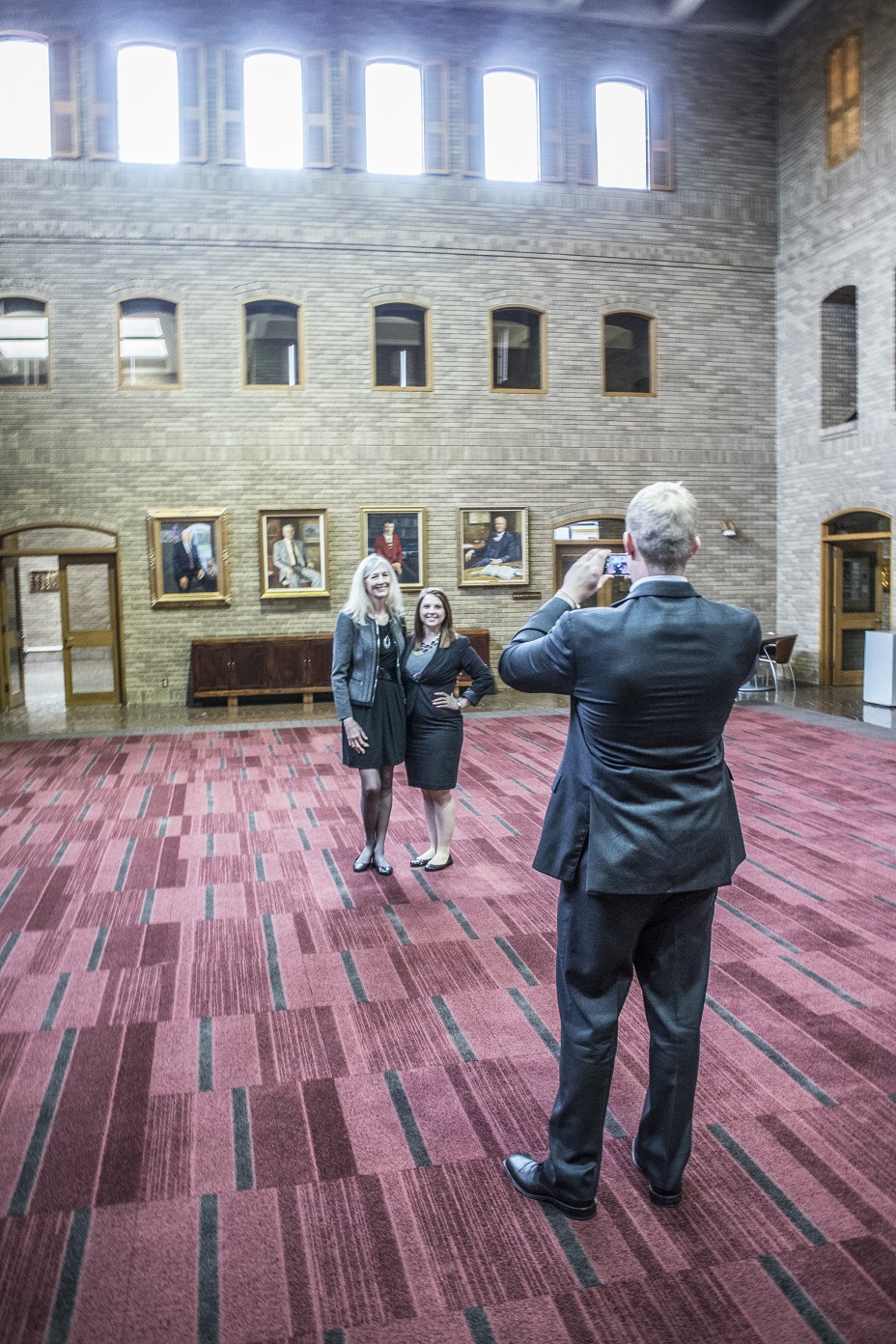
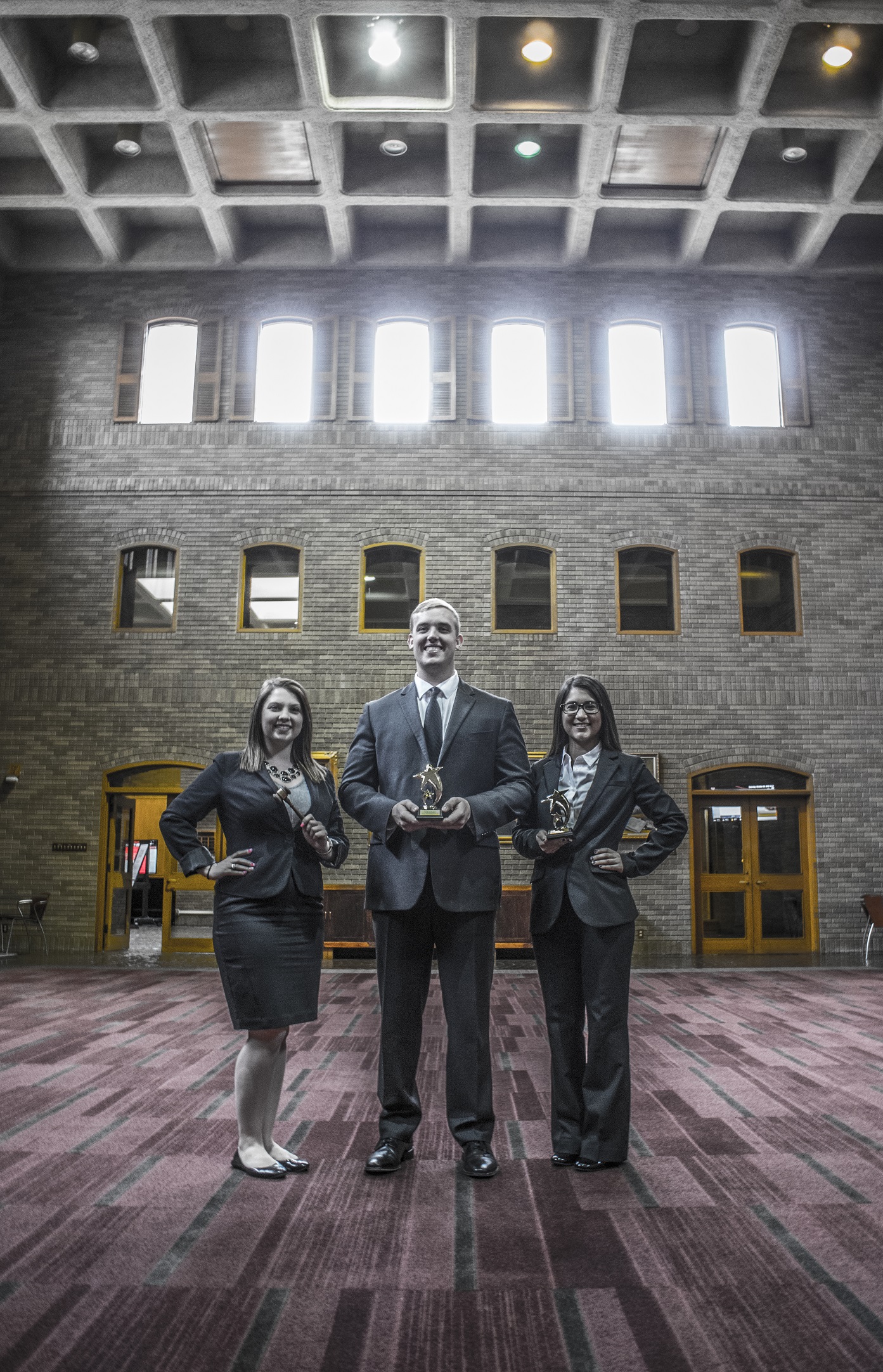
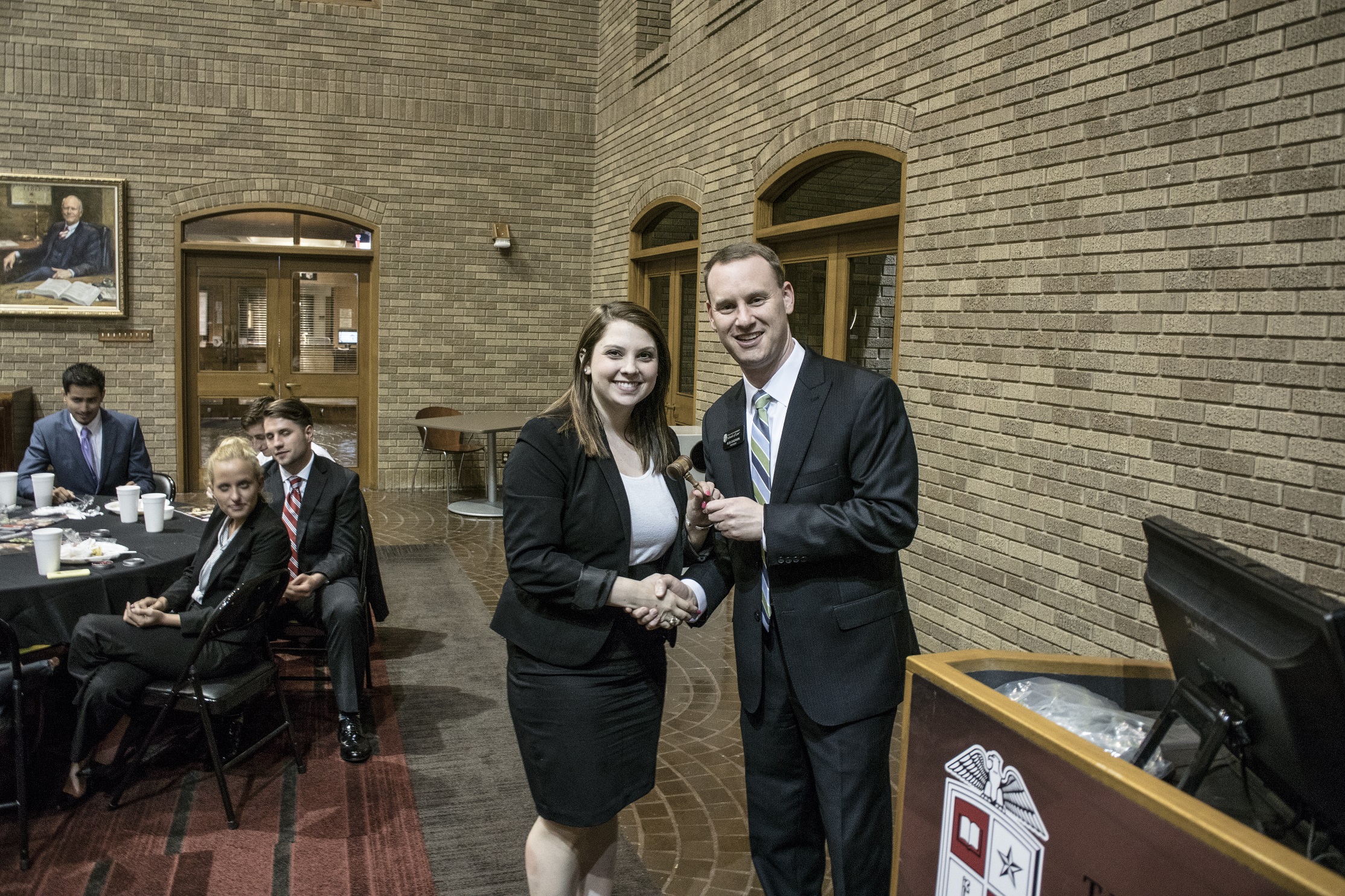
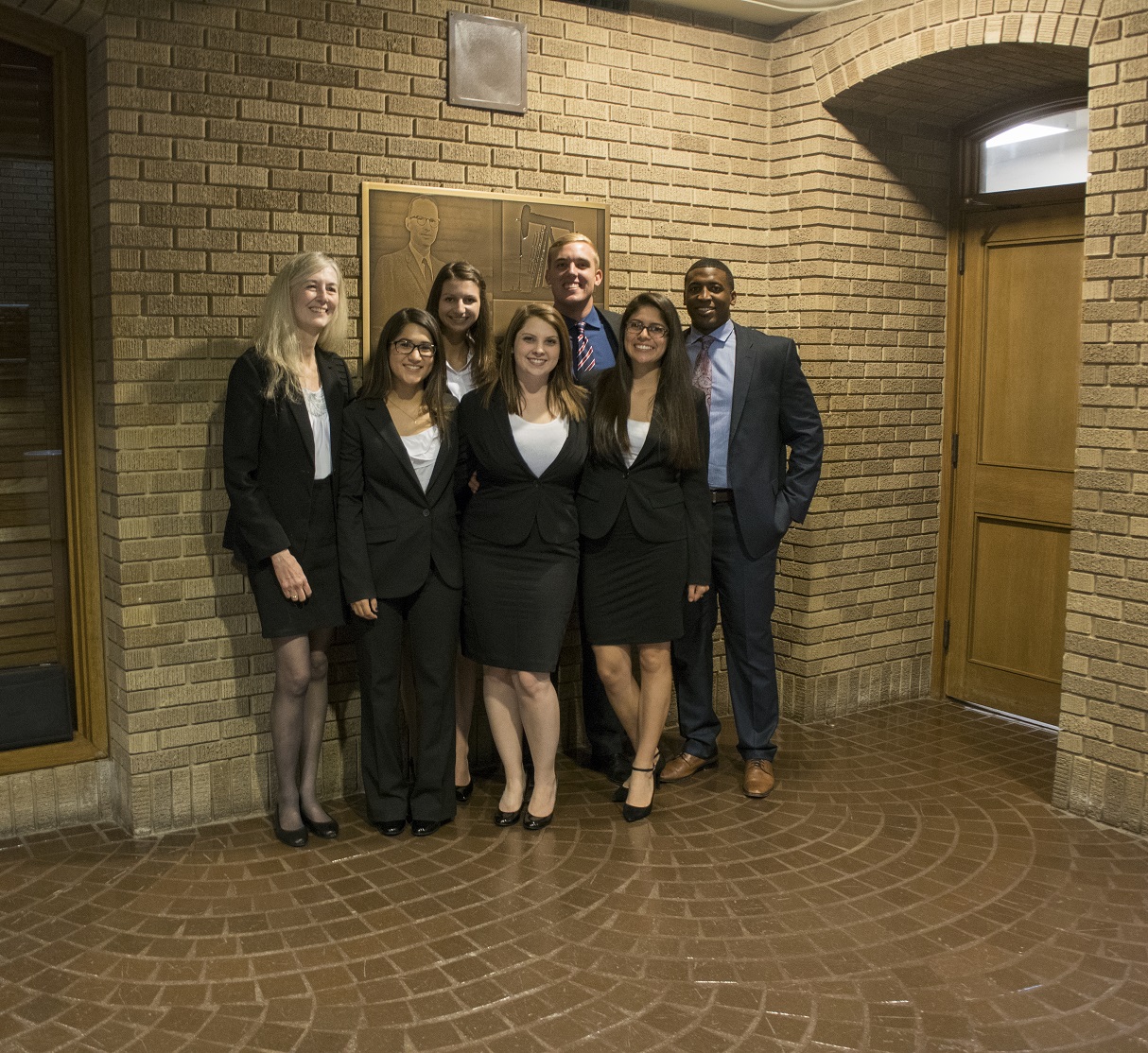
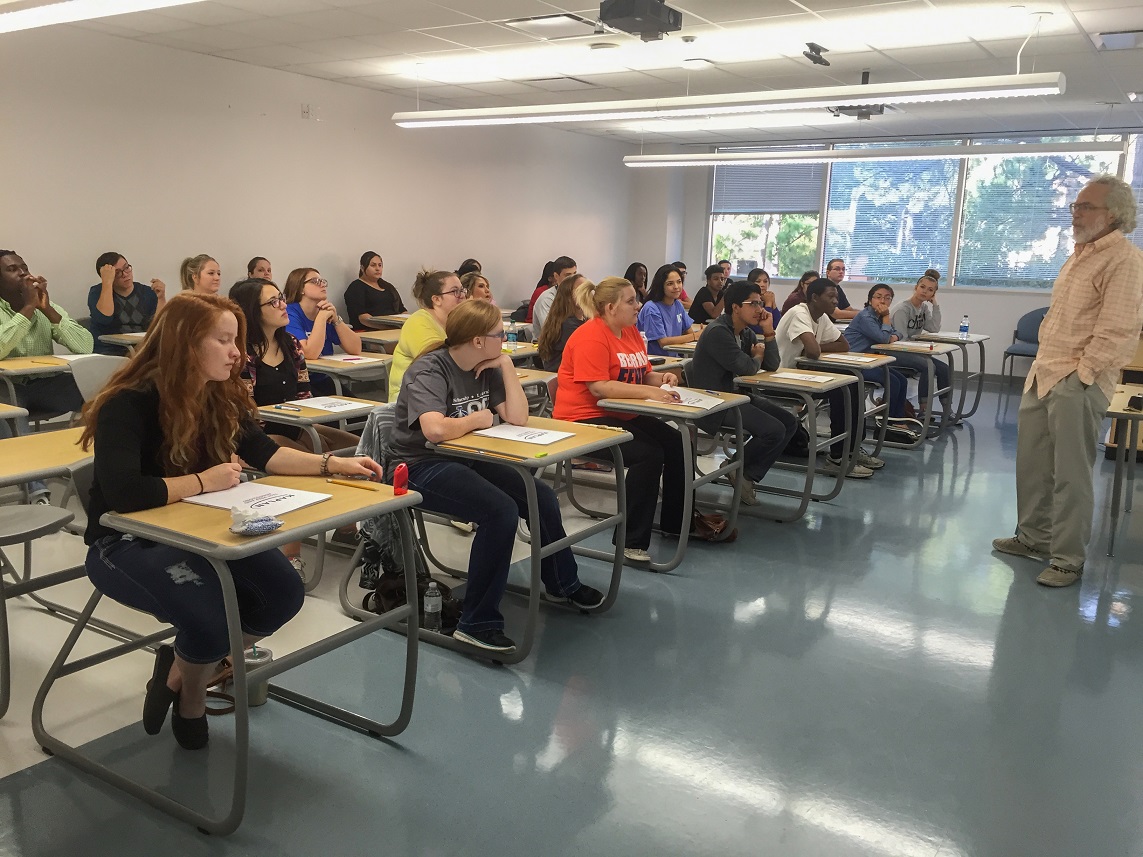
With some help from TDCJ CFO Jerry McGinty, LEAP Center students and guests went behind bars on Thursday, touring the Huntsville Unit (aka Walls Unit). The guest list included attorneys Audrey Biggar and Jeremy Romoser, City staff Marla Diers, SHSU Staff Deanna Briones and Renee Starns, and retired teacher Leanne Woodward.
The extensive tour included the historic part of the Walls Unit, where Clyde Barrow and Chief Satanta once served time, and the solitary confinement cell of John Wesley Hardin–who spent two years in solitary. It also included the holding cell for the death chamber, as well as the death chamber itself, by far the most sobering part of the tour.
The execution chamber is a small room, painted green, with a gurney located in the center. The gurney has numerous straps to hold down the inmate in his final minutes, and only three individuals are permitted in the room: the condemned inmate, the warden, and the chaplain. Invited guests witness the execution from viewing rooms. The execution has a live feed, but no recording equipment.
Also of interest was the textile mill, supervised by James Langley, who gave us a tour of its many-faceted operations. We saw how inmates made cotton for the uniforms; material for the mops, used at units across the state; and even the material used in mattresses for the inmates (and sold to Universities for dorm bedding!).
Finally, we concluded the tour with a walk-through of the chapel, the cell block, and a Q & A period following the tour. Perhaps most interesting is the sheer magnitude and diversity of running the prison system. While most people realize this involves guarding and housing inmates, few people probably realize that there more than 100 units across Texas; or that TDCJ owns some 1,600 horses; or that TDCJ farms produce millions of eggs; or that TDCJ is left to bury some 100 inmates annually, inmates who either don’t have families or whose families don’t have the means or desire to provide a burial themselves.
It’s a daunting enterprise. But the enterprise was explained coherently and, at appropriate times, even entertainingly by Warden Jones, CFO McGinty, and Officer Langley.
While TDCJ tours are not available to the general public, much of TDCJ’s history and artifacts can be viewed at the Texas Prison Museum on HWY 75N.
LEAP students, looking to become more civically involved, had the opportunity to learn from Huntsville leadership Thursday afternoon. In what was considered “Local Government Day” at City Hall, LEAP students came prepared to re-enact a city council meeting, complete with scripts and councilmember assignments.
The afternoon began with Mayor Woodward talking to students about the importance of civic involvement . We learned about his resume as mayor and of the ins and outs of holding the office. Mayor Woodward gave us a good portion of his afternoon to chat and answer questions before his next event. Taking his place, City Secretary Lee Woodward instructed us on city government and how it works. She spoke about the mission of the city, the different positions held by city workers, and what she does, specifically, as city secretary. Students, often coming to Huntsville from Houston where they are not as involved in the local happenings, listened intently, learning of all the opportunities that await them as members of the Huntsville community.
After learning about Huntsville’s Council-Manager system, students engaged in the exercise of the afternoon, acting out a city council meeting as members of the council and mayor. Each student was assigned to a different position, ranging from mayor to city attorney to hospital administrator, and we read from a script and extemporized the happenings of a typical city council meeting, including the proposal of a texting and driving ordinance–a topic of particular interest to college students.
We had the chance to be coached throughout by City Secretary Woodward and Professor Yawn, both of whom have extensive experience in the Tuesday night council meetings. Students acted their parts well for the most part and, in some cases, argued the proposal of the ordinance with the fervor of actual city council members. In all, we acted through two separate council meetings, with each of us switching roles.
Overall, we did pretty well. One of the most difficult things was adjusting to parliamentary procedure. Another was understanding the various rules under which city governments have to operate. If nothing else, this was a good exercise to know how hard council members work for virtually no pay ($10 a meeting).
This slideshow requires JavaScript.
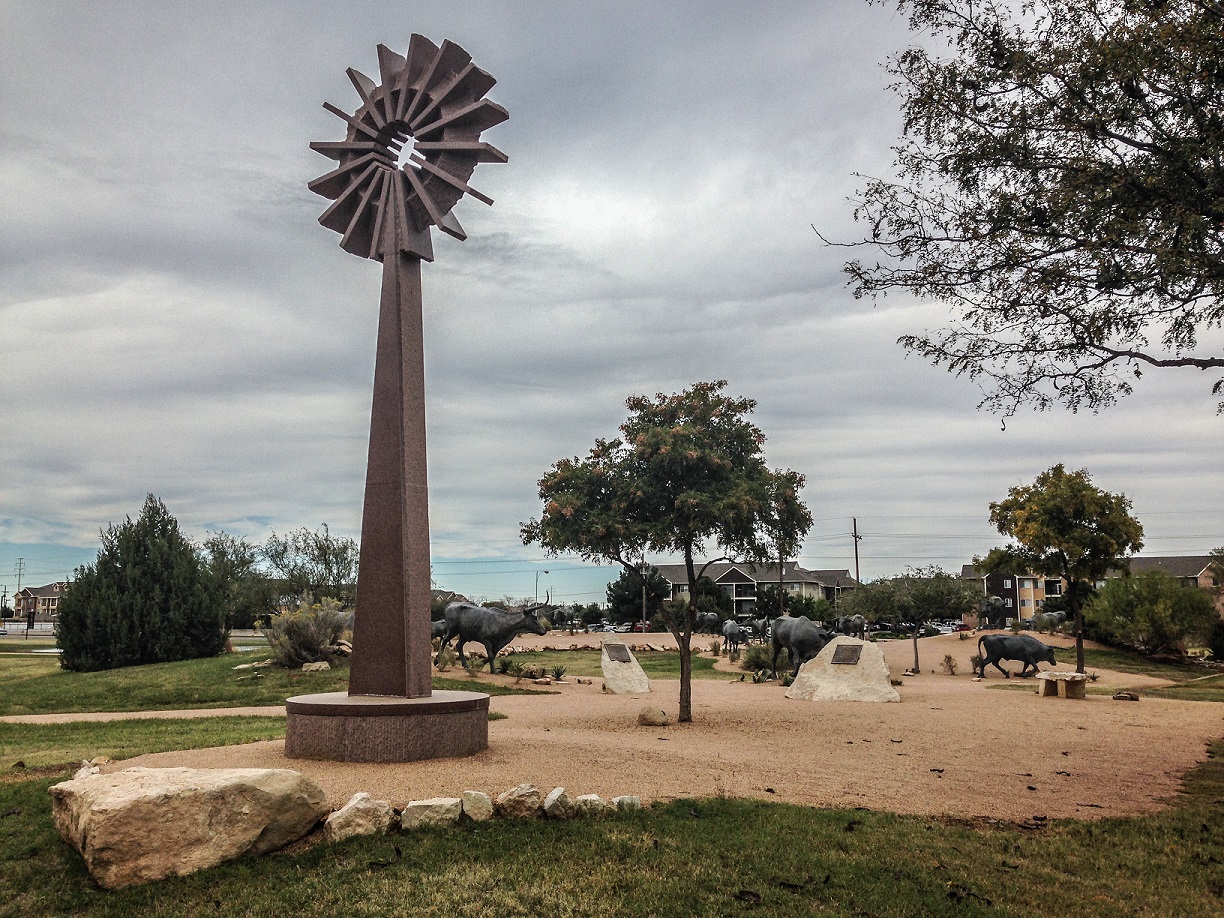
Ending the afternoon, students enjoyed cupcakes from and chatted about the excitement of being mayor or a councilmember for a few hours. We explored the park behind city hall and saw Charles Pebworth’s “Totem #1.” Inspired to become involved and entrenched in city politics, LEAP students left city hall eager to make a difference in the community. We would like to thank Mayor Woodward and City Secretary Woodward for their hospitality and for hosting LEAP during such an educational afternoon.
While beginning the fall semester at Sam Houston, LEAP students had a lot to look forward to: new classes, LSAT preparation, moot-court practice, and meetings with four-star general Stanley McChrystal. This semester, we started the semester off right with a visit to The Woodlands to meet and speak with General Stanley McChrystal as a kind of kick-off to our two-day retreat.
When we first met General McChrystal, we immediately felt how his presence dominated the room.
Very calm and relaxed, he reminded us more of the laid back, logically thinking dad more than the head command of JSOC (Joint Special Operations Command), the force credited with the elimination of many terrorists. General McChrystal began the small-group question-and-answer session,we learned that he followed in his family footsteps and attended the United States Military Academy, where he learned to be the disciplined officer turned four-star general we know today. While in command in Iraq, General McChrystal noticed that while our system of war making decisions and standard operating procedures was efficient, it was not appropriate for a new world that was “faster, flatter, and more flexible.” After reviewing the organization and its strengths and weaknesses, McChrystal re-organized the JSOC and implements a new system of communication that connected 7,600 people and their teams in 76 different counties and nations.
While much of his story and later on speech involved his role in the Iraqi war, General McChrystal spoke mostly on his leadership style and how he became the leader he is now. When asked about his views on leadership, General McChrystal compared his job to being a gardener. This was an intriguing analogy, but McChrystal explained that a gardener isn’t responsible for nature. He’s responsible for ensuring that the environment is favorable for growth–removing obstacles (e.g., weeds) and providing resources (e.g., water). While commanding the JSOC, McChrystal ensured that his direct reports and troops (1) knew their mission, (2) had the information they needed to make good decisions on their own, and (3) had the resources they needed to fulfill their mission.
What made General McChrystal’s speech applicable to LEAP was his outlook on leadership as well as his courage to adapt to an evolving world of communication and technology within the framework of a “team of teams”. As an organization made up of different kinds of students with different strengths and weaknesses, LEAP students strive to follow this “team of teams” concept and look forward to using it this year to become a more productive and efficient organization at Sam.
We ended the evening by following the pull of our ravenous bellies. The Black Walnut Café was calling our name and we graciously decided to answer. The lighting and warm colors of mahogany and magenta, as well as the smell of the fresh seasonings in the air greeted as we entered the door and invited us to sit down and enjoy time with each other, while bonding over a delicious meal. We enjoyed great diversity in the menu in the form of salads, burgers, and pasta, and even some very impressive garlic bread. We closed the evening, cherishing our time with General McChyrstal and with each other, amidst discussions of the next LEAP adventure.
The story of the Princess in DC comes to a close, but not before embarking on new learning adventures.
Beginning with a tour of the Coastal Guard’s Headquarters, courtesy of Ademide, where she briefly discussed the history of the buildings and introduced me to several of her co-workers. Later that afternoon, I toured the Capitol, it was a privilege to see the Senate Gallery along with the old Supreme Court Chamber and the exhibition hall.
That evening, Ademide and I enjoyed delightful cupcakes from Georgetown Cupcakes and ended the day with a visit to the Marine Corps War Memorial.
Throughout the week, I attended a press club panel at the National Press Building hosted by the Rabaa Story Foundation in commemoration of the second anniversary of the Rabaa Massacre. There I had the opportunity to hear stories from a couple witnesses of the Massacre and learn about the conditions in Egypt since the tragic occurrence.
In the week, I had the privilege to assist Nancy with a speech for a UN official to be delivered to the President of Nigeria.
I also visited The Library of Congress where among other galleries…
I had the opportunity to see Thomas Jefferson’s collection of books and admire the breathtaking architecture of this building.
Afterwards I headed to the Supreme Court, where I was greeted by a statue of John Marshall as I walked in!
I had the opportunity to actually see the court! It was so exciting to be in this building.
Continuing the last two weeks of my stay in DC, I visited the National Archives.
This was an extraordinary experience where I was able to see The Constitution, The Bill of Rights, and the Declaration of Independence along with other very interesting documents that have created history!
After visiting the National Archives, I continued towards the Smithsonian Castle, but stopped at the National Sculpture Garden and the Butterfly Habitat Garden on the way.
The Smithsonian Castle is a marvelous structure which contains much of the history behind the Smithsonian Museums. After learning about the Smithsonian Museums, I visited the Hirshhorn Museum and came across some interesting pieces.
Following the Hirshorn Museum, I met Ademide for dinner at Ted’s Bulletin.
We enjoyed breakfast for dinner at this lovely family restaurant, and had homemade pop-tarts for dessert. We said our goodbyes as she dropped me off at the Washington Monument where the adventure continued.
At the Washington Monument, I met with one of Ademide’s friends Ifa, who I had never met, and then I had two tickets to give away to go to the top of the Washington Monument. After asking a handful of people, I finally gave them away one of which decided to join us. So Ifa, Kevin, and I, three complete strangers at the time, ventured to the top of the Washington Monument together. Getting to know each other along the way and enjoying the stunning sight from the top as well as learning about the history of the building. But the adventure of the newly founded friends didn’t end there, we ended the night with some exploring of the city led by the two natives.
I also accompanied Nancy to give a presentation at the Leadership Institute regarding Fundraising and an all-day Fundraising Bootcamp which was a great learning experience for me. After a long day of fundraising, I had a delightful farewell dinner with Nancy at Bobby Van’s Steakhouse, and enjoyed a delicious dessert.
Continuing the week, I had the opportunity to reunite with camp friends that were in town for a couple of days and had dinner with them at Mehak an Indian restaurant in Chinatown which I loved, and will definitely be having again!
I also had the opportunity to visit the National Cathedral, which took 83 years to build! It was an impressive building.
Followed by a walk along the Chesapeake and Ohio Canal National Historical Park in Georgetown.
The adventure ended with a late night stroll through the National Mall reminiscing on the adventures of the last several weeks, and sitting in front of the reflecting pool facing the Washington Monument admiring it for quite some time. On this peaceful summer night, I felt incredibly grateful to be in this beautiful city.
Thank you Professor Yawn, Nancy Bocskor, Chuck Jones and Ademide for making this possible.
It was the final day of our trip, and we wanted it to count as much as the previous days.
We began with a quick walk around the French Quarter, checking out the shops, restaurants, art galleries, all the things you don’t see in our home towns. We then went to the New Orleans City Park, which houses the New Orleans Museum of Art and the Besthoff Sculpture Garden. It’s a wonderful city park, with jogging trails, playing fields, large oak trees, botanical gardens, a kids’ section, a mini-railway, a lake, and waterways.
We explored the whole park briefly, then tackled the sculpture garden, which was beautiful and wonderfully interactive.
Interestingly, we saw art works by artists we had seen on other parts of our trip and on other trips. One of the first sculptures we saw, for example, was a totem by Jesus Moroles…
This slideshow requires JavaScript.
…we had seen his work in Birmingham, at UT when we traveled there in June, and of course at our own University, SHSU. But we don’t know a lot about art, so it’s an interesting find when we come across art we do know.
We also saw the “Blue Dog” by George Rodrigue, whose gallery we had seen the night before in New Orleans.
And we saw Robert Indiana’s famous “LOVE” sculpture, which inspired The Beatles to write, “All you need is love.”
…similar to one we had also seen at the University of Texas. Interestingly, when we drove around the Garden District, we saw one in someone’s front lawn! One of these pieces costs about $219,000, or about the cost of a nice home in Huntsville, Texas.
We also saw a piece by famous Spanish artist Jaume Plensa. This one was called “Overflow”….
…but it is very similar to the set of sculptures he has around Buffalo Bayou in Houston, called “Tolerance.” Plemsa also did the “Crown Fountain” at Millennium Park.
Finally, we saw work by Louise Bourgeois, who is famous for her large spiders.
In passing, we saw works by Henry Moore, Rodin, George Segal, Anish Kapoor (who did “Cloud Gate” in Millennium Park) and Paul Manship. It was a fun and educational morning, and much more fun than a typical sculpture garden!
Following the art garden, we booked it back to the French Quarter and visited the market. We mostly went our own ways, shopping and having lunch.
None of the food we tried really stood out, but it was functional and allowed us to maximize our time looking at shops and such, along with a final picture of Jackson Square.
With a sad goodbye, we turned our back on New Orleans…
…and headed back to Huntsville–via Baton Rouge.
In Baton Rouge, we visited our fourth state capitol building of the trip. Amazingly, we (the students) had only visited the Texas capitol, so we each increased our total numbers of capitols visited by a factor of five!
The Louisiana Capitol isn’t the prettiest one in the country, but it is the tallest.
It also is historically interesting. Besides sitting beside the Mississippi…
…it is the location of the Huey Long assassination. There is a small exhibit on the first floor marking the site of the assassination, along with some basic facts. One interesting item is that they aren’t entirely sure that the “assassin” killed Long. The Senator’s bodyguards fired dozens of bullets at the assassin, and it’s at least possible one of them killed the governor. One of the bullet holes is still visible in one of the marble columns.
The capitol building has beautiful chambers for the House and Senate…
This slideshow requires JavaScript.
…and also has an observation deck on the 27th floor…
…which allows for good views of the aforementioned Mississippi, the armory, and the gardens.
This slideshow requires JavaScript.
This 360 degree view…
…was a fitting conclusion to a trip that gave us a similarly panoramic view of the south, its culture, and its politics.
After a great night of rest, we made our way to the impressive Biloxi Visitors Center. At the visitors center we were able to sign up for a tour Biloxi’s Lighthouse. The Biloxi Lighthouse was built in 1848 with a cast iron exterior and brick interior. It is 65 feet tall and has been electrically operated since 1926. An interesting fact about the Biloxi Lighthouse is that it was civilian operated and many of its operators were women, including one stretch of 50+ years where only women operated it. As we walked to the lighthouse we noticed another one of its unique features: it is the only lighthouse between a highway thoroughfares.
To enter the lighthouse we had to make our way up a wobbly, metal stair case until we reached the top. Once we all reached the lantern room, our tour guide gave us a brief overview of the lighthouse’s history. As we stood in at the top of the lighthouse we began to feel the intense heat caused by the cast iron exterior of the lighthouse.
We couldn’t imagine what it was like to be the lighthouse keeper in the southern heat!
When all of us had enough of the heat we began our journey down the stairs. It was way easier to go down than up, but still frightening for some. Once we were back inside the visitors center we were able to learn more about the lighthouse and the challenges they have faced on the coast of MS. For example, the lighthouse has endured many storms, most notably Hurricane Katrina. Hurricane Katrina caused much damage to the lighthouse. It filled the lighthouse with 21.5 feet of water and four hundred thousand dollars in reconstruction costs. The lighthouse was torn and battered by the destructive storm, but it still stood tall and was seen as a symbol of hope and resilience during the disaster, and the light in the lantern room still lights up the waters every night.
Following our exhilarating climb at the Biloxi Lighthouse, we drove along the shore to the George Ohr-O’Keefe Museum of Art. George Ohr is the self-proclaimed “Mad Potter” whose art was relatively unknown until fifty years after his death.
Designed by architect Frank Gehry, the museum building and grounds provide a stunning man-made counterpoint to the beautiful beaches, which are located directly across the highway.
Since it is the tenth anniversary of Hurricane Katrina, much of the current museum exhibits are dedicated to commemorating the hurricane. Biloxi, right on the Mississippi coast, was hit hard when Katrina rolled in. The damage to the lighthouse helps visitors visualize the magnitude of the storm in Biloxi.
In the lobby of the museum, there are many statues constructed out of wood.
Marlin Miller, a popular artist who took the dead and destroyed trees left after Hurricane Katrina and carved them into masterpieces that now decorate the once desolate landscaping of Biloxi. The museum contained a few of his sculptures each representing various emotions surrounding Hurricane Katrina.
The sculptures were beautiful and representative of the way Biloxi rebuilt itself after the storm.
The exhibits reminded visitors of how severe Katrina was and the change that has occurred since then. The Mississippi Power Company and the local news each had exhibits in the museum explaining the aftermath and their job when cleaning up. After the Katrina exhibits, we visited the main exhibit showcasing George Ohr’s pottery. George Ohr was born in 1857 and in 1879 he began his pottery career in New Orleans, LA. Ohr’s philosophy was that no two pieces of pottery should be alike because no two people were alike. To create thousands of pieces and not craft two pieces alike illustrates his creativity and support for individualism. Unfortunately, George Ohr’s pottery studio was burned in a fire in 1894. However, when he opened his new studio, it marked a significant change in his pottery with many brighter and bolder colors than his previous works of art. It was amazing to see the shift in his artwork and the transformation throughout his life.
Although not entirely what we expected, we immensely enjoyed learning about Hurricane Katrina’s impact on Biloxi and about the famous “Mad Potter”. The museum marked our last stop in Biloxi and we departed for New Orleans, the penultimate destination of our Tour of the Deep South.
Upon arriving in New Orleans we stopped for lunch at a New Orleans style restaurant, Elizabeth’s. The restaurant was founded in 1996 and their mission has, since then, been to make everything from scratch to provide a great product with the care and creativity that it deserves. We began with boudin balls and praline bacon as appetizers. Kaitlyn went with the special for the day which was Elizabeth’s original, Joe’s scramble. Alex and Karla went with the hot sausage Po’ Boy which was plenty of food for both of them.
This slideshow requires JavaScript.
It was also something they had never had before. It was a sandwich with a sausage with a soft spice kick to it. The restaurant was also very unique with plenty of colorful art on the walls that is from a local artist named, Dr. Bob. The art featured many NOLA sayings and recycled bottle caps as borders. His shop was located directly down the street from the restaurant.
After days of intense sightseeing and learning, we decided that retail therapy would be a nice way to spend an afternoon in New Orleans. For a few hours we walked the interesting streets of the French Quarter, shopping and absorbing the culture of the great city. There were countless vendors that sold a variety of things. We saw the traditional Mardi Gras beads, souvenirs, and so much art work! I bought a print from a local artist of one the horses that give carriage rides to locals and tourists. All of the artwork was unique. And while the shopping was going great, we were even more amazed by the entertainment that filled the streets. Instruments of all sorts made music that could be heard throughout NOLA. Dancers, magicians, comedians, and many more make a living on the streets of New Orleans keeping folks entertained sun up to sun down.
This was a new experience for all of us – especially Bourbon Street.
Many of us had heard what it would be like, but being there was totally different than any of us expected. It was a diverse place that offers so much to do and see.
For dinner we went to the famous Oceana Grill, we heard great things about this restaurant and couldn’t wait to try the food. We got there and were surprised by a long line of people waiting to be seated outside the door.
After waiting in line, we finally got seated. We began with gator tail bites, Cajun alligator sausage, Oceana’s famous oysters, and gumbo.
For most of us it was our first time trying many of these appetizers. It seemed like a lot for starters, but they were all great and gone in no time. Megan and Alex shared one of New Orleans Favorites, the Taste of New Orleans that came with creole jambalaya, crawfish étouffée, red beans, and rice with smoked sausage. Kaitlyn and Karla shared a crawfish fettuccini pasta with freshly diced green peppers and New Orleans seasonings. We were all so pleased with our food, it was much more than we expected. It added more definition to the culture.
After an appetizing dinner, we walked around the town for a while. The “day crowd” was different from the “night crowd”, but unique all the same.
Dessert was spent at Café Du Monde enjoying some warm and fresh beignets and chatting about the day’s events.
On the walk back to the hotel we enjoyed taking pictures at landmarks and learning a new way of life. We were all very sad that tomorrow would be the last day of our tour, but thankful to have had this amazing opportunity! The South has been great to us.
Sad to leave Savannah, we awoke early this morning before sun rise to begin our travels. Montgomery was our first destination of the day. Before heading into the city, we visited Liger’s Bakery for sweet treats to kick off the day. For a few of us, a doughnut was a perfect way to boost our energy after little sleep.
Once chosen for its central location within the Confederacy and for its easy access to travel routes, Montgomery was the perfect place to build the first Confederate White House during the Civil War. Since then, the building has been moved to its new location on the South side of the Alabama State Capitol. President of the Confederate White House, Jefferson Davis and his family lived in the home from the time it was built in 1835 until the time the Confederate Capitol was moved to Richmond in 1861. The home showcased two bedrooms, the First Parlor, the Second Parlor, the Dining Room, and the President’s Study. The first of the two bedrooms was Jefferson Davis’s bedroom which included artifacts from throughout his life, such as his slippers and Bible.
Another interesting room, the President’s Study contained many pieces of furniture used by Jefferson Davis and was a room where many important decisions were made for the Confederacy. Amidst the current controversy surrounding the Confederate Flag, the Confederate White House in Montgomery seemed unbothered by the dispute and fit in with the surrounding landscape with the capitol.
Against this strong backdrop of confederate history, more modern history also played out in Montgomery–the civil rights movement. Rosa Parks was a thriving civil rights activist along with Martin Luther King Jr. and Reverend E.D. Nixon. She was born and raised in Tuskegee, Alabama. Because her mother was an educator, she was taught to read and write and later attended the city Industrial School for Girls.
We had the opportunity to not only visit the museum dedicated to her and the history she impacted, but also the exact spot Rosa Parks boarded the segregated bus…
…and the bus stop where she was arrested.
The Rosa Parks Library and Museum tour began with background history of Mrs. Rosa Parks and her involvement in the Civil Rights Movement. She was the secretary of the NAACP and worked very closely with Dr. King and Rev. Nixon in the nonviolent protest for equality. Mrs. Parks refused to give up her seat on the bus and was arrested. This was a transition point for the state of Alabama and segregation laws. This also prompted the Bus Boycott that caused the bus companies to lose thousands of dollars. In order to support the boycott African Americans refused to ride the bus, so they walked or carpooled around town. This boycott lasted 13 months until justice was served. Rosa Parks was the perfect example of using educational and spiritual guidance to seek justice. Her and many other Civil Rights leaders have paved the way for many Americans today. Following the tour of the museum, we walked across the street to stand at the spot she was arrested. It was an honor standing in a place where a brave woman had made up her mind to be treated nothing less than equal. With conviction and respect, we stood reflecting upon how different America would be today without Rosa Parks contribution and leadership in the Civil Rights Movement. Time was running short so we made our way to visit the Alabama State Capitol, after briefly checking out some of the beautiful architecture, art, and history in the downtown.
Architecturally, the Alabama State Capitol modestly resembles the United States White House.
Much smaller than the Texas State Capitol, many offices have moved out of the main Capitol building and into various buildings bordering the Capitol building.
Our self-guided tour began in the Governor’s Hall, a common feature of state capitol buildings. Here, we admired the portraits of previous Alabama Governors leading up to the current Governor’s office. Also, on the first floor we were able to see the previous Supreme Courtroom which has now been converted into a World War Memorial. On the second floor, the previous House and Senate Chambers are now open for public viewing.
Stove in AL House of Reps
Reflective of the Antebellum Era, much of the furniture and fixtures were original from when the capitol building was originally built in 1849. Part of the second floor opened up to the rotunda, richly decorated in warm colors with scenes throughout Alabama’s history.
Finally, the third floor consisted of the House and Senate gallery where citizens could come and observe the legislature in session. One of the most interesting locations at the Alabama State Capitol is the location where Jefferson Davis was sworn in as President of the Confederacy. Marked by a bronze star, everyday visitors are able to stand in the same spot Jefferson Davis entered office for the confederacy. The Alabama State Capitol is our third state capitol to visit on our Tour of the Deep South. Not only has it been interesting to learn about their architectural similarities and differences, but also to learn about how the state government works in each state. In order to stay on schedule, we hurried over to the Dexter Avenue King Memorial Baptist Church where Dr. Martin Luther King Jr. preached for six years of his life to read the historical marker and take a quick picture.
Interestingly, the cross-walk in front of the church is marked by painted shoeprints. The shoeprints not only decorate the city scape, but also reflect MLK’s march from Selma to Montgomery, but also the African-American’s bus boycott, which required them to walk rather than take the bus.
For lunch we went to Chris’, home of the world famous hot dogs in Montgomery, Alabama. Chris’ opened in 1917, celebrating their 98th year anniversary May 1st of this year. The restaurant is mostly known for their hot dogs. Their special hot dog comes with 2 dogs, sauerkraut, chili, onions, and mustard. The addition of their famous Chris’ chili gives its world famous recognition. Not only did the restaurant have great lunch food, it also has an interesting history. Hank Williams, a famous country musician often visited Chris’, making it one of the hottest places to hangout in the mid nineteen hundreds.
The restaurant also advertises their support of equality during the Civil Rights Movement where their served African American citizens alongside white citizens. In the end, this was a neat place to have a comfortable lunch in the heart of downtown Montgomery.
After lunch we embarked on our trip to Monroeville, Alabama. Once we arrived in Monroeville we stopped to tour the Old Monroe County Courthouse to learn more about Harper Lee and her friend, Truman Capote.
Harper Lee is the author of “To Kill a Mockingbird” and Truman Capote is the author of “In Cold Blood” and “Breakfast at Tiffany’s”. The Old Monroe County Court House was restored to its 1930’s appearance. The courthouse is also the model for the courtroom in the To Kill A Mockingbird movie.
Many people think that the movie was filmed in the Monroeville courthouse but it was actually recreated onto a Hollywood sound stage by Henry Bumstead. Fans of the novel and movie visit Monroeville because it is Harper Lee’s hometown which she based Maycomb on. The court house became a famous attraction which prompted Monroeville to build a separate court house and turning the Old Court House into a museum. We were able to wander through the museum and read Harper Lee’s words regarding her book being turned into a movie and learn about Truman Capote’s childhood. One of the quotes that I liked best from Harper Lee was “In an abundant society where people have laptops, cell phones, iPods, and minds like empty rooms, I still plod along with books. Instant information is not for me. I prefer to search library stacks because when I work to learn something, I remember it.” Capote also had much to say about Harper Lee and through his words I learned that Harper Lee longed to become a lawyer like her father and almost did before realizing her calling was really writing. My favorite thing in the museum was a piece of “the famous tree” where Dill, Jem and Scout found the pieces of gum, marbles and a watch left by Boo Radley. Once everyone had the opportunity to look around we hoped back in the van, checked out some of the city’s homages to Lee…
…and to Truman Capote’s boyhood home…
As we arrived in Biloxi, we searched to find dinner. In the end, we chose Adventurous Pub and Spirits. A few members of the group shared the seafood platter with a combination of fried shrimp, oysters, catfish, and fries. Biloxi’s location to the Gulf of Mexico, made seafood an easy choice for dinner. Although, it was a much different restaurant than what we expected, the group enjoyed it and headed to check into our hotel to catch up on extra rest. Tomorrow, we have another eventful day of sightseeing and traveling as we head to New Orleans.
We began our last day in Savannah embarking on an adventure. We went on a dolphin tour through the Savannah River and Atlantic Ocean. It was a sunny day, perfect weather for a boat ride.
Our tour took us past Tybee Island and into the Atlantic Ocean.
The view of Tybee Island from the ocean was nice. We encountered a shrimping boat that attracted many pelicans and dolphins.
The majority of the dolphins we saw today gathered around the boat because they feed off anything the shrimpers throw back into the ocean. My personal favorite was a baby and momma dolphin swimming together!
The Southern Legislative Conference provided us with lunch on our dolphin tour. We had packed sandwiches, chips, fruit, and a cookie for dessert. It was an okay lunch with a great view.
We learned much in the process. For example, the US government has established several “bird islands,” where birds can go to nest. Predators’ populations are controlled and care is taken to ensure that birds have a natural habitat.
The tour also highlighted several forts, energy plants, and bordering states.
As the tour came to a conclusion, it started raining. Fortunately, we dodged any serious storms. The tour was perfect way to begin our last day in Savannah, however we still had a long day ahead of us.
After briefly freshening up, we headed out to the Liquid Sand Glass Gallery to look at the glass art.
We browsed the store and a couple of us bought glass nail filers that we’re pretty excited about. On our way back to the car, we stopped at a nifty shop right next door that sold many natural products such as soaps, seasonings, and oils.
After some shopping, we visited the birthplace of Juliette Gordon Low…
…and, a few blocks away, her carriage house, where she founded the Girl Scouts of America.
Megan and Alex tried to get into the Girl Scouts photo with us, but they weren’t Girl Scouts, so we wouldn’t let them be in the picture. Well, they were in the picture, but not in any official capacity. The photographer captured them sulking in the background.
We also took another look at the Andrew Low House (Juliette Gordon Low’s Father in Law).
After taking photos, we made our way to Forsyth Park to see the famous Savannah water fountain that was built in 1858.
The fountain is striking from a distance…
…and from up close…
While at the fountain we took some selfies, group photos and tried to capture the beauty of the fountain.
This slideshow requires JavaScript.
Forsyth Park was laid out in the 1840’s so we really enjoyed the giant Oak trees covered in Spanish moss.
We also took a look at the Confederate War Monument in the Park, one of many veterans memorials in Savannah.
By the time we were done “modeling” for the camera at the fountain, we were all ready for Leopold’s Ice Cream. Leopold’s Ice Cream was founded in 1919 by three immigrant brothers from Greece and has been visited by many including Johnny Mercer, the famed lyricist.
We each tried Leopold’s famous Ice cream sandwiches. They were absolutely delectable!
Before wrapping up our time in Savannah with the State Dinner, we made a pit stop at Bonaventure Cemetery in Savannah. Bonaventure Cemetery is where Savannah native, Johnny Mercer is buried. Johnny Mercer is relevant to the state of Georgia for many reasons. He was a thriving lyricist with over 850 songs and founder of Capitol records.
He wrote a hit song called Moon River and today he still makes profits from his music. The cemetery overlooks the Moon River, so while there we snapped some photos of us and the famous river.
For many years, the Bonaventure Cemetery was the home of “The Bird Girl,” a statue featured on the best-selling book, “Midnight in the Garden of Good and Evil.” Because of the success of that movie, however, visitors flocked to the cemetery, and the sculpture was moved to Jepson Art Center.
The visit to the cemetery was interesting. While leaving flowers at gravesites is popular, we saw rocks on tombstones at this particular one. We couldn’t figure out what they represented, but they were different and some rocks were beautiful. Because we were running short on time, we didn’t spend as much time as we would have liked to, but nevertheless we enjoyed our time learning about Mr. Mercer and Moon River.
Following a few more photographs of local scenes…
…and street performers…
Every evening, the conference has hosted a reception for socializing and networking. Each night, the receptions have been fun and memorable. This evening, the final night of the Southern Legislative Conference, we attended the State Dinner, which featured presentations and speeches by elected officials and entertainment. The dinner theme was “Georgia on my mind.” All the details of the décor reflected Georgia and its signature items, such as peaches and cotton.
We were pleasantly surprised when the LSC staff asked the four SHSU students to represent Texas in the flag parade.
While elected officials represented most of the 15 states attending, Texas was represented by four college students!
Alex, Megan, Karla, Kaitlyn Represent TX at SLC
Following the parade, the Georgia Speaker of the House, David Ralston welcomed the conference attendees and thanked everyone for their dedication to the conference.
Dinner began where we enjoyed the filet mignon and peach glazed chicken among sweet tea and southern style sides.
Our table consisted of our group and Mr. & Mrs. Hickman. Mr. Hickman is the Deputy Staff Director of the Senate Finance Committee in the Virginia Capitol. Both Mr. and Ms. Hickman were knowledgeable and very welcoming, they offered interesting history facts about their hometown of Richmond, Virginia and travel tips for when we have the opportunity to visit Virginia. Our dinner conversation was pleasant and we were happy to have met them.
For entertainment, Jeff Foxworthy delivered hilarious comedy material, which everyone enjoyed.
Although most of his set was new material, he closed with some redneck jokes, including:
If your matching salad bowls all say, “Cool Whip,” you might be a redneck.
If your son’s name is Dale, Jr., but your name isn’t Dale, you might be a redneck.
Comedy was an amusing way to end dinner.
Comedy did not end the evening, however. That honor fell to Sheila Raye Charles, the daughter of the late Ray Charles. She sang some new materials, some covers of various artists (including Maroon 5) and covers of songs made famous by her father.
Just before we left, Ms. Hickman, introduced us to her friend and Virginia State Senator, Barbara Favola.
LEAP Center Students and Senator Favola
Senator Favola offered her advice and experiences on how to pursue a career path in politics one day. She was very knowledgeable and gave us some insight to her career. Throughout our Tour of the Deep South, it has been interesting to learn about how state legislatures differ from Texas’s. Thank you to Ms. Hickman for introducing us to Senator Favola!
After a few final pictures, we headed back to the hotel to get ready for our early morning departure and next full day of sightseeing in Alabama and Mississippi. Reflecting back on our time in Savannah, we have learned a lot about the rich history of the city and immensely enjoyed all the sightseeing. Thankful for the opportunity to attend the Southern Legislative Conference, we are sad to leave the beautiful city of Savannah…
Girls Contemplate Leaving Savannah, GA
…but excited about visiting more cities in our Tour of the Deep South!