A mysterious death. A howling hound. A suspiciously Texan heir. What do all these things have in common? Chaos, comedy, and the incredible Todd Waite in his final bow as Sherlock Holmes at the Alley Theatre.
With only five actors and 36 characters flying in and out of scenes, The Hound of the Baskervilles was a theatrical juggling act, with a few wig, costume, and accent changes. Which is to say: it was impressive, ridiculous, and a lot of fun.
Before diving into the fun, we primed ourselves with a little chaos of our own: lunch at Post Market. In the spirit of the show’s variety, we went for food from all corners: noodles, rice, sushi, and African inspired power bowls— none of which appeared to be from the same restaurant.
Our group included LEAP friends Bill and Carol Hyman and Wayne and Andrea Scott, along with students Macey Schank, Jacob Wessels, Chrissy Biello, Michelle Moya, Mikaela Baires, and Austin intern Cinthia Villarreal. We showed up full and ready for whatever the Alley threw at us.
The Hound of the Baskervilles follows Sherlock Holmes and Dr. Watson as they investigate the mysterious death of Sir Charles Baskerville and the legend of a supernatural hound that haunts his family’s estate. In this version, five actors take on dozens of characters, adding a fast-paced, comedic twist to the story.
When we saw Todd Waite last month at Murder by the Book, he mentioned how Sherlock Holmes is, frankly, a smart aleck, but one you can’t really get mad at, because he’s always right on the nose. Having heard him talk about the role made seeing him perform it even better. His timing, his wordplay, and even his smallest asides all landed with precision. He clearly knows Sherlock inside and out.
Dylan Godwin was another fan favorite in this show among our group. As the Texan heir to the Baskerville estate (among a dozen other characters), he was constantly shifting personalities and finding ways to distinguish the hilarious traits for both a grumpy street cop and a simple minded Texan—even when they are both in the same scene!
In all, this was a great experience for the LEAP Center to share with some amazing community friends.
Even with the busiest time of the legislative session in full swing, the LEAP Ambassadors always find ways to stay engaged and keep learning. After a long day at the Capitol, we made our way to BookPeople in downtown Austin for an author event featuring Lise Olsen and her latest true crime book, The Scientist and the Serial Killer.
As true crime fans and students focused on criminal justice and pre-law, this event was right up our alley. Lise Olsen, known for her investigative reporting and current work with the Texas Observer, has spent her career uncovering the truth behind long-forgotten crimes. The conversation was moderated by Michelle Pitcher, one of Olsen’s colleagues who also covers criminal justice topics.
The book centers around Dean Corll (Nicknamed Candy Man), a Houston serial killer responsible for the abduction and murder of over 27 teenage boys in the 1970s. Despite the scale of the crimes, police negligence allowed Corll to operate undetected for years. After the crimes were uncovered, the investigation was shockingly mishandled. The Houston Police Department sent inmates with trash bags and shovels to dig up remains from a boat shed where the victims were buried—no forensic experts, no proper evidence collection, and very little communication with the victims’ families.
That’s where the heart of the book lies. Olsen reported on the findings and the work of Sharon Derrick, a forensic anthropologist who became deeply invested in identifying the unnamed victims. Derrick took on the challenge of reexamining the case, believing at first it might be simple but she quickly realized she was wrong. Many of the families were gone, DNA matches were limited, and records were scarce. Still, Derrick worked to connect the dots, uncovering overlooked evidence, personal items, and even previously unidentified remains. Olsen followed and reported on this journey, often reaching out to families herself to gather clues and piece together the victims’ stories along the way.
Pitcher asked Olsen about how she was able to capture not just the investigation but also the social and institutional failings of the time.
The book dives into what policing looked like in 1970s Houston: limited resources, no communication systems, and almost no understanding of serial killer patterns. Authorities often dismissed missing teens as runaways or troublemakers, even blaming parents. There were rumors that some had fled to avoid the draft. And the juvenile crime division? It consisted of officers who would write a one-page report/description and move on.
Olsen interviewed hundreds of people—friends, family members, investigators—and gave space for those who had been grieving in silence for decades. Her mission wasn’t to glorify a serial killer, but to give voice to the nameless victims and to honor the hard work of investigators still trying to bring justice and closure. The book is haunting, especially as a Houston native who’s grown up hearing stories about the Candy Man.
After the talk, we got the chance to chat with Ms. Olsen for a bit about criminal justice and let her know how much we enjoyed the event. It was a great way to end the night—getting to meet someone who’s doing meaningful work and hearing firsthand how much time and care goes into telling these stories. We snapped a quick selfie and left BookPeople feeling a little more curious, a little more inspired, and definitely glad we made the time to go.
Despite a packed day in Huntsville—with Junk-a-Palooza and the Pineapple Run taking place simultaneously, and Rotary’s “Wine Fest” and a Sip N’ Shop event scheduled for later—the Wynne Home remained a go-to destination for local families eager to celebrate the season, drawing more than 200 people in attendance.
This year’s event was led by Wynne Home and Economic Development Events Coordinator Angela Robinson, along with Wynne Home Director Andrea Howard, and Administrative Assistant Lauren Payne. They were supported by an enthusiastic team of volunteers, including LEAP Ambassadors (some of whom drove in from Austin where they work as SHAIP interns in the Texas Legislature)…
…City Fellows Interns, Pre-Law Society members, and longtime community contributors Lois Stehlik, Nancy Ormsby, Janette Roesler, Stephanie Fors (our in-house chef!), and City Fellows intern Liv Hernandez.
To prepare for the festivities, volunteers arrived early to hide eggs—some tucked away in much trickier spots than others.
To make sure the games ran smoothly, a few volunteers even did a “test run” of the activities beforehand.
By 11:00 am, families began to arrive, and the children wasted no time jumping into the fun.
There was something for everyone: chalk, bubbles, hula hoops, jump ropes,
From cornhole…
Ring toss…
Velcro darts…
And the ever-tricky egg-and-spoon race.
This game is no easy feat, but that did not stop kids from giving it their all—even if it meant using a few creative tricks to stay balanced and win.
For those who preferred a quieter activity, the crafts table with Lois Stehlik and Nancy Ormsby offered a space to sit down and create something festive.
Not to mention, visitors could bring home their very own balloon art. Some opted for swords, while others wished for animals or flowers!
Then came one of the most anticipated moments of the day—the arrival of the Easter Bunny! Most children welcomed the Bunny with big smiles, hugs, and high-fives. A few were a bit unsure, but the Easter Bunny remained cheerful and kind throughout.
To fuel up before the big egg hunt, Stephanie generously prepared lunch for everyone—grilling around 200 hot dogs, served alongside chips and (hopefully not too messy) mustard and ketchup.
At 12:45 pm, it was finally time for the main event: the Easter Egg Hunt! Children were divided into two age groups—5 and under, and 6 and up. When the signal was given, kids took off running, eagerly scooping up eggs in every direction.
With 800 eggs hidden for the older group and 700 for the younger group, there were around 1,500 eggs in total—more than enough for every child to fill their basket.
Although the event officially ended at 1:00 pm, many families stayed afterward to play a few more games or proudly show volunteers the eggs they had collected.
The Easter Egg Hunt at the Wynne Home Arts & Visitor Center continues to be a heartwarming tradition that brings the community together for a joyful Saturday morning.
A long-lasting tradition in Huntsville, Texas is a music series, Sundown at Sam’s, which is hosted by the Sam Houston Memorial Museum and Republic of Texas Presidential Library. This event was started by Economics Professor Darren Grant and Birdsall to introduce local artists to the loving Huntsville community.
Derrick Birdsall Opens with Introductory Remarks
This year’s event showcases three different themed performances: Blues Night with Lowery Bridges and Mighty Orq; Americana/Country Night with Katy Bell and John Toland, also featuring Joey McGee; and Gospel Night with Dave McMahon and Praise on Purpose.
On the Americana/Country night this week (April 10), the audience was full of SHSU students, Huntsville locals, and some Pre-Law Society members, such as Olivia Discon, Christina Biello, Michelle Moya, Nataly Elizondo, Neehal Ahmed, and Jose Carreno (Hunter Hogan also showed up, but he sat with his other, lesser friends).
First to perform was Katey Bell and John Toland. Katey Bell is an East Texas Singer/Songwriter who has been writing songs since she was a little girl. John Toland is a singer and musician associated with the John Toland Trio which is a funk and soul collective of like-minded artists. Their voices and guitar playing brought smiles to all those in the audience as their music filled the air.
John Toland and Katey Bell
My favorite song was Tornado Watch by Katey Bell. Katey sounds so emotional when she is singing this song and it highlights her voice range and beautiful guitar playing, and it also references Walker County!
Last to play was Joey McGee, who plays a harmonious combination of country, rock, and soul music.
Joey McGee
His guitar and harmonica playing were very impressive. He is a very bubbly and funny person, which was shown when he would tell jokes in between songs while changing harmonicas.
To go along with the amazing music, you could buy pupusas, quesadillas, and sodas from Delmy’s Food Stand and beverages from Sam’s Table. It was so nice to see the community gathered at such a historical and significant place in Huntsville.
If you want to experience this event, Sundown at Sam’s will have one more date during this semester on May 1, themed “Gospel Night,” and it promises to be another heavenly experience with angelic voices!
Michele Miller has spent over five decades documenting the world through her lens. Since beginning her photography career in the 1970s, she has captured scenes from across the globe, producing images that reflect both her technical skill and her keen eye for everyday beauty.
Her most recent exhibit, Canvasing the World, opened at the Wynne Home Arts and Visitor Center with more than 50 guests in attendance. The event, coordinated by Wynne Home staff members Angela Robinson, Andrea Howard, and Lauren Payne, welcomed community members for an evening of art and conversation.
A highlight of the exhibit was a display of Postcards Magazine issues, a local family-owned publication founded in 2009 by Karen and Wes Altom. Their son, Marshall Altom, has since joined the business, and the publication continues to be a staple in the Huntsville community. Miller has made a lasting contribution to the magazine, with 12 of her photographs featured on its covers.
During her speech, Miller reflected on her time as a photographer, explaining how her photos often resemble paintings due to being printed on canvases. Though she once aspired to be a painter, she felt she could achieve the same artistic affect through other means, so she turned to photography as a way to express that vision.
She then shared some of the stories behind her most memorable works.
One such piece is her photograph of Kylemore Castle, located in the Connemara region of County Galway, Ireland. Originally built as an estate, the castle has served as a home for an order of nuns for the past 100 years.
Miller also recounted capturing an image of a rare lotus flower from West Lake in Hangzhou, China, noting how difficult it is to find such a bloom and explaining the specific conditions required for lotus flowers to thrive. To further immerse the audience in her experience, she even brought lotus seeds to show the attendees.
Olivia McCaughan, with Her Favorite Photo from the Exhibit
Another captivating story came from her Canadian polar bear photographs. Miller described a rare opportunity to step out of a vehicle and photograph the bears. While others in her group carried large firearms for protection, she remained focused on capturing the polar bears as they played with one another in the snow.
Other notable images in the exhibit included the northern lights over Ireland, a hawk from the Galápagos Islands, the Oldest Wrought Iron Bridge in Birr Castle, Ireland, and a close-up of the Texas State Capitol Dome.
LEAP Ambassador Michelle Moya with Her Favorite Photo from the Exhibit
Miller’s photography encourages viewers to pause and observe the world with intention. Her images, taken from years of travel and observation, reveal the quiet beauty found in distant landscapes and everyday scenes.
Nataly Elizondo with Her Favorite Photo from the Exhibit
Canvasing the World will remain on display at the Wynne Home Arts and Visitor Center through June, giving the community the opportunity to visit the exhibit if one did not have a chance to attend the opening.
LEAP Students with Photographer Michele Miller
Carbonero Rotisserie
Since 2009, Carbonero Rotisserie has introduced Huntsville diners to the tastes of Salvadoran and Latin American cooking. Situated on 11th Street, the restaurant draws not only local residents but also travelers passing through, offering a flavorful experience that highlights authentic dishes from across Latin America.
The menu at Carbonero’s is extensive, offering a variety of dishes that showcase the richness of Latin cuisine. Among the most popular items are pupusas, ropa vieja, and crema de camarón. With so many options available, it may be difficult to choose, but diners are unlikely to leave disappointed.
One standout option is Combo Plate #4, which includes one quarter of rotisserie chicken, a pupusa, and sweet plantains. A variety of pupusa fillings is available, allowing diners to choose what best suits their taste. Options include pork (traditional), chicken, shrimp, and vegetarian selections such as jalapeños, mushrooms, loroco, cheese, and beans.
Another noteworthy offering is the chaufa rice. This dish features a fusion of flavors with scrambled eggs, cilantro, green onions, and soy sauce. Guests can choose between chicken, vegetarian, or a combination of chicken, beef, and shrimp. The dish is served with a house salad, making it a well-balanced meal.
For seafood lovers, the Mariscada is a highlight. This rich seafood stew includes shrimp, mussels, clams, crab, and tilapia in a creamy broth infused with fresh herbs and spices. Its bold and satisfying flavors make it a favorite among returning customers.
Those seeking something familiar yet flavorful may gravitate toward the tacos al carbon. Offered with chicken, pork, beef, or shrimp, the tacos are served on corn tortillas and topped with sautéed onions, fresh avocado slices, and pico de gallo. Beans and rice accompany the dish, rounding out a satisfying and hearty meal.
Carbonero Rotisserie stands out in Huntsville for its commitment to authentic Salvadoran and Latin American cuisine. With a menu full of rich, flavorful dishes and a welcoming setting, it offers a memorable dining experience that keeps people coming back. Whether you are exploring Latin cuisine for the first time or looking for a familiar favorite, Carbonero’s is worth a visit.
3 Spoons Yogurt
Next door to Carbonero Rotisserie is 3 Spoons Yogurt, a frozen yogurt shop known for satisfying the sweet cravings of Huntsville residents. It is a popular stop for a dessert or snack, whether after dinner, lunch, or in the middle of the day.
With a wide variety of frozen yogurt flavors and toppings, there is something for everyone to enjoy.
Among the customer favorites are cake batter; cake batter mixed with New York cheesecake; and strawberry and banana…
Whether you are finishing a meal at Carbonero Rotisserie or simply looking for a refreshing treat, 3 Spoons Yogurt offers a satisfying way to enjoy what Huntsville has to offer. With its multitude of flavors and casual (colorful) setting, it is a sweet stop worth making in Huntsville.
Few schools offer as much as SHSU when it comes to preparing students for a career as an attorney. Sam Houston has a dedicated pre-law advising center (the LEAP Center), offers law-related internships, features a robust Pre-Law Society, boasts extensive programming, sports a Moot Court team, and ranks among the top four percent in North American Universities as a “law-school feeder,” according to the Law School Admissions Council.
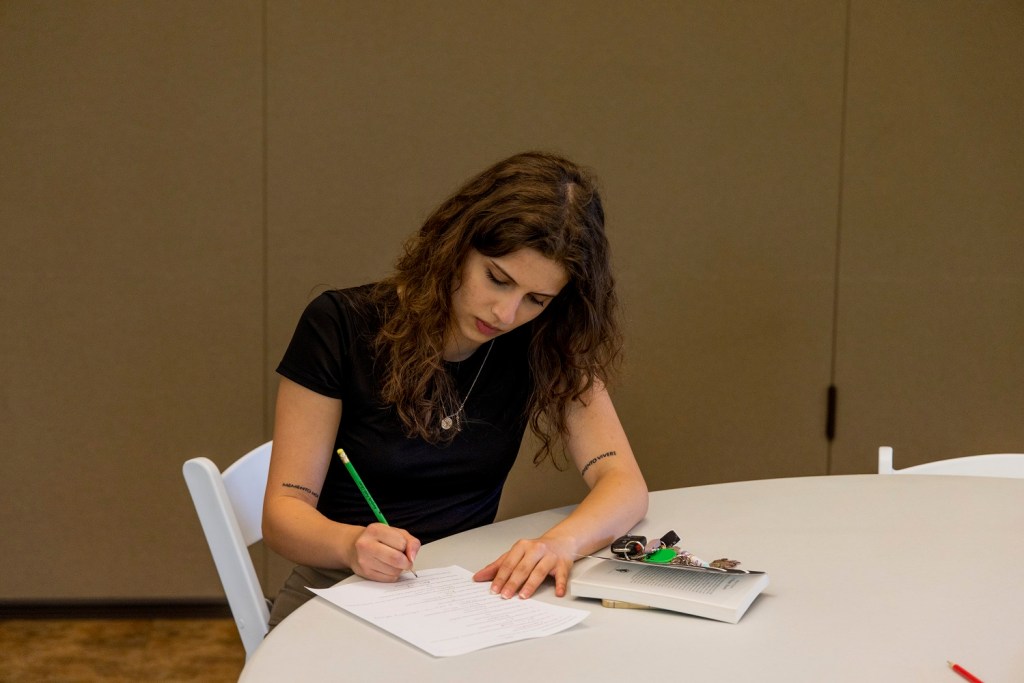
One small part of this equation is students’ access to free practice LSATs under supervised conditions, professionally scored. Each long semester, the LEAP Center hosts a Mock LSAT, where students–freshmen to post-grad–can come in and take the LSAT under test-like conditions. In the past year, more than 100 students have availed themselves of this option.
This includes 45 students who showed up today, on a rainy Saturday morning for a three-hour test.
All of them are part of the Pre-Law Society at SHSU, one of the largest academic organizations on campus, and one of the largest pre-law organizations in Texas.
The simulated test provides many advantages: (1) it provides test-day conditions for the LSAT, giving students a better idea of what to expect on the day of their real test; (2) it gives students an idea of how close they are to achieving their desired score; and (3) it allows them to compete for the Pre-Law Society scholarship for LSAT test preparation.
These advantages are just some of the reasons that SHSU ranks among the top LSAT feeders in the country. Of course, that ranking also reflects the fact that SHSU students are sufficiently dedicated to their studies and their futures that will awake early on a Saturday and sit through a grueling test.
For the motivated students at SHSU or who might be considering SHSU for their pre-law studies, advising is available at the LEAP Center. Professor Mike Yawn (mike.yawn@shsu.edu) or Ms. Jean Loveall (jal072@shsu.edu) can assist students with a timeline, steps to take, and, of course, regular opportunities such as the Mock LSAT.
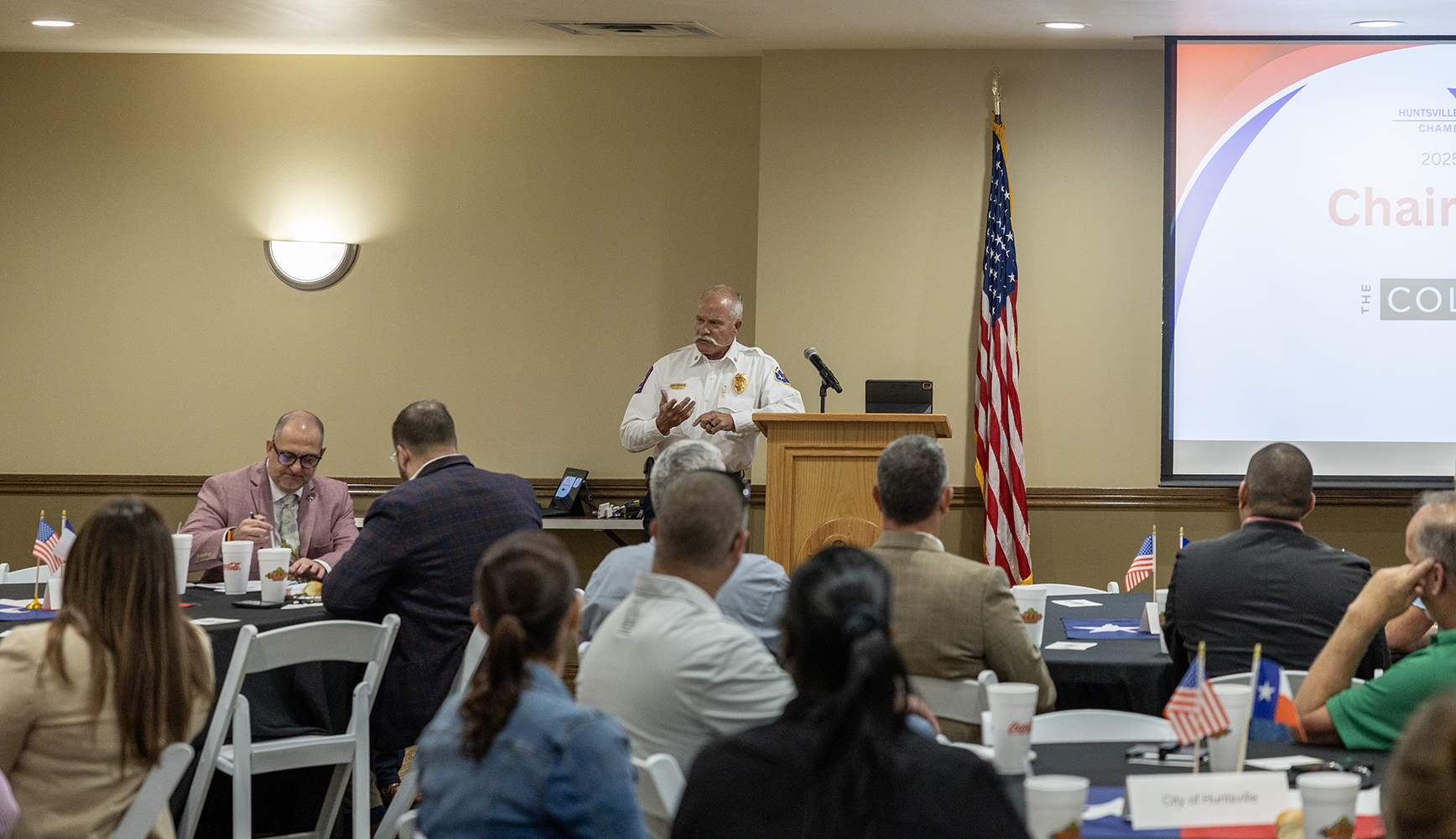
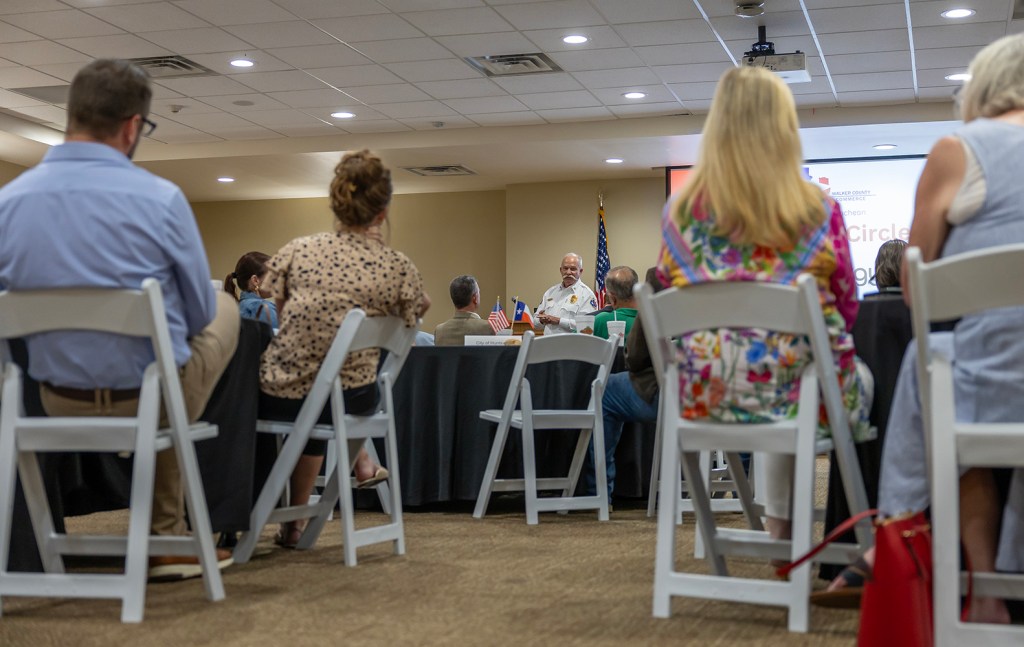
As part of the City Fellows Internship Program, we are continually exploring the inner workings of Huntsville. Our latest adventure took us to the heart of the city’s safety net: the Huntsville Fire Department, where we got an exclusive tour of the facility, led by Chief Greg Mathis.
The tour began in the lobby, where we were greeted by an impressive piece of history—a restored 1927 Huntsville fire truck. Chief Mathis regaled us with tales of the truck’s features and its rich history.
Macey and I even took a picture on the fire truck, joking that we were “officially” part of the fire department now.
Among the artifacts on display, Chief Mathis highlighted a particularly interesting item—a black-ball lottery device. This relic from the past determined whether someone would last as a volunteer firefighter. The process was simple yet harsh: firefighters would vote by placing either a white ball (yes) or black ball (no) in the container.
We then headed to Chief Mathis’ office, a treasure trove of knowledge where we learned the most about the department’s operations. Among his office testaments of pride, we got to see his impressive coin collection, which includes challenge coins from various of his experiences. These coins recognize achievements and build team spirit in the fire department.
He also emphasized that his job extends beyond fighting fires; it also involves securing grants, managing budgets, and ensuring his team can serve the community while staying safe.
We also noted the three hats from his career journey (including one that showed just how dirty the job gets).
Then we explored the residential area of the department, noting a unique feature—the “petrified wood” used in the television design is the same as the fireplace in the Josey Boy Scout Lodge. We also saw the “watch room,” which serves as the department’s nerve center, monitoring all alarms and operations.
As we learned more about the watch room, Chief Mathis emphasized the crucial role that volunteers play in the Huntsville Fire Department. Volunteers undergo rigorous training and are equipped to respond to emergencies alongside career firefighters.
The living quarters were equally impressive, with bunk rooms featuring sliding barn doors and four closets each. They also have access to a private gym with equipment like a rowing machine, treadmill, and Jacobs Ladder.
Finally, we arrived at the apparatus bay, where the fire trucks are stored—representing the traditional perception of a fire department.
Chief Mathis pointed out the physical fitness test equipment outside for the Candidate Physical Ability Test firemen have to pass. Our very strong Macey even tried her hand at the test, successfully lifting to an extent, while Jacob also gave it a go with full strength and managed to lift it off the ground!
Now, my favorite part of the tour. The multi-force wood door device they have been experimenting with lately. It’s designed to simulate various door types and jamb materials, allowing firefighters to practice different breaching techniques. Attempting it once more with Macey! After a lot of effort, she managed to get the door open!
The day showed us not just how a fire department operates but also how city services, budgeting, and management all work together. Not to mention, Macey learned just how hard it is to be a firefighter!
We are grateful to Chief Mathis and the entire Huntsville Fire Department for sharing their time and knowledge with us! We deeply appreciate all they do.
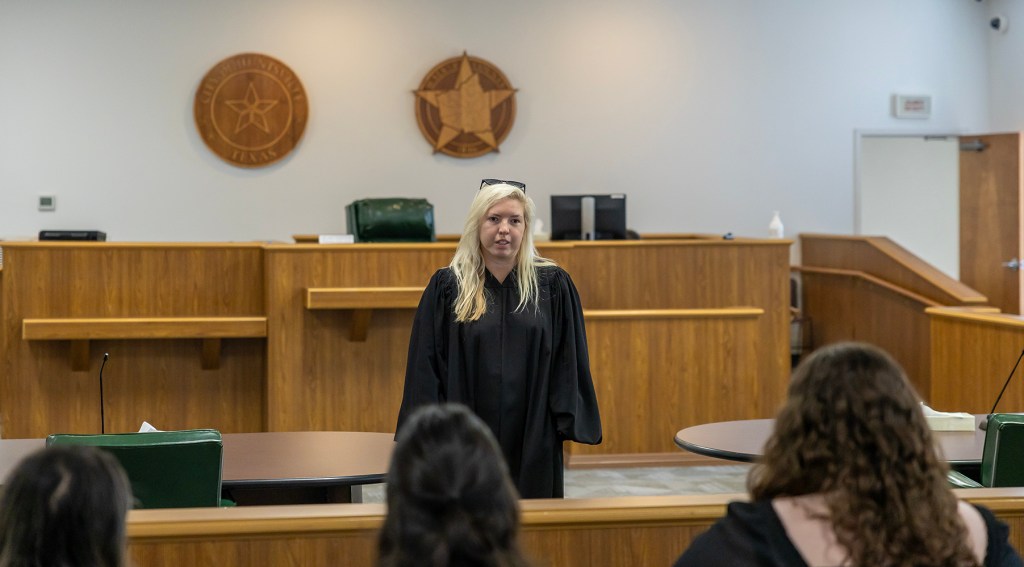
Every Wednesday in the fall and spring semesters, a select group of freshmen meet to learn about leadership. The topics vary, but the emphasis on building leaders persists from week-to-week and, in fact, from year-to-year. For one of these sessions, the LEAP Center offers a program, typically focusing on leadership at the local level, and this year was no different: Professor Mike Yawn and LEAP Ambassador Chrissy Biello adopted roles of locally elected officials to demonstrate how a courtroom operates.
Thus, last week, a simulated voir dire was presented to 24 students selected for the Freshman Leadership Program, as well as program leaders Dante Tamez, and Emily Figueroa. Professor Yawn took on the roles of judge, defense attorney, and prosecutor, while Chrissy took on the role of District Clerk.
Each student was provided a fabricated background, created by Chrissy, to guide the students’ answers as prospective jurors. Some students, for example, had been convicted of various crimes; others had clean records; some were Republicans; others, Democrats; some were unemployed; some were employed, and some were overachievers. Beyond these general biographical details, students could fill in their answers in a manner they believed consistent with the backgrounds provided.
The presentation went through being called for jury; arriving and filling out paperwork, which sometimes contains intrusive questions; the research that is done on potential jurors, both behind the scenes and live, in the courtroom; and the screening process, which can also be intrusive.
Along the way, students asked questions; posed scenarios, some of which were not anticipated by Yawn and Biello; and answered voir dire questions in ways that led to more interesting scenarios. One student even–in her hypothetical world–claimed her “water was about to break” and she “needed to be excused from service.” So much for civic duty…
As it turned out, several of the students are on a pre-law path, providing the opportunity for some additional discussion about courses of action. All of the students, however, are on a path to leadership, and after eight months at SHSU and in the Freshmen Leadership Program, are closer to fulfilling their promise as leaders of tomorrow.