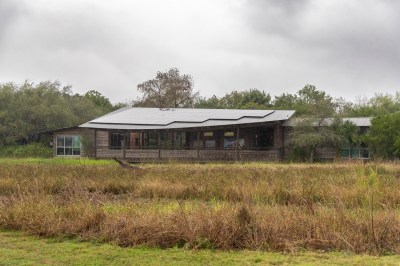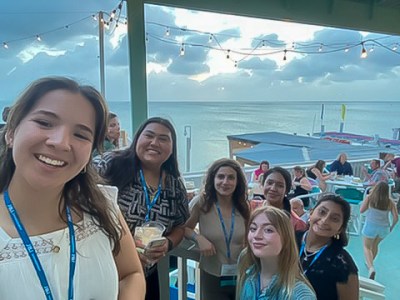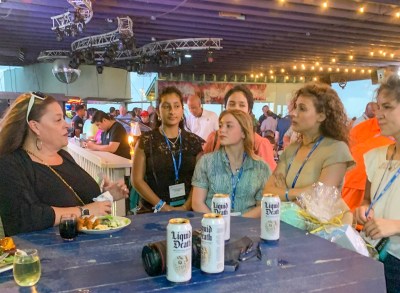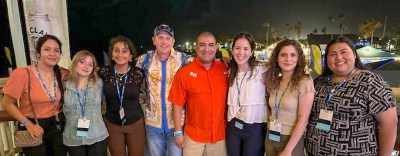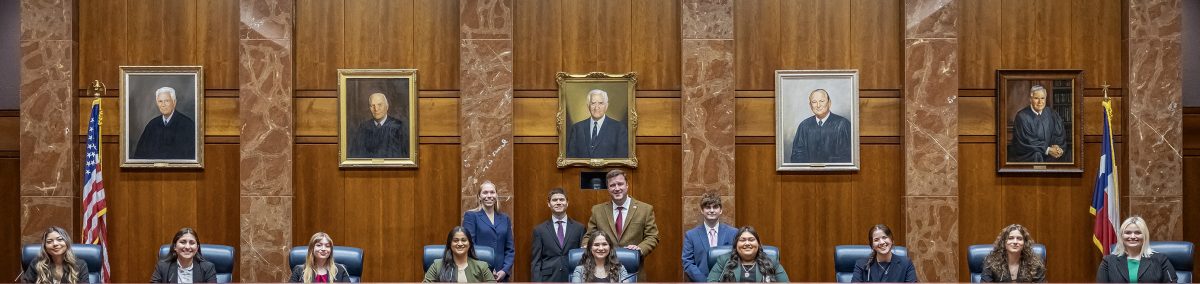
As the semester draws to an end, the City Fellows–interns placed by the LEAP program–are wrapping up their internships. As part of that process, and following numerous professional development activities this semester, they took on the roles of City Council and City Directors and participated in a Mock City Council at the beautiful Wynne Home.
On hand to guide and observe were supervisors Andrea Howard (Wynne Home), Amanda Schillaci (Huntsville Main Street), Tammy Gann (Economic Development), Aron Kulhavy (City Manager), and Mac Woodward (former Councilmember and Mayor).
The process involved knowing parliamentary procedures, researching topics such as dockless scooters, park acquisitions, and municipal contracts. Participating were Cinthia Villarreal (Mayor)…
The “process could be intimidating,” noted “Mayor” Villarreal, “but what we get from it is outweighs in importance any embarrassment or hesitation we might feel at the moment.”
Although the topics were relatively straightforward, they elicited questions such as: (1) who owns that GPS data from scooter usage and what can such data be used for?; (2) on what streets would scooters be legal?; (3) what are the downsides of designating land a “park”?; and (4) who is allowed to speak at council meetings, on what topics are they allowed to speak, and for how long?
It was, noted Biello, “quite the learning experience, offering me valuable insights into the legal nuances and special considerations essential for effective governance.”
With expert guidance from City staff, as well as a comparative perspective from those who have worked at other cities (including Madisonville, TX and Salado, TX), we were able to pass some good things for our Sim-City, learn a whole lot, see some great art, and spend time with some great people!
“Sundown at Sam’s,” notes Museum Director Derrick Birdsall, “is a way for us to bring a diverse (community and University) crowd to the Museum grounds.”
And the crowd was a wonderful mix of locals and students; among those was spotted were: Marjean Creager; SHSU Associate Vice President Amy Salazar (and her husband, Tim); Bridget Maloney; Councilmember Tore Fossum; City Manager Aron Kulhavy; LEAP Ambassadors Olivia Discon, Cinthia Villarreal, Morgan Robertson, and Michelle Cardenas; Kristie Stevens; SHSU Vice President Matt Bethea and his wife, Carrie; Wes and Susan Sanders; Bette Nelson; SHSU’s Emily Binetti; SHSU student Crystal Herren and her children; Brian Blalock; SHSU student Sarah-Hope Carter and her boyfriend, Parker; and many others.
The many others included pets…
…some of which showed off by doing pet tricks.
Adding to the entertainment was a variety of food and drink options, including Delmy’s, C.A.T. Cafe, and Tap Truck Outlaws. Or, you could bring your own snacks. In short, the setting offers everything you could need for a delightful evening.
And indeed it was an enjoyable, relaxing, and fun evening. The music, a mix of traditional sounds–Americana, Roots, and Bluegrass–was appropriate for the Museum grounds.
For Sarah-Hope, it is an annual tradition: “I love going every year! I especially enjoyed seeing John Krajicek, whose singing and writing is beautiful. My favorite song was “Blue Bird in my Heart…”
…and I also enjoyed hearing the Fire Ants String Band. The banjoist was incredible! It was great be part of the community, and it was great to see so many people come out and support local artists.”
Sundown at Sam’s will continue on May 2 and May 16. And for music fans, Huntsville Main Street will be hosting their own music series later this summer.
Thanks to Darren Grant and the staff at the SHMM for hosting quality events for the whole community!
After registering for the Congressional City Conference, we had a detailed schedule that we hoped to follow. That changed at about 5am on Monday morning, when Professor Yawn called us letting us know that, well, plans had changed.
Instead of arriving at 9:15am for the 9:45am opening, we would be arriving at 7:30am, in time to register and get in line. And why would we need to arrive so early? Because overnight, President Joe Biden had been announced as the key speaker, and this, understandably, creates a large crowd.
Opening Session
With Biden scheduled to speak, the introductory speakers had the difficult task of capturing a distracted audience, although some nice opening ceremonies helped set the stage.
It also helped that Doris Kearns Goodwin, Pulitzer Prize winning author and well-respected historian, was Biden’s lead-in.
Like Biden, Goodwin is in her 80s, and also like Biden, she came out feisty and lively, quickly drawing the audience to her. She regaled the more than 1,000 attendees with stories of her days in college, when she was an anti-LBJ, anti-Vietnam War activist, and nonetheless, the President selected her for a fellowship. She didn’t always agree with his policies, she noted, but she did see things from his perspective, and this made for a good relationship. In fact, he asked her to help him with his memoirs in his post-presidency.
Goodwin also discussed how local leaders play a role in making Presidents successful, highlighting civil rights as an example. She also discussed the key elements of leadership, one of which she emphasized: the experience of personal struggles, which allows presidents to grow personally and to empathize with others.
This, of course, has applied to many presidents and leaders–and she highlights Abe Lincoln, FDR, LBJ, and Teddy Roosevelt. It could also apply to President Biden, whose life has been marked by the death of two children and a spouse.
And it was a feisty President Biden who showed up to speak to the large crowd of municipal leaders.
Echoing many of the themes from his State of the Union speech–albeit with a greater emphasis on more local matters–Biden stressed his support for efforts to rein in gun violence, his call to pass the “toughest border bill ever drafted,” and his economic track record.
He also hearkened back to the formation of the National League of Cities, which occurred in 1924–and he insisted that he was NOT in the room for that initial get together.
Biden’s speech was greeted enthusiastically by the large crowd, and he received an extended ovation.
After the opening session, we returned to the National League of Cities conference for a very interesting general session. This session featured multiple remarkable speakers who presented projects and shared their expertise. NLC’s 2nd Vice President, Steve Patterson, expertly emceed the general session.
Among the speakers was Julie Su, the United States Deputy Secretary of Labor, who shared some important points on the pivotal role of local leaders in shaping labor policies and fostering economic growth within their communities. She emphasized the necessity for collaboration between federal and local forms of government to effectively address challenges in labor. Amongst the issues she presented, child care and transportation seemed to be the most pressing issue for the Biden Administration. Secretary Su made sure to emphasize the crucial intersection between local government and national labor initiatives.
One of the sections of the general session included a panel discussion moderated by NLC’s First Vice President, Sharon Weston Broome. The participants included Mark Hayes, Executive Director of the Arkansas Municipal League; Steve Marshall, Attorney General of the State of Alabama; and Donald Mason, Mayor of Janesville, Ohio. The topic of discussion was the alarming rise in opioid-related deaths over the past few years. The panelists shared the devastating impacts the crisis has had on their communities. Attorney General Marshall highlighted the financial costs that opioid-related incidents bring to Americans, citing a cost of $98 billion. Director Mark Hayes shared a very personal story about losing his son to a fentanyl overdose, emphasizing the urgent need to address the crisis to prevent others from experiencing such pain.
The panelists mentioned the importance of flexibility and learning from mistakes, acknowledging the varied approaches taken by all 50 states in tackling the crisis based on their unique community needs. They encouraged city officials to take initiative and not be afraid of failing in the process.
Pete Buttigieg, the Secretary of the U.S. Department of Transportation, concluded the National League of Cities general session. He emphasized the difficulty of local government and gave props to all the officials for their hard work in serving their community. Buttigieg also highlighted the $1.3 trillion infrastructure deal that is allowing communities and cities to improve. He introduced new grant programs with the ultimate goal of enhancing communities.
During his discussion, he spotlighted Baltimore’s 150-year-old railroads and stations that will be fixed and replaced so they can be used by citizens. Buttigieg mentioned how important transportation is, closing his session with a very insightful quote worthy of reflection: “Transportation is not just a connection to the other side of town but a connection to opportunity.” left This observation left a lasting impression on me, making him my favorite speaker of the general session.
Aligning Workforce Dev with Plans for Economic Growth
Olivia Discon
Later that afternoon, our group decided to attend one of the “Deep Dive” panels, which offers a more specialized conversation regarding some of the most pressing city matters. We decided to take a ‘deep dive’ with the “Aligning Workforce Dev with Plans for Economic Growth” panel. Having some experience with the City of Huntsville’s Economic Development department, we thought this panel would be a great way to expand our understanding of what comprises a healthy economy for a city.
This panel had no shortage of experience. We had the pleasure to hear a bit from Brittany Stich, Senior Advisor of the U.S. Department of Labor, Tess Mason-Elder, Director of Office Relations of Americorps; Colleen Rathgeb Associate Deputy Assistant Director of ACF; Catherine McConnell, Policy Advisor for U.S. Department of Education; Paige Shelvin, Strategic Advisor for IWD and USDOT; and moderated by Adriana Rocha Garcia, Council Member of San Antonio.
To attract, retain, and expand businesses to a city, there are a multitude of factors that incentivize businesses to choose that city, and for workers to choose to work there. A good standard of living is at the forefront of that choice. This, of course, comes in many forms, including the quality of the city’s cost of living, safety, education, community events, and existing businesses. Interestingly, this panel placed an emphasis on childcare facilities, career and technical education, and good infrastructure to incentivize a strong workforce. While these factors may not appear to be a crucial aspect to this issue, they are implicit and are potentially one of the deciding factors between one city or another. It was incredibly stimulating to consider how some of the talking points tied into a common outcome for cities, and ponder how Huntsville may fit into the equation.
The LEAP Center (Law, Engagement And Politics) recently hosted an event that left attendees intrigued by tales of espionage, moral dilemmas, and the weight of keeping national secrets. The guest speaker for the afternoon was James M. Olson, a distinguished former chief of CIA counterintelligence, whose career has been a fascinating journey through the shadows of international threats.
Mr. Olson shared his story with two groups: Rotary Club of Huntsville and a large group of SHSU students.
James M. Olson is an expert on the clandestine world; Olson’s career spans more than three decades in the Central Intelligence Agency. Rising through the ranks, he eventually became the chief of CIA counterintelligence, tasked with safeguarding the nation’s secrets from foreign adversaries. His level of expertise in espionage, national security and counterintelligence is unmatched.
However, what sets James M. Olson apart is not just his professional achievements but the personal sacrifices he made to serve his country. As he shared during the events, Olson had to keep his work secret from his own family and children to ensure their safety. The burden of secrecy weighed heavily on him, presenting numerous moral dilemmas. Yet, with the support of his wife, Meredith Olson (also a CIA Agent), he navigated these challenges with resilience and dedication.
During the program, Mr. Olson recounted how he eventually revealed his secret life to his children. Contrary to his fears, they reacted with pride upon learning about their father’s role in protecting the nation. He took the time to highlight the complexities of balancing duty with family obligations.
Throughout the day, one theme resonated deeply with Mr. Olson: his unwavering passion for the United States. He spoke extensively about the honor he felt in being entrusted with some of the nation’s most important secrets. His commitment to upholding the ideals and values of the country underscored his dedication to service.
However, alongside his admiration for his country, Mr. Olson touched a more sensitive subject; those who betray their nation. He had harsh words to express his resentment toward individuals who commit treason, labeling them as the worst kind of individuals in the world.
The day with James M. Olson was truly captivating and eye opening. The topics of espionage, patriotism, and moral integrity truly make you reflect on the future of America and all the individuals who put their lives on the line for our safety. I was definitely left with a newfound appreciation for the sacrifices made by individuals like Mr. Olson in safeguarding the nation’s security.
For 13 years, the LEAP Center has hosted the 10th Court of Appeals, allowing Sam Houston State University students and Huntsville residents to hear three appellate court cases in the courtroom of the George Beto Criminal Justice Building. The 10th Court of Appeals, out of Waco, TX, serves 18 counties in Texas including Walker County. The court, which currently consists of Chief Justice Gray, Justice Johnson, and Justice Smith, is able to travel and try cases in any county seat in their jurisdiction.
We had a full house for every case today and a line out the door, waiting to see if a seat would be available. In the first case this morning we were happy to have District Attorney Will Durham watch the case, checking things out in advance of his turn in the courtroom at 1:30pm.
The unique thing about the hearings held at SHSU is that the lawyer for each party is allotted three minutes to relay the facts of the case to the audience.
After those three minutes the attorneys turn to the Justices and begin their 20-minute formal arguments. The Justices can interrupt for questions at any point during the arguments and after each attorney has spoken, the appellant attorney then gets a 5-minute rebuttal to the defense.
Another special treat, at least for us, is that during these hearings, LEAP Ambassadors were asked to fill in for the Clerk, who is responsible for, among other things, asking the visitors to “All Rise” and then asking for a blessing on the court.
During the first case today, the appellant attorney’s main issue with the previous court ruling was that there was insufficient evidence to charge the appellant with manslaughter. The attorney argued that a manslaughter charge includes knowledge about the substantial risk of death, of which the appellant did not have. The attorney for The State of Texas actually brought props and photos that were used during the original trial to argue against the appellant party.
The second hearing was a real treat because President White was able to sit in on the arguments. It was the first time in 10th Court history that a University President attended at SHSU!
The second hearing broke down the importance of understanding Miranda Warnings and how language barriers can affect criminal proceedings.
After the 11 am hearing, the court was adjourned for lunch where LEAP students were able to talk with the justices, President White, and court staff. I was lucky enough to be sitting with Justice Smith and Justice Johnson, who discussed their careers as attorneys and how they fell into the position of judge, and eventually to justice.
LEAP Ambassadors also provided Justice Gray with a gift basket and a heartfelt thank you as this is his last year doing the 10th Court of Appeals at Sam Houston State University, his alma mater.
Court readjourned at 1:30 pm with the final hearing of the day. The court room was attended by County Clerk Leslie Woolley and Judge Tracy Sorensen. This case was really interesting as the main arguments pertained to the use of cell-phone data. In 2008 police obtained records from a man’s cellphone that linked him to a murder, but 10 years later the U.S. Supreme Court ruled that police must get a search warrant for that information; essentially, the question was should the data then be used in trial.
Thank you to everyone who came out to watch the cases today, especially President White. Thank you to Chief Justice Gray, Justice Johnson, and Justice Smith for allowing students to have this opportunity and for being so welcoming and helpful to future law students. Chief Justice Gray, we wish you well in your retirement and we want to thank you for continuously showing support for the LEAP Center and the Pre-Law Program at SHSU.
What is a personal statement and why are they important? Personal statements are what law schools use to understand what an applicant is like in personality, determination, and in writing skill. This section on a law-school application can make an applicant stand out from the pile and become a deciding acceptance factor.
This week the Pre-Law Society wanted to help their members create a strong thesis on their personal statements by asking two questions, “Why do you want to go to law school?” and “What do you want law schools to know about you?”.
To begin, we broke off our members into groups of two to discuss their answers.
In thinking about these questions and developing their answers, the students come a little closer to a personal statement.
After our discussions, our Secretary Jessica Cuevas, and one of our Legal Studies Advisors, Ms. Jean Loveall, explained how to make your personal statement stand out.
Advice included (1) think about what influenced you to choose law as a profession; (2) don’t duplicate your resume; and (3) explain why you would fit at the law schools to which you are applying. And–have multiple people look at your statement!
Of course, workshops and regular meetings aren’t the only things the PLS does. In the next month, we’ll be doing a Mock LSAT, bringing the 10th COA to campus, and bringing guest speakers to campus.
Follow our Instagram for future events and information @prelawsocietyshsu. See you at our last meeting of the semester on April 17!
As LEAP Ambassadors, we do our best to maximize our experiences. This means taking as many opportunities as possible in a given location. So, following a day of conference sessions, we took advantage of a free evening to see “Shear Madness” at the beautiful Kennedy Center.
As we entered the building, a majestic, jaw-dropping hall with worldwide flags hung from the tall ceiling greeted us…
…and at the end, windows from top to bottom with a red dragon on it allowed us to see into the Potomac River.
To add to it, the sun setting on the other side of the building gave us an amazing reflection inside the hall and an awesome view of the D.C. skyline.
While wandering around the building, we were able to recognize the artists of the various art pieces at the patio. Throughout the trip, we have seen numerous works of Lichtenstein so, even though not a fan favorite, we still felt proud to recognize his art.
This trip we have learned and gotten to know the work of Joel Shapiro. Using rectangular abstracts of human figures, Shapiro captures movement of the human body.
Olivia and I saw Debra Butterfield’s work on our Southwest trip at the Texas Tech campus and were ecstatic to see her work again, and in the other side of the country, too.
As we entered the Kennedy Center’s lobby, beautiful chandeliers showed the way into the theatre…
…and we were ready for the play to begin.
The play takes place in a present-day Georgetown in retro styled beauty salon where Tony Whitcomb and Barbara DeMarco, the hair stylists; Mrs. Shubert; Eddie Lawrence, an antique dealer; and Nick O’Brien, an undercover police officer, are introduced to the public.
As Tony and Barbara are at work, they get sidetracked and wrapped in current gossip, frequently unbothered about their costumer’s time or even safety. Suddenly a piano starts playing and Tony begins to complain about Isabel, the upstairs elderly neighbor who is also a worldwide recognized pianist.
Suddenly, the group is told that Isabel has been mysteriously murdered and everyone becomes a suspect to an open crime. As the interrogations begin, the crew starts acting suspiciously and begin to throw each other under the bus with the police in order to not be the main suspect.
What truly made this experience one-of-a-kind, is when Officer O’Brien turned to the public for their insight on the case. With this, the play became interactive, and the crowd begins calling the actors out for lying, covering each other, or acting suspicious. He then invited the public to ask questions, which forced the actors to come up with the answer impromptu, and consequently, start improvising with jokes about current affairs and even about the audience.
Being new to the theater world, I never thought I would find the theater so captivating and humorous. It was amazing to witness the true skills needed for improvisation and I seriously admire the actor’s professionalism and readiness for staying in character without knowing what was to come.
In a small way, it’s like being a LEAP Ambassador, grabbing opportunities as they come, even when we don’t know what might be around the corner!
After exploring several museums in Washington D.C., it was time to stop by the Smithsonian American Art Museum (SAAM). This museum is well known for housing the National Portrait Gallery and its collection of presidential portraits, while also having an impressive collection of works by both established and emerging artists.
Upon entering the museum, we were immediately greeted by the works of renowned artist Gilbert Stuart. Stuart is mostly known for his presidential portraits, including his famous depiction of George Washington found on the dollar bill.
Additionally, the museum featured pieces by other notable artists such as Thomas Sully, who did the famous work of Andrew Jackson…
…and Norman Rockwell, who softened Richard Nixon in his official portrait.
A standout highlight of SAAM is Amy Sherald’s remarkable portrait of former First Lady Michelle Obama. Sherald’s portrayal of Mrs. Obama was intriguing. She captured the persona of the former First Lady but also challenged traditional portraiture.
Other notable portraits include Kehinde Wiley’s depiction of Barack Obama, Peter Hurd’s portrait of LBJ, Chuck Close’s complex mosaic of Bill Clinton; and Elaine de Kooning’s atypical portrait of Kennedy . It was wonderful to see how different artists envisioned our past and present presidents in a painting.
And, of course, we would be remiss if we did mention seeing a bust of “our very own” Sam Houston!
But the Museum does not exclusively reflect portraits of presidents and other notables. They are an American Art Museum as well, and I was able to see a work by Jean-Michel Basquiat, a personal favorite of mine, whose work I admired only online before visiting the museum. We were also fortunate enough to reinforce our knowledge and recognition of Alexander Calder.
We saw Edward Hopper works…
…a work by one of Professor Yawn’s favorites, Thomas Hart Benton…
…and pieces by artists as diverse as Grandma Moses, Georgia O’Keeffe, Fredric Remington, Samuel Morse, and Luis Jimenez.
We also saw a piece by Sam Houston alum James Surls…
SAAM’s diverse collection reflects all the changes of American life and its history. Through these portraits and artworks we gained a deeper understanding of our history while connecting it to art.
Whether we were in awe of presidential portraits, or discovering new favorites among the museum’s vast collection, or encountering iconic works by beloved artists, we sure enjoyed our time at the Smithsonian American Art Museum.