In an effort to educate the campus and community about what the LEAP Center is, the LEAP Ambassadors compiled pictures of events to showcase the organization in the LSC Art Gallery.
The exhibit, which was open from September 2-September 16, showcased some 160 photographs (culled down from more than 90,000) across six categories: speakers, travel, fine arts, volunteerism, experiential learning, and programs.
LEAP Ambassadors Following Installation of Art Exhibit
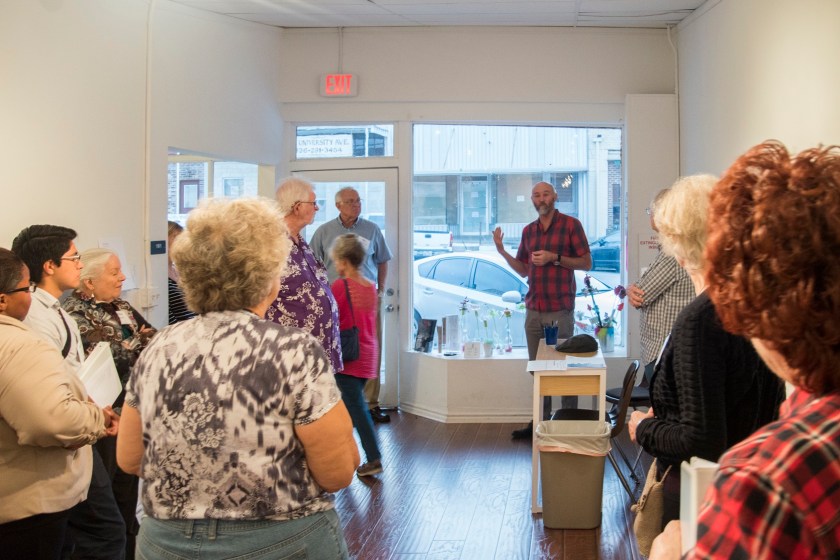
This past September 14th the LEAP Center hosted an opening reception for the art exhibit. Many students, University staff, and community members came out to support the LEAP Ambassadors and learn more about what the LEAP Center does.
Each category emphasized our favorite and most notable events. For example, LEAP Ambassadors have traveled twice to see Stephen Hawking present a lecture, and we have also seen public figures such as Alan Alda, Bill Schneider, Douglas Brinkley, Governor Abbott, and Vicente Fox. All of these photos appeared under “Speakers” and, of course, additional photos were featured in the other categories.
The LEAP Center is thankful for the opportunity to showcase the organization. Numerous students attended, some of whom might make for good LEAP Ambassadors themselves someday!
We were also grateful for the support from University officials such as Provost Eglsaer…
…President Hoyt…
…Mac Woodward, Charlie Vienne, Gene Roberts, and many others. We also had a chance to see some of our favorite community people, including Linda Pease, Terry Stivers, Carol Hays, and others.
Excited murmurs could be heard from Art Building F as people were flooding in for the LEAP Centers’ 2nd annual heART of Huntsville program. Art enthusiasts from SHSU and the community are annually invited to this four-week program where they can explore various art media created by local artists around the SHSU campus and the picturesque town of Huntsville.
We started out in one of the many classrooms of the Art Department. The LEAP ambassadors were elated to see many of our community friends such as former mayor Mac Woodward and Wynne Home Director, Linda Pease; as well as friends on campus such as English Professor, Dr. Ralph Pease and Political Science Professors, Dr. Tom Haase and Wen-Jiun Wang.
After everyone had finished their survey of local art and artists (not without a few grumbles), Dr. Micheal Henderson, chair of the art department, welcomed us to the the Gaddis-Geeslin Gallery.
Inside the gallery, Dr. Henderson presented us the “Selections” exhibit by revealing the type of art that could be found within. The art gallery consisted of creations from alumni dating as far back as the late 1930’s up until the Spring semester of 2016. There were many pieces from former SHSU professor Ken Zonker. The artist had a special resonance for Leap ambassador Beatriz Martinez, a previous Wynne Home Intern who had organized a Zonker exhibit.
Dr. Wes Sanders Hangs Art by Ken Zonker at the Wynne Home
There were also pieces by Zonker’s apprentice, J Miller, who had actually painted a portrait of Mr. Zonker. Exhibited was also a painting by the renowned sculptor James Surls (whose art would appear later in the tour). Titled Cockfight, Surls produced the work in the late 1960s while he was still a student at SHSU. At this, few of the attendants revealed how the had been friends of Surls at a younger age, and we spoke with Dr. Keri Rogers, who several years ago helped hang this piece in the LSC.
LEAP Ambassadors and Keri Rogers With James Surls’ “Cockfight”
After seeing more SHSU faculty and alumni art…
…we decide to head on over to the second stop: the College of Humanities and Social Sciences (CHSS).
As we got closer to the CHSS building, we stopped outside to gaze at the Water Wall by Jesus Moroles. This 9-ft wall was erected to harmonize the elements of earth, stone, and water. The attendees where then amused by how Jesus Moroles (as a lover of multimedia art), had planned to unveil the sculpture by having SHSU dance majors dance atop the CHSS building’s roof.
Fortunately for us (and the dancers), their platform became the top of the Water Wall. The Water Wall’s intended function was to offer a venue for outside lectures. Currently it is most often used as a great study spot for students, and is occasionally seen hosting CHSS socials. Once inside, we saw a piece by Bruce Marion, Confluence, lining the walls. Seeing as how the Humanities and Social Sciences college deals with human interactions and circle of connections, Marion transitioned colors and interwove circles to showcase these two ideals.
The group later traversed through the summer heat to the Lowman Student Center Art Gallery, which was probably the LEAP Ambassadors’ favorite gallery, as they had spent many hours, nails, and mounting squares in order to set up their very own LEAP exhibit. Showcasing the various features of the LEAP center, such as special speakers, fine arts, volunteerism, experiential learning, programs, and travel, it gave heART of Huntsville participants an opportunity to gain a further insight of the different fields in which LEAP Ambassadors engage.
From there, we went to the Nancy Gaertner Performing Arts Center where Craig Brossman, the facilities manager of the building,was waiting to give us a tour.
We toured the Concert Hall, which impressed the heArt of Huntsville participants as it has been named one of 25 best art venues in the nation. Equally impressive was the dance theater with a sprung floor which is tailored to fit a dancer’s needs. There are only 2 or 3 like it in the state, and about a dozen in the nation. We proceeded to view Kathleen Ash’s Elements, Stanley Lea’s Four Seasons, and a serpentine marble sculpture by Jesus Moroles. The most prominent installation was the 16 ft, wood and steel, Around the Flower Wall by James Surls. We also got to see some art from Charles Pebworth, whose first and biggest sculpture lies in the Woodlands at about 40ft tall. As we were exiting, we saw Jason Lawrence’s Firedance, our last beacon of crystalline light as we retired for the night.
Or at least until we got to Austin Hall. This historic building awaited us with food to be deliciously devoured upon as we interacted with the other participants and shared our anticipation for next Monday’s adventure, which will start at the grand Sam Houston Statue on Monday, September 19.
With the presidential elections around the bend, the LEAP Ambassadors attended the Walker County Republican Women’s non-partisan meeting on the various aspects of voting this Monday, August 29. The evening’s agenda included speakers focused on new voting ID requirements, the history of political parties, and the nearly unfathomable electoral college. The LEAPsters therefore were more than delighted to start off the semester with proper political education.
The first speaker, County Tax Assessor and Elections Officer Diana McRae, headed the conversation on new voter ID laws.
Walker County Tax Assessor Collector Diana McRae
With experience running more than fifty elections, McRae outlined the various kinds of identification that a voter may present at their polling station. From a normal driver’s license (acceptable even if expired for up to four years), to military identifications, those present are at peace knowing that this upcoming November they will be ready to present the proper requirements to vote.
Followed thereafter was SHSU’s own Political Science Professor Yawn. With a presentation focused around the history of political parties Yawn touched on the early years of American politics from the Federalists and the Anti Federalists, the Whigs, the Democratic- Republican party, finally reaching our present day decided political spectrum.
Professor Mike Yawn Speaks About the History of Political Parties
Highlighted were also presidents that shaped those political parties such as George Washington, Abraham Lincoln, John F. Kennedy and many more. As her first time seeing Professor Yawn teach outside the classroom, Christina (one of the newest additions to the LEAP Ambassadors) deemed the presentation “as a very interesting one.” As a political science major however, this was to be expected. As for the rest of the non-student audience, they occasionally responded to Yawn’s presentation with laughter–not out of spite but as a result of the amusing presidential tales from Yawn’s dynamic presentation.
To finish the evening’s meeting Michael Ethridge, Huntsville’s field representative for U.S Congressman Kevin Brady, elucidated the audience on “How the President Really gets Elected.”
Michael Ethridge Discuss Presidential Elections
His main topic was the electoral college and how it affects the way presidents are voted into office. He showed us how one county can change the outcome of the entire state, like Ohio. He also answered questions related to our electoral college, and the process of voting. He showed a time line of the electoral process between November and January of election years. One thing he emphasized on was that voting is important. As college students who share his beliefs, the LEAP Ambassadors all thought it was an important message to share. Likewise the efforts of the Walker County Republican Women reflected this political responsibility of educating the community on voting, political history, and the electoral process.
The LEAP Ambassadors are on the road again as we return from Dearborn, Michigan. Even though we left yesterday, our trip back to Huntsville is, in LEAP style, exploiting the learning opportunities along the way. Driving through the Midwest, we have been enjoying fields of green, skies of blue and white ornamented with sunny streaks, while visiting locations of historic prominence. From the birthplace of one of the fathers of the modern age to the resting place of our nation’s 29th president, we knew that our Friday itinerary would be as fun as any of the previous adventures in our Vagabond trip.
Constructed along the banks of the Milan Canal in 1839, this modest home was where young Edison spent his childhood until he was seven-years old. Even though the family left in 1854 due to the town’s low job opportunities, the home would be owned again by the original family when Marion (older sister of Thomas) bought the home. Eventually the home was bought by Tomas Edison and efforts from his wife and sister were later made to turn the home into a historic site. These finally came to fruition in 1947 when the home was inaugurated as a museum on 100th anniversary of Edison’s birth.
Upon arrival to the restored home along Edison Avenue, seemingly as common as the neighboring homes, we stepped into the birthplace of one of the most important inventors of all time. On the living room stood a cradling bench, one that would have been used to cradle young Edison. What was of greater interest was the adjacent room. In a small, four-walled enclosure, intended for the younger children’s living quarters, stood a complimentary rope bed. Mother Nancy Edison moved to the warmer, oven-heated space on which she gave birth to her youngest child. We stood on the threshold of where Thomas Edison had been born on a February evening in 1847. As we stepped upstairs we were able to sense young Edison’s childhood.
The first bedroom we went into would have been young Marion’s room, now decorated with her christening gown and a knitted tapestry on the wall which she chose not to finish. We then crossed to the opposite room which Thomas and wife Mina Millar used as a bedroom after purchasing the home. Various pieces of apparel owned by the Wizard of Menlo Park were exhibited in the closets. One garment which we found amusing was a pair of slippers, the preferred footwear for the insomniac inventor who would often nap on the strategically placed cots located around his laboratory in Orange, New Jersey.
As we walked downstairs into the parlor room we spotted a portrait which depicted Edison on a fireside’s edge telling a story to a group of children and friends, on of which we recognized as a very attentive man with the name of Henry Ford. As we had spent a week researching the pairs’ 1915-1926 trips across the nation, it was exciting to view signs of their great friendship. We were further amazed, however, by the small space behind the parlor room. On this small storage room stood dozens of artifacts that the inventor had patented during his lifetime. As T. Edison held a list of over 1000 patents, it was rewarding to view artifacts such as the electric pen and the talking doll (the first toy of its kind in the US.) Other items included one of his first successful lightbulbs of bamboo filament (the lightbulb still works), a Western Union telegraph machine which he sold for $40,000 after its creation, and Edison spark plugs, which further helped solidify his connection with Ford.
With our tour ending at the home’s basement, in which artifacts from the period such as a pole latter and a waffle maker were shown to us, we took our last glimpse of the home and started on our way towards Marion, Ohio.
Before reaching the home town of William G. Harding, however, our homesickness was too strong. Along the road, we came across Tackett’s Southern Bar-B-Que. After overlooking the menu, Paul ordered a brisket sandwich, Professor Yawn chose a plate of pork, and Brian ordered a meal of St. Louis ribs, a bit incongruous considering the venue’s advertised title. Regardless of the cut’s name, the ribs of mouthwatering delight, along with the other meats, were savory to our southern palates. Accompanied with a side of coleslaw and beans (which were bathed in barbecue with a trace of meat) our lunch was more than enough to satisfy our appetite for Texas cuisine.
Warren G. Harding Historic Sites, by Paul Oliver
After lunch we headed to the Warren G. Harding home. Harding was President of the United States after Woodrow Wilson. This meant the he had to oversee the period immediately following the First World War. Importantly, for the purposes of our trip, Harding was also a Vagabond camper, having joined Henry Ford, Thomas Edison, and Harvey Firestone on their 1921 trip.
Ford, Edison, Harding, Firestone “Camping”
Unfortunately for us, we were running short on time, therefore, could no take the tour of the home, only visit some of its exhibits, tour the grounds, and look over the gift shop.
Warren G. Harding Home
However, we did manage to head down the street to the Tomb of the both President Harding and the First Lady.
Warren G. Harding Tomb
The tomb is a beautiful structure. Circular columns form the exterior. These columns themselves stand upon a massive base of what appeared to be white marble or polished granite. Inside the pillar arrangement was a walkway, shaded by an overhang above. This overhang was in turn supported by an interior range of columns, of the slight ornate iconic order. In the center of the tomb was a circle of green grass, bushes, and a tall tree whose branches seemed to reach upwards towards the sun, with roots streaming down on to two large grey sarcophagi.
Behind the twin stone coffins of Mr. and Mrs. Harding was an inscription carved into the back wall which contained their names and dates of death. It was an impressive monument to a President from a bygone era.
Ohio Capitol, by Paul Oliver
After touring the monument, the three of us jumped back into the van, and set off towards Columbus to tour the capitol of Ohio. We arrived just in time to join the tour, and were treated to an hour-long walk through of the grand statehouse. Interestingly, unlike most capitals, the Ohio capitols is not domed, at least not from the exterior.
Rather, it was built with a towering cupola perched atop its roof. The interior of the capitol, however, offered a view from the rotunda of what appeared, from the interior, to be a dome.
The capitol was built earlier than most capitols (construction began in 1838), so it was somewhat less grand than many others (say, the Texas Capitol). But it offered interesting exhibits and interactive features…
…as well as some interesting interior art.
Interestingly, for a state that produced eight presidents, the large portraits on their walls were dedicated not to these presidents but to Thomas Edison on one side…
…and the Wright Brothers on the other side.
Aside from the art, we were able to visit both the House…
…and the senate.
Although not a spectacular capitol, it was a stop well worth our time, and we enjoyed the tour very much.
As we finished our capitol tour to step outside and view a little of Columbus architecture, we continued on our 160-mile journey towards Indianapolis, Indiana. We arrived at the city accordingly for we were already getting hungry. Therefore, we stopped for dinner at a deli which served exceptionally good subs. Paul enjoyed a 12” Italian sandwich, while Brian and Professor Yawn shared an Italian and a Reuben sandwich between them. After a cookie desert, tired from a long trip and days’ adventure, we retired to our hotel. We contemplated how tomorrow we would have a long day of sight-seeing and total of 7-hours of driving. But with the proper LEAP attitude, we greet tomorrow and days to come, anticipating the best of adventures.
The LEAP Center’s mission is to offer unique educational opportunities for students. An example of this is the Center’s annual trip to the Southern Legislative Conference, to which the LEAP Ambassadors are invited to attend. While the conference offers the opportunity to learn about policies among 15 southern (and near-southern) states, the travel to and from the conference also presents learning opportunities.
Following the students’ 11-day trip across eight states and more than 20 educational sites, the seven students selected their favorite destinations across categories such as food, historical landmark, museums, and cities. The results are below:
Favorite Cities:
Eureka Springs, AR: This quaint little town proved to be the favorite of the group, with almost every student placing it on their top three.
LEAP Ambassadors in Front of “Flatiron Building” in Eureka Springs, AR
Lexington, KY: The site of our conference also proved popular. With its beautiful horse farms, pretty downtown, and attractive parks, students enjoyed four days in the horse capitol of the country.
The LEAP Ambassadors at Triangle Park, Lexington
Hot Springs, AR: This was a surprise to our professor, but the students enjoyed seeing the springs, the historic architecture, and meeting other SHSU students by happenstance!
LEAP Ambassadors in Front of Ozark Bathhouse, Hot Springs, AR
Little towns ruled the culinary arts on this tour!
Favorite Works of Architecture:
Frank Lloyd Wright House (Bachman-Wilson House) at Crystal Bridges was the favorite, edging out some other top designs. The large living room won the day!
LEAP Ambassadors Outside of Frank Lloyd Wright’s Bachman-Wilson Home
Anthony Chapel at Garvin Gardens, Hot Spring, AR was one of three Fay Jones’ Chapels the student saw, and it proved the favorite. Although larger than the other two (which are in Bella Vista and Eureka Springs), the three designs are very similar.
Garvin Gardens by Fay Jones, Hot Springs, AR
Honorable Mention should go to several structures. The students very much enjoyed the Gateway Arch in St. Louis, the Union Station in St. Louis…
LEAP Ambassadors at Union Station, St. Louis, MO
…the Old Mill is always a favorite stop.
LEAP Ambassadors at Old Mill, Little Rock, AR
…and The Parthenon proved a favorite as well.
The LEAP Ambassadors at the Parthenon, Nashville, Tennessee
Favorite Works of Art
The Turrell Skyscape, “The Way of Color” at Crystal Bridges:
This slideshow requires JavaScript.
Au Cafe, by Stanton MacDonald-Wright was also popular, providing much head-scratching and discussion.
“Au Cafe,” by Stanton MacDonald-Wright
George Seurat’s “Outer Harbor” at the Crystal Bridges Museum
George Seurat’s “Outer Harbor” at the St. Louis Art Museum
Activities
Hiking: The students enjoyed both their hike at Pinnacle Mountain…
LEAP Abassadors at the Peak of Pinnacle Mountain
…and Devil’s Den State Park…
LEAP Ambassadors at Devil’s Den State Park
Ropes Course at Megacavern in Louisville, KY
Karla Rosales and Ryan Brim at the MegaCavern
Tie: Skeet Shooting…
Brian Aldaco Hitting Targets
…and meeting Blair Hess and Cameron Ludwick, authors of “My Old Kentucky Road Trip.”
LEAP Ambassadors with Authors Blair Hess and Cameron Ludwick
It was another enormously rewarding road trip, providing us with the opportunity to learn about history, art, architecture, civil rights, politics, law, and public policy. It was a happy eleven days!
Saturday was our first day to awake in “The Bluegrass State,” and we had a full day ahead of us. As part of the Southern Legislative Conference, which is hosted each year in a different city, and brings together legislative members from all across the south for a week of idea sharing and networking.
Leaving Louisville
Our first objective was to hit a couple of sites in Louisville, and then head to Lexington, the host city for the conference. Although there is much to do in Louisville, we first wanted to see Thomas Edison’s home, where he lived briefly while evolving into the inventor he would later become.
LEAP Ambassadors Outside Edison’s Butchertown Home
Although Edison lived in this home only from 1866-1867, his work there pre-figured his role as an inventor (he was fired for experimenting on the job). Similarly, it prefigures our work in a couple of weeks, when some LEAP Ambassadors will be heading to Detroit to work with Jeff Guinn, who is writing a book on Thomas Edison (and Henry Ford, Harvey Firestone, and others).
A second must-see stop for us was the Zachary Taylor cemetery, one of seven National Cemeteries in Kentucky.
Some of the 14,000 Soldiers Interred at the Zachary Taylor National Cemetery
Although more than 14,000 people–including two medal of honor winners–are interred in this cemetery from six wars, the most notable grave is that of Taylor, who served as the nation’s 12th president.
Zachary Taylor’s Grave
..and a monument to his service to the country.
Alex Galvan at Zachary Taylor Monument
We started out with a walking (“plus”) tour of historic downtown Lexington. A few blocks from our start, we arrived in Gratz Park, one of Lexington’s oldest and most beautiful areas. With the help from our knowledgeable tour guide (who was the Curator of the Henry Clay Home), we passed the city park, a beautiful centerpiece for the neighborhood, and several historic homes, such as: Bodley-Bullock House, which served as both the Union and Confederate Headquarters at times when each side controlled the city; Transylvania University, which was the first university in Kentucky. Also on our walk, we saw the Christ Church Episcopal Cathedral where Henry Clay and his wife attended, and the office where Henry Clay practiced law, which was quite a treat for aspiring lawyers.
LEAP Ambassadors Outside of Henry Clay’s Law Office
The visit was a nice precursors to our impending visit to Ashland, the home of Henry Clay, “The Great Compromiser.”
Ashland: The Henry Clay Estate
Entering the ash tree-covered estate, from which the home bears its name, we saw a grand portrait of Clay painted by Matthew Jouett when the Senator was 45. Walking through the estate (which does not allow interior photography), it was impressive to learn that the home had stayed in the family from its construction in 1804 until it was sold to the Henry Clay Memorial Foundation in 1959. In fact, family preservation of the home was only interrupted after the Civil War when the house was appropriated by Transylvania University to house its president, from 1865-1882.
One of the parlor rooms, which accommodated the first piano to be brought to Lexington, also held a large portrait of Henry Clay, Jr., and his wife, Lucretia Hart Clay. These paintings were hung in honor of the Clays’ favorite son, who was killed in the battle of Buena Vista in the Mexican-American War, by the woman who is credited with the preservation of the home.
Leaving the front parlors, we turned into the east wing of the home, into one of Clays’ most cherished rooms in the home. Here Clay would have spent most of his time working at his desk, reading his law books, and perhaps preparing his winning defense of Aaron Burr’s trial for treason. The small study now exhibits many of Clay’s personal items, such as a clock from 1832 during his presidential campaign against Andrew Jackson, a bookcase from his law office, a book written by Clay on the subject of agriculture and horse breeding, and some of his correspondence while serving as a senator.
On the subject of horses, he was known as an expert, as he bred his own Thoroughbreds and Standardbreds on the estate. Kentucky, therefore, attributes much of it horse history to the Senator’s fondness for equines. His affection for his livestock was represented in “The Eventful Day of Henry Clay,” a painting by Alvan Fisher depicting Clay and his favorite, prize bull Orizimbo. Legend also has it that in Clay’s study his ghost manifests itself to guests appearing near the mantle.
Even though we did not see his spirit, we did learn much about it. A great orator, Henry Clay was considered a “rock star” of his time. He was depicted thus in a painting in his library, right off his study, in which the vivacious Clay is delivering a speech to an attentive crowd, which includes a very eager Lincoln, cupping his left ear to catch every word of Clay’s speech. Such a sight would be common when Clay delivered a speech – drawing upwards of 100-200 thousand spectators at times.
We learned that not only were his public appearances notable, his deliberations in the Senate were also remarkable. At times, “The Great Compromiser” would stand on the senate floor to for upwards of four hours to deliver his valued opinion on any given piece of legislation. Such may have been true as he developed the Missouri Compromise of 1820, the Tariff Compromise of 1833, and the Great Comprise of 1860. A man of great social networking skills, Clay was also friends with Benjamin Henry Latrobe, the first American architect, who designed the wings of the Ashland estate and is best known for designing the Capitol in Washington, D.C.
As we stepped upstairs, the oak wood staircase (which replaced the previous staircase, making it the “newest” renovation to the home, in 1892) gave way to a landing upon which the John Neagle portrait of Clay is presented. A rendition of his unsuccessful 1844 presidential campaign, Clay stands with disappointed hands pointed towards a fallen American flag over white stone pillars while his gaze is fixed upon a field of grazing bulls. Although depicted as such, even at an advanced age (67) and having suffered a heart attack, many thought this would have been Clay’s last chance to run for the presidency. However, as Clay was a true, relentless Kentuckian, he ran again in 1848, his sixth failed attempt at the presidency.
One of the most notable facts about Clay was his lifelong feud with President Andrew Jackson. After the alleged “corrupt bargain” between John Q. Adams and Henry Clay, which ensured Adams’ victory in the presidency, both Clay and Jackson harbored similar grudges against each other. The hatred was such that Clay once swore that if he ever saw Jackson again, “he would shoot John C. Calhoun,” (Jackson’s Vice President), “and hang Andrew Jackson.”
In the master bedroom a Freemasons’ apron which was laid on Clay’s casket during his funeral was displayed. It was at this point that our guide informed us that on the day of our tour, exactly 164 years previously, Clay’s body had returned to his estate to reach his final resting place.
As we descended the stairs, with the smell of oak and sound of creaking steps, we ended our tour inside the room where Clay’s casket was likely displayed for his funeral. After a quick gift shop stop and photo op…
LEAP Ambassadors Outside of Henry Clay Home
we headed back to the conference bus for our next, and last destination on this tour, the Mary Todd Lincoln home.
Todds and Lincolns in Kentucky
Originally built as an inn and not a residence, the Mary Todd Lincoln residence was purchased when Mary was 13. In all, some 16 children would have spent time in the house–Mary and her 15 siblings–not counting cousins and other more distant relatives.
LEAP Ambassadors Tour Mary Todd Lincoln Home
At an early age, Mary began attending a finishing school where she studied literature and became fluent in French. When her father died of cholera, he had no will, so all of the items he owned were liquidated, including their collection of over 350 books. As a result, the museum has very few pieces of furniture original to the house, although they do have pieces that date from that time.
When Mary was about 20, she went to live with her sister, Elizabeth, for an extended period of time. Elizabeth and her husband lived in Springfield, Illinois, which is where Mary met and later married Abraham Lincoln. There was talk about Mary’s visions of becoming a First Lady long before she married Lincoln, and much credit is given to her for his rise up the political ranks.
All was not smooth, though. While in the White House, Mary spent the a large sum of money on redecorating the White House in the first six months of their stay, which led to some talk about how extravagant she was. Some of the President’s opponents tried to use the fact that many of Mary’s brothers and sisters were either fighting for the Confederacy or married to Confederate soldiers against him. In fact, while she was living in her family home, the Todds had anywhere between three and five slaves.
After Lincoln’s death, Mary went into perpetual mourning, and only wore black from then until her own death. She lived in Europe twice with Tad, one of two sons who were still alive at the time, although Tad, too, died young, like both Willy, in 1862, and Eddie, in 1850. In 1875, Mary had a premonition that Robert, her last remaining son was in peril, so she went to him. Given her behavior, he had her declared insane and committed her to a private sanitarium, although she was released after only a few months.
Recently, the Washington Post speculated that her illness might have been caused by a vitamin deficiency, our tour guide explained, although there are many theories as to her mental state, especially after losing two sons and her husband. Altogether, the tour was interesting and informative (and Ryan’s favorite stop on the tour).
Our awesome downtown tour was long (about four hours), so the LEAP Ambassadors had a late lunch at Stella’s Kentucky Deli, a locavore restaurant in downtown Lexington. The options weren’t too exotic, but Brian tried a lamb-burger (“pretty good”) and Kaitlyn loved her fried green tomato BLT. The rest of us were not too impressed with our dishes. As with any new experiences, sometimes it’s a hit and other times it’s a miss. We are always happy to try new things though – that’s part of what keeps our trips interesting!
Keeneland: Betting on Fun!
Later in the afternoon, we were all eager for the bus ride to Keeneland, a Thoroughbred racing facility and sales complex for SLC “family night.” We passed through various luscious green pastures, and were greeted with music, and excited to sample varieties of the well-known, authentic Kentucky bourbon and barbecue. Not to be disappointed, we arrived at the main patio area where different tables and serving areas had been set up.
Opening Night of Southern Legislative Conference–Keeneland
We piled our plates high with savory brisket and ribs. Next we hit the barbecue sauce table where sweet tea, pineapple ginger and smoked tomato flavored barbecue sauces were available for sampling as well.
After we finished the delicious offerings, we met retired jockey Jean Cruguet, who kindly gave us his autograph and posed with us for a group shot.
LEAP Ambassadors with Triple Crown Winner Jean Cruguet
Cruguet is a legendary jockey, one who rode Seattle Slew to a triple-crown victory in 1977, the only undefeated horse ever to do so. In the final leg of that crown, Slew was leading by four lengths heading into the stretch, and Cruguet, in an act of bravado, stood on the stirrups, raised his riding whip in the air, and declared victory 20 yards prior to the finish line.
Jean Cruguet on Seattle Slew
Perhaps inspired by this meeting, both Ryan and Brian (named B-Ryan for the purposes of our trip), got on horse simulators to experience the horse-racing experience.
Ryan Brim and Brian Aldaco on Mechanical Horses
Brian and Ryan experienced what it would have been like to be a professional jockey, giving the practice horse a tryout ride. Both had great “natural talent” and, perhaps a bit presumptuously, felt ready to take on an actual horse race after their practice.
To see some real horses, we headed to the stables. Everyone took turns approaching the majestic horses for some tender, loving pats on the nose.
This slideshow requires JavaScript.
Having checked in with the breadwinners of the stables, we moved on to a more educational event Keeneland sponsored, the mock auction. Unfortunately, we arrived late, only in time for the tail end of a Q&A session with Mr. Cruguet.
Beatriz, though, didn’t let the end of the session slow her down. She met briefly with the auctioneers for her own private Q&A, to find out more about the process of horse auctions, as well as the amount one could spend on a horse: Did you know that the highest bid they have ever had for a horse is 3.6 million dollars? Did you know that Keeneland had 500 million dollars in horse sales last year? I found that pretty impressive.
Beatriz Martinez with Keeneland Auctioneers
We made some last rounds at Keeneland, enjoying the last round of music by local band Sundy Best, “Home,” as we took pictures in the sunset at the track.
LEAP Ambassadors at Keeneland Race Track
None of us has ever been to a horse race, but being so close to the track does hint at the kind of excitement that might be possible during a two-minute race.
Having a beautiful sunset also helps.
We also posed in Keeneland’s Starting Gates. Incidentally, Brian was stationed in the same gate as American Pharaoh, the last triple crown winner (2015) and, with a victory at the Breeder’s Cup, stands as the only horse to win the “Grand Slam” of horse racing. Fittingly, American Pharaoh was bred in Kentucky.
LEAP Ambassadors in Position at Keeneland
With one last look around Keeneland, we agreed with the band, Sundy Best, that, “Yeah it’s time to go home.” So we headed back to the hotel!
Triangle Park
Before we were fully able to call it a night, we explored the city park by our hotel, Triangle Park. It is a beautiful gathering space, with splash pads, a “democracy wall,” and a beautiful fountain that covers more than an entire city block.
Triangle Park, Lexington, KY
With the calming splash of the water and the peaceful, happy ambiance of the park, and the satisfaction of a full-day of activities, we called it a day.
After a day of getting our feet wet in the Capitol and of renewing acquaintances with LEAP Alumni, we were ready bright and early for Day Two in the Texas Legislature.
Megan Chapa Heads to Work
Like yesterday, it was a day of learning. I am doing my learning, at least for the first half of the week, in Representative John Zerwas’s office.
Zerwas represents District 28–an area with which I am familiar because I was actually raised in the district. A graduate of Baylor College of Medicine, Rep. Zerwas is an Anesthesiologist who has served in the House of Representatives since 2006. He currently serves as the Chair of the Higher Education Committee, and he is a member of the Public Health Committee.
Dr. Zerwas’s chief of staff, Nelda Hunter, welcomed me and quickly assigned my duties. My project was to do research on Texas higher education admission policy and compare it to other states who have similar demographics or size. I had the unique opportunity to attend a briefing hosted by Representative Zerwas’s office. The briefing was a presentation done by a representative from Educate Texas, an advocacy council that specializes in post-secondary education in Texas. Its mission is to offer policy recommendations that improves the overall quality of higher education. This council is made up of education experts.
Less glamorous but as important, I was also able learn how to use the phones and the Correspondence Management System (CMS). Although it was only two and a half days in Representative Zerwas’s office, everything I learned was truly valuable and appreciated.
During my lunch “break,” Alex Galvan and I were able to meet with Erin Daly-Wilson, who works for Speaker Joe Straus. During the meeting she stressed the importance of interning and gave us tips on how to be an effective professional. I learned that the committee appointments are made within the first three weeks of session and the Speaker is elected on the first day of session by the House Members. Speaker Straus was elected in a special election in 2005 and now has three bodies of constituents: his San Antonio District, the House, and the entire state of Texas. The Speaker of the House is the 3rd most important position in the legislature only following the Governor and the Lieutenant Governor. It was great meeting with such an experienced and dedicated individual and we were grateful she carved time out of her busy day for us.
Immediately following our work day we headed to Gourdough‘s, an extreme donut restaraunt, for a sweet meeting with Representative-Elect Ernest Bailes and his future chief of staff, Nick Raymond. Representative-Elect Bailes will be representing Huntsville in the State Legislature, so it was an honor to spend some time with him.
As a student who would like to intern during the Session, I asked Mr. Bailes numerous questions about the qualities he looks for in an intern and took mental note of his wise words.
Every interaction is an interview. Represent yourself well;
Open up and converse. People want to feel welcome when they walk into an office;
Offices look for young people who will be reliable, professional, and skilled.
Tuesday Night Excursion: Mount Bonnell
After a day of (we hope) climbing the ladder of success, we decided to also climb Mount Bonnell.
Climbing is a bit of an overstatement, because Mount Bonnell is more of a stroll, but it does offer very pretty views, to the east and the Austin Skyline…
The Austin Skyline from Mount Bonnell
…and to the West…
The Colorado River at Sunset from Mount Bonnell
The elevation, sunset, and beautiful views prompted some fun photographs…
This slideshow requires JavaScript.
…many of them utilizing all of Bonnell’s 780-foot elevation to prime advantage…
Near the Peak of Mount Bonnell, at Sunset
Mount Bonnell is part of Austin’s impressive park system, one that helps the state’s capitol rank high in the “most fit cities” lists that crop up now and then. But although there are some trails on Mount Bonnell, it’s more of a place to enjoy the sunset…
…or to enjoy a group outing…
LEAP Ambassadors with Professor Yawn on Mount Bonnell
…or simply to contemplate nature and the future…
And after a day of building our skills, learning from others, and pursuing our dreams, we did indeed feel as though we had gotten a glimpse into a bright future.
On June 13, 2016 Alex Galvan, Kaitlyn Tyra, Megan Chapa, Karla Rosales, and I headed into the Capitol for our first day as Austin interns.
SHSU Interns at the Texas Capitol
Unlike the rest of the SHSU students, however, this was my first time in Austin, and I could not help but look in awe at the marvelous building I would be working in for the week. As we got further inside, I stood on top of the terrazzo floor tiles forming the six seals of the six nations that had governed Texas…
and I stood looking up at the dome.
I spun in a circle and all around me I saw portraits of governors.
Looking further up, I noticed that every floor had various portraits all around the rotunda and at the very top was a star painted on the dome. With the sun shining through the windows all around me, I hoped it was a premonition of the day ahead and that the wonder would be only a taste compared to the amazing things I would later discover.
As soon as I entered through the door of Representative Armando “Mando” Martinez’s office, I was cheerfully greeted by his Chief of Staff, Scott Jenkines. Mr. Jenkines made me feel right at home as he explained the expectations and rules of the office. With Mr. Jenkines being from Weslaco, we reminisced about the Rio Grande Valley, and discussed the many issues the people there were facing, as well as different possibilities that Representative Martinez was trying to implement to try and help these issues get fixed.
To start off the day, Mr. Jenkines led me through the maze that was the Capitol and took me to get my photograph taken for my ID. He also offered a quick tour and, again, my head spun round and round, as we took turn after turn, leading me deeper and deeper into the Capitol. I was shown where the Capitol Grille was, the place to go when anyone inside was hungry; we passed by the post office (grabbing the mail in the process); and we saw the different committee offices, especially Transportation and Higher Education, which are two of the committees Representative Martinez is heavily involved in.
The House of Representatives, where Representative Martinez votes, was closed for renovation, but the Senate Gallery was open and splendid!
One of the most interesting things I learned about the Capitol was the process of hanging the governors’ portraits. Heading back, Mr. Jenkines explained that when a new governor’s portrait was added (only after they leave office), each of the portraits has to be moved exactly one spot backwards, meaning every single portrait has to be removed and rehung.
At another stop on the tour, we visited the library, almost directly beneath Representative Martinez’s office. On the library walls are paintings of the judges. One stood out: The Portrait of the Unknown Judge.
It is interesting that an unknown judge could make it on to the wall of the capitol and yet not have anything known about him.
Once I got back to the office, I got to meet Jack Walls, a Baylor intern who is also be interning at Representative Martinez’s office. He showed me the basics of the typical office day for an intern: answering phone calls, navigating the computer system, and communicating with people. Then I was left to my own devices so that I could read and learn more in depth about bills, statutes, and committees.
Later in the day, Mr. Jenkines received a call that my ID was ready. As we were heading back up to the office I got to show off my brand new name tag.
Later, still, I would get a nameplate, just like a real employee!
At the office, Mr. Jenkines mentioned a leadership program called “Subiendo”. This program was aimed at high-school students so that they can gain leadership skills during a training in which they can learn about and address different issues going on in the real world today. This event takes place on Wednesday, and I will have the chance to go along as part of the Representative Martinez team.
At the end of the day, Professor Yawn took us to a vegetarian restaurant called Mother’s. We were greeted by Blake Roach, Melva Gomez, and Emily Johnson who were alumni and part of the Junior Fellows when they were at SHSU. Everyone relaxed and spent a pleasant evening in this quaint little restaurant. We were all a bit thrown off by the lack of meat (Vegetarian isn’t big in the Valley), but it was an interesting experience to see the wonderfully creative recipes they had instead. I had the plate called Momma’s Quiche. We left after various elaborated talks of the past memories and the new ones being created.
It was a special day, one made so by my boss, Scott Jenkines; and by Megan Chapa and Alejandra Galvan, who made a trip to the Valley to take me to Austin; and the opportunities that come with being an SHSU student.
Beatriz Martinez and Kaitlyn Tyra at the Capitol
Beatriz Martinez is finishing her first year at SHSU. She is eighteen-years old but, amazingly, has completed 100 hours, compiling a cumulative GPA of 3.90 (and a 4.0 at SHSU). She is the youngest of the LEAP Ambassadors.