Skip to content

Center for Law, Engagement, and Politics

Leap At SHSU!

  • About LEAP
  • LEAP Ambassadors
Center for Law, Engagement, and Politics

Tag: Monticello

A Day With the Founding Fathers

It’s difficult to see everything in Washington, DC. Knowing we would have limited time, we wanted to prioritize, and we made a “Founding Fathers” tour a priority. Fortunately, there are a lot of presidential homes in this area, and we were able to see Mount Vernon, Montpelier, and Monticello.

Mt. Vernon

Olivia Discon

Nestled along the banks of the Potomac River, Mount Vernon stands as a testament to the life and legacy of George Washington, the first President of the United States. Visiting this historic estate offers a glimpse into the luxurious lifestyle of the Father of the United States. After all, we had to see for ourselves what compelled President Washington to remark “I can truly say I had rather be at Mount Vernon with a friend or two about me, than to be attended at the Seat of Government by the Officers of State and Representatives of every Power in Europe”.

As you approach Mount Vernon, the sprawling estate emerges, surrounded by lush greenery and overlooking the tranquil waters of the Potomac. The estate’s centerpiece, the mansion itself, is a beautiful example of 18th-century architecture, with its iconic cupola and striking symmetry. Interestingly enough, the structure was entirely crafted with wood and painted with sand to make the exterior appear as stone.

Before our tour, we witnessed a performance on the field, where a group of volunteers played “Grand Old Flag” and “Star Spangled Banner.” The music filled the air, creating a sense of reverence and patriotism that was truly moving. The crowd, including us, thoroughly enjoyed this beautiful moment!

Stepping inside the Home, you are transported back in time to the days when Washington called Mount Vernon home.

The mansion’s interior reflects the elegance and charm of the period, with meticulously restored rooms that offer a glimpse into Washington’s life as a plantation owner, military leader, and statesman.

The 9 guest rooms, in particular, are stunningly beautiful, showcasing the luxury and comfort that guests of Mount Vernon would have experienced.

During the tour, we also had the opportunity to see George Washington’s place of death, adding a poignant note to the visit. Standing in the room where Washington spent his final moments was a powerful reminder of his humanity and longstanding impact on the United States of America.

We also had the honor of participating in a ceremony for George Washington at his tomb. It was here that we were able to pledge allegiance, listen to a piccolo rendition of “Taps” before our President.

The ceremony was a beautiful and respectful tribute to Washington’s memory, highlighting the reverence with which he is still held by many Americans today.

In our short time in D.C., we had the opportunity to witness both our first and current U.S. President’s firsthand. These experiences have very built on top of each other to reinforce and contextualize the future experiences we will make both in the rest of our time in D.C. and beyond.

Montpelier

Olivia Discon

In the midst of exploring the foundation of our country (and its various presidential residences), it seemed only fitting to add another to our list: James Madison’s “Montpelier.” The home of the founding father was a testament to his remarkable intellect, his refined attention to detail and his dedication to serving others.

The elegance of the mansion was immediately noted upon entry.

The grand foyer, with soaring ceilings and an immediate immersion into fanciful busts and portraiture, welcomed us into the home with a sense of grandeur. The parlors and sitting rooms, with their period furnishings and delicate decor, spoke of a time when entertaining was an art form.

My favorite room in President Madison’s lavish home was his study. His desk was littered with papers…

…and the room’s walls were lined with books.

It was here that he spent hours contemplating the future of the nation. The study opened into one of the most intriguing features of the home, which would be President Madison’s final resting place. Even as President Madison continued to grow sick, his sharp wit and intellectual curiosity never faltered. Though he laid in bed sick, there was a door that connected the bedroom to the dining room, allowing him to engage in conversations with guests and work late into the night without disturbing his wife, Dolley.

One of the most beautiful aspects of Montpelier was its gardens. Similarly to Madison’s Presidential counterparts, the gardens were a testament to his desire to create a retreat from the demands of such a highly publicized life. We spent a bit of time here enjoying the serene landscape and botanical design.

It was easy to imagine James Madison himself walking these halls, pondering the future of the young nation he helped create…

…and we were immensely grateful to be guests—albeit a couple of centuries late!

Monticello

Michelle Cardenas

After visiting Washington’s Mount Vernon and James Madison’s Montpelier, we were eager to explore Thomas Jefferson’s Monticello. His beautiful estate is located in the rolling hills of Virginia.

I was extremely excited to visit Monticello, especially after my recent viewing of “Thomas Jefferson” by Ken Burns, a documentary that gave me a little bit of insight into Jefferson’s life and his home. Jefferson inherited thousands of acres from his father after he passed away. He had high hopes of one day building a home and with that the idea of Monticello was born. 

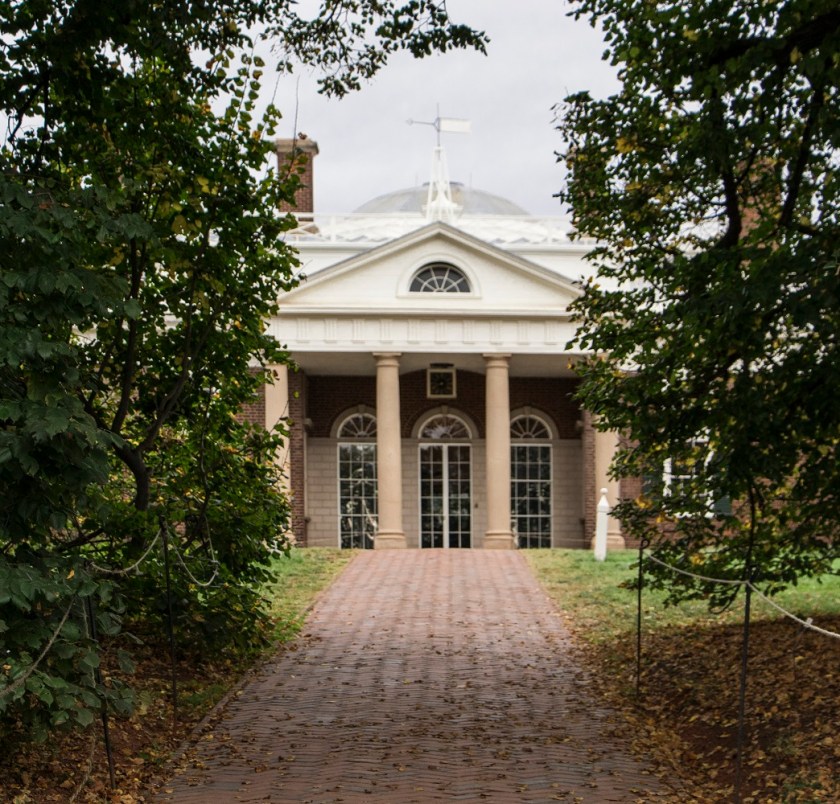
Thomas Jefferson was incredibly intelligent; he was a man knowledgeable of many disciplines. He served as the third president of the United States and the principal author of the Declaration of Independence. However, he also had an incline toward architecture, engineering, innovation, and design. His love for Greek and Roman architecture influenced his design for Monticello as well as his admiration for the works of Andrea Palladio.

The home is incredible, the elements of the exterior are incredible, showcasing symmetry and one of the most famous Jeffersonian features, the dome. However, it does not compare to the interior of the home. Each room showcased amazing pieces that were collected by Jefferson and put on display for guests to observe and indulge in. Clocks, hunting trophies, animal skins, and fossils were on display.

The Parlor, which was my favorite room, was adorned with several paintings, portraits, chairs, Jefferson’s gadgets…

…beautiful drapery, chess boards, and maps.

One of the most fascinating aspects of Monticello is Jefferson’s inventive spirit. He wasn’t just a statesman; he was a visionary inventor. Jefferson created ingenious devices to make his daily life easier and more convenient. Amongst these inventions was the polygraph, a machine capable of making three copies of a document simultaneously. His home was adorned with various pulley systems, orchestrating tasks like serving wine with remarkable efficiency.

Construction of the home began in 1769 and concluded over 40 years later. The residence includes multiple guest bedrooms and cellars for food and wine storage to accommodate guests. Additionally, the home also included living quarters for servants, a blacksmith’s workshop,…

…a kitchen area, stables, and extensive farmland surrounding the main residence.

Walking through the halls of Monticello, there was something to admire in every corner. Jefferson held Monticello near and dear to his heart, it was his haven from his hectic career and political efforts. The home is a true testament to his brilliance and creativity. As we explored the grounds, we were reminded of the remarkable individuals who shaped our nation’s past and left an incredible mark on its future.

Unknown's avatarAuthor mikeyawnPosted on June 16, 2024Format AsideCategories Architecture, Art, Civic Engagement, Politics, TravelTags Center for Law Engagement And Politics, George Washington, James Madison, LEAP Ambassadors, Monticello, Montpelier, Mount Vernon, Sam Houston State University, Thomas JeffersonLeave a comment on A Day With the Founding Fathers

Monticello: An Afternoon at Thomas Jefferson’s Home

Cinthia Villarreal Carrillo

My first time to travel to Washington, DC was earlier this month, when I traveled to the nation’s capital for the Congressional City Conference. It is an understatement to say that I learned a lot: in a three-day period, we saw President Joe Biden, Mt. Vernon, and on the last day, Monticello. It was a LEAP-worthy experience:

It was a beautiful day, perfect for the great tour that was offered.

As we walked along the grounds, we noticed a reflecting pool under a tree that is hundreds of years old. It looked like a perfect opportunity for a photograph.

I got as low as I could to maximize the reflection, and I got the photograph I wanted, just in time for our photography exhibit!

Unknown's avatarAuthor mikeyawnPosted on March 25, 2024Format AsideCategories Architecture, Civic Engagement, TravelTags Center for Law Engagement And Politics, LEAP Ambassadors, Monticello, Sam Houston State University, Thomas JeffersonLeave a comment on Monticello: An Afternoon at Thomas Jefferson’s Home

American Architects: Thomas Jefferson & Frank Lloyd Wright

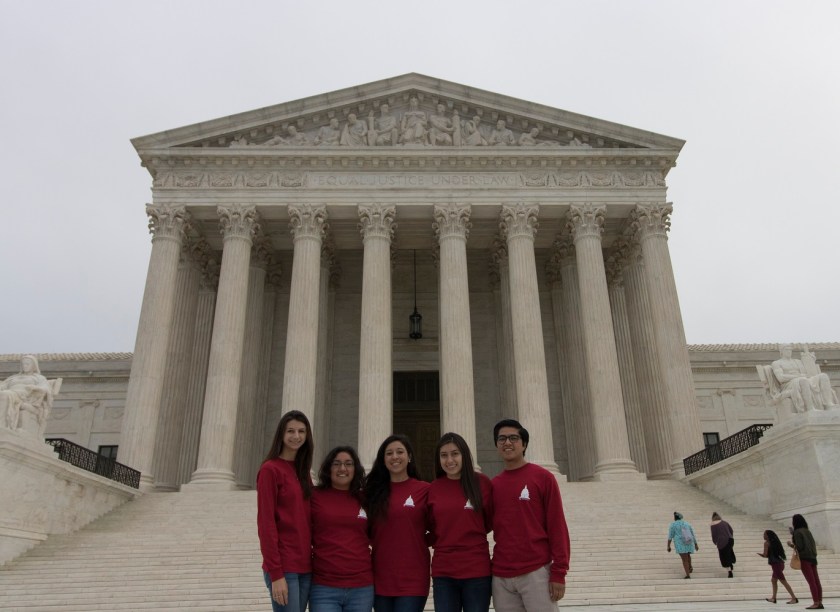
Supreme Court- Karla Rosales

As we arrived at the United States Supreme Court, we were all anxious to see and learn what we could about the judicial branch first-hand. The classical Corinthian-style architecture by Cass Gilbert was structured in such a way that would seamlessly blend in with its neighboring congressional buildings, without diminishing its impressive nature.

SHSU, LEAP Center, LEAP Ambassadors, Washington DC, United States Supreme Court, USSC

It certainly depicted the epitome of American and legal themes by displaying the famous phrase “Equal Justice Under Law”. Inside the “Temple of Justice”, we were greeted by a large statue of the fourth Chief Justice, John Marshall as we walked down the Great Hall. The statue was sculpted by William Wetmore Story in 1883 and was originally placed at the U.S. Capitol, before moving it to the Great Hall in the Supreme Court.

There were various exhibits showcasing the history of the Supreme Court building as well as the Justices that have served within it. One of my favorite exhibits was dedicated to Justice Sandra O’Connor.  She was appointed by President Reagan in 1981 becoming the first woman to be appointed in the U.S. Supreme Court. She was a fellow Texan.  After she retired, she was awarded the Presidential Medal of Freedom by former President Obama for her work. The exhibit displayed her original chair and a beautiful portrait of her.

SHSU, LEAP Center, LEAP Ambassadors, Washington DC, United States Supreme Court, USSC, Sandra Day OConnor

After a quick glance at the other exhibits, we ran upstairs to get a seat in the Courtroom to hear a lecture on the procedures, architecture, history, and art. Security is very tight within the Courtroom. Reporters and photographers go old-school with regular paper and pen. The audience will line up hours in advance to get to listen in on the hearings. Once inside, there are several options ranging from being able to listen to the entire thing to only staying 3-5 minutes at a time. However, I do not understand why anyone would want to stay for so little time after being surrounded by the expensive, yet beautiful Italian marble columns within the Courtroom. Or by being watched by all the important historical figures that advanced the evolution of law throughout time.

Pope-Leighey Home- Kaitlyn Tyra

Our next stop took us outside the city and into the country side! We rented an SUV and drove into Virginia to see Frank Lloyd Wright’s Pope-Leighey Home and Thomas Jefferson’s Monticello.

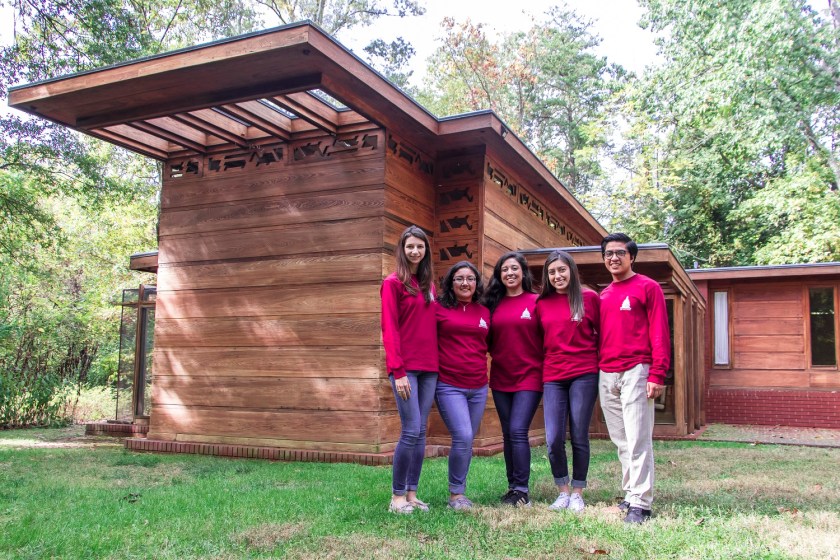
Our first venture to the Pope-Leighey Home was exciting! Frank Lloyd Wright, an architect known for his modern designs and cohesion with nature, designed and built more than 500 hundred homes throughout the United States. Each home was unique and distinctive from the rest.

SHSU, LEAP Center, LEAP Ambassadors, Washington DC, Frank Lloyd Wright, Pope-Leighey House

In 1939, Loren Pope commissioned Frank Lloyd Wright to design and build a home in the rolling hills of the Virginia/D.C. border. Wright built Usonian homes, which was his attempt to build affordable homes designed for modern families and built to be environmentally responsive. The result was a small, artful home perfect for the Popes…. until they had three small children in a 1,200-sq. foot home!

SHSU, LEAP Center, LEAP Ambassadors, Washington DC, Frank Lloyd Wright, Pope-Leighey House

After 5 years, the Pope family sold their home to the Leighey family. Upon Mr. Leighey’s death, Mrs. Leighey donated the home for tours and preservation to the National Trust for Historic Preservation which allows visitors like us to learn about Frank Lloyd Wright each year.

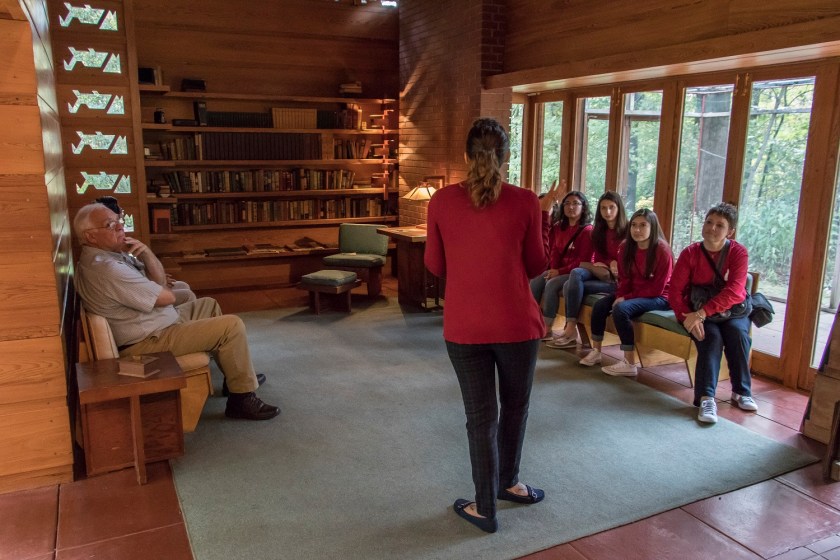
The home itself is designed to not distract from nature. Not very tall, the home creates horizontal lines on the outside with the arrangement of the wooden paneling and the brick alignment. It was interesting to learn about the natural elements of the home that really draw guests in from the outside.

We learned about Frank Lloyd Wright’s signature compression and expansion where he used small spaces, such as hallways to introduce visitors to a large, grand room. Although, the room wasn’t huge, the effect was the same because of the previous small space visitors just stepped out of. Additionally, the Pope-Leighey home showcased a lot of natural light. The windows and doors made the home flow right into nature.

SHSU, LEAP Center, LEAP Ambassadors, Washington DC, Frank Lloyd Wright, Pope-Leighey House

For a few of our group, it was their first time visiting a Frank Lloyd Wright home and made memorable for the rest of the group by the fun stories and beautiful architecture stood out as a favorite for Frank Lloyd Wright home’s we visited!

SHSU, LEAP Center, LEAP Ambassadors, Washington DC, Frank Lloyd Wright, Pope-Leighey House

The Wharf-  Christina Perez

Although the LEAP ambassadors were enthusiastic to add another state to their travel map, we were also excited in adding new restaurants to their list. For lunch we stopped in Alexandria, Virginia the downtown square to sample the cuisine at The Wharf. The Wharf is a nautically themed restaurant with a lot of character. The building was built in 1790 and had been known as The Miller Company which imported crockery, and china. It became The Wharf in 1997. Today, the restaurant still has original brick and even nails from the original building. The Ambassadors always like to try new foods so today Beatriz tried her first salmon sandwich and Mayor Woodward ordered a fried fish sandwich. It was lunch full of good food and great conversations.

SHSU, LEAP Center, LEAP Ambassadors, Washington DC, The Wharf

Monticello- Brian Aldaco

From one marvel of architecture we moved to another in Charlottesville, Virginia. Thomas Jefferson designed his treasured home of Monticello and began construction in 1769. 248 years later, the home still stands with the grandeur Jefferson set out to conceive.

SHSU, LEAP Center, LEAP Ambassadors, Charlottesville VA Thomas Jefferson, Monticello

Upon entering the grand home, we were welcomed by some of Jefferson’s most impressive artifacts and innovations. For example, above his door hung a clock that worked through a pulley system brought down by cannon balls. On one wall were his “gifts of friendship” (Native American artifacts that were given to Lewis and Clark during their expedition) and displayed on another wall were mastodon fossils that he once laid out inside the rooms of The President’s House.

Quickly on the tour, we learned that this Founding Father was not only the political genius that crafted the Declaration of Independence, but was one of the greatest minds of his time. While we explored his library, we were told by our tour guide of the intense assortment of literature (over 6,000 books) once owned by Jefferson. Even more impressive, was one Don Quixote book that stood by a Spanish grammar book on his shelf. These books were both owned by Mr. Jefferson and were his tool to learn Spanish, one of six other languages in which he was proficient.

Jefferson, of course, not only excelled in languages, but was also a prodigy in architecture. Among other things, Jefferson envisioned that every space in his home serve its maximum purpose.

SHSU, LEAP Center, LEAP Ambassadors, Charlottesville VA Thomas Jefferson, Monticello

Every room in Monticello was adorned and designed for an already conceived purpose. In his parlor room, for example, he hung portraits of American heroes (him included) to remind his guests of the nation’s history. As another example, the walls in his dining room were painted with some of the finest oil based yellow paints, to demonstrate the wealth that he possessed. For me, there was no need to go to such choice in colors to show off his wealth. The grandeur of his home, the artifacts inside it, and the stories held within were proof to this Renaissance man’s intellectual wealth.

Following the Monticello indoor tour (where photography was prohibited), we had a chance to roam the exterior, taking photos and seeing the grounds.  We noted that Monticello is featured on the back of the nickell…

SHSU, LEAP Center, LEAP Ambassadors, Charlottesville VA Thomas Jefferson, Monticello

…of course, we also took an obligatory LEAPing photo…

SHSU, LEAP Center, LEAP Ambassadors, Charlottesville VA Thomas Jefferson, Monticello

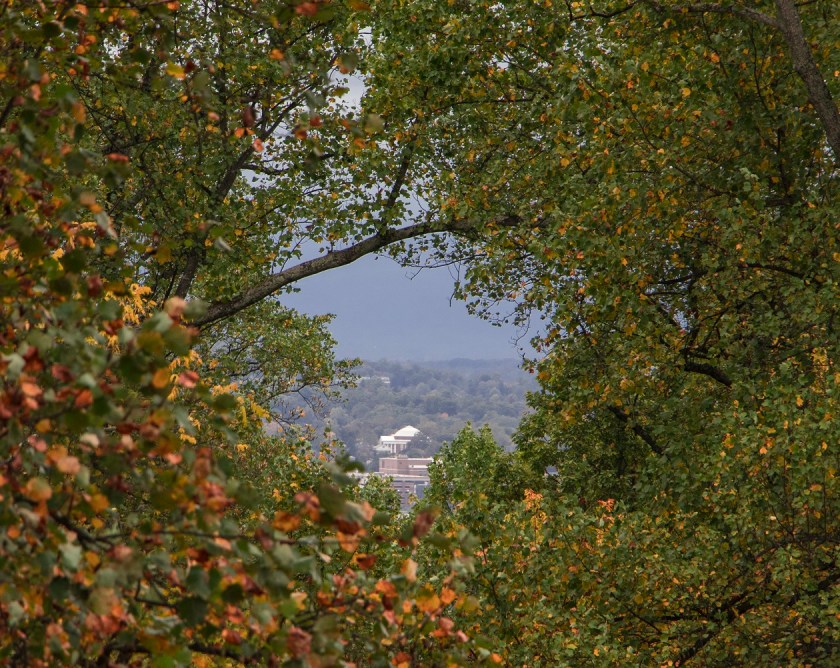
…and we also noted that you can see one of Jefferson’s other designs–the University of Virginia–from his home.

SHSU, LEAP Center, LEAP Ambassadors, Charlottesville VA Thomas Jefferson, Monticello, University of Virginia

University of Virginia- Brian Aldaco

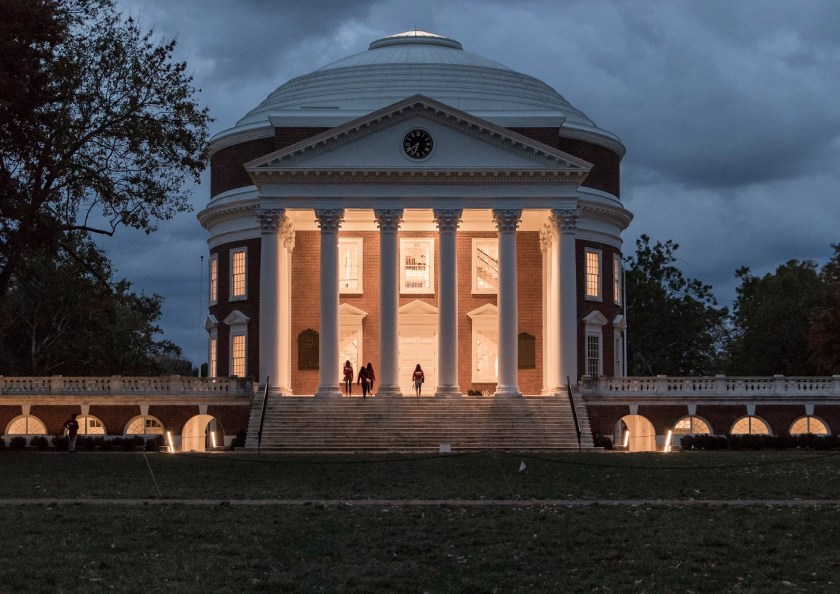
A chief principle that Jefferson believed was necessary to preserve democracy was to educate the public. This principle was so dear to him that he set out to establish and design the University of Virginia. After we left Monticello, we dropped by the beautiful UVA campus to admire these Jeffersonian structures.

SHSU, LEAP Center, LEAP Ambassadors, Charlottesville VA Thomas Jefferson, University of Virginia

One of the grandest of Jeffersonian buildings on campus is the Rotunda. Located at The Lawn of the campus, this grand building sits on top of the hill with student dorms standing on the sides of the pathway that leads towards The Rotunda. On the way up the hill, we were so impressed by the dorms that we decided to peek inside.

SHSU, LEAP Center, LEAP Ambassadors, Charlottesville VA Thomas Jefferson, University of Virginia

Well, we gave ourselves a brief tour of the rooms, but the grandeur at the top of the hill kept calling us. When we got there, we found out that the doors were locked, however that didn’t stop us from giving a look inside through the windows and other cracks in the building.

SHSU, LEAP Center, LEAP Ambassadors, Charlottesville VA Thomas Jefferson, University of Virginia

Enjoying every minute of the campus, we quickly lost sense of time. Before we knew it, it was time to head for dinner.

Citizen Burger Bar- Christina

Before leaving the great state of Virginia we headed to a local burger bar called “Citizen Burger Bar.” The restaurant’s motto is “A delicious burger is your right. Perhaps even your responsibility.” Of course, we had to exercise our rights to a good burger, so we ordered some of the best things on the menu. We started our meal with onion rings, which just kept coming so we had plenty of them! Kaitlyn, our mushroom lover, ordered the Wild Mushroom and Swiss burger and Beatriz ordered a grilled cheese sandwich with slices of apples inside! During dinner, everyone shared their favorite events of the day.  Then, we headed back to DC to prepare for a White House Tour in the morning.

SHSU, LEAP Center, LEAP Ambassadors, Charlottesville VA Thomas Jefferson, University of Virginia

Unknown's avatarAuthor mikeyawnPosted on May 7, 2019Format AsideCategories Art, Civic Engagement, Food, Law, Politics, TravelTags Charlottesville VA Thomas Jefferson, Frank Lloyd Wright, John Marshall, LEAP Ambassadors, LEAP Center, Monticello, SHSU, United States Supreme Court, University of Virginia, USSC, Washington DCLeave a comment on American Architects: Thomas Jefferson & Frank Lloyd Wright

LEAP Ambassadors Are Involved!

This slideshow requires JavaScript.

Follow Us On Facebook!

Follow Us On Facebook!

Catch Up With Us

  • A M*A*S*H* Wrapup December 24, 2025
  • Understanding Globalization: Lessons from a Leading Journalist December 22, 2025
  • Crafting for a Cause December 18, 2025
  • Exploring The Shining: A Kubrickian Journey December 15, 2025
  • Interactive Experiences at Asia Society Texas: A Student’s Perspective December 14, 2025

Join The Conversation!

The Civic Leadership… on Foundational Activities of the…
The Civic Leadership… on The Philosophical Foundations…
LEAPing Into Action… on The Philosophical Foundations…
Jada Cook's avatarJada Cook on SHSU Students LEAP Across Five…
Reflections from the… on Kicking off the Semester Right…

Find Previous Posts

Fun parts of preparing for an office anniversary: working with these three. True story: @megface purposefully composed this photo so that Professor Yawn was most near the ‘ol’ in the sign.

We also have Twitter!

My Tweets

LEAPing Into LEARNing

This slideshow requires JavaScript.

  • About LEAP
  • LEAP Ambassadors
Center for Law, Engagement, and Politics Blog at WordPress.com.
  • Subscribe Subscribed
    • Center for Law, Engagement, and Politics
    • Join 487 other subscribers
    • Already have a WordPress.com account? Log in now.
    • Center for Law, Engagement, and Politics
    • Subscribe Subscribed
    • Sign up
    • Log in
    • Report this content
    • View site in Reader
    • Manage subscriptions
    • Collapse this bar
 

Loading Comments...