Separating the “governing” part of our day and the “campaigning” part of our day was the local pizza joint, “Frank & Angie’s.” While everyone grubbed on the delicious food—pepperoni with Canadian bacon pizza, pepperoni garlic bread, cannolis, and tiramisu—Professor Yawn elucidated the various cultural allusions in the restaurant. It is named for Frank Sinatra, and the menu includes references to Italian superstars, Sergio Leone, Mario Puzo, Bela Lugosi, and Mira Sorvino.
With well-fed stomachs and minds, we moved on to the second part of our day: the Campaign Bootcamp, sponsored by the Annette Strauss Institute’s New Politics Forum. Our introduction to the process was by Taylor Foody, the coordinator for the NPF…
…who introduced our two mentors: Matt Glazer and Luke Marchant. They introduced themselves, explained why the affiliated with the parties they did (Glazer is a “D”, and Marchant is an “R”), and issued our campaign marching orders: to run a successful “mock” campaign for US House.
Our training then began in earnest, with Rob Johnson and Cliff Walker—veterans of local, state, and national campaigns—who covered the recruitment of political candidates. After noting that running for offices has nothing in common with “West Wing” or “House of Cards,” they discussed the importance of running for offices for the right reasons (e.g., making your community a better place) and the importance of hiring competent campaign managers and financial advisors who, beyond being competent, should also have integrity.
Session Two was led by Taylor Holden, who is the Development Director for New Era Colorado, but who has Texas campaign experience. She was very energetic—she drank coffee during her presentation, we noted—even as she discussed fundraising and budgeting.
Campaigns cannot run unless there is sufficient money. Her points were simple:
Get to the point;
Don’t be afraid to ask for a specific dollar value;
Don’t avoid “awkward” silences; and
Stress urgency.
The importance of urgency was not lost on us, not with only fifty-two hours to meet our campaign team, learn about our campaigns, learn how to campaign, and develop a campaign plan. With that in mind, Ms. Foody allowed us to meet with our campaign groups. Christina and Isabela were placed in separate teams for separate Republican candidates, and Brian was on a team working for a Democratic candidate.
Our closing session—the keynote—was presented by Austin City Councilman Gregorio Casar, who discussed city politics and his campaign experience. Casar, who was elected at the age of 25 and is a New Politics Forum alumnus, offered an interesting presentation not only because of his advice (e.g. “rely on friends”) and personal story (e.g., the youngest person to ever serve on Austin’s City Council)…
…but also because of the interesting things going on in Austin’s politics. For example, most people know that Austin recently required Uber and Lyft to abide by the same regulations as taxis, but did you know that Austin also prohibited local employers from asking about criminal records on their applications? Even large corporations are now required to change their Austin applications to avoid any mention of a police record. This led to much debate among the students, a debate stopped by Mr. Marchant’s admonition that we are here to learn about campaigns, not to debate policy.
It was an interesting close to a day in which we learned about both policy and campaigning and much else, much to our delight and edification.
The LEAP Center Student Advisory Board (and some fellows SHSU students) embarked to Austin this week to attend the New Politics Forum’s “Campaign Bootcamp.” But in the true multi-disciplinary spirit of the organization, we had a few other things to tackle first…
Salado Creek
To begin of our first full day in Austin, LEAP students headed to Salado, TX to explore a tiny, tourist town full of southern hospitality. Upon our arrival, we visited Salado Creek with hopes to see Tabletop Rock, where wagons crossed the creek bed during the nineteenth century. The group took the opportunity to take selfies with the overflowing creek.
Salado College
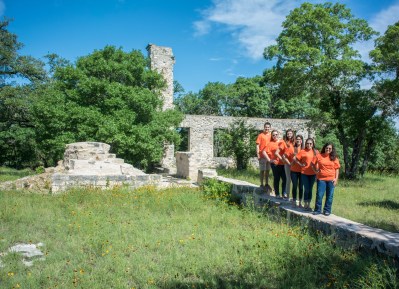
In the nineteenth century, Salado was also home to Salado College, which had 300 students at peak registration. Unfortunately, in 1901 the college burned down leaving ruins which have since been converted into a public park. The ruins made for an exciting photo opportunity!
Following our visit to the Salado College ruins, LEAP students eagerly enjoyed browsing about in local shops. We encountered many different types of art, jewelry, and homemade goods. Helping to boost our energy, the group stopped at Salado Mercantile, a gift shop, which offered a variety of unique bottled sodas and their specially seasoned crackers.
The Legend of Sirena
Regaining a bit of jump in our step, the LEAP Center students headed to the statue of Sirena, by Troy Kelley. According to mythology, Sirena, an Indian woman, wished to marry a brave man who did not feel the same passion for her. Drawn by her pain of unrequited love, a magic wielding catfish found her and promised her marriage with the warrior if she swam as a mermaid with him each full moon for a year. She married her brave man, knowing that no human could see her in her mermaid state, lest she be mermaid forever. The last full moon of her penance, Sirena’s husband saw her swimming in the river, sealing her mermaid fate. She now lives as a bronze sculpture, forever in anguish on the bank of Salado Creek.
To suppress our mid-morning sweet tooth, we made our way to a special treat that included sampling a delicious assortment of fudge at Salado’s Mud Pies Pottery. In the end, the group favorites were the crème brûlée, red velvet, and salted caramel fudge. Inside, we also eyed with want the wonderful ceramics masterpieces by local artist, Titia Arledge.
Salado’s Sculpture Garden
One of the unique parts of Salado proved to be the Salado Sculpture Walk. Consisting of a single pathway and a small creek, the sculpture walk was an unexpected surprise. Students enjoyed observing the unique pieces of art such as Troy Kelley’s “Handicapped Mask” and another by La Paso named Starburst for its kinetic motion.
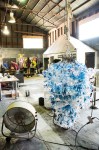
Bringing the adventure of Salado to an end, LEAP students had the opportunity to watch one of Salado’s glass blowing artists, Aaron Gist, in action as he created hand blown pieces for a Chihully-like chandelier masterpiece. Watching in amazement, LEAP students observed the art of making glasswork in one of the many local shops that exhibits the importance of art to Salado’s community.
Georgetown’s Monument Cafe
On the way back to Austin, LEAP students made a speedy stop for lunch at the Monument Café in Georgetown.
The Cafe specializes in breakfasts (served all day) and lunches. We opted for the lunch fare, with our group enjoying home cooked biscuits, club sandwiches, burgers, and delightful fried blueberry pies with frozen custard. The food was good, the service was friendly and quick, and we left satisfied and in a hurry to get to the New Politics Forum Campaign Bootcamp.
New Politics Forum
Our Salado adventures were so intriguing that we arrived late to the University of Texas campus and managed to walk straight into the beginning presentation. Luke Marchant, the director at Mammoth Marketing Group, who has successfully managed state and federal political campaigns for people such as U.S Senator Marco Rubio, was our first Republican mentor along with Democrat Matt Glazer. Matt Glazer is currently the executive director of the Austin Young Chamber of Commerce and is also a seasoned NPF democratic mentor. The two mentors opened up by discussing the types of campaigns and highlighted the different areas of them. We learned that using previous polling data would help us decide to simply mobilize the voters or persuade new voters. Marchant and Glazer also spoke to us about the elements of a campaign and some of those elements include knowing the reason why are you running, the issues that matter, the goal and the message that you want your campaign to portray. Asking yourself why you are running is one of the most important questions of campaigning.
After a short break, we were introduced to Rob Johnson and J.D. Gins. Rob Johnson is the former campaign manager for Rick Perry for President and J.D. Gins is the executive director of Travis County Democratic Party. Like the first two speakers, Gins and Johnson are men of opposing parties to fulfill the nonpartisanship ideals of the program. Both speakers agreed that running a campaign involves “blocking and tackling”, meaning that following the steps to create a successful campaign is key. Rob Johnson pointed out that the Digital Director is one of the most important persons in a campaign and that adapting to society is crucial to produce a win.
Johnson and Gins at NPF
When Gins and Johnson are determining if they want to run the campaign of a candidate, they ask a few important questions, including whether they have enough money, whether there’s an open position, and most importantly whether a candidate WANTS to run and put in the effort that it takes to win. As Gins said, “When you walk in, do the work in front of you” meaning that not even the candidate is above the smallest job that needs to be done. Before closing their presentation and going to a break, the two men let the students know that they look for people who take direction well, work hard, are willing to challenge the senior staff, while being humble enough to ask for help.
When we returned from our break, Pasha Moore spoke to us about fundraising. She informed us of the reasons individuals give to campaigns and the components of a finance plan. There are many reasons that people give, such as friendships, habit, to change or affect policy, but Moore let us know that the main reason that people give to campaigns is simply because they are asked. She also emphasized “the ask”. There are different ways of asking and you should always be confident and straight forward when asking people to donate money. Finally, she closed by reminding us to always thank the donors.
Seeing as the afternoon was turning into evening, we finished the last session to emulate a real campaign scenario with a “working dinner” of pizza and salad, while being able to meet and interact with our teams for the first time.
The weekend of campaign bootcamp consists of long days of training, finishing with presentations from each team on Sunday. Ironically enough, most of the LEAP Center students, Republicans at heart, were placed on Democratic teams. This might stem some interesting debate among peers.
Our first task as a team was to pick a name. This proved to be a great way to interact with our team for the first time and share ideas. After so much brainstorming we finally came up with our team names and began planning for our presentations. We shared our ideas on different political views, which should prove helpful in order to strategize for our campaign plans.
After our “working dinner” it was time to get back to our next presentation on volunteering. Executive director of the Dallas County Democratic Party, Taylor Holden, presented how volunteers are the building blocks to a campaign. We learned about recruiting, training, and rewarding volunteers. Volunteers will authenticate and build momentum for a political campaign. We learned the cardinal sins and commandments of volunteering such as never lie or skip training and building relationships with volunteers. Seen by most as the most important building block of a campaign, we sat with bated breath while taking in all of the complexities that volunteering entails.
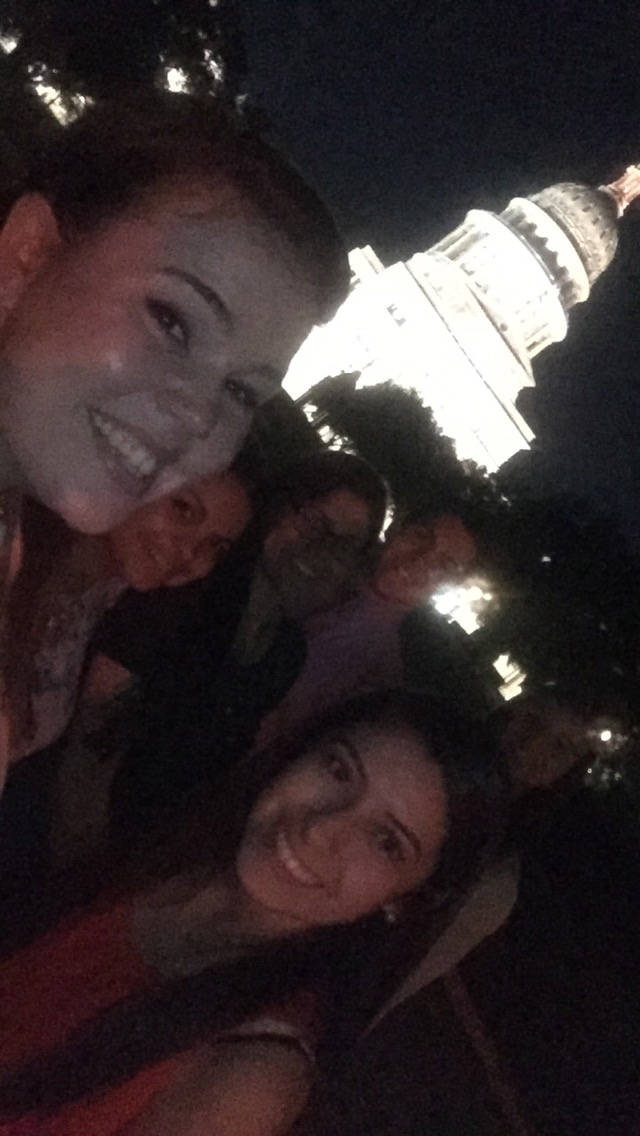
Exhausted, we ended our first day of campaign bootcamp and headed back to the hotel. On our way back to the hotel we made a quick stop at the Capitol building for a goodnight selfie.
Excited about our day tomorrow full of training, we headed to bed ready to learn and soak up all that boot camp has to offer.
May 31–Our Austin agenda is packed, and Friday morning was no different. We visited the Bob Bullock State History Museum, which covers hundreds of years of Texas history—from Spanish explorers to Apollo 13 landing on the moon and reporting back to Houston. With so many interesting facts about the state, it was impossible to learn about all the exhibits and artifacts. But we each had our favorite, lingering over important documents, old fashion tools, jewelry, many weapons, and large-scale displays.
Perhaps the most intriguing of the exhibits to our group was the “Goddess of Liberty.” The exhibit allows you to get close to a full-sized replica of her, and her features were over-large and unflattering.
The reason, according to the Museum, was so that the facial features would be noticeable from 310 feet away, which is the height of the Capitol Building. Rumor has it that she was placed atop the capitol building to make it just a bit taller than the US Capitol. My favorite exhibit, however, was Lone Star flag, which included a quote from Sam Houston, who noted that the flag is a “symbol of heritage that marks who we are as a people, who the land has made us, and who we will become…” It was a fitting quote for our group from SHSU, the University which marks us as a group and will influence who we will become.
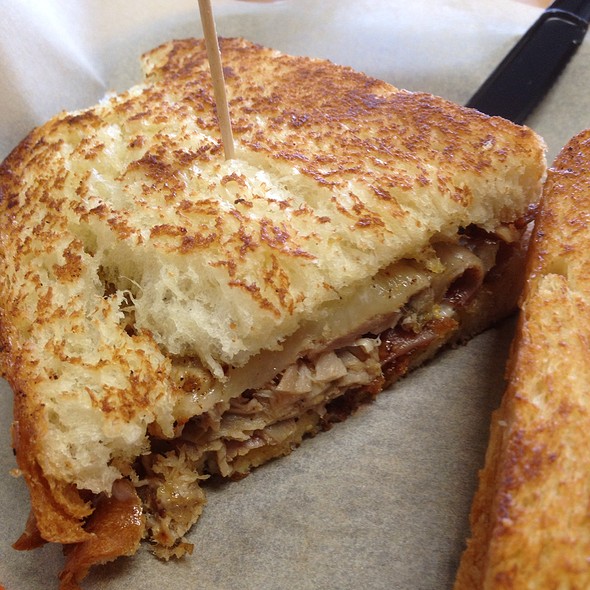
After feeding our brain with knowledge of Texas history, we were also introduced to new spices, flavors, and foods. For lunch, we tried the Noble Sandwich, where a long line for the food attested to the popularity of the restaurant. The line also gave us the opportunity to discuss the menu options, which culminated with Jake deciding on the Noble Pig Sandwich (pulled pork, bacon, spiced ham, and provolone) and the ladies sticking together and ordering the delicious Turkey Chop (red onion, cucumber, fresh herbs, and lemon coriander vinaigrette. Professor Yawn opted for the Smoked Duck Pastrami, which consisted of duck, sauerkraut, and Russian dressing.
We also expanded our palates by trying a double fudge cookie, a coconut cookie, a maple and pecan cookie, and an exotic chocolate bacon tart!
We ended the night with a visit to Quack’s 43rd Street Bakery. We greatly enjoyed a lively conversation, as well as desserts, coffee, and tea. Lupe and Jake finished off a piece of Peanut Butter Fudge cake and a double chocolate brownie, while Joyce and Makeebba shard a Vegan Lemon Blueberry cupcake, and we all enjoyed ginger cookies, a specialty of the bakery.
In between lunch and our late night snack, we spent a full day at the New Politics Forum’s “Campaign Bootcamp.” We met students from all over Texas, students from the University of Texas, Texas State, Texas A&M, Rice, and University of Houston. We weren’t sure what to expect, but we were eager to learn from veteran campaign staff, who serve as presenters and mentors on topics such as fundraising, campaign management, volunteer recruitment, message shaping, crisis control, getting out the vote, and social media. Emily Einsohn, the Coordinator of the New Politics Forum, offered introductions, and she helped establish a welcoming environment, allowing us to focus on the substantive topics.
Our first presenter, Parag Mehta, was the Outreach Coordinator for the Barack Obama Presidential Transition Team, and he led off with a poem for an introduction. It was a nice icebreaker.
Dr. Regina Lawrence, the Director of the Annette Strauss Institute began with a discussion of statistics, helping us know how to target vote totals.
We also heard from Luke Marchant, the Republican mentor, and Parag Mehta, the Democratic mentor—both have worked for high-level elected officials.
At least one of us found the campaign management seminar, led by Rob Johnson and Ed Espinoza, to be the most informative. It was a great overview of the process, and appropriate for our first day.
We also broke into our groups and were given a hint of our hypothetical scenarios, in which we work to ensure victory for our hypothetical candidate. One of the nice—and fun—aspects of the campaign is that the scenarios bring together Democrats, Republicans and Independents together to work on the same team. We’ll see how that goes!











 Center for Law, Engagement, and Politics