With an impending departure from Santa Fe looming, we wanted to get in one more experience: a hike. We had considered the challenging Picacho Peak and the easy Hondo Arroyo, but we opted for a middle option.
Sun Mountain Trail is listed as a 1.6-mile round trip hike that is still challenging–a function of its 734 feet elevation gain.
And from what we’ve read, the hike offers impressive views from the top of the trail.
The hike begins in a semi-residential area, and it soon grows steep.
For Texans such as ourselves, the thin air is a challenge. Denver may be famous as the “mile-high” city, but Santa Fe is a 1.4 miles above sea level. Houston, by comparison, is about 50 feet above sea level, so between the exertion and the thin air, we were breathing heavy.
Photo by Olivia Discon
Stopping for breath had other virtues.
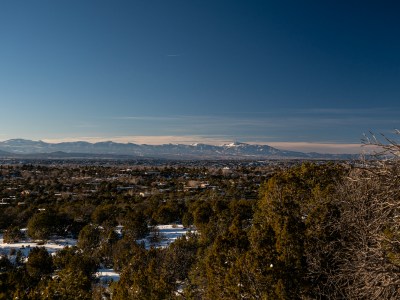
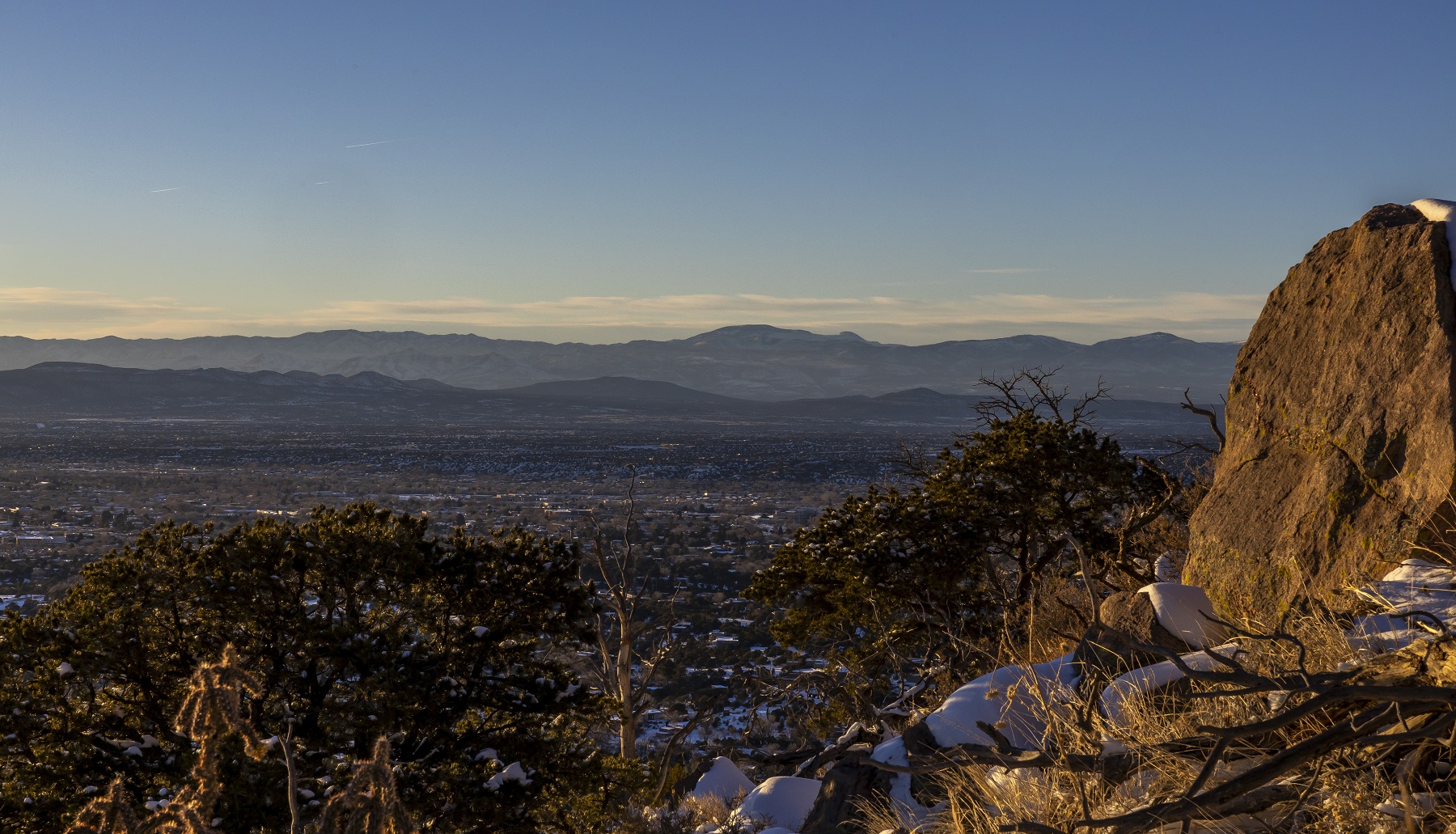
The trail wends its way up the mountain, offering periodic views of the community below, the mountains on the horizon, and the snow that had recently blanketed the area.
As you approach the top, you go through a series of switchbacks which can be difficult, but which offer even better views.
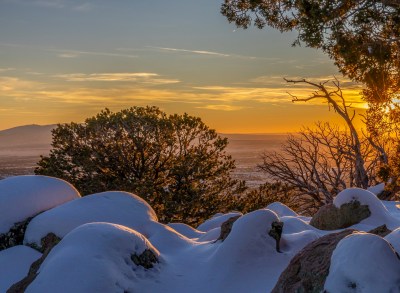
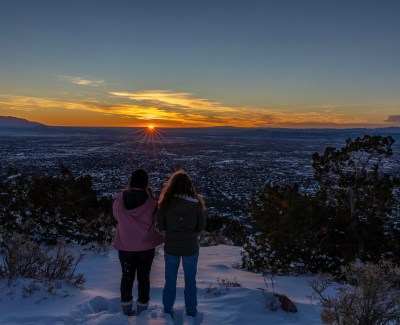
As you might imagine, it’s windy at the top, but it’s beautiful, especially at sunset.
Photo by Cinthia Villarreal Carrillo
It was cold, but we stayed in the wind and cold so we could see the sun drop below the horizon, soak in the blue hour, and enjoy the feeling of accomplishment. For Cinthia and Olivia, this was the highest elevation ever reach: 7,920 feet.
It was, we decided, a great vantage point from which to say au revoir to Santa Fe, knowing we will be back one day.
The second leg of our trip is focused on activities and individuals in Santa Fe, NM, and it was to this destination that we set out early Sunday morning. Armed with coffee (and muffins) from Que Suave, we stopped by the Old San Miguel Mission in Socorro as a way to learn more about New Mexican culture…
…but also to practice our skill at architectural photography.
San Fancisco de Assisi, Golden, NM
Leaving Socorro for Santa Fe, we opted for the “Turquoise Trail” rather than simply taking the quickest route. This allowed us a more scenic drive, while also giving us the chance to stop in some smaller towns along the way. One of these towns was Golden, NM, where we stopped to see another Church: The St. Francis de Assis Catholic Church. It’s a beautiful church, surrounded by the graves of parishioners.
We also stopped in Madrid, NM, a wonderful little town that is as charming as it is unusual. We purchased more than two pounds of chocolate at Shugarman’s. Olivia and Cinthia were not expecting to buy chocolate, but after sampling some of the intriguing flavors (e.g., Hibiscus Flowers with Lemon and Ginger), we were hooked.
Indigo Gallery
by Olivia Discon
One of the first places we visited in Madrid was the Indigo Gallery, owned by artist Jill Shwaiko. It seemed to have been the perfect day to stop in, because the artist herself was in the gallery and ready to share some of her work with us! Her work commonly features a thought-provoking goat/sheep motif, along with inspiration from the petroglyphs of indigenous people.
Ms. Shwaiko strives to capture emotions such as perseverance, strength, and frailty in her art, and this is apparent when looking at her work. She also uses vibrant colors, and she even provided us with a mini-lecture on color theory! Her work brought forth many new perspectives, and her lessons resonated with me. Most of all, she encouraged us to experience life, not just survive it. On a special, fun-filled trip such as this, what better advice could one have? We all left Ms. Schwaiko’s gallery excited for what other excellent experiences we have in store.
Olivia, Cinthia, and artist Jill Shwaiko, in Madrid, NM
Finally, we stopped by the Mine Shaft Tavern for our daily fix of food that includes green chile, a semi-must while we are in New Mexico. We had green chile stew, green chile chicken pizza, and the green chile cheeseburger–the latter of which won “the green chile burger smackdown.” The food was excellent!
Santa Fe
When we arrived in Santa Fe, we immediately went to the Plaza. The Plaza is rich with history and many other attributes, so it was a nice way to begin our Santa Fe journey. Our first stop was the Palace of the Governors, where Native Americans are given exclusive rights to sell their products as long as they meet certain requirements (one of which is that the work must be hand-made).
We bought a total of three pieces of art/jewelry from different vendors, and we very much enjoyed learning about the program and the lives of the artists.
Olivia Discon, Cinthia Villarreal, and artist Jeremiah Herrera
New Mexico Museum of Art
by Olivia Discon
To continue our pursuit of immersing ourselves in the New Mexican art scene, we stopped by the New Mexico Museum of Art on the Santa Fe Plaza. Here, we were able to discern several familiar names which we have grown accustomed to while on our tour of the southwest, especially John Nieto, Jesus Moroles, and Allan Houser. But we also had the opportunity to learn more about New Mexico through some artists we hadn’t yet familiarized ourselves with. In my case, I took to a painting by Joseph Henry Sharp, titled “The Stoic”. The size of the piece would be sufficient to capture one’s attention, but it was also captivating in its composition.
“The Stoic,” by Joseph Henry Sharp
Interestingly enough, Sharp was one of the first Americans to visit, and remain in, Taos, New Mexico, and he is regarded as the ”spiritual father” of the Taos Art Colony.”
An artist that was new to Cinthia and me was Fritz Scholder, and we saw his work in various locations and on various media. At the New Mexico Museum of Art on the Plaza, we were able to see a few paintings of his, the most interesting of which was a self portrait.
Fritz Scholder, “Self Portrait”
A close second for the group was a totem of his in the sculpture garden!
Fritz Scholder, “Totem”
The New Mexico Museum of Art on the Plaza also has an auditorium that resembles a chapel, with beautiful murals lining the walls. My personal favorite mural was “The Apotheosis of St. Francis”; a scene that personifies the humanities. Art, religion, literature, philosophy, and society can be seen as gifts of St. Francis to humanity. It was particularly enjoyable to decipher which personification matched which discipline (I implore the reader to guess themselves).
In all, this museum was the perfect place to learn further about New Mexican art, along with reinforcing some of the art that we have come to know and (mostly) love.
The Georgia O’Keeffe Museum
by Cinthia Villarreal
In case it has gone unnoticed, art is an essential part in LEAP’s interdisciplinary philosophy. Learning about different artistic styles, media, eras, and artists contributes to our broadened horizons and cultural awareness. With that, it was essential that we visited the museum of renowned artist Georgia O’Keeffe, who spent her later years in New Mexico. Not all of us are huge fans of work, but even the doubters found many works to enjoy and much to learn about.
To our surprise, the museum provides visitors with an audio tour O’Keeffe’s thought process and life happenings behind several of her works. The art works were divided by different stages throughout her life, which were seemingly different from one another. This helped us watch how she grew alongside her art. One of Olivia and my favorite pieces ended up being a watercolor painting done by O’Keeffe at just 16 years old!
Of course, O’Keeffe is specifically known for her abstracts of flowers and landscapes using bright New Mexican colors;
….nonetheless, she proved her versatility and resourcefulness by painting the skyscrapers and night sky of New York with unusual colors for her palette.
Another period in her life that really resonated with us was when she moved to New Mexico after the death of her husband, Alfred Stieglitz. The artist intensely expressed herself by using dark, ominous abstracts.
As she settled in the new state, she noticed the lack of flowers in the deserted environment around her and decided to change her portrait subjects by collecting skulls and bones. This interesting and unique idea set her apart from the rest of the artists in her time for, again, her creativity and originality.
Olivia’s favorite art work from the museum was “Black Place I” because of its looming gray landscape with some hinted red hues along the bottom of the painting. This is O’Keeffe’s depiction of the American Southwest, which she described as “a mile of elephants”.
Professor Yawn enjoyed the ‘Church Steeple,” and…
…I enjoyed the colorful abstract, “Pelvis.”
Interestingly, O’Keeffe only did three sculptures in her life, and we had the chance to see two of them. The first we saw at the New Mexico Museum of Art–a large sculpture of a spiral shape.
That shape, we learned from the O’Keeffe Museum was actually inspired by a ram’s horn…
…and it’s a figure she also painted…
The other sculpture we saw was a small, semi-abstract.
As our minds expand to appreciate and understand art from a more mindful perspective, we left the museum, but not before stopping at the gift stop for something to remind us of this great endeavor.
It was enriching day, filled with learning, new experiences, and the beauty of Santa Fe. As we left the Museum and re-crossed the Plaza, the sun set, leaving us in the “blue hour,” and it began to snow. With the remaining light of the sun’s glow, reinforced by the Christmas lights on the Plaza, we took a final photo of the day.
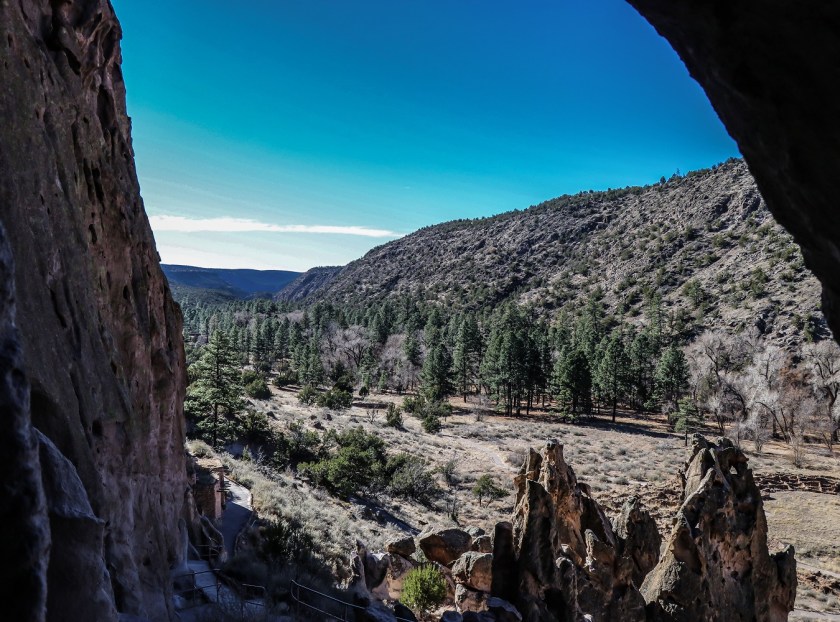
On our last day in the rugged west, we went for an early morning hike at the Bandelier National Monument, where the Ancestral Pueblo people lived starting approximately 11,000 years ago.
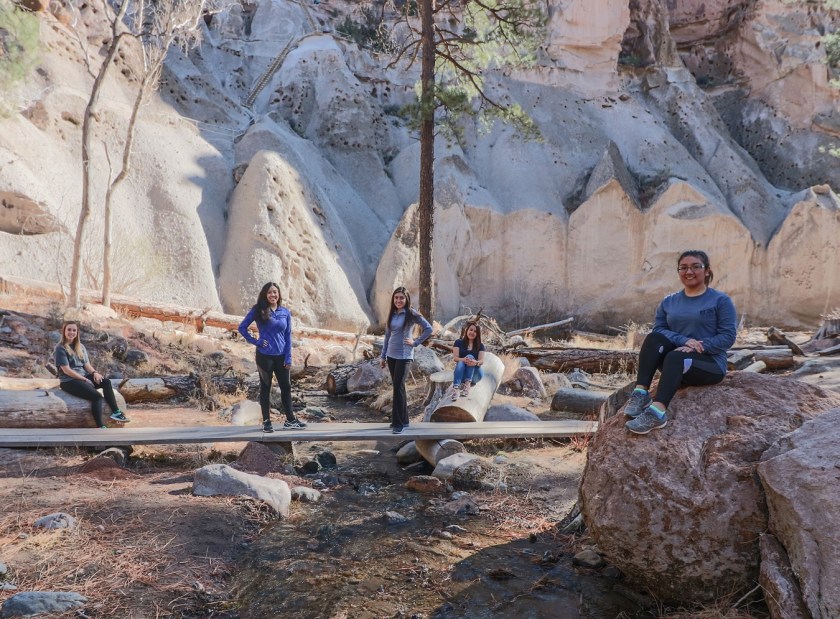
The Bandelier National Monument encompasses over 33,000 acres of protected land and over 70 miles of trail. We adventured on the most popular trail at the national monument, the Main Loop Trail, also known as the Frijoles Canyon Trail. As we wandered on the 1.2-mile trail, we had the opportunity to see archeological sites such as Big Kiva…
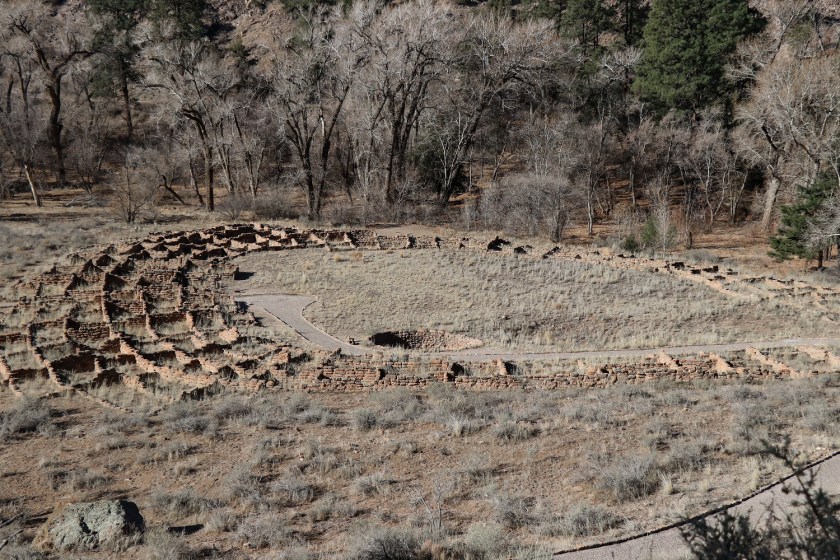
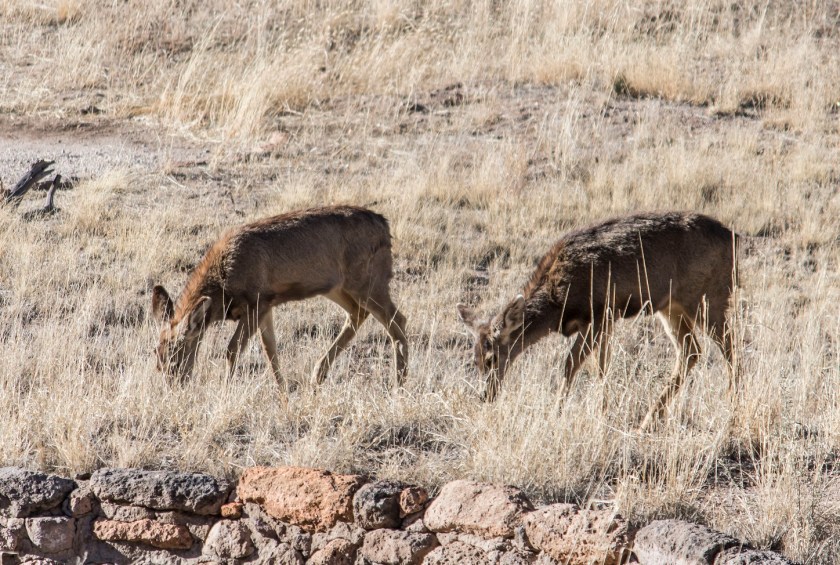
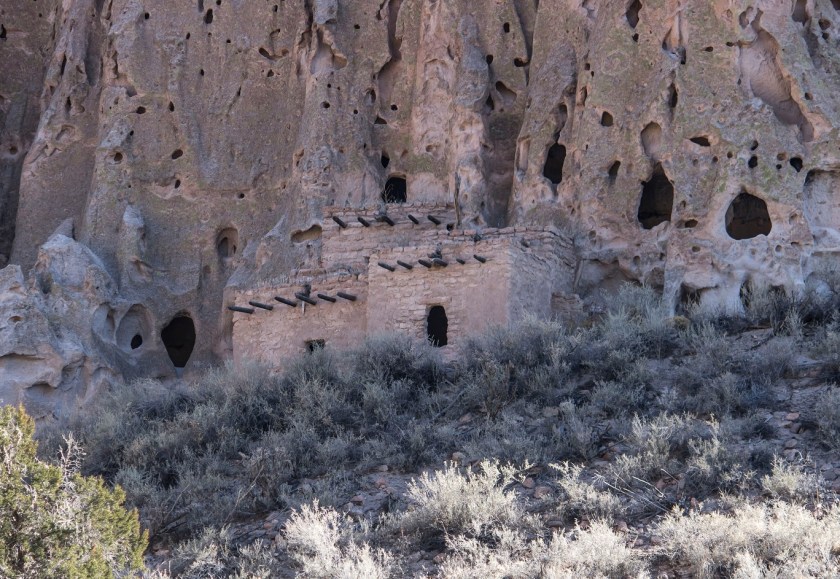
…Tyuonyi, Talus House and the Alcove House. As we learned about Big Kiva, a communal meeting place used for religious, educational and decision-making purposes, we spotted three mule deer around the Tyuonyi ruins. To our surprise, one by one, the deer calmly approached the site, stopping a couple feet away from us to snack on some of the grass (although we want to believe that it was because we are some kind of wildlife whisperers).
As we continued with our tour, we learned that the Tyuonyi pueblo was one of the several large pueblos located within the Bandelier National Monument. The Tyuonyi once had over 400 rooms and it was home to approximately 100 people.
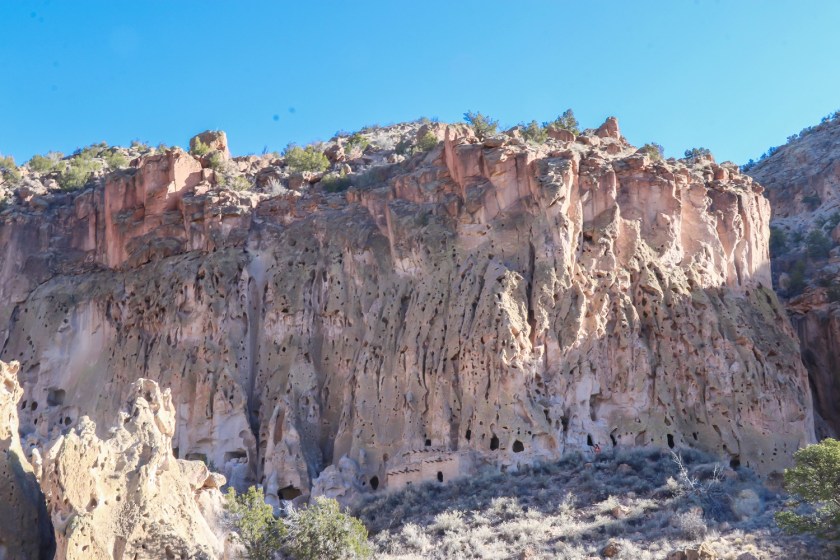
We were able to better appreciate the scale of the remainings of the Tyuonyi structure after climbing a volcanic tuff cliff situated in front of it. Resting on the cliff were the Talus Houses which were reconstructed in 1920.
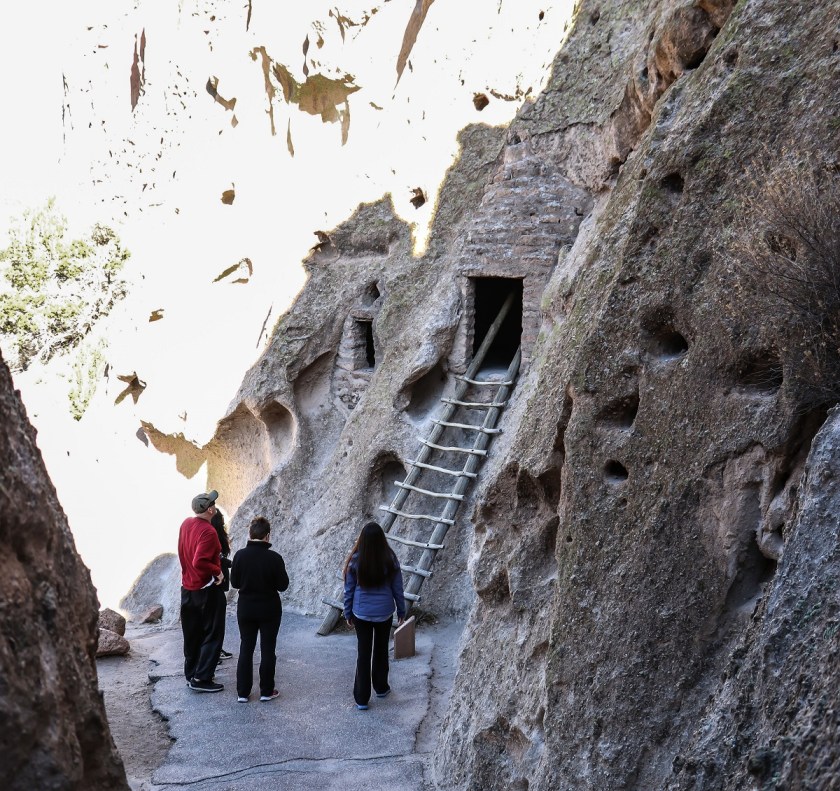
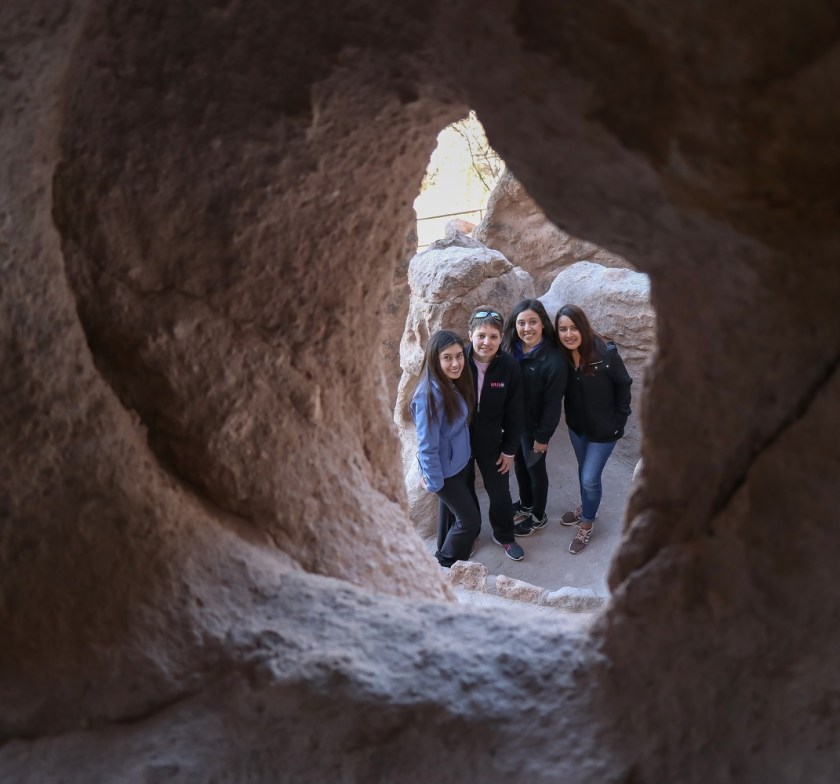
We had the opportunity to enter the small cave dwellings called cavates via ladder.
We learned that because the clay rock was crumbly, the people would burn the clay constantly to make it sturdier.
Midway through our trail…
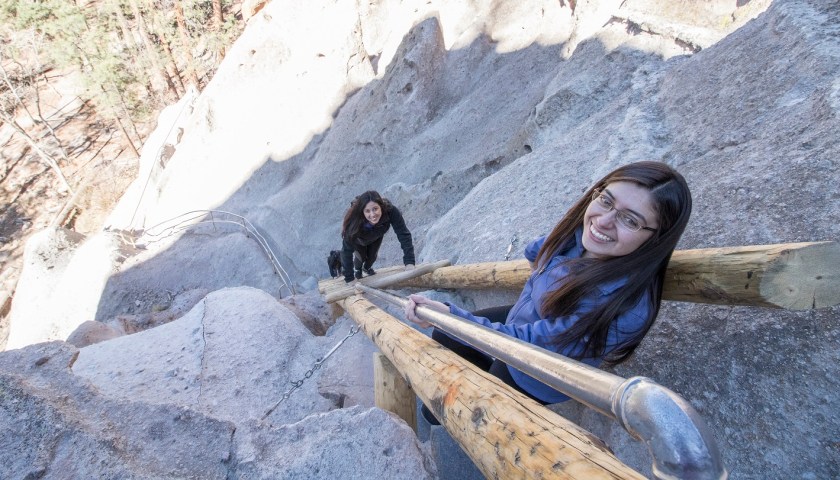
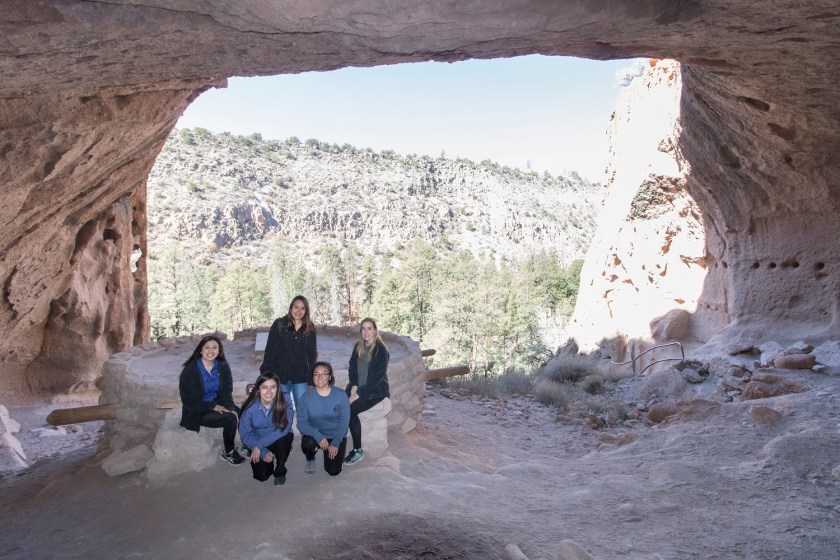
…we adventured on the Alcove House which rests in the upper part of some large volcanic tuff cliffs.
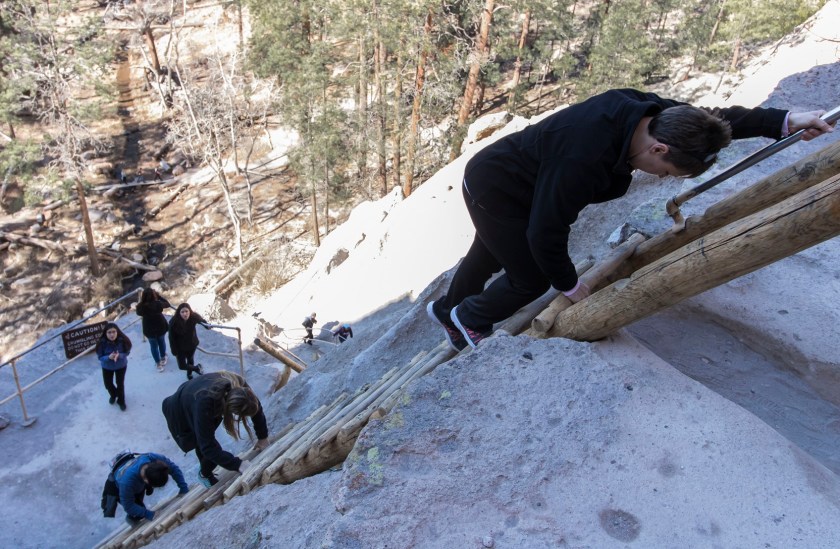
To reach the former ceremonial cave, we climbed 140 feet up via four steep wooden ladders…
…all despite Karla’s fear of heights.
Luckily…
This slideshow requires JavaScript.
…the narrow and partly paved paths were not crowded by visitors, which gave us some extra time to carefully explore…
This slideshow requires JavaScript.
…and enjoy the views…
of such a scenic and photogenic place.
Shopping Downtown by Karla Rosales
After our hour-long hike at the Bandelier National Monument, we headed back to the hotel to pack up and enjoy our last few hours in Santa Fe. We spent part of our afternoon at the heart of downtown Santa Fe around the plaza market which was filled with various shops and art galleries.
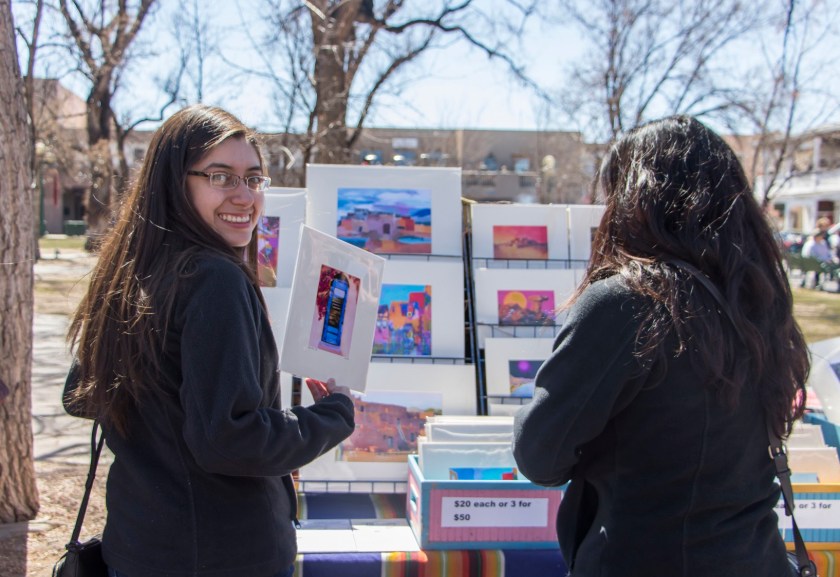
We began our walk through the portal at the Palace of the Governors which was filled with Native American Vendors. The Native American artists, from approximately 41 pueblos and tribes, make and exhibit jewelry, pottery and other works of art.
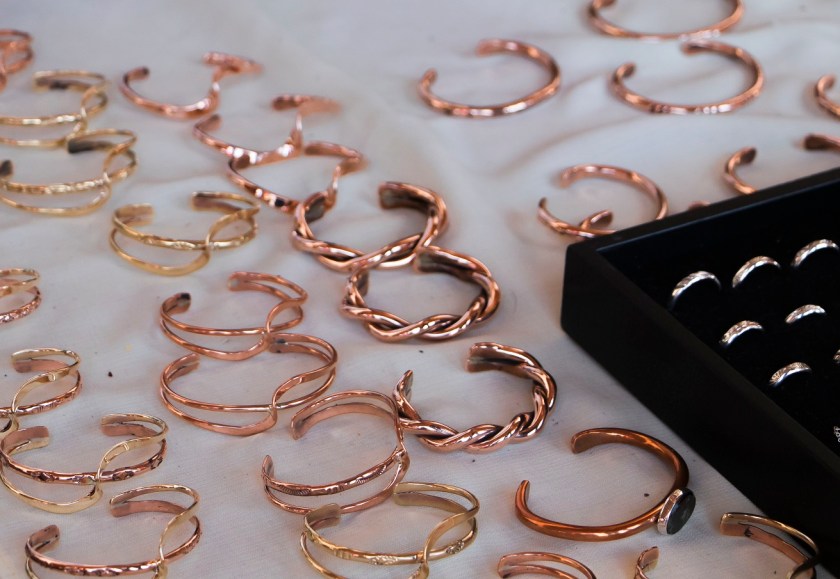
The program that allows Native artists to showcase their art is called Portal Native American Artisans Program and it requires for the vendors to be members of New Mexico tribes and Pueblos and for all of their pieces sold to be genuine pieces. Some of us bought copper bracelets and even a copper guitar pick which were handmade and had unique cultural symbols and designs. Other ambassadors decided to walk around the plaza and enjoy a hot cup of coffee from a local shop.
We wrapped up our quick shopping trip and hurried to meet with Mark Burns for lunch.
Lunch with Mark Burns by Christina Perez
Make Burns is a well-known photographer who grew up in Houston and who is known for the National Parks project that featured his photographs of all 59 National Parks. Currently, The LEAP Center and Mark Burns are collaborating to create a documentary on his profession and his successful career as a photographer. Interestingly, as he was working on the National Parks Project he spent some time in Santa Fe. Besides joining us for lunch, he also met us to work on the documentary and allow us to take a few photos of him. Because of being so familiar with the city, he recommended that we visit Tomasita’s Restaurant which serves Northern New Mexican cuisine. Tomasita’s was first opened in 1974 and has been a local favorite since then. During lunch we enjoyed listening to experiences Mark Burn’s had during the last few months. He shared news about his project of the 100th-year anniversary of the Grand Canyon and his new website design.
Canyon Road Walk and Film with Mark Burns by Bianca Saldierna
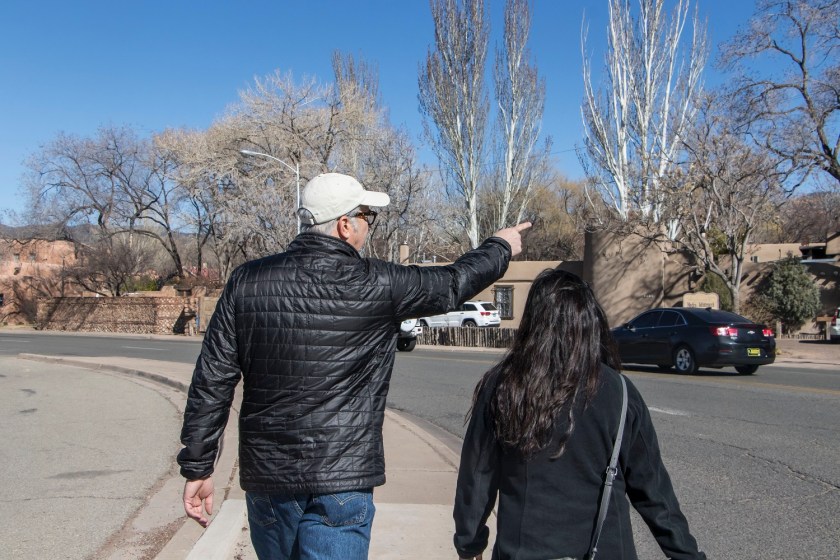
Our conversations were carried on through our walk with Mark Burns around Canyon Road.
The half-mile long road located in Santa Fe’s Historical District houses more than one hundred galleries, boutiques and restaurants.
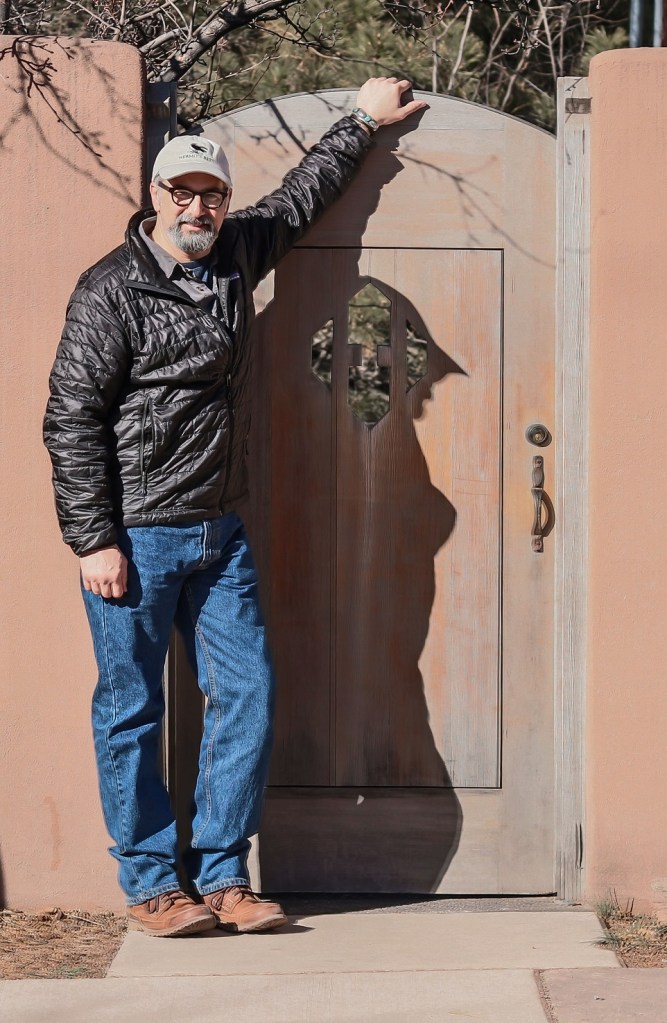
As previously mentioned, Mark Burns sporadically lived in Santa Fe while he completed his National Parks Project. He took us to his short-term house located in this picturesque road. We were able to briefly film and photograph Mark Burns in this location to include the material as part of our documentary.
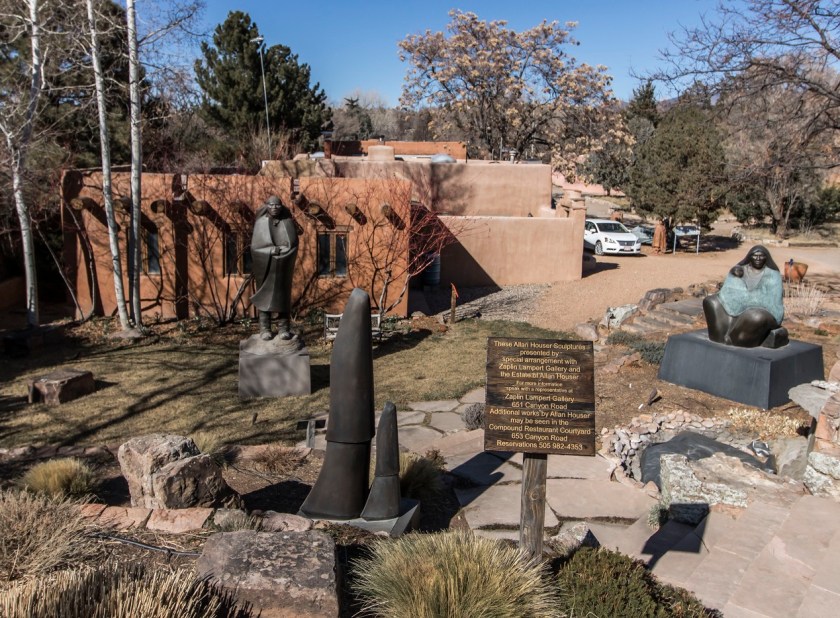
To our surprise, the neighboring gallery displayed several pieces of one of the ambassadors’ favorite sculptor, Allan Houser Haouzous.
We also had a chance to photograph Burns at the front of the home in which he stayed during his various trips to Santa Fe.
After concluding our work with Mark Burns, we strode through the charming road…
This slideshow requires JavaScript.
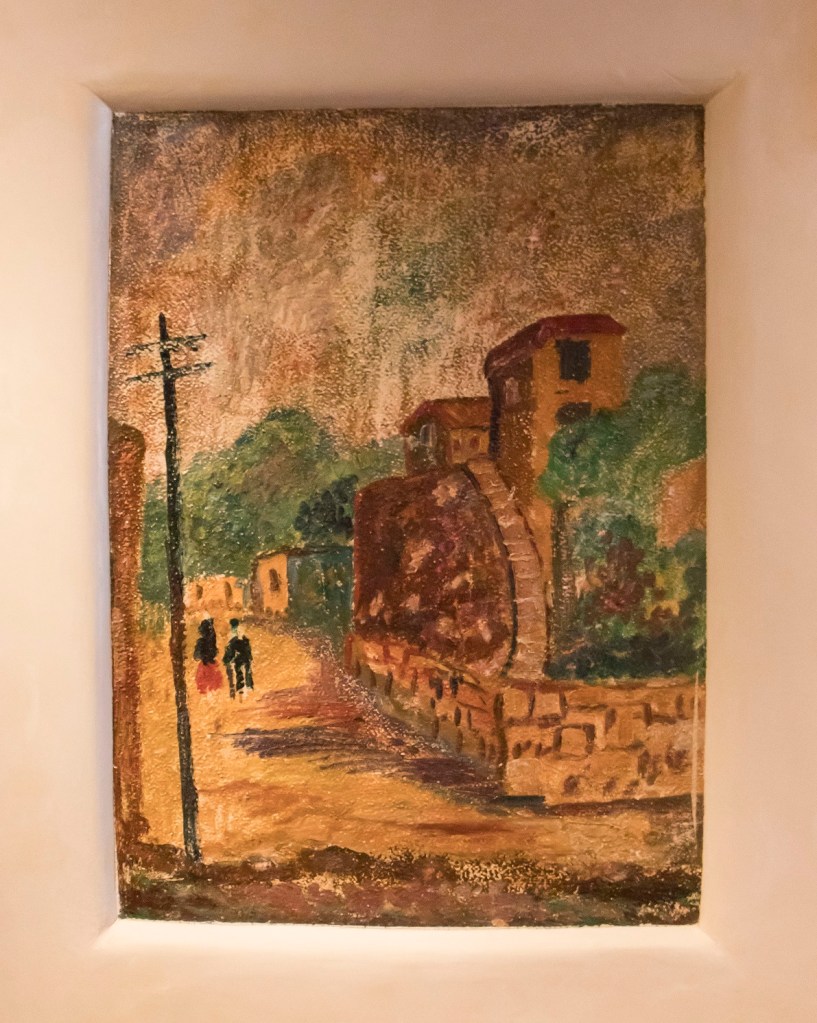
…peeked into a couple of galleries, took some photos, and visited a restaurant with a noteworthy side story. The walls of El Farol’s (The Lighthouse) restaurant display five small murals brushed by Alfred Morang, an artist who made Santa Fe his home and whose house and former studio sit just off of Canyon Road.
We had previously admired Morang’s artwork at the New Mexico Museum of Art…
…in fact, our knowledgeable museum tour guide directed us to his artwork at this unique restaurant. Our New Mexico visit ended in this historic and popular part of Santa Fe. Although we were nostalgic to leave such beautiful city, we headed back to our home state delighted to have learned about the city’s culture, people, art and history.
New Mexico’s beauty is unparalleled and unique to that of other states that we have traveled to previously. On our second day in New Mexico, we were still in awe of the adobe houses with their reddish-brown hue and their flat roofs, and we admired them all as we headed to our next destination.
Allan Houser Sculpture Garden by Beatriz Martinez
The Houser Gallery was about an hour south of our hotel, and we left early to make it to our appointed time. Houser was an incredibly well known native-American sculptor, with pieces featured at the Winter Olympics in Utah and the New Mexico capitol. We were cheerfully greeted by our tour guide and Allan Houser expert, Sina Brush, who began the tour by telling us Houser’s life story.
Allan Houser’s family belonged to the Apache tribe, and his grandfather was first cousin to the famous Apache leader, Geronimo. Houser began his education by attending the Indian School for Art with classes taught by Dorothy Dunn. However, during that time period Native Americans were severely discriminated against and the children were only taught what whites viewed as appropriate for Native American artists to learn. Houser thought that this was too constricting and began to explore different artistic styles on his own.
One of our favorite stories dealt with his first sculpture. After World War II he applied for a commission in the Haskell Institute in Kansas. Knowing absolutely nothing about sculpting stone, he somehow convinced the jury that he was well-practiced in doing so. Shockingly, he did not disappoint! After that success, he became incredibly well-known in the art scene. Three of his main artistic themes seen throughout his 1,000 sculptures he completed during his lifetime are women and children, dancing figures, and action or movement involving animals. He worked with different materials, including Carrara marble; the same marble preferred by Michelangelo.
His artwork was truly impressive to us, especially because we were invited to touch the pieces!
Meandering among the sculptures of animals and representations of members of many different Native American tribes, we were able to truly get a feel for what Allan Haozous Houser wanted to convey to us.
The emotions that many of the pieces symbolize may sometimes be abstract, but they showed through nonetheless.
Whether it be the sculpture named “Prayer” commissioned as a memorial for a young boy or “Sacred Rain Arrow” that depicted an Apache rain ceremony, through work of Houser we were able to discern the different Native American cultures and history that each piece is meant to represent.
It was such an honor to pay a visit to the Allan Houser Sculpture and catch a glimpse of the 80 sculptures scattered throughout the 50-acre plot of land.
With a great deal of sadness, we said goodbye to Houser’s works and moved on to our next destination.
Ski Santa Fe by Beatriz Martinez
We had a drastic change of scenery as we headed away from the Houser Sculpture Garden and into the Santa Fe National Forest. With a base elevation of 10,350 ft. mountain, the ski resort was definitely a new kind of challenge for the Leap Ambassadors. Three of the five Leapsters had never been skiing before, and those who had were still incredibly excited to explore the Santa Fe Mountains.
Getting geared up was probably the most time-consuming part as well as having to learn how to ski.
Thankfully, we discovered that the Professor Yawn’s excellent teaching skills extend beyond the sphere of Political Science and also into the realm of skiing.
Thanks to his guidance, Victoria, Bianca, and myself were able to start off easily at the bunny slopes. Victoria caught the hang of it surprisingly fast…
and left to try the bigger slopes while Professor Yawn worked more with the other beginners.
I can be at times considered the clumsiest among the Leapsters, but today I shocked everyone and was soon also zipping through the trees.
Meanwhile, Bianca and Christina took it slow, practicing in the Bunny Slope. Karla truly won the Bravery Award because she faced her fear of heights by going on two different ski lifts.
Everyone enjoyed the fun in the snow…
…and soon it was time for us to trek back to the car and head over to the New Mexico museum that we had been looking forward to since we first arrived.
Georgia O’Keeffe Museum by Christina Perez
After our half day of skiing we headed back into Santa Fe to visit the museum dedicated to one of the most famous women in art.
Georgia O’Keeffe was born on November 15th, 1887 in a small town in Wisconsin. Her first pieces of art were simple sketches of her family. She eventually decided that she would trade her small town for a big city, and she moved in 1905 to attend the art institute of Chicago. Her art was first exhibited in New York in 1916 by famous art dealer and photographer Alfred Steglitz, and that’s where it all began. She is now known as one of the most boldly innovative artists of the twentieth century.
Her style, whether it is with flowers, landscapes, and bones, is what set her apart from other artists.
The LEAP Ambassadors have learned quite a bit about art but Georgia O’Keeffe is usually the first artist whose work they can organize when they begin visiting art museums.
As we walked through the museum we came across a timeline of events from her life. It was interesting to follow it throughout her life and see what was happening during her lifetime in regards pop culture, art, and politics, while also connecting her to other Museums we have visited.
It allowed us to compare her life to the lives of other great artists such as Pablo Picasso, Andy Warhol, and Jackson Pollock. As we walked through the exhibit Professor Yawn mentioned that he enjoyed her art piece called “A Street” which was painted in 1926.
Christina on the other hand liked “Clouds 5” and the study of the painting next to it. It was a painting of clouds seen from an airplane window, but it showed that Georgia O’Keeffe had been inspired by all of the traveling that she did in the 1960’s. As we headed for the gift shop to find a few trinkets, we stopped to snap a couple of photos of our favorite art…
…then we posed for a photo outside…
…and then we headed to dinner!
Jambo Café by Christina Perez
For dinner we were able to add another type of food to our trip cuisine! We visited an award winning restaurant in town named Jambo Café. It has been named the best international cuisine by Santa Fe reporters for the past five years, and the owner is Ahmed Obo who first mastered the African cooking style and then decided to open his own restaurant in Santa Fe in 2009. We decided to order multiple appetizers and entrees and share amongst ourselves so that it would be a bit easier for everyone to try new things. We ordered Kenyan style beef kebobs, and combination plates that included goat stew, curry chicken, and Moroccan lamb stew all atop a bed of rice.
During dinner, we discussed all the different types of food we were able to sample thus far on our trip. Included were French, Mediterranean, Mexican, and of course African cuisines. It was difficult for many of us to decide our favorites, but Jambo Café was definitely high on all of our lists!
















 Center for Law, Engagement, and Politics