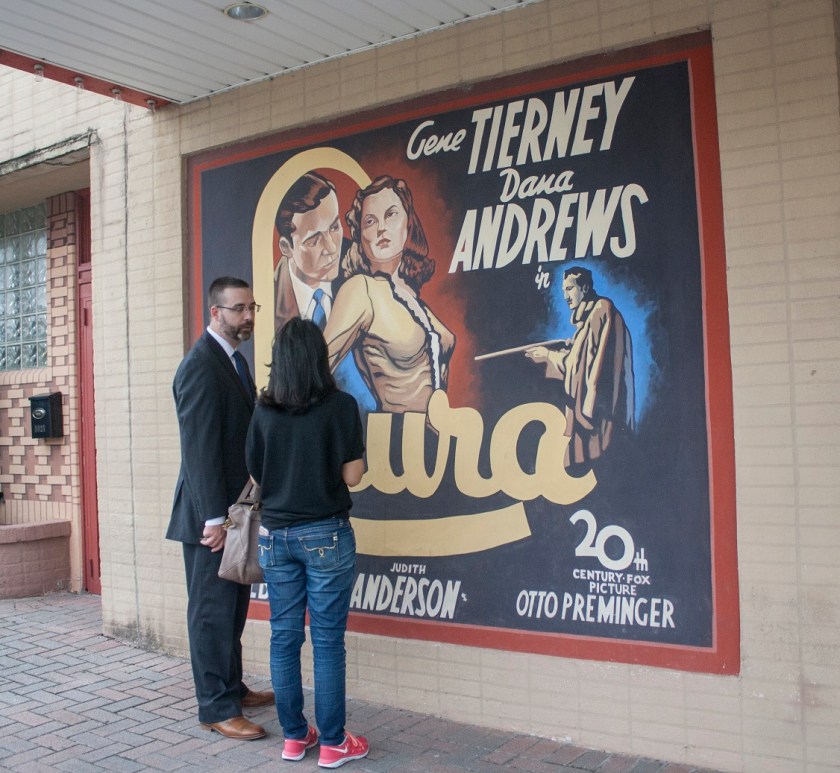
In Dr. Carl Rollyson’s sixth visit to Huntsville, the LEAP Center welcomed him to our Texas town with a screening of Rio Bravo. The film was not only appropriate for the throng of John Wayne fans in town, but also for Dr. Rollyson, whose most recent biographies addressed one of Wayne’s frequent co-stars: Walter Brennan. Accordingly, this past Friday the LEAP Ambassadors open the doors to the Kathy E. Don Education Center…
…to make room for the Wayne/Brennan admirers (along with a few newbies to the western flicks) for a night of corrupt land owners, noble peacemakers, and the beloved Stumpy.
Before the show, however, the western wearing guests clanked their boots around the center to mingle and enjoy of our delicious punch and popcorn.
It was nice to visit with many friends who attended the screening of the Howard Hawks’ classic.
This slideshow requires JavaScript.
Judge Tracy Sorensen brought her son, Cody, and he had seen the film some 15 times. Indeed, he knew much of the film’s plot, and was heard to complain that “John Wayne didn’t make enough movies”.
Other audience members, including many LEAP Ambassadors, took the time to pose next to our John Wayne cutout.
This slideshow requires JavaScript.
Before the screen opened up to the vastness of the West, however, Dr. Rollyson gave us an overview of some of those characters who made up this endless country.
This slideshow requires JavaScript.
Dr. Rollyson even acted out a couple of parts…
in his enjoyable and informative introduction to the film.
Before long, Rio Bravo began, and the audience sat still for a hundred and forty minutes of enjoyment. Among the audience we could feel the empathy towards Dude’s (Dean Martin) alcoholic struggle…
…coupled with the amusement towards the numerous comic remarks by Stumpy (Walter Brennan). Interestingly, one of the well-liked characters was Pedro Gonzales-Gonzales, who was both loyal and maddening to Sheriff Chance (Wayne’s character) but, of course, it was Wayne who was the star of the show.
Regardless, no matter how young or how old, whether this was the 50th or first time to watch, everyone who left, left with a smile in their face and a craving for more of the Duke, more of the Western thrill, and more of Brennan.
Fortunately, this latter wish came true for those who left the screening with a copy of A Real American Character: The Life of Walter Brennan, signed by its author Dr. Carl Rollyson.
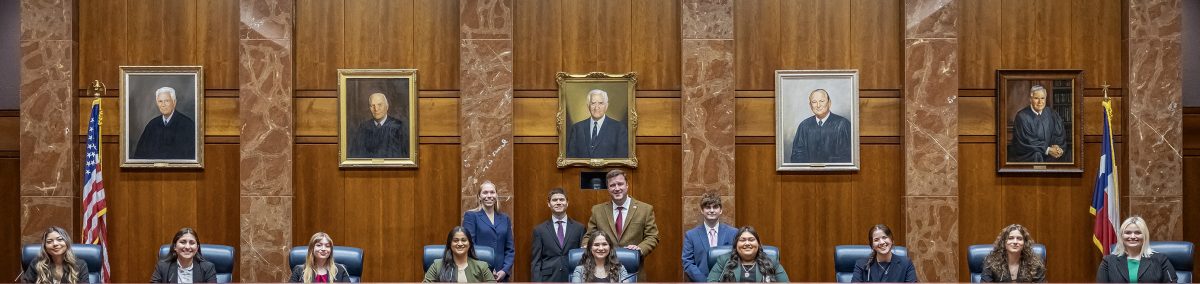
The LEAP Center was glad that everyone left happy from the screening and couldn’t miss an opportunity to take a group picture with two Texas heroes: John Wayne and Sam Houston.
The LEAP Center would like to thank Dr. Carl Rollyson for his friendship, expertise, and fine analysis of films and diverse biographical subjects!
The perfect afternoon activity after a Monday full of classes for some students might be lounging around, relaxing by the pool soaking in the last summer rays or even sitting back and watching Netflix, but not if you’re a LEAPster. When we were made aware of Congressman Kevin Brady’s 4th Annual Blues & BBQ event, we all leaped at the opportunity to volunteer!
The venue, Dosey Doe Big Barn, was perfect for the western-themed night. It was the ideal take on a “rustic-vintage” look with the wooden beams that doubled as décor, the old Coca-Cola, Sunoco and General Electric signs that adorned the walls, and the many different types of quaint little chairs that surrounded each dinning table.
As guests began pouring in through the large stained wooden doors, we welcomed them with a warm greeting and thank them for attending while directing them to the dining area, buffet, and bar. Once Congressman Brady arrived, people began lining up to speak to him and shake his hand. After non-stop tête-à-tête conversation with his guests, Congressman Brady hopped on stage to speak about the upcoming presidential election and the importance of his constituents.
As Chairman of the Ways and Means Committee, Congressman Brady’s chief responsibility is to oversee the tax code. Impressively, eight Presidents, eight Vice Presidents, twenty-one Speakers of the House of Representatives, and four Supreme Court Justices have served in the Ways and Means Committee! As a government official of great responsibility he gave everyone an update on what he has been working on in D.C. and stated his goals. After the applause died down guests continued to enjoy their meals. Along with a rewarding speech we were lucky enough to enjoy tasty brisket, roasted BBQ chicken, potato salad, and grilled squash!
The night closed once everyone had enjoyed a slice of dessert from the Texas sized cake that congratulated Congressman Brady.
Before the guests made their way out, they made sure to get some last words with the Congressman snapping some pictures with him along the way.
Congressman Brady was more than happy to take a picture with us as well, and his staff (The Brady Bunch) even invited us to hop on stage and join them in their staff picture! We all had a great time, and we hope to participate again soon!
When the first leaves start to fall in the pine country we all know what time it is. No, not football season, but the annual HEARTS Museum garage sale. The HEARTS Veterans Museum of Texas is a museum that honors those who have fought for our freedom in many different wars. Apart from serving as an engaging Veterans museum (not a military museum) it is a unique addition to our community. With proceeds that often exceed $10,000, the Garage Sale contributes directly to preservation of the Museum’s collection.
The Museum is also one of the LEAP Ambassadors foremost philanthropic causes, with the Ambassadors volunteering at key events throughout the year. This weekend was no different, with the ambassadors participating as cashiers…
…hot dog sales(wo)men, and even box builders.
As with any HEARTS Museum event, in this writer’s opinion, “the best thing about volunteering are the stories the veterans share.”
Some of the items that were sold at the garage sale included clothes, hats, books, tea sets, and other marvelous curiosities. With the non-stop rush of Huntsvillians in the shopping spirit, the Ambassadors were plenty busy, at times carrying cart-full of antiques through the Storm Shelter doors. Although the garage sale is labor-intensive work, we had a lot of fun.
And, after our shifts were over, we were able to shop around and stock up on nifty knickknacks.
In all, the active volunteering and shopping made it a great way to spend a weekend!
The LEAP Ambassadors would like to thank Letty Clark, for her great work at the HEARTS Museum and for being such a pleasure to work with and for!
In an effort to educate the campus and community about what the LEAP Center is, the LEAP Ambassadors compiled pictures of events to showcase the organization in the LSC Art Gallery.
The exhibit, which was open from September 2-September 16, showcased some 160 photographs (culled down from more than 90,000) across six categories: speakers, travel, fine arts, volunteerism, experiential learning, and programs.
LEAP Ambassadors Following Installation of Art Exhibit
This past September 14th the LEAP Center hosted an opening reception for the art exhibit. Many students, University staff, and community members came out to support the LEAP Ambassadors and learn more about what the LEAP Center does.
Each category emphasized our favorite and most notable events. For example, LEAP Ambassadors have traveled twice to see Stephen Hawking present a lecture, and we have also seen public figures such as Alan Alda, Bill Schneider, Douglas Brinkley, Governor Abbott, and Vicente Fox. All of these photos appeared under “Speakers” and, of course, additional photos were featured in the other categories.
The LEAP Center is thankful for the opportunity to showcase the organization. Numerous students attended, some of whom might make for good LEAP Ambassadors themselves someday!
We were also grateful for the support from University officials such as Provost Eglsaer…
…President Hoyt…
…Mac Woodward, Charlie Vienne, Gene Roberts, and many others. We also had a chance to see some of our favorite community people, including Linda Pease, Terry Stivers, Carol Hays, and others.
Excited murmurs could be heard from Art Building F as people were flooding in for the LEAP Centers’ 2nd annual heART of Huntsville program. Art enthusiasts from SHSU and the community are annually invited to this four-week program where they can explore various art media created by local artists around the SHSU campus and the picturesque town of Huntsville.
We started out in one of the many classrooms of the Art Department. The LEAP ambassadors were elated to see many of our community friends such as former mayor Mac Woodward and Wynne Home Director, Linda Pease; as well as friends on campus such as English Professor, Dr. Ralph Pease and Political Science Professors, Dr. Tom Haase and Wen-Jiun Wang.
After everyone had finished their survey of local art and artists (not without a few grumbles), Dr. Micheal Henderson, chair of the art department, welcomed us to the the Gaddis-Geeslin Gallery.
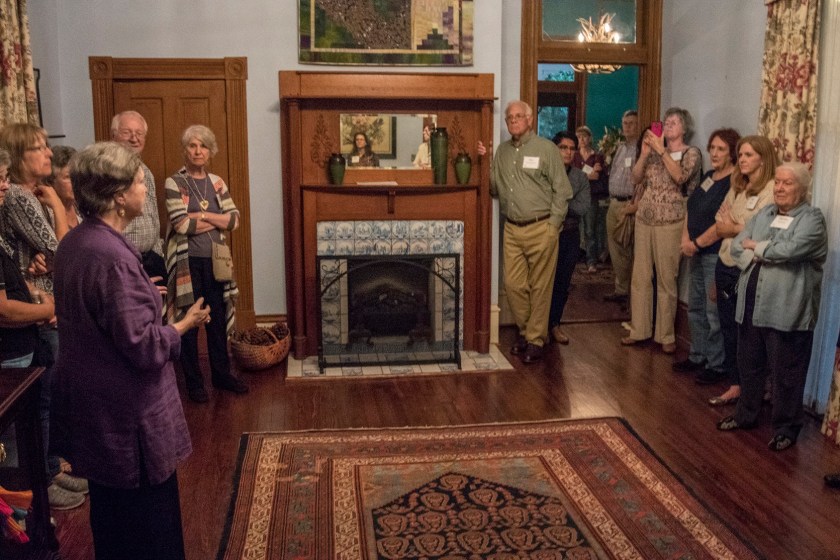
Inside the gallery, Dr. Henderson presented us the “Selections” exhibit by revealing the type of art that could be found within. The art gallery consisted of creations from alumni dating as far back as the late 1930’s up until the Spring semester of 2016. There were many pieces from former SHSU professor Ken Zonker. The artist had a special resonance for Leap ambassador Beatriz Martinez, a previous Wynne Home Intern who had organized a Zonker exhibit.
Dr. Wes Sanders Hangs Art by Ken Zonker at the Wynne Home
There were also pieces by Zonker’s apprentice, J Miller, who had actually painted a portrait of Mr. Zonker. Exhibited was also a painting by the renowned sculptor James Surls (whose art would appear later in the tour). Titled Cockfight, Surls produced the work in the late 1960s while he was still a student at SHSU. At this, few of the attendants revealed how the had been friends of Surls at a younger age, and we spoke with Dr. Keri Rogers, who several years ago helped hang this piece in the LSC.
LEAP Ambassadors and Keri Rogers With James Surls’ “Cockfight”
After seeing more SHSU faculty and alumni art…
…we decide to head on over to the second stop: the College of Humanities and Social Sciences (CHSS).
As we got closer to the CHSS building, we stopped outside to gaze at the Water Wall by Jesus Moroles. This 9-ft wall was erected to harmonize the elements of earth, stone, and water. The attendees where then amused by how Jesus Moroles (as a lover of multimedia art), had planned to unveil the sculpture by having SHSU dance majors dance atop the CHSS building’s roof.
Fortunately for us (and the dancers), their platform became the top of the Water Wall. The Water Wall’s intended function was to offer a venue for outside lectures. Currently it is most often used as a great study spot for students, and is occasionally seen hosting CHSS socials. Once inside, we saw a piece by Bruce Marion, Confluence, lining the walls. Seeing as how the Humanities and Social Sciences college deals with human interactions and circle of connections, Marion transitioned colors and interwove circles to showcase these two ideals.
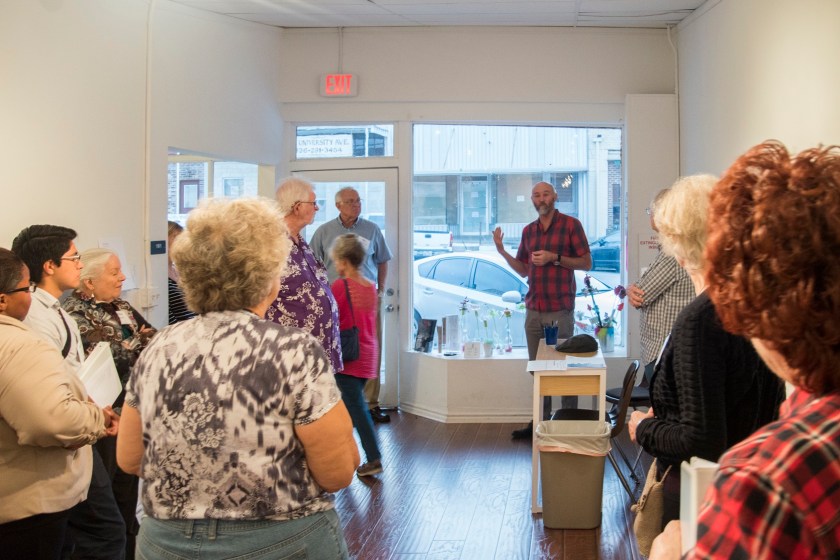
The group later traversed through the summer heat to the Lowman Student Center Art Gallery, which was probably the LEAP Ambassadors’ favorite gallery, as they had spent many hours, nails, and mounting squares in order to set up their very own LEAP exhibit. Showcasing the various features of the LEAP center, such as special speakers, fine arts, volunteerism, experiential learning, programs, and travel, it gave heART of Huntsville participants an opportunity to gain a further insight of the different fields in which LEAP Ambassadors engage.
From there, we went to the Nancy Gaertner Performing Arts Center where Craig Brossman, the facilities manager of the building,was waiting to give us a tour.
We toured the Concert Hall, which impressed the heArt of Huntsville participants as it has been named one of 25 best art venues in the nation. Equally impressive was the dance theater with a sprung floor which is tailored to fit a dancer’s needs. There are only 2 or 3 like it in the state, and about a dozen in the nation. We proceeded to view Kathleen Ash’s Elements, Stanley Lea’s Four Seasons, and a serpentine marble sculpture by Jesus Moroles. The most prominent installation was the 16 ft, wood and steel, Around the Flower Wall by James Surls. We also got to see some art from Charles Pebworth, whose first and biggest sculpture lies in the Woodlands at about 40ft tall. As we were exiting, we saw Jason Lawrence’s Firedance, our last beacon of crystalline light as we retired for the night.
Or at least until we got to Austin Hall. This historic building awaited us with food to be deliciously devoured upon as we interacted with the other participants and shared our anticipation for next Monday’s adventure, which will start at the grand Sam Houston Statue on Monday, September 19.
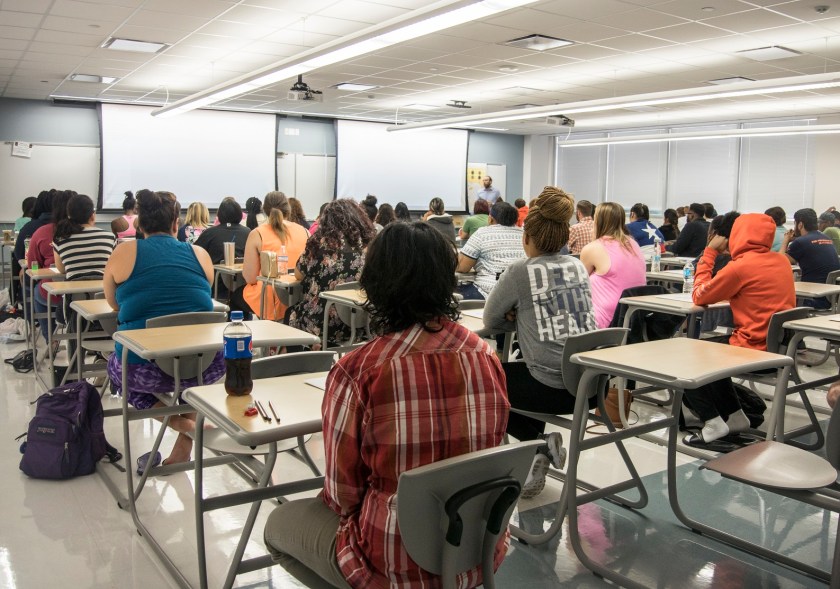
To kick off to the semester the LEAP Center opened up its doors to incoming freshman, transfer and current students to come by and see what LEAP is all about. With about roughly 70 students throughout the night, we enjoyed delicious ice cream, cookies, sweet tea, and the chance to see school friends again.
In preparation, we set up The Holcombe Room with decorations, a prize wheel…
Brian Aldaco As Pat Sajak
…and, of course, ice cream and other snacks and refreshments.
As might be expected with free food on campus, there was a line awaiting the open of the event. Later, we would have a packed house.
We were happy to note that, in addition to many students…
Alexis Gordon and Alex Galvan
…Dean Zink, Dean Nardone, Dr. Waggener, Dr. Mahoney, Dr. Svenson, Dr. Bittick, Dr. Enia. Dr. Haase, Dr. Wang, Dr. Evans, Kristin Trojacek, Belinda Myers, Deanna Briones, and Jennifer Knapp all attended as well.
Although folks seemed to enjoy the prizes, the t-shirts were definitely the most wished for. But even after the prizes were gone, many of the students hung around, catching up on their summer activities and their plans for the fall.
We hope that some of those plans will involve LEAP Center events, the dates for which were provided at the ice-cream social. For those of you who missed it, here’s a calendar for the next month or so:
September 12, 19, 26, and October 3: heART of Huntsville
September 14 (4:30-6:00): LEAP Open House (LSC Art Gallery)
September 20 (2:30-3:45): Legislative Staff Panel
September 21 (6:00-7:15pm): Pre-Law Society Meeting
September 30 (6:00-8:30): Walter Brennan/John Wayne Film Festival
With the presidential elections around the bend, the LEAP Ambassadors attended the Walker County Republican Women’s non-partisan meeting on the various aspects of voting this Monday, August 29. The evening’s agenda included speakers focused on new voting ID requirements, the history of political parties, and the nearly unfathomable electoral college. The LEAPsters therefore were more than delighted to start off the semester with proper political education.
The first speaker, County Tax Assessor and Elections Officer Diana McRae, headed the conversation on new voter ID laws.
Walker County Tax Assessor Collector Diana McRae
With experience running more than fifty elections, McRae outlined the various kinds of identification that a voter may present at their polling station. From a normal driver’s license (acceptable even if expired for up to four years), to military identifications, those present are at peace knowing that this upcoming November they will be ready to present the proper requirements to vote.
Followed thereafter was SHSU’s own Political Science Professor Yawn. With a presentation focused around the history of political parties Yawn touched on the early years of American politics from the Federalists and the Anti Federalists, the Whigs, the Democratic- Republican party, finally reaching our present day decided political spectrum.
Professor Mike Yawn Speaks About the History of Political Parties
Highlighted were also presidents that shaped those political parties such as George Washington, Abraham Lincoln, John F. Kennedy and many more. As her first time seeing Professor Yawn teach outside the classroom, Christina (one of the newest additions to the LEAP Ambassadors) deemed the presentation “as a very interesting one.” As a political science major however, this was to be expected. As for the rest of the non-student audience, they occasionally responded to Yawn’s presentation with laughter–not out of spite but as a result of the amusing presidential tales from Yawn’s dynamic presentation.
To finish the evening’s meeting Michael Ethridge, Huntsville’s field representative for U.S Congressman Kevin Brady, elucidated the audience on “How the President Really gets Elected.”
Michael Ethridge Discuss Presidential Elections
His main topic was the electoral college and how it affects the way presidents are voted into office. He showed us how one county can change the outcome of the entire state, like Ohio. He also answered questions related to our electoral college, and the process of voting. He showed a time line of the electoral process between November and January of election years. One thing he emphasized on was that voting is important. As college students who share his beliefs, the LEAP Ambassadors all thought it was an important message to share. Likewise the efforts of the Walker County Republican Women reflected this political responsibility of educating the community on voting, political history, and the electoral process.
As we wend our way home from “The Motor City,” we stopped in Indianapolis to see a heap of historic sites, from extensions of our research on The Vagabonds, to the Indy 500, to a presidential home, a capitol, and a fine art museum. Although it was our second-to-last day on the road, it promised to be a full one.
Indianapolis Motor Speedway
We have friends who have been to the races here, and they indicate it’s pretty incredible. The Museum, however, is not incredible. It’s actually quite boring.
The Museum itself consists of approximately three rooms: a large show-case style room, a smaller room beyond the main room, and a room to the left which houses “special exhibits.” The main room has a timeline, which consists of a series of photographs on the walls, and then the winning cars from the past 100 years of races.
Indy-Winning Cars on Display at the Speedway Museum
Although it is of some interest to see the evolution of cars from long ago to today (mostly, the long-ago cars were cooler), there wasn’t a whole lot of context or the interesting tidbits you can learn from even small museums.
After looking around and wondering, “Is this all there is?”, we opted for the “short video” that provided “background.” It was short–about 8 minutes–but it provided almost no background. It was an eight-minute commercial for the special “spirit” of the Indianapolis 500. It provided little or no substantive information about the origin of the race, why Indianapolis became home to racing, or how things have changed over the years. It, too, was a disappointment.
Indiana State Capitol
Undaunted by the Speedway disappointment, we sped out of there and had breakfast at the City Cafe in downtown Indianapolis before heading to the Indiana State Capitol building.
Upon entrance to the Indiana capitol we noticed the nice but fairly typical exterior…
Indianapolis State Capitol Building
…but we were truly struck by the interior.
Indianapolis Capitol Dome
Interestingly, it houses all three branches of government; executive, legislative, and judicial. Thus we were able to see the working Governor’s office…
Governor Mike Pence’s Office
…the House and Senate chambers, and the court room of the Indiana Supreme Court, which doesn’t resemble a lot of the past statehouse tours.
Indiana Supreme Court
The interior of the Indiana Capitol is made of smooth, polished Vermont marble and Indiana limestone. The architecture is evocative of the Italian style. The rotunda at the heart of the building boasts an impressive stained-glass ceiling, and two wings that extend outwards in each direction.
The wings mirror each other, and have large open areas that go four floors upward before terminating in a glass ceiling that lets natural light filter down to the floor. Each open space is surrounded by walkways set into the walls and supported by columns in a colonnade fashion. Of special note was the fact that all three of the classical Greek styles of columns were represented. The first floor showcased doric columns; the second floor was supported by imposing, almost un-ornamented ionic columns; and the third floor was held up by thinner, more artistic corinthian columns. All of the columns were made of grey-white marble, and lacked fluting (vertical lines running up and down the length of the column).
Our tour guide led us through this pleasant architectural feat, showing off various interesting busts of famous Hoosiers.
He also made sure to impress upon us some pertinent facts about Indiana. We learned that the state bird is the cardinal, the state flower is the peony, the state tree is the tulip poplar, and the state song is “On the Banks of the Wabash, Far Away.” Most importantly, he told us that Indiana is one of only four states with an official state pie, which for Indiana is the sugar-cream pie. It was a nice tour, with a very nice tour guide.
And although we missed seeing Governor Pence at the Capitol, we did see people protesting Pence.
Trump/Pence Protestors at Indiana State Capitol
Indiana Soldiers’ and Sailors’ Memorial
But before heading to our next historic home, we decided to go to the Indiana Soldiers’ and Sailors’ memorial.
View of Indiana Solders’ and Sailors’ Memorial from the Capitol
This edifice boasts a pool and fountain beneath a circular, raised dais decorated by various sculptures. Soaring above it all is a tower that rears upwards toward the clouds.
You can actually climb up a set of 330 stairs on the inside of the obelisk, or take an elevator to the top for a small fee. Prof. Yawn elected to pay, while Brian and Paul adventurously took the stairs all the way to the top, compelled to do so after all of the vertigo-filled adventures of the trip. It was a beautiful view from up above, making the climb up worth it.
Brian and Paul from the Memorial’s Observation Deck
Our feat of athleticism was soon rewarded by a short visit to the Chocolate Cafe right across the street from the memorial. While sipping on a very sweet, creamy Chocolate Chai and nibbling on a very rich caramel sea salt chocolate, we people-watched. This was made more interesting by the gathering of people in our midst. There was, for example, a convention of sorts for Mennonites, who sang on a town square…
Circling them, on a pedal-powered bar (“The Pickled Pedaler) was a party of some sort (perhaps a wedding based on the sign on the back, which read, “Congratulations Tom & Ed”).
How you effectively avoid Mennonites and traffic in a town the size of Indianapolis–while drinking alcohol–is beyond us. It’s also not clear how this doesn’t violate some drinking and driving ordinance. Presumably, the steering-wheel operator doesn’t drink, but the people providing the power do.
Amidst all of this, it was also Gen-Con, a convention of strange people dressed as super-heroes and other characters.
It wasn’t quite the bar scene in Star Wars, but it wasn’t far off, and it wasn’t what we were expecting from Indianpolis, “The Crossroads of America.”
Benjamin Harrison Home
Benjamin Harrison, the 23rd President of the United States of America, was a native of Indiana. He raised a regiment during the Civil War, and fought as a general on the Union side. Interestingly, he was preceded in the presidency by Grover Cleveland and was, oddly enough, succeeded by the same man! Other aspects of his presidency were how his federal spending exceeded $1 billion for the first time in American history; he started the process of preserving places of natural beauty; and he strengthened the United States by modernizing the navy, making it the 5th most powerful in the world. This later may have come in handy for the coming First World War.
As a very interesting president, his home was just as special in that 70-80% of the furniture is both authentic (not replicas) and on display.
Benjamin Harrison’s Parlor
You can see his prodigious library, the many of the gifts that he was given in life, including a strange chair given by a Texan…
Benjamin Harrison’s Chair
…made of Longhorn horns, a bobcat hide seat, and the overall look of Texas tacky. We also saw his death bed, which was covered with the same comforter he used…
Benjamin Harrison’s Bed
…which was not Texas-Tacky, but was tacky-cool.
Harrison was a volunteer fireman, and the staircase was fashioned from a fireman’s hose…
…the home’s foyer was adorned with a 38-star flag (reflecting the number of states when Harrison took office)…
…and his desk was the height of 19th-century organization which, in our book, beats 21st century simplicity.
Benjamin Harrison Desk
However, such an artifact was in no way detrimental to the rest of the home’s beauty…
Paul Oliver and Brian Aldaco at the Harrison Home
…almost comparable to our next item on the day’s itinerary.
Indianapolis Museum of Art
After leaving the home, we soon reached the Indianapolis Museum of Art. The art museum, to our pleasant surprise, shared a few similarities with Harrison’s home in that within the halls were exhibited works by Jacob Cox. Cox’s works were also present inside the Hoosier president’s parlor room. He and other Indiana artists were being commemorated in the “19th Stars” special museum exhibit which included renewed artists of talent such as T.C. Steele, Robert Indiana, and George Rickey among others.
George Rickey Art
After appreciating sights of silver mobiles, beautiful landscapes, and painted canvases with the intent to reflect on society’s morals, all from the creativity of Indiana natives, we continued on through the halls of the museum.
Nearing the first exhibit room we noticed that the art had been arranged in chronological order, allowing us to view a sort of art evolution. Beginning with the realist school of American painters such as Charles Wilson Peale…
“George Washington,” by Charles Wilson Peale
…Albert Bierstadt…
“Alaska” by Albert Bierstadt
and John Haberle, we were further schooled in the art of capturing the essence of reality. Such an aspect in art was truly captured in Haberle’s depiction of American currency in U.S.A. (1889). The oil painting was mistaken for real money upon unveiling which caused near tremulous sensation as viewers claimed the artist had glued money on a canvas. We later saw paintings of other American artists which we had seen on previous museums such as those by Georgia O’Keefe and a very expressive Norman Rockwell by the name of The Love Song.
“Love Song,” by Norman Rockwell
Throughout the other rooms we viewed other artists of remarkable ability, one of which was George Seurat who rightfully deserves the description. His pioneered pointillism-style of expression inspired fellow talented impressionists of his time such as Paul Signac, Henry Van de Velde, Camille Pissarro (these being among Brian’s favorites), and Van Gogh.
Van Gogh Landscape
Wandering through the other rooms we were delighted upon nearing a ver peculiar modernist painting by the name of Man and Woman. In a style resembling that of Picasso’s cubism, the shapes of color and shadows form two figures, a man and a woman, embracing each other’s kiss. Even though the depiction in itself was phenomenal, it was the man behind the brush strokes, Fernand Leger, that caught our attention. Between the years of 1948 and 1950 a young Huntsville artist by the name of David Adickes traveled to France to study art under the teachings of Leger. Adickes, as any Hunstvillian may know, was the talented sculptor who erected the Sam Houston statute which towers at the town’s edge. Satisfied that we were able to identify with one of the celebrated artists, we toured some more of the halls to later exit onto the grounds. With a scenic gushing fountain, the grounds were decorated by sculptures by Roy Lichtenstein…
Brian and Roy Lichtenstein
…and Robert Indiana’s famous LOVE sculpture, which we have seen at three or more art museums throughout the US.
Robert Indiana and Roy Lichtenstein’s Artwork on the Lawn of Indianapolis Museum of Art
Robert Indiana, interestingly, was born Robert Clark. But he changed his name to honor his home state. Interestingly, one of his pieces, a 12-foot LOVE sculpture (which are obviously not unique) recently sold for 4.1 million dollars.
After enjoying the green fields of artistic delight, we regrouped in our mini-van and buckled up for our stretch towards the end of our trip. As we only have one more day left in our Mid-Western tour, we arrived in our hotel late at night eager to get some rest and prepare for an exciting last day of our odyssey, in Little Rock, Arkansas.