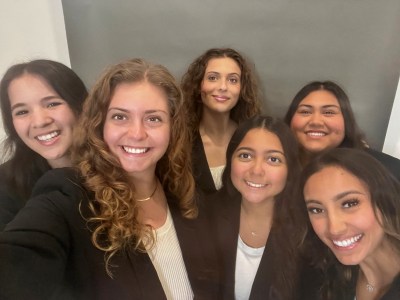
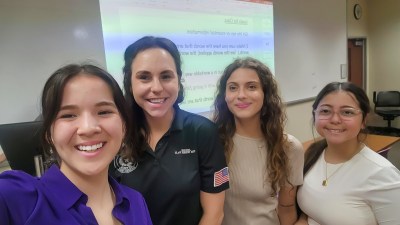
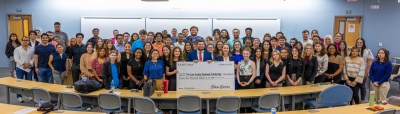
With today being Leap Day, we thought it only appropriate to reflect a bit on what a week in the life of a LEAP Ambassador looks like. We get a lot of questions about what LEAP Ambassadors do, and the answer isn’t easy, because our activities are diverse and numerous. Perhaps a look at our last week will provide some insight!
The LEAP Center has only two staff members, so our job is to assist the Center with the events. In the process, we have the benefit of networking, gaining professional skills, and learning new things. So, here’s our week leading up to LEAP Day:
Monday: Every other week, we begin with a general meeting, which usually lasts around three hours. Much planning goes into this meeting, and it allows us to maintain an every-other week meeting schedule (we have advisor-less meetings on off weeks) and be prepared for our upcoming events.
Tuesday (Afternoon): We offered a Mock Law class taught by South Texas College of Law Professor, Val Ricks. You can read about it here, and as usual, Professor Ricks did a great job teaching. This event also gives an insight into the LEAP process.
Note: The above event provides some insight into how LEAP works. More than 45 students attended the event, plus a local judge and a teacher from HHS. All attended without being given credit, “service/engagement hours,” or extra credit. Moreover, some had to take off work, and all had to do readings before hand. If you offer quality programs, people will attend without artificial inducements, and they will get more out of the program.
Tuesday (Night): That evening, a few of our Ambassadors volunteered at the Reagan Dinner, enjoying dinner with Judges Smith, Moorman, and Johnson and seeing some old friends, while others did additional preparations for our upcoming photography exhibit at the Sam Houston Memorial Museum and Republic of Texas Presidential Library.
Wednesday: We had our first Pre-Law Society meeting of the semester. With a record 96 members (!), we showcased LEAP Alumni, including first-year attorney Victoria McClendon, 3L student Quinn Kobrin, and Blake Roach. Afterward, we had a chance to catch up additionally over dinner. We also did a photo-op for a recently established pre-law scholarship following donations of $25,000!
Thursday: This was just our regular day of classes, office hours, and work. Among the five LEAP Ambassadors, they have 7 jobs–and a collective 3.70 GPA!
Saturday: We joined 25 other community members to plant trees at Huntsville Elementary. This event, which you can read about here, was with our friends at Trees for Houston. And we met new friends at Huntsville Elementary, where we discussed with Principal Cross the possibility of returning in the fall to do social studies presentations to students and a “Mock Election.”
In all, we participated in events with more than 750 people, we hosted a program for the University, and developed our (and others) knowledge of pre-law, politics, theatre, the sciences (the environment and botany), landscape architecture, and event planning! A typical week in the life of a LEAP Ambassador!
Following a long week, LEAP students headed to the theater to decompress by watching SHSU’s rendition of Rosencrantz and Guildenstern Are Dead. This group, in particular, had varied tolerance for theatrics. Regardless of our backgrounds, we waited with anticipation for the curtain to open and allow ourselves to be immersed in the fictional world.
The story takes place in Denmark during the Elizabethan era and focuses on Rosencrantz and Guildenstern, lesser-known characters from Shakespeare’s Hamlet.
Even though it appears light-hearted, it profoundly touches the audience; leaving a significant impact, its exploration of human nature and existential questions left me thinking throughout the night.
Rosencrantz and Guildenstern frequently find themselves in predicaments, unsure of their location or identities. Further, the actor’s line delivery elicited plenty of laughter from the audience. This quickly turns when the narrative causes viewers to ponder the pointlessness of trying to rationalize a world lacking logic or purpose.
The two attempt to control their destiny as the crisis worsens but are trapped in a cycle of events beyond their influence or understanding. As the characters fall to an unavoidable end, the audience is saddened as we realize what has happened to the characters we have come to adore.
In many respects, the last activities of our trip were a perfect bookend to our initial activities on the trip. We began by visiting an art museum and attending a law-school tour, and we ended it the same way. Our first stop on the art leg of this adventure was the Oklahoma City Museum of Art.
Oklahoma City Museum of Art
We were immediately met with a tremendous 55-foot Dale Chihuly piece in the entryway of the museum.
It was tempting to jump directly into the Chihuly exhibit, but we restrained ourselves and, instead, saved Chihuly for last.
We enjoyed looking through their permanent collection, which had some of our favorite artists on display. Cinthia especially enjoyed the works by Moran, whom she learned about on this trip. By the end of the trip, it seemed to be second nature for her to recognize a Moran on sight!
In fact, it was a great chance to see many of the artists we had seen on the trip or had reinforced on the trip.
The much-awaited Chihuly exhibit did not disappoint. LEAP Ambassadors have had the privilege to see Chihuly in numerous capacities, each of which are uniquely beautiful. This was the first time, at least in our case, to have seen his pieces in a gallery with lighting designed to complement his works.
This allowed for the glass to shine in ways you couldn’t fathom. My favorite work, “Orange Baskets” won me over with the casted reflection of the light hitting the glass…
…which made a warm, wave-like image on the wall behind it.
Cinthia’s favorite, “Putti Installation”, had beautiful angelic figures made of glass atop a transparent, hollow vase. It was a first for us to see these detailed figures in his work, composed with his signature medium, and it was both eye-catching and exciting!
But in a larger sense, we had the opportunity to view and learn the scope of Chihuly’s work. This included some paintings…
…more chandeliers, and other styles, including his famous Persian ceiling.
But even as we left the Museum, we had one more art-related stop in Oklahoma City. The City has done a wonderful job revitalizing its downtown, and this includes a river walk adorned with art. One stop we had to make was to see the City’s statue of Sisyphus, a must-do since one of Olivia’s favorite books is Camus’s “The Myth of Sisyphus.”
Fred Jones Jr. Museum of Art
Unbeknownst to Cinthia or me, OU students don’t have to go off campus to see fantastic art–they have an art museum of their own! In fact, the Fred Jones Jr. Museum of Art was one Cinthia’s favorite museums of the entire trip. This University museum had works of art from renowned artists such as Pierre-Auguste Renoir, Degas…
…Van Gogh…
… Pisarro….
…O’Keeffe…
…John Steuart Curry…
….and Monet, the latter of which is a favorite of LEAP Ambassador Jessica Cuevas. They even had a copy from the 1800’s of Giorgio Vasari’s “Works of Vasari: The Lives III”, the first known art history book, in their ‘Treasures of Tuscany’ special exhibit!
We also saw more of key “LEAP” artists, such as Luis Jimenez…
…and Allan Houser.
Amidst all of the southwestern and prairie themed art, the Andy Warhol almost looked out of place–except, of course, it was of John Wayne!
After a trip of learning of various artists and their signature pieces, recognizing their work in museums was beginning to feel like running into an old friend. However, I almost didn’t recognize one of my go-to artists, James Surls!”–whose “Big Standing Bird” was different than what I had seen previously.
We didn’t have any firm expectations coming into the museum, but it was a very favorable surprise!
Though it was the last day on our tour of the Southwest, the momentum we had from experiencing incredible hikes, interesting art and history, and a handful of slips and falls, left us feeling pumped! With the onset of the spring semester looming, we were determined to finish the trip strong.
Oklahoma Capitol Building
After visiting the New Mexico Capitol and its hallways full of art, we weren’t sure that we were able to see anything nearly as colorful in Oklahoma.
But as we approached the OK Capitol, we felt right at home–we were greeted by an Allan Houser statue!
Moreover, we stood corrected about the colorfulness of the capitol! The Oklahoma Capitol is both extravagant in its composition and color, with paintings lined on every wall of the building-even the dome!
“The Guardian” graces the top of the Capitol Dome…
…and a replica of the statue is also inside.
And the capitol dome’s interior was beautiful!
Of course, it goes without saying that there were several pieces of Oklahoma history in this building. There is something to be said, however, about the manner in which the history is represented in its art collection, which included a room dedicated almost exclusively to busts of its former governors…
…as well as murals of some of its most impressive native sons.
We had the chance to step into the House and Senate Chambers, both of which had their own themes. The Senate Chamber had its beautiful stained glass ceilings and brown hues, and the House had a serene ambiance, intricately carved floral ceiling tiles, and lots of green. Both, in their own right were simply stunning!
And, although we are bloggers, we don’t often feel like journalists–until today. Following some time in the chambers, we undertook another first: using a phone booth!
Although no longer equipped with phones, it still serves its purpose of giving journalists a quiet space to work or call their editors following eventful days in the state legislature. For us: we would just like to “report” that we had a fantastic time!
For Cinthia, this was her third capitol building, all visited in the past two years. For Olivia, it was her fifth capitol building, all visited in the past two years. These won’t be the last.
Following our adventure at Great Sand Dunes National Park, we made it back to the tip of the Texas Panhandle: Dalhart, TX. Our goal for today, was to get to Amarillo, then to Canyon, TX, and make our way to Oklahoma City. It was–both literally and figuratively–a whirlwind visit. We literally saw our first-ever tumbleweeds.
Cadillac Ranch
As we approached Amarillo well before noon, we stopped at Cadillac Ranch, a unique art installation. We had never seen it before, and what a sight!
Some nice people visiting loaned us some spray paint, and we left our mark!
It was a nice stop amidst the flat Amarillo landscape, made much more colorful by art.
Panhandle Plains Museum
Located on Texas A&M’s West Texas campus, the Panhandle-Plains Historical Musuem. Within the largest history museum in Texas, we had the ability to outline Texas history from indigenous settlement and conquistadors to where we are today.
A collection that served as a great conversation starter was ‘High Fashion to the High Plains’. Here we found an extensive wardrobe from high fashion designers such as Chanel and Emilio Pucci that are representative of the fashions of West Texas over time.
While this is a West Texas museum, we were most enthused with the East Texas representation in their ‘Art of Texas State Parks’ collection!
We saw artist and friend Lee Jamison’s work in the museum’s collection. While we are huge fans of all of Mr. Jamison’s paintings, our favorite one from the museum was of the Grave of Hubris, San Jacinto Battleground State Historic Site.
I thoroughly enjoy the vibrancy of the landscapes Mr. Jamison creates, whether or not the scene itself is particularly bright. His paintings serve as a reminder to appreciate even the most simple of your surroundings, as there is an innate intricacy to each of them.
Palo Duro State Canyon Park
On such a fitting note, we ventured to the Palo Duro State Canyon Park to capture the scenic views on our last outdoors trek of the trip.
It may be sheer coincidence, but we truly saved the best hike for last! There was truly so much to see while on this short trail, with a different vista under a beautiful sky at almost every turn.
Maybe it was the fact that we had previously been immersed in scenes covered in pillowy white snow, but there was something awe-inspiring about looking over the cliff to see the red-casted landscape.
Photo by Olivia Discon
We explored far more than we anticipated we would, walking out to every outcrop…
Cinthia Villarreal Enjoys the View (not so much the wind); Photo by Olivia Discon
…looking over ledges…
Photo by Cinthia Villarreal Carrillo
…and climbing as many hills as possible.
We did our best to soak it in…
Photo by Olivia Discon
…and explore the area they call “The Grand Canyon of Texas.”
In fact, we didn’t really want to leave, but we wanted to get one more hike in, so we returned to the car.
Our last hike was the “Hole in the Wall Trail,” so named for obvious reasons!
This short hike involved a walk up to a cave. Although short, it was a somewhat rugged walk, and it was also filled with colors and different types of rocks.
The area immediately outside the cave offered interesting views of the landscape.
Photo by Olivia Discon
In the cave were three different holes in the top, and these looked intriguing to us–so much so that we found a way up to the to the top of the hill.
Olivia: “I don’t think I like this.”
We made it to the top after much climbing and scrambling, and climbed a way into the hole.
We also got interesting photos through the hole, from our vantage point!
Photo by Cinthia Villarreal Carrillo
I may have been a bit apprehensive to make the climb, but Cinthia was a voice of encouragement (or perhaps she was just more confident than I), and we made it to safety.
While we already live and learn in the great state of Texas, this was a completely new and refreshing day for everyone. However, it was not time to turn back home just yet! We packed our bags and headed towards the last state of our Southwest tour, Oklahoma.
While our time in Taos was brief, we wanted to maximize our chance to photograph the famous San Francisco de Assisi Mission. Upon arriving last night, we left our hotel–in temperatures of about eight degrees–to photograph the famous mission.
Construction began in the late 18th century and was completed in 1816. The Spanish settlements featured key aspects of their mission and culture, with churches being centrally located within a plaza that was easy to defend.
Although the Mission has been endlessly photographed and painted, we haven’t seen a lot of night scenes. Part of that may be that, as we found out, is that it is difficult to photograph at night.
To the extent that the temperatures and light allowed, we did our best to photograph the building. With the many lights in the front of the building, we were drawn to the building’s rear, with its beehive buttresses and intriguing contours.
Photo by Olivia Discon
I was able to get a night shot, without some of the distracting street lights. But these lights did drown out some of the stars that we would have liked to have seen.
Fortunately, we were able to try again early the next day, just as it was being touched by the morning sun. Having the chance to view this structure in two different capacities was not only exciting to witness, but also to photograph!
Cinthia and I got the chance to be creative and capture our separate perceptions of the church and how it interacts with its landscape.
Photo by Cinthia Villarreal Carrillo
Intriguingly, the community meets every June to use a mixture of mud and straw to repair the exterior adobe. Seeing the structure in person, it’s easy to see why the community is attached to it–and why tourists, such as us, flock to it.
Photo by Cinthia Villarreal Carrillo
It’s also easy to see why artists and photographers flock to it. In fact, several people we spoke with described it as one of the most photographed churches in the United States.
San Francisco de Assisi, by Ansel Adams
That is certainly evidence from the different art galleries and museums we visited!
San Francisco de Assisi, by Georgia O’Keeffe
It was, in short, a beautiful way to end our time in New Mexico!
Although it was our last day in Santa Fe, it was a day packed full of eclectic adventures and learning. On tap: A tour of the New Mexico Capitol building; a tour of Allan Houser’s art studio; and a hike up Sun Mountain.
After some coffee at CrashMurderBusiness, we headed to the Capitol, where Marylynn Collins was waiting to educate us on the workings of the New Mexico government.
As aspiring participants in Sam Houston State University’s SHAIP program (where students are placed in legislative offices in the TX Capitol), this was of particular importance to us. Cinthia and I have been to 5 Capitol buildings between the two of us, so this visit allowed us to compare how the New Mexico Capitol compares to other states.
Mrs. Collins started the tour by taking us to the center of the capitol’s rotunda. In contrast to most other state capitol buildings, the New Mexican capitol is shaped in a circular manner and has no dome. The reason, Mrs. Collins explained, is to signify the circle of life portrayed in the Zia symbol. The roof of the rotunda is intricately done with stained glass, the shape of which signifies a pueblo basket and the orange and blue colors signify the earth and sky.
The Zia symbol was adapted by the New Mexican people from the Zia Pueblo tribe and, as mentioned above, it portrays a circle in the middle with four sets of four lines coming out of the circle in four different directions. Each of the sets are symbolic in four different capacities: the four seasons of the year (Spring, Summer, Fall, and Winter), the four stages of life (infancy, youth, adulthood, and old age), four times of the day (dawn, daylight, dusk, and dark), and the four cardinal directions (north, south, east, and west). The symbol is also portrayed in the state flag is seen and used throughout the state.
Something that also sets this state apart is their official state question, “Red or Green?”. This was strange to us before the trip, but New Mexico is very fond and proud of being the home of the green and red chile, which is deeply engraved in their state’s culture and which we have had the opportunity to try in a variety of dishes and restaurants along the trip. Mrs. Collins also mentioned that this is the only state with an official scent; an aroma of roasting green pepper in the air.
We then stepped into the second floor of the “Round House” where we were able to admire the huge permanent collection that filled the walls. Consisting of work from regional artists with different styles and techniques, the paintings, even though completely contrasted one to another, represent the state’s cultures throughout the centuries. While admiring the art work, we were able to see some new artists and also recognize some of the artists we have been learning about, our favorite being Anderson’s “Canyon Segundo”…
Unfortunately, we had to rush from our capitol tour to get to our next stop: Allan Houser’s studio. Even more unfortunately, we learned that because of the massive amounts of snow that had fallen, the Houser Studio was cancelling the tour. But, ever resourceful, we switched gears and visited Houser’s downtown gallery, where we saw 30-40 of the Native American artist’s works.
We had previously seen his works at the Albuquerque Museum, at the New Mexico Capitol building..
…and, in fact, at Professor Yawn’s house, so it wasn’t entirely new to us. But we appreciated seeing the diversity of his art, and the gallery generously gave us–or, rather, SHSU–a very nice book of all of Houser’s works.
With more time on our hands, we ventured over to the Loretto Chapel, where we were able to see another church and another architectural marvel.
Known around the world as the Miraculous Staircase, this winding spiral staircase has left architects in awe of the pure physics of its composition.
Taking two 360 degree turns, its impossible to say how it has managed to sustain itself with neither support beams nor nails.
As we took a moment to marvel at the beautiful chapel ourselves, we also took the time to look around the many gift shops that are connected to the chapel and picked up a few souvenirs for ourselves and our loved ones.
Santa Fe is a charming town that we have come to cherish over a mere two and a half days.
The second leg of our trip is focused on activities and individuals in Santa Fe, NM, and it was to this destination that we set out early Sunday morning. Armed with coffee (and muffins) from Que Suave, we stopped by the Old San Miguel Mission in Socorro as a way to learn more about New Mexican culture…
…but also to practice our skill at architectural photography.
San Fancisco de Assisi, Golden, NM
Leaving Socorro for Santa Fe, we opted for the “Turquoise Trail” rather than simply taking the quickest route. This allowed us a more scenic drive, while also giving us the chance to stop in some smaller towns along the way. One of these towns was Golden, NM, where we stopped to see another Church: The St. Francis de Assis Catholic Church. It’s a beautiful church, surrounded by the graves of parishioners.
We also stopped in Madrid, NM, a wonderful little town that is as charming as it is unusual. We purchased more than two pounds of chocolate at Shugarman’s. Olivia and Cinthia were not expecting to buy chocolate, but after sampling some of the intriguing flavors (e.g., Hibiscus Flowers with Lemon and Ginger), we were hooked.
Indigo Gallery
by Olivia Discon
One of the first places we visited in Madrid was the Indigo Gallery, owned by artist Jill Shwaiko. It seemed to have been the perfect day to stop in, because the artist herself was in the gallery and ready to share some of her work with us! Her work commonly features a thought-provoking goat/sheep motif, along with inspiration from the petroglyphs of indigenous people.
Ms. Shwaiko strives to capture emotions such as perseverance, strength, and frailty in her art, and this is apparent when looking at her work. She also uses vibrant colors, and she even provided us with a mini-lecture on color theory! Her work brought forth many new perspectives, and her lessons resonated with me. Most of all, she encouraged us to experience life, not just survive it. On a special, fun-filled trip such as this, what better advice could one have? We all left Ms. Schwaiko’s gallery excited for what other excellent experiences we have in store.
Olivia, Cinthia, and artist Jill Shwaiko, in Madrid, NM
Finally, we stopped by the Mine Shaft Tavern for our daily fix of food that includes green chile, a semi-must while we are in New Mexico. We had green chile stew, green chile chicken pizza, and the green chile cheeseburger–the latter of which won “the green chile burger smackdown.” The food was excellent!
Santa Fe
When we arrived in Santa Fe, we immediately went to the Plaza. The Plaza is rich with history and many other attributes, so it was a nice way to begin our Santa Fe journey. Our first stop was the Palace of the Governors, where Native Americans are given exclusive rights to sell their products as long as they meet certain requirements (one of which is that the work must be hand-made).
We bought a total of three pieces of art/jewelry from different vendors, and we very much enjoyed learning about the program and the lives of the artists.
Olivia Discon, Cinthia Villarreal, and artist Jeremiah Herrera
New Mexico Museum of Art
by Olivia Discon
To continue our pursuit of immersing ourselves in the New Mexican art scene, we stopped by the New Mexico Museum of Art on the Santa Fe Plaza. Here, we were able to discern several familiar names which we have grown accustomed to while on our tour of the southwest, especially John Nieto, Jesus Moroles, and Allan Houser. But we also had the opportunity to learn more about New Mexico through some artists we hadn’t yet familiarized ourselves with. In my case, I took to a painting by Joseph Henry Sharp, titled “The Stoic”. The size of the piece would be sufficient to capture one’s attention, but it was also captivating in its composition.
“The Stoic,” by Joseph Henry Sharp
Interestingly enough, Sharp was one of the first Americans to visit, and remain in, Taos, New Mexico, and he is regarded as the ”spiritual father” of the Taos Art Colony.”
An artist that was new to Cinthia and me was Fritz Scholder, and we saw his work in various locations and on various media. At the New Mexico Museum of Art on the Plaza, we were able to see a few paintings of his, the most interesting of which was a self portrait.
Fritz Scholder, “Self Portrait”
A close second for the group was a totem of his in the sculpture garden!
Fritz Scholder, “Totem”
The New Mexico Museum of Art on the Plaza also has an auditorium that resembles a chapel, with beautiful murals lining the walls. My personal favorite mural was “The Apotheosis of St. Francis”; a scene that personifies the humanities. Art, religion, literature, philosophy, and society can be seen as gifts of St. Francis to humanity. It was particularly enjoyable to decipher which personification matched which discipline (I implore the reader to guess themselves).
In all, this museum was the perfect place to learn further about New Mexican art, along with reinforcing some of the art that we have come to know and (mostly) love.
The Georgia O’Keeffe Museum
by Cinthia Villarreal
In case it has gone unnoticed, art is an essential part in LEAP’s interdisciplinary philosophy. Learning about different artistic styles, media, eras, and artists contributes to our broadened horizons and cultural awareness. With that, it was essential that we visited the museum of renowned artist Georgia O’Keeffe, who spent her later years in New Mexico. Not all of us are huge fans of work, but even the doubters found many works to enjoy and much to learn about.
To our surprise, the museum provides visitors with an audio tour O’Keeffe’s thought process and life happenings behind several of her works. The art works were divided by different stages throughout her life, which were seemingly different from one another. This helped us watch how she grew alongside her art. One of Olivia and my favorite pieces ended up being a watercolor painting done by O’Keeffe at just 16 years old!
Of course, O’Keeffe is specifically known for her abstracts of flowers and landscapes using bright New Mexican colors;
….nonetheless, she proved her versatility and resourcefulness by painting the skyscrapers and night sky of New York with unusual colors for her palette.
Another period in her life that really resonated with us was when she moved to New Mexico after the death of her husband, Alfred Stieglitz. The artist intensely expressed herself by using dark, ominous abstracts.
As she settled in the new state, she noticed the lack of flowers in the deserted environment around her and decided to change her portrait subjects by collecting skulls and bones. This interesting and unique idea set her apart from the rest of the artists in her time for, again, her creativity and originality.
Olivia’s favorite art work from the museum was “Black Place I” because of its looming gray landscape with some hinted red hues along the bottom of the painting. This is O’Keeffe’s depiction of the American Southwest, which she described as “a mile of elephants”.
Professor Yawn enjoyed the ‘Church Steeple,” and…
…I enjoyed the colorful abstract, “Pelvis.”
Interestingly, O’Keeffe only did three sculptures in her life, and we had the chance to see two of them. The first we saw at the New Mexico Museum of Art–a large sculpture of a spiral shape.
That shape, we learned from the O’Keeffe Museum was actually inspired by a ram’s horn…
…and it’s a figure she also painted…
The other sculpture we saw was a small, semi-abstract.
As our minds expand to appreciate and understand art from a more mindful perspective, we left the museum, but not before stopping at the gift stop for something to remind us of this great endeavor.
It was enriching day, filled with learning, new experiences, and the beauty of Santa Fe. As we left the Museum and re-crossed the Plaza, the sun set, leaving us in the “blue hour,” and it began to snow. With the remaining light of the sun’s glow, reinforced by the Christmas lights on the Plaza, we took a final photo of the day.