On the Outskirts of DC, the Center of Education

Cinthia Villarreal

To experience DC fully, we thought it important to visit just outside of the nation’s capital and explore a work by Frank Lloyd Wright, the Pope-Leighey House, and Old Town Alexandria.

Interestingly, Old Town Alexandria was, for many years, part of Washington, DC, but it was ceded back to Virginia in 1846. George Washington had a house in Alexandria, and he, in fact, surveyed the streets, which are laid out in a grid pattern.

It was a pleasure to see the historic buildings, the red-bricked streets, and the beautiful harbor area while learning more about the nation’s history and George Washington.

We also had the opportunity to see history of a more recent version: the work of Frank Lloyd Wright.
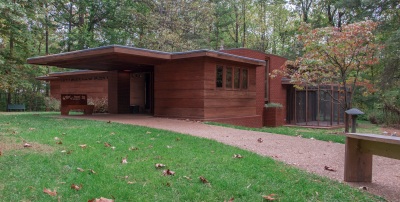
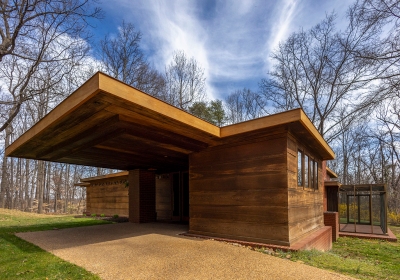
The Pope-Leighey house is the essence of what Wright believed a home should be. It is a “Usonian” home, so designated by Wright to reflect its fundamental democratic and American nature. Like almost all of his houses, it embodies a horizontal motif, embodying, Wright believed, the non-hierarchical society in the United States. Moreover, as a Usonian, it was designed to be affordable.

To keep them affordable, Wright kept them small, while still incorporating his unique touches.


Wright was a firm believer that a home’s first purpose is to provide shelter from the outdoors. He exemplified this by having a low roof as one entered the house, in order to transfer the person to a sense of confinement and safety–shelter.
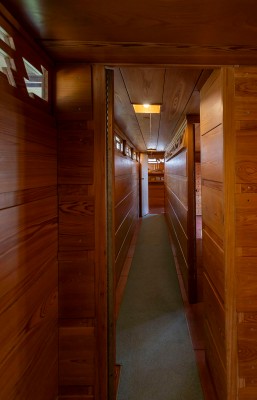
Beyond the entrance, however, the interior opens in the central living area, where the need for mere “shelter” gives way to higher order needs of family togetherness. This sense of “compression and release” was central to Wright’s architectural philosophy, and this has been, over the decades, adapted to the “open-floor concept” of today.

Another aspect of huge importance for Wright is connection with nature. He wanted his design to blend with the outdoors, to be one with its surroundings, which he achieved at times by using materials from the immediate surroundings for the material structure of the home.
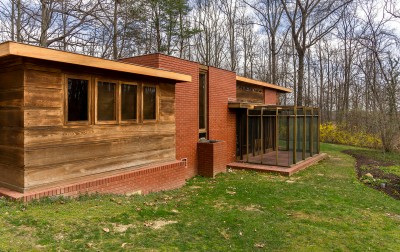
He also utilized “transitional spaces” to usher people from the outside of the home to the inside. So, the outside eaves might provide light, similar to outdoor windows.

The indoors, too, might have windows in unusual places, to allow for light from the outdoors.

And, in the “community spaces,” the windows would be large (and they often opened, as doors) to allow full interactivity with nature.

Wright’s Usonian designs definitely stand out to us compared to the historical houses we have visited and will visit throughout this week. Nonetheless, this was a great opportunity for us to expand out limited knowledge in architecture and see how history, art, and social living interact.
Dial “LEAP” for Entertainment

For the first weekend of the summer session the LEAP Ambassadors gathered with alumni and friends to attend another of the Alley Theatre’s wonderful productions, this one “Dial ‘M’ for Murder,” the Hitchcock classic adapted to the stage by Jeffrey Hatcher.

As is our norm, we met friends at the Houston Post Market for dinner. This venue allows everyone to try something new, while also providing for a diversity of taste options.

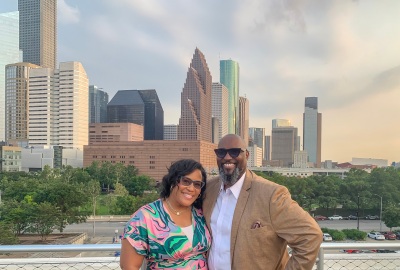
And the Post Market also provides a wonderful view–from the rooftop!

Although a casual dinner, it was celebratory. Not only was it a wonderful way to spend time with friends, but it was also the Spencers’ birthdays! Yes, they share the same birthday of June 1.

Following dinner, we zipped to The Alley Theatre, where we settled in for “Dial M for Murder.”

We were able to see some familiar faces, regulars from the Alley’s professional cast, such as Dylan Godwin (from SHSU) and Todd Waite. But we were also able to see some new (to us) talent, including Teresa Zimmerman, Geena Qintos, and Brandon Hearnsberger.

We loved the play, with some debate about whether this, “The Nerd,” or “Shear Madness” (at the Lincoln Center in DC) was the LEAP Ambassadors favorite among recent productions.

In broad outlines, the play follows the 1954 Hitchcock thriller, but this production added in more humor, particularly in the second half. There were also a few modernizations and an added twist, ensuring that even those familiar with the film classic will find new aspects of the thriller to enjoy.

All agreed that the sets and lighting were one of the chief assets of the production.

There was less consensus on which of the actors was the best, but everyone agreed that watching Todd Waite is a joy.

It was a wonderful way to spend an evening, precisely how we wished to kick off the summer session–with entertainment, education, and friendship.

PLS Spring Social: Legal Fun

by McKenna Nonnenman

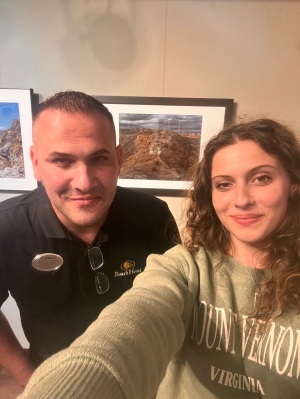
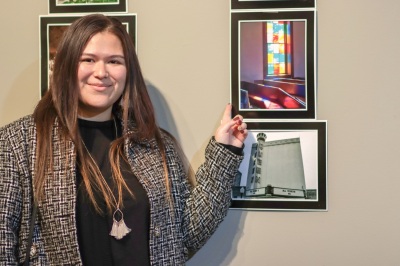
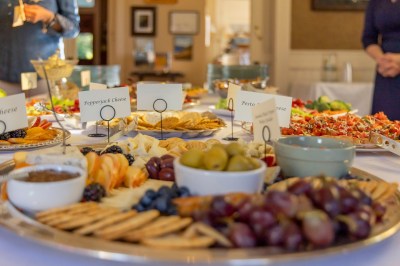
With the semester drawing to a close, the Pre-Law Society hosted its Spring Social, a fun-filled evening with a lot of snacks. What’s better, we held it at the Wynne Home, where we surrounded by its beautiful art!

Although the evening was designed with fun in mind, the activities we all law-themed. Thus, we have a debate tournament based on childhood cartoons such as Scooby-Doo and Sponge-Bob SquarePants, the latter of whom was charged with a DUI in our retelling.

Then the jury groups switched with prosecution and defense for the next case: the murder of Scooby-Doo (spoiler alert: Velma did it with poisoned Scooby-Doo snacks in the kitchen). All groups reviewed their charges….

…and were given a four-minute time frame to explain key points of their positions and a one-minute rebuttal. The jury from both cases decided on the best arguments for both cases choosing the two teams to go head-to-head for the final debate: Texas v. Bradley.

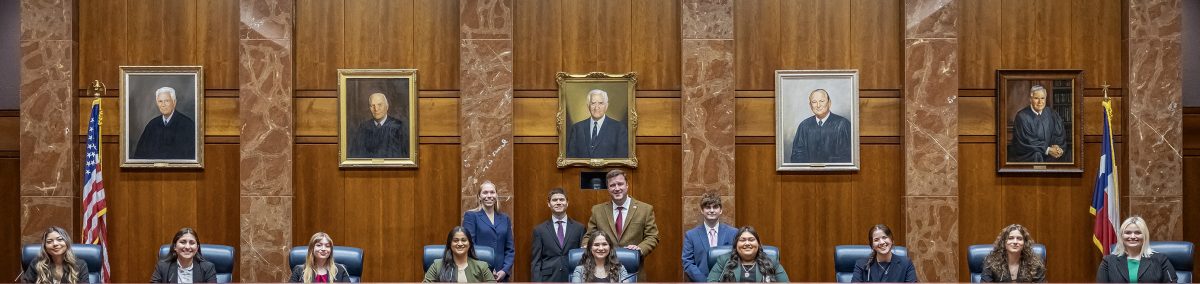
Both teams argued very well, and the jury decided Emily Albright, Lillie Bourgeois, Katherine Burnett, Nicole Erazo, and Natalie Mujica won the debate, with good sportsmanship shown all around.

Next after a long break of Italian soda and snacks…

…our members played a game of Jeopardy. If our debate game did not bring out our members’ competitive sides, our game Jeopardy game certainly did! The question consisted of information about past Pre-Law Society Meetings, “Is it legal”, Sam Houston University, The Wynne Home, and Spring. After lots of debating, yelling, and cheering…

…Neehal Ahmed, Chrisi Biello, Olivia Discon, Mark Harkrider, and Isaac Mokrane won by a landslide!

Our members finished out the night with chips, cookies, and Scooby-Doo snacks (not poisoned of course) and shared funny stories from home and or work.

This social brought out the competitive sides of all our members who attended, forged new bonds, and created new friendships. Thank you to the Wynne Home Arts and Visitor Center for providing us with a space to host our social; and thank you to our Spring 2024 Semester Planning Committee for creating these activities and a fun-filled night.

Shear Madness is Sheer Fun!

by Cinthia Villarreal

As LEAP Ambassadors, we do our best to maximize our experiences. This means taking as many opportunities as possible in a given location. So, following a day of conference sessions, we took advantage of a free evening to see “Shear Madness” at the beautiful Kennedy Center.

As we entered the building, a majestic, jaw-dropping hall with worldwide flags hung from the tall ceiling greeted us…

…and at the end, windows from top to bottom with a red dragon on it allowed us to see into the Potomac River.

To add to it, the sun setting on the other side of the building gave us an amazing reflection inside the hall and an awesome view of the D.C. skyline. 

While wandering around the building, we were able to recognize the artists of the various art pieces at the patio. Throughout the trip, we have seen numerous works of Lichtenstein so, even though not a fan favorite, we still felt proud to recognize his art. 

This trip we have learned and gotten to know the work of Joel Shapiro. Using rectangular abstracts of human figures, Shapiro captures movement of the human body.

Olivia and I saw Debra Butterfield’s work on our Southwest trip at the Texas Tech campus and were ecstatic to see her work again, and in the other side of the country, too. 

As we entered the Kennedy Center’s lobby, beautiful chandeliers showed the way into the theatre… 

…and we were ready for the play to begin.

The play takes place in a present-day Georgetown in retro styled beauty salon where Tony Whitcomb and Barbara DeMarco, the hair stylists; Mrs. Shubert; Eddie Lawrence, an antique dealer; and Nick O’Brien, an undercover police officer, are introduced to the public.

As Tony and Barbara are at work, they get sidetracked and wrapped in current gossip, frequently unbothered about their costumer’s time or even safety. Suddenly a piano starts playing and Tony begins to complain about Isabel, the upstairs elderly neighbor who is also a worldwide recognized pianist. 

Suddenly, the group is told that Isabel has been mysteriously murdered and everyone becomes a suspect to an open crime.  As the interrogations begin, the crew starts acting suspiciously and begin to throw each other under the bus with the police in order to not be the main suspect. 
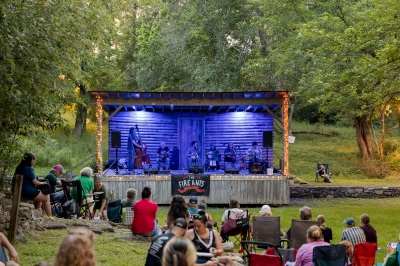
What truly made this experience one-of-a-kind, is when Officer O’Brien turned to the public for their insight on the case. With this, the play became interactive, and the crowd begins calling the actors out for lying, covering each other, or acting suspicious. He then invited the public to ask questions, which forced the actors to come up with the answer impromptu, and consequently, start improvising with jokes about current affairs and even about the audience. 
Being new to the theater world, I never thought I would find the theater so captivating and humorous.  It was amazing to witness the true skills needed for improvisation and I seriously admire the actor’s professionalism and readiness for staying in character without knowing what was to come.

In a small way, it’s like being a LEAP Ambassador, grabbing opportunities as they come, even when we don’t know what might be around the corner!