Skip to content

Center for Law, Engagement, and Politics

Leap At SHSU!

  • About LEAP
  • LEAP Ambassadors
Center for Law, Engagement, and Politics

Category: Civic Engagement

City Fellows Interns Tour the Huntsville Fire Department

by Michelle Moya

As part of the City Fellows Internship Program, we are continually exploring the inner workings of Huntsville. Our latest adventure took us to the heart of the city’s safety net: the Huntsville Fire Department, where we got an exclusive tour of the facility, led by Chief Greg Mathis.

The tour began in the lobby, where we were greeted by an impressive piece of history—a restored 1927 Huntsville fire truck. Chief Mathis regaled us with tales of the truck’s features and its rich history.

Macey and I even took a picture on the fire truck, joking that we were “officially” part of the fire department now.

Among the artifacts on display, Chief Mathis highlighted a particularly interesting item—a black-ball lottery device. This relic from the past determined whether someone would last as a volunteer firefighter. The process was simple yet harsh: firefighters would vote by placing either a white ball (yes) or black ball (no) in the container.

We then headed to Chief Mathis’ office, a treasure trove of knowledge where we learned the most about the department’s operations. Among his office testaments of pride, we got to see his impressive coin collection, which includes challenge coins from various of his experiences. These coins recognize achievements and build team spirit in the fire department.

He also emphasized that his job extends beyond fighting fires; it also involves securing grants, managing budgets, and ensuring his team can serve the community while staying safe.

We also noted the three hats from his career journey (including one that showed just how dirty the job gets).

Then we explored the residential area of the department, noting a unique feature—the “petrified wood” used in the television design is the same as the fireplace in the Josey Boy Scout Lodge. We also saw the “watch room,” which serves as the department’s nerve center, monitoring all alarms and operations. 

As we learned more about the watch room, Chief Mathis emphasized the crucial role that volunteers play in the Huntsville Fire Department. Volunteers undergo rigorous training and are equipped to respond to emergencies alongside career firefighters.

The living quarters were equally impressive, with bunk rooms featuring sliding barn doors and four closets each. They also have access to a private gym with equipment like a rowing machine, treadmill, and Jacobs Ladder.

Finally, we arrived at the apparatus bay, where the fire trucks are stored—representing the traditional perception of a fire department.

Chief Mathis pointed out the physical fitness test equipment outside for the Candidate Physical Ability Test firemen have to pass. Our very strong Macey even tried her hand at the test, successfully lifting to an extent, while Jacob also gave it a go with full strength and managed to lift it off the ground!

Now, my favorite part of the tour. The multi-force wood door device they have been experimenting with lately. It’s designed to simulate various door types and jamb materials, allowing firefighters to practice different breaching techniques. Attempting it once more with Macey! After a lot of effort, she managed to get the door open!

The day showed us not just how a fire department operates but also how city services, budgeting, and management all work together. Not to mention, Macey learned just how hard it is to be a firefighter!

We are grateful to Chief Mathis and the entire Huntsville Fire Department for sharing their time and knowledge with us! We deeply appreciate all they do.

Unknown's avatarAuthor mikeyawnPosted on April 2, 2025April 2, 2025Format AsideCategories Civic Engagement, UncategorizedTags Center for Law Engagement And Politics, City Fellows, Huntsville, Huntsville Fire Department, LEAP Center, Sam Houston State University, SHSULeave a comment on City Fellows Interns Tour the Huntsville Fire Department

Law and Leadership at the Local Level

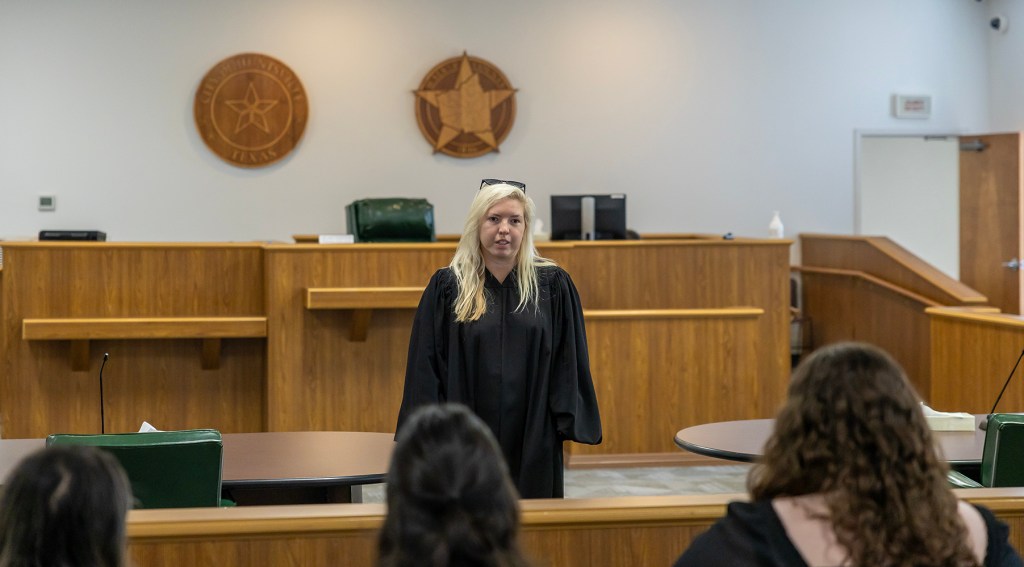
Every Wednesday in the fall and spring semesters, a select group of freshmen meet to learn about leadership. The topics vary, but the emphasis on building leaders persists from week-to-week and, in fact, from year-to-year. For one of these sessions, the LEAP Center offers a program, typically focusing on leadership at the local level, and this year was no different: Professor Mike Yawn and LEAP Ambassador Chrissy Biello adopted roles of locally elected officials to demonstrate how a courtroom operates.

Thus, last week, a simulated voir dire was presented to 24 students selected for the Freshman Leadership Program, as well as program leaders Dante Tamez, and Emily Figueroa. Professor Yawn took on the roles of judge, defense attorney, and prosecutor, while Chrissy took on the role of District Clerk.

Each student was provided a fabricated background, created by Chrissy, to guide the students’ answers as prospective jurors. Some students, for example, had been convicted of various crimes; others had clean records; some were Republicans; others, Democrats; some were unemployed; some were employed, and some were overachievers. Beyond these general biographical details, students could fill in their answers in a manner they believed consistent with the backgrounds provided.

The presentation went through being called for jury; arriving and filling out paperwork, which sometimes contains intrusive questions; the research that is done on potential jurors, both behind the scenes and live, in the courtroom; and the screening process, which can also be intrusive.

Along the way, students asked questions; posed scenarios, some of which were not anticipated by Yawn and Biello; and answered voir dire questions in ways that led to more interesting scenarios. One student even–in her hypothetical world–claimed her “water was about to break” and she “needed to be excused from service.” So much for civic duty…

As it turned out, several of the students are on a pre-law path, providing the opportunity for some additional discussion about courses of action. All of the students, however, are on a path to leadership, and after eight months at SHSU and in the Freshmen Leadership Program, are closer to fulfilling their promise as leaders of tomorrow.

Unknown's avatarAuthor mikeyawnPosted on April 1, 2025April 1, 2025Format AsideCategories Civic Engagement, Criminal Justice, Law, PoliticsTags Center for Law Engagement And Politics, Freshmen Leadership Program, Sam Houston State UniversityLeave a comment on Law and Leadership at the Local Level

Leadership, Law, and Learning: Alberto Gonzales at SHSU

by Michelle Moya

To round off an eventful week, we had the honor of hearing Judge Alberto Gonzales provide both inspiring and informative perspectives. Known for his distinguished career in law, government, and academia–which Olivia Discon shared with us in her introduction…

…Gonzales shared invaluable insights, drawing from his extensive experience as the 80th U.S. Attorney General, White House Counsel to President George W. Bush, Texas Supreme Court Justice, and, most recently, as the Dean of Belmont Law School.

Judge Gonzales began with a visual presentation that showcased personal photographs from his time in the White House, and President George W. Bush, as well as images from his early years.

These visuals setting the tone as powerful reminders of how far a dedicated individual can go—from humble beginnings to the highest levels of government.

But it was principles taught to him by his parents, he explained, that guided him from his humble beginnings as one of eight children born to a construction worker through the highest levels of government service. Gonzales underscored the guiding principles that shaped his path, particularly the importance of “showing up,” his father both literally and figuratively taught him, which he emphasized as a key tenet of the work ethic he hopes to instill in any student.

The presentation seamlessly transitioned into an insightful comparison of Gonzales’ two high-profile roles: White House Counsel and U.S. Attorney General. Judge Gonzales, having held both prestigious positions, offered unique perspectives on these roles that few Americans can provide.

He explained that while both positions serve the American people, they do so in vastly different ways—the White House Counsel advises the President and a select group of legal advisors, while the Attorney General leads the nation’s legal apparatus, overseeing thousands of lawyers, acting as the chief law enforcement officer, and spending a lot of time on television.

Perhaps one of Gonzales’s most memorable moments was being the “designated survivor” by President during the 2007 State of the Union Address.

Using this opportunity to explain the presidential line of succession—from Vice President to Speaker of the House and beyond—and his own astonishment at the possibility that, under catastrophic circumstances, he could have become President of the United States.

Gonzales also focused on the importance of professional networks, sharing his own journey–from serving in the Air Force to attending Rice and then Harvard Law–which led to meeting Governor George W. Bush. This connection would profoundly shape Gonzales’s career–and it is clear his appreciation for this impact remains deeply felt.

When Jacob Wessels asked Gonzales what his most difficult action as Attorney General was, the former AG mentioned the investigation of former Congressman William Jefferson, which involved a search of the Representative’s congressional office.

While law-enforcement officials argued that the search was necessary to nail down a conviction, Gonzales was concerned about long-held principles relating to the separation of powers. He authorized the search, which was challenged in court (eventually being ruled partially unconstitutional), but Congressman Jefferson was ultimately convicted and sentenced to 13 years in prison-the longest such sentence imposed on a member of congress.

Having served many prestigious roles, Judge Gonzales distilled his philosophy into three key characteristics: integrity, vision, and discipline—qualities he emphasized as essential for success in both law and public service.

In addition to his reflections on leadership and ethics, Gonzales offered practical advice for students considering law school as Dean of Belmont Law–to which we listened attentively!

His advice was both practical and powerful: highlighting the importance of staying informed about current legal issues and honing strong writing skills—fundamental abilities for anyone pursuing a career in law and government careers. Gonzales also offered advice to students hoping to go to law school, from what to include on personal statements to the importance of GPA and LSAT scores.

Throughout the session, students were able to pose a range of thoughtful questions.

I had the chance to ask about Gonzales’s time on the TX Supreme Court, which he indicated he wasn’t sure was right for him. Gonzales had spent little time in a courtroom, and he had never been a judge before the appointment. Eventually, though, he decided that service was his calling, and this position led to his eventual appointment as White House Counsel and US Attorney General.

For SHSU students, this interactive discussion proved a great learning experience. As a thank you, LEAP ambassador Chrissy provided Judge Gonzales with a signed copy of the “The FBI Code” by former Assistant FBI Director Frank Figliuzzi. Grateful for his time and wisdom, we left the event motivated to dream big and stay committed to our paths of service and leadership!

Unknown's avatarAuthor mikeyawnPosted on March 31, 2025March 29, 2025Format AsideCategories Civic Engagement, Criminal Justice, Law, Politics, Public AdministrationTags Alberto Gonzales, Belmont College of Law, Center for Law Engagement And Politics, LEAP Ambassadors, Sam Houston State UniversityLeave a comment on Leadership, Law, and Learning: Alberto Gonzales at SHSU

Understanding the Legal Process: Insights from a LEAP/COCJ Collaboration

by Chrissy Biello

The Sam Houston State University Center for Law, Engagement, and Politics recently partnered with the SHSU Criminal Justice Department to host a CJ Real Talk event. With approximately 50 students in attendance and moderated by Professor Mike Yawn, the panel featured Montgomery County Chief Prosecutor Darla Faulkner, retired Lieutenant Criminal Investigator for Harris County Paul Smithers, and 12th District Court Judge David Moorman. 

Professor Yawn structured the discussion chronologically, guiding the panelists through the legal process from the moment a crime is committed to when it reaches a judge’s docket. To set the stage, he introduced a hypothetical scenario in which a Sam Houston student is caught drinking and driving, registering a blood alcohol concentration of 0.12, which is above the legal limit of 0.08.

The conversation began with Investigator Smithers, who explained the circumstances under which an officer could pull the student over. He noted that probable cause is required to initiate a traffic stop. If the officer administers field sobriety tests, the next steps depend on the county’s policies.

In Harris County, for example, officers must contact a district attorney, provide all relevant details, and obtain approval before filing a charge for driving while intoxicated.

As the case progresses, investigators remain actively involved. When asked about her collaboration with criminal investigators, ADA Faulkner emphasized the close working relationship between prosecutors and investigators.

Smithers elaborated, comparing the dynamic to that of a married couple. Investigators, he explained, are responsible for gathering all available evidence and ensuring no crucial details are overlooked. Their role is to present a complete case during discovery so that defendants receive a fair trial.

When asked what factors could influence a case, Faulkner stressed the importance of mitigation evidence. She explained that defense attorneys should present information that humanizes their clients, such as testimony about their family life, employment, or community involvement.

These factors, she noted, can significantly impact the district attorney’s decision on whether to offer a plea deal. Faulkner further emphasized that many ordinary individuals receive DUI charges, and understanding their personal circumstances can shape the outcome of their cases.

Judge Moorman was then asked whether he had ever defended a DUI case while practicing law and what advice he would offer a student defendant.

He responded that he would begin by looking at the student’s academic record and community involvement, as prosecutors often focus solely on the risks posed by the defendant’s actions. Highlighting positive character traits could help, but he cautioned that students must take responsibility for their actions and avoid making the situation worse by repeating their mistakes.

The discussion then turned to last-minute developments during trials. Investigator Smithers explained that unexpected evidence can surface, requiring investigators to act quickly to obtain necessary documents or verify new information.

This, he said, is why district attorney investigators must be present in court; they need to assist prosecutors in real time. He emphasized that when prosecutors are in trial, investigators are actively involved as well. Professor Yawn humorously added that he had once been told that if a prosecutor asked an investigator to procure a goat for a closing argument, the only acceptable response would be, “What color eyes should the goat have?”

During the Q&A  session, many students took the opportunity to ask a question, including one about common misconceptions in the courtroom. ADA Faulkner addressed a prevalent myth about prosecutors: that they must secure a certain number of convictions to meet a quota. She clarified that her duty is to ensure justice is served, whether through dismissals, pre-trial diversions, fines, or other resolutions.

With strong student participation and insightful discussions from the panelists, the Center for Law, Engagement, and Politics was proud to work with the always-wonderful Doris Pratt and the SHSU Criminal Justice Department.

For those interested in similar opportunities, the Texas Tenth Court of Appeals will be visiting Sam Houston State University on April 16 in the CJ Courtroom. Cases will be heard at 10:00 a.m., 11:00 a.m., and 1:30 p.m.

Unknown's avatarAuthor mikeyawnPosted on March 28, 2025March 28, 2025Format AsideCategories Civic Engagement, Criminal Justice, LawTags Center for Law Engagement And Politics, College of Criminal Justice, Darla Faulkner, Judge David Moorman, Legal System, Paul Smithers, Sam Houston State UniversityLeave a comment on Understanding the Legal Process: Insights from a LEAP/COCJ Collaboration

The Plains of Kansas

With our longest driving day of the trip (8.5 hours in the car), we set out to see as much as we could while driving across the “Sunflower State.” While some may think of the Plains as plain, we were determined to see interesting spots, and we did!

The Largest Easel

Goodland, KS is the unlikely destination of artist Cameron Cross’s “The Big Easel” installation. The art project includes not only the titular easel, but also a replication of Vincent Van Gogh’s “Three Sunflowers in a Vase.”

Cameron Cross’s Homage to Van Gogh in Goodland, KS

Interestingly, it is one of seven such pieces that Cross has either created or hopes to create, with the other completed projects being in Emerald, Central Queensland; Altona, Manitoba; and Arles, France.

In all, the Goodland structure is eighty-feet tall, and it is a creditable replica of Van Gogh’s masterpiece.

Further, it is located in the midst of a city park, complete with a pagoda, a lending library, and some walking trails. It was a pleasant stop while traversing the western corridor of Kansas.

Lindsborg, KS

Nestled amidst the plains of Kansas is Lindsborg, KS, otherwise known as “Little Sweden USA.” The moniker derives from the fact that city was founded by a hardy group of Swedish immigrants in 1869, led by pastor Olaff Olssen. Even today, thirty percent of the population is of Swedish origin, and it is home to the biennial Svensk Hyllningsfest.

Downtown Lindsborg

It is a lovely town and a delight to explore. The street is lined with “Dala” horses, a representation of Swedish culture and heritage. They are cleverly done, with a “one-Dala” horse being painted green and adorned with features from US Currency; a “Blue-Colla Dala,” recognizing the workhorses in the community; and, probably our favorite, a “Salvador Dala” horse, featuring the Spanish artist’s characteristic surrealist landscape.

Salvador Dala

We also loved City Hall…

City Hall, Lindsborg, KS

…a historic bank building originally built in 1887 (and reminiscent of the Roche Building in Huntsville, TX)…

…the quaint downtown streets, which were wonderfully walkable…

…and Swedish-themed telephone booth, as charmingly anachronistic as the town.

Small World Gallery

by Chrissy Biello

Jim Richardson is a legend in the field of photography, with countless features in National Geographic and a long list of prestigious awards to his name. His work has shaped how people see the world, especially Scotland and Midwestern America. But despite his global recognition, he calls the small town of Lindsborg, Kansas, home, where he owns a Main Street gallery and studio called Small World.

Small World Gallery

I recently had the chance to take Richardson’s The Working iPhone Photography Class over Zoom. The two-session course, each lasting two hours, completely changed the way I look at phone photography. Before, my approach was basically point, click, and hope for the best. But Richardson’s class made me realize just how much potential my iPhone camera had if I actually took the time to use it properly.

Jim Richardson’s “iPhone Photography” Class

During our trip to the Academy of Criminal Justice Sciences Conference, I tried to put some of Richardson’s lessons into practice. I was not sure if I was using his advice correctly, but I made an effort to be more intentional with my photos.

On the day we left Colorado and entered Kansas, we decided to stop in Lindsborg and visit Small World. To our surprise, Richardson was there in person. It also happened to be the first day of a new exhibit featuring some of his latest photographs from Scotland, Kansas, and other areas of interest.

Inside the studio, there was a lot to take in. Along with Richardson’s prints, there were books, drawings from other artists, and handmade jewelry crafted by his wife Kathy and Briana Zimmerling. Every part of the space had something interesting to look at.

Seeing Richardson’s work in person gave me a new appreciation for his photography. His photos capture people in a way that feels natural and genuine. His landscapes and wildlife shots show the same kind of attention to detail and care.

“Wheat Fields,” by Jim Richardson

While looking around, we had the chance to talk with Richardson. Since I had taken his class online, I was excited to meet him in person. He was just as engaging and knowledgeable as he had been on Zoom. He even gave Olivia a photography tip, suggesting she use her hand as a shade when harsh light was hitting the frame. She later tried it while photographing a Henry Moore sculpture at Wichita State University, and sure enough, it worked like a charm.

Henry Moore’s “Reclining Figure”

Of course, we could not leave without taking a few prints home. Choosing just one was nearly impossible, but after much debate, we each settled on the piece that spoke to us the most. As a bonus, each print purchase came with a free postcard; Olivia and I chose one that featured the Great Sand Dunes National Park as we had just visited.

Jim Richardson

Before we left, Richardson took the time to personally sign all our purchases, making them even more special. The visit had already been unforgettable, but this was a very thoughtful gesture that meant much to us all. 

It is clear that Richardson is not only an exceptional photographer but also a truly kind and genuine person, qualities reflected in both his work and how he connects with others. It was an honor to meet him and have the opportunity to learn from him, even if only for a few hours. I gained valuable insights and look forward to applying them to my future photography.

Birger Sandzen Museum

One of the city’s most famous native sons is Birger Sandzen, a world-renowned artist who also taught art at the local Bethany College. Indeed, Sandzen was part of the Bethany faculty for an astounding fifty-two years.

Sandzen was known for his impressionist paintings, which he created using impasto strokes and vivid, sometimes unnatural colors. The result is a striking, three-dimensional effect, making Sandzen a highly collectable artist. Indeed, his work is in the Denver Art Museum, the Smithsonian American Art Museum, Art Institute of Chicago, the Nelson-Atkins Museum, the Brooklyn Museum of Art, and many others. But it is the Birger Sandzen Museum in Lindsborg, KS, that has the most works on display at any given time.

Birger Sandzen Memorial Art Gallery

The Museum, founded in 1957–three years after Sandzen’s death–now houses an impressive collection of the artist’s body of work, which was voluminous. It is tastefully displayed in two galleries, with three additional galleries devoted to rotating exhibits

Sandzen’s work, which ranges from small, monochrome lithographs to expansive, colorful landscape, is effectively showcased in the gallery.

We enjoyed looking through the rooms, seeing his body of work, distinguishing among his different styles, and picking our favorites.

Chrissy’s favorite featured Rockport Massachusetts, one of several paintings Sandzen did while visiting the Bay State.

Olivia’s favorite featured the Garden of the Gods, a wonderful area in Colorado Springs, CO, where Sandzen taught in 1923 and 1924. The artist painted several such pieces in the area, and his work in Colorado was featured in 2016 at the Colorado Springs Fine Art Center.

Professor Yawn’s favorite was “Early Moonrise,” where Sandzen ventured into pointillism, producing a work with strong overtones of Paul Signac.

Beyond the main gallery, the Museum also featured an exhibit by Wayne Conyers, who had some clever riffs on other artists and some very nice ceramics.

In our group, other pieces from the Museum’s collection stood out prominently. Professor Yawn found Grant Wood and Thomas Hart Benton pieces; Chrissy was surprised to see works by Rembrandt; and Olivia spotted two Albrecht Durer works!

Wichita State University

Following a day of driving and art-themed exploration, we doubled down and did some more! We ventured onto the grounds of Wichita State University…

…which has a public art collection of almost 100 pieces, and we soon learned that many luminaries were among them.

We began with some big-hitters–Jesus Moroles, Joan Miro, and one of Robert Indiana’s “LOVE” sculptures.

LEAP Ambassadors with Robert Indiana’s “LOVE”

We then did a walking tour of the campus, where we met many oddly friendly squirrels, and we saw even more great art. There was Oldenburg’s “Inverted Q”…

Claes Oldenburg’s “Inverted Q”

…one of George Rickey’s kinetic sculptures…

One of George Rickey’s Kinetic Sculptures

…Auguste Rodin’s “The Cathedral”…

Rodin’s “Cathedral”

…another Rodin, “Grand Torse de L’homme qui Tombe”…

…a “Reclining Figure” by the incomparable Henry Moore…

…Louise Nevelson’s “Night Tree;” and a large and attention-drawing Luis Jiminez sculpture, “Sodbuster San Isidro.”

Luis Jimenez Sculpture: “Sodbuster San Isidro”

We noticed that many of these pieces had been donated by (1) collectivities of students (such as cohorts or organizations); (2) alumni; or (3) funds from the Student Government Association. As LEAP Ambassadors and students who are passionate about arts, we have been excited about TSUS’s recent emphasis on the arts. We have also offered our own arts programs, and we hope to do so again.

But seeing the investments made by current students and the SGA on WSU’s campus provided examples of how collective action by students and governing organizations could be used to beautify the campus, engage the student body, and raise the profile of the University.

as another day closed on our art tours, and we headed to Oklahoma City–following a brief stop at the Allen House, by Frank Lloyd Wright– en route to a return to SHSU.

Unknown's avatarAuthor mikeyawnPosted on March 26, 2025March 26, 2025Format AsideCategories Architecture, Art, Civic Engagement, TravelTags Birger Sandzen, Center for Law Engagement And Politics, Claes Oldenburg, Frank Lloyd Wright, Henry Moore, Jim Richardson, Lindsborg KS, Luis Jimenez, Robert Indiana, Rodin, Sam Houston State University, Small World Gallery, Wichita KS, Wichita State UniversityLeave a comment on The Plains of Kansas

ALPR at ACJS: More Crime and Punishment in Denver

by Olivia Discon

After months of compiling data, conducting interviews, and researching, Professor Yawn, Chrissy, and I finally had the opportunity to present our work at the ACJS Conference in Denver, CO. This experience was unlike anything I’d encountered before, and presenting research at an academic conference as an undergraduate was both exhilarating and nerve-wracking.

So, what is our research about? In short, our group is examining the implementation of police technology in home-rule cities across Texas. Contrary to common perception, innovation in cities isn’t driven by a single department, organization, or state entity. Instead, it emerges from a complex interplay of governance. Our primary focus is on Automatic License Plate Readers (ALPRs), which rapidly scan license plates to aid in crime prevention. From a policy perspective, ALPRs are particularly interesting because they raise important questions about efficiency, privacy, and local governance.

Professor Yawn, who chaired the panel, led the presentation. As the primary researcher on this project, he has created an incredible opportunity for Chrissy and me to contribute meaningfully to the work.

While we still have a way to go before we “reach saturation” in our research, presenting at ACJS and receiving feedback from an engaged audience was invaluable.

Chrissy, who spearheaded our quantitative data collection, presented the methodology and preliminary findings. She did an excellent job of breaking down the statistical nuances and translating them into clear, digestible insights for us common folk.

Our session also featured a presentation from Tiffin University (TU), where undergraduates Zaria Moore…

…and Lauren Swartzlander…

…shared their public health study on mental health and alternative treatments.

They pursued this research voluntarily with strong mentorship support from TU faculty.

After both presentations, we engaged in a Q&A session with the audience…

…whose thoughtful questions and feedback left us excited to refine and expand our work further.

Safety, Crime, and Health in Urban Spaces

After our presentation, we attended another fascinating session on urban crime patterns and community development. One standout presentation came from Lauren Perron of Temple University, who examined agency collaboration in response to opioid use disorder.

She explored how organizational structure, leadership, and policy decisions impact the outcomes of the opioid crisis, particularly in the context of steering committees.

My favorite presentation of the session was Broken Windows in the Age of Big Data, which focused on Graffiti-Free NYC, a program led by the New York Sanitation Department. The study examined the correlation between quality-of-life indicators—such as graffiti removal and cleanliness—and crime rates.

While perceptions of crime can be subjective, this research provided compelling data-driven correlations that reinforced the impact of environmental factors on urban safety.

Chrissy’s favorite session was Policing the Opioid Crisis, which analyzed police-led deflection programs in Plymouth County, Massachusetts.

This case study, conducted by Professor Sean Verano and student Niki Poutre, explored the effectiveness of these programs in helping individuals struggling with addiction and how police officers ranked the anticipated success of different approaches.

One particularly striking finding was that while deflection programs increased the odds of relapse, they did not significantly impact fatal overdoses.

This session was our favorite of the conference—not just because we could finally relax after our own presentation, but because the discussions were incredibly thought-provoking. The insights we gained from these panels will undoubtedly inform our research moving forward.

Presenting at ACJS was a milestone experience, giving us the chance to engage with experts in the field, refine our work, and gain a deeper appreciation for the complexity of crime, policing, and policy implementation.

Dinner at Le French

by Chrissy Biello

Feeling the weight lifted off our shoulders, we headed to Le French for dinner. Founded by Senegalese-French sisters Aminata Dia and Rougui Dia, Le French is known for its combination of many worldwide influences and modern French cuisine. As semifinalists for the James Beard Best Chef in the Mountain Region in 2024, the Dia sisters have brought their culinary expertise to the forefront, making this dining experience even more exciting.

Through LEAP, my peers and I have had the unique opportunity to dine at James Beard-nominated and award-winning restaurants, and this was another highly anticipated experience for Olivia and me. Having not eaten much due to nerves, we were more than ready to indulge in what promised to be a great meal after a long day.

With little experience in French cuisine, Olivia and I found many menu items intriguing. To sample a variety of dishes, Olivia opted for the prix fixe menu. For her starter, she chose French Onion Soup, a dish she had never tried before.

When it arrived, she was thrilled with her choice. Not only did she enjoy a new experience, but she also discovered a dish she truly liked.

Professor Yawn and Stephanie ordered the escargot as their appetizer, and they were equally pleased with their selection.

For our main courses, I ordered the Saumon Fumé Savory Crepe, Olivia got the Suprême de Poulet Sauce Champagne (chicken breast with champagne sauce), Professor Yawn chose the Colorado Bass et Plantains, and Stephanie decided on the French Onion Soup.

When our meals arrived, we were all delighted with our choices. In true LEAP fashion, we made sure to sample each other’s dishes. Every selection turned out to be excellent, giving us a variety of flavors to experience.

For dessert, Olivia had the Panna Cotta, a dish featuring hibiscus, citrus, and marmalade berries. This was another first for her. Additionally, we shared a crème brûlée as a table.

It was a day full of firsts, from trying great new foods to presenting at our first academic conference. Nevertheless, we are especially grateful for the guidance of Professor Yawn and Stephanie. Their insights and encouragement, even their lighthearted stories to ease our nerves, were invaluable and something we could not have found elsewhere.

The Yard Milkshake Bar

Later in the night, after doing some laundry, Olivia and I walked to The Yard Milkshake Bar for another sweet treat. I chose the Cookies and Cream Cheesecake milkshake, while Olivia went for the Cake Batter milkshake. Both were delicious and well worth the walk from our hotel.

With the stress behind us, we are excited to continue our trip, filled with fun, learning, and new experiences.

Unknown's avatarAuthor mikeyawnPosted on March 24, 2025March 22, 2025Format AsideCategories Civic Engagement, Criminal Justice, Food, Law, Public AdministrationTags Academy of Criminal Justice Sciences, Center for Law Engagement And Politics, College of Criminal Justice, Denver CO, Le French Denver, Sam Houston State UniversityLeave a comment on ALPR at ACJS: More Crime and Punishment in Denver

Crime & Punishment in Denver

by Olivia Discon

The ACJS Conference has officially begun! As we inch closer towards our presentation on Automated License Plate Reader technology (as it relates to the Criminal Justice world), the anticipation only continues to rise. This is our first time presenting on a panel at an academic conference–or any conference, for that matter! With that being said, we of course scoped out the space and enjoyed several sessions on day one. 

Criminologists Converge

While hundreds of criminologists converged at the Sheraton in Denver, we split up a bit, maximizing the coverage of the conference and the sessions it offered. Collectively, we attended sessions on “Perceptions of Law Enforcement Technology,” where the standout presentation was “Support of BWCs by Type of Law Enforcement Agency,” by Dr. Mustafa Demir (John Jay);

“Rational Choice Theory and Crime: Emotions, Cognitions and Opportunity Structures,” which featured SHSU professors Timothy Barnam…

…and Shaina Herman;

…”Crime, Data, and Technology;” and the Presidential Panel: Key Strategies for Successful Academic-Practitioner Partnerships, the latter of which, we turn to next.

A Presidential Panel with the College of Criminal Justice at Sam Houston State University

The highlight of these sessions was unanimous among our group, which was the Presidential Panel from Sam Houston State University’s (SHSU) College of Criminal Justice. We were, of course, incredibly biased, but it was fascinating to see the various leaders within the college along with the diverse institutes they represent.

As noted by Dean Lyons, SHSU is uniquely positioned to serve as a leader in the criminal justice field, and the College has “its finger on the pulse” of criminal justice.

Whether it be forensic science, corrections, policing, criminal justice legislation, or sociological phenomena, SHSU remains a leader, a resource, and an asset to the state of Texas. Interestingly, the nationally recognized program is the reason I chose to attend college and, by extension, to major in criminal justice.

We had the opportunity to hear from John Ray, Executive Director of LEMIT;

…William Wells, Faculty Research Director of LEMIT; Christie Haney, Assistant Director of CEMIT; Michael Aspland, Executive Director of the Institute of Homeland Security;

Ryan Randa, Associate Professor; Doug Dretke, Director for the Office of Comparative and International Education and Leadership;

…Erin Orrick,  Associate Dean for Programs and Assessment; and Dr. Bitna Kim, President of ACJS, professor at SHSU, and former doctoral candidate at SHSU!

Among the College of Criminal Justice at SHSU’s many accolades and amenities, what stuck out was its embodiment of a concept, noted by John Ray, as “pracademics”.

The relationship between academician and practitioner, as we devolve further into niches and silos, is more important than ever. I truly respect how SHSU has gone beyond what others simplify Huntsville to be–a “prison town” – and instead aim to drive crucial research and policy that impacts the state, our country, and impressively, the entire world as it relates to criminal justice.

It was a great opening to a first experience for us, made all the more comfortable and welcoming by being among friends and mentors.

Unknown's avatarAuthor mikeyawnPosted on March 14, 2025Format AsideCategories Civic Engagement, Criminal Justice, LawTags Academy of Criminal Justice Sciences, ACJS 2025, SHSU College of Criminal JusticeLeave a comment on Crime & Punishment in Denver

A Capitol Day in Denver

When LEAP Ambassadors travel, they aim to make the most of it, unsure of when they might be able to return. Today exemplified that spirit, as we tried interesting food, dropped in to our ACJS Conference site, roamed the Denver Public Library, toured the Clyfford Still Museum, explored the Colorado State Capitol Building, and visited a National Wildlife Refuge.

Denver Public Library

The Denver Public Library is not only the home of thousands of books, ideaLAB Makerspaces, and research materials, but it also owns some impressive art, and that is one of the major reasons we stopped by.

Along the way, we saw some impressive pieces, such as a Frederic Remington…

…but we also had a chance to see the work of artists new to us, such as Marie McFarland, Chase Varney, and, especially, Otto Kuhler.

Perhaps most impressive among the paintings was an Albert Bierstadt!

Although we also just loved some of the spaces, such as one of the reading rooms…

Our experience suggests that a robust library system across a wide variety of services benefits the community greatly. They promote literacy; allow for research in the community, which foster a sense of community identity; if done correctly, they can beautify the community; and, perhaps most important, they bring a community together. And this is what we witnessed in Denver: a friendly staff, a beautiful interior–further beautified by the art; and a diverse group of users, which included us!

Clyfford Still Museum

The Clyfford Still Museum gave us a chance to see the evolution of an artist who refused to conform to the art world’s expectations. The galleries were arranged to show the progression of his work, starting with his early pieces, which were more representative and realistic, before gradually shifting toward abstraction.

I found his earlier works particularly interesting, especially the ones featuring figures with large hands and elongated faces.

While I’m still not entirely sure what to make of them, they seem to reflect struggle and resilience, possibly tied to the hardships of the Great Depression.

What stood out to me the most, though, was Still’s complete rejection of the art industry. He despised galleries, museums, and critics, believing they distorted the meaning of art and prioritized profit over artistic integrity. He was known to pull out of exhibitions and refused to title his paintings, even going so far as to remove preexisting titles to prevent outside interpretation.

His frustration was clear in a statement he made in 1971: “I am deeply outraged that my entire life is being interpreted as a long struggle to be recognized by some damn fool art critics or to be sold successfully in the galleries or even to find their way into art museums because I consider these institutions to be corrupt in the purpose and their meaning and their effect on the artist and society.”

One of the more unexpected features of the museum was the use of canvas screens to partially cover certain pieces, allowing them to be revealed while also being preserved.

As we moved through the galleries, we could see how Still’s work became more abstract and how much control he maintained over his legacy.

Even after his death, his wishes shaped how his art was displayed and handled. Unlike many of his peers, his work wasn’t scattered across various museums or private collections—it was kept together, exactly as he intended. He may have been a particular man, but he was also a particularly fascinating man.

Colorado State Capitol Building

by Chrissy Biello

The Colorado State Capitol took fifteen years to complete, finishing in 1901 at a cost of nearly three million dollars. Despite its distance from Texas, the building evokes a sense of recognition among many Texas visitors. This familiarity comes from its design by Elijah E. Myers, the same architect who designed the Texas State Capitol. In fact, Myers’ influence extends beyond these two states, as he also designed the Michigan State Capitol in Lansing.

Walking into the building, visitors can see many features that connect it to significant landmarks across the country.

The floors, made from white Yule marble, are the same material used in the construction of the Lincoln Memorial and the Tomb of the Unknown Soldier at Arlington National Cemetery in Virginia.

Moreover, the building showcases rare Colorado Rose Onyx, a pink-hued stone found only in a quarry near Beulah in Pueblo County. Nearly the entire known supply was used in the Capitol’s construction, making it the only building in the world to feature this material.

For sci-fi fans, one particular design in the Rose Onyx resembles the likeness of Princess Leia‘s hair from Star Wars…

And one interesting detail for those interested in city government is that John Hickenlooper, the 42nd Governor of Colorado, was the mayor of Denver from 2003 to 2011. His gubernatorial portrait stands out dramatically among the gallery of solemn official paintings in the West Foyer. Instead of opting for a conventional formal pose, Hickenlooper is captured atop the dome of the Capitol with the Denver City and County Building behind him, dressed casually in a plaid shirt.

When touring the Capitol, one will also notice how some of the building’s design nods to the British Parliamentary system. The Senate chamber is filled with red-colored stencils on the wall, while the House features green. 

In the Senate, there are multiple stained glass portraits of some of the state’s most influential figures. Ruth Stockton, the first woman to serve as President pro tem of the Senate, is one that is frequently mentioned. She made history not only by being the first woman in that role but also by serving longer than any other woman in the legislature (24 years).

While the Senate has several stained glass portraits, the House Chamber has just one: a stained glass portrait of Barney L. Ford. Ford was an escaped slave who became a civil rights leader and fought for voting rights for African Americans in Colorado.

The ending highlight of touring the Colorado State Capitol is the opportunity to go up to the dome.

However, you will need to brace yourself for the 99-step climb, which is also pretty steep.

From this elevated vantage point, the panoramic view encompasses significant landmarks throughout the city.

Straight ahead, one can spot the Denver City and County Building featured in John Hickenlooper’s gubernatorial portrait.

To the left, one can see the Colorado Supreme Court building. Most notably, the Rocky Mountains can be seen in the distance, providing a stunning backdrop that highlights Denver’s unique geographical setting.

Rocky Mountain Arsenal National Park

To end the day on an even higher note of adventure, we headed eight miles northwest of Denver, where forty years ago, the United States Army operated a chemical weapons manufacturing plant—scary stuff.  After an expensive clean-up process, the site is now the Rocky Mountain Arsenal National Wildlife Refuge, an expanse of land that hosts more then 330 species of animal.

We did not see all of those species, but we saw a sufficient amount to make our afternoon. 

We saw rabbits and deer.  We have, of course, seen these species previously, but on this day we saw more than 60 deer on the eleven-mile driving tour!

Moreover, we saw some species that, for us, were first-time spottings.  A favorite was Prairie Dogs, which we saw scurrying from the sound of our vehicle, barking a warning to their fellow Dogs, or simply going about their business of eating.  They were a delight.

We also saw several species of birds, including the ever-present Canadian Geese…

…Robins, Red-Tailed Hawks, Canvasbacks, a Tri-Colored Heron, Northern Shovelers, European Starlings, Red-Winged Blackbirds, and a murder of crows–one of which was carrying a bone.

That may not sound exciting, but we also saw a Bald Eagle (Chrissy’s first), , numerous Magpies (first for both Chrissy and Olivia), and three Wild Turkeys (another first for both Chrissy and Olivia).

Of course, the big find was the herd of Bison.  Numbering more than 100, they spent most of their time eating, but they were surrounded by some amazing scenery, as they roamed the prairies with the towering and snow-capped Rocky Mountains in the background. 

We even saw part of the herd begin to run, kicking up dust all the way, as they rejoined part of the herd from which they had separated.  It was a majestic sight at a majestic site.

As we headed to the close of the wildlife drive, we were able to spot the Denver skyline framed against the beautiful Rocky Mountains.

Tocabe

Our final stop of this long and adventurous involved additional adventure: dinner. Keeping with the LEAP tradition of exploring food consistent with the cultures we are visiting and/or learning about, we decided to eat at Tocabe, which is co-owned by a member of the Osage Nation, and which bills itself as a restaurant offering meals that tell the stories “of our American Indian culture through native-sourced recipes and ingredients.”

We tried a variety of dishes and did some sharing, hoping to get sampling of their entire menu. Professor Yawn tried the Indian Fry Bread, stuffed with shredded Bison; Olivia opted for the chicken; and Chrissy explored the ground Bison; and we also ordered a bowl of Bison chili and, for desert, we tried Wojapi with Indian Fry Bread (with cinnamon and sugar, of course).

It was a fulfilling way to end the day, providing insight into the culinary traditions of Native Americans, offering a new food experience, and whetting our appetite for more Bison and Wojapi.

Unknown's avatarAuthor mikeyawnPosted on March 12, 2025Format AsideCategories Architecture, Art, Civic Engagement, Food, History, Outdoors, Photography, TravelTags Center for Law Engagement And Politics, Clyfford Still Museum, Colorado Capitol Building, Denver Public Library, Rocky Mountain Arsenal National Wildlife Refuge, Sam Houston State University, TocabeLeave a comment on A Capitol Day in Denver

Posts pagination

Previous page Page 1 … Page 12 Page 13 Page 14 … Page 107 Next page

LEAP Ambassadors Are Involved!

This slideshow requires JavaScript.

Follow Us On Facebook!

Follow Us On Facebook!

Catch Up With Us

  • Lessons in Leadership: Judge Gonzales and Colonel Yebra April 3, 2026
  • Pre Law Society and Public Safety March 27, 2026
  • Firearm Possession, Sexual Abuse, and Drug Possession on Tap for SHSU Courtroom March 19, 2026
  • Past as Prologue: An Evening with Jon Meacham March 18, 2026
  • Pre-Law Society hosts Dr. Rhonda Beassie March 16, 2026

Join The Conversation!

Multi-Platform Media… on Fun and Flavor: Chilly at the…
Highlights from the… on Glazing-A-Trail with Lauren…
The Civic Leadership… on Foundational Activities of the…
The Civic Leadership… on The Philosophical Foundations…
LEAPing Into Action… on The Philosophical Foundations…

Find Previous Posts

We also have Twitter!

My Tweets

LEAPing Into LEARNing

This slideshow requires JavaScript.

  • About LEAP
  • LEAP Ambassadors
Center for Law, Engagement, and Politics Blog at WordPress.com.
  • Subscribe Subscribed
    • Center for Law, Engagement, and Politics
    • Join 490 other subscribers
    • Already have a WordPress.com account? Log in now.
    • Center for Law, Engagement, and Politics
    • Subscribe Subscribed
    • Sign up
    • Log in
    • Report this content
    • View site in Reader
    • Manage subscriptions
    • Collapse this bar
 

Loading Comments...