Waite(ing) for “Baskerville” at Murder by the Book

Olivia Discon

We were at Murder by the Book, and we had some time to “kill.” We leafed through the Michael Connelly, thumbed the Agatha Christie, photographed the many Sherlock Holmes artifacts on display…

…and even bought a “Hound of the Baskervilles.”

But the real reason we were there was to see Todd Waite.
With 25 years at the Alley Theatre and an incredible 135 productions under his belt, he’s an institution in Houston theater. When he announced that he will be semi-retiring following his upcoming lead role in Baskerville: A Sherlock Holmes Mystery, we felt the “weight” of the occasion. It was “elementary:” we purchased tickets.

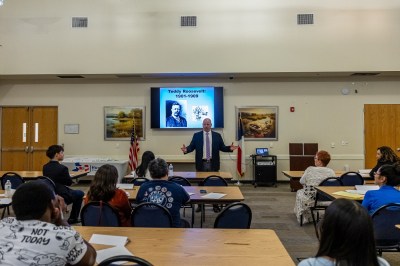
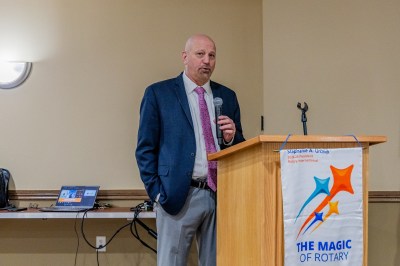
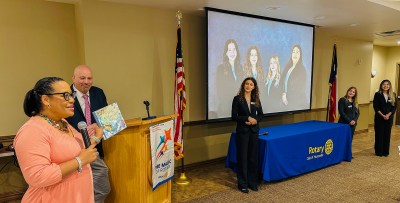
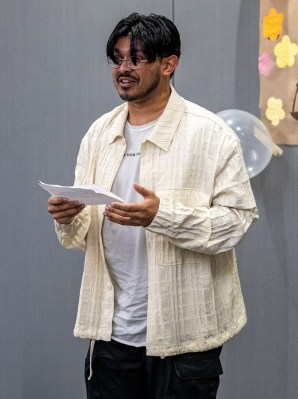
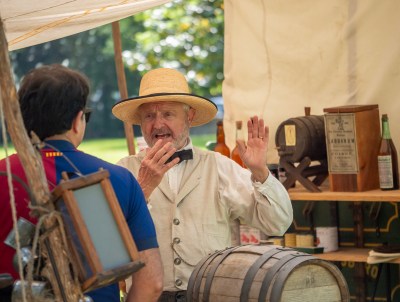
As a prelude to opening night, Waite spoke at Murder by the Book, where he took the stage to the delight of a full house.

During the discussion, Waite discussed his love of language, a passion instilled in him by his mother, an English teacher who taught him early on to appreciate the weight of every word. This foundation shaped his approach to performance, where even the smallest vocal shift—from “ah” to “oh”—can redefine a line’s meaning.

He spoke about the complexity of human emotion and how, beyond the broad categories we assign feelings, true depth is conveyed through inflection, gesture, and tone.

His role as an actor, he explained, is to bring those nuances to life in a way that honors the writer’s intent. He illustrated these ideas with stories from his career, sharing insights from specific productions that influenced his philosophy.

Theater, he notes, is a form of alchemy—combining words, movement, and presence to create something greater than the sum of its parts, and this is something the LEAP Center tries to capture in its approach to education, incorporating the fine arts, history, law, politics, and literature into its curriculum. It is perhaps appropriate, then, that a majority of LEAP students have seen their first professional play with Waite on the Alley Theatre’s stage.

LEAP Students / Alumni at the Alley’s “Thirty-Nine Steps”

The Alley Theatre itself is something of an anomaly in contemporary American theatre. According to Waite, the Alley employs a full-time, year-round resident company—one of the few, if not the only, to do so. And this, of course, allows the residents of Houston and the surrounding areas, to see first-class theatre year-round.

Although we bid farewell (for now) to Waite’s (Murder by the Book) performance, we eagerly anticipate seeing him take the stage once more as a resident of the theatre company on April 13. We anticipate Baskerville leaving audiences “howling” for more.

Pre-Law Workshops at SHSU

On March 19th, the Pre-Law Society (PLS) convened for our second meeting of the Spring 2025 semester.

With a focus on several professional workshops, the officers quickly addressed general business, discussing finances, membership, and exciting upcoming events.

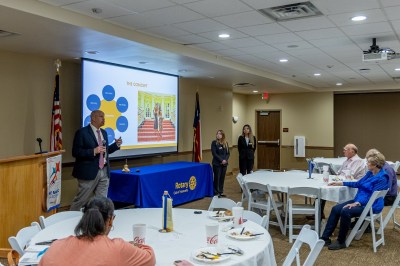
President Olivia Discon unveiled the formation of two new committees, the Communications Committee and the Social Planning Committee, giving members an engaging new way to be involved with the Pre-Law Society.

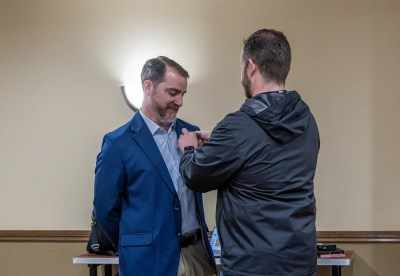
Afterwards, Professor Yawn, advisor to the Pre-Law Society, presented scholarships to select students: Timi Akindele, Lindsey Castro and Michelle Moya, based on their attendance in previous events.

He then urged the attending members to consider the importance of acting on the information they gain from the Pre-Law Society, highlighting the success of some graduating seniors to motivate the younger members of the organization.

Pre-Law Professionals Workshop

President Olivia Discon then gave a preliminary workshop on basic business etiquette, discussing appropriate business attire and email etiquette. 

We then broke off into groups, with members selecting which of the various workshops they wished to attend. These workshops are important because they provide students with valuable knowledge on professional attire, email etiquette, law school timelines, and the law school application process including key do’s and don’ts.

Law-School Timeline Workshop

Led by Pre-Law Advisor Jean Loveall, this workshop aimed to provide clarity to underclassmen about how to carry themselves during their undergraduate programs to best prepare for law school.

During their freshman and sophomore years, Ms. Loveall advised students to select their majors and minors and focus on building a strong academic record and cumulative GPA. Additionally, she advised underclassmen to join PLS, take a mock LSAT to gauge their strengths and weaknesses, begin to think about building their resumes and schedule an appointment with a pre-law advisor each semester.

 During the Fall of their Junior Years, Ms. Loveall advised students to begin developing criteria for their choice of law schools and begin to think about professors who might write them letters of recommendation. Here, Ms. Loveall stressed the importance of developing personal relationships with professors, as it leads to stronger letters of recommendation. Ms. Loveall also advised students to begin thinking about their personal statements and to create an LSAC account.

During the Spring semester of Junior year, students were advised to take a practice LSAT and figure out when they want to take their actual LSAT, drafting a study plan accordingly. Students were also told to narrow their law school search and to begin drafting the other components of their application (e.g. the personal statement and optional addenda) in accordance with the standards set by their chosen law schools. Furthermore, students were told to request their letters of recommendation and to request that their transcripts be sent to LSAC. Most importantly, students should continue to meet with their pre-law advisor.

During the Fall of their Senior years, students should register for and take the LSAT, finalize the components of their applications, fill out their FAFSA forms and apply to law school. From that point forward, students must wait for responses from law schools.

Applying to Law School Workshop

This workshop, led by seniors Christina Biello and Hunter Hagan, focused on the process of applying to law school, which the two seniors had diligently undergone during the prior semester.

To begin with, they taught attending members how to make an LSAC account, perhaps the most pivotal step on the journey to law school (As it’s literally impossible to apply without one). Afterwards they ran through a variety of the procedural aspects of applying to law school, such as how to ask for letters of recommendation and how to submit your transcripts to LSAC.

Chrissy and Hunter then discussed some tools available to students that make the process of applying to law school less daunting, such as LSAC forums and the LawHub platform. They also provided a copious amount of advice on topics such as the LSAT, Personal Statements and the benefits of applying for fee waivers during the application process.

Resume Building Workshop 

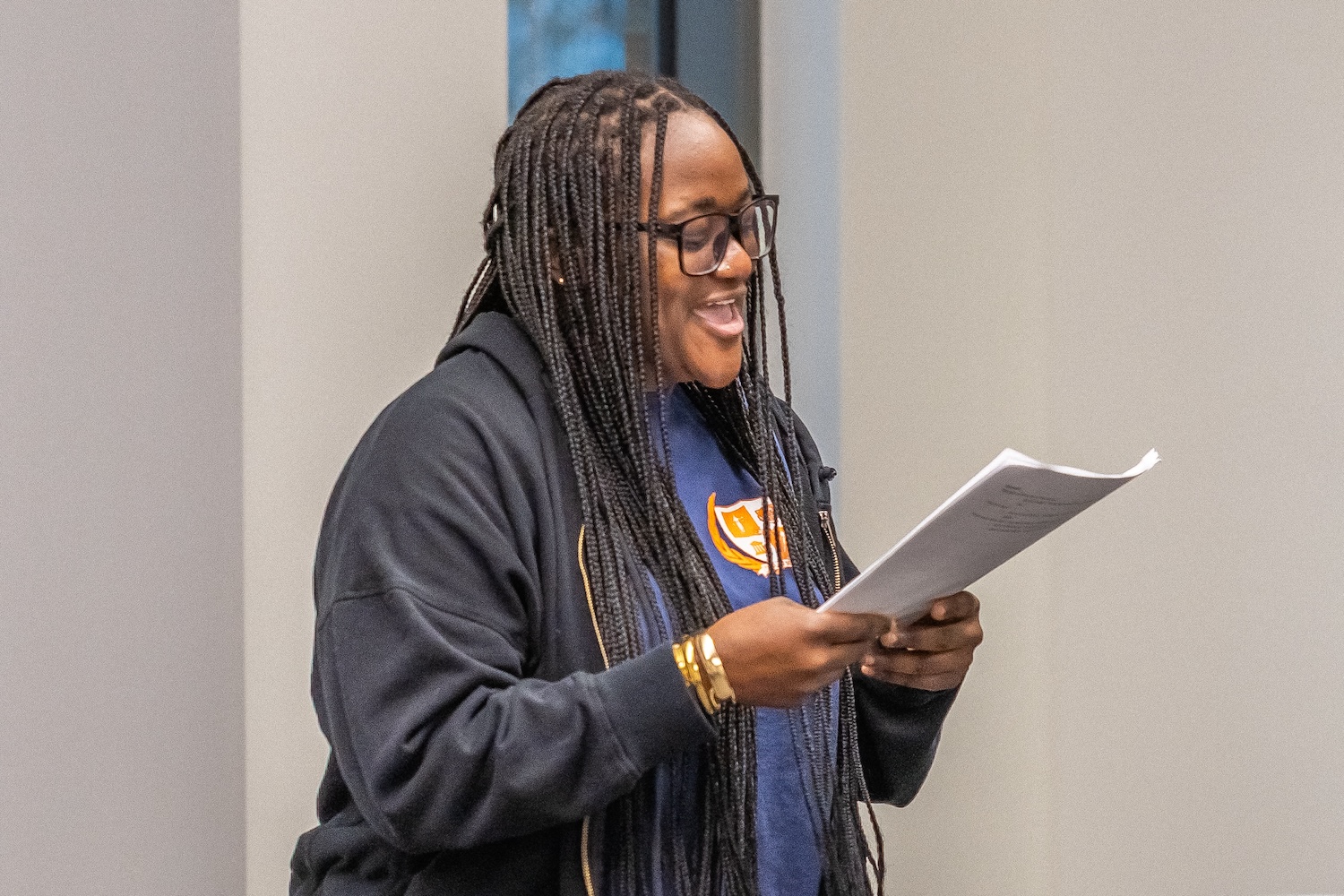
The Resume Building Workshop, led by Olivia Discon, focused on strategies for building a strong resume. Olivia outlined her five step approach to building a strong resume, after graciously sharing her first resume as a necessary example of what not to do when making a resume.

Olivia’s first step is to identify the resources available to you. She highlighted the Career Success Center as a resource available to students on campus, which provides them with templates on their resumes, as well as advice on how to improve them. The second step is knowing how to order your education and work experience. This step focused on understanding how to organize information on your resume, and recognizing what qualifies as relevant experience.

The third step is to know your strengths. Here, Olivia emphasized the difference between hard and soft skills, as well as knowing what skills are relevant for the job you are applying to.

The next is to become a stronger candidate. To do so, a student must utilize opportunities, list the honors they’ve achieved and any volunteer opportunities they may have been involved in. Olivia’s fifth step is to Advance Professionally, Intentionally. Olivia outlined what she refers to as the STAR test (situation, task action result) as a framework to bring purpose and clarity to each section of your resume.

Our next meeting is on April 16th; Stay tuned for our next blog!

Boulders, Books, and Rocks–Along the Rocky Mountain Way

Being in Denver, we felt compelled to visit Rocky Mountain National Park on an off day, so we set out early to do just that! Along the way, we visited the Pearl Street Mall in Boulder to explore the local shops. One store we stopped at was the Boulder Bookstore, where Olivia purchased a notebook, a copy of Martyr! by Kaveh Akbar, and a set of beautiful notecards. It was an excellent bookstore, and I am sure we all wished we had more time to explore it.

Nearby, we saw the Boulder County Court House, a building designed in the art deco style.

Finally, to prepare for our trip, we went to a local market in Lyons called St. Vrain Market, Deli, and Bakery. At the deli, we picked up sandwiches to enjoy on the mountain.

Rocky Mountain National Park

by Olivia Discon

The trails were a patchwork of ice and untouched snow, the lakes frozen over into eerie stillness. A single blue Stellar’s jay flitted between bare branches, watching us with the kind of judgment only nature can provide. 

Rocky Mountain National Park in winter is a mix of beauty and betrayal.

The meadows stretched wide and open, peaceful and quiet under the weight of the season.

Trails wove through icy patches and steep layers of snow. Every step was a guessing game—solid ground or sudden sinkhole?

We crunched through the meadows, the wind howling low across the open expanse, until we reached the rocks. 

That’s when things escalated.

Professor Yawn and I decided, in our infinite wisdom, that we should climb them. Not just once. Not just some rocks. No, we scaled rock faces like mountain goats who had lost all sense of self-preservation.

One climb turned into another, and before we knew it, we were standing at a questionable height, looking out over the vastness of the park.

And that’s when we heard it.

A faint, disembodied voice from below.

It was Chrissy.

From where we stood, she was just a tiny figure, barely visible, shouting up at us as if we had ascended into some divine realm. The wind carried our voices down to her, but to her ears, it must have sounded like the echoes of gods speaking from the mountaintops. We, of course, did not correct this perception.

“Chrissy, we see all,” I replied, as if we had unlocked some kind of mountain-wisdom. “We are everywhere and nowhere.”

She was not impressed. But she did eventually find her way up.

And we were able to share in the beautiful views.

We eventually made our way back down, the snow still unpredictable beneath our feet, the air crisp and unforgiving.

But it was as beautiful as it was unforgiving.

And we explored that beauty by circling the perimeter of Sprague Lake (on the East side of the Park, where it was much snowier)….

Note: Chrissy and Olivia in Distance

…where we witnesses to a proposal!

The winds were brutal, but the scenery was just compensation.

And we ultimately enjoyed our time on the Lake–so much so that we decided to go to another!

The Brutality – Scenery tension was a bit more on the side of Brutality at Bear Lake. The snows were deeper, so much so that the trail was indiscernible, except for the occasional signs that were almost buried in the snow.

Note “Bierstadt Lake,” Named for Artist Albert Bierstadt

Few people were on the trails, for good reason.

But we ventured on, trudging through the snow, around rocks, and even on the frozen lake!

It was quite a different experience than we were accustomed to in Texas on spring break.

As we made additional forays into the park, we made additional discoveries, such as deer (we ended up seeing almost 50).

On one case, when returning to the van, Stephanie interjected, saying, “Moose. Don’t step any further.”

Little did we know, there were two of them—the first that Chrissy and I had ever seen.

They moved through the trees, pausing only to munch on whatever food they could find amidst the snow. Later, on our drive out, we saw even more moose, casually grazing along the roadside. Professor Yawn and Chrissy, feeling adventurous, hopped out to get closer for photos. Stephanie and I, however, stayed in the car, content with admiring from a safe (and smart) distance.

Despite the unpredictability of nature, we thoroughly enjoyed Rocky Mountain National Park.

It became, by a wide margin, our favorite National Park experience. It was immediately understood why painters and romantic poets expressed the sense of awe provided by America’s vast and inspiring landscape.


Mile-High Art

Following panels where we had a chance to see some SHSU professors and staff, we proceeded to explore the art scene in Denver. With four major art museums in the city, Denver is considered a high-profile art destination–a reputation we wanted to assess for ourselves.

Denver Museum of Art

After a quick lunch break, we decided to spend our afternoon stimulating our minds in a different fashion by visiting the Denver Museum of Art. Not knowing what to expect, besides a “scavenger hunt” list provided by Professor Yawn, we were eager to explore and curious to know what we would come across.

LEAP Ambassadors with a Claes Oldenburg Sculpture at the Denver Art Museum

To our great surprise, there were several incredible pieces from many of the great artists, especially in both contemporary and western art. The building, which is quite modern in and of itself, was filled with names such as Keith Haring, Louise Bourgeois, Victor Higgins, Donald Judd, and Birger Sandzén (more on Sandzen in upcoming blogs).

There were some important outliers to be noted in this collection. Chrissy especially enjoyed a wintery scene by Monet, which she fondly associated with the film, Citizen Kane.

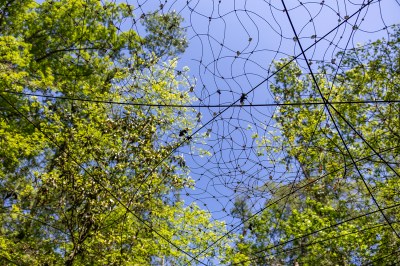
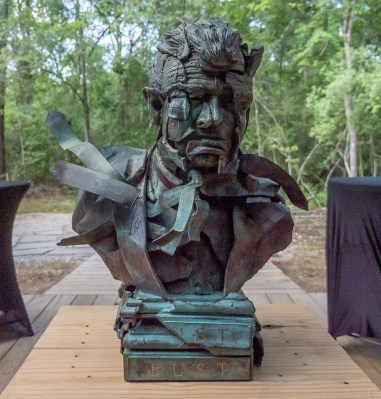
She also enjoyed some modern pieces, and if you know Chrissy, that is a true surprise! Particularly, she preferred works by Roxie Paine in varying mediums.

It’s been a pleasure to see her immersion into becoming an art enthusiast, branching out into more types of art.

Sure, it did require a phase of Andy Warhol, but it was worth it!

It is too bad fellow LEAP Ambassador Michelle Cardenas was not with us; she is a big fan of the idealized paintings of Albert Bierstadt, Thomas Cole, and Thomas Moran, and there were many of these to be seen!

As for me, I enjoyed tying in themes in this trip, and seeing some newfound favorites reinforced their name and style further. Allan Tupper True…

…Alexander Phimster Proctor…

… and Victor Higgins.

I also saw some of my all-time favorites! Among Deborah Butterfield’s herd of bronze-casted horses, we came across three, including the best one I’ve seen in person, which was a horse lying down.

Butterfield’s work is interesting. Not only does she create horses from broad solid objects not typically associated with horses, but the material is often disguised. The above piece, for example, appears to be pieces of wood put together to resemble a horse, but in fact, this piece was made of metal. The metal was cast from wood and then assembled to create the horse.

In the past, we’ve seen Butterfield pieces in DC (the Kennedy Center), NOLA (Besthoff Sculpture Garden), Lubbock (Texas Tech University), and Fort Worth (Fort Worth Museum of Modern Art), but we’ve never seen three in the same place!

Kirkland Museum of Fine and Decorative Art

by Chrissy Biello

When people think of art, they might not immediately picture chairs, tables, clocks, or other everyday objects. However, these ordinary objects become extraordinary when designed with unique styles that allow individuals to showcase their personalities and express what truly makes them who they are. The Kirkland Museum of Fine and Decorative Art in Denver, Colorado, highlights this idea by showcasing a diverse collection, offering visitors a unique museum experience.

One of the museum’s most distinctive features is its chronological layout. Rather than grouping pieces by type or artist, the collection is arranged by time period, starting in 1870 and continuing to the present. This approach allows visitors to see how artistic styles and design trends evolved over the decades.

Among the many artists featured, the museum showcases the work of Vance Kirkland. His early paintings focused on realism, as seen in Moonlight in Central City

Later in life, his style shifted toward abstract expressionism, reflecting a dramatic change in his artistic approach.

For those curious about Kirkland’s creative process, his personal studio is preserved within the museum. It features a spacious area where he painted, and in front of this space stands a large bookshelf spanning the back wall. The books include artists such as Matisse, Cézanne, and Botero.

Beyond paintings, the museum features an impressive collection of furniture. One highlight is the Taliesin Dining Chair, designed by architect Frank Lloyd Wright in 1955. The name comes from Wright’s home, which was destroyed in a fire in 1914 and rebuilt. The chair’s “Taliesin edges” are a signature element in his designs. 

Many other Wright pieces can be found throughout the museum…

The museum also displays work by Philip Johnson. Johnson is known for designing the PPG Building in Pittsburgh and the AT&T building in Houston. His Floor Lamp, created with lighting designer Richard Kelly, offers visitors a look at different approaches to lighting and design.

Another highlight is the collection of works by Charles and Ray Eames, a husband-and-wife duo known for their work in architecture, graphic design, and filmmaking, though they are best recognized for their innovative chair designs. Their chairs, displayed throughout the Kirkland Museum, differ from modern furniture yet remain highly functional.

In terms of trinkets, you can find a Noguchi bird compact, a ceramic pitcher designed by Pablo Picasso, and small tea cups designed by Alexander Calder. 

Additionally, visitors can view a piece by Dale Chihuly…

…and a set of Roy Lichtenstein dinner plates!

In all, the Kirkland Museum of Fine and Decorative Art offers a unique experience for those accustomed to traditional art museums. With its diverse collection of paintings, furniture, glassware, and more, there is truly something for everyone to enjoy.