Beyond Bars: Prosecution & Courts

October 11, 2022

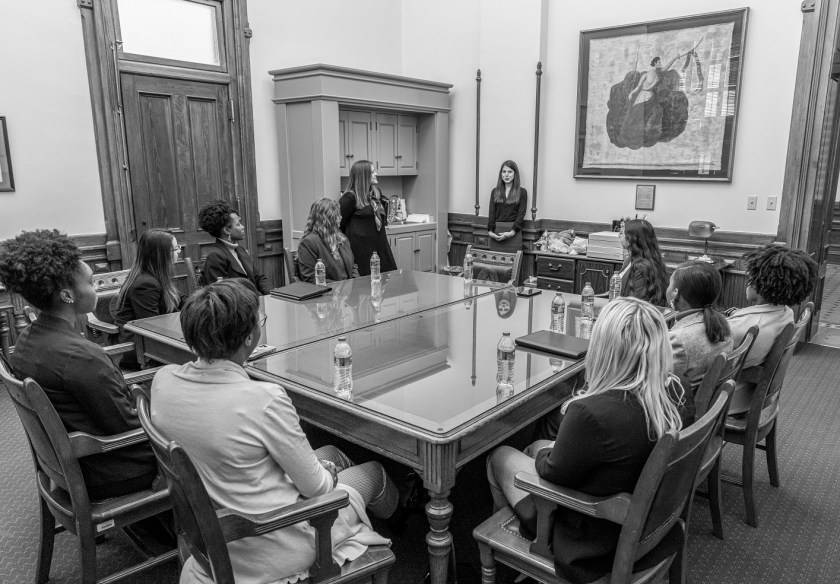
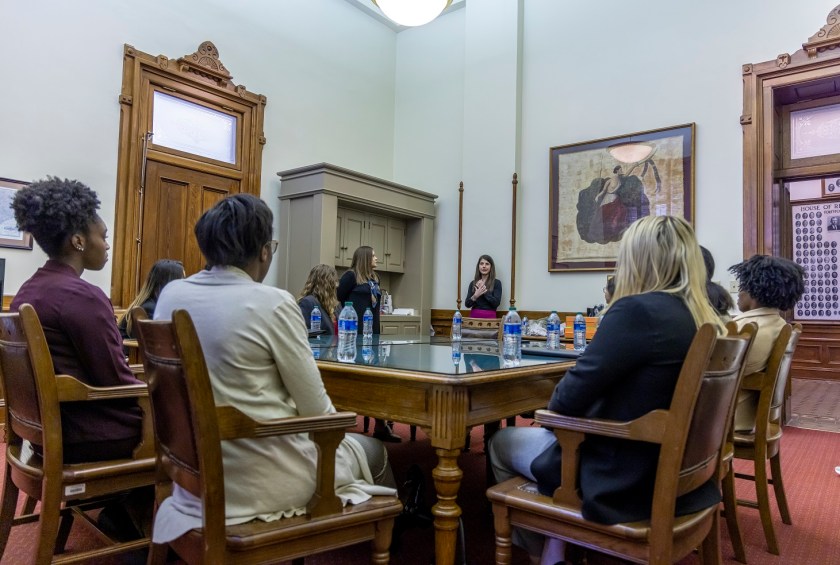
The second step in our journey through the incarceration process involves the prosecution and courts! We had an excellent opportunity to have a Walker County Courthouse tour, one led by County Court at Law Judge Tracy Sorensen. To discuss the prosecution side of things was Jennifer Jenkins, Senior Felony Prosecutor for the District Attorney’s Office. Every participant walked into the courthouse excited to hear the inner workings of a court from a judge’s and prosecutor’s perspectives.

Starting with the County Court at Law courtroom, Judge Sorensen explained her defense attorney days, as well as her two terms as Judge.

She oversees and handles cases involving juveniles, probates, child custody, and adult misdemeanors in the County Court at Law. Judge Sorensen has a trial jury of six total jurors in the issues that make it to trial.

We were even being taught scenarios about some instances that Judge Sorensen could hear and Prosecutor Jenkins might prosecute. For example, one of the students in Beyond Bars, Rachel Hill, was kind enough to let Professor Yawn use her as an example of a college student caught with less than a gram of marijuana.

Judge Sorensen and Jenkins mentioned they could probably reach a deal, one that might allow for a deferred adjudication, allowing Ms. Hill to keep this incident off her record. This made Ms. Hill very happy.

It was interesting to hear how the process works, while also getting advice from both Ms. Jenkins and Judge Sorenson.

Making our way up to the other side of the courts is the District Court, where Judge Hal Ridley and Judge David Moorman preside when in Walker County. These courts are physically larger, with space for a larger audience and 12 jurors. Portraits of prior judges are hung in the room, along with a portrait of Sam Houston.

While in this room, we shared our experiences of being a juror.

One of our participants, Steve Covington, discussed the time when he was selected to be on a jury hearing a pornography charge. As a juror, he was “forced” to watch hours of pornography in the jury room (with a jury consisting mostly of older women) to determine whether the content was criminal.

Ms. Jenkins and Judge Sorensen were kind enough to join us for dinner at Sam’s Table, where we all had a variety of Sam’s Table’s special menu items such as the Caprese Panini, Sams’s Secret Burger, and the Casado. Everyone enjoyed their meal while they had the opportunity to ask more questions about what it is to be a prosecutor and judge.

We took in new information from the tour and dinner; for that, we would like to thank Judge Sorensen and Ms. Jennifer Jenkins! It was fantastic getting to know more about the prosecutions and courts.

Beyond Bars: Police Department Tour

Jessica Cuevas

There was no better way to kick off our newest LEAP Program, Beyond Bars, than with a back-stage tour of the Huntsville Police Department led by Corporal David Warner. Starting us off was Lieutenant Curt Landrum, who told us the stories behind the artifacts, photos, and mementos that can be found in the waiting area. These included photos of all the chiefs, equipment from back in the day, and the “honorary” shovel used for the groundbreaking.

We also learned more about the building itself, and the interesting features of the structure. These included but were not limited to bullet-resistant glass, interview rooms, a gym, a locker room and showers, and a relay room. All of these have proven to be helpful and beneficial for various reasons such as security, privacy, and in the case of an emergency or a court hearing for those that drive in for a shift accommodation.

We had the opportunity to see the officers’ offices, computer spaces, and interview rooms. In a bullpen area with lots of open space and computers, we met a rookie who was enjoying (or not) filling out paperwork.

The coolest thing in this room was the computer screen that informs everyone where each patrol officer is, whether they are on a call, and if so, how long they have been on the call and the nature of the call. Interestingly, one officer had been called to the State Park to address “six teenagers taunting an alligator,” a crime-in-progress that we did not expect to see.

Before eating dinner, we had the opportunity to see the evidence room, and a joke was made that I would likely fit in one of the evidence lockers because of my small stature, haha.

We also learned a bit of Huntsville trivia. Did you know that on April 15, 2021, one officer gave 99 citations in a single shift? It was the most tickets ever imposed in the City’s history, at least as far as known, and it was done by a motorcycle officer.

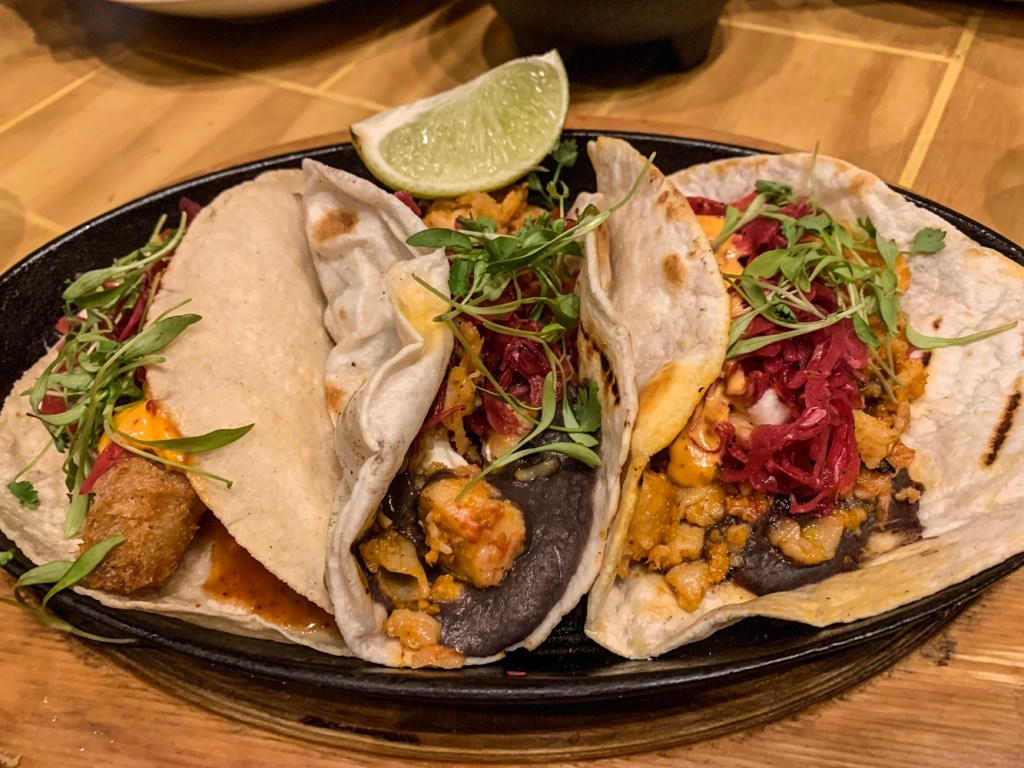
As the tour came to an end, we had the opportunity to dine in the Police Department’s lounge area with Corporal Warner, and little did we know of the activity that was awaiting us. On the menu, were delicious tacos al carbon: beef, chicken, pork, or shrimp, and or a choice of vegetarian, cheese, or pork pupusas from the local Salvadorian Restaurant, Carbonero’s.

Corporal Warner provided us with a demonstration of what is done during a sobriety test. In particular, he spun us around and then conducted a “nystagmus” test, which is one of the key indicators of sobriety or the lack thereof. Jazmin Palacios, a Ph.D. student at SHSU, was voluntold to participate, and she not only did this test, but also wore the “drunk goggles” provided while doing a field sobriety test.

Corporal Warner instructed her to take nine steps and walk in a straight line, with each step she took she had to keep her hands by her side and walk heel to toe while counting out loud. It was slightly amusing to watch, but it is less fun when you are the one doing the test! Morgan also got lucky and was asked to do a one-leg test, where she had to count to ten out loud while keeping her leg raised up about an inch from the floor. Somehow, she managed to successfully complete this task.

As the night came to an end, the officer who had been sent to the State Park returned, and inquiring minds wanted to know: what happened to the alligator-taunting teenagers? As it turned out, “there were no alligators, no teenagers, and no witnesses.” Some of us may have been disappointed in the way that turned out.

It was a fun and educational night, everyone had the opportunity to wear the goggles and experience what it is like to be on both sides of the law. Many thanks to Corporal Warner and to the entire police department for helping to keep our community safe.

The LEAP Center would like to thank the Annette Strauss Institute for Public Life and their “Texas Civic Ambassadors Program” for assisting with the costs of the program.

How to Get Into Law School–A Texas Tech Case Study!

McKenna Nonnenmann, October 29, 2022

This past week at the Pre-Law Society meeting, we welcomed Ms. Shawn Adams, the director for recruitment at Texas Tech School of Law.

Ms. Adams graduated from Texas Tech with a Master’s in Business Administration and a JD! We learned a lot from her educational background and experience as a practicing attorney.

On this evening, her goal was not only to recruit students to Texas Tech School of Law, but also to give us loads of advice regarding the law school application process and what to look for in law schools. She started by looking for three main things when choosing a law school. 

  1. Looking at what the cost of living will be at the school apart from tuition
  2. Bar passage rate
  3. Post-graduate employment rate

All three items can be located on the law school’s 509 reports!

Ms. Adams covered what is needed in a law school application: transcript, letter of recommendation, personal statement, LSAT score, and resume–and how those are weighted at Texas Tech.

We also learned more about what Texas Tech school of law offers and how beautiful and engaging their campus life is! In addition, they offer many great resources for students interested in criminal defense and even have a dual degree program.

As the meeting ended, Ms. Adams stressed that it is essential to go at our own pace, and it is okay if we do not make straight A’s in law school because of how rigorous it is. And she encouraged us, noting that if we continue to work hard and have our hearts in the studying, we can go far. 

Many thanks to Ms. Shawn Adams for her continual support of the LEAP Center and Pre-Law Society at Sam Houston State University.

Minding Monkeypox: Expert Panel Peels Back Contemporary Viruses

Ashlyn Parker

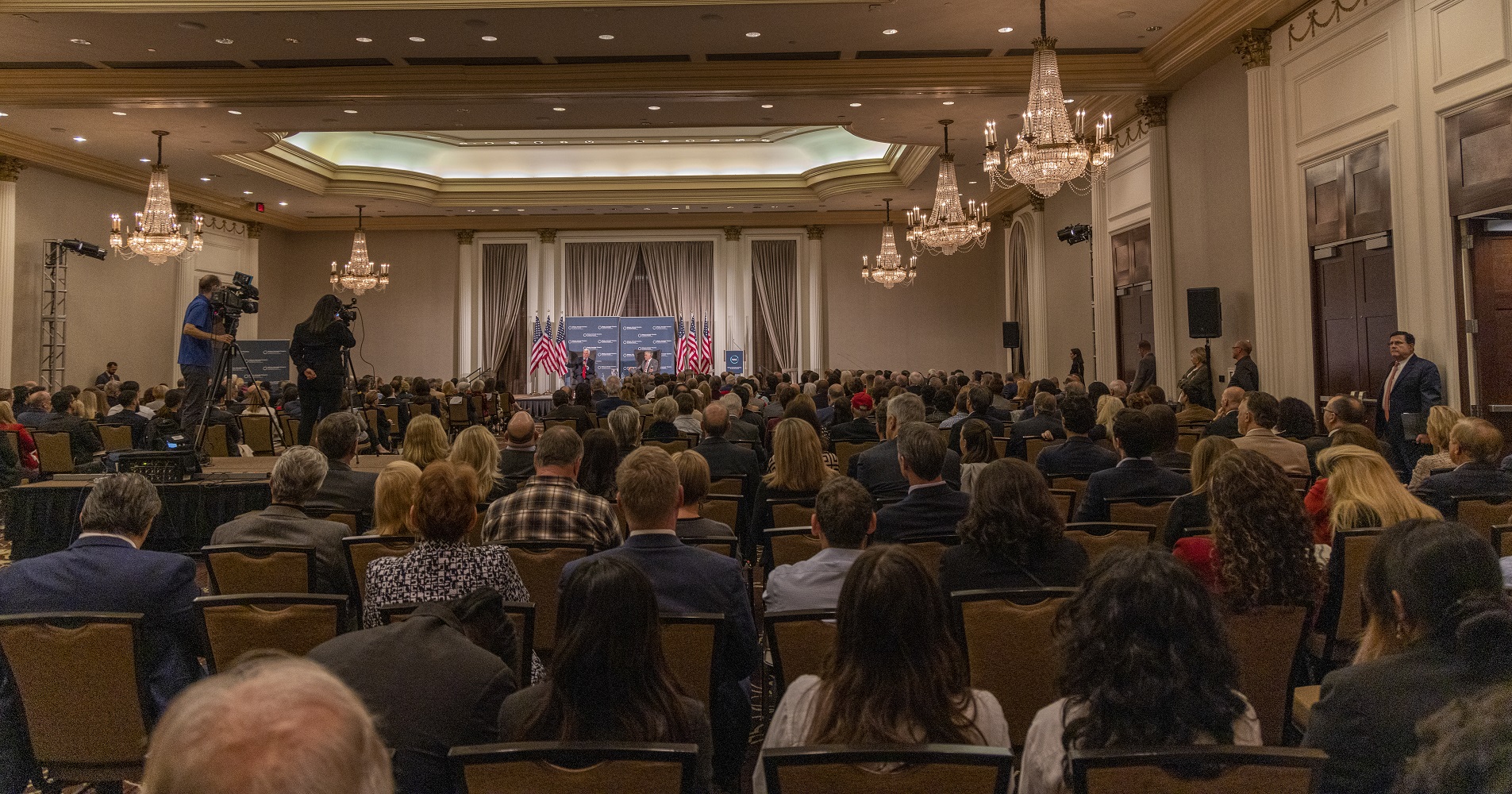
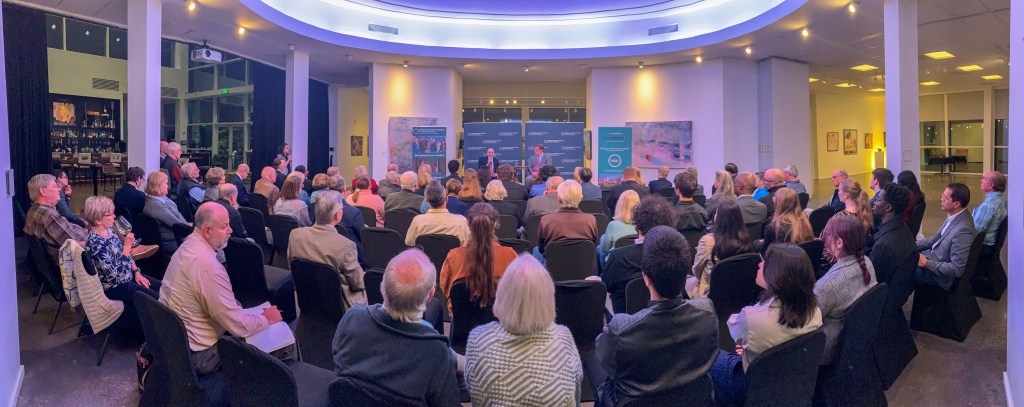
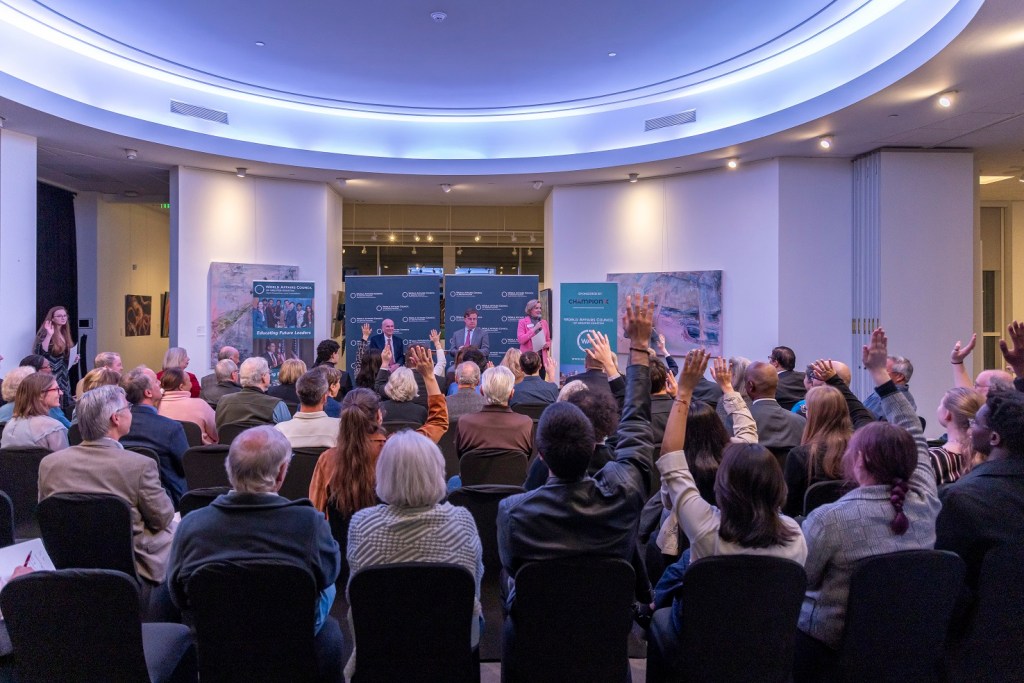
Unless you’ve been comatose for the past several years, you know there have been a series of healthcare crises, the most prominent of which was, of course, COVID. More recently, there has been a resurgence of Polio (!) and, of course, Monkeypox–and the latter was the topic of an expert panel assembled by the Bush School: Drs. Robert Carpenter, Syra Madad, Jennifer A. Shuford, and Robert Kadlec, moderated by Gerald Parker. It was a fascinating discussion, one that left us more educated and a bit more concerned.

There are about 60,000 confirmed cases of monkeypox in the world, and the U.S. makes up about 39% of those cases, which makes us first in the dubious distinction of leading the world in monkeypox cases. As a public health student, it was especially intriguing to hear how current public health officials view this threat, and what steps are being taken to prevent another pandemic.

Monkeypox is not a new phenomenon. It was first observed in 1958 in monkeys, and in 1970 it made its first known “jump” to humans. Resembling smallpox, it was dubbed monkeypox. This condition appears as lesions on the skin, and these sores make you contagious for up to four weeks. Monkeypox is spread from close skin-to-skin contact where bodily liquids are shared (e.g., kissing or sex).  At present, it is most commonly circulating within the male homosexual population (currently, more than 90% of cases are in men), but it is expected to eventually become a disease in the general population. To protect yourself from Monkeypox, practice safe sex, follow good hand hygiene, and avoid contact–especially skin-to-skin contact–with someone known to carry the virus.

The panel also discussed the differences between the COVID-19 pandemic and the Monkeypox outbreak. The key difference between the two was the level of readiness at the very beginning. Because we have been studying monkeypox for more than five decades, and because it is a relative of smallpox, we have vaccines that are effective against it. For COVID-19, we had to invent the vaccine more or less from scratch.

Both, however, may be suffering from misconceptions and poor communication. In Monkeypox, there is a misconception about who can catch it (everyone can catch it), and with COVID-19, there was resistance to the idea that it was even a threat. Those who adopted the latter group were also resistant to vaccines. Add to this the fact that vaccine distribution was spotty in rural areas, and there were some problems reaching everyone.

Dr. Robert Carpenter discussed with us how his team, Texas A&M Health Maroon Line Clinic, helped deal with COVID-19 in rural communities. One of the major issues he brought to our attention was the health disparities people face living in a rural community, such as not having sufficient medical staff. He and his team have brought vaccinations to these small Texas towns, distributing more than 240,000 vaccines and holding more than 2,000 events for COVID-19-related causes. Beyond COVID-19 the Maroon Line Clinic also has provided many primary and secondary prevention tactics such as cancer screenings, diabetes education, and substance abuse intervention.

LEAP found this panel discussion very intriguing and informative, as we further our careers in politics and policy. Going to sessions complements our classes at SHSU and inspires us to make a real change like them in this world. Many thanks to the panel and the Bush School’s Scowcroft Institute for hosting a fantastic program.

Ohana Korean Grill

With inspiration from last week’s venture to see General Chun, we decided to go for Korean food. We choose Ohana Korean Grill in College Station, which was, for most of us, our first time trying Korean food.

We ordered a few samplers such as the seafood pancake, which included vegetables and, to our surprise, octopus. We each got a traditional Korean dish such as the BiBimBap, which is a bowl of rice that comes with an assortment of vegetables and beef on top. I ordered the spicy seafood which came with an array of different sea creatures that most other restaurants might not have included. We sat around talking for so long that they brought us some cinnamon and ginger tea which was a wonderful cap to an entertaining and educational evening.

Many thanks to Marybeth Rayburn for joining us!