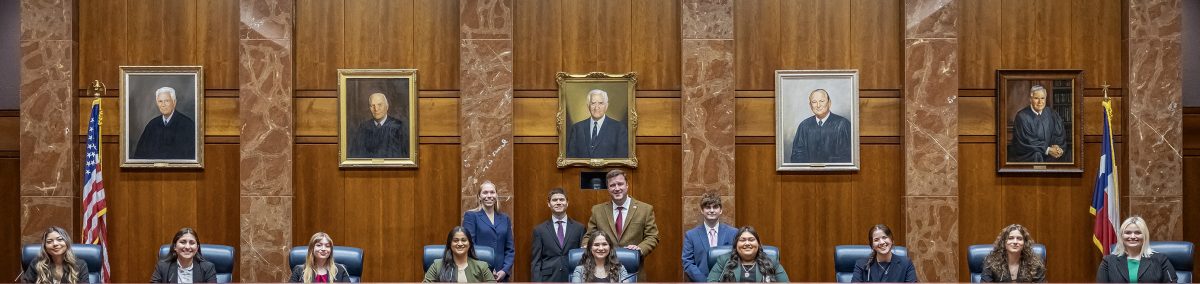
Yes, Tropical Storm Albert is encroaching on the Gulf of Mexico, but duty beckons. The LEAP Ambassadors are representing SHSU and the City of Huntsville in the TCMA‘s annual “Intercollegiate Bowl (ICB),” in which University programs compete for the title of the “Best Public Administration Program in Texas.”
But to participate, we first had to get there, and this involved loading up a 12-passenger van, and driving the eight hours to South Padre. Eight hours is a long time, but it’s especially a long time when it involves navigating a tropical storm.
University of St. Thomas
In our typical LEAP fashion, however, we made the most of our travels by learning as much as possible. Thus, we did a bit of homework on modern architecture and, specifically, Philip Johnson, whose buildings dotted our travels.
Our first stop was the University of St. Thomas, where we saw Johnson’s beautiful “St. Basil Chapel.” This post-modern design features a sphere (the dome), a cube (the chapel proper), and a plane, the latter of which cuts through the structure.

The front, made of concrete, is marked by a conspicuous cleft on the right side.

This is the entrance, designed to resemble a tent’s entrance, and it serves as a transitional space, ushering visitors in from the outdoors, but not quite indoors.
From this de-facto foyer, doors then lead into the interior, which is as beautiful as the exterior.

Along the wall was an etching of the stations of the cross…

… a beautiful sculpture served functionally as the alter; and a pipe organ loomed large on the front-right wall.

The interior was illuminated through three openings, providing a diffuse and ethereal lighting of the chapel.

The chapel is the culmination of an “academic village,” which Johnson modeled after Thomas Jefferson’s design of the University of Virginia (which we visited in March!). In Johnson’s case, the chapel is at the north end of the campus, with the library on the south end, and academic buildings on the east and west sides.

And, interestingly, in one of those buildings, we saw the artwork of an old friend, David Adickes!

Smither Park
Although it rained for about 90 percent of the day, the precipitation courteously stopped or slowed at key points along our journey, including a stop at Houston’s Smither Park.
Designed by Huntsville’s own Dan Phillips, the park is a marvel of fun.

Recycled mundanities are placed in ways that create patterns which, in turn, can create beauty.

Thus discarded tiles turn into a river; old SHSU pins turn into a bright sun;

and broken glass, old signs, and other odds and ends turn into a “Fish Amphitheater.”


And have you ever seen a gecko playing the piano?

Corpus Christi
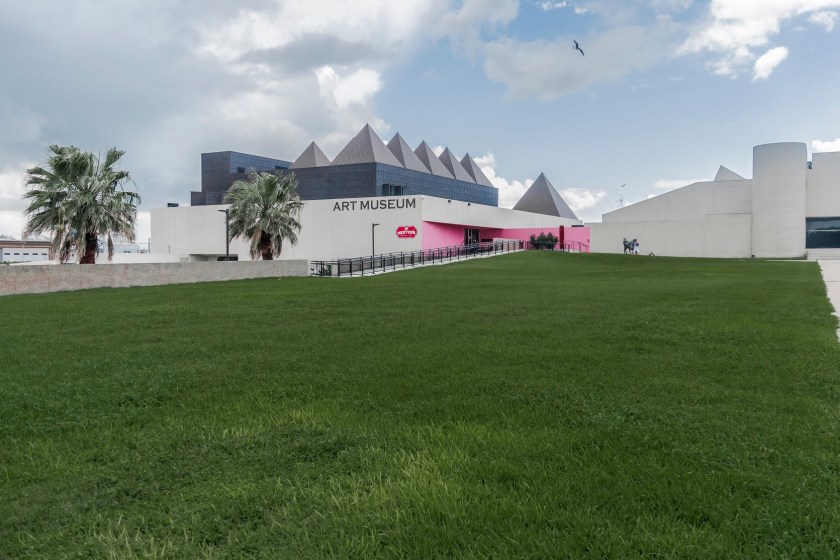
A few hours later, we rolled into Corpus Christi, where we resumed both our Philip Johnson tutorial and our refresher in Huntsville natives central to the Texas art world. Although the Art Museum of South Texas, showing much less resilience than SHSU students, closed for the day owing to the storm, we stopped by to see Johnson’s design.

The building, which has been expanded by Ricardo Legorreta, is stark white, with clean lines. It is perched on the seawall, and from the interior, at times provides a bunker like view into the harbor, where the USS Lexington serves as a historic artifact and museum.

Although we could not enter the building, we did peek through the windows, seeing a Dale Chihuly, Jesus Moroles, and Charles Pebworth. The real treat, however, was on the Museum’s lawn, where a large James Surls welcomes visitors.

The highlight for this group, however, was the Selena Memorial, which is on Corpus Christi’s Shoreline Drive. The site features a statue of Selena looking to the sea…

… a white flower facing west, and a cupola atop the memorial–which is titled “Mirador de la Flor,” or “Overlook of the Flower.”

Despite the rain, there were half a dozen people paying respects and taking selfies at the Memorial, us among them.

It was an interesting experience, interacting at a space designed to memorialize Selena’s tragically early death, while also capturing some of the hope and beauty reflected by Selena’s music.
And it was somewhat appropriate for the occasion, as our bi-cultural group returned to the car, slogged through torrential rains to South Padre, with hopes of a sunnier tomorrow and a bright future ahead.










 Center for Law, Engagement, and Politics