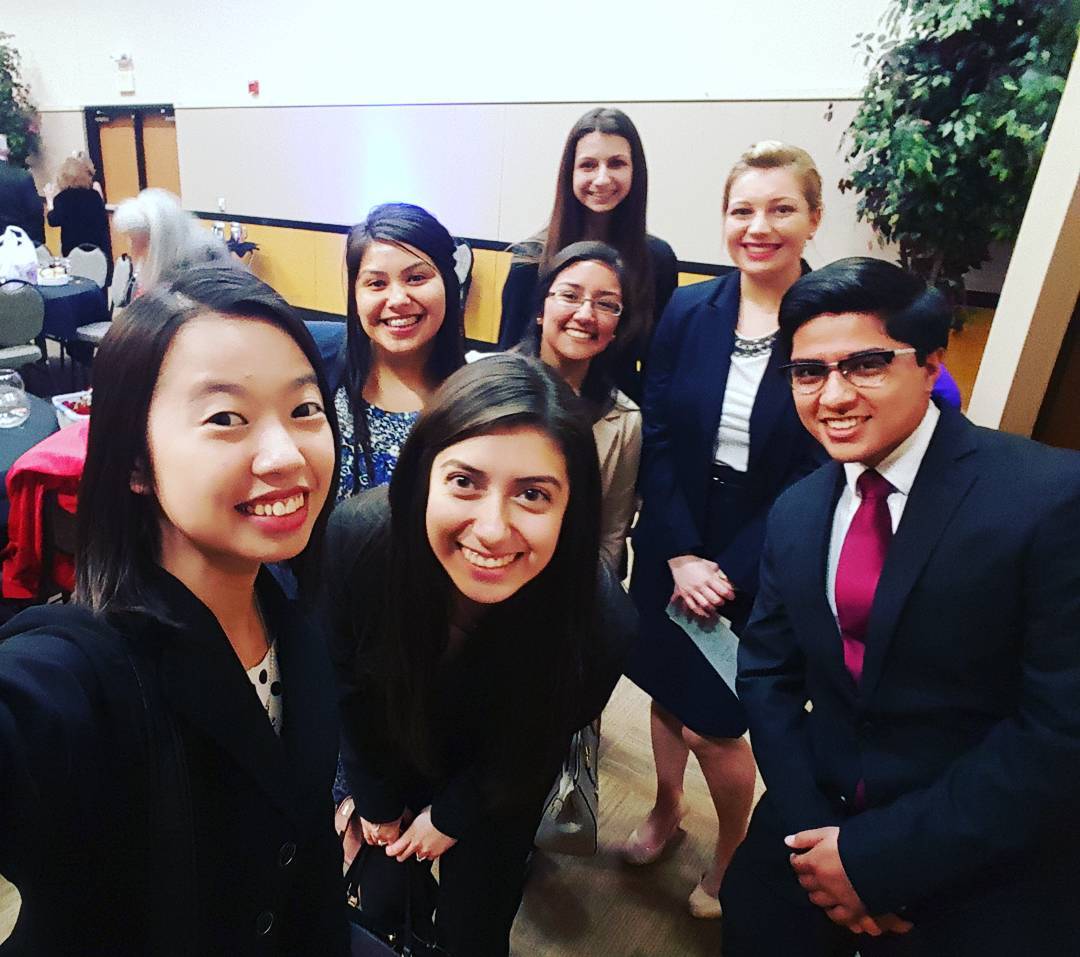
Following a busy day of classes and entertaining guests, we looked forward to a similarly busy evening of entertaining guests and ourselves at the Reagan Dinner. LEAP Ambassadors arrived early to help greet guests as they arrived and escort them to their seats. Because we had a large slate of volunteers, we also had the chance to socialize with each other, something that happens less than you might expect.During the reception, hosted by the Walker County Republican Women, we had the opportunity to spend more time with the guest of honor, Ambassador Chase Untermeyer, and with many community members. Among the guests were County Judge Pierce, Judge Sorenson, Congressman Brady, County Chair Linda McKenzie, WCRW President Terry Stivers, and numerous others who are currently running for local office.
It was at this time that many LEAP Ambassadors took the opportunity to have Ambassador Untermeyer sign our books. He gladly agreed and discussed his book eagerly with us. How Important People Act: Behaving Yourself in Public gave us many pointers on how to act when we are in the spotlight, no matter how big or small. Ambassador Untermeyer speaks from years of experience from multiple levels of government. Ambassador Untermeyer worked under multiple Republican presidents, including Ronald Reagan, making him a perfect speaker for the Reagan Dinner.
In that book, he notes that your actions should be appropriate for the occasion. He noted, for example, that a President should not take a selfie at a funeral. At a festive occasion such as this dinner, however, there are no such prohibitions:
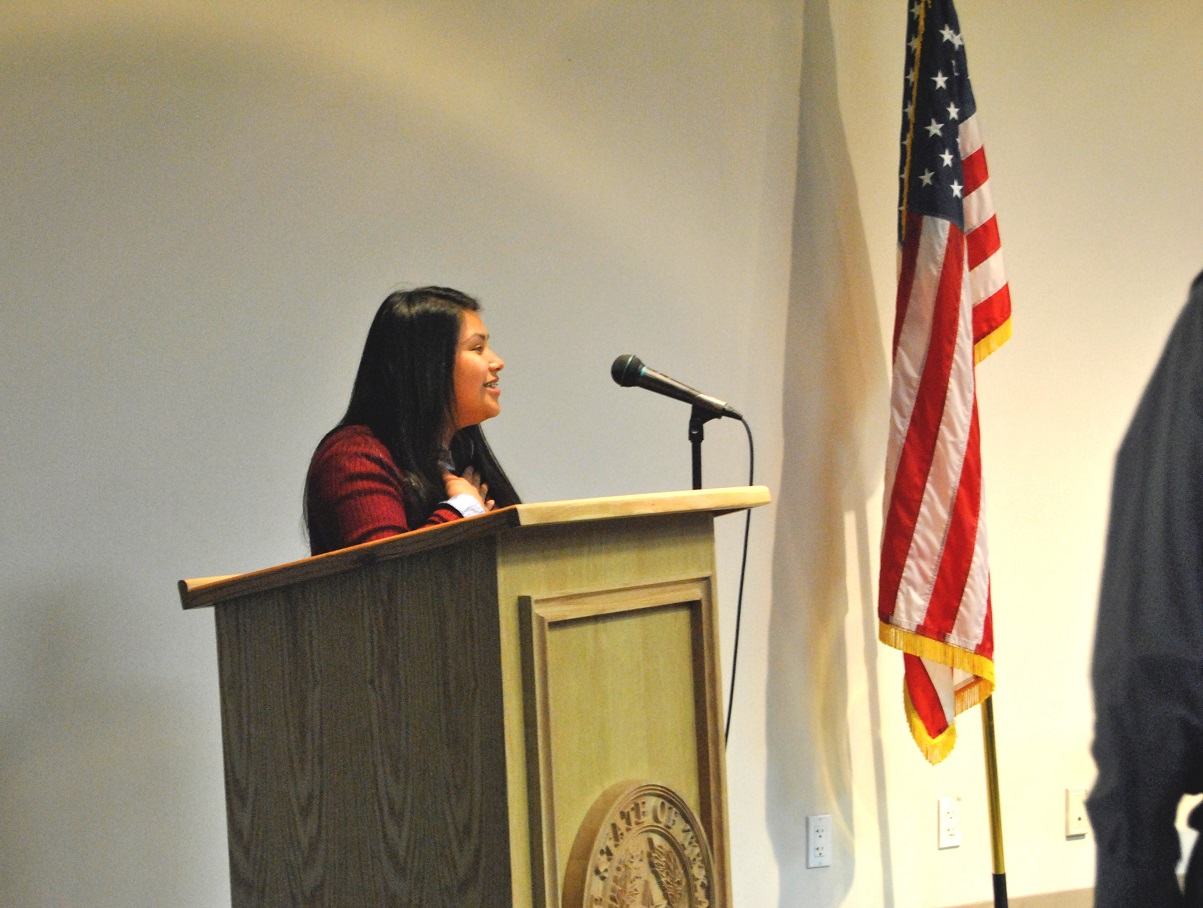
Once the invocation and the pledge of allegiance was given, dinner began. Students were fortunate enough to sit with a variety of respected individuals such as: Ambassador Untermeyer; State Representative Candidate Wesley Hinch; Tenth Court of appeals Chief Justice Tom Gray; Field Representative for Dr. Schwertner, Hayden Paul; John McManners; and Mac and Leanne Woodward.
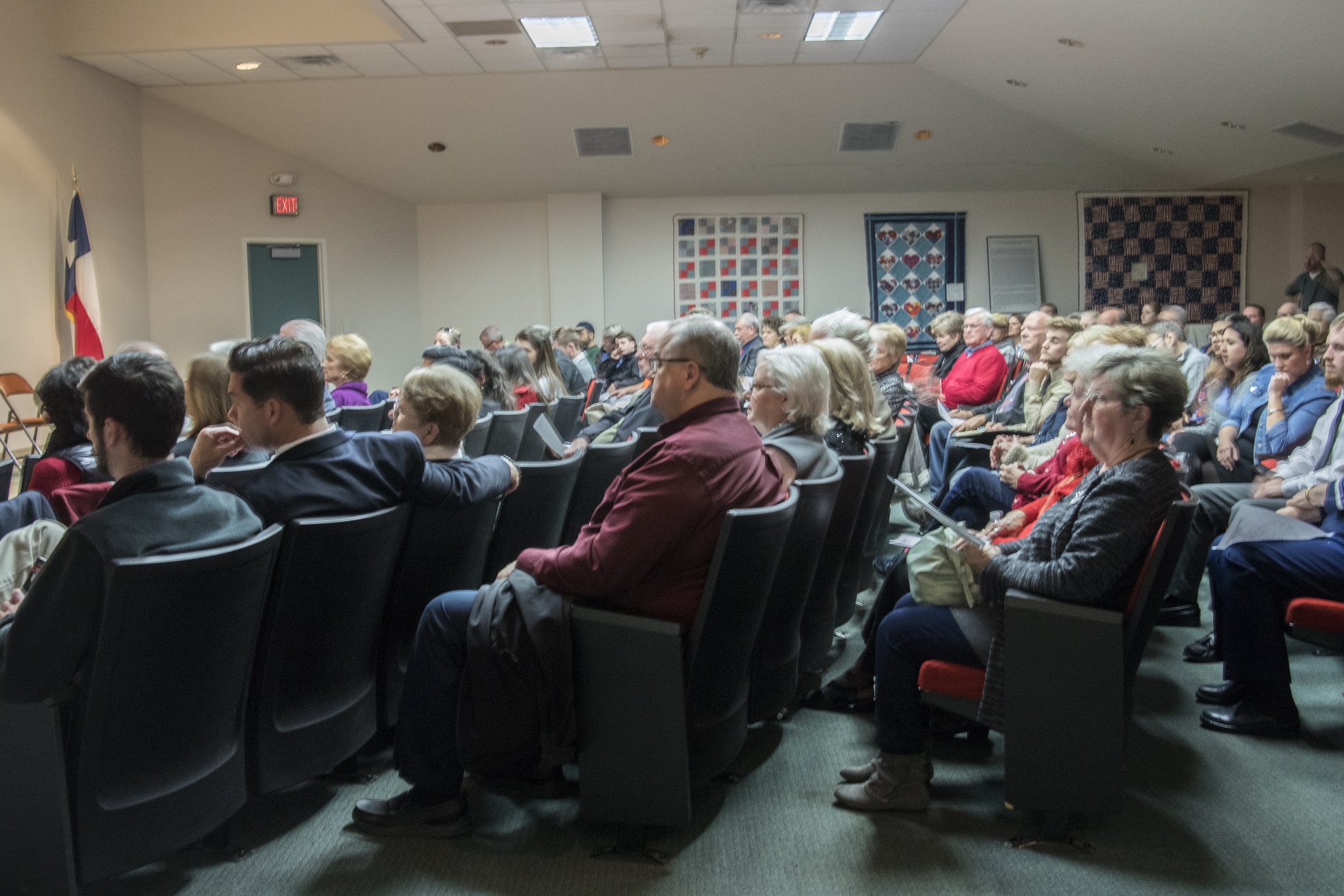
U.S. Representative Congressman Brady spoke for a few moments about his new position as the Ways and Means Committee Chairman and his plans with committee. He also thanked the LEAP Center for their work in Walker County! It was a real honor for the Ambassadors to be recognized by our U.S. State Representative.
Next, Professor Yawn introduced Ambassador Untermeyer for the keynote address of the evening. Ambassador Untermeyer outlined the qualities President Reagan utilized in the White House to be a successful leader of a divided house.
First, his optimism allowed him to focus on much more of the positives rather than the negatives. He also used courage and compromise to get bills passed in Congress. According to Ambassador Untermeyer, President Reagan was not afraid to reach across the aisle in order to promote cooperation between parties. He encouraged our current elected officials to do the same. The final quality Ambassador Untermeyer discussed was President Reagan’s sense of humor at the proper time. His ability to be lighthearted is vastly different from the politics of today. Following Untermeyer’s speech, one of the Ambassadors noted, “I wish all candidates shared those views.” It was a sentiment we all shared.
Ambassador Untermeyer observed all of these qualities while working as Reagan’s appointed Assistant Secretary of the Navy for Manpower and Reserve Affairs. Ambassador Untermeyer’s years of experience provided the audience much insight into who President Reagan was. With President Reagan’s birthday approaching, The Reagan Dinner was a wonderful way to commemorate President Reagan’s legacy.
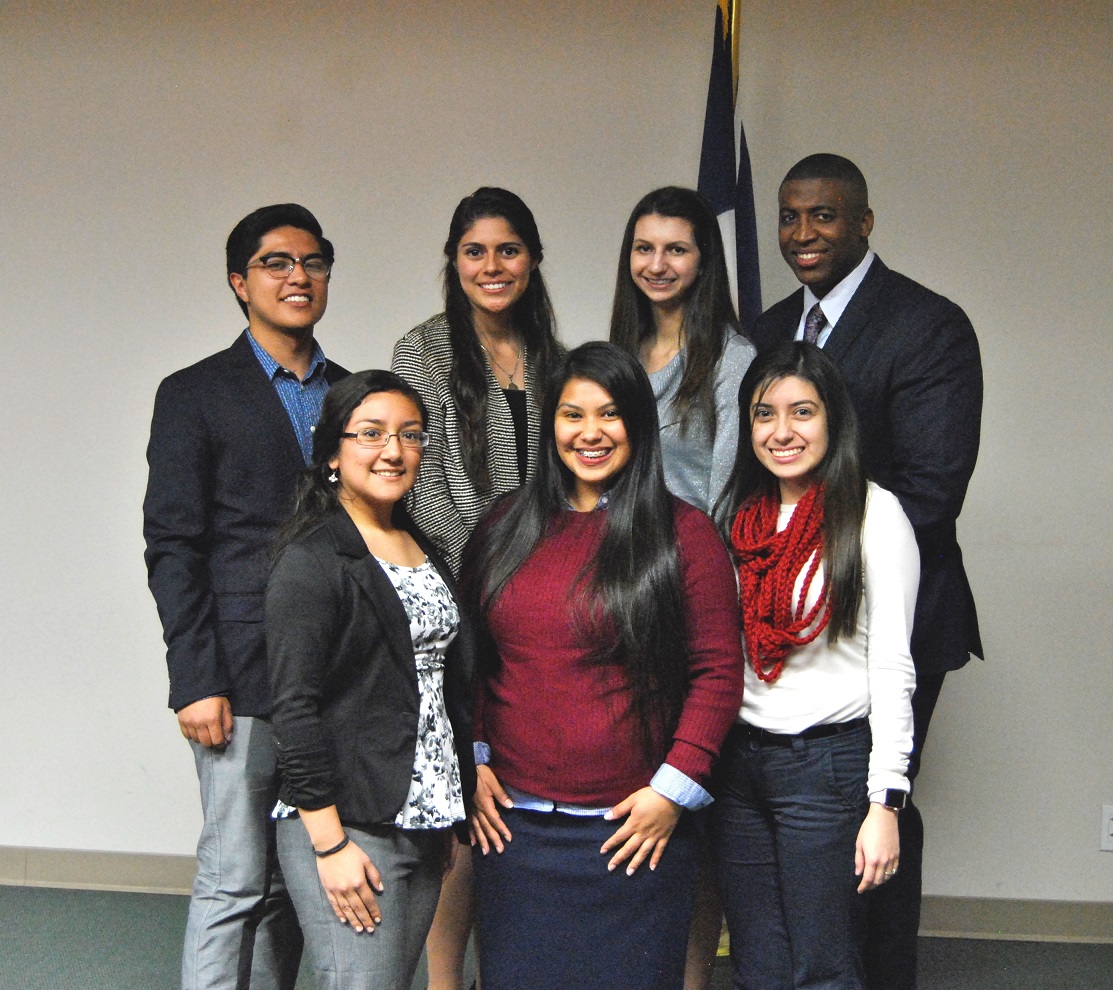
Concluding the evening, LEAP Ambassadors utilized the opportunity to take pictures with some of our favorite community members and elected officials.
Thank you to the Republican Party of Walker County for hosting a wonderful evening and for allowing the LEAP Ambassadors the opportunity to participate in the evening. We enjoyed ourselves immensely.
This slideshow requires JavaScript.
Also, thank you to Ambassador Untermeyer for spending the day in Huntsville and speaking at the Reagan Dinner!
Part of being an engaged citizen is participating in the electoral process. For most people, that involves voting. For political science majors–and especially for LEAP Ambassadors–it involves going beyond that. Accordingly, a couple of us signed up this spring to be election workers for the election on Tuesday, March 1. For the political science nerds among us, it’s an exciting prospect!
To be an election worker, you have to be registered to vote in the county for which you plan to vote. Fortunately, all LEAP Ambassadors are registered to vote, making us all eligible to work an election. The county has a need for these workers, so the act of working an election is not only a personal goal, but also a civic duty of sorts: it’s providing a real public service.
Of course, the election workers have to be trained to make the correct decisions and follow the the procedures. To ensure that is the case, the Walker County Tax Assessor Collector, Diana McRae, provides training to the volunteers. Thus, Bella and I found ourselves at the Walker County Annex for three hours on a Tuesday morning, learning about the electoral process.
It’s more complex than it seems. There are certain rules that must be followed: no cell phones in the voting area; no political slogans or signs; no persuasive talk. There are also procedural elements. Voters sometimes get confused about (1) whether they are registered and, if they are (2) which county they are registered in; and, even if they have the right county, (3) they may be in the incorrect precinct.
We learned how to address those issues during our training, and we also met some nice people.
We are looking forward to March 1, 2016 and working our first election!
With only seven members, it occasionally becomes necessary to split up two be at two places at once. Monday, January 25 was such a day, when some of the Ambassadors headed to the Walker County Republican Women “planning meeting” and another group of Ambassadors headed to the Walker County Bar Association. Both meetings provided great learning opportunities.
The Walker County Bar meeting arose at the invitation of Gene Roberts, the Director of SHSU’s Legal and Mediation Services Center. The featured speaker on this day was Deandra Grant, an attorney from the Dallas area who specializes in DWI cases.
The presentation was a wonderful learning opportunity, as Ms. Grant laid out the various ways in which evidence can be incorrectly collected, handled, or tested from arrest to possible prosecution. Officers might, for example, use the wrong vial to collect blood; or the machine that tests blood might not be correctly calibrated; or the blood vials might even be switched by a lab assistant.
The presentation was enlightening, and the attorneys appeared as interested as the prospective attorneys.
While the Bar Association meeting was underway, other Ambassadors were learning more about the Walker County Republican Women.
Two of the students, Alejandra Galvan and Sadie McLaughlin, were actually on hand as interns, and assisting with planning for the spring.
It was a great day of learning, and we’d like to thank Gene Roberts and Terry Stivers for their support and mentorship.
Garrison Keillor is best known for his Prairie Home Companion, but he occasionally goes on the road without his entourage. Even solo, he is quite the entertainer.
Keillor stopped n Houston on Wednesday, January 27th, and he spent a wonderful two hours discussing his background, his career, and all the while telling wonderful stories, singing the occasional song, and telling jokes.
Although Keillor has written for The New Yorker, he is best known for his midwestern musings, discussing the qualities that make up middle America: religion, literature, and family life. Central to his stories is “Lake Wobegon,” a fictional place where all the women are strong, the men are good-looking, and the kids are above average.”
Among his songs, jokes and tales, our favorites:
Song: The Ballad of Sergeant Musgrave
Jokes:
Where do you find a dog with no legs? Right where you left him.
Tales: Several tales, really, involving his aunts and uncles. The wedding tale involved a duck decoy that doubled as a duck-blind; a naked para-sailor; a poorly-dressed lover named Raul; Babe Ruth’s last home-run ball; and a car wreck by the prospective bride and groom.
Keillor closed the evening to the strains of “Red River Valley” and “Goodnight Irene.”
Following the event, Keillor signed books and other memorabilia. He spent much time with individuals. Rather than have the line come to him, he would sign and then move himself to the next person, even going up the stairs of Jones Hall.
To Ryan Brim, who is in a quest for the right college, Keillor offered: “You’ll never need math.” Following a couple of minutes of conversation, Keillor signed Ryan’s book, “Lighten up, Ryan.”
Most students enjoy sleeping in on Saturday mornings, but the LEAP students were more than willing to spend their Saturday morning learning about campaigns. It was an interesting educational experience, combining hands-on learning with exposure to campaign volunteers, staff, and even a US Congressman, all willing to share their knowledge.
One of the staples of campaign life is to feed your volunteers, and Congressman Kevin Brady did so enthusiastically. In fact, we kicked the morning off at The Black Walnut Cafe where we enjoyed coffee, kolaches, breakfast tacos and mingling. Congressman Brady, who joined us in the walk, offered a pep talk; Francine Stanfield, his campaign director, made sure we were comfortable; and Kory Curtis, an analyst for Brady’s campaign, showed us the ropes.
With a map, a clip board and a lot of enthusiasm, the block-walking teams set off to their assigned neighborhoods. It was a great experience, especially for a group of Political Science majors.
The initial results were encouraging, with many opening doors, welcoming us, and thanking us for information about Congressman Brady. This helped us build confidence.
The experience also taught us the importance of the communication process between voters and elected representatives. Block walking, town forums, and district presence are all an important part of learning about the concerns of voters–directly from the voters.
In canvassing the other student volunteers (who had gone in tandem in different directions), they had a similar response. Some of the introverts indicated they wouldn’t want to do this every week, but the extroverts were energized by the process. All of us learned a lot, from the voters, from Congressman Brady, and from the campaign staff. It was particularly educational for one of our high-school volunteers, Ryan Brim, who is an introvert but is exploring career options and community engagement.
Beatriz Martinez, who block-walked last week as well, enjoyed spending additional time with Congressman Brady.
She had actually never met a US Congressman. Megan also enjoyed spending time with Congressman Brady, and this is probably her fourth or fifth time at one of his events.
Kaitlyn Tyra, an Accounting Major, enjoyed learning more about campaigns from the staff. I enjoyed these things, too, but also enjoyed seeing how campaigns play out on the ground.
We all also appreciated the lunch provided. Walking builds an appetite, and we were able to relax again for lunch at the Black Walnut, where we enjoyed burgers and other comfort foods, as well as the closing remarks from Congressman Brady expressing his appreciation.
One of the great things about being a POLS major or, more generally, a student is SHSU, is that our learning takes place inside and outside of the classroom. Another great thing is that so much of our learning is fun. Today was a great example of both of these qualities.
The LEAP Center Ambassadors are a non-partisan group. Individual Ambassadors make their own choices regarding volunteerism or work. Past and present Ambassadors have worked for Representative Senfronia Thompson (D), Representative John Otto (R), Mayor Anise Parker (D), US Congressman Kevin Brady (R), Senator Mary Landrieu (D), and many other members of both parties.
Welcome back to the LEAP Blog! Hopefully, you had a great winter break and you are ready to follow us throughout what we hope will be an amazing Spring 2016 journey! Our first stop of the year took us to the Brazos Bookstore in Houston, Texas to speak with Brantley Hightower, who wrote The Courthouses of Central Texas.
While teaching a course on Architecture, Hightower was inspired by some of the work of his students to explore the different architectural designs and meanings of the courthouse of central Texas. The courthouse, he explained, was for much of Texas’s history, the main meeting place for most areas in Texas. As such, its look and materials and spaces reflected the values of that area.
Although an architect, Hightower was a skilled presented, perhaps reflecting his prior work in teaching and also his interest in the topic.
As an architect, Hightower was interested not only in the look of the buildings, but also some of their technical features, and he described different techniques that the builders of these courthouses used in yesteryear to cool the structures and their occupants. Through the use of courtyards or cupolas that promoted air circulation, courthouses could reduce the temperature by 17-18 degrees.
Mr. Hightower also discussed some of the shifts sociologically that have resulted in a transformation of courthouses. In the late 19th century or early 20th century, the courthouse was a structure that expressed the aspirations of a community: it towered over other buildings, it was grand, and it was beautiful, or at least distinguished. But as time has marched on, people have moved to cities; City Hall has become the focal point of local government moreso than counties. Moreover, citizens look to government for more functional purposes today rather than for the symbolic expressions of community will and aspirations.
The presentation was interesting, a prismatic look at the functions and aesthetics of government buildings, and we hope to have the opportunity to meet with Mr. Hightower again.
The Black Walnut Café definitely lived up to its wonderful reviews and reputation. With a smooth, sleek, and wood-laden design the aromas of the kitchen captivated our taste buds! Some of us went with soup, others with pasta, and one with an evening omelet, however, the two standout dishes of the night were the all American cheeseburger and the “North of the Border Fajita Tacos”.
Of course, we did have to some delicious Gelato ice cream!
After following in the ways of our courthouse founders, with fellowship over a meal, we headed back to Huntsville to continue our prep for our upcoming events!
As the semester concluded, what better way to celebrate than volunteering for the Walker County Republican Women’s Christmas Party! Hosted at Dr. and Mrs. Deahl’s home, the party provided the opportunity for (Republican) members of LEAP to socialize and reminisce about the year while enjoying an array of tasty treats. LEAP ambassadors served as greeters as the guests arrived, served punch, and replenished food throughout the night.
To add to the atmosphere, a jazz band played throughout the evening adding soft background music.
For the ambassadors who attended, it was wonderful to mingle with many elected officials and familiar faces throughout the evening. The main event occurred when the new officers for the Republican Women were sworn in for the upcoming year by County Court At Law Judge Tracy Sorenson: President- Ms. Terry Stivers, Vice President – Ms. Sally Kelly, Secretary- Ms. Carol Hayes, PAC Treasurer- Ms. Mert Gribble. As the party resumed, we took the opportunity for a few photos with the stunning Christmas tree.
Thank you to Mr. and Mrs. Deahl for hosting the Christmas Party and to Ms. Stivers for inviting the LEAP Ambassadors to volunteer. We are thankful for the many opportunities to participate in Republican Women’s events throughout the year. Congratulations to the new officers for 2016 and Merry Christmas from the LEAP Ambassadors!
Over a two-day period, students with the Center for Law, Engagement, And Politics (LEAP) heard from some of the brightest minds around. Mayors Annise Parker (Houston) and Harry LaRosiliere (Plano) talked local government with Councilmembers Bill Spelman (Austin) and Jungus Jordan (Fort Worth); Representative Larry Gonzalez talked the state legislature with Senator John Whitmire; and a host of policy experts explored corrections, privacy, human resources, public administration, and health care. The conference was presented by Governing Magazine, and the discussions served to trumpet many of the “best practices” used by government leaders across the country. Below, the students who attended discuss the panel each found most interesting.
Jake Rivera: “Deploying Data & Performance Metrics to Achieve Results”
This panel featured Brian Anderson (Information Security Officer at Texas A&M-San Antonio), Bill Bott (Consulting Partner, Change & Innovation Agency), and Jerry Madden, for the Representative in the Texas Legislature; and the moderator, Dustin Haisler (Governing Magazine). These men discussed the difficulties that public officials have of evaluating their own programs, a fact compounded by concerns about privacy and even foreign espionage. They also discussed some interesting new technologies (e.g., an app that points drivers to empty parking spots) that could make governance more efficient and customer oriented.
Jessica Rodriguez: “The Local Perspective”
How do you spark connections between elected officials and their constituents? You couldn’t do better than to ask Harry LaRosiliere (Mayor of Plano), Annise Parker (Mayor of Houston), Bill Spelman (City Council, Austin), and Jungus Jordan (City Council, Fort Worth). Although unrehearsed, they each emphasized infrastructure—from basics such as the roads to cutting-edge innovations designed to bring citizens closer to each other and to those that represent them. Perhaps the most intriguing example of these types of connections is the “Food 4 Kids” program in Plano, Texas, in which the City partners with the North Texas Food Bank and local businesses to provide lunches on the weekends for children. The panelists also seemed to be in agreement that local government, while not the most glamorous of the elected positions in the country, was the closest to the people: “If you want to be a [local] official,” noted Mayor Parker, “you have to care about the potholes in the streets, whose trash didn’t get picked up, and toilets being able to flush properly.”
Local Government Leaders
All: “The Legislative Perspective:Empowering Reform in Service Delivery.”
In this panel, Senator John Whitmire and Representative Larry Gonzales had a free-wheeling and far-ranging discussion of issues facing Texas: crime, transportation, mental health, and education.
Senator Whitmire
This was probably the most invigorating of the discussions, with the experts on the stage being given time to explore fully various alternatives. Nothing was off the table. How about an income tax? How about legalizing marijuana? The panel didn’t necessarily try to answer some of those questions, but they raised a number of intriguing possibilities, offering discussions that lingered with us beyond the conference.
Representative Gonzales
Ariel Traub: “Workforce and Management Strategies:”
Featuring star panelists Joyce Wilson (CEO of Workforce Solutions, Upper Rio Grande Valley; former City Manager of El Paso), Bob Lavigna (Vice-Chancellor of the University of Wisconsin), and John Keel (Texas State Auditor), this session brought to light numerous intriguing ideas for attracting, training, and retaining professional employees in government. Citing the difficulties government has competing with private businesses on salary, the panelists suggested combining the following strategies to sweeten the deal for potential and current employees:
Offering school loan forgiveness
Providing tuition flex time or work-at-home days
Ensuring fair evaluation methods
Promoting workforce morale through reward and recognition programs
Working with working mothers and fathers to provide flexible leave programs for workers with children
Although many of these programs have been published elsewhere, the panelists offered interesting twists. Joyce Wilson, for example, noted that it was difficult for many employees to pay for tuition up front and wait to be reimbursed. She suggested that companies bear the up-front costs rather than reimbursing employees. Moreover, all of the panelists noted that, in addition to offering specific benefits to individuals, the proposals also had community-wide salutary effects. Flex-time and work-at-home opportunities, for example, not only provide flexibility to employees, but these policies also cut down on traffic and pollution. Leave programs for mothers and fathers promote strong and stable families. Tuition programs promote greater productivity and employee self-actualization. And so on.
Although the panel was specific to HR strategies, it offered an example of strong approaches to build a stronger organization across all departments.
Tara Cobler: “Investing in Talent: Developing the Workforce to Sustain and Grow Texas’s Economy.”
This panel took a more macro look at the workforce, discussing the outlook on Texas employment. The panelists were well qualified, featuring Betty Harvey (Manager, Texas Workforce Development, Fort Worth Chamber), Alan Miller (Executive Director, Workforce Solutions Capital Area Workforce Board), Bill Purcell (former Mayor of Nashville and lawyer at Jones, Hawkins, and Farmer), and Dr. Mark Funkhouser moderating (Publisher of Governing Magazine and former Mayor of Kansas City).
Any discussion of future employment opportunities has to involve in training and education, and these panelists covered these topics thoroughly. One interesting problem that was broached by an audience member was the issue of Texas’s large prison population. Texas prisons hold more than 150,000 people, the largest prison population in the United States. Accordingly, there is also a large population of ex-inmates, and even more relevant, many people convicted of lesser crimes who were not actually sent to prison. These previous convictions are huge impediments to gaining employment. Some former offenders go through extensive training programs (many of them state funded), only to find that they cannot be licensed in their field with a conviction. The result is a triple loss: (1) the prospective employee remains unemployed, (2) taxpayers have spent thousands of dollars on training to no avail, and (3) the prospective employee is often left dependent on other forms of public assistance.
The panel suggested that criminal histories should be contextualized more fully, giving more ex-offenders the opportunity to gain employment, when appropriate. The program was not only enlightening, but it was also important because it illuminates how public officials can gain knowledge and sympathy to the plights encountered by those who are most affected by public policy.
Alan Garcia: “Closing Remarks: Adrian Garcia”
As a citizen who grew up in Harris County, I expected a great speech from Sheriff Adrian Garcia–and he delivered. He did an excellent job with his closing remarks, tying together the themes of previous speakers and providing an inspirational coda to the day’s panels.
Sheriff Adrian Garcia
Echoing the sentiments of previous speakers, Sheriff Garcia noted the importance of electing officials who truly care about citizens. Slick candidates may be able to appeal more effectively to voters, but the day-to-day governing activities require dedicated and devoted public servants. Similarly, Garcia reiterated the importance of community institutions such as family, non-profits, and public-private partnerships (“P3s”). Garcia drew on his personal experiences and background to illuminate the different factors that led to his success, and it provided a microcosm for community success. Like Sheriff Garcia, I am a first-generation American, the youngest child in my family, and–like Sheriff Garcia–I hope to be a successful public figure in the United States while also honoring my Mexican-American heritage.
The conference was a wonderful learning opportunities for us, and we are grateful to Governing Magazine for this opportunity. In addition to hearing from the panelists, we had numerous opportunities to speak with professionals from across the state. This is a wonderful program for current professionals and a great opportunity for aspiring professionals, and we are grateful to both Governing and SHSU for providing this opportunity for us.