Seeing Tennessee: One Day in the Volunteer State (Nashville Version)

Tennessee is known as the volunteer state, so named because of the disproportionate number of volunteers they have provided to the US Military in wartime.  While none of the LEAP Ambassadors have served during wartime, we do volunteer a lot, so we felt a distant kind of kinship.

The first stop planned for our third day of the Southern leg of our trip was The Hermitage, Andrew Jackson’s home.

Hermitage_Jackson_Web

Our tour began with museum exhibits describing the history of the seventh President of the United States in chronological displays. The exhibit began with the wars in which Andrew Jackson played important roles, the War of 1812 and the Battle of New Orleans in 1815.

Hermitage_Beatriz_Web

Original artifacts, such as swords used by the British and the Americans during these historical events, were also displayed in glass cases allowing each visitor to stop and admire the details of each. Larger artifacts, such as his carriage, were displayed on the floor of the exhibit space.

Hermitage_Carriage_Web

The exhibits were packed with history, but also well-organized, making it easy to follow and understand.

Hermitage_Brian_Web

We learned not only about Andrew Jackson’s life, but also much about his wife, Rachel.

Hermitage_Alex_1_Web

After the indoor museum exhibits, we moved on to a self-guided audio tour of the grounds that led us to Jackson’s mansion.

Hermitage_Ambassadors_Web

The guides on the tour discussed every room in the 8,000 sq. foot mansion. The parlor downstairs off the entryway was covered in elegant wallpaper that General Jackson ordered from France, along with many original artifacts. Although the mansion was beautiful, it does not have all the modern conveniences that homes today have, such as indoor plumbing! The second floor houses guest rooms and the grandchildren’s rooms. And as a special treat, the upstairs tour guide pointed out one of the guest rooms where Sam Houston slept during one of his visits to see General Jackson.

After the mansion tour, we meandered the garden, still guided by the audio tour. In the garden, elaborate for its time, we saw the tombs of the Jacksons, along with several family members.

Hermitage_Grave_3_Web

The garden was originally made for Rachel as a place for her to relax, a much-needed respite from the stress of her husband’s political career. Sadly, she passed away days after Andrew Jackson was elected President; and it is said that the political stress caused her death. After the tour of the museum exhibits, the mansion, the garden, and a quick photo-op on the $20 bill…

Hermitage_Beatriz_Bill_Web

…we had worked up an appetite, so we made our way to The Pharmacy for a quick fix.

We know what you’re thinking, but no, we didn’t go to the local drugstore for lunch! The Pharmacy is actually a burger parlor and beer garden, although we didn’t sample the latter. The restaurant has been named the “wurst burger joint” around because of the German influences in their food and beverages. The phosphate and crème sodas, Wurst, and beer make this Nashville spot distinct and popular. The restaurant was cozy with a large outside patio garden.  The patio was beautiful; however, we sat inside to cool off after a morning of sunshine at The Hermitage.

We ordered different varieties of burgers made from 100% Tennessee beef. Beatriz, ordered the Farm Burger, with bacon, egg, and ham and other fixings, while others tried the Biergarten Platter, which had a variety of wurst sausages and mustards. All the food and cream sodas were satisfying and we were more than ready for our next stop, The Parthenon.

Gryphons stared down at us serenely as we climbed up the steps of Nashville’s Parthenon. We entered through the west side, noticing that atop the majestically stoic Doric columns a scene was unfolding depicting Athena being crowned by Nike (the winged goddess of victory, not the shoe brand). Built in 1897, this replica Athena’s shrine was at one point meant to be temporary.  Due to Nashville’s love of the thought of having their own Parthenon (they were known as “the Athens of the South”) and since it had quickly grown in popularity, it stayed.

Parthenon_Group_Exterior_2_Web
LEAP Ambassadors at the Parthenon–Nashville, Tennessee

As we set foot into the structure of classical architectural style, not only did we travel across space towards Athens, Greece where the real Parthenon lay, but we also stepped into a place of art. Literally. The Parthenon is both a bona fide replica of the authentic Parthenon and a museum housing more than 60 pieces of art donated by Mr. James M. Cowan under a strange circumstance…he had donated the pieces of art with only one condition: that he remain anonymous as the donor until after his death.

We moved upstairs where we were able to see the goddess of wisdom herself. Made of a number of materials, including 3.6kg of gold leaf, she stands impressively tall with Nike in her right hand and her faithful shield in the other.

Parthenon_Group_2_Web

One of the many interesting things about Nashville’s Parthenon are the gargantuan bronze doors. Measuring up to 6.5 ft. in height and weighing about 7.5 tons, these doors are thought to be the largest set of bronze doors in the world. However, even the smallest of our group could easily move them.

After digesting much great Greek mythology, art, and architecture, we passed by a gryphon one last time…

Parthenon_Students_Athena_Web

…Beatriz giving it a fist bump of gratitude for its great work at guarding Athena.

Parthenon_Beatriz_Lion_Web

With that last goodbye, and a last glance at the great Athena, we left wiser on the subjects of art, architecture, Nashville history, and a bit of the goddess of wisdom herself.

From there, we visited the Tennessee Capitol.

TN_Capitol_Exterior_Web

Like many other major building projects, construction of their capitol was behind on schedule and way over budget, taking fourteen years instead of three, and costing about three times as much as the initial budget.

The Tennessee Capitol is one of 13 state capitols which does not have a dome.  Instead, it was built in a Greek revival style. Not only is it different in architecture, but this capitol is the only one to be home to three deceased people, the first being the architect who designed it, William Strickland. Strickland is buried in the walls of the building, which he regarded as his greatest work. Along with Strickland, Samuel Morgan, the original building commissioner, is also buried on the site (actually, in the walls of the building).  And wrapping up the list are President James K. Polk, and Polk’s wife, Sarah, are bured on the grounds (but not in the walls).

TN_Capitol_Polk_Grave_Web

We learned much about Polk and the other two presidents from Tennessee (Andrew Jackson and Andrew Johnson). As we went along our tour, our guide (who was very knowledgeable and one of the best tour guides we’ve had!)…

TN_Capitol_Tour_Web

…pointed out a bearded Sam Houston, who was governor of both Tennessee and Texas.

TN_Capitol_Sam_Houston_Portrait_web

Although one LEAPster, who shall remain nameless (Megan), failed to recognize him, it was nice to see that General Houston was given credit for the work he’d done in Tennessee.

Tired of waiting for the entire capitol building to be built, the Supreme Court of Tennessee decided to move right in and start hearing cases. One judicial record, the tour guide explained, indicates the Court held a construction company in contempt of court for making too much noise while working on the building.

TN_Capitol_Tour_2_Web

Even so, the tour was great, filled with humor and interesting facts, such as the two occasions in which a president chose a vice-president with the last name Johnson, which didn’t work out so well for the presidents, who both ended up dying in office. Our cheerful tour guide made the tour one of the most interesting capitol tours we’ve been on.

This slideshow requires JavaScript.

To top it off, we even got to use the old-timey state seal press to emboss our programs.

TN_Capitol_Seal_Ryan_Web


So, as the day and the tour came to a close…

TN_Capitol_Ambassadors_Exterior_2_WEb

…we knew it was time to move on to our next destination, Louisville, Kentucky.

The LEAPsters are always up for adventure no matter how frightening it may appear.  One member of group stated that completing the fully-underground, aerial ropes challenge course at Louisville Mega Cavern truly embodied the LEAP spirit.

As we opened the front “door,” it was apparent that the cavern’s interior had been refurbished with artificial ceilings and walls in order to accommodate the recreational attractions inside. Louisville Mega Cavern houses a bike course, ropes course, “mega” zip line, and holds tours of the cavern’s mines.

Megacavern_Karla_Ryan_Web

This night we were set for the elevated, trapeze-style obstacles on the ropes course.

Megacavern_Karla_Standing_2_Web

Several of us are not fond of heights, and regardless of the multiple, secure straps attached to every elevated obstacle, fear of falling was still prominent.

Megacavern_Karla_Hugging_2_BW_Web

Our pseudo phobias did not deter us from trying as many hanging rope bridges within our time limit, though.  Bridges between the platforms varied in size, shape, difficulty and amount of balance required to traverse, from suspended, unbalanced planks to tension ropes to challenges that simply cannot be described without seeing them.

Megacavern_Beatriz_Walking_2_Web

For Alex, acrophobia kicked in while trying to balance over this system of suspended ropes and planks: At these moments my blood would rush in anticipation of hitting the ground, my palms would start to perspire inside my leather gloves making them almost slide off my hands, and my head would be showered in more sweat as I noticed how high off the ground my struggling body hovered. I would tightly clench the rope from which each overpass was suspended and inch my way through with each move coordinated to keep balance. No matter how much I wished to stay safely footed on the floor, I mustered all the courage my shaky spirit could supply.

Megacavern_Alex_Walking_2_Web

For the most part, though, we successfully walked, crawled, and hopped, and prayed over the obstacles without falling.

Megacavern_Ryan_Walking_Web

And all the LEAPsters made it to the grand finale:  the zip line.

Megacaverns_Beatriz_Zipline_Web

Some jumped off, some slid off, and at least one asked to be pushed off,  but we all made it off the platform at least once.  We wrapped up the late night and with blistering hands and muscles strained from the continuous stress of cheating an unwelcome dive to the hard ground, we climbed in our traveling van, ready to reach our hotel for some much-needed rest.

Megacavern_Group_Web


Rocking In Memphis: LEAP Ambassadors Visit Tennessee

July 7, 2016

After a long hike last night, and a much-needed sleep, we began the second day of our Midwest/Southern Tour with what is now a traditional scenic stop at The Old Mill, the final extant set of Gone With the Wind.

Old_Mill_Ambassadors_Cropped_Web

Most of us had been to The Old Mill before, but we were still very excited to jump out of the van and take in the beauty The Old Mill has to offer.  Moreover, Beatriz actually hadn’t been there, so she got her first taste of The Old Mill.

Old_Mill_Beatriz_Cropped_Web

Interestingly, the LEAP Center and Junior Fellows have photos at The Old Mill dating back to around 2006, making it almost a ritual among the organization.

Old_Mill_Ambassadors_3_Cropped_Web

After some exploration, and a few photo ops, of course, we all hopped back into the van for our next destination: the National Civil Rights Museum at the Lorraine Motel in Memphis, Tennessee.

On the way to the museum, though, we stopped by Graceland, the home of Elvis Presley, to leave a few messages on the stone wall.

Graceland_Signing_Web

And take a group photo.

Graceland_Ambassadors_Cropped_Web

We began the tour of the National Civil Rights Museum…

Lorraine_Motel_Sign_WEb

…with a special exhibit by artist Baret Boisson. Her work, themed “Inspiring Greatness through Words and Deeds,” focuses on portraits of heroes such as Mahatma Ghandi, Muhammad Ali, Rosa Parks, Abraham Lincoln, JFK, and her most recent–Martin Luther King, Jr.

The museum portrayed the process of the civil rights movement from the beginning to present in a very detailed and educational manner, and really emphasized the important role that civil disobedience and non-violent protest played thought the years.

Lorraine_Motel_Exhibit_6_Web

The museum’s first exhibit focused on the beginning of slavery. Slaves were considered property and were sold in exchange for items such as 40 pounds of gun powder, two iron bars, one copper bar, or even a mere five pieces of cotton cloth (an average cost of about $200 in the early 1800s). As they were bought they were expected to do heavy labor such as tending acres of tobacco plants.

The slave trade lasted about 366 years, and we were able to see the process of change in America through the museum’s many exhibits. The exhibits were displayed in order beginning with the Montgomery Bus Boycotts…

Lorraine_Motel_Exhibit_4_Web

…followed by Freedom Rides, and the decision in Brown v. Board of Education.

Lorraine_Motel_Exhibit_5_Web

The final exhibit included the two hotel rooms where MLK was staying at the Lorraine Motel when he was assassinated.  The rooms have been restored to what their actual state at the time, including a clear view of the balcony where he was assassinated.

Lorraine_Motel_Exterior_Web

After touring the National Civil Rights Museum, we made our way through a stretch of decorative Memphis buildings to Gus’s World Famous Fried Chicken. We were astonished by how many visitors were crammed inside the small building. With elbows grazing, eager tourists and locals ready to indulge in the restaurant’s signature hot and spicy fried chicken, we LEAPsters pondered whether this chicken was worth the claustrophobia. As tables were cleared and re-filled and waiters rushed through the cracks of the narrow table arrangements, we took our seats.

Soon after ordering, our waiter made his way towards us with an arrangement of fried chicken, coleslaw, fried pickles, beans, fried okra, and seasoned fries hovering over his hand. As his arm motioned this behemoth lunch to float down to the table’s center, our senses where overwhelmed by the scent of fried heaven. Our hunger took hold of us, and after taking a second to strategize distribution of our food, we went through legs, wings, and breasts until there was only left some bones and a some shavings of breaded fibers. Each bite was an experience in itself, with the spice piercing, but not stabbing, at every taste bud, the layer of breading just right. It was clear that this meal was not the typical greasy chain-restaurant type of fried chicken. As our empty plates were lifted and our tables cleared it seemed that we were in need of more bites from this joint’s menu. We satisfied this with a shared slice of chess pie – the sweet, creamy treat was perfect to send us off onto our next Memphis adventure.

Memphis, also known as “Home of the Blues” and the “Birthplace of Rock and Roll,” boasts a small gem that has contributed to music we love and cherish, Sun Studio.

Sun_Record_Studio_Exterior

Sun Studio recorded legends during the 50’s and 60’s that most of us still know and love. After a bit of looking around on our own…

Sun_Record_Studio_Kaitlyn_Megan_Web

…and going through old records…

Sun_Record_Studio_Ryan_Web

To begin the tour, we learned about Sam Phillips, founder of Memphis Recording Services, which later became Sun Studio. Phillips originally opened the recording service using only a tape recorder to create recordings! Phillips primarily recorded blues music with artists like Howling Wolf, country music with a familiar name, Johnny Cash, and later transitioning into rock-n-roll with names like Jackie Brenston.

Sun_Record_Studio_2_Web

Even though many legends got their big break at Sun Studio, the fact that the most famous star to get his start at Sun Studio was Elvis Presley is hardly ever argued. In 1952, Memphis Recording Services transitioned to Sun Studio and began producing their own labels. Shortly after graduating high school in 1953, Elvis recorded his first tape at Sun Studio with a sliver of hope that he would be “discovered” by Sam Phillips. It took time for Elvis to win over Phillips, who was interested mainly in blues music, but with a push from Phillips’ secretary (who actually recorded the future “King of Rock-n-Roll”), he finally decided to give Elvis a chance.

Mixing old blues and country, a combination that hadn’t been experimented with yet, Elvis finally got his shot when his song (“That’s All Right (Mama)”) was played on the radio one afternoon in Memphis. The radio station’s phones were ringing off the hook.  Finally, Sam Phillips knew that he had someone special in his studio.

We visited the actual studio where Elvis recorded his music, on the last part of the tour.  Our ears were ringing with joy while listening to the original recordings of some of Elvis’ songs! Carl Perkins, Johnny Cash, and Jerry Lee Lewis were also discovered by and signed with Sun Records. Known as the “Million Dollar Quartet,” or the “Class of ‘55,” these four musicians would all shine fame on Sun Studio.

To end the tour, we had the opportunity to take pictures with the only original piece of equipment left from the heyday of Sun Records, a microphone that was most likely used by the members of the “Million Dollar Quartet,” and Elvis himself!

This slideshow requires JavaScript.

In the spirit of historical research–which has nothing to do with the fact that she finds him handsome–Megan searched out a  photo of Elvis to pose beside.

Sun_Record_Elvis_Megan

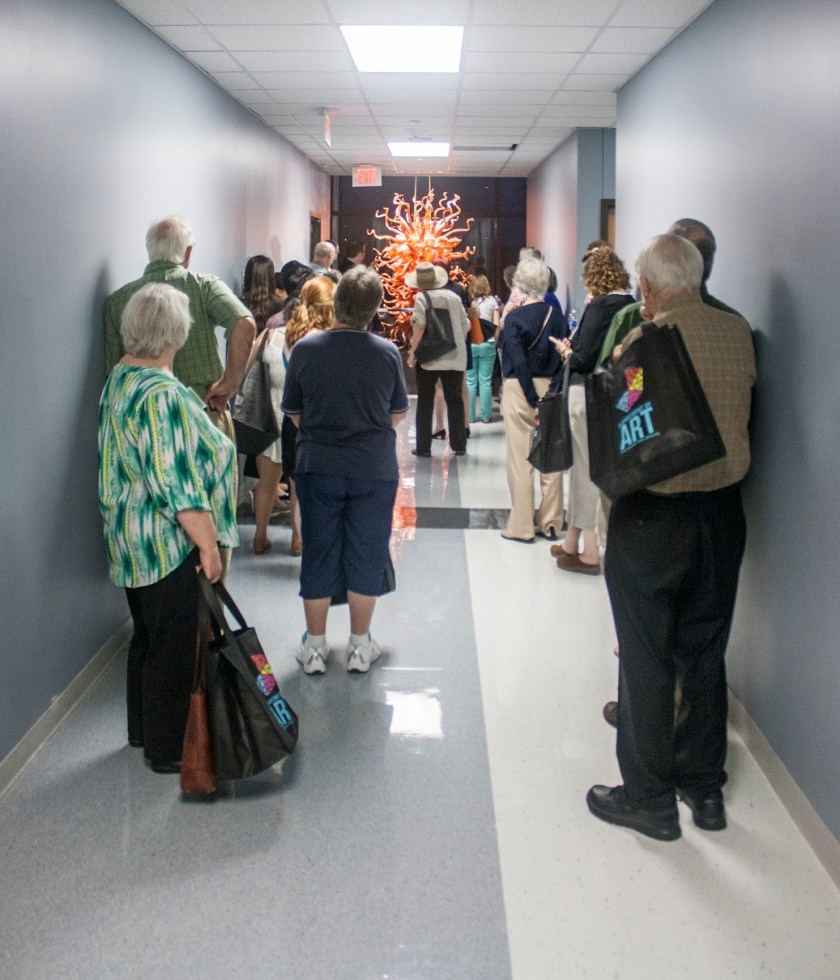
After rolling through the ages, the spirit of rock-n-roll stayed with us as we headed to Nashville and the Cheekwood Botanical Garden and Museum of Art. We began with the art museum in the Cheek mansion, which is not only large and beautiful, but is also graced by a large Steve Tobin sculpture in the front yard.

Cheekwood_Tobin_Daylight_Ambassadors_Web

The home was previously owned by Leslie and Mabel Cheek from 1933-35. Their daughter, Huldah Cheek Sharp, then offered the home to be used as a botanical garden in the 1950s. Now, the mansion is home to and furnished with many elegant works of art.

The current exhibit allowed us to roll through the various ages of art, from American Impressionism to abstract work. Also, like musicians’ attempts to provoke sensations in their audiences, these artists’ works are a direct translation of their life experiences — evident throughout the museum. Perhaps most interesting to us was a chandelier by Bruce Munro, an artist we saw at the High Museum of Art in Atlanta last year…

Cheekwood_Munro_4_Web

The compositions that filled the 55-room home were moving and memorable. Artists such as Childe Hassam used impressionistic paintings of nature that struck a different chord with art enthusiasts and provided a lasting respect for self-interpreting environmental art.

Megan: “My favorite painting was called, “Outskirts of East Gloucester.” The loose brushstrokes of a countryside brought a sense of home to me and happened to be a theme of the Cheek mansion. How often does one have the opportunity to look at beautiful art in a beautiful mansion? The garden and museum were definitely a “top hit” with the LEAP Ambassadors.”

Cheekwood_Painting_1

Still in the spirit of rock-n-roll, we began rocking the trails in search of the Carrell Woodland Trail’s sculptures (pun fully intended). The botanical garden was beautiful. Instead of arrangements of beautiful flowers, the parts we visited reminded us more of a state park. With cedar trees standing tall and proud, the sweet melody of the birds chirping and the cicada drone, we meandered across the trails looking for the sculptures.

As part of the trail, we passed the Cheekwood Prime Matter, Untitled, Steeple Dance, and Glass Bridge, among others.

Cheekwood_Siah_Armajani_Glass_Bridge_2_Web

Last on our list was James Turrell’s Blue Pesher. The whole purpose of this chamber was to create a space where one could reflect by making their perceptions more sensitive. We sat inside, staring up the hole in the ceiling, into the sky, pondering on how to face the music of our lives. As the plaque outside the Blue Pesher puts it, “In this room, discover a commentary on the heavens and what it looks like from the inside of the chamber.” (Interestingly, “commentary” is the definition of the Hebrew pesher.)

Cheekwood_Turrell_Skyscape_Web
The sky at dusk as seen from the floor of Turrell’s Skyscape, Blue Pesher

With the sunset, the symphony within ourselves had to come to a slow and soft end, as the sky could no longer be seen. We headed back to the van knowing that the melody in our hearts had been heard and that our self-perspectives would be seen in a new light.

Cheekwood_Tobin_Ambassadors_Moon_Web

To continue enjoying our Nashville evening, we had dinner at Mitchell Delicatessen. Housed within a wooden facade that resembled a country home, the deli offered an eclectic assortment of sandwiches. From tofu to BBQ brisket to a Tennessee Tuna Melt to an Asian flank steak, it was a challenge to narrow down which to choose.

Megan: I chose the Asian flank steak. This renowned deli magnum opus (which was apparently featured in the Travel Channel) was unlike any other sandwich I had ever had the honor to taste. With steak smothered in provolone cheese on a bed of sliced bell, banana pepper, celery, carrots, and olives, this deli delicacy was enough to send my palate down a ride of flavorful delight. To make the experience even more interesting and add tad of an effervescente ride, my meal was accompanied by one of the eatery’s own draft cola.

We rounded out our second day of the trip with a very satisfying repast from Nashville’s culinary spectrum and headed to our hotel for a good night’s rest.

Cheekwood_Steve_Tobin_Moon_Web

Touring the South and Midwest: Arkansas

July 6, 2016

Three in the morning might be an outrageous time for some people to start a road trip, but not for the LEAP Ambassadors! We packed up the van and began our 11-day journey that we had all been eagerly looking forward to. Even though our main destination is the Southern Legislative Conference in Lexington, Kentucky, we do our best to make the most out of all trips, so we created an itinerary that involves numerous southern and midwestern states: Arkansas, Tennessee, Kentucky, Ohio, Missouri, and Oklahoma.


Hot Springs: Garvan Woodlands Gardens

Our first stop was Hot Springs, Arkansas, where we visited Garvan Woodlands Gardens.  While walking through the Gardens, we stopped to admire the Full Moon Bridge (so named for the arched tunnel under the bridge)…

Garvin_Gardens_Moon_Bridge_2_Web

…a waterfall…

Garvin_Gardens_Group_Waterfall_2_Web

…even to feed fish in a Koi pond!

This slideshow requires JavaScript.

And, of course, to stop and smell the flowers.

Garvin_Gardens_Alex_Flower_Web

Also, of interest to us was the Fairy Village. The most breathtaking part of the gardens came towards the end when we visited Anthony Chapel.

Garvin_Gardens_Chapel_1_Web

Designed by Fay Jones, a student of Frank Lloyd Wright, the chapel is constructed of floor-to-ceiling glass and wood.

Garvin_Gardens_Chapel_2_Web

It is one of three Fay Jones’ chapels that we will visit this trip (the other two are in Bella Vista, AR and Eureka Springs, AR.  The design is intended to complement the surrounding woodlands so that it will look “one with nature”. The chapel is approximately 50 feet tall, roughly the same height as the surrounding trees to help give it a sense of belonging in the woods. We were all taken with its simple, yet elegant beauty!

Garvin_Gardens_Chapel_Group_1_Web


Zoe’s Eatery and Art

After leaving Garvan Gardens, we headed to lunch at a place Alex chose, Zoe’s Eatery and Art, a place with delicious and healthy food. As we walked in we were immediately greeted by their staff and surprised by all of the nice decorations and art around us. Some of us felt as if we had walked straight into a Pinterest world. They immediately accommodated our large group and got us taken care of.

I had the aloha grilled chicken salad, which is a grilled chicken breast with a wedge of pineapple, sprinkled with toasted coconut sprinkles, and macadamia nuts served with a side of salad and a muffin. The fruit was extremely fresh and sweet! Kaitlyn really enjoyed the Southern Bell grilled Chicken salad, which was a leafy green salad topped with chicken breast stuffed with apricot corn bread, and topped with a baked peach (her favorite!) with a black berry drizzle.

kaitlyns meal

It was a great way to freshen up with healthy food and get ready for the next item on the itinerary, but before heading out we decided to have some dessert. We all tried the chocolate cake…

Dessert

…bread pudding, and hummingbird cake. It was difficult to choose one favorite since we all had different preferences, but the bread pudding definitely made the list. As we were getting ready to leave, the owner of the restaurant asked if she could take a picture of our group. We definitely looked like a tourist group!


Hot Springs in Hot Springs!

After a great time at Zoe’s Eatery and Art, The Hot Springs bathhouses were our next stop, along with some shopping.  After a stroll down Central Ave. where we drank for the town’s natural spring water…

Hot_Springs_Water_Brian_Drinking_Web

…posed for some photos outside of bathhouses…

Hot_Springs_Ozark_Bathhouse_Web

…and went into the Fordyce Bathhouse. Thanks to the natural thermal springs that run beneath the city, many bathhouses, like the Fordyce, were at one point the center of attraction of the city. Hundreds of people needing a cure from an untreatable illness would rush into the Hot Springs in need of the attention and treatment that a medical center could not offer. These hot springs were believed to cure patients with terminal illnesses.  One such case was Samuel Fordyce, who was given only six months to live by his doctor, but came to Hot Springs, AR, where he recuperated and lived another 48 years.  Attributing his recovery to the springs, he created the Fordyce Bathhouse, which treated patients from 1915 to 1962.

As we toured the bathhouse, we got a sense of how these patients used wholistic treatment as a last resort.

Hot_Springs_Bathhouse_Tour_1_Web

Inside the woman’s bathhall were four stained glass windows, seven bath tubs, and a hypnotherapy room. The room, which stood in the middle of the women’s and men’s bath hall, is equipped with sun-ray cabinets (which would cover the patient’s body in hot steam) and frigid cabinets (in which the patient would sit a block of ice a allow their body to counteract the heat.) Thus, the patient’s body was treated to a cycle of extreme heat and extreme cold, allowing their blood to flow freely, their pores to open a close, their muscles to contract and expand, and the water’s minerals to enter their system. Further treatment was provided through electric baths (which exerted minor electric shocks to the body) and needle baths (administered by physicians through a system of pressured water which if done wrong could burn and tear the patient’s skin.)

Hot_Springs_Water_Valves_Web

Upon crossing the threshold we gazed at the luxurious hall the men would have bathed in.  The hall was decorated with a stained glass roof depicting Nepture’s daughter and as a center piece bronze fountain of Hernando de Soto, the Spanish conquistador who discovered the town’s springs.

Hot_Springs_Bathhouse_Tour_2_Web

In this time period bathhouses were considered more of gentlemen’s commodity, and the  nicer room reflected that.  But irrespective of gender, the bathhouse and its water were praised as a kind of miracle, while also adding economic prosperity to the community.


As an interesting side note, on our tour of 22 people, there were two other parties from SHSU.  While this no doubt falls into the coincidental category, it’s also a reflection of SHSU’s growing student base inside and outside of Texas.


Hot Springs Mountain Tower

Mountain Tower was our next endeavor. We were ecstatic to ride, or for the braver ones, climb to the top of the 216-foot observation tower. The tower has a unique history in that it is the third tower to be built on a mountain. The tower was actually first built out of wood but burned down after being struck by lightening. It was also once known as the Rix Tower after the land was sold in the Louisiana Purchase; however, that tower was destroyed as well. The present tower is surrounded by the Hot Springs National Park.

At the top we admired the beauty of the hills and surrounding architecture.

Hot_Springs_Tower_Group_1_Web

We are sure none of them however, gave justice to the view we experienced. The LEAP Ambassadors were sure this would be the HIGH-light of the day, but we had even bigger things in store.


Pinnacle Mountain, Little Rock, AR

For our final activity of our 22 hour day, we headed just outside of Little Rock, where we planned to hike Pinnacle Mountain.  Although several of the Ambassadors had been to Little Rock, none had ever hiked this mountain, so we weren’t sure what to expect.

From the trailhead, however, we found ourselves looking up a nearly endless slope.  In fact, it was more than 1,000 feet high, which is a steep incline when climbing over rocks.  Sharp rocks stabbed our feet as we climbed…

Pinnacle_Mountain_4_Web

..and we slipped and slid, as we groped our way toward the peak.  Hikers, having already reached the prize, climbed down with smiles on their faces. Seeing them so enlightened, we knew that all of our efforts would be worth it once we reached the top. Finally, after having climbed almost a mile up, we reached the top and gaped in awe.  It was beautiful!

Pinnacle_Mountain_Hike_Karla_Web

To our left was a seemingly endless green landscape…

Pinnacle_Mountain_Hike_Kaitlin_Alex_2_Web

…and to our right was Lake Maunelle, winding gently into the distance with the sun slowly beginning to hide behind it.

Pinnacle_Mountain_Sunset_Megan_5_Web

We sat there, perched, at the highest point, where only eagles could fly (or in this case they might have actually been vultures), watching the sun disappear little by little until finally it was gone.

Pinnacle_Mountain_Sunset_4_Web

Which reminded us that we had better start descending before we ran out of daylight.  But in between our reaching the top and the sunset, we took myriad photographs…

Pinnacle_Mountain_Ryan_Sunset_2_Web

…of individuals…

Pinnacle_Mountain_Karla_Sunset_Web

Pinnacle_Mountain_Ryan_Sunset_Web

…in duos…

Pinnacle_Mountain_Kaitlyn_Alex_5_Cropped_Web

…in trios…

Pinnacle_Mountain_Kaitlyn_Alex_Mike_Web

…and many in groups…

Pinnacle_Mountain_Group_Ledge_Selfie_Cropped_Web

Pinnacle_Mountain_Group_Sunset_3_Web

Now experts on nature’s challenges, we clambered down the west side’s slippery rocks so fast that any goat would have be green with envy.

Pinnacle_Mountain_Hike_4_Web

After taking an hour to climb up the east side, it took us only about 20 minutes to walk down the east side.  While Professor Yawn and Ryan ran ahead to get the van (from the east side’s trailhead), we enjoyed the dancing fireflies, the vestiges of the sunset, and our accomplishment.  Brian Aldaco noted that this was probably the most fun he’d ever had outdoors, and Karla reflected on our teamwork, “We reached the goal together, lending a hand and encouraging words when it matters.  We marvelled at nature’s beauty side by side, knowing we couldn’t have done it without each other.”

It was a fitting end to a 22-hour day, and a great start to an eleven-day trip of learning, fun, and teamwork.

Pinnacle_Mountain_Hike_Group_Sunset_1_Web


A Campaign Diary, Part II: Brian Aldaco

Brian Aldaco is a freshman at SHSU who spent the last month in upstate New York working on a congressional campaign.  For a student who hadn’t spent much time outside of his home state, it was a great window into the world of politics and the opportunities of travel. 

This blog entry is his second addressing the campaign work he did in June 2016.

As the culmination of the New York District 19 Republican Primary drew near, campaign volunteers were tasked to muster up every single ounce of energy to go through our block walking assignments and ensure a Heaney victory.  As before, this included going to the various towns and villages of the district; from the Hudson Valley and through Catskill Mountains we marched from house to house in hopes of being heard.

Campaign_Sign_Truck_Web

Additionally, as a means to operate more effectively, we were  relocated to a country home in the candidate’s home town of Millbrook. With creaking wooden floors, book shelves filled with literature, and antique house decorations, we could get a feel for the home’s historic spirit. This also allowed us to experience the region’s house culture, which is replete with historic homes.  In fact, it’s not uncommon to see the year the home was built on or near the doors of the homes, with many of the years dating back to the 19th century.

Two days before the election we came together to phone bank. This tedious process included being placed on a call queue, waiting for a voter to answer, and hope that the prospective voter doesn’t hang up or yell at you.  Although these were common responses, we continued to call, ever eager to reach out to voters.  On Monday, alone, we were able to reach 1,600 voters.

As dawn broke on June 28, we awoke with a sense of excitement. Finally, the day we had all been working for had come. Finally, our month-long work was about to pay off, to hopefully gain a victory. With these high hopes, we drove 45 minutes to campaign headquarters, in Hyde Park.

Inside the office, decorated with pictures of Winston Churchill and FDR, we were tasked with completing phone banks. Thus began one of the most extensive endeavors in which I had ever participated. By this time, the voters had begun to tire of the frequent calls from candidates’ staffs, and they let us know it–loudly and frequently.  The day progressed, and an assignment of 500 calls morphed into an assignment of 600 calls, then 1,000.  Collectively, we became a calling machine, reaching more than 20,000 voters in a two-day period.

At 7:30, with a sore, throbbing ear and exhausted vocal cords, I regrouped with the volunteers, Joe Williams, and Campaign Manager David O’Connell for one last briefing. It had all come to a close; there was no more we could do but wait for the polling results and head on over to Mr. Heaney’s viewing party.

As we crossed the threshold of the bar and grill we stepped into an assembly of celebrating campaign sympathizers and friends. No matter what the polling results would yield, we had all worked just as hard, the campaign had become our purpose, every single door we had knocked and number we had dialed, we did so as to ensure Mr. Heaney’s victory. For a month we had become the campaign and on that night it would end.
Campaign_Headquarters_Web

As the Congressional District 19’s results were posted it was evident that our candidate was not receiving the support it needed to win the primary. After the majority of precincts reported the results, it was clear that Mr. Heaney would not make it to the general election.

Nonetheless, we all held our head high with pride. For the volunteers, it was the first time we had worked in such an extensive campaign. Even though I was not able to see my candidate win the primary, I was just as grateful for being part of his efforts. We all learned an extensive amount of the political world that we could not learned anywhere else. For that reason alone I am grateful to Grassroots Consultant Joe Williams, Campaign Manager David O’Connell, and Mr. Andrew Heaney.

Heaney_Speaking_Web

A Campaign Diary: Brian Aldaco

Brian Aldaco is a freshman at SHSU and a LEAP Ambassador.  After a fun and education filled first year at SHSU, Brian got a call asking for his help with a Republican congressional campaign in New York state.  Showing the adventurous spirit, Brian took the offer and set off on a 30-day learning experience.  This is the first of two blog entries from him on the trip and work.

The call came late in the campaign season.  Would I fly to New York to work on a campaign?   With only four days notice, I didn’t have much time to think.  Fortunately, I didn’t need much time to think.  Yes!

As with any far away trip, my travel began at the airport. I was to fly from the Houston Bush International Airport, transfer planes in Atlanta, Georgia to finally arrive at the Albany International Airport.

Clouds_Airplane_2_Web

At 10:00 at night, already having crossed over to the eastern time region, I arrived at my destination in the gorgeous (not-as-much-as-Texas) state of New York.  It was only my second time in a plane, and it was my first time in New York.

The campaign was for Andrew Heaney, a Republican who is running for US Congress in the Albany region of New York state.  My job was to be part of the many volunteers and staff on hand to help him win.  This includes: block-walking, phone calling, assisting with events, and other duties.

Brian_Working_Web

The day after I arrived, the rest of the block-walking brigade and I, a total of six students, woke up early in the morning to get a short briefing by campaign mangers Joe Williams and David O’Connell. As very experienced professionals in Get Out To Vote (GOTV) strategies, the managers delegated areas of the state’s Congressional District 19 to us. Hence we were deployed from our hotel in the village of Colonie, pumped up and ready to meet voters on behalf of candidate Heaney to ensure his victory in this June 28 Republican primary.Heaney_Signs_Web

Riding through the various towns and villages of the district has been a pleasure. As a lover of nature’s wooded paradise it has been delightful to see the congressional district composed of the counties of Ostego, Montgomery, Schohaire, Greene, Rensselaer, Columbia, Delaware, Sullivan, Ulster, and Dutchess. Amidst woodpeckers thumping in trunks, chipmunks trailing through every garden, beavers bravely rocking across the streets, and the occasional rabbit bouncing through the green fields, the Heaney block walkers have toiled through the week to encourage residents of this gorgeous country side of New York State to support us.

Road_Greenery_2_Web

Tasked with this endeavor, I have met along the way a wide variety of people along with the different tempers they offer when either rooting for our candidate or shrugging us off as if we were pesky soliciting salesman. I might add, however, that regardless of resentment for our candidate from some of the houses, there is still a sense of polite generosity whereupon most of these nay-sayers will end their farewell with a sincere “good luck.”

By traveling through these small upstate New York villages I am getting a better sense of the northern culture. This small community feel was not so much different from a town like Huntsville, for example, where it is always pleasant to visit the town square and enjoy a lunch. This first week this is how we all spent our midday breaks…

Pizza_Web

by enjoying such delicacies as Ruben wraps, Philly cheese steak sandwiches,

BBQ_Sandwich_Web

classic dinner hamburgers with fries, small town coffee-shop espressos and tea, and much other delicious treats that help illuminate the delightful taste of the different communities of New York’s 19th congressional district.

However, the highlight of the week was having the chance to meet with Mr. Heaney on Wednesday in the city of Oneonta, located in Ostego County about an hour’s drive south of Colonie. There, a debate would be held between Heaney and his opponent John Faso. With the temperature dropping to 45 degrees along with menacing rain clouds trailing along the mountain tree tops which surrounded the city, we were eager to go inside the city’s theatre production center where the debate would be held. The debate between the two New York Congressional candidates was diplomatic with minimal hostility.

Heaney_Speaking_Web

At the end of the debate we were able to shake hands and meet with Mr. Heaney. He shared how impressed he was with our work thus far, which motivated us to work even harder. This motivation would later be demonstrated when block walking through Saturday’s rainy morning. Nonetheless the evening of the debate we chose to relax over an all New Yorker pizza in Oneonta’s very special Italian restaurant Joe Ruffino’s.

Joe_Ruffinos_Web

With a week of block walking through beautiful and quirky New York villages it has been a great pleasure to have this great opportunity to be a part of an amazing campaign. Even though at times the steep mountainous roads have caused us consternation, (especially when the pavement ends) it has been rewarding to enjoy the picturesque landscapes. With so much country beauty it’s hard not to get lost in the rolling fields and piny woods of upstate New York from which I have to shake off its trance and continue on this northern grass roots mission to success.

Road_Greenery_Web

Au Revoir Austin

Although our official work week was over, it didn’t mean our education was complete.  Accordingly, we planned out a day that involved virtual exploration, actual exploration, and some adventurous food choices!


Bob Bullock Museum and National Parks

We began our morning with virtual exploration of the National Park system at the Bob Bullock Museum.  The Museum was presenting America Wild: National Parks Adventure.  It was narrated by Robert Redford, whom we had just seen in Butch Cassidy and the Sundance Kid on Thursday, and it reinforced some of what we had learned when we brought Mark Burns to campus in March to exhibit his photos of the 59 national parks he had visited and photographed in Black and White.

The Documentary was created to commemorate the one hundredth anniversary of the National Park Service.  Although Abraham Lincoln, Teddy Roosevelt and others had taken steps to preserve America’s most treasured lands, it was Woodrow Wilson who signed the legislation enabling the National Park System for generations of Americans to enjoy.

The documentary was in 3-D, so we put on our glasses, sat back, and enjoyed the show…

Bullock_Museum_3D_IMAX_Web

…while reinforcing our appreciation of the National Parks in the United States.

The Bullock Museum also has a limited exhibit of photographs from the National Park System, and we were followed up the documentary with a viewing of the photographs.

Bullock_Museum_National_Park_Gallery_Web


From Virtual Exploration to Actual Exploration

After seeing a high-adventure documentary, we chose to experience some of that adventure ourselves.  That evening, we headed off to the Rowing Dock to get in some kayaking.

It took Karla and me (Alex) a while to find our rowing rhythm, but once we did, we sped up to catch up with the others.

Kayaking_Alex_Karla_2_Web
Karla and Alex Begin Their Kayaking Adventure!

The river was full of kayakers, canoers, and paddle boarders rowing up and down the river and under the busy bridges. I admired the mix of city and nature as we paddled up the river.

Kayaking_Alex_Karla_5_Web
The Austin Skyline from a Kayak

It was a combination that I am not accustomed to seeing. After a while of paddling, we all gathered under a bridge that seemed to be making a strange sound. We stayed there for a while as Professor Yawn explained to us that the noise was being produced by bats! Apparently “South Congress” is known for its bat population that flies out at sunset every day.  We paddled along and saw a few more interesting water mechanisms; a swan boat, a Cambridge Racer…
Kayking_Sunset_Web

….and paddle boards with bicycles as the motor. But mostly we all just enjoyed the exercise…

Kayaking_Kaitlyn_Beatriz_3_Web
Beatriz and Kaitlyn Taking Off from the Rowing Dock

…the skyline…

Kayaking_Stephanie_Megan_1_Cropped_Web
Stephanie and Megan Enjoy the River

…each other’s company…

Kayaking_Kaitlyn_Beatriz_6_Web

…the sunset…

Kayaking_Alex_Karla_6_Web
Alex and Karla Sail Into the Sunset

…actually, we enjoyed the sunset a lot…

Kayaking_Kaitlyn_Beatriz_9_Web
Kaitlyn and Beatriz Sail Into the Sunset

…and even the moonrise.

Kayaking_Austin_Bridge_Web

In fact, we were so taken with the moon that we were a little late getting our kayaks back.

Kayaking_Kaitlyn_Beatriz_8_Cropped_Web
Kaitlyn and Beatriz Pull in at Moonrise

It was a satisfying adventure all around.

Kayaking_After_Girls_Moon_Web

After learning about the bats under the bridge, we decided to get a look for ourselves.  Accordingly, we scurried off to the Congress Avenue Bridge, where hundreds of people gathered to watch for the 750,000 or so bats that begin coming out around sunset.
 

Austin_Moon_Web

We didn’t see 750,000 bats, but we saw a lot of them!  They are difficult to photograph, however, and we didn’t get any usable photographs, at least not of bats.  We did get a decent group shot, though:

Austin_Moon_Girls_Web


A Food Adventure

With more time than typical, we could explore our food tastes.  And explore we did!

For lunch we enjoyed Indian cuisine at Clay Pit, a place known not only for its food, but also for being housed in the Bertram historical building.  The Clay Pit offers a lunch buffet, giving us the chance to sample varieties of food.  Starting with crunchy fried veggies to the scrumptious Chicken Tikka Masala we stuffed ourselves with food in a classy environment filled with Indian music. Accompanied with these dishes were naan: some filled with melted cheese and jalapenos, while others had sweet cherries, nuts, and raisins. After our meal, we decided to get dessert which consisted of Chai Spice Creme Brulee and strangest of all,or at least not commonly heard of, Gajjhar Halwa. This is a dessert described as a “hot and cold love”.

Dessert_Chapa_Alex_Web

Interestingly, it consisted of cold vanilla ice cream and warm carrots, a dish recommended to us by SHAIP (Sam Houston Austin Internship Program) alumnus Shelby O’Brien. Everyone enjoyed this shockingly delicious dessert!

Despite the large lunch, our evening kayaking adventure whetted our appetite for a large dinner, which consisted of Ethiopian food.

Our appetizers were Sambusas, which are pastries filled with onion, green pepper, and beef accompanied by a spicy sauce.

While we waited for our food, we talked about our favorite experiences during our week in Austin. We all had different favorites, but we all agreed that we definitely learned a lot this past week. It was filled with fun and adventure, but also a lot of work and learning time; the best combination!

That learning and fun continued with the arrival of our entrees, presented in a large Ethiopian basket!

Our entrees consisted of the Habesha special meat combo that included Doro Wot, Siga Wot, Kitfo, Yebeg Tibs, Alicha Fitfit, Bozena Shiro, Gomen Besega, Habesha special tibs, and Ayib; thankfully we had a great waiter that could explain each one of these to us! We also ordered from the Poultry menu, the Doro Tibs, chicken breast cubes sautéed with slices of onions, herbs, and sauce. For the least adventurous, we ordered spaghetti with meat sauce. The food really seemed to be authentic Ethiopian food which was a great way to introduce this type of food to us first-timers.

Even as first-timers, we did our best to eat in the Ethiopian tradition, using the injera bread as utensils.  It was great food and a great way to wrap up our adventurous week in Austin.

We headed back to the hotel to pack up and get ready to hit the road the next morning. We were all thankful for the opportunity to intern at the Texas Capitol for the week. We were also thankful to meet extremely helpful people and eat really good food. Until next time, Austin!

Too Bad It’s Friday: A Wonderful Week in Austin

By Karla Rosales:

For most, Friday is a day to exult the end of the work week.  For five SHSU interns, however, it was a sad day, a reminder that our week in Austin was coming to an end, at least for now.


Last Day in the Capitol

I worked in Representative Zerwas’s office for the second half of the week where I was able to apply the concepts I previously learned in Senator Schwertner’s office. I was able to see some differences between the Senate and the House, but in actuality, they work in similar ways. During the week-long “internship” I was able to familiarize myself with Correspondence Management System (CMS), deal with constituent issues via telephone and mail, and even do some bill analyses. Both Senator Schwertner’s and Representative Zerwas’s staff were very friendly and helpful in teaching me how things in their office and in the Capitol function.

Capitol_Seal_Karla_1_Web

I thought I knew the process on how a bill became a law, but there was so much more to it than I realized! There is a team of teams system behind this process. The Legislative Counsel helps with drafting the bill and the Legislative Budget Board helps assess the budget impact of the bill.  And while the office staff typically initiates the bill, the staff also listen closely to constituents.  Many of the ideas behind the legislation come from constituents, who alert their representatives to what is working and what isn’t.

The great part to this is that everyone in each of the offices works great as a team and everyone I encountered at the Capitol was very friendly and helpful. I think that’s a huge plus when working together to accomplish the same goal.

I also learned much more about how committees get their work done and what it means to be the Chair of a Committee. Representative Zerwas is Chair of the Higher Education Committee, a committee that will be meeting this Tuesday, prompting much preparation.  Interested, knowledgeable, and affected parties often testify at these hearings, providing additional information that may be helpful in finalizing the bill.

I was fortunate to see some of these preparations unfold.  I was invited, for example, to lunch with Representative Zerwas’s staff and David Montagne, a member of the TSUS Board of Regents.  It was a privilege to be able to learn from the expertise of others, and I was glad to be brought into the loop.

Following lunch, we returned to the office, where I finished up working on projects I was given, and thanked the staff for the wonderful opportunity I was afforded.

Capitol_Steps_Karla_Web


UT Tower

After our last day as interns in the Capitol, we headed for a tour of the University of Texas Tower.  As you might expect from the site that witnessed one of the first mass shootings on a college campus, security is tight.  Following a discussion of rules and regulations by the tour guides (UT students), we  crowded into a small elevator…

Elevator_UT_Tower_Web

At the top, the tour guides offer background on the UT Tower. The tower was completed in 1937, and it continues to be one of the most recognizable buildings in the city of Austin. Paul Philippe Cret designed this building, which is two feet taller than the Austin Capitol Building. The building was originally used as an old-school library, one that utilized the card catalogue system.  Approximately 25 percent of the tourists knew what a card catalogue system was, so that was explained to us, before we were freed to explore the observation deck.

UT_Tower_View_Girls_Web

The wire cage enclosing the observation deck are to prevent suicides, which is a rather sobering thought.  Even with the wire, however, the views are impressive!

Capitol_View_Tower_2_Web


Interestingly, the tower offers a protected view of the Texas Capitol.  By “protected,” I mean that the City of Austin passed an ordinance prohibiting the building of any building that obstructs views of the Capitol from the Tower.  It is one of 35 or so such protected views in ATX.


Dinner

With a play to attend at 8, we had to hustle for dinner.  Fortunately, the New World Deli (“where bland is banned”) accommodated our schedules, offering good foot, to boot.

As we headed for our table at the restaurant we found a huge surprise. Our team mom, Stephanie, joined us for dinner and will join us for the rest of our weekend! We began to tell her all about our week-long internship while we waited for our food which consisted of sandwiches for everyone and salad for Megan. Even though we were stuffed at the end and were in a rush to get to Austin Playhouse, we still made room and time for dessert. We enjoyed some key lime pie and salted chocolate chip cookies which were delicious!


A Little Night Music

After dinner, we headed to Austin Playhouse for the musical, A little Night Music. It was a humorously romantic musical, penned by Stephen Sondheim and Hugh Wheeler.

Austin_Playhouse_Stage_Intro_Web

As one of the most famous musicals, it’s plot is well familiar while also being intriguingly complex.  With six main characters and as many love triangles, the play mixes humor, great music, and bittersweet romance.  On top of its complex plot, the songs also offered complexity, with duets, trios, and a couple of patter songs.

Although “LEAP” stands for Law, Engagement, And Politics, it could just as easily stand for Law, Engagement, Art, and Politics.  This was our second musical of the last couple of months (Damn Yankees being the other), and as yesterday’s blog noted, we regularly visit art museums and even sponsor our own art program.

But this was a more complex and serious piece of musical theater than we usually see, and we’re glad we had the opportunity.  The music was great, the acting was fine (the Austin Playhouse uses professional actors), and the cast was excellent!

Austin_Playhouse_Close_Web


It proved another late night for us, but it was a musical and fittingly bittersweet end to our “work week” in Austin.  But just because our work week is over, our education continues, with trips to the Bob Bullock Museum, town parks, and other educational excursions awaiting us tomorrow.  Our panoramic view of Austin and the political world continues!

Capitol_Senate_Girls_Pano_1_Web

I’d like to thank the staff in Senator Schwertner’s office (especially Ariel Traub) and the staff in Representative Zerwas’s office for hosting me this week.  Thank you!